Guest “bwahaha!!!” by David Middleton
The world may never recover its thirst for oil
Analysis by Julia Horowitz, CNN BusinessUpdated 6:59 AM ET, Wed April 29, 2020
London (CNN Business) The world is learning to live with less oil.
It may never look back. The coronavirus pandemic has destroyed demand for gasoline and jet fuel as billions of people stay home, and there’s no guarantee it will ever fully recover despite rock-bottom prices.
The oil industry is bracing for the effects of the crisis to linger. Employees keep working from home. International travel stays scarce. And citizens in once polluted cities, having become accustomed to blue skies, demand tougher emissions controls, encouraging governments to redouble efforts to tackle the climate crisis.
Such changes would come on top of a push for investors to dump oil assets that had been gaining momentum before the recent price crash. Sustainable energy investments, by comparison,appear to have held up relatively well despite stock market volatility.
[…]
Darth Vader: This is CNN!
I don’t know which is funnier…
Analysis by Julia Horowitz, CNN Business

Or…
London (CNN Business) The world is learning to live with less oil.

The dumbness of the CNN “analysis” is dumbfounding. (Yes, I know it’s the exact opposite of dumbfounding; I just liked the sentence.)
This is as bass-ackwards as a green fantasy can get:
The world is learning to live with less oil.
2016 BA in Political and Social Thought
The “world” is putting up with being under house arrest, creating a situation where there is too much oil. On the other hand, the oil industry is learning how to already knew how to deal with this sort of situation.
Six US oil firms are expected to shut 300,000 barrels per day of production in May and June
PUBLISHED WED, APR 29 20209:18 AM EDT UPDATED MOMENTS AGO
Natasha TurakU.S. energy companies are taking an axe to their rig numbers, deepening production cuts for the industry that in the last few years made America the world’s number one oil producer.
Six major U.S. shale producers are expected to shut some 300,000 barrels per day (bpd) of crude for the months of May and June, according to an analysis of the companies’ early communication by Rystad Energy.
“Analyzing communication by Continental Resources, Cimarex Energy, ConocoPhillips, PDC Energy, Parsley Energy and Enerplus Corporation, we estimate that oil production cuts in May and June 2020 could amount to 300,000 bpd, an increase from about 100,000 bpd of cuts projected for April 2020,” Rystad wrote in a report Tuesday.
In March, American producers were still pumping at record highs, according to the Energy Information Administration, even as prices plunged due to the loss of demand from the coronavirus pandemic. The latest weekly government data shows production at 12.2 million bpd in the third week of April, the lowest level since July and a stunning 900,000 bpd less than its record peak of 13.1 million bpd in early March.
[…]
Artem Abramov, Rystad’s head of shale research, estimates a further production decline of “900,000 bpd, 250,000 bpd and 400,000 bpd in Permian, Eagle Ford and Bakken throughout 2Q20 respectively,” referring to the biggest shale formations in the U.S., with shut-ins accounting for 60% of that initially.
As rigs disappear, US is set to return to ‘net importer’ status
When OPEC and non-OPEC producer countries including Russia, Canada, Norway and Brazil joined forces to implement a coordinated oil production cut to put a floor under prices — by a historic 9.7 million bpd from May 1 — the U.S. did not technically join, relying instead on market dynamics to force production down. That’s happening now, both in the form of companies shutting in their wells and cutting investment and projects for new wells.
[…]
And with production costs much higher than most of its global competitors, the EIA actually expects the U.S. to “return to being a net importer of crude oil and petroleum products in the third quarter of 2020.”
[…]
Market watchers are now questioning whether the U.S. shale industry — fuelled for years by cheap money and drowning in debt — will ever be able to attract investors again, save for the large-cap companies whose balance sheets will allow them to survive this downturn.
[…]
CNBC
With US production set to decline by 2 million bbl/d (or more) in the second quarter of 2020, OPEC+ and other producers cutting production by about 10 million bbl/d is coupled with a resumption of demand growth, guess what will happen?
Oil Up on Cuts and Early Signs of Demand Recovery
by Bloomberg|Sharon Cho and James Thornhill|Thursday, April 30, 2020(Bloomberg) — Oil advanced for a second day on signs fuel consumption is starting to recover in the world’s biggest economies, while global production cuts also begin to offset the demand destruction caused by the coronavirus.
Futures in New York rose around 10% toward $17 a barrel. They surged by more than a fifth of their value on Wednesday as Energy Information Administration data showed a surprise drop in American gasoline stockpiles and a jump in demand. In China, traffic is returning to the streets, supporting a boost in fuel consumption and refinery processing rates.
U.S. output will fall by 2 million barrels a day in May compared with March and the price of crude has likely bottomed out, according to the head of trading house Mercuria Energy Group Ltd.
[…]
RigZone
We may still see repeats of the May contract price collapse, but the rebalancing is well under way. Many oil companies will file for bankruptcy. Smaller, “shale” players will be particularly hard hit. Some companies won’t survive at all, “but rocks don’t go bankrupt”…
When the dust settles in the Permian Basin and other American shale fields, the survivors will be leaner and more tech savvy, according to Daniel Yergin, a Pulitzer Prize-winning oil historian and vice chairman of IHS Markit Ltd. That means lower production costs and a greater ability to respond to the next price rebound with the last thing Moscow and Riyadh want — another boom.
“Companies go bankrupt, but rocks don’t go bankrupt,” Yergin said in an interview. “When this all shakes out, there will be other people to develop shale.”
World Oil
“Inertia” will eventually cause production to fall behind demand growth. Production will fall until demand rises enough to push oil back over $40-50/bbl. Then production will start rising again, US producers will layer on hedges… “Same song, different verse”… But, what if?
The oil industry is bracing for the effects of the crisis to linger. Employees keep working from home. International travel stays scarce.
2016 BA in Political and Social Thought
Yes… The “oil industry is bracing for the effects of the crisis to linger,” that’s why most of us are feverishly working on being cash flow positive at $30/bbl and those with solid hedge positions are thankful for having lost money on hedges when prices were rising. Been there, done that, got a closet full of T-shirts.
“Employees keep working from home”… until they’re directed to come back to work. According to a recent survey, over half of Americans who still have jobs have been forced to work from home over the past month.
There are approximately 150 million people in the US workforce. Extrapolating the results of our survey out to the larger population, we can estimate that around 85 million people are now working from home due to Coronavirus.
WaveForm
Prior to the ChiCom-19 Hostage Crisis, only about 8% were working from home. Let’s do some math using the WaveForm numbers (I have no idea if their numbers are right)…
| Pre-ChiCom-19 | Hostage Crisis | |
| Work Force | 150,000,000 | 150,000,000 |
| Office/Workplace | 133,860,000 | 18,860,000 |
| Home | 11,640,000 | 96,640,000 |
| Unemployed | 4,500,000 | 34,500,000 |
Assuming their numbers are in the ballpark, somewhere around 120 million Americans are currently driving or taking mass transit a lot less than normal, because they are either unemployed or being forced to work from home. As the economy reopens, will these people choose to stay home? Or will they choose to go back to work or back to their offices/workplaces? Only about half of those working from home during the hostage crisis wish it was permanent.

However, the choice will mostly be up to employers, not employees. Bureau of Labor Statistics data indicate that those who worked at home only put in about 3 hours per day, while those who worked at a workplace put in slightly over 8 hours per day. Most employers would prefer 8 hours per day, or more, from salaried employees.
And citizens in once polluted cities, having become accustomed to blue skies, demand tougher emissions controls, encouraging governments to redouble efforts to tackle the climate crisis.
2016 BA in Political and Social Thought
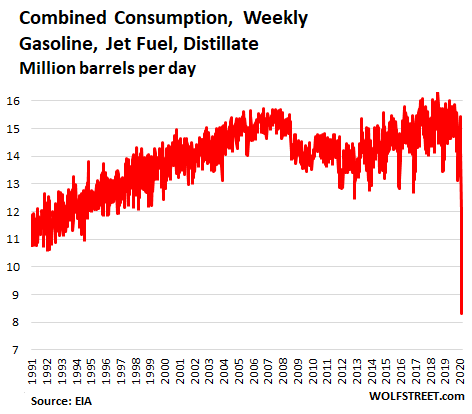
That’s not what the “citizens” are demanding. This is the Hockey Stick that has Americans taking to the streets, demanding an end to the hostage crisis…

…encouraging governments to redouble efforts to tackle the climate crisis.
2016 BA in Political and Social Thought
It was either Dr. Evil, Tommy Lee Jones, Larry the Cable Guy or Ron White… Dr. Evil seemed most appropriate.


Such changes would come on top of a push for investors to dump oil assets that had been gaining momentum before the recent price crash. Sustainable energy investments, by comparison,appear to have held up relatively well despite stock market volatility.
2016 BA in Political and Social Thought
Why would any sane person, who has ever had a real job, expect the green schist industries to be immune to ChiCom-19 and the hostage crisis?
Apr 16, 2020,
Covid-19 Lockdown Could Kill 500k Cleantech Jobs
Ken SilversteinSenior Contributor
EnergyThe coronavirus caught the United States flatfooted, rolling over the cleantech sector in the process. It employs 3.4 million people in this country but it lost 106,000 jobs in March — a number that is expected to rise to 500,000 by summer.
Those are real people: electricians, welders, plumbers, installers and construction workers — tied to everything from energy efficiency to mechanical trades to manufacturing plants. They are not just America’s bread-and-butter but they are also the country’s voters and they are based in several states that are up for grabs in the 2020 presidential election.
[…]
And now they are at risk. CMC Services weatherizes and retrofits homes and businesses to make them more energy efficient: In the last month, its revenues have fallen by 85% and its technical field staff has been idled, says its president, Tina Bennett. “Many of our peers have furloughed or laid off their workforce,” she said, on the call. “These industries are challenged by and vulnerable to the lock-down.”
[…]
Forbes
In the Gulf of Mexico, where I work (I don’t actually work in the Gulf), we acted proactively to keep as many production platorms and drilling rigs operating as possible…
Gulf of Mexico operators move proactively to keep oil flowing during pandemic
By JENNIFER A. DLOUHY AND DAVID WETHE on 4/7/2020WASHINGTON – Inside more than a thousand offshore drilling rigs and oil production platforms that dot the Gulf of Mexico, workers navigate narrow corridors, sleep in shared rooms and dine in crowded mess halls.
It’s an environment designed for efficiency — not for keeping a lethal coronavirus at bay.
“There’s no way to do social distancing on a rig,” said Tim Tarpley, vice president of the Petroleum Equipment and Services Association.
That’s led to worries about the safety of the sites, the biggest of which resemble mini-cities with as many as 200 workers, and the nation’s dependence on their output. Oil wells in the U.S. Gulf of Mexico supply about 2 million barrels of crude a day, or 15% of U.S. production.
Similar coronavirus concerns are affecting other energy businesses that rely on employees sleeping in cramped conditions on site — from oil worker camps in North Dakota and Alaska’s North Slope to an aluminum smelter in Canada and copper mines in the Chilean desert.
There have been notable outbreaks in other close quarters too, including the aircraft carrier USS Roosevelt and cruise ships, underscoring the challenge of containing a virus that spreads easily.
The practical complication of extracting oil amid the coronavirus pandemic is only the latest headwind for an industry already reeling. Oil prices have crashed as Russia and Saudi Arabia engage in a price war even as the virus causes demand to plummet.
In response to the outbreak, offshore operators have stepped up screening and cleaning, lengthened job assignments and subjected workers to isolation periods. Some officials have even gamed out hypothetical scenarios that include shutting down operations if the pandemic spreads.
For now, the focus is on staying “fully operational,” Interior Secretary David Bernhardt told industry representatives in a conference call Friday, according to two people familiar with the discussion. Bernhardt also said he was deploying Interior’s top offshore drilling regulator, Scott Angelle, to Louisiana, in an effort to keep outer continental shelf oil operations running and ensure a nimble agency response.
There have been at least 23 positive coronavirus cases tied to offshore oil and gas facilities, according to the National Ocean Industries Association. That may correspond with a rapid rise in cases in Louisiana, the home base for many Gulf oil operations and offshore workers.
“The only option is you’ve got to clear everybody before they get on,” the petroleum association’s Tarpley said. “You’ve got to make sure you don’t get positive folks out on the rig.”
[…]
World Oil
This demonstrates that it is possible to keep a business running, where social distancing is not possible, by taking proactive measures to inhibit the spread of the Chinese Communist virus. The Federal government supposedly did consider shutting this in due to a few positive tests on offshore personnel…

Production from the Gulf of Mexico recently exceeded 2 million bbl/d for the first time in its 70+ year history. While production will soon start to decline until prices recover, it won’t decline nearly as quickly as the “shale” plays… Very different “rocks.”
De oppresso liber!
Sgt. Muldoon says, “Get back to work, America!”

David,
I saw an EIA graph on Wolf Street – it seems to show that US oil consumption for gasoline, jet fuel and distillate has dropped 7 mbd or so during the lockdown.
This seems like a lot higher number than the 2 mbd you note above. Q1 data?
Sorry, something weird happened when I tried to add this link:
What is “cleantech”? As in “Covid-19 Lockdown Could Kill 500k Cleantech Jobs”?
Is this some Newspeak lingo that everybody knows but me? I try to keep up but never heard of it before. The author says “electricians, welders, plumbers, installers and construction workers” are “cleantech”. Why?
Is farming “cleantech”? What about logging, mining, food processing, milling, transportation, smelting, building, frycooking, and janitorizing?
Is there such a thing as “dirtytech”? Garbage collection?
If it has to do with producing food, clothing, shelter, and energy is that “cleantech” or not? Is there such a thing as “basicsurvivaltech”? Or is that stuff passe and so last millenium?
The fall in energy demand is one of the symptoms of the ‘problem’.
Oil companies’ resilience and ability to change is good. That is not however going to solve the energy demand problem.
Problem 1:
People are absolutely terrified of the virus. We need real solutions (and there are real solutions) to this problem that enable people to get rid of the masks and to go back to normal life.
Natural Solution, cheapest. Cuts all total country medical costs by more than 50%
We have a no patentable drug, solution to the medical problem which is almost perfect. The natural solution, increases the entire population’s resistance to all diseases and to cancer. It is cheap and the research is done. This is just a story/technical problem/solution that needs to be told.
The problem is it will also reduce our health care costs by more than 50%. Obviously, there are special interest groups that do not want our health care costs to be reduce by 50%.
‘Vaccine’ solution. Human trials of two advance ‘vaccine’ technologies has started. If this new technology is success (it worked for Ebola). There will be a vaccine available this fall.
P.S.
To keep people scared, the brainless, clueless CNN machine, is floating the idea that there will never be a vaccination for Corvid.
https://www.cnn.com/2020/05/03/health/coronavirus-vaccine-never-developed-intl/index.html
Problem 2: Making civilization changing technical changes that hurt special interest groups
To make the US (and the other developed countries) great again we must stop fighting and get all party support to make civilization breakthroughs.
Warren Buffett’s company Berkshire Hathaway sells all of his US airlines shares
Mid Feb Delta airlines (WB had 11%) share price was $59, but for last 6 weeks it was moving around $22-$23. He said that he had been wrong to invest in the airline industry.
I suppose might be a further sharp drop in all airlines shares tomorrow.
Well its a really interesting vision of how things are likely to play out. It does seem that big companies are going to have to change their stance on working from home. Nobody can dispute the benefits of cleaner air and lower oil consumption but then everything’s connected and the economic impact of that etc etc. Anyway, I really enjoyed reading this one. Lots to think about.
The only way that oil demand doesn’t recover is if civilization doesn’t recover, and I don’t even want to contemplate that.
How do you manage to get a high-school diploma and not understand simple economics? When production increase, they will need an increase in transportation to deliver goods. This will drive an increase in fossil fuel consumption (demand), which will drive an increase in prices.
Unless the world stays in lock down until half of it starves to death, demand will pick back up as the economies reassert themselves.
BA in Political and Social Thought
***********************************
degrees in stuff like that scare me more than the kungflu….
4 years?
I would have thought a weekend would be enough.
David,
Thanks for another timely article.
Several facts not mentioned by the media which is real
1. There is different technology today. I retired about 20 years ago and started consulting via an engineering firm that was bought out by a much bigger firm. The Local office I consulted in was closed about a year ago and I have been consulting from home with no decline in hourly work. Technology today allows work via e mails, google searches for technical resources, Web-ex meetings, telephone calls, etc. The last few months I have probably averaged 5 Web ex meetings every weeks on several ongoing Projects.
2. While most of my Career I worked in the downstream energy side of the business, today 90% of my business is on the Chemicals side of the business that uses fossil fuels for feedstocks and this is still a thriving business for Oil companies not mentioned by the MSM or the “smart” people on wall street.
Nobody who understands energy believes we can sustain our economy w/o fossil fuels for many, many decades. I have also worked on numerous failed alternative fuels projects and there is still nothing on the horizon.
I just bought a bunch of oil stock two weeks ago. We will see how stupid that was !!
Could go horribly wrong.
“I just bought a bunch of oil stock two weeks ago. We will see how stupid that was !!
Could go horribly wrong.”
Yah. But if you bought into a company that was well managed, you might ask Mr. Middleton (who apparently works for one such outfit) to report back on the initiative of him and his co-workers to relook at their development inventory at $30/bo and $1.75/mcf. If those wells, with good EUR’s and (I suppose) good production schedules, in fields with surface CAPEX mostly spent, can’t make muster, I’d compare that to what you own, and act….
The good thing about stock purchases vs shorts and futures contracts, is the fact that a stock price can’t go below $0.00.
Very true. Still not much fun for those holding stock that does go to $0.00. Of course, if it was a dividend stock that you managed to pocket some dividends off of before it went bust, then it’s technically not a total loss. Still not much fun though.
Tin hat on! Sarc on… David Middleton. Is it not time to jump to the abiotic theory and bug%%r the greens with ‘Oil is the most renewable of all the energy sources’. Never mind the politics of long established science, is it not time to play these idiots at their own game. Smoke and mirrors!