Reposted from Dr. Roy Spencer’s Blog
March 22nd, 2020 by Roy W. Spencer, Ph. D.
Some global warming alarmists are celebrating the current economic downturn as just what is needed to avert climate catastrophe. I’ve seen a couple estimates that China’s manufacturing and commerce might have seen up at 40% reduction recently.
The current global crisis will be a test of just how much economic pain is required to substantially reduce CO2 emissions (assuming there is no reasonably affordable and practical replacement for fossil fuels).
I already know that some of my “deep skeptic” acquaintances (you know who you are) who believe the global CO2 increase is mostly natural will claim a continuing CO2 rise in the face of a decrease in economic activity supports their case. I have previously shown that a simple model of the CO2 variations since 1959 forced with anthropogenic emissions accurately explain the Mauna Loa observations (see Fig. 2 , explanation here). It will take considerable evidence to convince me that the long-term rise in not anthropogenic, and maybe the current “coronavirus experiment” will provide some contrarian evidence.
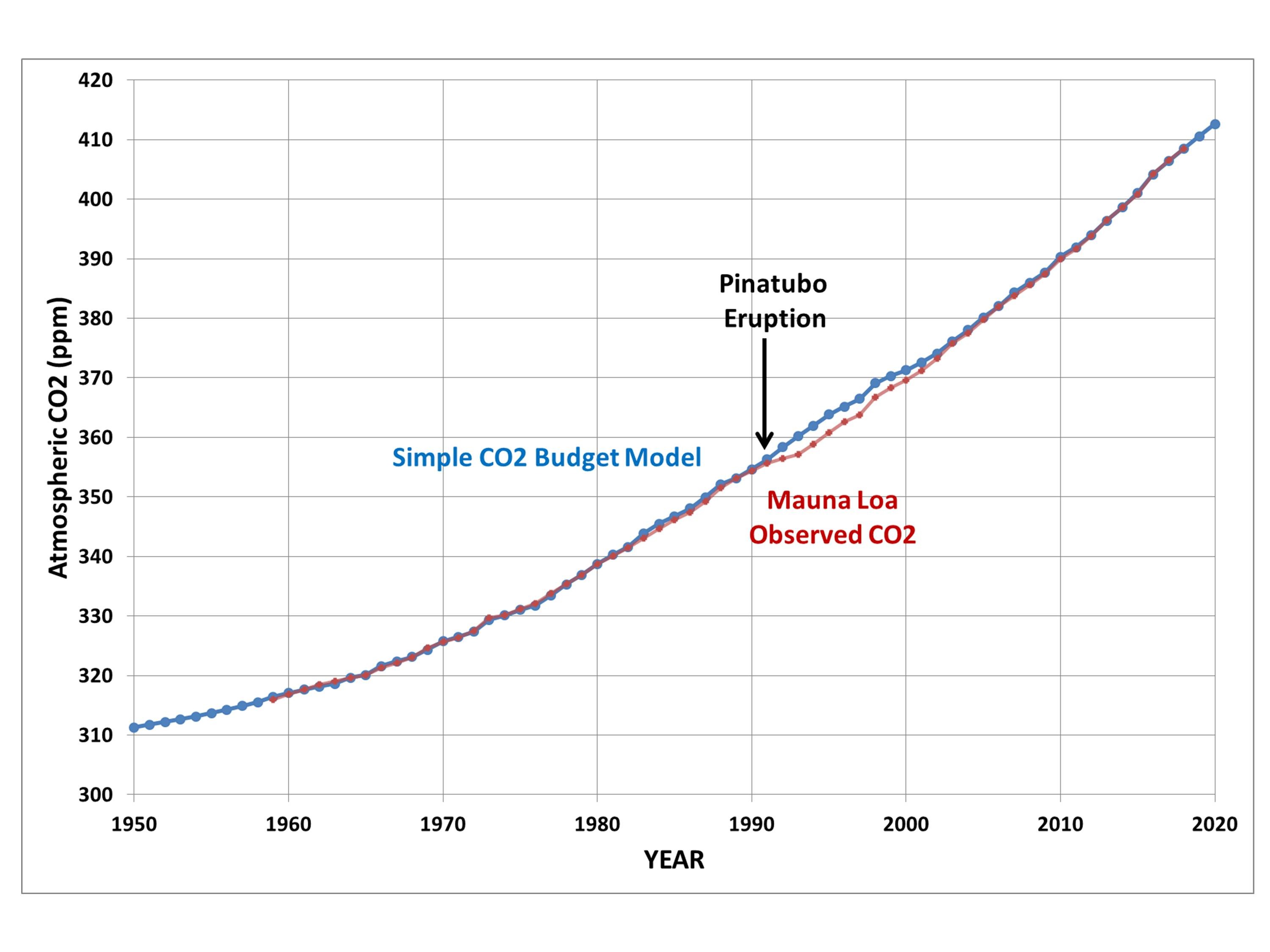
Of course, for anthropogenic CO2 emissions reductions to have any effect, they actually have to show up in the atmosphere. The most widely cited monitoring location for CO2 is on Mauna Loa in Hawaii. It is at high elevation in a persistent subtropical high pressure zone that should be able to detect large emissions changes in several weeks time as weather systems move around the world.
I’ve had several requests, and seen numerous social media comments, suggesting this is something that should be looked at. So, I’ve analyzed the Mauna Loa CO2 data (updated monthly) through February 2020 to see if there is any hint of a CO2 concentration downturn (or, more accurately, reduced rate of rise).
The short answer is: No… at least not yet.
The Mauna Loa Data: Removing Seasonal and ENSO Effects
While an anthropogenic source of CO2 can explain the long-term rise in CO2, the trouble with finding an anthropogenic signal on time scale of a few months to a couple years is that natural variations swamp any anthropogenic changes on short time scales.
The monthly data (arbitrarily starting 1996, below) shows a continuing long-term rise that has been occurring since monitoring began in 1958. Also seen is the strong seasonal cycle as the vegetation in the Northern Hemisphere goes through its normal seasonal variations in growth and decay.

Obviously, not much can be discerned from the raw monthly average data in the above plot because the seasonal cycle is so strong. So, the first step is to remove the seasonal cycle. I did this by subtracting out a 4th order polynomial fit before removing the average seasonal cycle, then adding that statistical fit back in:

Next, there are some wiggles in the data due to El Nino and La Nina (ENSO) activity, and if we remove an average statistical estimate of that (a time lag and averaging is involved to increase signal), we can get a little better idea of whether the most recent month (February 2020) is out of the ordinary. I have zeroed in on just the most recent 5 years for clarity.

The polynomial fit to the data (thin dotted line) shows what we might expect for the coming months, and we can see that February is not yet departing from the expected values.
Of course, there are a variety of natural variations that impact global average CO2 on a month-to-month basis: Interannual variations in wildfire activity, land vegetation and sea surface temperatures, variations in El Nino and La Nina effects, and short-term fluctuations in anthropogenic emissions immediately come to mind. (The Pinatubo and El Chichon volcano eruptions actually caused a reduction in global CO2, probably due to post-eruption vegetation effects from an increase in diffuse sunlight penetration of forest canopies).
I will try to update this analysis every month as long as the issue is of sufficient interest.
Roy wrote, “(The Pinatubo and El Chichon volcano eruptions actually caused a reduction in global CO2, probably due to post-eruption vegetation effects from an increase in diffuse sunlight penetration of forest canopies).”
Interesting!
Two other possible causes or contributors to that effect are:
● perhaps because particulates ejected by the eruption cooled the planet, which temporarily increased CO2 absorption by the oceans (because CO2 and other gases dissolve more readily in cooler water), and/or
● perhaps because iron and other minerals in the volcanic ash fertilized the ocean and thereby increased CO2 uptake by ocean biota (Sarmiento, 1993).
The effect of El Chichon (April, 1982) was slight, but the effect of Pinatubo was obvious:

I was going to say the same. Temporary cooling of oceans and the increased uptake of CO2 due to Henry’s law was the cause of CO2 decrease after Pinatubo eruption.
Can anyone see the dip in CO2 from the financial crash in 2008? Just lost in the noise.
JeffC
An alternative hypothesis to consider is that there is no correlation between atmospheric CO2 and the economic well being of the world because anthropogenic CO2 is not driving the rise in atmospheric CO2. Confounding the relationship is that the change in annual atmospheric CO2 is only about 40% of the estimated anthropogenic CO2 emissions. Speaking of “noise,” the anthropogenic CO2 production is a small fraction of the total Carbon Cycle, and it is not well characterized in detail.
In my lifetime the weather has been unpredictably predictable. Our weather and climate ‘medics’ have been forever scrabbling around for better data and a higher degree of resolution of that data just like other professions who deal in things that change. Some extreme weather events happen as they always have done and some panic ensues just as it always will. And then a ‘genius’ comes along and claims we are murdering ourselves slowly and surely because things we have naturally learned to do over time through scientific endeavour are somehow of a scale that is damaging our planet. The genius offers, as evidence, proof that a rise in CO2 is pushing temperatures up on an unprecedented scale. This genius is later found to have cooked the books but instead of being ridiculed and banished, those who have huge reasons to persist with this idea that we are killing ourselves, wish to protect the potential enrichment they have noticed in their own lifestyles. Meanwhile the planet ticks over sighs another ‘Whatever next?’ A battle ensues between those who wish to protect science and those who wish to protect their ill got lifestyles. Honesty moves a safer distance away from them.
Is human sourced carbon dioxide increasing? Of course it is since the population is increasing. Is it damaging the planet? Nobody seems to have a winning theory or clue about a) how that would work; b) how you could see it working; c) why the planet has cleaned up much bigger messes than this many times before. Nature doesn’t appear to registering this event as at all important and is very much business as usual.
How is it that in the twenty first century we seem to be going backwards?
“as long as the issue is of sufficient interest.”
This is of vital interest, because the whole basis of the “carbon budget” is based upon the idea that we can only emit so much CO2 before disaster awaits. Annual changes in Mauna Loa CO2 do not follow annual changes in in emissions. Annual changes in temperature do not follow annual changes in Mauna Loa CO2. Dead theory.
Professor Jamal Munshi
https://www.academia.edu/33779445/RESPONSIVENESS_OF_ATMOSPHERIC_CO2_TO_FOSSIL_FUEL_EMISSIONS_UPDATED
“The IPCC carbon budget concludes that changes in atmospheric CO2 are driven by fossil fuel emissions on a year by year basis. A testable implication of the validity of this carbon budget is that changes in atmospheric CO2 should be correlated with fossil fuel emissions at an annual time scale net of long term trends. A test of this relationship with in situ CO2 data from Mauna Loa 1958-2016 and flask CO2 data from twenty three stations around the world 1967-2015 is presented.
The test fails to show that annual changes in atmospheric CO2 levels can be attributed to annual emissions. The finding is consistent with prior studies that found no evidence to relate the rate of warming to emissions and they imply that the IPCC carbon budget is flawed possibly because of insufficient attention to uncertainty, excessive reliance on net flows, and the use of circular reasoning that subsumes a role for fossil fuel emissions in the observed increase in atmospheric CO2.”
See http://www.realclimate.org/index.php/archives/2020/03/further-perspectives-on-pandemics-and-climate-change/ to see how the alarmists are linking the two problems. I read that blog but I say little as I know I’d get smacked if I did.
Oh, regarding the notes at the bottom of the reply screen- one says “Notify me of follow-up comments by email” and the other says, “Notify me of new posts by email”. Not sure what’s the difference. What I’d like is to have an option that would only let me know if somebody replies to one of my comments. Once I checked one of these- and got dozens of other comments from a particular thread – not comments responding to my comment.
I noticed that also. I don’t check the “Notify” block, I just check back a few days later to see if anyone posted any followup comments,
If I look at the weekly data here
ftp://aftp.cmdl.noaa.gov/products/trends/co2/co2_weekly_mlo.txt
I see in the produced graph
http://camargue-flaamenco.de/Upload/CO2weekly.png
an lower peak (greeen line)
sorry
http://camargue-flamenco.de/Upload/CO2weekly.png
seems I have probs with mey keyboard,
In addition zoomed in the data 03/18 – 03/20
htttp://camargue-flamenco.de/Upload/CO20318-0320.png
Better detail view of what happend last month ’til march 15th
I really have kb probs: :–(
http://camargue-flamenco.de/Upload/CO20318-0320.png
I have seen satellite mapping of Asia showing atmospheric NO….. and northern China went down and now is recovering….sorry, no link. I assume it is manufacturing related and CO2 should be similar.
When the next UAH monthly temperature update is released, if it shows a reduction in the positive “anomaly”, it will be distorted by warmists as more proof of the direct link between CO2 emissions and atmospheric temperature, even if total atmospheric CO2 has not gone down.
Coronavirus could provide an unprecedented opportunity to establish once and for all the fraction of CO2 rise (eg at Mauna Loa) that is human caused.
If it is, then the steady rise in CO2 should be checked – there should be a discontinuity in the CO2 rise.
If CO2 continues to rises without the slightest change, this argues that the CO2 is coming from somewhere else. Such as ocean out gassing from warming.
The discontinuity to look for will be small. But with modern precise instruments, it should be clearly measurable.
A Popper alert to scare the alarmists 😁
If the CO2 is from outgassing we should see an increase in the ocean pH level.
Dale
You said, “If the CO2 is from outgassing we should see an increase in the ocean pH level.” The unstated assumption is that there is a one-to-one correspondence. That is, all the anthropogenic CO2 is going into Hawaiian surface waters. It is estimated that more than half of the CO2 goes into the oceans. However, the bulk is apparently dissolved in high latitude waters, sinks, and is not available for sampling. What is happening in Hawaii (NOAA graph) is not representative of all of the oceans. Upwelling and outgassing is strongest along the Equator and on the western shores of the continents. One might say that Hawaii is essentially anecdotal evidence.
seems you can see it here the is a discontinuity in the rise – I’ll follow the data and update the graph, here based on 3/18 ’til 3/20 15th – weekly data.
Excerpt: March 22nd, 2020 by Roy W. Spencer, Ph. D.
Roy Spencer, ….. I not only believe that the “steady & consistent” long-term rise (1958-2020) in atmospheric CO2 is a function of the continuing Interglacial Warming that restarted at the end of the LIA, …….. but I also believe the unquestionable and factual science that supports the aforesaid.
And Mr. Spencer, …… how can you possibly claim that “anthropogenic emissions accurately explain the Mauna Loa observations” ….. when there is NO, NONE, ZERO, ZILCH ……. “human signature” to be found anywhere within the 62 years of the Mauna Loa data. There are El Niño signatures, La Nina signatures, volcanic signatures …….. but no “anthropogenic” human signature(s).
To wit, actual factual data extracted from the Mauna Loa Record
1979 – 1994 YTD CO2 — “Max” ppm @ur momisugly mid-May (5) … “Min” ppm @ur momisugly end of Sept (9)
SD = summertime decrease May(5)-Sept(9) ….. WI = wintertime increase Sept(9)-May(5)
year mth Max ppm …………. mth Min ppm .. SD ….. WI …. yearly increase
1979 _ 6 _ 339.20 .. El Niño ___ 9 … 333.93 … – 5.27 … 7.54 …. + …..
1980 _ 5 _ 341.47 ……………… 10 … 336.05 …. -5.42 … 6.96 …. +2.27
1981 _ 5 _ 343.01……………… 9 … 336.92 …. -6.96 … 7.75…. +1.54
1982 _ 5 _ 344.67.. El Niño ….. 9 … 338.32 …. -6.35 … 7.64 …. +1.66 El Chichón
1983 _ 5 _ 345.96 ……………… 9 … 340.17 …. -5.79 … 7.38 …. +1.29
1984 _ 5 _ 347.55 …………….. 9 … 341.35 …. -6.20 … 7.57 … +1.59
1985 _ 5 _ 348.92 …………… 10 … 343.08 …. -5.84 … 7.45 … +1.37
1986 _ 5 _ 350.53 …………… 10 … 344.47 ……………………. +1.61
1987 _ 5 _ 352.14 ……………. 9 … 346.52 ……………………. +1.61
1988 _ 5 _ 354.18 ……………. 9 … 349.03 ……………………..+2.04
1989 _ 5 _ 355.89 .. La Nina .. 9 … 350.02……………………../ +1.71
1990 _ 5 _ 357.29 …………… 9 … 351.28 ..…………………… +1.40
1991 _ 5 _ 359.09 …………… 9 … 352.30 …………………….. +1.80
1992 _ 5 _ 359.55 .. El Niño .. 9 … 352.93 …. -7.25 … 7.26 …. +0.46 Pinatubo
1993 _ 5 _ 360.19 …………… 9 … 354.10 ……………………. +0.64
1994 _ 5 _ 361.68 …………… 9 … 355.63 ….………………… +1.49
All 62 years of the Mauna Loa CO2 ppm data portrays basically the same trend as noted above …… with the Keeling Curve Graph explicitly portraying the bi-yearly (seasonal) “sawtooth” cycling, including the “yearly increase” in CO2 ppm.
Iffen anthropogenic CO2 was causing a measurable effect on the MLR or the KCG …. then there should be a readily recognizable steady and consistent INCREASE in both the “wintertime increase” (WI) and the “yearly increase” in CO2 ppm …… to account for the increase in world population.
Dr. Spencer states: “It will take considerable evidence to convince me that the long-term rise in (CO2 is) not anthropogenic. ”
Now Roy S, …… is the exponential increase in world population during the past 80 years, ….. from 2.3 billion to 7.7 billion people, ….. be “considerable evidence that is satisfactory to your liking?
If so, …… then, to wit:
year — world popul. – % incr. — May CO2 ppm – % incr. — avg ppm increase/year
1940 – 2,300,000,000 est. ___ ____ 300 ppm est.
1950 – 2,556,000,053 – 11.1% ____ 310 ppm – 3.3% —— 1.0 ppm/year
[March 03, 1958 …… Mauna Loa — 315.71 ppm]
1960 – 3,039,451,023 – 18.9% ____ 320.03 ppm – 3.2% —— 1.0 ppm/year
1970 – 3,706,618,163 – 21.9% ____ 328.07 ppm – 2.5% —— 0.8 ppm/year
1980 – 4,453,831,714 – 20.1% ____ 341.48 ppm – 4.0% —– 1.3 ppm/year
1990 – 5,278,639,789 – 18.5% ____ 357.32 ppm – 4.6% —– 1.5 ppm/year
2000 – 6,082,966,429 – 15.2% ____ 371.58 ppm – 3.9% —– 1.4 ppm/year
2010 – 6,809,972,000 – 11.9% ____ 393.00 ppm – 5.7% —— 2.1 ppm/year
2019 – 7,714,576,923 – 11.7% ____ 414.66 ppm – 5.5% —— 2.1 ppm/year
Source CO2 ppm: ftp://aftp.cmdl.noaa.gov/products/trends/co2/co2_mm_mlo.txt
Based on the above statistics, to wit:
Fact #1 – in the past 79 years – world population has increased 235% (5.4 billion people) – atmospheric CO2 has increased 37.3% (112 ppm)
Fact #2 – human generated CO2 releases have been exponentially increasing every year for the past 79 years (as defined by the population increase of 5.4 billion people).
Fact #3 – the burning of fossil fuels by humans has been exponentially increasing every year for the past 79 years. (as defined by the population increase of 5.4 billion people).
Fact #4 – a biyearly or seasonal cycling of an average 6 ppm of atmospheric CO2 has been steadily and consistently occurring each and every year for the past 61 years (as defined by the Mauna Loa Record and Keeling Curve Graph).
Fact #5 – atmospheric CO2 has been steadily and consistently increasing at an average yearly rate of 1 to 2 ppm per year for each and every year for the past 61 years (as defined by the Mauna Loa Record and Keeling Curve Graph).
Conclusions:
Given the above statistics, it appears to me to be quite obvious that for the past 79 years (or the 61 years of the Mauna Loa Record) there is absolutely no direct association or correlation between:
#1 – increases in atmospheric CO2 ppm and world population increases:
#2 – the biyearly or seasonal cycling of an average 6 ppm of atmospheric CO2 and world population increases;
#3 – the biyearly or seasonal cycling of an average 6 ppm of atmospheric CO2 and the exponential yearly increase in fossil fuel burning;
#4 – the average yearly increase in atmospheric CO2 of 1 to 2 ppm and the exponential increase in fossil fuel burning;
#5 – there is absolutely, positively no, per se, “human (anthropogenic) signature” to be found anywhere within the 61 year old Mauna Loa Atmospheric CO2 Record.
#6 – this composite graph of 1979-2013 uah satellite global lower atmosphere temperatures and yearly May max CO2 accumulations is literal proof that anthropogenic causes, ….. green growing/decomposing NH biomass …… and/or near surface air temperatures have little to no effect whatsoever on atmospheric CO2 ppm quantities.
And ps, Roy, …… it is biologically impossible for the NH “wintertime” microbial decomposition of dead biomass to cause the biyearly (seasonal) increase of average 6 ppm in atmospheric CO2 as defined by the MLR and/or KCG. And likewise, the “green growing” biomass in the NH is not responsible for the biyearly (seasonal) ‘summertime” decrease of average 6 ppm in atmospheric CO2 as defined by the MLR and/or KCG.
Cheers, Sam C
The human signature is the Suess effect.
The human signature is the Guess effect.
there fixed it for you
@ur momisugly Jack Dale
“The human signature is the Suess effect.”
Jack D, ….. here is the “junk science” you are citing, to wit:
But now, Jack D, …… research “facts” tell the correct story, to wit:
Impressive argument, Samuel
I’ve always been suspicious of the extremely smooth linearity of the Mauna Loa Keeling curve.
What kind of signature is a straight line?
I thank you for your kind response, Phil.
“the extremely smooth linearity of the Mauna Loa Keeling curve.”
Phil S, if your above statement was intended to be satire, ….. then it went “SWOOOOSH” right over my head.
But then, maybe, anyone with dyslexia that looks at this KC Graph probably can’t see the bi-yearly (seasonal) cycling that is denoted in “red” and can only see the “black” line that denotes the “average”, or to be more exact, the “black” line denotes the “average yearly increase” as a result of the ocean waters warming-up from the cold of the LIA.
It could still be caused by the effects of deforestation/land-use change. A significant extra addition to atmospheric CO2 input caused by the concomitant large scale destruction of carbon sinks.
The deciding evidence lies in the Δ14C measurements. We need to see an update to the Levine2013 paper with measurements from Jungfraujoch and the other site, whose name temporarily escapes me.
That was almost the exact point where atmospheric 14C should have fallen below the level observed before the atmospheric nuclear tests.
In short, if the extra CO2 is coming from “cold” fossil fuel sources then the 14C level will continue to fall below the pre-1945 levels at roughly 3% per annum. If the extra CO2 is coming from more recent carbon compounds (i.e. trees, soil, etc) then it will not be “cold” and the 14C levels will remain close to the pre-war levels. (Measurements and geo-biochemical assertions based on Δ13C measurements simply aren’t good enough.)
While I haven’t looked hard for an update to the Levine 2013 paper for a couple of years now, I’ll bet dimes for dollars that if was a clear-cut case in favor of the prevailing “consensus” then we might have a heard a lot about it.
I would be most grateful for anyone with the data making it public. Real scientists really do like to see the data, even if it proves them wrong. And the people doing the measurements appeared to be genuine scientists and I doubt that the projects were stopped at such a critical moment.
Excerpted from above commentary by Roy S:
But, ….. but, ….. but, …. there was an El Niño in progress at the same time those two volcanoes were “blowing their top”, …….and El Niño are noted for causing increases in atmospheric CO2, ……. see my above post.
Dr. Spencer we do have a precedence for this global shut down the years of 2014-2015-2016 That is a 3 years of baseline of manmade CO2 (no increase)
In the years 2014 though 2016 man made output of CO2 remained flat (using a standard base line) and actually declined during 2015 and 2016 This information is supplied by the Global Energy and CO2 Status report released in March of 2019 by the International Energy Agency (your tax dollars at work).
The CO2 detectors on Mauna Loa observatory of those years shows no corresponding leveling off (pause) in the rise in CO2. (in fact between 2015 and 2016 the rate of rise actually accelerated)
For the year 2013 CO2 was measured at 396.52 ppm
For the year 2014 CO2 was measured at 398.65 ppm
For the year 2015 CO2 was measured at 400.83 ppm
For the year 2016 CO2 was measured at 404.24 ppm
If man were causing the increase in CO2 wouldn’t a decline in output show a pause in the CO2 readings at Mauna Loa?
I am guessing that man made CO2 production dropped during the global recession of 2008 thru 2012 as well, with no concurrent drop in “MEASURED” CO2
https://www.iea.org/reports/global-energy-co2-status-report-2019
The volume of atmospheric CO2 measured at Mauna Loa is the well mixed residual, given SST and atmospheric circulation patterns for that year. Talk of Mauna Loa – atmospheric CO2 and the carbon cycle must include what the image in the link details. CO2 moves upward through the atmosphere and out past the 100km altitude. The following chart is largely ignored. Look at the seasonal movements, they are obvious even with only six data points per year.
Regards
http://saber.gats-inc.com/images/wn_0315_2.png
http://saber.gats-inc.com/news.php
Nice graph, Martin.
And “YES”, …… “the seasonal movements” (of CO2 ppm quantities) explicitly defines the “season” warming and cooling of the ocean waters in the Southern Hemisphere. 😊
As the waters “warm”, the atmospheric CO2 increases. As the waters “cool”, the atmospheric CO2 decreases. Henry’s Law, ya know.
Roy, you wrote
1. Also seen is the strong seasonal cycle as the vegetation in the Northern Hemisphere goes through its normal seasonal variations in growth and decay
2. The Pinatubo and El Chichon volcano eruptions actually caused a reduction in global CO2, probably due to post-eruption vegetation effects from an increase in diffuse sunlight penetration of forest canopies
That is your interpretation or assumption.
An alternative interpretation is based on the fact that the solubility of CO2 in the ocean decreases with increase in the ocean temperature. Based on this fact, the seasonal cycle in atmospheric CO2 is due to the seasonal cycle in ocean heat content with some delay. Similarly, the reduction in atmospheric CO2 after the eruptions of Pinatubo and El Chichon were due to the cooling of the ocean that absorbed more CO2 from the atmosphere.
I was also thinking of the effect of the reduction in human emission of CO2 due to the economic downturn as a result of COVID19 on the observed atmospheric CO2 concentration. Thanks for writing this very interesting article.
My expectation is even if human emission of CO2 were reduced to zero, the atmospheric CO2 concentration would continue to increase because the increase in atmospheric CO2 is caused by the warming of the deep ocean because of heat flow from the warmer mixed ocean layer to the colder deeper ocean since mid 19th century. This is based on the 2nd Principle of Thermodynamics that states “heat must flow downhill on the temperature scale” (Holman, 1981, p. 2)
Girma – March 23, 2020 at 12:43 pm
I agree, Girma, …… but with the one “noted” exception.
IMLO, it is NOT ….. the warming of the deep ocean water, ….. but simply the “continued” warming of the ocean surface layer …… from the “cold” of the Little Ice Age.
It was much “warmer” during the Medieval Warm Period, but we have no way of knowing what the actual atmospheric CO2 ppm was.
Samuel, how do you then explain the secular heat storage of the ocean during global warming and the release of this energy from ocean during global cooling?
“ the secular heat storage of the ocean ”
Girma, ….. did you per chance mean to say …. “circular heat storage” ….. as in reference to the Thermohaline Circulation?
If so, then learn more about it here: https://en.wikipedia.org/wiki/Thermohaline_circulation
Anyway, Girma, when the Sun, per se, crosses the equator, it “marks” the changing of the equinoxes from the “start of Spring-Summer” in the hemisphere the Sun is moving toward ….. or the ”start of Fall-Winter” in the hemisphere the Sun is moving away from. And the ocean “surface waters” react accordingly via “warming and melting ice” and “cooling and freezing ice”.
And when the ocean SURFACE waters (in their respective hemisphere) “cool down” (wintertime) they absorb copious amounts of atmospheric CO2. And when the ocean SURFACE waters (in their respective hemisphere) “warm up” (summertime) they emit copious amounts of atmospheric CO2.
And the ocean surface water in the Southern Hemisphere is the “control knob” for atmospheric CO2 simply because ……. the Northern Hemisphere is 60% land and 40% water, whereas the Southern Hemisphere is 20% land and 80% water.
Hope the above answers your question.
Samuel, my main point is that on average the mixed ocean layer is warmer than deeper ocean during the global warming since mid-19th century. As a result, because of the 2nd principle of thermodynamics that states “heat must flow downhill the temperature scale” there is a secular heat flow from the warmer mixed ocean layer to the colder deeper ocean.
During global cooling, the deeper ocean becomes warmer than the colder mixed ocean layer and heat flows from the deeper ocean to the mixed ocean layer to the atmosphere and to space. This mechanism explains the oscillation in the global mean temperature from the medieval warm period to the little ice age and to the modern global warming.
Willis:
I would have thought that the most obvious cause would be the surface cooling leading to more absorption from cooler sea water. The opposite to out-gassing.
Occam and all that.
Mucho apologies for the false attribution, I’d skipped from a Willis post and quoted Dr Spencer.
I still think Dr. Spencer is make too much of this. There is a clear relationship between dCO2 and SST on short to medium term. Attempting to “correct” for ENSO will just mask the obvious.
If Mt.P affects your ENSO metrics, like El Nino 3.4 SST, then you are already removing what you should be studying.
“ There is a clear relationship between dCO2 and SST on short to medium term. ”
“YUP”, …… the seasonal “cycling” of atmospheric CO2 ppm as defined by the MLR and/or KCG has been pretty much “steady & consistent” for the past 62 years ……. and there is ABSOLUTEY nothing that is or ever has been “steady & consistent” about human activities, near-surface air temperatures or weekly/monthly/yearly weather.
It is not a time lag, it is a differentiation that you need to look at: d/dt(CO2) vs SST. Or diff both a second time:
https://climategrog.wordpress.com/gauss_rm_fft/
https://climategrog.wordpress.com/d2dt2_co2_ddt_sst-2/
A naive time lag with be the quadrature of the dominant cycle ( annual already removed ) , 9mo lag from roughly 3 year cycles.
Forget CO2, what has the shutdown in China and reduced flying done to temperatures. Surely there has been reduced SO2 and contrails.
Both Italy and China have shown dramatic declines in NOx emissions.
https://www.space.com/coronavirus-pollution-emissions-drop-china-italy-satellite-views.html
About the US Economy Pause and the Wuhan virus:
If these drug treatments for the Wuhan virus work out and the US can go back to work full-time, then I think our economy will do just what Trump says it will do and bounce back in a V-shape.
Assuming the government arranges to makeup for the lost wages that folks have lost over these past weeks of idleness, the US economy should rebound and start functioning much like it was doing a couple of months ago, before the Wuhan virus showed up, when the economy was booming.
The US economy is dominated by domestic spending, with 75 percent of US Gross Domestic Product generated within the United States. The other 25 percent comes from foreign trade, with the bulk of that taking place between Canada and Mexico, with China being the third largest trading partner of the US.
So most of our economy is generated internally, and about half of the rest is generated between the US and Canada and Mexico, and I think if the government lifts the restrictions on movement, then people are going to go out and spend just like they did two months ago.
No doubt there have been some disruptions to the economy and we will have to adapt to some things, but if we can get back up and running in a short period of time then I think we will continue on down the road to prosperity, just like we were doing before the Wuhan virus hit.
It all depends on if the hydroxychloroquine/antibiotic combination or one of the other promising drugs will effectively control the Wuhan virus. The hydroxychloroquine/antibiotic path would be the easiest since it is cheap and we can ramp up production very quickly (which is happening even as I write).
So we have to wait on the medical clinical trials but I think if we keep getting reports that 100 percent of patients are being cured of the Wuhan virus, than I don’t think business or the public is going to want to wait too long.
They will be putting the politicians under pressure to get us moving, and from the way Trump was acting, it looks like he is eager to get things moving because he is seeing these medical results. Trump is “Chomping at the Bit”! As are the rest of us.
If “things get back to normal” before the the virus is wiped out the health care system will be overburdened and with more people sick, the economy will be in worse shape.
In Canada we are being given far more conservative estimates for the production of cures and vaccines. Ironic, eh?
Nope FDA approved it Tom, they had clinical history on the drug.
Yes, the malaria drug is approved for human use, but the FDA has not approved it specifically for use on the Wuhan virus. President Trump has authorized all US doctors to use these drugs on a “compassionate use” basis, so basically any doctor can prescribe hydroxychloroquine to their patients, if the doctor thinks it is warranted.
Meanwhile, numerous clinical trials are underway, including the biggest one of them all, the New York epidemic. Trump said New York will recieve a delivery of hydroxychloroquine tomorrow morning.
So, over the next 10 days we may see a dramatic reduction in the number of people infected in New York. New York might not need all those hospital beds and respirators like they were thinking.
I really hope you are right. I guess pragmatically even if it doesn’t work at least it stops the confusion and we get a clear yes/no answer going forward so the trial is a good thing.
“Yes, the malaria drug is approved for human use, but the FDA has not approved it specifically for use on the Wuhan virus. ”
Tom Abbott, …… what the hell makes the difference?
No one died because of that “malaria drug”, …….. did they?
Yes.
https://www.forbes.com/sites/tarahaelle/2020/03/23/man-dead-from-taking-chloroquine-after-trump-touts-drug-for-coronavirus/#6d1104f472e9
@ur momisugly Jack Dale
“Yes. (people died)”
Shur nuff, Jack, …… stupid people do stupid things, to wit:
“Tom Abbott, …… what the hell makes the difference?
No one died because of that “malaria drug”, …….. did they?”
Samuel, I think you misunderstand my position. I’m all for using these malaria drugs, the more the better. I was just stating the legal technical issues as I understand them.
I apologize, Tom A, ….. I jumped the gun thinking about the FDA refusing a dying patient access to a “new” untested drug …… claiming it might kill them if they take it.
Worthwhile reading on chloroquine.
https://www.acsh.org/news/2020/03/20/chloroquine-coronavirus-not-so-fast-14650
Why is this worthwhile?
Chloroquine and Remdesivir appear evenly matched in virus inhibition graphs, although Chloroquine’s inhibitory effects seem to exceed those of Remdesivir at higher doses.
Blooms’ list of side effects for Chloroquine seem extensive, perhaps reflecting its hundreds of years of use. This side effects list should be particularly useful when doctors prescribe it, since, apparently, it will be used “off label”, and can only be given by doctors who know their patients’ conditions and medical histories.
No such list of side effects is provided for the drug Remdesivir in his parallel article, “Can Gilead’s Remdesivir Tame The Coronavirus?” although he clearly favors a “YES!” answer to his own question and touts its effectiveness and safety over Chloroquine’s.
The author does, howver, discloses his IRA holdings of Gilead in a footnote to the article.
Without putting too fine a point on this, Trump haters hate anything that bears the Trump imprimatur, including a reasonably safe drug with a long history that might help put an end to this lock-down crisis.
Some news:
“Top COVID-19 aspirants chloroquine, AbbVie’s Kaletra and a flu drug disappoint in clinical tests”
https://www.fiercepharma.com/pharma-asia/top-covid-19-aspirants-chloroquine-abbvie-s-kaletra-and-a-flu-drug-disappoint-clinical
China tests corona vaccine on first patients
“Above all, it’s one thing: a race with the United States.”
China had a headstart of a couple of months.
If the hydroxychloroquine/antibiotic combination proves effective against the Wuhan virus, then the U.S. population can go back to work full-time just as soon as there is enough of these drugs to treat every person in the USA.
Then, we can go to work, and if someone catches the disease, they can go to the doctor and get a five-day treatment of drugs which should clear the virus out of their body, so they will only have to stay away from work for a short period of time and when they return, they will be immune to any further effects from the Wuhan virus.
We can in effect attain 80 percent or higher herd immunity to this virus by doing this.
I listened to Trump’s news conference tonight and I would say this nation is going back to work within the month. Trump says he will decide the future path after his 15-day pause is up next week, and I think if the drug tests look good, then he is going to say let’s go back to work, we have this virus under control. Not eradicated yet, but well on the way, and it can’t hurt us now like it has in the past.
I think even if there are problems that develop with these treatments, Trump is going to get us going, using different methods that don’t depend on these drugs.
We are going back to work in weeks, not months, imo.
If the US is going back to work in weeks, Canada will build a wall.
You can just dig a big trench for the oil to run out of the tar sands, you aren’t going to use it anyhow. Then you just need a pile of feathers for anyone who gets thru the trench.
Rather mysterious the Mauna Lao station seems to have stopped giving its daily updates!!!
https://www.co2.earth/daily-co2
Do you think they know this is starting to expose the CO2 scam and are beginning to fiddle the raw data?
Why all of a sudden is the daily data unavailable????
yes I noticed that too. 21 and 22nd and 23rd unavailable and the previous dates show an increase in ppm
The Mauna Loa analyzer is currently down. No new data will be available until further notice.”
very suspicious
Value for March 25th has been posted, so hopefully the analyzer at Mauna Loa will be OK from now on. Value is around 1ppm higher than the last reported value on the 20th, but we need to wait to see if that holds up.
Apparently CO2 emissions are down.
https://www.severe-weather.eu/global-weather/covid-19-global-co2-slowdown-climate-fa/
I doubt anyone would argue that CO2 emissions will have dropped. The link suggests that atmospheric growth of CO2 at Mauna Loa has stalled. As I pointed out earlier to Geoff Sherrington, this is completely normal for this time of year. We need to wait and see what happens during April/May.
Last year the rate of growth kicked up at end March/early April towards its annual peak in May:
https://www.esrl.noaa.gov/gmd/ccgg/trends/weekly.html
I argue that and I have shown earlier above – the graph march 2018 – march 2020
again for you, latest date was march 15th
here
Krishna,
I was unable to view your earlier graphs, but I could see your latest one, so thanks for posting.
I was also a bit brief in my last comment and may not have been as clear as I should have been. I shall try to clarify my view and the reasons for it. First, I believe that most people, myself included, accept that CO2 emissions must have dropped recently due to the shutting down of industry (especially in China). Do you agree with that?
Secondly, and the point of Dr Spencer’s post, was to try to see if we can identify a reduction in the rate of growth of atmospheric CO2 at Mauna Loa, which could be a consequence of the reduced emissions. Geoff Sherrington and the link provided by Jack Dale both noted that atmospheric CO2 had been essentially flat (no growth) over the last few days/weeks at Mauna Loa.
As I mentioned to Geoff, I observed this characteristic a few years ago, and even asked Scripps what they thought was the cause. Using monthly data, it shows up as a reduction in growth rate at this time of year (Jan/Feb/Mar) and appears every year except for being (much) less clear in some El Niño years, which corresponds with the fact that we see higher growth during such years (less of a ‘pause’). If you look at this plot:
https://www.esrl.noaa.gov/gmd/ccgg/trends/
you will see the reduction in growth rate in early 2017, 2018 and 2019. In early 2016, there is a very slight reduction in growth rate, barely visible, that being an El Niño year.
If you look at the weekly plot at the same site (use “Last 1 Year” tab) you will see that last year the weekly values for March were actually dropping during the month. This year, we see the weekly rates being below the February monthly average from mid-Feb to mid-March. We also see that around this time of year there is much greater scatter in the daily data than at other times.
Does that help?
Jim,
I was also a bit brief in my last comment and may not have been as clear as I should have been. I shall try to clarify my view and the reasons for it. First, I believe that most people, myself included, accept that CO2 emissions must have dropped recently due to the shutting down of industry (especially in China). Do you agree with that?
Thats exactly the reason why I postet my graph, what’s missing are the coming weeks, if the values continuee to flatten as they seem to bee.
If there are new data, I’ll add the to my sheet.
Data from here
PS
you see, I postet the graph of the weekly data 3/18-3/20, so, why a tab on last year, you have the full graph, can’t fully follow your thoughts
If CO2 rates of increase do show a decline from their normal high point, they might be on the order of 5%. We should look carefully at the satellite data from MODIS showing the greening effect of plant mass.
The world is literally a greener place than it was 20 years ago…
Taken all together, the greening of the planet over the last two decades represents an increase in leaf area on plants and trees equivalent to the area covered by all the Amazon rainforests. There are now more than two million square miles of extra green leaf area per year, compared to the early 2000s – a 5% increase.
https://www.nasa.gov/feature/ames/human-activity-in-china-and-india-dominates-the-greening-of-earth-nasa-study-shows
Did you read what you posted? The greening is not associated with CO2, it is human activity.
“China’s outsized contribution to the global greening trend comes in large part (42%) from programs to conserve and expand forests. These were developed in an effort to reduce the effects of soil erosion, air pollution and climate change. Another 32% there – and 82% of the greening seen in India – comes from intensive cultivation of food crops.”
Jack,
I’m here to learn. Just so I’m clear… you’re saying there is no association between the terrestrial biomass and atmospheric CO2 levels. I hope you can clarify this.
There has always been an association between the terrestrial biomass and atmospheric CO2 levels. It is part of the natural carbon cycle which was in balance until we dumped 1.5 trillion tonnes of anthropogenic CO2 into the atmosphere by burning fossil fuels. Prior to the industrial revolution CO2 levels fluctuated between 180 and 300 ppm for at least 800,000 years.
There is no natural “”balance” in carbon cycle as you believe.
Without human activity, CO2, on longer scales is declining, stored in carbon, in plants, in oceans…
What do you believe, why in earth history the earlier high CO2 decreased over the time.
So, and now, here are the humans adding CO2 and plants start growing more, question of search of a new balance.
So is nature, time to understand it.
PS
In nature, nothing is in a balance, never ever :perid
Did you read what you posted? The greening is not associated with CO2, it is human activity.
Yes, we all read, I think, but you Jack have to read correctly:
Now, with the MODIS data that lets us understand the phenomenon at really small scales, we see that humans are also contributing.”
So, what wouldt you tells ??
Jack, your numbers are so precise…never below 180 and never above 300? Was that Mauna Loa station measuring all that time? Jack, you have a “man made CO2 global warming” Hammer….and you see a CO2 nail everywhere…and Hammer Time! Jack, we gotta have the plants for O2 and the plants gotta have CO2…at least 150 ppm or else ….Jack, tell us….what is the ideal temp of planet earth and what is the ideal CO2?
The 180 -300 ppm data is from the 800,000 year Vostok ice core data. That range is probably the Goldilocks one. We never got to to the 150 ppm mark in that time period. No one is trying to rid the atmosphere of CO2.
For economic development 13C seems about right. Different plant species are suited to different temperatures.
“Here we unify these seemingly contradictory results by accounting for non-linearity at the macro scale. We show that overall economic productivity is non-linear in temperature for all countries, with productivity peaking at an annual average temperature of 13 °C and declining strongly at higher temperatures. The relationship is globally generalizable, unchanged since 1960, and apparent for agricultural and non-agricultural activity in both rich and poor countries.”
https://www.nature.com/articles/nature15725
Jack, there are published graphs of CO2 and temp going back 40 million years….don’t ask me how accurate…but the graphs show no correlation between CO2 and temp…they show no permanent climate cycles….they do show a general decline in CO2 from thousands of ppm…apparently, Mother Nature wants to rid the atmosphere of CO2….Mother keeps putting CO2 in water…and rocks…and plant material…I believe we are very lucky that man came along and thwarted Mother’s plot to rid the world of atmospheric CO2. Have a nice day.
800,000 years of natural cycles that suddenly go off the scale. Check the correlation between CO2 and temperature. This was the Earth in which homo sapiens evolved and our food crops were domesticated.
http://ossfoundation.us/projects/environment/global-warming/myths/images/natural-cycle/Forcing-Temp_1.9wm2.png
Yes, bad homo sapiens started that agriculture…when was that….8000 years ago? Jack wants to starve our friends – the plants- and I want them to flourish with at least 1000 ppm CO2…come on folks…we can do it…..1000ppm CO2 by 2099. I just planted a tomato plant and some basil…love those plants…..and love that O2 from them…thank you plants everywhere…and Jack, keep cool…cooler temps ahead…Grand Solar Minimum. Have a nice day.
At 550 ppm Co2 the nutritional value of food crops is compromised.
https://www.nature.com/articles/nature13179
Increased CO2 results in increased predation by pests.
https://www.ncbi.nlm.nih.gov/pubmed/18375762
https://www.annualreviews.org/doi/abs/10.1146/annurev-ento-120811-153544
jack dale
you do realize that paper on CO2 at 550 ppm’s and crops in “nature” magazine was retracted…..
you probable should have Retraction Watch on your reading list.
Can you provide a link to the retraction notice please?
My search of Retraction Watch yielded:
“Your search – Impact of anthropogenic CO2 emissions on global human nutrition site:retractionwatch.com – did not match any documents.
Suggestions:
Make sure that all words are spelled correctly.
Try different keywords.
Try more general keywords.
Try fewer keywords.”
When Zharkova’s paper was retracted the URL showed:
“RETRACTED ARTICLE: Oscillations of the baseline of solar magnetic field and solar irradiance on a millennial timescale”
This is what the URL for Smith and Meyers shows. No retraction notice.
“Impact of anthropogenic CO2 emissions on global human nutrition”
There was a correction, no retraction.
“Correction to: Nature https://doi.org/10.1038/nature13179, published online 07 May 2014.
In this Letter, we ought to have cited four relevant references. The first two1,2, published after submission of the first version of our manuscript, report a cultivar-dependent reduction in wheat grain quality under elevated carbon dioxide (CO2) in an Australian Grains Free-Air Carbon dioxide Enrichment (AGFACE) experiment. A subset of these results was reported in two papers published in 2012 (refs. 3,4). Although our work was independent of these papers, we regret not citing them to highlight their relevance. The original Letter has not been corrected.”
The correction supported their conclusions.
Science says there will be no global cooling.
“Any reduction in global mean near-surface temperature due to a future decline in solar activity is likely to be a small fraction of projected anthropogenic warming. ”
https://www.nature.com/articles/ncomms8535
“Here we use a coupled climate model to explore the effect of a 21st‐century grand minimum on future global temperatures, finding a moderate temperature offset of no more than −0.3°C in the year 2100 relative to a scenario with solar activity similar to recent decades. This temperature decrease is much smaller than the warming expected from anthropogenic greenhouse gas emissions by the end of the century.”
https://agupubs.onlinelibrary.wiley.com/doi/full/10.1029/2010GL042710
https://climate.nasa.gov/blog/2953/there-is-no-impending-mini-ice-age/
Jack, you and your models have never been able to get it close to right. Yet you post the garbage on this site. Nice try. Models are not reality… and when the record of unreality is wrong, and you continue to follow them, you become (fill in the blank).
GCM are quite accurate. Some science for you.
“Early climate models successfully predicted global warming
Climate models published between 1970 and 2007 provided accurate forecasts of subsequently observed global surface warming. This finding shows the value of using global observations to vet climate models as the planet warms.”
https://www.nature.com/articles/d41586-020-00243-w?
You are fooled at how they perform back testing which is that when they know the answer already they tune a model to reproduce what they already know. That is not prediction. That is a curve fitting exercise. That is why they have all been wrong. ALL OF THEM at predicting anything that happens in the future. You are not very science literate and confuse politics with science.
“Before applying their method, they found that 10 projections were consistent with observations.”
So 10 out of 17 were “consistent” (that would be about 65% agreed) then the applied their method, to make their models agree more.
“Moreover, on the basis of GMST forecasts alone, it is hard to predict, for example: to what extent sea level will rise; how ocean acidification caused by uptake of atmospheric CO2 will influence marine ecosystems; and the frequency and magnitude of future fires, droughts and floods.”
I don’t know how you missed that in the “research”
I did see that. I also understand the difference between “projection” and “prediction”.
Did you see the correction rather than the retraction of Smith and Myers?
Nature listed the paper with a letter of “concern”.
double speak for “Things are wrong in this paper and we are thinking of reacting it.”
I am somewhat impressed that you found the letter of concern. I will give you kudos for that, sorry a lot of people don’t do just a few more clicks on their computer to get to the truth of science or sudo science.
Where is the “letter of concern”? Please provide a link.
The correction was the addition of references that supported their conclusion. The correction was made by the authors of the study.
There is no indication of ” “Things are wrong in this paper and we are thinking of reacting (sic) it.”
I found a correction, not a letter of concern.
BTW – what is “sudo science”?
Dale
You quoted, “Early climate models successfully predicted global warming
Climate models published between 1970 and 2007 provided accurate forecasts of subsequently observed global surface warming.”
For another take on the claim:
https://wattsupwiththat.com/2018/06/30/analysis-of-james-hansens-1988-prediction-of-global-temperatures-for-the-last-30-years/
Hausfather looked at 17 models.
Your singular assessment of one paper might well be regarded as cherry-picking.
Jack Dale
Yes, a single paper could be considered Cherry Picking were it not for the fact that the alarmist community praises the Hansen results and it is similar to the other 16 papers that Hausfather looked at. The modelers operate with blinders and loose definitions of what constitutes skillful results. It is a case of no one in the modeling community being willing to acknowledge that “the king has no clothes.”
I’ll pile onto that:
The alarmist community considers the Keeling rise, which is the only direct measurement of CO2 of any length (only 60 years) to be rock solid indisputable foundational substantiation of their entire project. They fall back on it as though it were The Axiom of Existence.
On the other hand, they dismiss the authority of nearly One Billion Direct Measurements of surface temperature around the world, which display no abnormal warming or cooling.
Which is it, warming advocates? Do extensive direct measurements reveal the truth or not?