Guest “Russia collusion” by David Middleton
As the Democrat-media-fueled Covid-19 panic continues to batter the global economy, Russia thinks they see an opportunity to kill the evil capitalist “shale” players…
Mar 7, 2020, 09:58am EST
Russia Yanks A Leg From U.S. Shale’s Three-Legged StoolDavid Blackmon Contributor
EnergyFor the last two-plus years, the U.S. shale industry has been able to continue its oil boom thanks to the existence of a figurative 3-legged stool of support. Those three legs have been easily identifiable:
*The ability to legally export crude oil to other countries;
*An ongoing license to build pipelines and conduct fracking operations; and
*The continuation of the OPEC+ deal limiting exports by other oil producing nations.
So long as all three legs of that stool remained in place, crude prices have remained healthy enough to allow shale operators to continue drilling wells, increase overall U.S. production and for the most part remain fairly profitable. But, as with any stool, the removal of any one of the legs upsets an undeniably delicate balance, potentially spelling disaster for anyone sitting atop it.On Friday, Moscow yanked one of the three legs from the stool by refusing to agree to additional export cuts that had been unilaterally proposed by the OPEC member nations on Thursday without Russian representatives in the room. Crude prices immediately collapsed, experiencing their worst day in more than 5 years with a drop of 10%.
[…]
On Thursday the OPEC nations proposed additional cuts that would have taken an additional 1.5 million barrels of oil per day off of the market, 1 million of which would have been born by the OPEC members, with the remaining 500,000 in cuts obligated to Russia and its fellow non-OPEC participants. On Friday, though, Russian Energy Minister Alexander Novak returned to Vienna and informed the group that his country would not agree to any further cuts.
[…]
Forbes
Since trading opened this morning, both Brent and WTI are down another ~$9/bbl. As of 0700 CDT, Brent is at ~$35.50/bbl and WTI is at ~$32.10/bbl. Unfortunately for Russia, this Communist plot is unlikely to accomplish much of anything beyond devastating the Russian economy, even more than it’s already been devastated.
[…]
Manish Raj, chief financial officer at Velandera Energy, told Marketwatch that “Russia is certainly betting that price crash will cause U.S. production to crash, helping restore its dominance.” If that is really Moscow’s thought process, it is likely to be disappointed. Saudi Arabia already attempted a similar strategy to kill U.S. shale, flooding the market with crude in 2014 to create an enormous glut and drive down prices in an effort to reclaim market share.
Such a strategy demonstrates a misunderstanding of American bankruptcy laws. While the crash in oil prices that began in late 2014 did ultimately result in hundreds of shale producers declaring Chapter 11 bankruptcy, the net result of that process is that most of those companies reorganize themselves and come back with far less debt load. The strategy also fails to recognize that most producers have already put hedges in place for most of their equity production through the remainder of 2020 and beyond.
[…]
David Blackmon is an independent energy analyst/consultant based in Mansfield, TX. David has enjoyed a 39-year career in the oil and gas industry, the last 23 years of which were spent in the public policy arena, managing regulatory and legislative issues for various companies, including Burlington Resources, Shell, El Paso Corporation, FTI Consulting and LINN Energy.
Forbes
When Saudi Arabia tried this stunt in 2014, it did force hundreds of U.S. oil companies into bankruptcy, some of which never recovered. However, most of those companies emerged from bankruptcy with their debt effectively erased. While U.S. crude oil production declined by about 1 million bbl/d from July 2015 through October 2016, by the time OPEC initiated talks with Russia about coordinated production cuts in August 2017, U.S. crude oil production had recovered to its July 2015 level of about 9.5 million bbl/d.
Furthermore, most U.S. producers layered on hedge positions when oil was around $60/bbl. Hedges effectively lock in prices. As of February 2020, U.S. oil production hedge positions were near an all-time high:
Swap dealer positions: Short positions held by swap dealers accounted for 32% of the open interest for the WTI futures contract as of January 21, 2020, slightly less than the all-time high of 33%, reached in 2018 (Figure 4). Initiating a short position, or selling a futures contract, enables the holder to lock in a price today for the physical delivery of a commodity at some future date. Oil producers commonly use swap dealers to hedge their future production. Swap dealer short positions increased to 30% of the WTI open interest in mid-December, when WTI prices increased to more than $60/b. This price level, according to a survey of U.S. exploration and production companies conducted by the Federal Reserve Bank of Dallas, is sufficient to generate enough cash flow from operations for the majority of firms to cover capital expenditures. The increase in swap dealer short may have increased, in part, because U.S. producers hedged some of their expected 2020 production at about $60/b.
U.S. EIA

While a protracted Russian price war to gain market share will hurt the U.S. oil industry, cause many bankruptcies, destroy a ton of equity, wipe out 10’s (if not 100’s) of thousands of jobs and possibly even cause Permian Basin oil production to decline long enough for idiots to declare it dead… It will fail. Russia won’t gain market share and U.S. oil production will quickly recover, even if many of the oil companies won’t.
The self-inflicted damage has already begun:
Russian Ruble Plummets Amid Oil Market Chaos
The ruble hit a four-year low against the U.S. dollar as oil prices crashed 30% overnight.The Russian ruble plummeted almost 10% overnight, falling to its lowest level in more than four years, as oil prices crashed following the breakdown of the Russia-Saudi Arabia pact to limit production.
The ruble was trading at a low of 74.9 to $1 on Monday morning, after another wild start to the week for financial markets. Russia’s rejection of a renewed round of oil production cuts in the OPEC+ format at a crunch meeting in Vienna on Friday shocked the global energy markets and has prompted analysts to talk of an “oil price war” between two of the world’s largest energy suppliers.
Benchmark Brent crude fell 30% to $33 a barrel when trading opened on Asian markets following the weekend, the sharpest one-day loss in almost three decades.
Falling oil prices put the Russian ruble under pressure, as Moscow still relies on energy exports for a large portion of its budget. The so-called budget breakeven rate is $50, while profits on oil sold about $42 a barrel are funnelled into Russia’s swelling National Welfare Fund (NWF).
With prices below those levels, Russia will either have to run into its substantial coffers to fund day-to-day government spending or borrow more.
[…]
The Moscow Times
Russia, the country, needs oil prices above $50/bbl to breakeven. These tangentially United States, the country, don’t have a breakeven price. Our economy isn’t dependent on oil export revenue. And U.S. oil producers now have much lower breakeven prices than we did in 2014.
RYSTAD ENERGY RANKS THE CHEAPEST SOURCES OF SUPPLY IN THE OIL INDUSTRY
May 9, 2019
In a major turnaround, North American tight oil is emerging as the second cheapest source of new oil volumes globally, just shy of the Middle East onshore market.
[…]
Tight oil – such as onshore shale oil in the US – has witnessed an impressive turnaround over the last few years. In 2015, North American shale ranked as the second most expensive resource according to Rystad Energy’s global liquids cost curve, with an average breakeven price of $68 per barrel. The average Brent breakeven price for tight oil is now estimated at $46 per barrel, just four dollars behind the giant onshore fields in Saudi Arabia and other Middle Eastern countries.
[…]
Rystad Energy

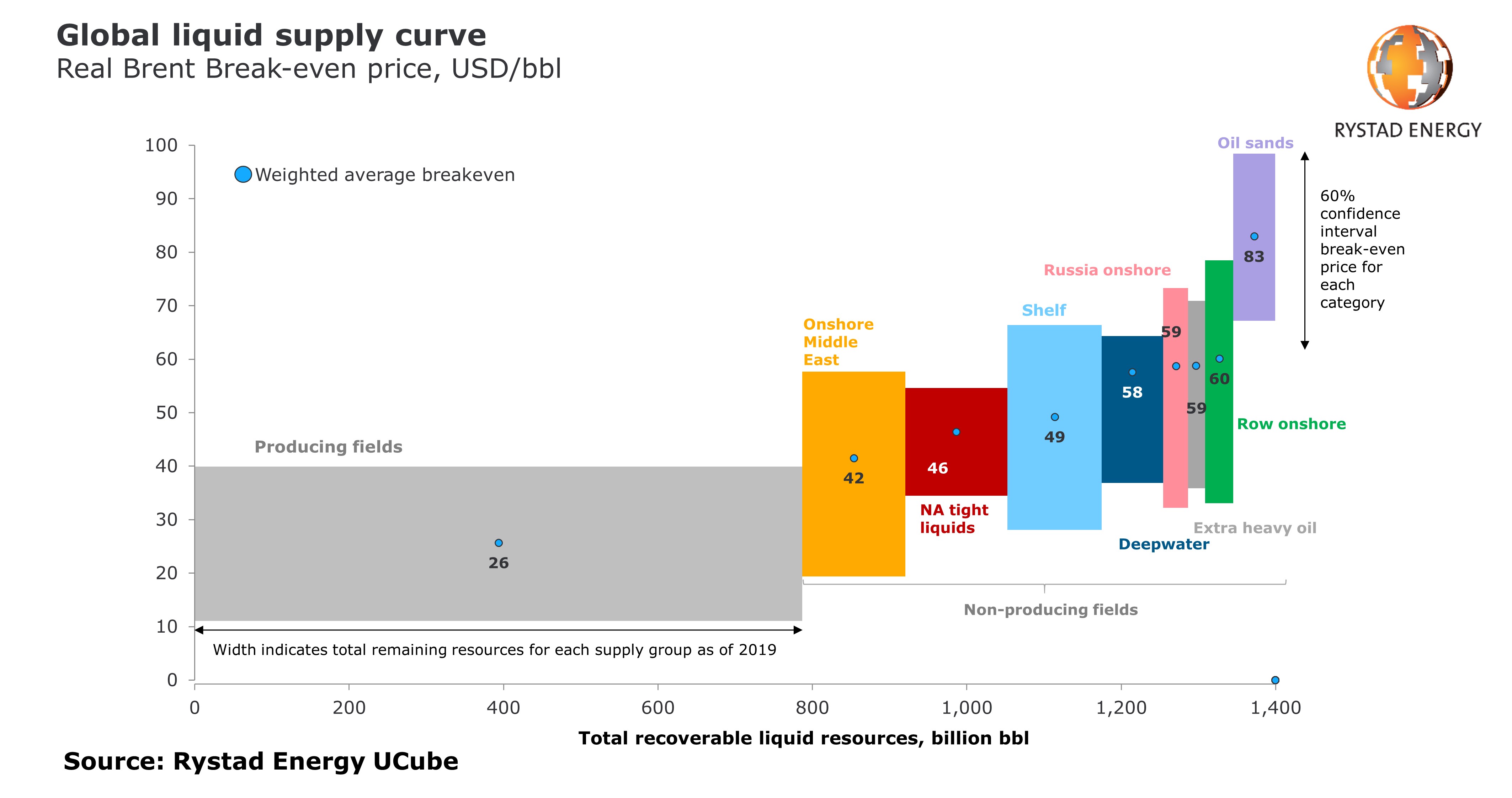
Russia’s average operational breakeven price is $13/bbl higher than U.S. “shale”. Furthermore, their resource base (width of the bars in Figure 2) is much smaller than the Middle East and U.S. “shale”.
Russia just brought a knife to a gunfight… A dull knife. So… Why is Russia doing this?
The Tell
OPEC price war one of three worst things that could hit virus-wracked markets, JPMorgan strategist saysPublished: March 9, 2020 at 11:39 a.m. ET
By Steve GoldsteinIn these coronavirus-wracked markets, there would be three, hypothetical really bad events, according to John Normand, head of cross-asset fundamental strategy at JPMorgan.
*One would be a large-scale shutdown of the U.S.
*Another would a second wave of virus infections in the China.
*And the third would be an OPEC+ price war.
Oops. That price war led to a 1800-point, or over 7%, drop in the Dow Jones Industrial Average in opening trade.
Normand said “the timing of this weekend’s shift seems somewhat random except to those who view it as President Putin’s attempt to complicate the U.S. economic outlook ahead of 2020 elections.’
[…]
MarketWatch
Vladimir Putin may be evil, but he isn’t stupid. He has to know that Russia can’t win this price war… But he can use it to interfere in our elections, hence: Covid-19 and Russia collusion to kill shale! Film at 11.
Film at 11
To those unfamiliar with American idiomatic expressions and/or too young to remember when the news cycle wasn’t 24/7…
Film at 11: Back in the “old” days, a breaking news story would be reported on the 7:00 PM (Eastern Time) news broadcast and would often be accompanied with the phrase “film at 11.” The film of the news story was still being processed and would be shown on the 11:00 PM news broadcast. At 7:00 PM, you would get a breathless CNN-style headline, hooking you into watching the 11:00 PM news to see the film of the event, usually a CNN-style nothing-burger.
While Covid-19 is far from a CNN-style nothing-burger, the panic is wholly unjustified. The Democrat-media complex continue to report that Covid-19 is 20 times as deadly as the common flu and far more contagious.
On the basis of a case definition requiring a diagnosis of pneumonia, the currently reported case fatality rate is approximately 2%.4 In another article in the Journal, Guan et al.5 report mortality of 1.4% among 1099 patients with laboratory-confirmed Covid-19; these patients had a wide spectrum of disease severity. If one assumes that the number of asymptomatic or minimally symptomatic cases is several times as high as the number of reported cases, the case fatality rate may be considerably less than 1%. This suggests that the overall clinical consequences of Covid-19 may ultimately be more akin to those of a severe seasonal influenza (which has a case fatality rate of approximately 0.1%) or a pandemic influenza (similar to those in 1957 and 1968) rather than a disease similar to SARS or MERS, which have had case fatality rates of 9 to 10% and 36%, respectively.2
The efficiency of transmission for any respiratory virus has important implications for containment and mitigation strategies. The current study indicates an estimated basic reproduction number (R0) of 2.2, which means that, on average, each infected person spreads the infection to an additional two persons. As the authors note, until this number falls below 1.0, it is likely that the outbreak will continue to spread. Recent reports of high titers of virus in the oropharynx early in the course of disease arouse concern about increased infectivity during the period of minimal symptoms.6,7
Fauci et al., 2020
Epidemiologists measure contagion with a statistic called the reproduction number, denoted as “R0.” It estimates the number of people each patient is likely to infect. Bloomberg rounded up R0 estimates for the coronavirus and other infectious diseases from the WHO and CDC and found that while the coronavirus’s R0 of 2.8 makes it more contagious than the seasonal flu (1.3) or Ebola (1.9), it is much less contagious than smallpox (4.8) or the measles (15.0). A separate New York Times analysis estimates it is also far less contagious than chickenpox.
Yet even these comparisons may overstate the transmission risk. As WHO Director-General Tedros Adhanom Ghebreyesus explained on Monday: “We don’t even talk about containment for seasonal flu – it’s just not possible. But it is possible for Covid-19.” He elaborated: “We have never seen before a respiratory pathogen that’s capable of community transmission but at the same time which can also be contained with the right measures. If this was an influenza epidemic, we would have expected to see widespread community transmission across the globe by now and efforts to slow it down or contain it would not be feasible.” WHO officials have also observed that the coronavirus appears to be much less contagious than the flu in their respective incubation periods, i.e., before symptoms appear.
Fisher Investments
When the dust settles, Covid-19 may turn out to be comparable to the seasonal flu, which annually kills 12,000 to 61,000 Americans, but doesn’t trigger market panics.
And… There are already indications that Red China’s economy is starting to rebound.
It is too soon to know exactly how the coronavirus will impact economic growth. There will almost certainly be some kind of hit, with most forecasts suggesting slowing growth. But, and this is key, it looks to be temporary. Already, various purchasing managers’ indexes hint at inventories falling while order backlogs rise—fuel for a rebound. In China, there are already signs of this. One Chinese online travel agency noted hotel bookings soared 40% in the week ending 3/1 from the prior, while flight demand skyrocketed. In a hard-to-refute sign the country is getting back to work, nitrogen dioxide pollution is back. The gas, a byproduct of utility output and factory emissions, largely vanished amid the twin impact of the Lunar New Year holiday and coronavirus-related shutdowns—which NASA captured in a recent image of the week. We aren’t cheering pollution, but it seems a pretty tangible sign of a rebound. Of course, there are many other pollutants—and China’s economy is mostly services these days, not factories. But it still seems relevant to note, in our view.
Fisher Investments
Nearly 2 weeks ago, Apple CEO Tim Cook said that they were already reopening factories in Red China.
As New Coronavirus Cases Slow In China, Factories Start Reopening
February 29, 2020As new cases of coronavirus infection slow in China, the country is gradually getting back to work. Authorities and businesses are taking a range of measures: Local governments are chartering buses for workers. Some companies are buying out entire hotels to house quarantined staff. A temporarily shuttered movie studio is even loaning employees to factories that are short on labor.
[…]
NPR
Good news in China: Factories reopen as new coronavirus cases drop
By JOE MCDONALD
ASSOCIATED PRESS |
MAR 05, 2020Factories are gradually reopening in China months after the new coronavirus that first emerged there upended daily routines.
The country, after many arduous weeks, appeared to be winning its epic, costly battle against the new virus. The World Health Organization said there are about 17 times as many new cases outside China as in it.
[…]
Shanghai-traded stocks have rallied nearly 12% since hitting a bottom on Feb. 3. They’re just 1.6% away from wiping out the last of the losses they’ve sustained since the new virus began to spread late last year.
[…]
Chicago Tribune
Reference
Fauci Anthony S., Lane H. Clifford, Redfield Robert R.. (2020) Covid-19 — Navigating the Uncharted. N Engl J Med DOI: 10.1056/NEJMe2002387.
Did a 1981 book ‘The Eyes of Darkness’ predicted coronavirus outbreak – Dean Koontz
A theory widely shared on social media claims that American author Dean Koontz predicted the 2019-2020 Coronavirus outbreak in 1981. Posts featuring the cover of “The Eyes of Darkness” book and a page in which Koontz allegedly describes the coronavirus in his novel have at least 39,000 shares and at least 2,000 retweets on Twitter as of February 27, 2020.
Most of the claims circulating on social media show the book’s cover and a page in the book mentioning a virus called “Wuhan-400”.
The widely circulated photo of Koontz’s book page includes some highlighted text reading: “They call the stuff ‘Wuhan-400’ because it was developed in their RDNA labs outside of the city of Wuhan, and It was the four-hundredth viable strain of man-made microorganisms created at that reaserch center”.
Some claims circulating also include an additional page that mentions the year 2020 and the outbreak of a “severe pneumonia-like illness”.
This is partly false. While it is true that Koontz wrote about a fictional virus in his novel and that its name “Wuhan-400” refers the Chinese city in which the 2019 Coronavirus outbreak (COVID-19) actually started, the illness in his book doesn’t share more traits with COVID-19.
In his novel, Koontz described “Wuhan-400” as “China’s most important and dangerous: new biological weapon in a decade”. He also wrote it was developed by labs outside of the city of Wuhan.
There is no proof that the new coronavirus was created in a lab. The virus is believed to have originated late last year in a food market in Wuhan that was illegally selling wildlife. Health experts think it may have originated in bats and then passed to humans, possibly via another species.
Reuters looked at further references of “Wuhan-400” in Koontz’s book.
The symptoms and behavior of Koontz’s “Wuhan-400” are very different to COVID-19. In the novel, the virus has an incubation period of “only four hours”. COVID-19’s incubation period is between 1-14 days. According to World Health Organization , the most common incubation time is around five days.
Koontz also describes “Wuhan-400” as a disease with a “kill-rate” of a 100%. “Once infected, no one lives more than twenty-four hours. Most die in twelve”, he writes. COVID-19’s death rate is far from this, according to the WHO, the case-fatality rate is between 2% and 4% in Wuhan and 0.7% outside Wuhan.
The symptoms described by Koontz are different to COVID-19. In his novel, “Wuhan-400” causes the secretion of a “toxin that literally eats away brain tissue” causing loss of control of bodily function.
“The victim simply ceases to have a pulse, functioning organs, or any urge to breathe”, writes Koontz. Meanwhile COVID-19 infections have a wide range of symptoms, including fever, coughing, shortness of breath and breathing difficulties. Mild cases can cause cold-like symptoms, while severe cases can cause pneumonia, severe acute respiratory illness, kidney failure and death.
In the novel, “Wuhan-400” is described to be “infinitely worse” than Ebola (EVD), but COVID-19 is less threatening than EVD. According to the WHO, the average EVD case fatality rate is around 50%, while case fatality rates have varied from 25% to 90% in past outbreaks. The new coronavirus death-rate is between 2% and 4% in Wuhan and 0.7% outside Wuhan.
It is worth noting that in the first edition of “The Eyes of Darkness” in 1981, the fictional virus was not named after the Chinese city, but after a Russian locality named “Gorki” (Gorki-400). In the original version of the novel, the virus was developed outside of “Gorki” and it was meant to be the “Soviet’s most important, dangerous new biological weapon in the decade”. This is confirmed by a Google Books’ search of the word “Wuhan” in the 1981 edition. In this edition “Wuhan-400” brings no results.
According to the South China Morning Post, the name of the virus was changed on the re-release of the book in 1989, toward the end of the Cold War. Their article here includes photographs of the previous edition that references “Gorki-400”). In this edition, Koontz also published his novel under his real name instead of using his pseudonym “Leigh Nichols”.
Reuters tried to contact the author and the publisher but is yet to receive an answer.
Some of the posts on social media also share a third image of a book page without any attribution, wrongly suggesting it is part of the same book. This page reads: “In around 2020 a severe pneumonia-like illness will spread throughout the globe, attacking the lungs and the bronchial tubes and resisting all known treatments”.
This page does not belong to “The Eyes of Darkness”. It comes from the 2008 book “End Of Days: Predictions and prophecies about the end of the world Paperback” by Sylvia Brown, an American author who claimed to be a psychic.
This claim is therefore partly false. Dean Koontz did write about a fictional virus called “Wuhan-400” in the 1989 re-release of his 1981 novel “The Eyes of Darkness”, but symptoms and effects of the disease do not match the official description of COVID-19. The additional page present in some claims suggesting an outbreak “around 2020” is from a different book.
VERDICT
Partly false: Dean Kootz wrote about a fictional virus called “Wuhan-400”, but its description has nothing to do with the new coronavirus.
Partly false claim: 1981 book ‘The Eyes of Darkness’ predicted coronavirus outbreak
It may have already been asked & answered; where’s the price point of production?
How much does it cost a barrel to pump shale oil in Texas?
Hopefully for the industry, this will clear and the market will rise to healthy levels.
Shale oil is a significant contributor to U.S. economic dynamism.
The average bteakeven price for new “shale” wells in the US is about $46/bbl…
Thank you, Mr. Middleton, the market needs to know that.
Hopefully, volatility will decrease and market stability will increase, allowing markets to find their investment floors, and thus easier to predict, which will keep the oil flowing.
For the stout of heart.
But that’s always been the oil business.
Dave, how much do you think that cost can come down? It amazes me how much service companies can cut their price when the option is work or sit idle.
Back in one of the 1980 price drops I hired a small seismic crew that was always available for small fill-in jobs. They had been running with 15 people, but when hard times hit kept it going with five. When the shooting was over, the recorder locked up his truck and went out to pick up geophones. I also started as a jug hustler, so I had a good evening walking the lines and racking jugs with him.
It seems that when the Saudis took the first swipe at the shale production, the economic threshold was in the $80 range, and those resilient oil patch folks became more efficient in a hurry.
Based on my experience oil has two prices:
– The price necessary to justify new exploration and drilling
– The price necessary to keep the lights on.
The second is much lower than the first. I was working in the Permian (West Texas) in the 80’s when the price of oil crashed from $30 to $10/bbl. The lift price of oil in the field was $1.50/bbl, so even at an oil price of $10/bbl the field generated significant free cash flow. The company decimated the exploration department and considerably reduced drilling at the time. Those of us in operations survived quite nicely. Field operations remained the same; maximize production against the Texas Railroad Commission production limits.
Which goes to David’s prior point. Many companies will go bankrupt if these prices persist. This is a debt service problem. The existing wells will still be produced because even at these prices they generate free cash flow. Production will drop along the decline curve until the price of oil rises high enough to justify drilling and completions. And in the meantime the survivors will figure out how to drill wells at an even lower cost. All the Russians and Saudi’s are doing is making their competition tougher.
All,
The South Koreans are the only country that has executed a comprehensive testing regime for Covid-19 (190,000 tests), resulting in a calculated mortality rate of 0.7% – which in itself is a likely over-report.
I have read a “best estimate” of a mortality rate of 0.56%. This is still ~5x’s higher than the flu, but by the time a Covid 19 vaccination is developed it is likely that mortality rates will have fallen further. What is most concerning is the proportion of Covid 19 infections requiring high level care (~25%) and mechanical ventilation (10%). We need to focus on making sure there are plenty of beds in ICU available.
Vaccine for this or any corona virus is a long shot at best.
There is a reason why there are, to date, exactly zero vaccines for any of the strains of coronavirus that have sickened tens of millions every year since forever years ago.
Wanting very badly to have a vaccine, and coming up with some molecules to test and see if they work, are in no way a guarantee that one will be found that passes safety testing and actually confers immunity.
Best chance are antivirals at this point.
Sure, one of these start up companies that have found a brand new way to make something they are hoping will be a vaccine, may in fact be successful.
But saying it as if there is a schedule for it seems naïve to me.
As it is, if they have something passed through clinical trials a year and a half from now, it will be by far a record for not just a new vaccine, but for any new drug getting FDA approval. Many years and billions of dollars is more common, as is many failures for every new drug that works and is safe.
That last comment of mine was poorly phrased.
I only meant to caution anyone against being overly hopeful for anything that might treat this anytime soon.
I did not mean to call anyone naïve.
I was actually thinking of the language I have heard many politicians and TV talking heads using.
Even remdesivir is considered by many a longshot, even though it is already proven safe enough, already is known to kill many viruses including some very similar to this one in vitro, in cell cultures, and in animals.
I am trying to think of any way it could NOT work, given the above, and yet there is really no way to be sure.
The search for anti-virals against many diseases, including HCV, has had very many promising candidates get to advanced stages of clinical trials before proving not to be very effective.
And some things work in the very carefully monitored clinical trials, in which the patients are carefully screened and get the very best full time care and attention, and confounding factors and other drugs taken by the patients is eliminated or held to a minimum, and the drugs are administered by experts who are highly motivated to do everything possible to get a good result…but then turn out to not work very well at all in a regular care setting, in which people are not carefully selected and screened.
This turned out to be the case with Vertex’s protease inhibitor telaprevir.
It was far less effective and had far worse side effects that shown by the clinical trials, and eventually wound up with at least one black box warning and was then withdrawn, years after being approved to much fanfare as the first direct acting antiviral against HCV.
There are very good reasons for taking many years for clinical trials, although it is also true that every trial and every success and every failure helps guide and streamline the process.
David,
Thanks for another interesting post on the world of “climate destroyers!” If the alarmists aren’t careful we could end up with a planet that is marginally warmer with widespread freedom and prosperity! Oh, the horrors!
Hopefully the panic over Wuhan virus will die down in the coming weeks; I pray that the media receives credit for trying to panic the public instead of informing them. It couldn’t happen to a nicer bunch!
My condolences for having to deal with the lunatics and liars but don’t be so gentle with them. Half of the fun of your posts is watching you b*slap the DemoKKKrats and ignorati around! But I repeat myself!
I think I enjoy the Guest “xyz……” (i.e guest “Russia Collusion”) phrases as much as the articles. Thanks for keeping it light yet informative David.
A post just isn’t complete without a funny tagline.
David most have a second brain, there is just too much info in his head for just one.
Just the one… But I have had people accuse me of employing a research department… 😉
Break even costs for shale are nowhere near $40/bbl once infrastructure, overheads and debt are taken account of. They are around $60/bbl. Hedging will cushion the blow, but the shale Ponzi scheme is ending in its current form.
Yet for some reason, the people who actually know what they are doing keep investing in shale.
The problem with coronavirus is not the number of deaths, for as many have pointed out it hits those closest to death who don’t have that long to go.
Instead the problem is the number of hospital beds that will be occupied by coronavirus patients so that for a significant period of time the US like most other countries will be without a health service (all resources being devoted to CV).
As s a result, if you have a heart attack, or sprain an ankle, are undertaking cancer treatment, or just want to see a doctor …. forget it during the peak weeks of the outbreak. And don’t imagine that if you have some expensive health plan that will save you … because thousands of others with expensive health plans suffering from CV will be in the beds before you … and on on the trollies, and on camp beds, and probably on mattresses on the floor and the rest gasping for breath at home becasue the hospitals are COMPLETELY full.
Italy is already looking like a war zone in their hospitals, and it is nowhere near the peak which could be 10x, 100x or 1000x the present scale. And what do I see here? Stupid americans on WUWT imagining it won’t happen to you. It will! Just as it will happen to every country in the world no matter how poor or advanced your healthcare system, because no health system no matter how advanced it is, can cope.
There are just under 700 active cases in the US, all but 8 cases are listed as in “mild” condition. Of the 27 deaths, 19 were in one nursing home in Kirkland, Washington.
https://www.worldometers.info/coronavirus/country/us/
https://www.livescience.com/coronavirus-updates-united-states.html
https://q13fox.com/2020/03/09/coronavirus-new-test-results-find-31-positive-cases-at-life-care-center-in-kirkland/
The US isn’t Italy. For that matter, neither are France, Germany or the UK. In Red China and South Korea, the number of cases peaked after about 1 month of spreading. Unlike the common flu, containment measures have proven to be somewhat effective against Covid-19. While the US hasn’t peaked yet, it’s unlikely to overwhelm any medical facilities other than the Life Care Center in Kirkland.
Based on current trend and assuming
1) No action take to reduce spred
2) That death rate remains as low when health service is hit by the tsunami of cases (which it won’t)
Date Reported Deaths
Wed 11 Mar 1339 40
Thu 12 Mar 1920 58
Fri 13 Mar 2752 83
Sat 14 Mar 3944 118
Sun 15 Mar 5653 170
Mon 16 Mar 8103 243
Tue 17 Mar 11613 348
Wed 18 Mar 16645 499
Thu 19 Mar 23856 716
Fri 20 Mar 34191 1026
Sat 21 Mar 49002 1470
Sun 22 Mar 70224 2107
Mon 23 Mar 100629 3019
Tue 24 Mar 144185 4326
Wed 25 Mar 206562 6197
Thu 26 Mar 295860 8876
Fri 27 Mar 423632 12709
Sat 28 Mar 606316 18189
Sun 29 Mar 867229 26017
Mon 30 Mar 1239292 37179
Tue 31 Mar 1768677 53060
Wed 1 Apr 2519496 75585
Thu 2 Apr 3579478 107384
Fri 3 Apr 5066023 151981
Sat 4 Apr 7130882 213926
Sun 5 Apr 9959403 298782
Mon 6 Apr 13756194 412686
Tue 7 Apr 18702993 561090
Wed 8 Apr 24868510 746055
Thu 9 Apr 32053485 961605
Fri 10 Apr 39592134 1187764
Sat 11 Apr 46247102 1387413
Sun 12 Apr 50534304 1516029
It hasn’t grown exponentially anywhere. In China and South Korea, where the outbreak has already peaked, the growth in total cases and deaths was logarithmic.
It has grown exponentially EVERYWHERE up until the point where major controls were put in place to stop it. In China they started welding people into their flats. In Korea they systematically tested whole populations for CV, but even that did not stop the growth. It Italy they quarantined first one area then the whole of the country.
Yet despite these measures it continues to grow.
In contrast in the US, rather than seeking out CV cases as they have in S.Korea, or making it free to get tested as in the UK, you charge for testing and that is why you have one of the lowest rates of testing and almost certainly the reason for your high death rate is the vast majority of cases (I’d guess 90%) are not being detected.
The ony country with a worse record that the US is Iran!! …. Correction, the only country that HAD a worse record was Iran as they have now halved their growth rate (although that may be by false stats).
I estimate that the because you are testing so few people, current number of infected people in the US is closer to 6000 rather than 600. At this stage in Iran I described the epidemic in Iran as “out of control” and that’s how I’d desribe it in the US.
No doubt that there are probably 10 asymptomatic and mildly symptomatic cases for every confirmed test. This is why the death rate is probably less than 1%.
Here’s total cases in South Korea:

It’s a logarithmic function. A log plot of an exponential function would be a straight line.
Here’s a log plot of total cases:
It’s the opposite of an exponential function.
Total deaths, linear…
Total deaths, logarithmic…
Once again, the opposite of an exponential function.
I am sure the number is far higher than has been reported.
It has to be, as people are turning up all over the place and no one has any idea how they got it.
And hardly anyone has been tested.
Also, this from the CDC:
“† CDC is no longer reporting the number of persons under investigation (PUIs) that have been tested, as well as PUIs that have tested negative. Now that states are testing and reporting their own results, CDC’s numbers are not representative of all testing being done nationwide.”
https://www.cdc.gov/coronavirus/2019-ncov/cases-in-us.html
The page also says the 647 number does not include people repatriated that already have the disease…such as all of the ones from the cruise ships, etc.
Just as an example, patient 0 in Washington state had all of his known contacts traced and it appeared he had not infected anyone except his wife, but then weeks later the high school kid in a town 15 miles away, a passenger on the cruise ship that was sent to Oakland, the people at the nursing home…no one has any idea what the chain of transmission was, and it could have been an extensive chain of transmission, with many dozens of people spreading it around.
It seem to only become known it is in an area when someone winds up in an emergency room.
There are now 14 states with no known cases in the US.
I would not bet a nickel that there is not disease transmission occurring in every one of those states.
Partly this is good news…it means that most people getting it never even know it.
But it also means there is a pig in the python coming, several weeks behind Korea and Italy, and only now showing up.
The US now seems to be like Italy was a couple of weeks ago when it was becoming obvious it was widespread in one part of the country, and a week later it was showing up all over the country.
If we assume that we will get the info if cases begin to pick up again in China, the next days to a week or two should be instructive, as China goes back to work.
Obvious why cases diminish when they lock down a city and weld doors shut and warehouse anyone even suspected of being infected.
But what happens when they attempts to go back to normal?
It seem like we can expect a month from when a few people in an area have it, to when it has sickened enough people that some of them are high risk and then progress to pneumonia, because this is when begins to make the first people in that area sick enough to seek medical attention and the hotspot is even known about.
I have no idea why anyone is still talking about containment.
For it to be eliminated this way, every single person who has it would have to be locked in place with no contact with anyone for long enough to clear the virus from their body.
Which is impossible because many people have no symptoms.
David, all you’ve done is prove my point that the rate of growth was linear when plotted on a log scale until the S.Korean government started proactive testing. In S.Korea the rate of growth is now on average 10fold increase every 26 days – which is good, but for how long can they sustain that?
It’s also pretty obvious that the growth was very closely exponential for about a week after their fairly stringent clampdown – and that there is a very clear “knee” between the simple exponential growth and the more complex reduced growth (indicating that the growth rate was responding to a variety of measures). However S.Korea are one of the best examples at the moment and they are chalk and cheese compared to the US approach which seems to be “head in the sand and hope it goes away”.
What you have also not factored in, is that S.Korea was not testing the entire population, but a sub-group and it is quite certain from what happened elsewhere that CV will have continued to grow outwith the original church going population in which it spread. I therefore expect it is likely at some point that we will see a rapid increase in cases as authorities realise the virus has spread to new populations.
This is how the pandemic has been going. “Controls” are put in place which for a short time appear to reduce numbers – but then it is found to be “burning” out of control in a new place and more severely than before. The response by authorities has always been too little too late and reacting to outbreaks rather than pro-active.
The reason why this is such a disaster for CV is that unlike SARS or Ebola, most people infected with coronavirus show very mild symptoms and are easily missed. So unlike SARS or Ebola, many of the infected individuals do not show up with severe symptoms and so go on to infect others. This is why we keep getting pockets of new outbreaks which are not noticed until we start getting deaths. Then, authorites REACT to the situation doing a lot more testing, finding a lot more cases which their previous testing had missed.
There is no question that the virus will grow exponentially unless controls are put in place. The real questions are:
1) how much of the population are sufficiently ill to self-report and be counted.
2) to what extent can it be contained by what measures
3) what is the “natural peak”
The first is an extremely difficult question to answer. I estimate the figure is between 10 to 20%, but using one rather than the other doubles the scale of the peak. A lower figure is good in that it reduces the overall death rate, but not the rate of spread and it also makes it a lot harder to stop the growth without draconian quarantine measures.
And remember, the crisis from CV is not the overall number of deaths or hospitalisations, but because of the extremely fast growth and the large number of people who end in hospital there is a very large wave or more accurately “tsunami” of cases that will completely swamp any healthcare system.
The second question is also extremely difficult to answer, partly because we only have one country (China) which has taken stringent measures, partly because we don’t know whether these have temporarily slowed the epidemic or whether they have stopped it, and partly because the Chinese are not known for accurate information and may be making up data. So to put it simply – we have no idea if it really stopped in China or the gov just changed the data to make it appear to have stopped.
The third question is the critical figure because it dictates the scale of the peak – and because we haven’t seen this peak we have no idea how big it will be. I have assumed only 10-20% show symptoms, so in effect CV is only seen in that percentage of the population. So the very maximum peak would be 10-20% of the population show with enough symptoms to seek medical care. Then of those around 20% seek hospitalisation and of those about 20% end up in intensive care.
Usually it is assumed that at least some of the population have immunity to a new virus, but unfortunately, being a novel virus, there is no reason why any group would not get infected, so unless people are physically isolated it seems to me that they will get the virus. Therefore whether it is the “wild-fire” growth currently seen in the US, or a slower “contained” growth as in S.Korea, the growth rate will be exponential until sooner or later most people will be infected and the growth slows because there is no-one left to infect.
The growth is never exponential.
A logarithmic function flattens over time. Even in Italy, where it hasn’t peaked yet, the growth rate is slowing.
People here in the U.S. are applying self control. Trips, especially cruises, are being cancelled. Planes and shopping malls, except where there are shops selling toilet paper, are less crowded. The good thing about fear is that it drives behavior and at least some of the decisions that people are making are rational and helpful toward containing viral spread.
Here is one paper on the subject of the growth rates of infectious disease outbreaks.
From the Results section:
“Simulations indicate that the generalized-growth model supports different epidemic growth profiles, as the “deceleration” parameter (p) is varied between zero and one (Fig. 1). These profiles include linear incidence (i.e., p = 0.5), concave-up incidence (p > 0.5), and concave-down incidence (p < 0.5) patterns whereas the relative growth rates decline inversely with time (Fig. 1). Moreover, epidemic size is predicted to be highly sensitivity to small variations in the deceleration parameter p, as shown in Fig. 2."
https://www.sciencedirect.com/science/article/pii/S1755436516000037
David Middleton March 10, 2020 at 11:57 am
The growth is never exponential.
Yes it is, most likely behavior is logistic growth which starts off as an exponential growth which later tails off showing an ‘S’-shaped curve.
Like the beginning of the AIDS epidemic in the US
http://www.nlreg.com/aids.jpg
Up until today the number of COVID-19 cases in Italy has been showing an exponential growth since the first few days until now (from 79 cases to 12,500 in 3 weeks).
The US has ~1300 cases today, about the number Italy had on Feb 29th, a week later it was over 5,000, I’d be surprised if the US has fewer than 5,000 cases in a week’s time. As of yesterday Italy was showing over 800 deaths.
A logistic function isn’t an exponential function.
David Middleton March 12, 2020 at 5:54 pm
A logistic function isn’t an exponential function.
Really!
The logistic function is given by f(x)= 1/(1+e^-x)
which shows exponential growth for negative values of x.
Which is not an exponential function.
David Middleton March 12, 2020 at 7:46 pm
Which is not an exponential function.
Sure it is, learn some math!
Exponential, meet logistic…
Technically, a logistic function is a type of exponential function… an inverse exponential function.
David Middleton March 14, 2020 at 4:26 am
Technically, a logistic function is a type of exponential function… an inverse exponential function.
Actually it’s an exponential function, as shown in the graph of AIDS cases I posted the early phase of the logistic curve is exponential growth. Just look at the US COVID cases from your source: Mar 2 100 cases, Mar 5 221, Mar 7 435, Mar 10 994, Mar 13 2247
that is a doubling time of 2-3 days, just what you’d expect from an exponential function.
Similarly with deaths: doubles every ~4 days.
By the way another math lesson for you: 1/(e^-kx) = e^kx
Since from the data we’re well short of the midpoint value that’s the behavior we’ll see.
Nice distraction David, as I pointed out the data shows that we’re still short of the midpoint, however you only show the value of the bounded exponential beyond the midpoint, not relevant to our present situation. Not sure where you get the 100 term from either?
The curve you show is for a logistic curve with the parameters Lmax=10, k=1 & xo=5.
So L(x)= 10/(1+ e^5*e^x) which for x=5 gives a value of 5
near x=1 (more representative of where we are) L(x)= 10/(1+e^5*e^-x) since e^4 is greater than 1:
L(x)≅ 10/(e^5*e^-x) = 10*e^x/e^5 i.e. an exponential.
However looking at S Korea which is showing a virtually complete logistic curve the parameters are xo~15, Lmax ~ 8000.
The US seems to behaving more like the Italian model so I expect that xo is more like 20
Our results would not show a logistic curve because of the administration’s incompetent management of testing but I expect the underlying growth to be logistic with the parameter stated above.
.
And certainly the US certainly is not France, Germany, or the UK, because you’ll be pleased to know the US are leading the pack!
Death rate
US 4%
France 1.7%
UK 1.6%
Germany 0.16%
Rate of growth (ten fold increase in days)
US 6.4
France 6.8
UK 7.8
Germany 8 days
The US has many multiples more population than any of those other countries, and is also a lot more closely economically tied to China.
Not saying that there isn’t a problem, but showing relationships as absolute values when the underlying denominators are very different, is not productive.
Take away one nursing home and the discussion is completely different.
Much of these “rates of growth” are not people just getting infected, but testing being done which reveals who is already infected.
The disease has had many weeks of a head start over testing, which is only now ramping up in the US.
It is very likely that new cases has in fact fallen sharply in recent days, since people have for a week or two been very cautious about contacts and such.
As such, trying to analyze the statistics of numbers that do not mean what it sounds like they mean makes no sense at all.
So rate of growth should say “Rate of success in testing people and finding new cases of infected individuals”, and should be given after the one labelled “Rate of growth of the number of people being tested per day.”
We have numerous emergency health care centers in the U.S. that serve on an outpatient basis, and which will be able to service those that do not need hospitalization, e.g. broken bones.
In the US we do not go to the hospital for the things you mention.
Except the heart attack.
We have hundreds of clinics and urgent care centers and imaging centers, and thousands of doctors office and labs, in every city and town, for all of that.
No one with insurance goes to a hospital to see a doctor or for a broken bone, stitches, sprained ankle, or any thing like that.
That is not how it is done here.
And we are not a bunch of helpless ninnies and sissies in a crisis.
You must be thinking of somewhere else.
You sound a little overwrought dude.
It is not the end of the world.
The reason cases level off is because everyone stopped going outside and congregating in crowds.
A silent stalker can sneak up on people who are unaware, but not so easily on people who know a stalker is on the loose.
Instead the problem is the number of hospital beds that will be occupied by coronavirus patients so that for a significant period of time the US like most other countries will be without a health service (all resources being devoted to CV).
As s a result, if you have a heart attack, or sprain an ankle, are undertaking cancer treatment, or just want to see a doctor …. forget it during the peak weeks of the outbreak.
No wonder those countries are “without a health service” and generally have such long wait lists if they have people with sprained ankles or just wanting to see a doctor as being the type that would normally be taking up Hospital beds!
Here in America sprained ankles do not require hospitalization, nor does just wanting to see a doctor. Most cancer treatment don’t even require hospitalization. (Heart attacks, I’ll grant you do usually result in a stay in a hospital bed for a period of time). As Scissor pointed out we have a large variety and number of outpatient programs and clinics, urgent care centers, individual doctor’s offices, etc. such that only the most serious of issue require hospital stays of any significant length. The vast majority of coronavirus patients do not require lengthy hospital stays (just as most suffers of colds, flues, and other seasonal viral aliments don’t). The flu, resulted in more deaths and hospitalization each year in the US than coronavirus without ever overwhelming the health care system. Perhaps if those other countries stop giving precious hospital beds over to sprained ankle patients, they’d be able to cope better as well 😉
David: Interesting an useful as always.
Question: what effect will the Saudi/Russian oil war have on Venezuela and other S. American producers?
Thanks.
That’s hard to say. Venezuela can’t become much more of a basket case than it already is. This is bad, in the short term, for all oil producers.
In the long term, oil companies with good hedge positions and solid balance sheets will likely weather the storm and have lots of acquisition opportunities.
Occidental Petroleum just slashed their dividend and cap ex.
Div yield had been over 20% given the drop in the stock price, and is now around 3% with the shares near $13.
The whole company is now worth a fraction of what they paid for Anadarko less than a year ago.
Shocking.
OXY has been the worst run company for many decades going all the way back to the days of Armand Hammer (“When he was talking, he was lying. When he was quiet, he was stealing”).
Hammer’s successor, B. Ray Irani was an improvement only because it would impossible to be worse than Hammer.
I wouldn’t put a dime into that company no matter the price.
Ray’s brother Barry was the Sr. VP of Reservoir Engineering for my first employer, Enserch Exploration. Barry was the “brains” behind the plan to lease every structure in East Texas, where the Travis Peak sandstone had at least 6% porosity and no more than 60% water saturation, because it would be productive. It’s almost impossible to find Travis Peak that doesn’t meet those criteria, productive or otherwise. There’s a reason they call it the “Tragic Peak”.
John,
Yes, this stock is toxic for sure.
I have jumped onto it for a trade a few times over the past year, including a bunch Monday morning that I dumped less than an hour later for a nice gain.
Cannot hold these stocks overnight anymore.
For a while it was possible to trade on technicals, and I have made as much on puts and on holding the stock briefly when it was oversold.
Not now.
Energy ETF is tempting for the yield, but there is so much movement everyday it is possible to make money far more safely than sticking out the neck while this is going on.
I rate a roughly equal chance the Russians will be back to the table as that the price war escalates and prices take another major leg down.
But prices for oil may drop no matter what happens re cuts in production, if economic news continues to worsen and the market overall takes another leg down.
Some airlines have been reporting that bookings are far worse than after 911, which makes sense to me given why people are not flying this time vs back then.
I personally am guessing, and it is a WAG, that if there is no good news with the antivirals that we are likely to see a feedback loop of reduced demand.
As I type there is a guy talking about remdesivir and how there have actually been a bunch of cases of it being given on compassionate use basis, which is when an experimental drug is given outside of any clinical trial protocols.
I have not heard anything negative yet, but maddeningly little to be encouraged about either, except for that one particular anecdotal account of patient 0 in Washington…who recovered basically overnight after getting Remdesivir.
David,
I think a number of the points you put forward are inaccurate.
1) Russia budget set to break even at $42, not $50
2) The source of the price cuts is Saudi Arabia, not Russia, prompted by the Russian refusal to agree to more cuts
3) Russia refused to cut again because it said the US oil frackers aren’t sharing the pain
Given that the US is now producing a much larger percentage of oil than before, this isn’t unreasonable.
As for whether the US oil fracking industry can rebound like it did in 2014: that seems to be a finance question, not a production one.
It does seem that loans today are a lot harder to come by than 2014, however.
Here’s Bloomberg saying Saudis are going to pump and dump – not Russia:
https://www.bloomberg.com/news/articles/2020-03-07/saudis-plan-big-oil-output-hike-beginning-all-out-price-war
Russia has no capacity to “pump and dump.” When OPEC (Saudi Arabia) put forward a plan to cut 1.5 million bbl/d of production, 2/3 of which would be on the Saudis, Russia bailed. So, the Saudis cut prices to certain markets by $8/bbl and intend to ramp up production. OPEC only works because Saudi Arabia generally maintains an excess production capacity of 2-3 million bbl/d.
Putin spent the past 3 years benefiting from Russia’s participation in OPEC+. This stabilized oil prices, enabling Russia to build up some cash reserves. The ruble is also a floating currency. It’s already been devalued by 10% since Sunday.
Both nations economies are dependent on oil export revenue and need $60-80/bbl to balance their budgets.
Putin is not stupid enough to think that their cash reserves and floating currency are enough to outlast Saudi Arabia. He’s also not stupid enough to think that Russia can take market share from the Saudis. Russia doesn’t have significant excess production capacity and their operational breakeven prices is around $59/bbl, $13/bbl more than most shale plays. He may think that $35/bbl oil will kill US “shale”… It will kill quite a few companies, but it won’t kill “shale.” The only calculus that makes any sense is that Putin did this to “stir the pot” of already boiling economic uncertainty ahead of the US elections.
A bit off the mark:
“Running Out Of Resources”
by Jeremy Grantham
Getting Used to Lower Growth and Higher Prices
… we are simply running out of everything at a dangerous rate. We apparently have trouble processing numeric issues of this kind, and this missing faculty will cause considerable grief. We do not understand the implications of exponential or compound growth rates: the main implication being that they are impossible to sustain.
No better example of resource limitation in the face of both denial and strong efforts can be found than U.S. oil production. As is well known, we have been on the steep down slope of production since 1974 despite our best attempts to “Drill, baby, drill!” The largest oil discovery in the Gulf in the last 20 years will keep our engines running for a mere 41 days. Nothing we do can reverse the decline, and drilling our reserves faster has been described as “oil independence through more rapid exhaustion of our reserves!” Coal reserves of the highest quality – anthracite – are basically mined out everywhere, and the second choice – bituminous coal – has probably also passed its peak. All attempts to maintain the growth of total hydrocarbon output must now depend on sub-bituminous coal, lignite (which is a little bit better than burning rock, but not much), and tar sands, which are themselves increasingly energy- and water-intensive to exploit.
Modern agriculture has been described as a way of turning hydrocarbons into food. Without cheap energy – a single gallon of gas is the energy equivalent of 100 hours of old fashioned labor – the world would certainly have trouble producing half of the current food supply, and that fraction could be substantially less. Hydrocarbons are not only critical to farm equipment and food distribution over very large distances, but also play a dominant role in fertilizer production. With sparse hydrocarbon usage, American agriculture would have to be totally and painfully restructured away from very large scale monoculture. Hydrocarbons are very efficient in the use of manpower but surprisingly inefficient with everything else, including output per acre and output per unit of energy…
Well, they (Club of Rome) have been hawking & predicting resource exhaustion for over 46 years and it hasn’t happened yet.
Seems technology & ingenuity keep getting in the way of the doomsters’s paradise.
That’s part of this whole AGW scam: they couldn’t sell the fear of scarcity, so they’ve gone to the opposite tack, abundance will hurt the planet (so “we” must control it).
Keep whistling that lonely tune while the rest of us enjoy the abundance of life in the good ol’ U.S. of A.
Always amazing to read 500 words without a single true statement or fact included.
For those intelligent Americans who haven’t got their heads in the sand denying the exponential growth that forms the normal unrestricted growth in any epidemic, here is a video from someone who understands the global position and is usually fascinating watching:
https://youtu.be/FZV9z0RVhy4
Oh… A YouTube video! That certainly trumps data.
David, the data clearly shows that there is exponential growth. Come back in a fortnight when Trump is being asked to resign for his appalling failure to deal with Coronavirus and then tell me I’m wrong.
But it’s really not my problem what the US do, living in Scotland I’m not the one who’s going to have to live with a demonrat president just because people like you led Trump to make a complete disaster out of coronavirus.
What failure?
Who in the US did any better?
Who in the world did any better?
David, most reasonable people know that epidemics have an exponential growth. You don’t believe that, so I don’t think any amount of data or argument will change your mind when the data clearly shows that there is exponential growth.
All I can say to you is come back in a fortnight when Trump is being asked to resign for his appalling failure to deal with Coronavirus and then tell me I’m wrong. And to be frank, it’s really not my problem what the US does. Living in Scotland I’m not the one who’s going to have to live with a demonrat president just because people like you led Trump to make a complete disaster out of coronavirus.
If epidemics exhibited exponential growth, every human being on Earth would contract every epidemic disease.
An exponential function is asymptotic. approaches, but never reaches infinity.
Epidemics grow exponentially until they are limited by some other factor, usually the size of the susceptible population. As Coronavirus is a novel virus that means almost everyone is susceptible. Therefore the main limit is the extent of social connectivity, which in modern society means that most people will get the virus.
Fortunately because most people get mild symptoms coronavirus will only be noticeable in a small group (20%). But of that 20% about 20% end in hospital and about 4% end up in intensive care. And because it spreads rapidly, whilst the total fraction is low, the demand on hospital beds will outstrip availability many times over.
And because we live in an information age, with news media able to broadast from this “war zone” hospitals, any politician deemed to be responsible is almost certain to be ousted from power. I’d rather like Trump to get a second term – but clearly you couldn’t care less if he got back.
Exponential has a mathematical definition.
People on the left want Trump gone in any way possible, so you have that going for you, but realistically, what you say will happen in two weeks time is very unlikely. First, Trump created a task force under Pence that has the best qualified people in the U.S. working on it. Mistakes have occurred and will continue to occur because that’s what happens in battle situations.
That task force insulates Trump. Nevertheless, the left will do what it does and will second guess and criticize, but the right knock on wood support him, so stalemate. Then, this virus will do what it will, which is to sicken mostly old and ill people in a logarithmic fashion.
Then “most reasonable people” are not only uneducated and clueless, then also utterly lack common sense. Might be the reason “most reasonable people” worship vaccines and mock people skeptical of any vaccine, while usually not being able to tell what they are vaccinated against.
Pretty sure we’re safe on this bit of crackhead conspiracy nuttery.
Which vaccine is beneficial?
When? Where?
I remember 40 or so years ago someone once saying that if you took everyone I knew and then everyone they knew and then everyone they and … out to 6 times from me then everyone in the world would be among “the known”.
That’s a statistic, I guess. I didn’t believe it possible at first.
Then I remembered that my Mom’s Uncle (I knew him.) was one of Patton’s translators.
One of my Uncles during WW2 in the China/Burma theater had Ho Chi Min as a neighbor.
I worked with a man who was a WW2 vet, an Italian army WW2 vet. He eventually ended up in Dachau.
ETC. ETC.
Go out 6 people from me and everyone is “known”?
Statically possible? Maybe.
A practical reality? Nah.
Provable? No.
Doubtful? Yes.
(There are still tribes in places like the Amazon that have never had contact with “civilization”.)
I’d say, but the growth IS being restricted and not every victim of an epidemic dies or suffers any long term effects. Often the effects are only short term.
The math is compelling for this to be true, but interpersonal human relationships are not based on math.
For one thing, what counts as “knowing” someone?
Is it anyone that was in any class you were in from Kindergarten on, anyone you have worked with and met but did not know except for being introduced once, etc?
If everyone knows 100 people, then 100 to the sixth power is a big number…many times the population of the Earth.
If a anthropologist visits a village in the Amazon jungle, does he count as knowing them all, if they all walked up and greeted him, or he saw their faces?
Of course, there is tremendous overlap in who knows who. So much double counting which is then multiplied in the math while in reality they should be dropped from the calculation
I remember watching Dr. Zhivago once.
The scene this reminds me of is when the people were the “liberated” reduced to burning scrap wood and furniture to keep warm.
I’d much rather just turn up the thermostat.
“When Saudi Arabia tried this stunt in 2014, it did force hundreds of U.S. oil companies into bankruptcy, some of which never recovered.”
Funny that “foreign meddling in US politics” hysteria wasn’t a thing then.
Might be because it’s 100% made up.
It’s 100% real… But it only matters to our media when Democrats lose elections.
I remember 40 or so years ago someone once saying that if you took everyone I knew and then everyone they knew and then everyone they and … out to 6 times from me then everyone in the world would be among “the known”.
That’s a statistic, I guess. I didn’t believe it possible at first.
Then I remembered that my Mom’s Uncle (I knew him.) was one of Patton’s translators.
One of my Uncles during WW2 in the China/Burma theater had Ho Chi Min as a neighbor.
I worked with a man who was a WW2 vet, an Italian army WW2 vet. He eventually ended up in Dachau.
ETC. ETC.
Go out 6 people from me and everyone is “known”?
Statically possible? Maybe.
A practical reality? Nah.
Provable? No.
Doubtful? Yes.
(There are still tribes in places like the Amazon that have never had contact with “civilization”.)
I’d say, but the growth IS being restricted and not every victim of an epidemic dies or suffers any long term effects. Often the effects are only short term.
MODS!
Sorry about the doubled comments.
This is the “double”.
Feel free to delete.
PS The “original” ended up in the wrong spot but I’m not going to ask you to fix that!
You spend the time to assemble something informative, and end up spending at least as much as much as again dealing with the leg biters.
‘Tragic Peak”.
Worked for Oxy, at one point, after they bought Cities. (Even knew Vicki Hollub, back when she started at the Jackson, Ms. office.) Worked N. LA and E. Tex, some of it production. For every TP well that you’d have been happy to have, there were pounds and pounds of dogs. Really ugly ones. Investors dislike dry holes but go broke on dumb completion decisions.
Didn’t know Irani had a brother, and would have never suspected – if I had – that he was as clueless as his sibling.
I know at least a few geo’s who worked for Cities Service back in the early 80’s. All of them spoke highly of the company.
Barry Irani is (or was) a really good log analyst. He taught a well log interpretation class for Enserch. I learned a lot from him. But I just don’t think he had the right operational experience.
Fond memories of Cities Service, Oxy was a grind that finally convinced me to leave – kept their stock long after I should have. No personal knowledge of Barry, other than the Travis Peak comment, and would assume he was pretty much as nice a guy as most I’ve worked with.
I’ve no idea as to how the Anadarko bet would have worked out for Hollub, absent this, but do regret she may end up getting whacked by it. She did very, very well, for a U of Al grad that started out in that little outpost in Jackson. (Think she was U of Al, anyway…. most of them there were, including my wife.)
Appreciate your posts, along with your attention to defending them.
For those interested in why CV spreads at a “wildfire” speed of 10x in a week compared to SARS at 2.5x in a month, this article explains it: https://www.statnews.com/2020/03/09/people-shed-high-levels-of-coronavirus-study-finds-but-most-are-likely-not-infectious-after-recovery-begins/
The key is that people are VERY infectous at a very early stage. So although they only infect on average about 2.5 other people, they do so within a couple of days of getting the infection and WELL BEFORE they would even consider going to a doctor (especially in the US where they charge because although CV testing is free – it can only be done after everything else is eliminated – which probably means people are only tested for CV AFTER they have stopped infecting others).
Another great article which examines the spread of CV in wuhan from a scientific perspective. I don’t say I agree 100% … but until it’s over we won’t have the evidence we need to know who was right so it’s as valid an approach as any other:
https://medium.com/@tomaspueyo/coronavirus-act-today-or-people-will-die-f4d3d9cd99ca
David,
Regarding Rystad estimate of shale breakeven at $46 Brent, a recent survey of Energy CEO’s by the Dallas Fed says that 41% of respondents put their breakeven at $50 and 40% put it at $55.
That would suggest that CEO’s put the breakeven price $4-9 above the Rystad estimate – a significant difference.
I agree that bankruptcy laws mean fraccers will re-appear in a different form after bankruptcy. It does suggest however that banks (the real losers here) may be less keen to provide new loans.
No doubt. And equity valuations will be even worse than they were before the crash.
These are the slides from the Dallas Fed presentation.
The average for most shale plays was $48-49/bbl for new wells.

The average price needed to operate existing “shale” wells was $27-28/bbl…
David, You are a scholar and a gentleman finding and posting those Dallas Fed slides so quickly – well played.
The one issue that would make the picture slightly darker, is that the question for each was what are the best 2 areas in your portfolio. If the portfolio includes others, then the overall picture is worse than this.
Your comment reminded me that I had bookmarked it.