Guest “who fracking cares?” by David Middleton
What is so newsworthy about peak oil predictions? The latest is from someone named Adam Waterous and it’s all over the news. This is a typical example:
Markets
Peak Permian Oil Output Is Closer Than You Think, Investor Says
By Simon Casey
January 14, 2020-Adam Waterous says U.S. shale is in an unsustainable position
-Likens industry’s plight to going through ‘5 stages of grief’Such is the extent of the shakeout in the U.S. shale industry that Permian Basin oil production is closer to peaking than many forecasts suggest, according to one energy investor.
Adam Waterous, who runs Waterous Energy Fund, regards the sector’s financial position as unsustainable after years of disappointing returns for investors and negative free cash flow. With capital markets now largely shunning shale producers, the impact will begin to show in oil and natural gas output from the largest U.S. oil patch, he said.
[…]
Predicting peak Permian output for 2020 isn’t a mainstream view. There’s plenty of debate about how much production growth in the West Texas and New Mexico patch may slow this year as shale drillers slash capital spending, but the consensus is that supplies will rise, albeit at a slower pace.
[…]
As head of investment banking at Bank of Nova Scotia, Waterous had a direct hand in mergers and acquisitions that reshaped the energy sector. But he says the model those deals represented, one in which oil and gas companies prioritized production gains and M&A, is now a relic.
“The capital gains model is broken,” he said. “The M&A market is gone and it’s not coming back.”
The kind of industry rationalization Waterous describes may work to his advantage. His Calgary-based private equity firm, which he founded in 2017, controls two Canadian oil producers.
[…]
Waterous likens the plight of U.S. shale in recent years to the five stages of grief. The first stage, denial, is characterized by a belief that the M&A market will return, he said. That’s followed by anger (“the market is wrong”), then bargaining, by trying to operate within cash flow, followed by depression — moving to the free cash-flow model that many shale operators have been touting.
The final stage, acceptance, is defined by Waterous as the industry finally resolving to provide investors with cash payouts via dividends so that they recover their initial investments.
[…]
Bloomberg
How many things can one “investor” get wrong? The Permian M&A market was booming in 2019 and overall, 2019 actually closed on an upswing. Regarding Permian Basin production, almost everyone is forecasting a slowdown in growth. A slowdown is inevitable because the explosive growth since 2016 was a key factor in driving oil prices down since October 2018 and this led to a drop in the rig count. The rig count largely drives production and price drive the rig count. Apart from oil prices, investors play almost no role in this cycle.

While the rig count has tailed off since November 2018, the productivity of new wells has increased.

So, the rig count can actually fall while production continues to increase. Although, production will eventually “peak” and then decline, without a resumption of increasing actvity.

Will Permian Basin oil production “peak” in 2020? This all depends on oil prices.
“It’s tough to make predictions, especially about the future.”

Arm-waving claims that Permian Basin oil production will peak this year, next year or twenty years from now are not very useful. Actual predictions, more accurately forecasts, attempt to quantify what the production will be at some point in the future. Wood Mackenzie (aka WoodMac) is a a professional research firm. They started out providing research and analysis products for the upstream oil & gas sector and have since spread out into many other industrial sectors. In many ways, WoodMac is a professional forecasting outfit. Let’s look at their 2017 Permian Basin forecast.
Geology vs. technology: How sustainable is Permian tight oil growth?
18 September 2017
*Peak Permian production could increase by 500,000 b/d over WoodMac’s base case in a modelling scenario where new technology adoption accelerates more aggressively
*Long term reservoir performance presents bigger risks and may bring peak Permian production forward by 4 years– putting more than 1.5 million b/d of future production in question
*Both upside and downside scenarios have potentially significant implications for oil price and industry cash flowTechnology has played a huge role in the rapid rise of production in the Permian. Operators are bullish on the region’s long-term potential and poised to exploit the Permian at an unparalleled pace over the next few years. However, according to a report by Wood Mackenzie, Geology vs. technology: how sustainable is Permian tight oil growth?, geological constraints that may arise as the play is aggressively developed could lead to production shortfalls, and in turn, higher prices early next decade.
In the report’s reference case analysis, Wood Mackenzie forecasts Permian production to increase to more than 5 million b/d in 2025. Fully modelling the potential impact of the latest breakthrough technologies reveals measurable upside to Permian peak production; however, downside risks related to tighter well spacing and well-on-well interference, could bring peak Permian production forward by 4 years compared to the upside case – putting more than 1.5 million b/d of future production in question.
[…]
A few things are clear from Woodmac’s sensitivity analysis though. Permian production will grow aggressively for the next few years, technology advancements will quickly spread across all operators, and EURs for many parent wells should keep rising. Further into the future though, huge downside reservoir risks may quickly become a reality if technologies don’t evolve to meet the geological challenges of the future.
“The technology vs. geology tug-of-war has the ability to profoundly alter the future production profile of the region, and ultimately oil price. Less Permian supply from 2021 onwards would exacerbate the global supply gap and effectively mean the US cannot deliver what the market believes it can. Other sources of higher cost, conventional production would be needed.” Clarke concludes.
[…]
WoodMac
Note the total lack of reference to investors. Geology, technology and oil prices would drive Permian Basin production growth. WoodMac forecast that Permian Basin oil production would peak at about 5 million bbl/d in 2025, with a range of 1.5 million bbl/d from low-end to high-end. In December 2019, Permian Basin oil production was 4.7 million bbl/d and the EIA’s short-term outlook is that it will average more than 5 million bbl/d in 2020, beating WoodMac’s forecast by 5 years.
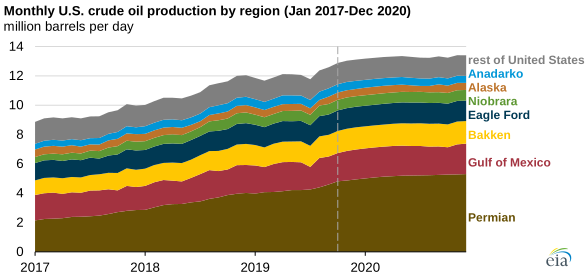
NOVEMBER 21, 2019
EIA increases U.S. crude oil production forecast for 2019 and 2020[…]
With these changes, EIA now forecasts U.S. crude oil production will increase to 12.3 million b/d in 2019 from 11.0 million b/d in 2018. Output in the Permian region is the primary driver of EIA’s forecast crude oil production growth, and EIA forecasts Permian production will grow by 915,000 b/d in 2019 and by 810,000 b/d in 2020.
Increases in Permian crude oil production in Texas and New Mexico are supported by crude oil pipeline infrastructure expansions that came online earlier this year. These expansions, which helped alleviate transportation bottlenecks and led to increased prices for WTI in Midland, Texas, (the price that producers may expect to receive in the Permian region) relative to prices for WTI-Cushing. The higher relative prices in the Permian region should continue to encourage crude oil production growth in the region.
EIA forecasts that the Bakken region in North Dakota will have the next largest crude oil production growth in 2019. EIA expects Bakken crude oil production will grow by 152,000 b/d in 2019 and 96,000 b/d in 2020. EIA forecasts that production in the Federal Offshore Gulf of Mexico will increase by 138,000 b/d in 2019 and 116,000 b/d in 2020.
Although EIA forecasts that overall U.S. crude oil production will continue to increase, EIA expects the growth rate will slow largely because of a decline in oil-directed rigs. According to Baker Hughes, active rig counts fell from 877 oil-directed rigs in the beginning of January 2019 to 674 rigs in mid-November, a 23% decline. Rig counts in the Permian region fell 15% during this period, from 487 to 408 rigs.
Because EIA expects WTI-Cushing crude oil prices to stay lower than $55/b until August 2020, EIA anticipates that drilling rigs will continue to decline as producers cut back on their capital spending, resulting in notable slowing in the growth of domestic crude oil production over the next 14 months.
Although U.S. rig counts are declining, improvements in rig efficiency, which allows fewer rigs to drill the same number of wells, partially offsets declining rig counts. In addition, higher initial production from wells (although not necessarily the total estimated ultimate recovery) is offsetting some of the slowdown in rig counts.
US EIA
Like just about everyone else, EIA forecast the growth rate to slow because they anticipated WTI to remain below $55/bbl through at least August 2020… Not because investors were demanding anything. This EIA report was published in November 2019. While 2020 is still young, WTI has averaged about $61/bbl so far. If WTI averages less than $55/bbl this year, Permian production may very well peak at a bit over 5 million bbl/d. If WTI rises to $75/bbl, the Permian Basin production rate will continue to climb. It is currently estimated that takeaway capacity will increase to 9 million bbl/d by the end of 2021. Depending on oil prices, Permian Basin production could rise to over 8 million bbl/d within a couple of years.
Many people think of the Permian Basin as a discrete oil field, when in fact is is massive collection of sedimentary basins (a super-basin) with over 7,000 oil fields producing from multiple, often stacked, oil & gas plays.

The Permian Basin is fracking YUGE…
Aug 17, 2017, 07:52pm
Gilmer: We Should View The Permian Basin As A Permanent ResourceDavid Blackmon
* If Gilmer’s estimate of the real scope of Permian Basin oil is on target, it would represent a prize of somewhere between $25 – $100 trillion at current prices.
*the experts in our industry have historically massively underestimated the resource potential.Allen Gilmer, Co-Founder and Executive Chairman at DrillingInfo, Inc., is not a man who minces words, an attribute that has served him well during a long career in the oil and gas industry. When it comes to the Permian Basin and the amount of oil and gas resource contained in it, he becomes positively loquacious.
We should view the Permian Basin as a permanent resource,” he says, “The Permian is best viewed as a near infinite resource – we will never produce the last drop of economic oil from the Basin.”
No one disputes that the resource in the Permian is huge, but ‘infinite’ is a big word. I asked him to expand on that concept. “That is the practical reality with the amount of resource that is in the ground,” he says, “The research we’ve done indicates that we have at least half a trillion barrels in the Permian at reasonable economics, and it could be as high as 2 trillion barrels. That is, as a practical matter, an infinite amount of resource, and it is something that has huge geopolitical consequence for the United States, in a very good way. It has a huge consequence in terms of GDP, and right now it is creating an American energy global ascendancy.”
[…]
Forbes
Amazingly (or maybe not), every candidate vying for the Democrat nomination to run for president this year is promising to spend trillions on green schist and to destroy $25 – $100 trillion worth of resources in the Permian Basin. Where’s that Ron White meme?

OH! And David, you write the best articles! I love your topics. Keep it up!
(Sorry, meant to finish up my former comment with that and hit the Post button too fast)
Once upon a time in the early 90’s I was on the Joint Staff, responsible for advising on potential industrial/resource availability to support military strategy. I was scared shxxless with all the apoplexy about the abysmal state of our manufacturing/resource base to include “peak oil.” Admittedly a neophyte on oil production, I hit the books to try to figure how reserves and production estimates were figured and presented. I was staggered by the apparent lack of analytical rigor and intellectual curiosity of those who declared “peak oil”. They just accepted the assertions of the supposed “thought leaders.” “Of COURSE we are approaching peak oil…..all the experts say so”. I was lucky in that I ran into a really smart petroleum engineer who advised me to ask the gurus about their assumptions about advances in exploration and production technology. He also gave me a tutorial about what HE thought what the advances might be. Of course the gurus thought my “naïve” questions were irrelevant and not useful.
As a newly minted mechanical engineer in 1968 that went to work for an oil company Midland Tx. I was being told the basics of how the wells were drilled to exposed the 10 feet or so pay zones that were drilled thru to set casing and perforated and produce. I naively asked why don’t they just drill horizontally and produce a large amount of the pay zone. The response from the petroleum engineer was this was impossible to do and he right for about 30 years. The next 30 years could bring about something that is impossible.
There is value in not having to transport the stuff from the ends of the world to the US. There is value in spending US money in the US to support US jobs that in turn produce consumption in the US in turn enhancing the industrial output of the country and so forth. Normal oil economics don’t apply to shale. How many times has shale been crossed off the list – and it’s still getting bigger. Who listens to those naysayers?