By Christopher Monckton of Brenchley
This will be a long posting, because it is necessary to nail the childish myth that global warming caused the bushfires in Australia. The long, severe drought in Australia, culminating in the most extensive bushfires in recent history, ought to have aroused sympathy for the cattle-ranchers who have lost their livestock and the citizens who have lost their homes. But no. Instead, those who profiteer by asserting that global warming is the cause of every extreme-weather event have rushed to state – falsely – that an “overwhelming scientific consensus” (to cite the Greens’ website) blames the incidence, extent, duration and severity of the drought and bushfires on the somewhat warmer weather caused by our having increased the atmospheric CO2 concentration by about 1 part in 10,000 from 0.03% to 0.04% by volume.
Nearly all of the news media have taken the line that capitalism in general and the non-socialist governing coalition in particular are to blame. Nearly all have failed to mention the true causes of the current firestorm.
Some years ago I spent a couple of weeks on a livestock ranch high in the hills north of Adelaide. The rancher, Peter Manuel, and I rounded up sheep and cattle using off-road motorbikes. I got to see the state of the land at first hand, and I asked two crucial questions.
First, I said, why was there so much uncleared scrubland all over Australia? After all, the national poet, Dorothea McKellar, had written in My Country as far back as 1904:
I love a sunburnt country
A land of sweeping plains,
Of ragged mountain ranges,
Of droughts and flooding rains.
Drought, then, is not exactly a new phenomenon in Australia. And with drought comes fire. Indeed, the aborigines or First Nations, or whatever the fashionable woke soubriquet is this week, used to conduct frequent controlled burnings of the scrub on the forest floor, precisely to prevent the continent-wide bushfires that they knew from thousands of years’ experience were bound to occur otherwise.
In 1642 Abel Tasman wrote of the smoke in the sky and the scorched trees wherever his expedition landed. Captain James Cook described the same conditions in 1770. This deliberate burning created the grassland landscapes that dominated pre-European Australia.
There are four further methods of hindering the spread of bushfires: livestock grazing, mechanical clearance of the scrub to create firebreaks; damming streams to keep well-stocked reservoirs so that if a fire starts there is enough water on the spot to put it out; and policing the forests to prevent arson, some of it at the hands of environmentalist extremists trying to “raise awareness” of global warming. Thus, the prophylactic measures available are slashing, burning, grazing, damming and policing.
Yet the first four of these sensible and prudent measures are either banned outright or heavily over-controlled by environmental regulations. Peter Manuel gave me an example. A resident of a small settlement in the bush cleared a small amount of scrub on his own land around his own house. The enviro-Nazis of the local administration took him to court for illegal destruction of valuable natural vegetation. The court – for custard-faced judges these days are increasingly remote from mere reality and easily infected by barmy environmentalism – fined the blameless villager $100,000. Not $100. A breathtakingly disproportionate $100,000.
The innocent citizen got the last laugh, though. A bushfire raged through the district the following summer, destroying every single house, barn and steading in that settlement, except his own, which survived unscathed. And did They refund his $100,000? No, of course not.
Worse, They did not learn the lesson from this incident, which is that the aborigines knew what they were doing because they had been doing it for hundreds of generations. The enviro-zombs, despite the anxious pleas of groups such as Peter Manuel’s Farmers’ and Landowners’ Group Australia, have hitherto refused to alter their insane policy.
It is the savagely-enforced banning of scrubland clearance – a ban enthusiastically endorsed over and over again until very recently by the climate Communists at the dismal Australian Broadcasting Commisariat – that is the direct and principal cause of the extent of the damage from this summer’s bushfires. The ABC has recently been pretending that it had never argued against scrub clearance. According to several accounts, it has been disappearing the many past video clips in which it had done just that. The memory hole has been working overtime.
That is not all. Peter Manuel showed me his own little dam, which held back a few thousand vital gallons from a tiny streamlet so that he could water his cattle and, where necessary, put out bushfires. He told me that the extremists in the State and national legislatures had passed laws requiring that Peter and his fellow-ranchers should pay for the rainwater that fell on their own land, and regulating the volume that they were permitted to retain, and requiring that in dry seasons they were to let the water out to keep the downstream ecosystem going.
Worse still, the so-called “Greens” and their shills in the civil service had let out most of the water from the giant dam that supplied all the water to the city of Adelaide, leaving the state ill-prepared to fight the large-scale bushfires that would inevitably arise the next time there was a widespread drought, and vastly increasing the cost of electricity.
What is more, Peter Manuel said that the environmental restrictions on keeping and running cattle were becoming ever tighter, making it more and more difficult to allow the livestock to keep the ground clear. In the very plainest terms, he told me that as a direct result of these policies, whose real purpose was to destroy ranching because ranchers did not vote Communist, the next big bushfire season would lay waste the land.
His chief criticism was not directed at the Communists but at the currently-ruling Liberal/National coalition – nominally somewhat conservative – which had failed to heed warnings from him and from many others throughout Australia that those who were hell-bent on destroying capitalism would instead destroy much of Australia herself unless their absurd environmental over-regulations were repealed wholesale and forthwith. Peter was so delighted at my support for his attempts to alert the dozy classe politique to the impending disaster that he was kind enough to name his prize bull after me. The disaster is now upon us, for the coalition did far too little to protect the people and the land.
Unsurprisingly, the environmental fanatics whose anti-scientific policies are directly responsible for that disaster are now desperately trying to cover their tracks by reciting over and over again their baseless mantra to the effect that there is an “overwhelming scientific consensus” that the bushfires are all attributable to capitalism’s sins of emission.
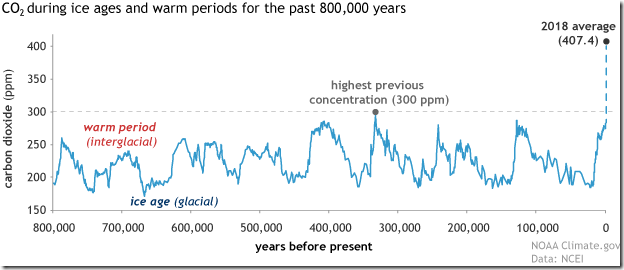
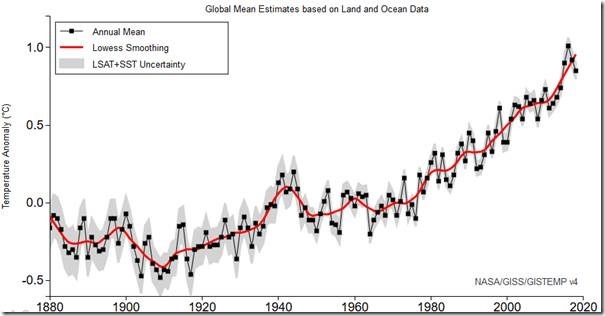
Recently an equity partner in one of Sydney’s largest stockbroking firms sent me the two “Charts of the Week” above. His firm had received these graphs from a financial data company (which, to spare its blushes, will remain nameless). CO2 concentration has risen. Temperature has risen. Therefore the former caused the latter. Thus ran the pathetically jejune argument in the data corporation’s propaganda sheet. Regular readers will by now be wearily familiar with this shoddy, shop-worn post hoc ergo propter hoc fallacy.
Now for the scientific truth. The first of many errors in the offending “Charts of the Week” propaganda sheet – errors each of which, significantly, points towards extreme exaggeration of what is in fact a non-problem, suggesting totalitarian prejudice on the part of the compilers – is to provide a visual comparison between an 800,000-year reconstruction of atmospheric CO2 concentration and a mere 120 years of observed temperature change.
The source of the 800,000-year CO2 graph is cryostratigraphy from the Greenland and South Polar ice-caps. Here, based on data in Jouzel et al. (2007), is the temperature reconstruction covering the same period and from the same ice-core data. Note that these data are presented, as is commonplace with data from geological time, recentiores priores: today’s temperature is at top left, and the temperature for 810,000 years ago is at bottom right. The data have been corrected to allow for polar amplification and thus to provide a respectable comparison with today’s global mean surface temperature, represented by the zero line on the graph.
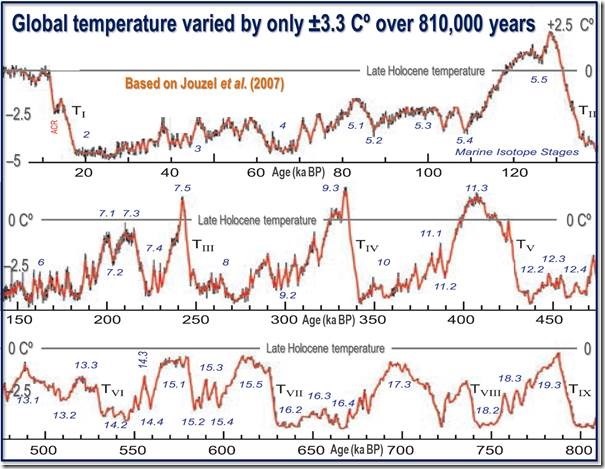
It will at once be seen that, though on the CO2 graph the recent concentration appears as unprecedented in 800,000 years, on the temperature graph today’s temperature has been exceeded at the peaks of each of the past four interglacial climate optima over the past 450,000 years, during each of which CO2 concentration was below today’s.
Despite the CO2 concentration increase since 1950, there has been no corresponding spike in global mean surface temperature.
This absence of a pronounced spike in temperature to match the pronounced spike in CO2 concentration would suggest to a fair-minded observer that the imagined connection between that CO2 spike and the modest recent increase in global temperature is imaginary. That fair-minded observer might want to go back rather further in the temperature record, to see whether the link between CO2 and temperature is evident throughout.
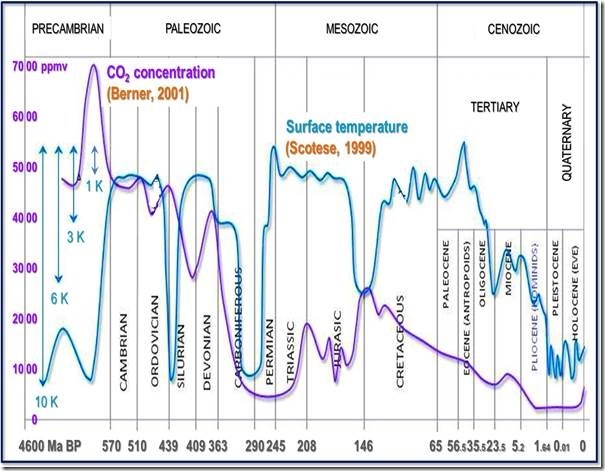
The above 4.6-billion-year record (time on a log scale) compares CO2 concentration (in purple) with global mean surface temperature anomalies (in blue).
It will be seen that in the Cambrian era, about 750 million years ago, CO2 concentration peaked at 0.7% of the atmosphere, 23 times the 0.03% in 1850 and 17 times the 0.04% today, and yet temperature was 1-2 K below today’s. How come, if CO2 is the tuning knob of the climate?
Temperature and CO2 for the most recent 450 million years (I remember them well) are compared below. Again, there has been no spike in temperature to match the spike in CO2:

Given that the data relied upon are chiefly from Greenland, it is worth examining the changes in CO2 concentration compared with changes in temperature at the summit of the Greenland ice sheet over the 10,000 years since the end of the last Ice Age:
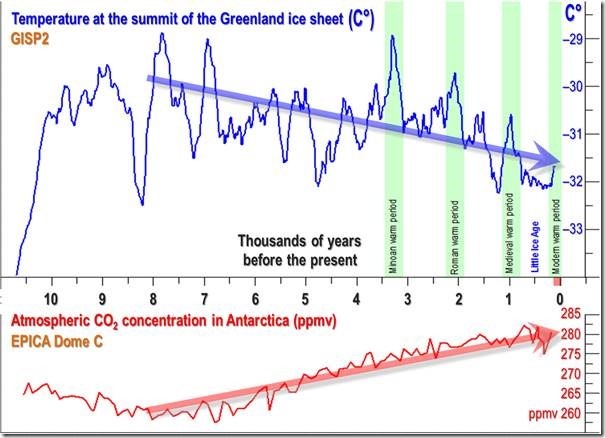
It will be seen from the above graph, which was the late Bob Carter’s favorite, that the concentration of CO2 has risen throughout the past 8000 years, and yet the temperature at the summit of the Greenland ice sheet has fallen over the same period.
It is also noteworthy that today’s temperature was exceeded by up to 3 C° in each of the four previous warm periods – the Mediaeval, the Roman, the Minoan and the Holocene (10,000 to 6000 years ago), during which temperatures were above today’s for 4000 years, aside from a brief drop to a little below today’s temperatures about 8200 years ago. From these graphs, the fair-minded observer would deduce that there is nothing unprecedented about today’s temperatures.
We now turn to the temperature record since 1880, presented in the propaganda sheet as though it were somehow terrifying. The warming appears alarming thanks to one of the oldest of all statistical frauds – stretching the y axis. Precisely the same data, plotted on an unstretched y axis, are unremarkable, which is unsurprising given that in absolute terms the global temperature has risen by one-third of one per cent since 1880:

Has the world warmed? Yes, it has. However, closer examination of the temperature record over the past century or so demonstrates that the rate of warming that began with the naturally-occurring Pacific Shift in 1976 has two precedents since 1900: and yet it is only in the third of these periods that the influence of Man could in theory have been significant:

The above graph (without the yellow arrows) was published thrice in the Fourth Assessment Report (2007) of the Intergovernmental Panel on Climate Change, which falsely concluded on each occasion that the rate of global warming was accelerating, and that we were to blame. The three yellow arrows superimposed on IPCC’s graph show that conclusion to be false: all three are parallel to one another.

However, the fraudulent statistical technique adopted by the Panel – inappropriate comparison of multiple trend-lines with varying starting-dates – could equally be applied to a sine-wave (which, by definition, has a zero trend), so as falsely to demonstrate that the sine-wave exhibits a rising trend, as the above graph shows. IPCC refuses to correct this error, from which we may legitimately infer that it is deliberate.
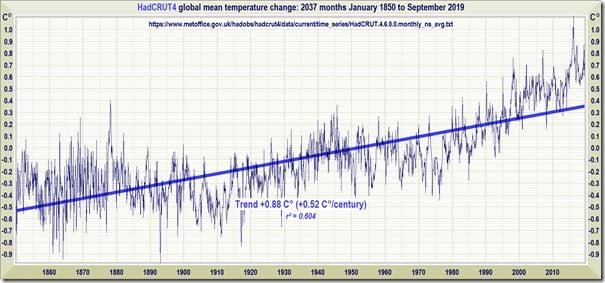
The above graph shows the temperature record in detail, and also demonstrates the least-squares linear-regression trend – the simplest guide to how fast the world is warming. The rate turns out to be a less than exciting 0.5 Celsius degrees per century, or less than nine-tenths of a degree over the past 170 years. What is the rate of warming predicted by the current models? The propaganda sheet does not enlighten us. Here is the answer:
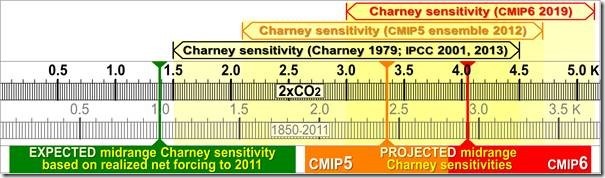
Projected midrange Charney sensitivities (warmings in response to doubled CO2: CMIP5 3.35 K, orange; CMIP6 4.05 K, red) are 2.5-3 times the 1.4 K (green) to be expected given 0.75 K observed global warming from 1850-2011 and 1.87 W m–2 realized anthropogenic forcing to 2011. The 2.5 W m–2 total anthropogenic forcing to 2011 is scaled to the 3.45 W m–2 estimated forcing in response to doubled CO2. Thus, the 4.05 K CMIP6 Charney sensitivity would imply almost 3 K warming to 2011, thrice the 1 K to be expected and four times the 0.75 K observed from 1850-2011.
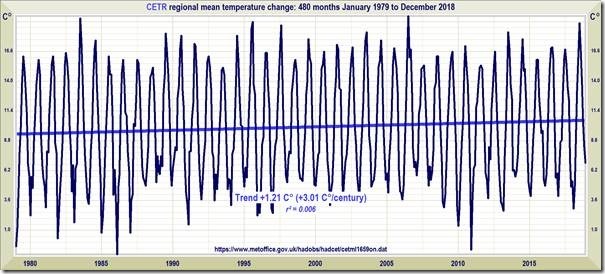
Nor can it be said that the rate of global warming since 1950 has been unprecedented. The fastest rate of warming in the recent record was in central England between 1694 and 1733, at a rate equivalent to 4.33 C°/century:

Note how small the warming is when compared with the annual fluctuations in temperature.
Let us compare that period with the “Anthropocene” 40-year period from 1979-2018 in the same dataset. The warming in central England has been equivalent to only 3 C°/century. Is that a bad thing? No. In our miserable climate, we want all the warming we can get.
At present, global mitigation policies are based not upon the unexciting observed or expected warming but on the predicted warming, which is currently thrice what is to be expected and four times what has been observed. Only 0.3% of 11,944 climate papers published after peer review in the 21 years 1991-2001 stated that recent warming (what little of it there has been) was chiefly manmade. It is likely, therefore, that our influence on temperature is very small.
Finally, the propaganda sheet says that 11,000 “scientists” have issued a statement that the mild warming we are likely to cause will drive “catastrophic” consequences unless the West is shut down. These “scientists” included Donald Duck and Mickey Mouse. Nearly all have no record of publication on climate. The supposed “11,000 scientists” statement was cobbled together by the usual suspects in response to a statement that there is no “climate emergency” by 800 proper scientists and researchers, all of whose names and qualifications were vetted before inclusion,. Most of the 800 have published on climate and related subjects.
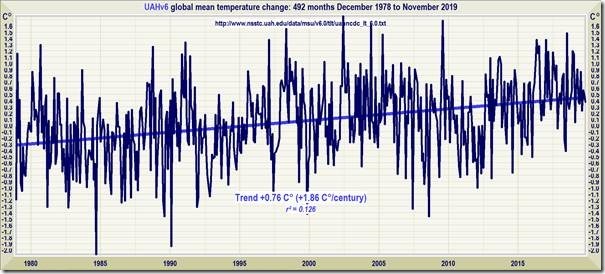
What, then, has been the warming in Australia? Usefully, UAH provides Australian data for the past 31 years:
For comparison, here is the UAH 31-year record for the world as a whole:
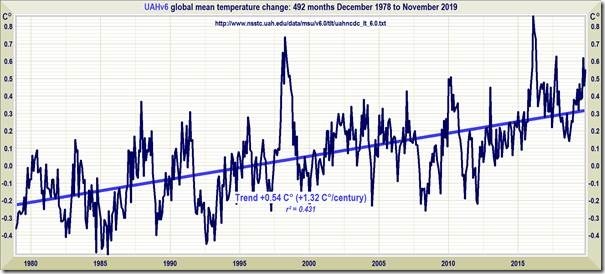
Thanks to poleward amplification, the warming in Australia was equivalent to 1.86 C°/century, compared with the global rate of 1.32 C°/century. Since there is no consensus on the extent to which Man has contributed to recent warming, cripplingly expensive measures piously intended to abate CO2 emissions and hence mitigate global warming may not make much difference to global temperatures.
The “overwhelming scientific consensus” of which the frantic Thermageddon fanatics so often speak does say that warmer weather will influence the incidence, duration and severity of forest fires. However, that “consensus” is to the effect that a warmer atmosphere can carry near-exponentially more water vapor as it warms, making droughts less likely, not more likely. The Clausius-Clapeyron equation, one of the very few proven results in the slippery subject of climatology, mandates that a warmer atmosphere will be a moister atmosphere.
So much for the theory, which is not in doubt. But what of the observed reality?
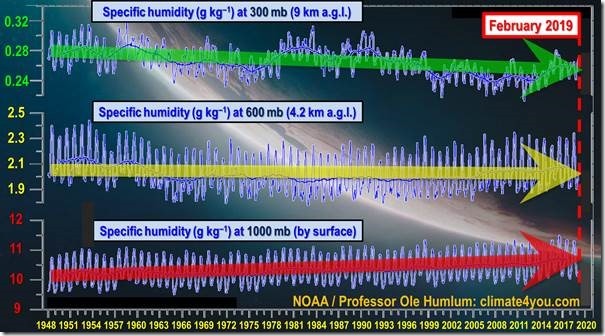
Sure enough, the atmospheric layer at the surface (the red arrow on the above graph) shows an increase in specific humidity precisely in line with Clausius-Clapeyron.
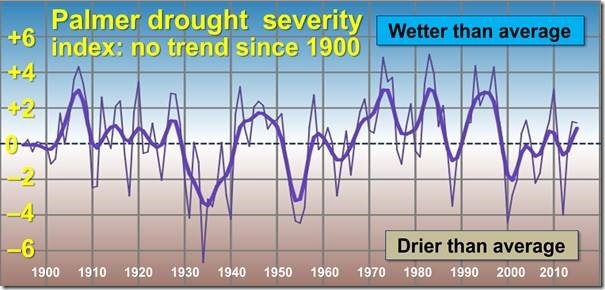
Since specific humidity has increased, one would expect – at the very least – no rising trend in drought intensity globally. Indeed, the Palmer Drought Severity Index shows no trend in more than a century:
The global land area under drought has not increased either. It declined throughout the 30 years to 2014, when the most comprehensive survey ever was conducted:

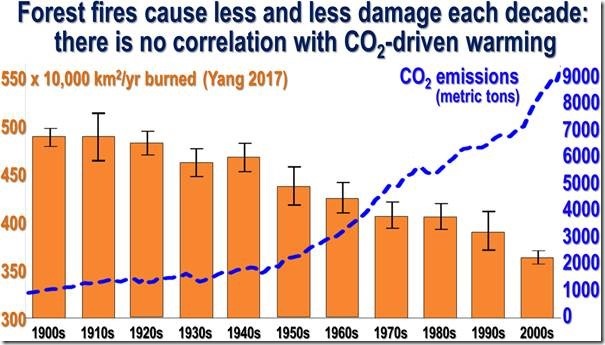
Since droughts have not increased either in severity or in land area affected, one would not expect forest fires to have increased globally. One would expect them to have declined. And that is just what has happened:
Viv Forbes draws the following conclusions from the scientific evidence:
“Misguided tree lovers and green politicians have locked the gates on ever-increasing areas of land for trees, parks, heritage, wilderness, habitat, weekend retreats, carbon sequestration etc. Never before on this ancient continent has anyone tried to ban land use or limit bush fires on certain land.
“The short-sighted policy of surrounding their massive land-banks with fences, locked gates and fire bans has created a new alien environment in Australia. They have created tinder boxes where the growth of woody weeds and the accumulation of dead vegetation in eucalypt re-growth create the perfect environment for fierce fires.
“Once ignited by lightning, carelessness or arson, the inevitable fire-storms incinerate the park trees and wildlife, and then invade the unfortunate neighbouring properties.
“Many of today’s locked-up areas were created to sequester carbon to fulfil Kyoto obligations. Who pays the carbon tax on the carbon dioxide released to the atmosphere by wildfires?
“The green bureaucracies and politicians are clearly mismanaging their huge land-bank. Aborigines and graziers did a far better job. There should be a moratorium on locking up any more land and a return to sustainable management for existing land holdings.”
Amen to all that. In due course, the drought in Australia will be replaced by the “flooding rains” of which her national poet wrote. A few years back, the ridiculous then climate Commissar of Australia, Tim Flannery, predicted that thanks to global warming the great river systems of the Murray-Darling basin would never see normal flow again.
Within months of that fatuous, ill-informed utterance, I visited Australia and brought some Scottish weather with me. So much rain fell on Australia that global sea level actually fell for a few months, and the entire river system was brimful.
Let us end, then, with Dorothea Mackellar’s words as much of hope as of history:
Core of my heart, my country!
Her pitiless blue sky,
When, sick at heart, around us
We see the cattle die:
But then the grey clouds gather,
And we can bless again
The drumming of an army,
The steady, soaking rain.
I thought Lord Monckton might have usefully added to his analysis following his listing of the Palmer Drought Severity Index (which shows cyclical movements in the index) by reference to the effects of the Indian Ocean Dipole and the ENSO which both contribute to recurring cycles of drought and flood in Australia.( such cycles being mentioned in Dorothea Mackellar’s poem of the early 20th century)
When much of the southern half of the continent is in summer, allied with the drought cycle the persistent heat further dries out the landscape predisposing its flora to wild fires. Add to this is the fire- prone nature of our largely eucalyptus forests which shed flammable bark, twigs ,dead leaves and large branches onto the forest floors
This leads to a build up of dry flammable fuels on forest floors which are the fuels which when hit by lightning strikes or by the work of arsonists ultimately set alight the tall trees whose foliage gives off highly flammable eucalyptus oil vapor which then causes the fire to spread at tree top level by large fireballs quickly covering large distances.
A photograph published in Monday’s Melbourne Age page 6 shows a fire near the town of Orbost in the east of the state of Victoria
That picture shows quite clearly that the fire is running horizontally across the forest floor before it is yet to climb vertically up the tree trunks also shown.
This phenomenon of initial forest floor fires has been repeated in quite a number of photographs and videos of the recent widespread fires across Eastern Australia thus giving emphasis to comments made that failure to conduct sufficient frequent cool weather burn-offs of forest floor flammable debris has contributed to fiercer hotter fires than need be encountered (which of course predictably and simplistically the OZ Greens blame on “Climate Change “)
In response to Thomho’s excellent point, I have seen (but have not yet verified) figures suggesting that as a direct result of the insane climate-Communist policy of not clearing underbrush before the summer there is a mean 8 W/m^2 of fuel on the forest floor compared with the 1 W/m^2 that was there before the climate Communists banned scrub clearance. That explains why the fires initially run along the ground: that is where the tinder-dry underbrush is to be found.
When I visited Montana and was given a tour of the forests by a County Commissioner, he said that climate Communists had banned even the removal of dead timber. Result: a few years later, exactly as he had predicted, there were monstrous forest fires.
It’s getting to the point where climate Communism is going to have to be made illegal, because so many people are dying thanks to the sheer calculated insanity of the policies on which it so viciously insists.
Time for charges to be brought against the law makers. Starting with manslaughter of fire fighters. Or, at least, civil actions for damages.
“Despite the CO2 concentration increase since 1950, there has been no corresponding spike in global mean surface temperature.”
Of course not. Jouzel’s deuterium temperature proxy only claims millenial resilution, even though they calculate 100-year averages as the finest unit. And they stop at 0BP, which is 1950. The system does not have the capacity to detect such a spike.
“Again, there has been no spike in temperature to match the spike in CO2”
Likewise. The Greenland ice data cited has at best century-level resolution, but ends in 1855.
“the concentration of CO2 has risen throughout the past 8000 years, and yet the temperature at the summit of the Greenland ice sheet has fallen over the same period.”
CO2 rose from 260 to 280ppm, a negligible change. The fall in temperature was due to the orbital forcing changes, and no-one expects a corelation with the small CO2 variation.
“It is also noteworthy that today’s temperature was exceeded by up to 3 C° in each of the four previous warm periods”
Nothing has been presented to support this. The GISP2 graph shows temperatures of order -30°C. These were not the temperatures of the Roman Warm period! But more importantly, again the GISP2 data ends in 1855, so tells nothing about today’s temperature, anywhere.
In the head posting I showed the graph by Jouzel et al. (2007), reconstructing the global mean surface temperature anomalies over the past 800,000 years, and wrote
“Despite the CO2 concentration increase since 1950, there has been no corresponding spike in global mean surface temperature.”
Here is Mr Stokes’ comment:
“Of course not. Jouzel’s deuterium temperature proxy only claims millennial resolution, even though they calculate 100-year averages as the finest unit. And they stop at 0 years before the present, which is 1950. The system does not have the capacity to detect such a spike.”
Let us answer prejudice not with prejudice but with data followed by logic. Jouzel is not the only dataset available to us. According to the HadCRUT4 dataset, the warming trend since 1950 has been a not particularly unusual 0.85 C°. Today’s temperature, then, is – as I said it was – below the peak shown in each of the four previous integlacials.
Furthermore, just as the cryostratigraphic data are insufficiently well resolved to show short-term spikes in temperature today, they are equally incapable of showing such short-term spikes that had occurred previously.
Next, I showed a graph reconstructing the past 350,000 years’ temperature and CO2 concentration, showing that temperatures in Antarctica had not spiked in parallel with the recent spike in CO2 concentration, and I wrote:
“Again, there has been no spike in temperature to match the spike in CO2.”
Mr Stokes comments:
“Likewise. The Greenland ice data cited has at best century-level resolution, but ends in 1855.”
But the data I was referencing were not from Greenland but from the other end of the Earth, in Antarctica. The hint is in the word “Antarctic”, plainly shown on the graph. Do try a little harder, when nit-picking, to pay attention to which end of the globe we’re talking about.
In Antarctica during the entire satellite record over the past 31 years there has been just one-twentieth of a Celsius degree of warming, equivalent to little more than a ninth of a degree per century. Not exactly a spike.
Next, I reproduced Bob Carter’s favorite graph, which shows CO2 concentration rising over the past 8000 years, even as temperature at the summit of the Greenland ice sheet fell. I wrote:
“The concentration of CO2 has risen throughout the past 8000 years, and yet the temperature at the summit of the Greenland ice sheet has fallen over the same period.”
Mr Stokes replied:
“CO2 rose from 260 to 280ppm, a negligible change. The fall in temperature was due to the orbital forcing changes, and no one expects a correlation with the small CO2 variation.”
Well, we are told over and over again that CO2 is the “control knob of the climate” (see e.g., Lacis et al. 2010, who wrote a paper with those words in its title”. Only now do we learn from Mr Stokes – a significant admission – that CO2 is not, after all, the control knob of the climate. The preindustrial increase in concentration was about 20 ppmv, which – if one believed the CMIP6 sensitivity estimate and adjusted it for polar amplification – would imply about 1 C° of warming should have occurred. Yet 1.5 C° of cooling occurred. Oops!
Here’s the thing. If “no one expects a correlation with the small CO2 variation”, even though it should have produced almost 1 C° of warming, why is it now imagined that the 1 C° of warming we have seen globally since 1850 is attributable solely or chiefly to CO2? There is certainly very little warrant for any such conclusion in the learned journals: as Legates et al. (2015) showed, only 41 papers, or 0.3% of the 11,944 papers on climate and related topics published after peer review over the 21 years 1991-2011 stated that more than half of that warming was anthropogenic.
Mr Stokes imagines that the cooling of 1.5 C° at the Greenland summit over the past 8000 years is attributable to “orbital variations”. He may or may not be right. If he were telling the truth, he would admit that nobody knows. It remains significant, however, that the CO2 concentration rose enough to cause 1 C° warming in Greenland, but 1.5 C° cooling occurred.
Next, citing Jouzel (2007), I wrote:
“It is also noteworthy that today’s temperature was exceeded by up to 3 C° in each of the four previous warm periods.”
Mr Stokes responded:
“Nothing has been presented to support this. The GISP2 graph shows temperatures of order –30°C. These were not the temperatures of the Roman Warm period! But more importantly, again the GISP2 data ends in 1855, so tells nothing about today’s temperature, anywhere.”
Plainly, there was no direct monitoring of temperatures at the summit of the Greenland ice sheet during the Roman climate optimum. I was hardly able to cite any such record, therefore. However, Jouzel et al. based their reconstruction on ratios of two distinct isotopes of oxygen in the Greenland ice cores, which give an indication of the temperature at the time the air became trapped under the firn. And, like it or not, the temperatures of each of the four previous interglacials were warmer than that of the late Holocene. There is nothing unprecedented about today’s temperatures.
And how much warming has there been at the North Pole since the satellites began watching in December 1978? The answer is just over 1 C°. Again, this is not a spike. It is well within natural variability.
It is, of course, highly inconvenient to the extremists that I should have made all these data available. Of course Mr Stokes and other supporters of the climate-fanaticist movement are upset. But it is becoming ever clearer that the predicted rates of global warming were three or four times too big; that the very small warming that has occurred has been accompanied by a reduction in the global land area under drought, for well-understood reasons; and that, therefore, it is simply not credible to lay the blame for the bushfires in Australia on global warming rather than local weather. No amount of futile quibbling will alter the fact that the bushfires are chiefly the result of insane environmental policies, and owe nothing to anthropogenic global warming.
Meanwhile, tens of millions die every year because most major banks and governmental lending agencies, influenced by disreputable pseudo-arguments such as those of Mr Stokes, deny funding to desperate developing countries to allow them to power their economies with coal, oil and gas.
The day of reckoning is not far off. Those who have peddled nonsense with the aim of persuading scientifically-illiterate Western governments to shut down the West in the name of Saving The Planet are, by their distortions and quibblings and inventions, condemning tens of millions to death every year because they are being denied electrical power. The Holocaust of the powerless will not be indefinitely endured.
“Jouzel is not the only dataset available to us. According to the HadCRUT4 dataset, the warming trend since 1950 has been a not particularly unusual 0.85 C°.”
You cannot match a volatile temperature of a single land site to “today” by adding the global average, which is far less variable, and furthermore dominated by ocean temperature..
“But the data I was referencing were not from Greenland but from the other end of the Earth, in Antarctica.”
Your sentence that follows was
“Given that the data relied upon are chiefly from Greenland…”
“Well, we are told over and over again that CO2 is the “control knob of the climate” (see e.g., Lacis et al. 2010, who wrote a paper with those words in its title”. Only now do we learn from Mr Stokes – a significant admission – that CO2 is not, after all, the control knob of the climate” – I have been saying as forcefully as I can for many years that most past changes were not due to CO2 forcing. Here is an example from 2015. To quote myself
“For CO2 to drive warming, something has to drive CO2”
Lacis wrote a paper demonstrating that CO2 worked as a control knob. His point was that forced variation of CO2 in the atmosphere would change temperature. But he did not claim that all past instances of temperature change were due to someone turning that knob. He did not examine any paleo instances at all. Lacis is referring to atmospheric control knobs; his abstract begins:
“Ample physical evidence shows that carbon dioxide (CO2) is the single most important
climate-relevant greenhouse gas in Earth’s atmosphere.”
It is scientifically accepted that ice age temperature fluctuations are due to orbital variations. But these are not a control knob, because no-one on Earth can vary them. They can be predicted.
“Here’s the thing. If “no one expects a correlation with the small CO2 variation”, even though it should have produced almost 1 C° of warming, why is it now imagined that the 1 C° of warming we have seen globally since 1850 is attributable solely or chiefly to CO2?”
Because the increase in CO2 in that period is not 20 ppmv but about 130 ppmv.
“Next, citing Jouzel (2007), I wrote:
“It is also noteworthy that today’s temperature was exceeded by up to 3 C° in each of the four previous warm periods.””
No, you were not citing Jouzel; you were citing the GISP graph (Bob Carter’s favorite). You wrote, very explicitly:
“It is also noteworthy that today’s temperature was exceeded by up to 3 C° in each of the four previous warm periods – the Mediaeval, the Roman, the Minoan and the Holocene (10,000 to 6000 years ago), during which temperatures were above today’s for 4000 years,”
And the temperatures of the GISP graph end in 1855, and cannot be extended by the device of grafting HADCRUT land/ocean temperatures onto the record of a single land site.
“The preindustrial increase in concentration was about 20 ppmv, which – if one believed the CMIP6 sensitivity estimate and adjusted it for polar amplification – would imply about 1 C° of warming should have occurred”
Really? CMIP6 seems to be about 3.8°C/doubling. 20 ppmv is an increase by factor of 20/260=0.077, and log_2(1.077)=0.107. So that would be 0.407 °C warming, when equilibrium is reached. But that small change was clearly outweighed by the orbital forcing since mid-Holocene.
“But it is becoming ever clearer that the predicted rates of global warming were three or four times too big”
No, the sensitivity definition that you are misapplying is based on a doubling (or fraction thereof) which all happens at the beginning of the period, and is measured when equilibrium is reached. In fact the warming has mostly happened gradually in the last four decades, and the process is far from equilibrium.
I did a talk with school kids back in Belfast in November. I was talking about science and what it’s like to be a scientist. For context, I’m a physicist and have spent most of my career in the applied physics/engineering part of the knowledge-to-reality process. So my work and methods have real consequences.
I was explaining in a simple way how science has a wide range of scenarios that are still deemed valid as long as your argument is consistent. As in your conclusions are limited to your assumptions.
The key element is the ethical question: when do we apply what we have found to reality? What are the risks of applying assumptions and can you catch them before you do?
I used the Christmas Roof Tiles story:
The Mayor of London passes an emergency bill to have all domestic buildings in inner London re-tile their roofs with special anti-slip tiles. They cost £1000 per square metre. Why?
So that Santa Claus and his reindeer don’t slip off and there’s a Health and Safety incident!
So I ask, is this a good policy to implement?
The kids immediately laughed and said of course not.
“Why?” I asked.
“Because Santa Claus doesn’t exist.”
“Okay, but assume he does. Where does your argument lead? Do you still think it’s a valid policy?”
Some kids said no, as it should be done on an individual basis, and on it went. I pointed out at the end with the help of their teacher, that a lot of science is “What If?” that sits in the hypothetical space and isn’t actually linked to what we would all call reality. The idea is that at some point those assumptions may become rooted in reality and the What If moves more towards a real possibility.
In the 1800’s Huxley warned about investing in theory with his The Great Tragedy of Science idea. When I was doing my PhD we were warned of it too.
DO NOT APPLY HYPOTHETICALS TO THE REAL WORLD. THERE BE DRAGONS.
So I am always amazed that even with sceptics, the temperature graph is pulled up as a valid metric to compare climate science theory with reality. Adjustments aside, the global temperature measurement is a hypothetical construction from the get go. Why?
Because the original tools were never designed to achieve the precision needed for climate science theory comparison. All the big agencies had to assume the uncertainties were Gaussian. They then apply the Central Limit Theorem to this where the more data the smaller the standard error of the mean.
The problem with taking this data as being useful is you have not demonstrated what is “real” signal and what is instrument. In other words, the fundamentals of signal to noise and Metrology 101.
But the real issue is the cognitive dissonance: What ethical sidesteps are needed to say that this hypothetical construct is real and action must be taken. Yet if your food and drink were deemed safe under the same imprecision, there would be uproar at the amount of people getting sick and possible dying?
People love theory and ideals, they hate ugly facts. Nature doesn’t care however.
It would be nice to see the actual error on these graphs rather than the hypothetical one quoted by people such as the Met Office.
You nailed it! The mathematicians and computer scientists of today are blissfully ignorant concerning the rules of significant digits. They think they can calculate temperature anomalies down to the hundredths digit from original data accurate to only the nearest degree! Complete and utter idiocy! When using the rules of significant digits we don’t even know if we are warmer or cooler than in past history!
Mickey,
You are perfectly correct.
In Australia, the Garnaut Review (2011) informed the Australian Government and people that the warming for the century to 2010 was 0.76C +/- 0.19C.
This was accurate and taken from the HadCru figures which are those of the UK Met Office.
Note the margin of error given.
So when we are told that the warming for the last century was 1 degree C. It could be two tenths of a degree either way and in any event the 1degree figure is exaggerated.
When 2016 is said to be the hottest year since 1880 by 0.04C ( HadCru) or 0.01C ( NASA Giss), above the second hottest year, 2015,what is the margin of error?
Professors Lindzen Koonin and Happer maintain the margin of error approximates 0.1C.
That claim can be sourced to the amicus curiae brief lodged with Judge Bill Alsup in the San Francisco v. Chevron litigation.
Lindzen has made that point repeatedly.
Lord Monckton has missed the key point about fires. Like SO2 from pre-1970s power stations, forest fires create cloud condensation nuclei. In London that affect pre-1970s enviromental led clean air legislation, led to dense smog. When the pollution reaches higher levels, it significantly increases cloud formation and increases sun blocking and hence cooling.
As a result since 1970s we’ve seen a literal “man-made warming”, or at least, man-made REDUCTION in man-made cooling. So, it is not surprising that if environ-mental-ists take over and suddenly (in climatic terms), go from a regime of largescale regular burning to little-burning, that the temperature in Australia will rise. Nor should it be surprising that if cloud condensation nuclei such as soot become sparse in the atmosphere, that there is less rainfall.
Unfortunately for there to be rain, you need to produce cloud condensation nuclei (rain) when there is moisture in the atmosphere, which requires regular burn off when there isn’t a drought. So, unfortunately, despite the massive burn-off Australia is unlikely to benefit!
Mike Haseler, as so often, makes a good point. But the influence of changes in the aerosol burden is very hard to quantify. IPCC appears to have greatly exaggerated the net-negative influence of aerosols.
Of course they did – because aerosols were their “The dog ate my homework” excuse for temperatures falling while atmospheric CO2 levels were rising during the “thermometer” era.
“having increased the atmospheric CO2 concentration by about 1 part in 10,000 from 0.03% to 0.04% by volume”
Really? The old “1 part in 10,000” chestnut? Are you that far down to the bottom of the barrel?
The increase by 0.01% is one part in 10000. Perhaps you have forgotten how to count?
Oh, I know, such miniscule amounts…that couldn’t possibly be having any affect on greening the earth either right? 0.03% to 0.04%? Ridiculous, you’d have to be completely insane to even entertain the idea. /sarc
CO2 is the lowest it has been in the history of the planet. Plants are starving for CO2, of course they’d react to any minuscule enhancement.
You mean a 45% increase?
“Loydo January 6, 2020 at 11:43 am
You mean a 45% increase?”
Ok the 45% increase in CO2 mantra!
Lets round figures up for ease…
from the IR the estimate for CO2 is 280ppm/v. Today it is 400, that is 120 ppm/v difference. 120/400 X 100 = 30. 30%, sounds drastic huh? Now lets compare CO2 increase to the whole atmosphere 120/1000000 X 100 = 0.012%. See how using numbers can skew things?
Allow me.
Start with 280ppm, today its 414, an increase of 134.
134/280 = .478
Yeah sorry, got it wrong, its not 45% its closer to 48. Thats how you green things up, not with yer piddling 0.012% or yer “miniscule 1/10,000th”; as if that would feed the world’s starving forests./sarc
45% of almost zero is less than almost zero….
A 45% increase in almost zero is 45% further away from zero.
Almost zero CO2 in the atmosphere is responsible for all life on earth.
@Loydo: If there’s been a 45% increase in CO2 in the air, but olyy a tiny (1%) increase in the global temperature, it suggests that CO2 has only a tiny effect on it—and, by extension, on the climate. (As Monckton said.)
“You mean a 45% increase?” Meaning what? Wouldn’t it be true that when, and if, CO2 had gone from 100ppm to 145ppm there was a 45% increase? Or from 200ppm to 290ppm, a 45% increase? Or from 250ppm to 363ppm, a 45% increase? Or countless other times depending on the starting number?
It is interesting to see how upset the climate Communists become whenever the fact of the very small alteration in the atmospheric burden of CO2 over the past century and a half is mentioned.
“Loydo” should take heed of Mynheer Zuiderwijk’s excellent point: The observed increase by 0.01% from 0.03 to 0.04% is indeed one part in 10,000. Back to the Komsomol Kindergarden for you, Loydo!
But it isn’t a “very small alteration” – it’s an increase of more than 40%. As far as the greenhouse effect is concerned, what matters is the relative change in CO2, not how it compares with the rest of the atmosphere.
Only a fool would deliberately double-down on that kind of disinformation. And you think that brands me as a communist? Is this really the intelectual legacy you want to leave?
“Bellman January 6, 2020 at 6:18 pm
But it isn’t a “very small alteration” – it’s an increase of more than 40%.”
It is not. Maths is not your strong point eh?
That’s nothing – when you point out that the only way they get to that figure of “increase” in CO2 to begin with is to use the scientifically incompetent comparison of “proxy” determined historical CO2 with “modern” atmospheric measurements of CO2, they don’t even know how to respond.
“… only way they get to that figure of “increase” in CO2 to begin with is to use the scientifically incompetent comparison of “proxy” determined historical CO2 …”
Are you suggesting the graph Monckton uses in the article, the one that was a favorite of Bob Carter, is scientifically incompetent?
Patrick MJD,
Current CO2 is around 410 ppm, at the start of the 20th century it was around 290 ppm, that’s an increase of 410 / 290 =~ 1.41, that is an increase of 41%.
Lord Monkton
I tried to post this last night but am not sure if it will be accepted but this YT video is about two Sydney Habours worth of water being wasted in the upper Murray river in 12 months. I feel it is quite relevant to what you are saying here.
https://www.youtube.com/watch?v=SgF4W_oDrLA
The way things are going I am glad I am over sixty as I feel things are similar to when the Roman Empire failed. :((
Mike Barntz is quite right: the deliberate topping-up of the oceans with river water that could have been retained for irrigation and extinguishing fires, not only in the Murray-Darling system but also in south Australia, is absurd – and it is driven entirely by anti-capitalist environmentalist extremists.
“it is driven entirely by anti-capitalist environmentalist extremists”
Mike Barntz is quite wrong, and so are you. You didn’t watch the program. It is not a program about water being allowed to run to the sea it please greenies. It is about thoroughly capitalist conservative governments and their politics. According to the program, the water is being released so that it can be used by irrigators downstream, who pay more.
It is sad Nick but you always come across to me as a very negative and argumentative person.
Actually I think that you are wrong and need to watch that video more thoroughly.
“you are wrong and need to watch that video more thoroughly”
Here is Sixty Minutes own lead in to the program:
“To understand why the Murray River might be deliberately flooded and all that water wasted, you have to step into the shadowy world of water trading – buying and selling water desperately needed by farmers, for profit”
They are not talking about greenies.
More details here.
“Instead, the water is being sent downstream, purchased on the temporary market, largely by almond growers.”
water desperately needed by farmers, for profit
≠=======
Without profit there would be no life on planet earth.
Every lifeforms takes in energy from the environment. It then uses a fraction of this energy to maintain itself and the excess energy left over is used for reproduction.
This excess left over is “profit”. In plants it produces seeds. In humans it produces children and the environment to nurture them.
Eventually, lifeforms that are unable to generate profit will eat their young to stay alive. Continued long enough, extinction results.
Mr Stokes is, as ever, wrong. I do not know when he last consulted real farmers in Australia, or rode the land, or consulted academic experts in country, or looked at the individual states’ regulations on water management, as well as that of the administration in Canberra. In South Australia, of which I wrote in the head posting, the policy of largely emptying the chief reservoir that supplies Adelaide was brought into effect at the insistence of environmental fanatics. Similar policies were followed in the Murray-Darling basin and in Queensland. As Peter Manuel puts, the environmental extremists’ policy of topping up the ocean is intended to do harm to Australia’s environment. They have succeeded. And it is they who will in due course get the blame for the intensity of the bushfires.
You had the guy that built a small dam for watering stock and having a spot where monsoon buckets could be filled up that got fined $100,000.00.
Another guy got fined for clearing a break around his dwelling that got fined but after a fire his house was the only one left standing.
The world is insane.
” or rode the land,”
Lord Monckton of the Overflow
“In South Australia, of which I wrote in the head posting, the policy of largely emptying the chief reservoir that supplies Adelaide was brought into effect at the insistence of environmental fanatics.”
Yes, you did write that. And as you’ll see upthread, there is no such giant dam, emptied or not. Mikebartnz was referring to large dams on the Murray (Mulwala and Hume). Adelaide is not supplied by these; Adelaide takes its water direct from the river far downstream, so is reliant on what they release, not what they retain.
Nick I wasn’t referring to any dam around the Murray river.
“Nick I wasn’t referring to any dam around the Murray river.”
Well, your link was. And you mentioned ” two Sydney Habours worth of water being wasted in the upper Murray river in 12 months”. What were you referring to?
Nick you blew it there.Thanks to Lord Monkton for misspelling my handle. Also I only said that I felt the YT video was quite relevant to his article so that means that I am quite wrong? Sad.
You also show your politics there which also ruins your case.
In another recent post about Aussie you said something was a myth and I know for sure that it wasn’t so you come across as a troll.
“Thanks to Lord Monkton for misspelling my handle.”
Hmmm.
Mr Stokes is, as ever, wrong. There is a very large reservoir in the hills above Adelaide, but it was largely emptgied some years ago at the insistence of environmental extremists. The fact that similar toppings-up of the ocean also occurred in the Murray-Darling basin merely makes my case a fortiori.
“There is a very large reservoir in the hills above Adelaide”
Where? According to SA water:
“At full capacity, our reservoirs can hold almost 200,000 megalitres (ML) of water. This equates to just under a year’s supply for metropolitan Adelaide.”
The largest reservoir has 46.4 GL capacity. To put this in context, Melbourne’s Thompson Dam has about 1100 GL capacity. AFAIK none of these Adelaide reservoirs have been emptied to satisfy greens.
Adelaide receives 55% of its water supply from the Murray on average.
Keep digging your hole Monkers, Adelaide can always use more storage.
Hi Christopher,
Excellent article and hits the nail squarely on the head but being a native ‘Crow-Eater’, a Hydrology graduate and somewhat pedantic, I take some issue with the accuracy of this quote:
“…Worse still, the so-called “Greens” and their shills in the civil service had let out most of the water from the giant dam that supplied all the water to the city of Adelaide, leaving the state ill-prepared to fight the large-scale bushfires that would inevitably arise…”
The Adelaide Hills are home to ten water storage reservoirs https://www.sawater.com.au/community-and-environment/our-water-and-sewerage-systems/water-sources/reservoir-data, none of which have their water ‘let out’ of them. Browsing the current storage statistics, you’ll see the most empty is (unsurprisingly) the South Para reservoir, which is theoretically one of the largest and has a large but low altitude catchment and is more empty more of the time than others. It’s unsurprising that Happy Valley and Hope Valley as nearly full as they’re down-stream storages which are kept topped up from upstream storages and from where water is reticulated. For firefighting purposes, the Millbrook Reservoir is often used to replenish helicopter water bombers and this reservoir now is 63% full.
Of the listed reservoirs, Kangaroo Creek is a deep narrow reservoir in the upper reaches of the Torrens Gorge and when filled to overflowing is something of a spectacle given it’s concrete spillway empties into a the gorge; but that is overflow, not deliberate ‘letting out’ of water and very much a winter only sight.
These reservoirs on their own are insufficient to meet the water demand of Adelaide and it is pipelines from the River Murray across the Mt Lofty Ranges that guarantees the water supply to the city and indeed much of the state.
Right off the top of my head, one ‘giant dam that supplies all the water’ is the Warragamba Dam South West of Sydney which at 2027 Gl is one of the largest urban storage reservoirs in the world and depending on your preferred source, meets the demand of 3.4 – 5 million of Sydney’s 5.2 million inhabitants. That dam was going to have its wall heightened recently (having already been strengthened and extended 5 metres in the late 1980s), but since some civil servants promoted the Blue Mountains as a world heritage site and achieved the dubious honour, any such expansion of Sydney’s largest dam must first be approved by delegates representing the United Numpties; the sort of outcome unlikely to have crossed the minds of the bureaucrat cheer squad championing world heritage status in the first place and a great example of shitting in one’s own nest. Or maybe in one’s own ecological, free trade latte?
Your cobber might alternatively have been referring to the Wivenhoe Dam which is an embankment dam for combined storage and flood control purposes 80km from Brisbane. The design intent of that dam is keep the lower half filled for storage and the top half empty to accommodate and buffer flood flows. After Flim Flannery’s advice that ‘drought is the new normal’ local authorities allowed the Lake Wivenhoe to fill to more than 100% of its intended storage capacity and during the 2011 flood, with the highest recorded inflows to the dam, it reached 191% of its intended storage capacity and floodwater was released to prevent spilling over its crest which would have risked the dam collapsing and an even worse flood in Brisbane than the one that eventuated; in no trivial part due to mismanagement of the flood control portion of the reservoir.
Perhaps the most likely culprit ‘giant dam’ that ‘Greens and their shills in the civil service had let out most of the water from’ could be a reference to the Snowy Mountains Scheme which diverts snowmelt from the eastern side of the Snowy Mountains watershed, normally lost to sea down the Snowy River, via tunnels from storage dams at Lake Jindabyne and Lake Eucumbene under the snowy mountains to the Murray and Murrumbidgee catchments. When the scheme was completed in 1974, 99% of the water normally flowing out to sea via the Snowy River was diverted, between 700 and 5000 Gl per annum depending on the weather. From 1998 there have been political demands for up to 21% of natural flow to be let down the Snowy River instead as ‘environmental flows’. That political target was apparently reached for the first time in 2017. With increased ‘environmental flow’ out to sea, a corresponding volume of water is not flowing down the River Murray for irrigation and water supply, which in theory could impact South Australia. However the Murray Darling Basin Commission who manage the country’s largest catchment and river system guarantee an annual flow of 1850 Gl over the border, although the median annual flow is usually around 4800 Gl, of which around 100-130 Gl meets the demand of metropolitan Adelaide.
I love it that you have quoted Dorothea as I always have done in the past whenever a millennial starts talking about climate change. It just stops the argument (discussion) in its tracks. But you left out the most important line……
” her beauty and her terror”
the terror refers to bushfires
They were there 116 years ago and keep coming, thats my country for you!
I want to ask about Prof Ole Humlum’s graph of specific humidity at 0.0, 4.2 and 9.0 km. Alarmists three degrees of climate sensitivity is said to be composed of 1.0C caused by CO2 and 2.0C caused by water vapour. Why can’t Prof Humlum’s humidity figures be used to demonstrate that it is impossible for water vapour to add the extra 2.0C to climate sensitivity.
Adrian, you are absolutely right. Those charts destroy CAGW. That’s why they are ignored. According to Dr Bill Gray the reduction in humidity along with additional clouds caused by that reduction lead to a negative feedback. This means the 1.0C is reduced in half (or more).
http://tropical.atmos.colostate.edu/Includes/Documents/Publications/gray2012.pdf
Milord,
As usual good stuff. Alarmist propaganda relentlessly exploits bush fires as direct effect of ‘climate change’. They don’t want to analyse the full picture, I’m afraid, it’s just about loud shouting: ‘Aussies on fire!’ Another interpretation I’ve heard is those fires act as the warning sign from above due to recent libralisation of abortion law in NSW.
The big problem happened when –
“After World War II, missions towns and cattle stations lured Aboriginal people away from their homelands with promises of work and education. [2] Fire management stopped with severe consequences for the land. Lightning strikes ignited large, hot fires late in the dry season, between August and December, when there was plenty of fuel’
“The devastating 2015 Christmas bush fire at the Great Ocean Road in Victoria, triggered also by lightning, was only able to destroy a third of homes in Wye River and “entire streets” because “this country has not burnt, had a fire in it, in decades,” as Craig Lapsley, Victoria’s Emergency Management Commissioner admitted. [7]”
“When Aboriginal people returned to country and properly managed it, the area that burned was cut in half. [2] Fire is an inevitable force in the dry season and needs to be managed. Fire burning has created a variety of habitats including places that are very sensitive to fire like rainforest’
“Managing fire requires knowledge about when to burn, where to burn and how to execute a burn. [10]”
“Cultural burning is a practice not limited to Australia. Other indigenous peoples applied the same technique, for example the Indigenous Peoples of Canada’
When to burn
“The timing of fire management is critical and needs to happen at the right time of the year. To Aboriginal experts, the country reveals when it is appropriate to use fire: indicators such as when trees flower and native grasses cure. “The knowledge is held within the landscape. Once we learn how to read that landscape and interpret that knowledge, that’s when we can apply those fire practices,” explains Aboriginal community member Noel Webster. [12]”
“If burning too early, big thick shrub develops after the fire which can become a big fuel load and is hard to manage”
https://www.creativespirits.info/aboriginalculture/land/aboriginal-fire-management
It’s like they knew the score already. Skin in the game strikes again.
Amusingly, such obvious disdain for Aboriginal wisdom looks like an easy (if cheesy) avenue of attack. Considering what the radical Progressives themselves preached non-stop, once they switched slogans from “manifest destiny” to pretense of equality.
Yang 2017? Could someone please provide a full reference to what is claimed to be the source of fire area data in the last graph of the article. (It’s a little disappointing Monckton doesn’t already give this. I have Googled it and find nothing).
Yang J, Tian H, Tao B, Ren W, Kush J, Liu Y, Wang Y (2014) Spatial and temporal patterns of global burned area in response to anthropogenic and environmental factors: Reconstructing glkobal fire history for the 20th and early 21st centuries. J Geophys Res Biogeosci 119, 249-263, https//doi.org/10.1002/2013JG002532.
Updated in Earl (2016) https://agupubs.onlinelibrary.wiley.com/doi/10.1002/2017JD027749
Climate change must cause arson to increase.
https://summit.news/2020/01/06/nearly-200-people-arrested-across-australia-for-deliberately-starting-bushfires/
Here’s how it works (^_^):
* more CO2 in air
* more mental sluggishness as a result
* more poor decision making, leading to more sex
* more children born, as a result, leading to more bad parenting
* more bad kids, as a result, leading to more arsonists
* more forest fires
Fake news….
Meanwhile in Victoria Police and Premier have said no one started Victorian fires.
Could the decreasing trend of area burnt with time be related to there being a decreasing trend in the area of forest on the planet?
Consider: Australia a big kangaroo (sorry) court ruling that wild dogs don’t eat babies and mom secretly sacrificed her baby is more plausible, back in 1980.
With rot this deep. A somewhat sane government may eventually improve the situation, but it can’t fix everything in but a few years, even if it cold remove whole departments of the Watermelons and plain socialists.
It’s sad nobody introduced these people to the concept of #SkinInTheGame, “Pagett M.P.” style. Having to run from a sudden mud stream could do wonders.
Number of arsonists arrested is reported to be 183 by The Australian.
The BBC and the Guardian and the rest of the British media report 1 arrest.
Sound familiar?
D’you think they want to keep the AGW narrative going?
The figure of 183 arsonists is erroneous, the figure given by the police and also reported by the BBC is 24.
Maybe someone should inform the arsonists and greenbeaners that their attempts to stop natural events and/or force the issue (e.g., arson –> wildfires) are what is causing climate change. They are the guilty parties, not the rest of us, because THEY are adding loads of CO2/CO to the atmosphere and destroying the very things they say they want to protect.
Hypocrites.
https://www.nma.gov.au/defining-moments/resources/federation-drought states that Australia is the driest inhabited continent. With the federation drought (1895-1903) being the worst in Australian history.
https://www.nma.gov.au/defining-moments/resources/black-saturday-bushfires
http://collectionsearch.nma.gov.au/object/76563
https://www.theguardian.com/news/datablog/interactive/2013/dec/01/history-bushfires-australia-interactive (at the bottom of the page is a slideshow of historical bushfires from 1851 to 2001)
https://www.australiangeographic.com.au/topics/science-environment/2011/11/the-worst-bushfires-in-australias-history/
http://www.bushfireeducation.vic.edu.au/verve/_resources/Bushfires_in_our_History.pdf
Surely there is a moisture content threshold to the flammability of forest/ bush floor timber and grass. When the temperature is high enough (every year in the Australian summer) the tinder on the floor will always be dry enough to burn. changes the the already warm air temperature will be irrelevant. So more warming will not make the tinder any more flammable.
[QUOTE FROM ARTICLE] ” However, that “consensus” is to the effect that a warmer atmosphere can carry near-exponentially more water vapor as it warms, making droughts less likely, not more likely. The Clausius-Clapeyron equation, one of the very few proven results in the slippery subject of climatology, mandates that a warmer atmosphere will be a moister atmosphere.”
The Clauseus-Clapeyron equation (or the more closely-fitting Antoine Equation) only shows that a warmer atmosphere can hold more water vapor than a colder atmosphere, but it alone does not dictate whether there will be more or less precipitation. Precipitation only occurs when moist air is advected upward into colder layers of the atmosphere where the partial pressure of water vapor exceeds the vapor pressure defined by the Clauseus-Clapeyron equation.
If a warmer atmosphere can hold more water vapor without precipitation, if the absolute humidity (partial pressure of water vapor) does not change, then there will be less precipitation.
For an island continent such as Australia, air temperatures over the land are likely warmer than over the neighboring ocean during the summer, so that a sea breeze of cool, humid air will likely be warmed over the land, and not produce precipitation unless it encounters a mountain range, where it can be lifted into colder layers of the atmosphere. Summer precipitation is also limited because the Australian continent only extends to about 40 degrees south latitude, without a large land mass farther from the equator where cold air can accumulate.
During the winter, the air over the land is generally cooler than over the surrounding ocean, so that humid air from the ocean could cause precipitation when it encounters cooler air over the land.
This situation is different from the North American continent, where the major land mass extends beyond 60 degrees North latitude (except in Hudson Bay), so that cold air masses can form even in summer over Canada, and the clash between them and warm, humid air from the Gulf of Mexico can cause storms year-round over North America east of the Rocky Mountains.
One of the major problems with climate models is their assumption that RELATIVE humidity (absolute humidity divided by saturation humidity) remains constant with increasing temperature, and that the extra water vapor absorbs additional IR radiation, thereby amplifying the effect of CO2. This overlooks the fact that additional water vapor in the atmosphere must come from somewhere, presumably by evaporation from oceans or other bodies of water, and the required heat of evaporation causes cooling of the atmosphere, which can remove about 50% to 75% of the heat used to warm the atmosphere, which is a negative feedback ignored by the climate models.
The Clauseus-Clapeyron equation is a good approximation for the saturation humidity of the atmosphere as a function of temperature, but it does not explain all the phenomena (evaporation, lifting of the atmosphere over mountains, lapse rate as a function of altitude, etc.) required to predict precipitation rates.
For those wanting to check the mathematics, the Clauseus-Clapeyron equation from theoretical thermodynamics states that
d(ln Pv)/dT = -Hv/RT^2
where Pv = vapor pressure at saturation, T is absolute temperature, Hv = heat of vaporization, and R is the ideal gas constant. If this is integrated assuming constant heat of vaporization, the vapor pressure is given by
Pv = A exp (-Hv/RT)
where A is a constant. However, for water vapor, Hv varies with temperature, so that a better empirical fit to the data can be achieved with the three-constant Antoine equation:
Pv = exp [A-B/(T+C)]
where A, B, and C are empirical constants. For water vapor, over the temperature range from 32 to 110 F, if Pv is in millibars and T is in degrees Kelvin, a regression results in A = 19.182, B = 4150.7, and C = -34.23, with an RMS error of 0.01%.
Austin, TX USA is a tinderbox. Quite frankly most of central TX is. A conservation consortium consisting of an NGO, City of Austin and the Feds have been buying up property with tax-payer $$, fencing it off and allowing Ash Juniper to grow unabated in order to preserve habitat for the Golden Cheek Warbler and Black Capped Vireo. Add a bad drought and spider mite infestation from a decade ago and you have a dangerous scenario of dead trees all over BCP controlled preserves, which are surrounded by development in most cases. Ash Juniper, aside from being a noxious allergen this time of year, is also full of oils, decomposes slower than almost any wood and burns like magnesium. I’m petrified of the next big drought. Here’s what Ash Juniper looks like when it is fouling our air with pollen. https://fbwat.ch/1abn6tMr03JL8CXF
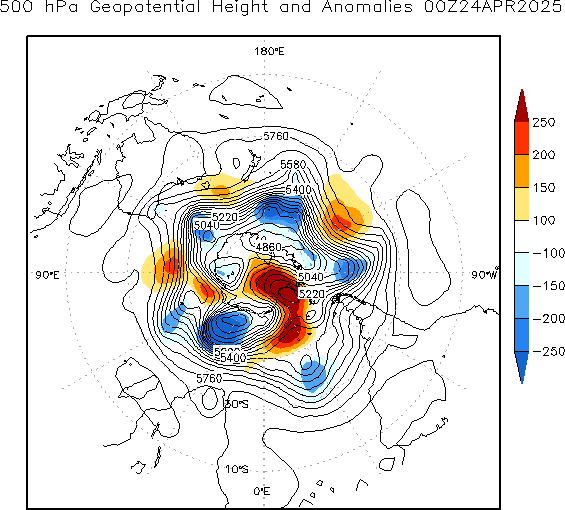
Low solar activity is associated with long-term circulation blocking in high latitudes.
https://www.cpc.ncep.noaa.gov/products/precip/CWlink/daily_ao_index/hgt.aao.shtml
The situation will temporarily improve in Australia.
https://www.longpaddock.qld.gov.au/soi/
Central England is not global.
Full marks for comparing like for like, but a mark away for still not correcting for seasonality in the CET. Both trends should be dropped by around 0.3 C°/century.
However, what is unprecedented in the CET is not the rate of warming but the actual temperatures. By the middle of the 20th century CET was already warmer than at the height of the 17th-18th century warming. The last 40 years of warming have been on top of that.
As to the warming between 1694 and 1733 you really need to look at the context. Temperatures where dropping from the start of CET in 1659 to the end of the 17th century, and plummeted during the final decade. Much of the warming during your period is returning to the temperatures of the mid 17th century, and this happens almost immediately at the start of the 18th century. To me this looks less like rapid warming, and more like the disappearance of whatever was causing the exceptional cold of the past decade.
Central England is not Australia.
The vexatious Bellhop appears to be unaware of elementary statistics. If one is comparing two periods in a single dataset, there is no need to offset both of them by the same amount: the difference between the warming rates of the two periods will remain the same. Back to kindergarten, Bellhop!
Oh, and the trend on the Central England dataset from 1659 to 2018 inclusive is just 1 K, equivalent to little more than a quarter of a degree per century. Hardly life-threatening.
The warming of 1694-1733 is generally attributed to the recovery of solar activity following the Maunder minimum (nicely demonstrating that it is the sun, rather than CO2, that is the real driver of the climate). The warming of recent decades is unexplained. Some of it is no doubt anthropogenic, but some of it – perhaps most of it – may well be attributable to natural variability: only 0.3% of 11,944 papers on climate and related topics published after peer review in the 21 years 1991-2011 stated explicitly that more than half of that warming was anthropogenic.
“If one is comparing two periods in a single dataset, there is no need to offset both of them by the same amount:”
As I said, the difference doesn’t make much difference to the argument, but I thought you might like to get the statistics correct.
“Oh, and the trend on the Central England dataset from 1659 to 2018 inclusive is just 1 K, equivalent to little more than a quarter of a degree per century.”
“The warming of 1694-1733 is generally attributed to the recovery of solar activity following the Maunder minimum.”
That may be the case, but the Maunder minimum didn’t end until the early 18th century. So if you think warming actually started in 1694, that might need some explaining. But the question is how did low solar activity cause the cooling, and was it regional or global.
“nicely demonstrating that it is the sun, rather than CO2, that is the real driver of the climate”
Unless more than one thing can influence the earths climate.
Which has nothing to do with the case, and it makes little sense to use a linear model when the entire CET is far from linear.
“Hardly life-threatening.”
I wouldn’t say the current amount of warming in the UK was life threatening here.
“The warming of recent decades is unexplained.”
I think there is an explanation – whether you accept it or not is a different question.
“some of it – perhaps most of it – may well be attributable to natural variability”
Could explain what you mean by “natural variability”? I think it’s a term that gets used in different senses. It could mean essentially random variation from year to year, that can result in spurious warming or pauses over the short term, or it could mean natural processes that cause longer term shifts in climate.
“only 0.3% of 11,944 papers on climate and related topics published after peer review in the 21 years 1991-2011 stated explicitly that more than half of that warming was anthropogenic.”
A claim which I’m sure you know is meaningless.
“Much of the warming during your period is returning to the temperatures of the mid 17th century, and this happens almost immediately at the start of the 18th century. To me this looks less like rapid warming, and more like the disappearance of whatever was causing the exceptional cold of the past decade.”
Now apply the same logic to the warming that followed the Little Ice Age, and you might be on to something. You might even start sounding like a skeptic! The horror!
What tangled webs we weave…
“Now apply the same logic to the warming that followed the Little Ice Age…”
Do you mean in the CET or global records? Also when do you think the little ice age ended?
It’s difficult to apply the logic of regional temperature changes to global temperature changes. In the CET there is a very noticeable change around the end of the 17th century. Between 1691 and 1698 no year was above 8.5°C, with several years below 8°C and one just 7.25°C. The following 10 years where never below 8.5°C with several years well above 9°C. To me it looks like an elastic band snapping rather than a smooth change. Whether this is a problem with the data, or a catastrophic change in the climatic conditions in England I don’t know, but I’m skeptical that something like this could be happening on a global scale.
MofB makes an important point that is all too often overlooked. Science has no value for natural variability. It has never been established. As a result, any claims that we are observing “climate change” are unscientific nonsense.
Logic allows for 3 states. True, false, and unknown. The simple fact that there has been no improvement in the estimate for climate sensitivity over many decades and billions of dollars is proof that natural variability is logically “unknown” and as a result climate change cannot be resolved.
All there is is an assumption of climate change, based on an assumption of low natural variability.
Ferd Berple is right. Indeed, the climate Communists have not even told us what is the ideal global mean surface temperature. The fact that they have not even asked that question reveals that global warming is a political and not a scientific matter. The fact that they have not answered it reveals that there is no logical or rational basis for any statement to the effect that warmer weather worldwide would be a bad thing.
The fact that they talk about a departure (i.e., increase) of two degrees – oh wait – one and a half degrees from “pre-industrial” climate, aka The Little Ice Age as being “catastrophic,” when it is the climate of that period (or anything colder, of course) that would, in actuality, be catastrophic, shows you exactly how unbelievably stupid their whole argument is.
Indonesia, Borneo and Papua new guinea. They are Australia’s neighbors and the climate is plenty hot. No bushfires, except where set by humans for agriculture.
Global warming not global?
“The warming appears alarming thanks to one of the oldest of all statistical frauds – stretching the y axis.”
Could you elaborate on what scale the y axis must be before it counts as fraud? In general I think it’s best to present an aspect ratio that makes it easy to see what is happening.
The usual recommendation is that the entire y-scale from zero to the temperature in question should be shown. The stretching of only a small fraction of the y axis so as to make small warming appear large is reprehensible.
Sorry, what do you mean by zero? If we are talking about anomalies than half the data will be negative. If you mean absolute zero, than I don’t accept it’s reprehensible to ignore such a range, and most of the graphs you present don’t go to 0K.
Do you regard the graph showing concentrations of CO2 on a scale from 260 to 280 ppm as reprehensible?
How about, for starters, that you don’t show any increment that is finer than the increment of the measuring instrument? Which means, for most of the instrument record (and therefore, all of it), you should graph the temperature in full degrees.
Then, also include the range of error in those measurements – which, in combination, should show exactly how “serious” the alleged “problem” really is.
Only showing monthly or annual global averages to the nearest degree is very silly, and certainly not what Lord Monckton was suggesting. If he was all of his graphs are making the same scientific “fraud”.