People sometimes ask me why I don’t believe the endless climate/energy use predictions of impending doom and gloom for the year 2050 or 2100. The reason is, neither the climate models nor the energy use models are worth a bucket of warm spit for such predictions. Folks concentrate a lot on the obvious problems with the climate models. But the energy models are just as bad, and the climate models totally depend on the energy models for estimating future emissions. However, consider the following US Energy Information Agency (EIA) predictions of energy use from 2010, quoted from here (emphasis mine):
In 2010, the U.S. Energy Information Administration projected that in 2019, the U.S. would be producing about 6 million barrels of oil a day. The reality? We’re now producing 12 million barrels of oil a day.
Meanwhile, EIA projected oil prices would be more than $100 a barrel. They’re currently hovering around $60 a barrel.
EIA had projected in 2010 that the U.S. would be importing a net eight million barrels of petroleum by now, which includes crude oil and petroleum products like gasoline. In September, the U.S. actually exported a net 89 thousand barrels of petroleum.
In 2010, EIA projected that the U.S. would be producing about 20 trillion cubic feet of natural gas by now. In 2018, the last full year of annual data, we produced more than 30 trillion.
The EIA had projected that coal electricity would remain dominant in the U.S. and natural gas would remain relatively stable — even drop slightly in its share of power supply. The opposite is happening. Coal-fired power is plummeting and natural gas has risen significantly.
Now remember, we are assured that these energy projections are being made by Really Smart People™, the same kind of folks making the climate predictions … and they can’t predict a mere ten years ahead? Forget about predicting a century from now, they are wildly wrong in just one decade. The EIA projections above missed the mark by 100% or more and sometimes didn’t even get the sign of the result correct … but as St. Greta the Shrill misses no opportunity to remind us, we’re supposed to totally restructure our entire global economy based on those same shonky predictions.

But I digress … Dr. Roger Pielke Jr. recently posed an interesting question—how can we fix what he called “apocalyptic” projections of future climate?
My response was:
My fix would be for all climate scientists to stop vainly trying to predict the future and focus on the past.
Until we understand past phenomena such as the Little Ice Age, the Medieval Warm Period, etc. to the point where we can tell why they started and stopped when they did and not earlier or later, pretending to understand the future is a joke.
For example, the Milankovich astronomical cycles that have correlated well with episodes of glaciation in the past say we should be in a full-blown “Ice Age” today. These cycles change the amount of sunlight in the northern hemisphere. And when the world went into the Little Ice Age (LIA) around the year 1600, there was every indication that we were headed in that direction, towards endless cold. The same fears were raised in the 1970s when the earth had been cooling for thirty years or so.

Gosh … another failed climate prediction. Shocking, I know …
Regarding why the Milankovich cycles indicated an ice age, here are Greenland temperature and solar changes in the Northern Hemisphere for the past 12,000 years or so.

But instead of the Little Ice Age preceding us plunging into sub-zero temperatures and mile-thick ice covering Chicago, the earth started to warm again towards the end of the 1700s … why?
Well, the ugly truth is, we are far from understanding the climate well enough to answer why it was warmer in Medieval times; why we went from that warmth into the LIA in the first place; why the LIA lasted as long as it did; why it didn’t continue into global glaciation; or why we’ve seen gradual slight warming, on the order of half a degree per century, from then to the present day.
And until scientists can answer those and many similar questions about the past, why on earth should we believe their climate/energy predictions for a century or even a decade from now?
The only thing that seems clear about all of those questions is that the answer is not “CO2”. Here’s another look at Greenland, this time with CO2 overlaid on the temperature:

My Dad used to say “Son, if something seems too good to be true … it probably is”. I never realized until today that there was a climate corollary to that, which is “Son, if something seems too bad to be true … it probably isn’t”.
So my advice is to take all such predictions of impending Thermageddon, drowned cities, endless droughts, and other horribly bad outcomes by 2100, 2050, or even 2030, with a grain of salt. Here’s what I’d consider to be the appropriate size of salt grain for the purpose …

My best to everyone,
w.
Couldn’t agree more. History is our friend, the UN, IPCC, CAGW activists and most climate scientists are our enemies with their bogus predictions and altering of the past.
We are reaping what Maurice Strong sowed when he funded ONLY the research finding HUMAN causes of global warming.
My father had a saying as well he quoted “Believe half of what you see one quarter of what you hear and nothing in the Media”.
Or as it was put by Mark Twain
“If you don’t read the newspaper you are uninformed, if you do read the newspaper you are misinformed.”
Milankovitch cycles don’t indicate we should be in another glaciation yet. Indeed, if you go by the eccentricity cycle, the present Holocene interglacial should last for tens of thousands of more years. But the axial tilt cycle probably rules, on which basis there are still millennia of warmth to enjoy.
We have however been in a temperature downtrend for at least 3000 years, since the Minoan Warm Period, if not indeed since the end of the Holocene Climatic Optimum over 5000 years ago.
Warm intervals are associated with higher solar activity, and cool periods, like the Little Ice Age, with minima. The LIA began closer to AD 1400 than 1600, suffering at least the Spörer, Maunder and Dalton Minima. The late 13th and early 14th century Wolf Minimum either marks the end of the Medieval WP or beginning of the LIA CP. There was a last gasp of warmth after it in the second half of the 1300s, usually considered part of the MWP. The previous, 11th century Oort Minimum, during the MWP, was mild, especially compared to the brutal Maunder.
Milankovitch cycles, although dominant, don’t control everything. John Imbrie, one author of the foundational research on them, thought the inertia of glacial ice to be a major factor in causing climate to deviate from a straight prediction based on the cycles.
https://science.sciencemag.org/content/194/4270/1121
Ocean heat lag most likely has some influence on shorter cycles.
Yup, other factors definitely affect timing of glacial onset.
There are Many cycles we don’t know anything about yet that can line up to start an ice age.
Just imagine a Moire’ pattern one piece of silk laid over another with some light shining through. Beautiful patterns of shifting lines, waves, looping around. It’s an example of cyclical interference in six dimensions(2 fabrics each with two patterns of threads). I’m sure there’s a mathematical name for the effect, but there is no reason our cyclical climate has to be limited to 2 or 3 variables to explain how it behaves.
I agree. Cyclical interference in an unknown number of dimensions would certainly lead to decades of aimless speculation and argumentation over causes and effects. And that is just what we have.
A micro-analogy to climate- change causes would be similar to the juggling of myriad factors that designers of high-end loudspeakers must contend with. They model, they measure, they build prototypes and finally rely on listening with ears to tell if they got it right. And even then different listeners will have different opinions about the product.
As far as the grander picture goes, the regularity of the glacial and interglacial periods shown in the ice core sample graphs over the last million years has been enough to convince me that we are much closer to the end of the current interglacial than the beginning. Maybe we have a thousand years give or take. Maybe time is up. I’m betting that time is up, while I’m hoping that humankind still has a millennium or so left. We’ll know once winter ice begins to persist and grow year after year in the high latitudes and altitudes. So far as I know, that hasn’t happened just yet.
The previous interglacial lasted about 5000 years longer than the Holocene has to date, but others have endured for even more millennia, since the Mid-Pleistocene switch to longer glacials. Some have been shorter than our present interglacial however.
The longest recent interglacial was MIS 11c, about 400 Ka, during which much of the Greenland Ice Sheet melted.
https://www.nature.com/articles/ncomms16008
MIS-11 duration key to disappearance of the Greenland ice sheet
Actually MIS 5e only lasted slightly over 10,000 years, about 117-128,000 years ago.
I’ve read estimates of 12 to 16 thousand years, ie 128–116 to 130-114 Ka:
https://www.sciencedirect.com/science/article/abs/pii/S0012825216301246
Eemian highstand in southern Oz at 115.0 ± 5.4 Ka:
https://www.sciencedirect.com/science/article/abs/pii/S0025322717303298
Great, so we have time to figure out how to get CO2 up to 800-1200ppm
I doubt that would be high enough considering we experienced a glacial period with CO2 levels approaching 5000 ppm.
That would optimum for C3 plants, but still not enough to stop the next glaciation.
Nor would burning all fossil fuels allow us to reach that ideal level.
Nor would burning all fossil fuels allow us to reach that ideal level.
We need to cook limestone….
well…it couldn’t be more obvious that China and developing world do not believe in global warming at all….
100%!!
There is an arrogance in predicting the future when one cannot explain the past. There are too many loose, confounding variables in the chaotic climate. The only thing we can safely say is that most likely the future will be somewhat like the past. And maybe it will be different. The climate will change. Weather, like the markets, will fluctuate.
So there is way more fossil energy to use and so more “what Greta can see” emissions to come than “scientists say” !
– it’s worse than we thought ! Evah !
Bingo!
Excellent illuminations, Willis!
Thank you.
Thanks, ATheoK. I am constantly amused by those with great faith in computer models. I wrote my first computer program in 1963, and have written thousands of programs and models of various systems since then.
One thing I learned is that computer programs are just the programmer’s understandings, misunderstandings, prejudices, and preferences made real and solid. They are NOT an independent look at the world. Their output is merely a transformed version of whatever the programmer believes to be true.
Only once we can truly understand the past should we put our efforts towards the future …
Regards to all,
w.
Spot on, Willis. And I say that as one who, for more than a decade, has earned most of his bread by testing the “products” of computer programmers.
A few things which climate models do not take into account:
1. Geology
2. Politics
3. Reality
But, but, but … aren’t we much smarter than we were, uh, uh, last year? We’re not? How very depressing. Now I am totally, I mean totally worried.
Well, maybe not!
w. ==> The uncertainty surrounding all of these “global” and regional > century temperature records is so high that we don’t even really know what we don’t know about the past.
We do know that the LIA was colder than today and that the RWP and MWP were warmer than the LIA.
It is a sign of incredible innumeracy to see people like Nerem at Colorado wresting the satellite sea level numbers to try to make global sea surface height figures given in millimeters into a catastrophic problem. The same innumeracy is applied to these global temperature figures in tenths and hundredths of a degree.
I disagree !! Steven Mosher knows exactly what the Earth’s temperature is. The only issue I can’t remember what version of his dataset he is on.
rbabcock
Neither does Mosher.
But it doesn’t matter! Because CO2! Oh, the HUMANITY!!!
“The uncertainty surrounding all of these “global” and regional > century temperature records is so high that we don’t even really know what we don’t know about the past.”
Exactly. Uncertainty and lack of temporal resolution means many of the paleo proxies wouldn’t even show a 30 year warming trend, some wouldn’t even show a 100 year trend.
I’ve recently been arguing on Twitter about innumeracy idiocy with some folks who have less than a clue. Folks like Mosher showing graphs with Temperature in the title and temps in the tenths and hundredths for as early as 1800.
When called on it the response is that they are projections using a common baseline. These folks, and that includes so-called climate scientists, don’t have a clue about the difference between counting numbers and significant digits. They are just all numbers to play with and slice and dice until you get what you want.
“We do know that the LIA was colder than today and that the RWP and MWP were warmer than the LIA.”
What we know is that these historical climate fluctuations were not uniform in severity, extent, nor in time. None are as uniform, extensive nor severe as modern AGW. Also the only way to make the Holocene optimum appear warmer than today is to either halt the graph in 1950 or to assume one ice core from Greenland can be extrapolated globally. It can’t.
But what about the ‘falling temp whilst CO2 rises’ problem? Really? A 7% increase over 4000 years? You mentioned the Milankovich cycles, but all of a sudden they don’t count? The ONLY conclusion we can draw is that “the answer is not “CO2””. Confirmation bias much?
Modern warming and a 40% increase in CO2 are strongly correlated but that can safely be ignored right? So can the the fact that instead of an expected continuation of late Holocene cooling we see a dramatic spike. But lets ignore all that because “anything but CO2”.
“Modern warming and a 40% increase in CO2 are strongly correlated…”
You misspelled “coincidental”. CO2 was far higher at the start of the current interglacial, again according to ice cores. I’d surmise the sudden decrease in CO2 was due to the rapid greening of the planet in the northern hemisphere as larger plants and trees took over and outpaced CO2 generation from living animals. We’ve only barely ticked the CO2 needle upwards during this modern age, no matter how heavy our use of hydrocarbons has been, compared to the levels of the past. Increasing the CO2 level to numbers which support more plant life is hardly a bad thing.
When was “ice in the Arctic” supposed to disappear again? I want to book my balmy summer North Pole cruise well in advance to get a better deal on it!
Loydo,
“ Modern warming and a 40% increase in CO2 are strongly correlated ……”
How much warming as gauged by the Global average surface temperature has there been since 1880?
The answer according to AR 5 is that between 1880 and 2010 the decadal warming is 0.064C +/- 0.015C.
Less than 0.7 C over that period.
The warming trend in the monthly HadCruT4 from January 2000 to April 2019 was 0.156 C. per year or a mere 1.56 C per century.
If you exclude the freak 2015/16 El Niño the trend drops to 1.32 C per century.
So the 40% “well correlated” CO2 increase has produced modest unthreatening warming!
Those in the developing world living in poverty need energy to lift their living standards, companies are willing to provide that energy and that energy use releases CO2. Is the IPCC planning on keeping them in poverty to limit energy use to limit CO2 growth?
When the error bars are added to IPCC forecasts, including water vapor which people don’t know how to model, the forecasts are all +/- 20 degrees Celsius which says the temperature will be somewhere between very hot and very cold in 2100.
Link for the article that adds error bars to the IPCC forecasts: https://www.frontiersin.org/articles/10.3389/feart.2019.00223/full
And, pointedly, recall that Frank’s statistical analysis in this paper established that ALL (except one) of the Climate Models were subject to a non-random error AND that it was, to a high level of certainty, the SAME error.
That outcome is not unlikely when scientific collusion is deeply entangled with political collusion.
Yes Tony Heller has a video with a nice short list of the predicted climate catastrophes we have survived this decade.
https://youtu.be/PYTr0dLo81c
This has nothing to do with Tony Heller’s content, but his presentation drives me up a wall. I spent many years making public presentations and defending my forecasts, and the way he does it causes a -9 on the believability factor. He really needs to get help on presentation.
But what about his content? He seems to be saying that all measured warming for the past century is due to falsified data. I can’t swallow that.
Thanks for this “common sense” approach, Willis.
When people ask why I am amongst those who are skeptical of all of the doom and gloom, I reply that I need to know why it was warm enough in Greenland for Erik the Red and his son Leif and their buddies to farm there for 400 years or so, and then why it got so cold as to freeze over again. If CO2 didn’t cause that warming, what did? Isn’t it possible that some other things affect climate, too?
People usually take the point, then typically refer to “scientists” and “models.” They don’t accept my response that, with so many factors that obviously affect climate, including the sun, model results are often just fancied-up assumptions, not “data.”
A model is like your dog. You tell them to sit and the dog will sit.
The climate models are not well-behaved dogs. They may sit for a few minutes, but then they’re off chasing some shiny heat.
Jeff Alberts December 27, 2019 at 11:26 am
It’s the difference between descriptive models and iterative models. I should likely do a post on that. For now, I’ll just put this up, it agrees with your statement about the dogs:
Regards to all,
w.
From someone who has built computer models for marketing purposes, yes. This is the most succinct and accurate description I’ve seen yet.
Incomplete or insufficient characterization and unwieldy. Science is, with cause, a near (i.e. limited) frame of reference philosophy and practice. Forward, backward, and all around is inferred and smoothed with regular injections of brown/dark matter.
This new article says that the past sea surface temperatures recordings are around 0.5 degrees Celsius or more too cold because the readings were truncated at the decimal points by the government in their records.
Also, the canvas buckets that were used to lift water to the ship to measure temperatures lost around a half degree in hauling the buckets up to the ships.
That means the sea surface temperatures in the past that might be used for modeling make the present SST seem much warmer than the past because of measurement errors.
https://www.npr.org/2019/08/19/750778010/how-much-hotter-are-the-oceans-the-answer-begins-with-a-bucket
This has nothing to do with Tony Heller’s content, but his presentation drives me up a wall. I spent many years making public presentations and defending my forecasts, and the way he does it causes a -9 on the believability factor. He really needs to get help on presentation.
A HALF a Degree!!! I’ll bet none of them have done a SST temperature reading with a bucket, I have and there is NO WAY that bucket of water is going to lose 1/2 a degree from the time the bucket is dipped in the water until measured unless you are in an arctic/antarctic air mass where the air temp is 30 or more degrees below the SST and then **maybe** but that isn’t the real problem. None of the merchant ships who send out the SST with their observations dip buckets anymore. They use the seawater injection temperature (the temperature of the seawater that is used for cooling the engines) which is **warmer** than the true SST because of the distance it travels from outside the hull to the engines.
In a century a lot could happen. Volcano activity effecting weather. A couple of solar cycles unless the sun simply goes quiet as it did in the Maunder minimum. There could be a repeat of the Carrington event of 1859. Something else perhaps, an unknown unknown. A century is longer than the average human lifetime. All the events that make up the disasters that have happened in your lifetime are less than that century. From Civil Wars to drought, flood and famine sprinkle every century. In a century a lot does happen.
They might even realize that the null hypothesis they have been using for surface temperature of rocky planet with an atmosphere is wrong, that back radiation hypothesis is pseudoscience, and rediscover the Kinetic Theory of Gases.
If you know the enemy and know yourself, you need not fear the result of a hundred battles.
If you know yourself but not the enemy, for every victory gained you will also suffer a defeat.
They know their audience are aligned in principle and interests, and “good Americans” who will defer (e.g. “go along to get along”) to the consensus.
“the Milankovich astronomical cycles that have correlated well with episodes of glaciation in the past say we should be in a full-blown “Ice Age” today”
Can you please provide the source for that statement? Others who track orbital mechanics (like David Dilley) maintain we are not there yet but our intergalacial period will be over around 2100+
It all depends on what the sun might do.
Steinhilber and Beer using their method produced prediction for next 500 years as shown here
http://www.vukcevic.co.uk/S-V-prediction.htm
As you can see I have added my own alternative calculations, using as a base centenary cycle (103 years) including couple of periodic harmonics, which well agree with S & B predictions suggesting that there are strong peaks around every 450 years.
Back to Milankovic: If planetary orbital configuration falls when the solar is high, then the interglacial end will be delayed until the sun enters prolong period of a long low activity.
According to the above, you may well be right, the current interglacial will terminate sometime between 2100 and 2300, while the next solar peak around 2400 arrives too late to save the humanity from the inevitable climate catastrophe.
Javier, who sometimes comments here, and is a frequent flyer at Judy Curry’s blog, published some deep dives into Milankovitch at Judy Curry’s. This is a quote from the into to his most recent post:
“Analysis of interglacials of the past 800 Kyr shows they depend on obliquity-linked summer energy, ice-volume, and eccentricity, and they end at glacial inception after ~ 6000 years of Neoglaciation-type temperature decline. The lag between orbital forcing and ice volume change indicates the orbital threshold for glacial inception is crossed thousands of years before glacial inception, and the Holocene went through that threshold long ago. In the absence of sufficient anthropogenic forcing glacial inception should take place in 1500-2500 years.”
“Nature Unbound X – The next glaciation” Posted on August 14, 2018
https://judithcurry.com/2018/08/14/nature-unbound-x-the-next-glaciation/
Note: That is the tenth in a series. You should follow the chain back to its begining. They are math heavy and kind of rough sledding for a complete amateur such as I.
“Until we understand past phenomena such as the Little Ice Age, the Medieval Warm Period, etc. to the point where we can tell why they started and stopped when they did and not earlier or later, pretending to understand the future is a joke.”
Well that one’s easy. You pretend those periods didn’t exist and quote Michael Mann’s work.
Seriously though, how can the scientific clown Michael Mann still be pontificating and pretending he’s a leading climate scientist? This was his field of specialty, and his dumbass research managed to miss both these significant climate periods.
You can tell Mann never took a course in organic chemistry.
….. or any subject involving data analysis.
That last graph. Persuasive as to settled science being not.
Simple common sense suggests that a Millennial Solar activity peak was reached in 1991 +/- and a corresponding global temperature and turning point from warming to cooling was reached at 2004+/-.It’s not “rocket science” or a “wicked problem” in the long term- and usefully plausible long term forecasts are possible.Short term weather forecasting is much more difficult.
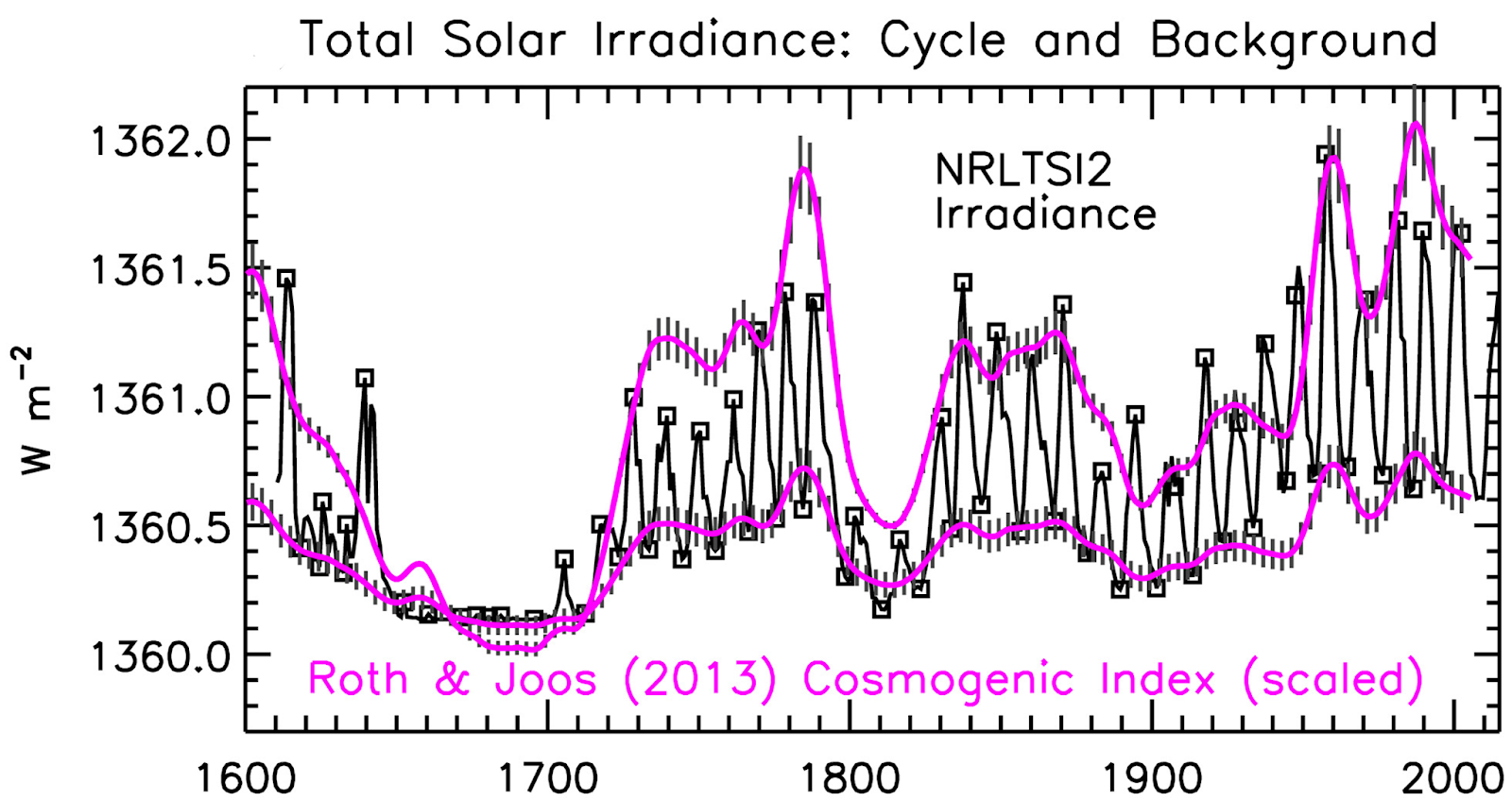
Here is the Abstract from my 2017 paper linked below
“This paper argues that the methods used by the establishment climate science community are not fit for purpose and that a new forecasting paradigm should be adopted. Earth’s climate is the result of resonances and beats between various quasi-cyclic processes of varying wavelengths. It is not possible to forecast the future unless we have a good understanding of where the earth is in time in relation to the current phases of those different interacting natural quasi periodicities. Evidence is presented specifying the timing and amplitude of the natural 60+/- year and, more importantly, 1,000 year periodicities (observed emergent behaviors) that are so obvious in the temperature record. Data related to the solar climate driver is discussed and the solar cycle 22 low in the neutron count (high solar activity) in 1991 is identified as a solar activity millennial peak and correlated with the millennial peak -inversion point – in the RSS temperature trend in about 2003. The cyclic trends are projected forward and predict a probable general temperature decline in the coming decades and centuries. Estimates of the timing and amplitude of the coming cooling are made. If the real climate outcomes follow a trend which approaches the near term forecasts of this working hypothesis, the divergence between the IPCC forecasts and those projected by this paper will be so large by 2021 as to make the current, supposedly actionable, level of confidence in the IPCC forecasts untenable.”
These general general trends were disturbed by the Super El Nino of 2016/17. The effect of this short term event have been dissipating so that “If the real climate outcomes follow a trend which approaches the near term forecasts of this working hypothesis, the divergence between the IPCC forecasts and those projected by this paper will be so large by 2021 as to make the current, supposedly actionable, level of confidence in the IPCC forecasts untenable.”
See my 2017 paper “The coming cooling: Usefully accurate climate forecasting for policy makers.”
http://journals.sagepub.com/doi/full/10.1177/0958305X16686488
and an earlier accessible blog version at
http://climatesense-norpag.blogspot.com/2017/02/the-coming-cooling-usefully-accurate_17.html
And /or My Blog-posts http://climatesense-norpag.blogspot.com/2018/10/the-millennial-turning-point-solar.html ( See Fig1)
and https://climatesense-norpag.blogspot.com/2019/01/the-co2-derangement-syndrome-millennial.html
also see the discussion with Professor William Happer at http://climatesense-norpag.blogspot.com/2018/02/exchange-with-professor-happer-princeton.html
Check also the RSS data at http://images.remss.com/data/msu/graphics/TLT_v40/time_series/RSS_TS_channel_TLT_Global_Land_And_Sea_v04_0.txt
I pick the Millennial temperature turning point peak here at 2005 – 4 at 0.58
I suggest that if the 2021 temperature is lower than that (16 years without warming ) the crisis forecasts would obviously be seriously questionable and provide no secure basis for restructuring the world economy at a cost of trillions of dollars.
The El Nino RSS peak was at 2016 – 2 at 1.2
Latest month was 2019-11 at 0.71
However the whole UNFCCC circus was designed to produce action even without empirical
justification. See
https://climatesense-norpag.blogspot.com/2019/01/the-co2-derangement-syndrome-millennial.html
” United Nations Framework Convention on Climate Change, later signed by 196 governments.
The objective of the Convention is to keep CO2 concentrations in the atmosphere at a level that they guessed would prevent dangerous man made interference with the climate system.
This treaty is a comprehensive, politically driven, political action plan called Agenda 21 designed to produce a centrally managed global society which would control every aspect of the life of every one on earth.
It says :
“The Parties should take precautionary measures to anticipate, prevent or minimize the
causes of climate change and mitigate its adverse effects. Where there are threats of serious or
irreversible damage, lack of full scientific certainty should not be used as a reason for postponing
such measures”
Apocalyptic forecasts are used as the main drivers of demands for action and for enormous investments such as those in the new IPCC SR1.5 report .
The establishment’s dangerous global warming meme, the associated IPCC series of reports ,the entire UNFCCC circus, the recent hysterical IPCC SR1.5 proposals and Nordhaus’ recent Nobel prize are founded on two basic errors in scientific judgement. First – the sample size is too small. Most IPCC model studies retrofit from the present back for only 100 – 150 years when the currently most important climate controlling, largest amplitude, solar activity cycle is millennial. This means that all climate model temperature outcomes are too hot and likely fall outside of the real future world. (See Kahneman -. Thinking Fast and Slow p 118) Second – the models make the fundamental scientific error of forecasting straight ahead beyond the Millennial Turning Point (MTP) and peak in solar activity which was reached in 1991.These errors are compounded by confirmation bias and academic consensus group think.
I have been following fisheries models since about 1990, and their parallel failures suggest a larger common problem. This model, 25 authors (too many but at least two older authors near end good scientists, one working on sea turtles for decades) compiled a large data set, with currents (too standardized), but paper seems to realize its remaining problems. Still missing younger stages out there in the sargassum or somewhere, but conservation of sea turtles mostly a success. Really smart people know their limitations better.
https://www.sciencedaily.com/releases/2019/12/191223122833.htm
https://onlinelibrary.wiley.com/doi/full/10.1111/ecog.04929
Open access
If you add in inflation, EIA projected oil prices would be more than $118 a barrel today. Or alternatively a barrel of oil today is less than $51.00 in 2010 dollars.
We do know what causes Little Ice Ages:
Scientific paper describes a model that is 97% accurate going back thousands of years, predicts the beginning of a little ice age (Grand Solar Minimum) in 10.5 years!
Executive summary:
https://phys.org/news/2015-07-irregular-heartbeat-sun-driven-dynamo.html
Here is full paper: https://www.researchgate.net/publication/283862631
Follow-up paper:
https://www.researchgate.net/publication/316950696_On_a_role_of_quadruple_component_of_magnetic_field_in_defining_solar_activity_in_grand_cycles
or http://tinyurl.com/yap388av
Latest paper:
https://www.researchgate.net/publication/316921302_Reinforcing_the_double_dynamo_model_with_solar-terrestrial_activity_in_the_past_three_millennia
or http://tinyurl.com/y9m2xk46
Dear Mr. Walter et al,
Our analysis of solar magnetic field is based on Principal component Analysis published in 2012 (Zharkova et al, MNRAS, http://computing.unn.ac.uk/staff/slmv5/kinetics/MNRAS-2012-Zharkova-2943-53.pdf ).
In 2015 we published the break-through paper: Zharkova et al., 2015 https://www.nature.com/articles/srep15689 which explained the occurrence of grand minima on a (semi) regular basis during the past millennia owing to beating effect of two dynamo waves of the sun formed in the inner and outer layers of the solar interior. Later we reported paper by Zharkova et al, 2018a http://computing.unn.ac.uk/staff/slmv5/kinetics/reply2usoskin_jastp17.pdf which have the proofs that the solar grand minima occurred on semi-regular basis in the past 5 millennia and will continue to occur in the future millennia. Some discrepancies with Sporer minimum are explained by the explosion of a supernova Vela Junior in the Southern Hemisphere that gave a strong flux of cosmic rays on the solar system which overriden the carbon-darting in 13-14 centuries and led to wrong impression that it was a solar grand minimum while it was a supernova gamma-rain on the Earth.
As you can figure out from our Fig.3 from the paper in Nature SR, Zharkova et al., 2015, the upcoming grand minimum will be seen only during the cycles 25-27 (2020-2053). After this time in cycle 28 the visible solar activity will be restored back to normal. Moreover, even in these years 2020-2053 the most reduced activity will be seen during the minima of solar activity between cycles 25 and 26, cycle 26 itself and then later between cycles 26 and 27. These 3 cycles will be a modern grand solar minimum, similar to the one we had in 17-18 century (Maunder Minimum) but twice shorter that the one in 17 century. The solar activity goes regularly through these grand solar minima (e.g. Wolf, Oort or Homer minima as described in our papers published recently Zharkova et al, 2017 https://arxiv.org/pdf/1705.04482.pdf Zharkova et al, 2018b http://computing.unn.ac.uk/staff/slmv5/kinetics/zharkova_iau335_paper1.pdf.
These GSMs occur every 350-400 years and are regular features of solar activity cause by interference of dynamo waves produced by solar dynamo in two different layers (inner and outer ones) (Zharkova et al, 2015).
In the RAS press-release of our paper in Nature SR in 2015 http://computing.unn.ac.uk/staff/slmv5/kinetics/press-release%20-NU2015_list_nat.pdf we shown that the solar irradiance is decreased by 3% only while the average temperature was reduced by more than a degree. This suggested that the temperature decrease was not mainly caused by a descries of solar irradiance but by a decrease of magnetic field. This in turn leads to the intensity increase of cosmic rays which break the high clouds and lead to opening the ‘greenhouse’ to the interplanetary space. Reduction of solar magnetic field leads also to increase of the role of planetary magnetic field, increased volcanic and earthquake activities. These processes are not included in any of the modern models describing the terrestrial temperature variations which cannot explain even the previous grand minimum – Maunder Minimum.
We hope this answers all the points raised in the u-tube presentation. which, actually, exposes the deficiencies of the current climate models more than the problems with the upcoming grand minimum which is upon us in 2020-2053. We will see the developing story in front of our eyes and decide who is correct.
https://phys.org/news/2015-07-irregular-heartbeat-sun-driven-dynamo.html
“http://computing.unn.ac.uk/staff/slmv5/kinetics/reply2usoskin_jastp17.pdf which have the proofs that the solar grand minima occurred on semi-regular basis in the past 5 millennia and will continue to occur in the future millennia. Some discrepancies with Sporer minimum are explained by the explosion of a supernova Vela Junior in the Southern Hemisphere that gave a strong flux of cosmic rays on the solar system which overriden the carbon-darting in 13-14 centuries and led to wrong impression that it was a solar grand minimum while it was a supernova gamma-rain on the Earth”; What effect will this have on archaeological carbon dating procedures, and are these allowed for when doing age estimates?
See https://agwnot.blogspot.com/ from nearly 9 years ago.
It would appear that I have overquoted. What caught my attention was the part “the explosion of a supernova Vela Junior in the Southern Hemisphere that gave a strong flux of cosmic rays on the solar system which overriden the carbon-darting in 13-14 centuries”, which seems to imply that the carbon-dating clock can be reset by gamma particles, in this case from a super-nova. I am curious as to whether this is accounted for when carbon dating for archaeological purposes, and if so, how it is done. Thanks for replying.
The Sun is spotless as predicted in 2015.
While the Terrestrial temperature increase in the current time is caused by the solar inertial motion and small gravitational disturbances of the Earth- sun distance caused by large planets – see the papers published in 2019. http://mpee.northumbria.ac.uk/staff/slmv5/kinetics/publications.php
And the temperature is expected to increase by further 3C by 2700z
Regards
V. Zharkova
What is 2700z? I know that 2400z is midnight UTC, but I haven’t heard of 2700z. Do you mean the year 2700? If so, that is further away in the future than the oldest recorded history in the past and is not a thing to be concerned about.
The year.
See https://agwnot.blogspot.com/ for a very similar projection done by a non-mathematician simply looking at what seemed to be the most eyeball visible solar cycles plus the millenial cycle. It is so nice to get confirmation by people who can really do mathematical analyses, several years later and completely independently. Now the trick is to identify the drivers of the shallow and deep grand solar minima – probably planetary motion.
“But the energy models are just as bad, and the climate models totally depend on the energy models for estimating future emissions.”
err NO.
climate models use CONCENTRATION PATHWAYS, not emissions,
RCP 8.5 means that the concentration of c02 is set.. INDEPENDENT OF EMISSIONS.
its in the acronymn
https://en.wikipedia.org/wiki/Representative_Concentration_Pathway
in Ar4 it was they used SRES EMISSION SCENARIOS.
https://en.wikipedia.org/wiki/Special_Report_on_Emissions_Scenarios
Waiting for another Smackdown…
Thanks, Mosh. Two points on that.
First, emissions pathways were used rather than Representative Concentration Pathways (RCPs) for all computer models from the first ones in the 1980s or so until 2014. So it’s a bit disingenuous to claim that emissions are not relevant. They were found to be most relevant for the first thirty years or so that we played this game.
Next, just how do you think that they estimated future concentration pathways? Do you reckon that they just picked numbers out of the air? Seems doubtful, since the results using the two methods are very, very similar.
Do you think that they simply made them up? Nope. They developed the RCPs from the projected emissions. Here’s the IPCC on the subject, WG1AR5 Chapter 12:
The IPCC, in turn, cites The RCP greenhouse gas concentrations and their extensions from 1765 to 2300, which says:
To summarize, just so everyone is clear: the RCPS are not emissions scenarios, but they are BASED ON the emissions scenarios.
So Steve, I’m afraid that while your statement is true (for the last 5 years we’ve used RCPs rather than emissions scenarios), it’s a difference that makes no difference because the RCPs are totally based on the emissions scenarios.
Best of the holidays to you, my friend,
w.
I wonder what the source of CO2 concentration rise was from about Year -2500 to 0. Probably the industrial revolution and internal combustion engine. Or mammoth farts.
Agreed Willis. Understanding the how and why of past climate is the key to understanding what will happen with future climate. Unfortunately, our understanding of past climate is like a fuzzy and grainy photo of Big Foot. There’s something there and it’s bi-pedal, but there’s no bringing it into better focus using the photo we have and, while everyone agrees the photo shows something there’s no agreement on what, exactly, it is. Maybe, in a few hundred years, we’ll be able to sharpen the image a bit and come to an agreement on what the photo shows. My guess is that it won’t be Big Foot, but it’s cousin, the Yeti.
Cheers
Max