Guest “riiiight” by David Middleton
From the perpetually wrong Nick Cunningham at Oil Price Dot Com…
US Shale Production Is Set For A Steep Decline
By Nick Cunningham – Oct 01, 2019U.S. oil production fell in July, another worrying sign for the shale industry.
The latest EIA data shows that oil output fell sharply in July, dipping by 276,000 barrels per day. The decrease can be chalked up to outages related to a hurricane that forced oil companies to temporarily idle operations in the Gulf of Mexico. Offshore Gulf of Mexico production plunged by 332,000 bpd in July.
As a result, the dip in output might easily be dismissed as a one-off aberration. However, U.S. output has stagnated in 2019, ending several years of explosive shale growth. Compared to December 2018, total U.S. production was only up 44,000 in June 2019, which essentially means that despite heady forecasts and lots of hype, U.S. shale has plateaued this year.
Because the Permian drives much of the growth and commands most of the attention, it is instructive to look at Texas. The latest EIA data shows that Texas boosted production by 40,000 bpd in July from a month earlier, which is not trivial, but down sharply from the triple-digit monthly gains routinely posted throughout much of 2017 and 2018. Year-to-date, Texas has only added 125,000 bpd, a rather modest figure. The state added 474,000 bpd in the first seven months of 2018 by comparison.
[…]
For shale drillers, the problem is made worse by the fact that they are facing financial stress and the prospect of persistently low prices. The rig count has fallen sharply, down roughly 20 percent since last November. Drillers are cutting back, hoping to improve their cash flow position amid investor scrutiny.
[…]
Oil Price Dot Com
At no point does Mr. Cunningham cite anything that supports the notion that “US Shale Production Is Set For A Steep Decline”. The hurricane-related shut-in of Gulf of Mexico production is totally unrelated to the Permian Basin and “shale” plays in general.
Hurricanes and the Obama maladministration’s unlawful drilling moratorium/permit-torium are obvious on this production plot:
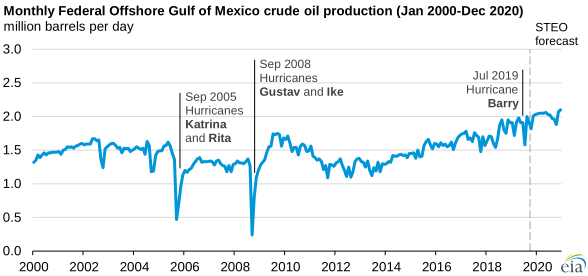
Most, if not all of that 332,000 bbl/d is already back online. GOM production is on track to exceeding 2 million bbl/d in early 2020.
A slowdown in growth is not a steep decline. As awesome as the Permian Basin is, production growth can’t perpetually accelerate. Mr. Cunningham did note that falling oil prices are a factor… It’s actually the only factor. The fact that every oil well ever drilled exhibits a decline curve, means that the only way to maintain and/or increase production is to keep drilling.
The Baker Hughes rig count for the Permian Basin pretty well tracks the price of crude oil (WTI).

The rig count has been falling with the price of crude oil since December 2018. With the rig count falling, the rate of production growth has slowed down, but “U.S. shale” has not “plateaued this year.”
The EIA tracks the monthly productivity changes for tight oil and shale gas plays. The September 2019 Drilling Productivity Report: For key tight oil and shale gas regions shows that U.S. tight oil plays are still growing, with almost all of the growth in the Permian Basin.

All of the regions, except the Haynesville, exhibited continued increases in productivity (new-well oil production per rig). The Haynesville is almost exclusively a gas play.
New Permian Basin wells are nearly 8 times as productive as they were in 2010.

While the rate of production growth has slowed, there’s no “plateau” in sight…

Mr. Cunningham then went with the “but, but, but, they can’t make money” angle, citing himself in the process…
For shale drillers, the problem is made worse by the fact that they are facing financial stress and the prospect of persistently low prices
Nick Cunningham

US SHALE INDUSTRY TURNS CASH FLOW POSITIVE
August 21, 2019In a remarkable turnaround, the second quarter of 2019 is the first three-month period on record when US shale operators achieved positive cash flow from operations after accounting for capital expenditures, according to Rystad Energy.
Rystad Energy – the independent energy research and consultancy in Norway with offices across the globe – has studied the financial performance of 40 dedicated US shale oil companies, focusing on cash flow from operating activities (CFO). This is the cash that is available to expand the business (via capital expenditure, or capex), reduce debt, or return to shareholders.
In the second quarter of 2019, 35% of operators in the peer group balanced their spending with operational cash flow, and reported an accumulated $110 million surplus in CFO versus capex.
[…]
Rystad Energy
While the more successful shale players, like EOG and Cabot, have been generating free cash flow for the past several years, the less successful companies are catching up.

Positive operating cash flow is essential for staying in business. It means your operations are generating more than enough revenue to cover your operating costs. Free cash flow is like Nirvana. It means that your operations are generating more than enough revenue to cover your operating costs (OpEx) and your capital expenditures (CapEx).
Cash Flow
Investopedia
Cash flow is the net amount of cash and cash equivalents being transferred into and out of a company. Positive cash flow indicates that a company’s liquid assets are increasing, enabling it to settle debts, reinvest in its business, return money to shareholders and pay expenses. Cash flow is reported on the cash flow statement, which contains three sections detailing activities. Those three sections are cash flow from operating activities, investing activities and financing activities.
Free Cash Flow
Free cash flow (FCF) is the cash a company produces through its operations after subtracting any outlays of cash for investment in fixed assets like property, plant and equipment. In other words, free cash flow or FCF is the cash left over after a company has paid its operating expenses and capital expenditures.
Free cash flow shows how effectively a company generates and uses its cash. Free cash flow is used to measure whether a company has enough cash, after funding operations and capital expenditures, to pay investors through dividends and share buybacks. To calculate FCF, we would subtract capital expenditures from cash flow from operations. (See “What’s the Formula for Calculating Free Cash Flow?“)
It’s not easy to generate free cash flow in this business, conventional or unconventional. Oil and gas exploration and production (E&P) is very capital-intensive. Companies with solid operating cash flows and EBIDAX often don’t generate free cash flow due to their CapEx. It was actually more difficult when oil was over $100/bbl, because the cost of doing business goes up and down with the price of oil.
Idiots and decline curves
The shale doomsayers will often latch onto decline rates. Shale and other tight reservoirs (unconventional) generally exhibit steeper decline rates than conventional wells.

“Shale” does have a few advantages over deepwater GOM:
- Virtually no exploration risk.
- Lower drilling and operating costs.
- On production faster.
However, the steep decline curves necessitate a higher operational tempo to maintain and/or grow production.

That said, the decline rates for “shale” wells aren’t some sort of Achilles Heal. A comment to my last post linked to a very frackingly stupid article, suggesting that the decline rate caused the oil to “vaporize…
More Than 50% Of The Mighty Permian’s 2018 Oil Production Has Vaporized
POSTED BY SRSROCCO IN ENERGY, NEWS ON OCTOBER 4, 2019
As dark clouds gather on the financial horizon, big trouble is brewing in the U.S. Shale Oil Industry. While most Americans are focused on the Mainstream media’s coverage of the ongoing Washington D.C. circus, the real threat to the domestic economy lies in the country’s oil heartland. And, if we look at what is taking place in the United States’ largest shale oil region, the signs are troubling.
The Permian Oil Basin in Texas and New Mexico accounts for nearly half (46%) of the total U.S. shale oil production. According to the data from Shaleprofile.com, Permian’s oil production peaked in May at 3.43 million barrels per day. Due to the massive decline rate, production in the Permian has stalled this year.
The chart below shows the Permian oil production declining even though more wells continue to be brought online. Unfortunately, there aren’t enough wells being added to offset the tremendous decline rate. You will notice how quickly the oil production that was added in 2018 (Light Blue color) has declined in just half a year:
[…]
EROI SRSrocco REPORT
“Vaporized”???
Dude! That’s how decline curves work. Every well ever drilled exhibits a decline curve. If the decline curve was “killing the ability of shale companies to increase production,” there would have never been an increase in production.

If the shale players had drilled no new wells in the Permian Basin since 2010, the decline rates would have done this to oil production.

A sober analysis
I am sober at the moment… But not an objective observer. I not only work in the evil oil & gas industry, I am also a YUGE fan of it too. Robert Rapier, on the other hand, is generally very objective.
Oct 3, 2019
U.S. Crude Production Returns To Record LevelsRobert Rapier Senior Contributor
EnergyWere it not for the explosive growth of U.S. oil production over the past decade, the recent attacks on Saudi’s oil infrastructure would have undoubtedly had a much larger impact on the world’s oil markets. Now, less than a month later, the prices of West Texas Intermediate and Brent crude are actually below the prices prior to the attacks.
[…]
Back in the summer, it looked like that production growth was slowing. Year-over-year production growth had been slowing since early in the year, and monthly production had been declining heading into summer. The key driver of these developments was that production growth in the important Permian Basin had plummeted over the past year.
But that was then and this is now.
Production started rising again during the summer, and last week the Energy Information Administration (EIA) reported that weekly production tied the all-time production record of 12.5 million BPD of U.S. crude oil production that had been first reached a month ago. This week’s report showed that production declined slightly to 12.4 million BPD, but is still 1.3 million BPD higher than it was a year ago. That is still robust year-over-year growth, and is higher than it was heading into the summer.
About half of the 400,000 BPD production increase since summer comes from the Permian Basin. Production there continues to grow, albeit at the slowest pace in three years.
[…]
Forbes
What a difference two days can make:
US Shale Production Is Set For A Steep Decline
Nick Cunningham, BA history, U of Maryland, MS international relations, Johns Hopkins. October 1, 2019
U.S. Crude Production Returns To Record Levels
Robert Rapier. BS chemistry & math, MS chemical engineering, Texas A&M University. October 3, 2019
Or maybe it’s the difference between ignorance and knowledge of the subject matter.
Peak oil is a lot like climate change.
Everything is evidence that there predictions are finally about to come true.
I like both because they can be subjected to analysis and predictions that serve to gauge the understanding of how they work. If predictions are wrong they should force a change in how we understand them.
My current prediction in oil is that World crude plus condensate production in 2019 will be lower than in 2018. We should know in 9 months.
David, as always, your post is educational and entertaining.
I’ve lost my pointer to the info on DNC (drilled not completed) wells. At one point it was somewhere around 5500 holes, where is it today?
They’re called DUC wells… drilled uncompleted. According to Robert Rapier’s article, there are about 8,000 DUC wells…
https://www.forbes.com/sites/rrapier/2019/10/03/u-s-crude-production-returns-to-record-levels/#1f03c9206617
Although I might have missed this point in my quick review of both your post and some of the comments, one item which the energy “press” tend to latch on is rig count. For some reason the “press” cannot seem to grasp that you don’t need ans many rigs to drill long lateral horizontal wells (both tight gas and oil) as was needed to drill “old style” vertical/ directional wells to develop the same acreage. Press reports equate drop in rig count = contracting industry/energy recession (due to low commodity prices). As you noted you cannot look at these individual issues in a vacuum but must be considered in context.
You do need to drill wells. While Permian Basing rigs are about 8 times as productive as they were 10 years ago, a prolonged drop in the rig rate will caused a falloff in production.
I enjoy your oil and gas debunking posts. I would add that economically, the Tight Oil and Gas industry looks a lot more like a manufacturing industry than a traditional oil and gas play because there is essentially zero exploration risk. Therefore players are primarily competing on driving down scale and experience curves as they introduce new techniques and tools that reduce labor costs and increase per well yields. It’s more like making steel than offshore which still has a large speculative component. And since each basin is different, I predict you’ll see basin specialization by companies because the experience curves will differ.
That’s a very good analogy.
Mr. Reeves
That is an oustanding analogy on so many levels.
From the world class snubbing companies originating in the Appalachian Basin enabling operators to drill 20,000 foot laterals to the Monobore drilling in the shallower Niobrara, the incredible speed of technological advances is simply breathtaking to behold.
The brand new $300 million water treatment plant from Antero in West Virginia may well be ‘obsolete’ with the latest chemical iterations allowing slickwater fracs to partially use treated produced water.
Implications for Permian completions should be obvious.
Unfortunately, mainline ‘reporting’ does not regularly offer opportunities for observers to learn of these matters … let alone project future ramifications.
New, young, hard charging CEO of EQT, Toby Rice, is attempting to position the company – now the largest gas producer in the US – to be profitable at $2 HH.
2 bucks for freakin’ a million btus, Mr. Reeves.
And THAT is one reason why the incredible buildout of processes and hardware involving mid scale, small scale, even micro scale LNG all over the place.
Combined with the most recent advances in modularization from the ships, the liquefaction trains, the containers to ship/store the stuff, we will see an explosive, global spread of LNG use in the coming years.
(BHGE is committed to building mid sized trains totalling 60 mtpa – million tonnes per annum – at their Avenza plant in Italy.
For context, that is within shouting distance of Qatar’s current 77 mtpa output).
I was habitating oilprice.com in it’s first year of operation.
What I read in both the published articles and forum was an absurd
collection of reporting and posting on it’s forums.
It was mainstream to report and argue the merits of Peak Oil and the
complete failure of the fracking processes; as well as the massive decline
rate in production output. Several authors repeatedly suggested the industry
would never go cash flow positive. This was later followed by the push of
“green” energy and the consequences of AGW.
After some five years of this drumbeat and shoddy and nonfactual
journalism, I discontinued my membership. My emails to the chief editor
provided no relief.
It did not come to a surprise to me that this website and it’s board originate
from the UK.
They do feature some good articles… But most of it is crap.
Back in the 1980s I prepared an annual reserve report for a small oil company. Their annual production had been steady for years as they relied on bank loans to finance a few new wells every year. But when the oil price crashed in late 1985, the bank ceased lending, the company couldn’t drill and their reserves and value declined precipitously. It’s the red queen effect. You have to keep running just to stay in place. We will eventually hit a plateau in the shale wells, but that should take quite a few years.
The Bakken and Eagle Ford have seen essentially flat production for years. This will eventually happen to the Permian. The question is when. I believe the answer is price. I expect flat to slightly up production from the Permian at $53 WTI. At $75 production could push higher for several more years. The price of WTI a year out is anyone’s guess.
Halliburton announced more layoffs today. Decreased rig counts and completions are killing the service companies.
The service companies always get hammered the most when oil & gas prices fall.
When the Permian eventually peaks, oil will probably push $100/bbl.
I agree. I’m in the camp that believes oil would have never dropped under $100 had it not been for the Permian. And its the Permian’s spectacular growth in 18 (plus a significant increase from the GOM) that is sitting on top of oil prices right now. The IEA is expecting most new oil growth over the next 5 years to come from the US and Iraq. The Permian is expected to be the single biggest contributor. For that to happen I believe oil prices will need to move meaningfully higher.
Here’s a question… Can older oil field production be pushed even further by drilling new horizontal wells – I am assuming there is already a method to increase the hydro-static pressure in place. Or are the older sites just too lean to pursue?
It depends on the nature of the reservoir. In Ghawar, they drill horizontal wells to stay above the oil/water contact (which has moved up-dip with oil voidage, and to avoid a high permeability zone that can draw up water like a straw.
Drilling a new well is expensive, whereas producing oil from an existing well is relatively cheap, even though the production rate declines with time.
There are a lot of factors that a US oil producer can’t control, that influence the price of oil. A hurricane can temporarily take Gulf of Mexico production offline, but that doesn’t usually last long–the wells are back online about a week after the passage of the hurricane, so that a hurricane will temporarily drop production, without enough time to drill new wells.
But an international event such as the bombing of the Saudi refinery by Iran could take a large amount of crude off the market for months or years, which could increase oil prices for long enough to incentivize new drilling, as Permian producers rush to meet the demand at a high sales price. The Permian production has probably also been helped by the failure of Venezuelan production due to mismanagement by the Maduro regime.
Another factor that is frequently overlooked by analysts is that fracked oil from the Permian Basin and Bakken fields contains much less sulfur than Middle East oil, and is also lighter, meaning that it yields more straight-run naphtha and diesel and less residue (high-boiling compounds requiring cracking), meaning that it is cheaper to refine into saleable products.
American refineries may be willing to pay a premium for such light, sweet crude over Middle East crude, since they get more useful products, and they don’t have to pay to ship it across an ocean, only across the state of Texas.
I’m a fan of WUWT and of David Middleton. Like him, I earned my keep in the oil industry. However, I am at odds with him on his analysis. Figure 6, which shows that the shale oil peer group of 40 companies have only just gone positive in Q1 2019 with regard to cash flow after Capex is not a good indicator. It is an indictment of the whole industry.
What are the key performance indicators of an industry that has spent the last 5 years in negative territory with regards to cash flow after capex? Maximise production, get management bonuses, but give a damn about the financial health of the company? Would a more sane approach to supplying capital have led to less robust production increases with a concomitant increase in price?
As he rightly points out, if it were not for the shale industry, the recent attacks on Saudi oil installations would have had an effect on oil prices. Well yes, and a whole lot of professionals who lost their jobs in the last 4 – 5 years might have had a better chance of recovering a job.
The increase in shale fraccing oil production (quite often done at a loss) has kept the market over supplied with oil, hence keeping prices down, despite production reductions in places like Venezuela.
I think you have to take a step back to 2014, when oil was over $100/bbl. It wasn’t overproduction here that triggered the price collapse. It was OPEC’s surprise decision to not cut production to maintain prices. In a failed effort to take back market share, they increased production and triggered the price collapse.
Since then, the entire industry has had no choice other than maximizing production while slashing costs.