Guest Yogi Berra-ism by David Middleton

NEW YORK (AP) — Earth is in more hot water than ever before, and so are we, an expert United Nations climate panel warned in a grim new report Wednesday.
Sea levels are rising at an ever-faster rate as ice and snow shrink, and oceans are getting more acidic and losing oxygen, the Intergovernmental Panel on Climate Change said in a report issued as world leaders met at the United Nations.
AP Series: What Can Be Saved
It warned that if steps aren’t taken to reduce emissions and slow global warming, seas will rise 3 feet by the end of the century, with many fewer fish, less snow and ice, stronger and wetter hurricanes and other, nastier weather systems.
“The oceans and the icy parts of the world are in big trouble, and that means we’re all in big trouble, too,” said one of the report’s lead authors, Michael Oppenheimer, professor of geosciences and international affairs at Princeton University. “The changes are accelerating.”
[…”Déjà vu all over again”…]
AP
This immediately made me think of one of my all-time favorite baseball players, coaches and managers: Lawrence “Yogi” Berra.

Why did I think of the Yogi Berra quote?

U.N. Predicts Disaster if Global Warming Not Checked
PETER JAMES SPIELMANN June 29, 1989UNITED NATIONS (AP) _ A senior U.N. environmental official says entire nations could be wiped off the face of the Earth by rising sea levels if the global warming trend is not reversed by the year 2000.
Coastal flooding and crop failures would create an exodus of ″eco- refugees,′ ′ threatening political chaos, said Noel Brown, director of the New York office of the U.N. Environment Program, or UNEP.
He said governments have a 10-year window of opportunity to solve the greenhouse effect before it goes beyond human control.
As the warming melts polar icecaps, ocean levels will rise by up to three feet, enough to cover the Maldives and other flat island nations, Brown told The Associated Press in an interview on Wednesday.
Coastal regions will be inundated; one-sixth of Bangladesh could be flooded, displacing a fourth of its 90 million people. A fifth of Egypt’s arable land in the Nile Delta would be flooded, cutting off its food supply, according to a joint UNEP and U.S. Environmental Protection Agency study.
″Ecological refugees will become a major concern, and what’s worse is you may find that people can move to drier ground, but the soils and the natural resources may not support life. Africa doesn’t have to worry about land, but would you want to live in the Sahara?″ he said.
UNEP estimates it would cost the United States at least $100 billion to protect its east coast alone.
Shifting climate patterns would bring back 1930s Dust Bowl conditions to Canadian and U.S. wheatlands, while the Soviet Union could reap bumper crops if it adapts its agriculture in time, according to a study by UNEP and the International Institute for Applied Systems Analysis.
Excess carbon dioxide is pouring into the atmosphere because of humanity’s use of fossil fuels and burning of rain forests, the study says.
The atmosphere is retaining more heat than it radiates, much like a greenhouse.
The most conservative scientific estimate that the Earth’s temperature will rise 1 to 7 degrees in the next 30 years, said Brown.
The difference may seem slight, he said, but the planet is only 9 degrees warmer now than during the 8,000-year Ice Age that ended 10,000 years ago.
Brown said if the warming trend continues, ″the question is will we be able to reverse the process in time? We say that within the next 10 years, given the present loads that the atmosphere has to bear, we have an opportunity to start the stabilizing process.″
[…]
AP
Setting aside the nonsense about sea level rise and the fact that Noel Brown is a moronic left-wing bureaucrat with no scientific education, training or knowledge, this bit is hil-fracking-larious:
The most conservative scientific estimate that the Earth’s temperature will rise 1 to 7 degrees in the next 30 years, said Brown.
Noel Brown, moronic bureaucrat
Warming since 1989 based on linear trend lines:
- HadCRUT4 0.54 °C (0.96 °F)
- UAHv6.0 0.42 °C (0.76 °F)
“The most conservative scientific estimate that the Earth’s temperature will rise 1 to 7 degrees in the next 30 years” was…
“Déjà vu all over again”
Seth Borenstein’s current version of “The Boy Who Cried Wolf” is based upon the latest UN hoax, which relied on the now-retracted Resplandy et al., 2018. It’s a laundry list of totally unsubstantiated, speculative and/or out-of-context claims:
— Seas are now rising at one-seventh of an inch (3.66 millimeters) a year, which is 2.5 times faster than the rate from 1900 to 1990.
— The world’s oceans have already lost 1% to 3% of the oxygen in their upper levels since 1970 and will lose more as warming continues.
—From 2006 to 2015, the ice melting from Greenland, Antarctica and the world’s mountain glaciers has accelerated. They are now losing 720 billion tons (653 billion metric tons) of ice a year.
—Arctic June snow cover has shrunk more than half since 1967, down nearly 1 million square miles (2.5 million square kilometers).
—Arctic sea ice in September, the annual low point, is down almost 13% per decade since 1979. This year’s low, reported Monday, tied for the second-lowest on record.
—Marine animals are likely to decrease 15%, and catches by fisheries in general are expected to decline 21% to 24%, by the end of century because of climate change.
“Déjà vu all over again”
I don’t have the time or patience right now to shoot down every claim on the list (some are addressed here); but the first one is easy.
Seas are now rising at one-seventh of an inch (3.66 millimeters) a year, which is 2.5 times faster than the rate from 1900 to 1990.
I don’t think so.

Since 1993, actual SLR has been 3.0 mm/yr. From 1900-1990, it was 2.0 mm/yr.

3.0 mm/yr is 0.5 times as fast as 2.0 mm/yr, not 2.5 times as fast.
(Correction: 3.0 mm/yr is 50% faster than 2.0 mm/yr; which would be 1.5 times as fast as 2.0 mm/yr.)
“Eustatic” refers to eustacy…
Eustacy
Of or pertaining to worldwide sea level.
Dictionary of Geological Terms. American Geological Institute. Archer Press, 1976
Eustatic means that it has been corrected for local/regional uplift and/or subsidence of the land (isostacy). Tide gauge reconstructions have to be eustatically corrected. The Climate Crime Syndicate currently tacks 0.3 mm/yr onto the satellite data, as a glacial isostatic adjustment (GIA). This is bogus. The satellites are measuring changes in sea surface elevation: Eustatic sea level. The GIA is added because there isn’t enough SLR to account for their wildly exaggerated claims of Antarctic ice loss.
And there’s nothing anomalous about 3.0-3.2 mm/yr of SLR.

The rate of SLR from 1929-1963 was the same as the rate has been since 1993. Sea level was actually falling from 1808-1861 at a rate of 1.7 mm/yr. Sea level was very likely 1-6 m higher than it currently is for much of the past 3,000 years.

One thing to always keep in mind with efforts to estimate eustatic sea level: The error bars are always large.

“Earth is in more hot water than ever before…”
I suppose I should have started with the mind-numbingly stupid first sentence in the article.

Seth Borenstein earns a Billy Madison medal, with a Noel Brown oak leaf cluster-frack.
References
Brock, J.C., M. Palaseanu-Lovejoy, C.W. Wright, & A. Nayegandhi. (2008). “Patch-reef morphology as a proxy for Holocene sea-level variability, Northern Florida Keys, USA”. Coral Reefs. 27. 555-568. 10.1007/s00338-008-0370-y.
Jevrejeva, S. , J.C. Moore, A. Grinsted, A.P. Matthews, G. Spada. 2014. “Trends and acceleration in global and regional sea levels since 1807”. Global and Planetary Change. %vol 113, 10.1016/j.gloplacha.2013.12.004 https://www.psmsl.org/products/reconstructions/jevrejevaetal2014.php
Siddall M, Rohling EJ, Almogi-Labin A, Hemleben C, Meischner D, Scmelzer I, Smeed DA (2003). “Sea-level fluctuations during the last glacial cycle”. Nature 423:853–858 LINK
Zachos, J. C., Pagani, M., Sloan, L. C., Thomas, E. & Billups, K. “Trends, rhythms, and aberrations in global climate 65 Ma to present”. Science 292, 686–-693 (2001).
Meanwhile over at Roys place (UAH, the data set skeptics love to quote)…. I see September is the warmest (+.61C) in the 41 year satellite history.
And how microscopic is that measurement?
And September in my state has been the coldest in over a decade.
And either way, the damned world isn’t ending.
“And how microscopic is that measurement?”
Records are always significant. I shouldn’t need to explain that. Particularly when this is just one of many recently. And… in a non el nino year… that makes it very significant.
On the other hand, the even larger number of record lows doesn’t matter in the slightest.
Regardless, most of the time, records mean that the length of the record is too short.
The hottest day in the last 30 to 50 years is a meaningless number. Even the hottest day in the last 200 years doesn’t mean much, especially since the numbers 200 years ago are little better than guesses.
You’d think when someone is actively playing a shell game, there would be some self-awareness of it.
Yet apparently not.
A few weeks ago someone posted – I think it was Pamela Grey – about all the ‘little proofs’ – these microscopic measurements – which Simon thinks is giving his argument weight – when actually it really supports the skeptic case – a small effect – nothing to worry about, certainly nothing we can control by micromanaging the population, for an even MORE microscopic non-effect on the climate via ‘mitigation’ efforts.
“On the other hand, the even larger number of record lows doesn’t matter in the slightest.”
Yawn… really? I call BS. But MarkW will now run for cover. Heat records break cold by a significant margin. That’s what happens in a warming world. But on the planet “make it up” where MarkW lives, pigs fly and he can produce his own data.
YOU call BS. You try to pull a shell game like this and still have that level of gall?
If you climb a mountain are descending down the other side and you are still at a high elevation, that doesn’t mean you’re still going up.
And posting late in the day, so the board has moved and no one replies is not ‘running’.
Can’t really be honest about anything can you?
Oh, and by the way, when average temperatures are up a degree or so over the last hundred years – and gee, aren’t they now calibrating by hundredths of a degree (that was an Obama-era contribution, by the way) – it only stands to reason, that would include the most recent years.
Four and a half billion years, and you’re crowing about microscopic changes over four decades of records.
And of course this means exactly jack in regards to cause – and most importantly long-term effects, or human ability to regulate it.
So – call your own BS and take a mouthful of it.
“And I will say again – HOW microscopic is that measurement? ”
It’s microscopic enough to have people with an IQ over 100 worried.
And MarkW often makes lame comments he’s called on, then doesn’t reply. He and you both know I m right. Heat records outweigh cool ones by two to one. End of story.
And your mountain analogy is a bit sad. We are going up the (long term)mountain not down.
And I will say again – HOW microscopic is that measurement? And reiterate that the world isn’t ending. Of course you ducked that one.
And because every bloody argument warmists put forward is a friggin’ shell game. The El Nino peak is trending down.
See David Middleton’s post below.
https://www.drroyspencer.com/
This paper helps to add depth, but not light.
https://journals.plos.org/plosone/article?id=10.1371/journal.pone.0218430
Now you present the satellite history even though it shows how the climate models have failed in their projections!?!
But a lot happened before the satellite history.
For my little spot on the globe, here’s a list of the record highs as recorded in April of 2012 sorted by year. (And, no, I’m not cherry picking. This was the list I had that I could sort quickly.)
11-Sep 96 1895
19-Sep 97 1895
20-Sep 97 1895
21-Sep 96 1895
22-Sep 95 1895
8-Sep 100 1897
10-Sep 96 1897
12-Sep 96 1897
15-Sep 97 1897
16-Sep 96 1897
25-Sep 93 1900
26-Sep 92 1900
24-Sep 92 1908
1-Sep 99 1932
7-Sep 98 1939
8-Sep 100 1939
9-Sep 95 1939
13-Sep 95 1939
14-Sep 98 1939
15-Sep 97 1939
16-Sep 96 1939
23-Sep 90 1941
23-Sep 90 1945
1-Sep 99 1953
2-Sep 100 1953
3-Sep 99 1953
4-Sep 96 1953
29-Sep 96 1953
30-Sep 92 1953
5-Sep 99 1954
6-Sep 99 1954
17-Sep 94 1955
18-Sep 95 1955
28-Sep 92 1959
23-Sep 90 1961
24-Sep 92 1961
10-Sep 96 1964
10-Sep 96 1983
26-Sep 92 1998
27-Sep 90 1998
24-Sep 92 2007
26-Sep 92 2007
PS My little spot is Columbus Ohio.
Great work David. Back in the 80’s I believed all this crap, hook-line and sinker. Glad I escaped from the fog of the unknown. Hopefully this will free some minds from the fog of the unknown.
Rodents Of Unusual Size? I don’t think they exist.
~¿~
I have been trying to reply to answer Steven Fraser’s question but it doesn’t seem to appear. This is a 3rd attempt using the Comment box at the end instead of the Reply feature after Stevens question.
The Scalloped shape is due to the annual and semi-annual signal not having been removed. This appears as a +/- 4 to 5 mm regular variation. Final sea level plots usually have this removed. The plot also shows +/- 2 standard deviations (SD) and a strange behaviour appears at 1998 and 2016 where the SD increases by about 15% up and down over a 2 year period.
Regarding SD results I am adding some previous comments I made.
Some additional thoughts on the NASA results. 25 years is much too short a period to ascertain any definite trends. And completely too short a period to pursue any enhanced acceleration up to 2100. The NASA results are usually given as a single value every 10 days but behind each value there is an enormous amount of data. Each 10 days between 300,000 and 500,000 readings are taken and a rolling 60-day average calculated. One not often quoted value is the standard deviation for each 10 days set of readings. This is generally about 100mm and the spread of readings can be worked out using probability functions. This can also be shown graphically using the Excel function NORMINV(Probability,Mean,Standard_dev) to generate a normally distributed set of random numbers. For example, assuming the mean value was 50mm and the SD 100mm a set of 10000 random values matching these parameters can be generated by inserting NORMINV(RAND(),50,100) in cells A1 to A10000 and then inserting a histogram plot. Each time it is executed a new histogram is produced. I ran cases of 100, 1000 and 10000 values and found 10000 was more than adequate to show the trends and variations. Life is too short to go any higher!
These runs show, as would be expected, that using bins in the histogram of 20mm range that less than about 8% of results fall in the maximum bin and that actual values can range from about -400mm to +500mm. A typical histogram is shown in the figure below
https://drive.google.com/file/d/1RZj_KHRfv0D3X3eYFe0PMmMyWQNMfdQD/view?usp=sharing
Seeing a typical histogram makes the consistency of all the NASA results over the 25 years even more remarkable.
If the above appears later 3 times it is because I don’t understand the process.
Nope…
Not in short term cycles………..

Not in medium term cycles………..

And not in Long term cycles………
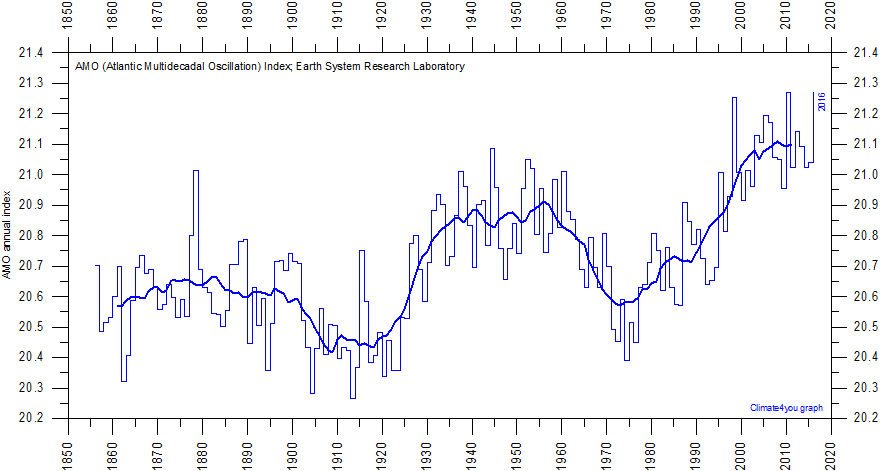
But then if you don’t get it with cycles anyway you’re lost and a tool of message managers.
“— The world’s oceans have already lost 1% to 3% of the oxygen in their upper levels since 1970 and will lose more as warming continues.”
O2 is being outgassed due to increasing temperature, but CO2 doesn’t follow the same rules, instead its concentration increases? Hmmm… me thinks not.
There’s certainly nothing like a grim new report Wednesday.
As it happened, I was telling a family memeber only a few minutes ago that Wednesday was my least favourite day of the week. Give me a Thursday or Friday, any day or everyday.
Hmmm… Being covered in ice doesn’t actually strike me as a desirable prospect.
And, puleeze… “professor of geosciences and international affairs”
Could they not be bothered to come up with some sillier job title? How about Professor of Chemistry and Dance?
Seth “The Quack” Borenstein is still around? Don’t these people ever get tired of lying and pushing the doom and gloom scenarios (that never come to pass)?
Seth as a “science writer” has sure given “science” a bad name in his long and undistinguished career.
I’m starting to wonder if all these Doomsday preppers you see on T.V. actually have a point. Years ago I branded them as idiots, but nowadays, I feel they might actually be on to something: stockpiling weapons, ammunition, food etc…….. Underground militias are forming, and not just in the US.