Guest Post by Willis Eschenbach
For reasons that will soon become evident, the comments on my previous wind turbine post reminded me of a long-ago sunset dinner with my gorgeous ex-fiancée on the verandah of a lovely treetop restaurant on Pohnpei island in the tropical Pacific.
The only “fly in the ointment”, as is often the case in the tropics, was … the flies. And various other tropical flying insects. So the treetop restaurant owners had thoughtfully installed one of those insect electrocution devices with the exposed power wires that go BZZZT every time another fly hits the wires, is electrocuted, and falls out of the sky.
In the lovely twilight, I thought little more about the occasional BZZZT! of the fly-killer until the owner of the restaurant said, “You should look over the edge of the verandah.”
We stood up, went to the edge, and looked down. And way down there on the ground, in the gathering darkness, was a group of very large tropical toads gazing straight upwards … and as we gazed down at their toadiness, BZZZT! went the fly-killer.
The freshly barbecued corpse of the fly fell straight downwards … but it never made it back to the earth …
I realized then that in nature nothing goes to waste. There’s always something waiting to consume any form of food, at times before it even hits the ground.
I bring this up because I’ve been thinking about the unexpectedly lethal habits of wind turbines. In the US, if someone kills a bald eagle they get slapped with a big fine … but wind turbines can kill the national bird, the Bald Eagle, by the dozens and absolutely nothing happens to them. They kill so many birds and bats that the US government has had to give them special exemption from all environmental rules and regulations about bird and bat deaths … and that’s a lot of deaths. It’s bizarre just how lethal wind turbines are.
So for example, it’s estimated that the wind farm at Altamont Pass in California not far from my home has killed 2,900 golden eagles in the quarter-century since it was built … and that’s just golden eagles. And estimates are that 600,000 bats are killed annually in the US alone.
I was thinking about my evening in the Pohnpei restaurant because someone said to me on Twitter “But … but … cats and tall buildings kill lots of birds, too” … and it’s a fact, they do.
However, there’s a huge difference with wind turbines, and I say that the difference, curiously, is bugs. Here is my theory as to why wind turbines kill so many bats and birds big and small, many more than anyone expected.
Wind turbines are surprisingly lethal because they kill bugs.
And not just a few bugs. Based on observations and model calculations, German researchers calculated that each wind turbine kills on the order of 12,000 insects per day, which is some 1,200 tonnes of dead insects per year in Germany alone. And for each bug that is killed, perhaps ten bugs are injured or dazed. Plus I suspect their calculations are too low.
First, a bit of background. Most folks don’t realize that the tips of those big slow-turning wind turbine blades are typically moving at 175 miles per hour (280 km/hr, an average of 21 different models), with some going as fast as 230 miles per hour (370 km/hr). YIKES! There’s no way to dodge something moving that fast.
It gets worse. At that speed, the blade tip doesn’t even have to hit an insect, bird, or bat to kill it or daze it. There is a near-vacuum on the back side of the blade. Just going suddenly from normal pressure to near-vacuum can cause a variety of injuries, including bursting the lungs of bats and birds.
So let’s follow the story, starting with the bugs. The turbine is acting like a giant bug-mincer. It is smashing bugs on the leading edges of the blades, just like the smashed bugs you get when you drive down the highway. It is injuring bugs through both turbulence and pressure changes. And it is constantly and invisibly spinning hundreds of both dead and wounded bugs, and lots of smelly bug-juice from the smashed insects, up into the sky.
What happens first, of course, is that the smell of the dead and wounded insects attract lots of other insects. Many insects are scavengers, and so more insects come to feed on the dead insects just like flies drawn to sh … well, you get the idea. So in addition to the bugs killed and wounded, we have all of the other very live bugs eating on them, and flying around between meals.
And of course some of these new bugs that came to feast on the dead get killed or injured as well, it’s a self-reinforcing insect death trap.
Now, remember what I said about the frogs eating the flies “before they hit the ground”? What happens next is that large numbers of both bats and insectivorous birds are drawn by the smell of thousands of dead and wounded insects. They do their very best to eat the dead and wounded insects before they hit the ground.
And when you mix large numbers of bats and insectivorous birds on the hunt, somewhat oblivious to their surroundings in pursuit of insect prey, with turbine blade tips going 230 miles an hour, that’s 370 km/hr, the outcome is unavoidable—large numbers of dead and wounded bats and birds.
Of course, wherever you have large numbers of dead and wounded bats and birds, you’ll inevitably attract numbers of the large predatory or scavenging birds such as owls, buzzards, vultures, falcons, eagles, kites, buteos, accipiters, and harriers. They come in to eat the living, wounded, or dead birds and bats that came in to eat the living, wounded, or dead bugs … and of course, since these large predators too are on the hunt and somewhat oblivious to their surroundings, when you mix in the high-speed turbine blades the raptors suffer the same fate as the smaller birds, the bats, and the thousands of bugs. Killed and wounded in hundreds and thousands.
How many birds die this way? The simple answer is … too many. But it’s hard to tell because the wind industry folks consider that a trade secret, and they won’t reveal their figures. The Audubon Society says:
Wind turbines kill an estimated 140,000 to 328,000 birds each year in North America.
Hundreds of thousands … however, this is just a guess, and the guesses keep getting revised upwards. In Hawaii, one of the few places where they’re legally required to measure the losses, I find articles like this one from 2017, “Wind farms killing more bats than expected“, or this one, “Hawaii windmills take a toll on endangered animals“
Right … I bet they are killing more than expected … bugs.
Me, I say that the reason people continually underestimate the number of birds and bats killed by wind turbines is that they never thought about the bugs. They think that a random bat or bird will only intersect with a turbine blade every once in a while as it flies through the landscape, so not many will die … they don’t realize that instead, the bats and birds are attracted to the turbines by an unending supply of easy insect prey. Those birds and bats, in turn, are preyed upon by raptors of all types … and all of them are chasing one of many dead or injured insects, birds, or bats through the lethal turbinespace, with the tragically predictable outcome.
Anyhow, that’s my own theory of why wind turbines kill so many birds and bats—because of bugs. Go figure. As always, YMMV.
Here, I’ve been packing. I’m leaving tomorrow for a couple-week vacation in the Nevada desert, so I’ll be out of touch with you good folks for a bit.
Sea fog is rolling back in, stay well,
w.
[UPDATE] As is often the case, science eventually catches up with WUWT. Here’s a scientific study from two years after this post, investigating the same question.
I personally won’t loose sleep if wind turbines wiped out a considerable amount of flying cockroaches. It is concerning that wind turbines are killing so may beneficial insects, bats and birds, though. And, yes, I know cockroaches to have a place in the ecology of the planet. But, so do viruses?
Willis, I did not see anywhere in your Guest Post, “…what I said about the frogs eating the flies “before they hit the ground”? (Paragraph 17) However, I did see reference to “…a group of very large tropical toads gazing straight upwards…” (paragraph 4) Just sayin’!
This site just against turbines?
Because there are lots of genuine bird killers out there…
https://www.birdguides.com/news/power-lines-killing-spains-raptors-at-alarming-rate/
https://www.theguardian.com/environment/2019/apr/07/how-many-birds-killed-by-skyscrapers-american-cities-report
A post and a site are two different things. Remember!
Way back in the early part of the 20th century an American named Jacobs invented wind generators for of grid use. He used a wooden propeller and carved it until it was perfect, he used a candle behind the blade when it did not flicker for its entire length when operating it was done. The formula he came up with for propellers is the gold standard for aircraft props.
Most raptors are opportunistic hunters – using energy conserving behavior (they don’t like flapping their wings much) – they soar on thermals or wind driven rising air currents from cliffs etc. or perch on some tall object to wait for a prey animal to enter their field of vision.
This very behavior puts them at greater risk from windmills and solar concentrators.
“I’m leaving tomorrow for a couple-week vacation in the Nevada desert…”
Going to “Storm Area 51”?
Just kidding.
Great post, and I think wholly reasonable. It’s truly deplorable that the Obama EPA would give a pass to the slaughter of birds of prey when so much as picking up an eagle feather off the ground and keeping it can get you a $5,000 fine plus jail time.
Have fun in Nevada!
Here’s a pic showing the vortex from a wind turbine. It is pretty intense considering how far downwind it carries. Link is to WUWT post from 2011. Real vertigo to a bat? https://wattsupwiththat.com/2011/04/28/the-wind-turbine-albedo-effect/
As I said above, why can’t they sue to stop the waivers?
https://www.foxnews.com/science/environmental-groups-sue-trump-weakening-endangered-species-act
Deciding to attack pet cats in defense of wind turbines has become the go-to for the greens lately in their denial over the danger of wind turbines. I’ve been seeing it all over. the crazy Australians have begun actually killing stray cats because of their “impact on the environment”, and others are trying to green-shame anyone whose kitty ever gets outside, accidentally or otherwise. Watch out for your pet cat, the environmentalists are coming for it!
Sounds like the fishing is going to be great below the offshore windmills.
Trump can stop the slaughter by reversing Obama’s executive order. It would be interesting to see the Press and Democrats calling for Trump to reinstate the slaughter.
might even be an interesting election issue. should we be willing to kill eagles to reduce climate change? If so, what else are we prepared to kill in the name of Climate Change? How about if we kill Polar Bears to prevent Climate Change from killing Polar Bears?
No matter how fast the blade is turning, the blade pressure load can #not# be higher than a static blade sitting in the same wind slipstream.
=========
here is an unpowered vehicle that says otherwise. 50 mph dead downwind in 20 mph of wind. static blades would not be able to do better than 20 mph.
It is amazing the things people assert, when the plain fact is that there are turbines all over the world and anyone can look at videos and do simple math to calculate the speed of the turbine tip, with only a stop watch, and knowing pi and a few simple formulas from 3rd grade geometry.
And at the rate they are shutting down Nuclear Power Plants the amount of CO2 emissions in the USA is going to start increasing. As of June 18, 2019, there are now only 97 commercially operating nuclear power plants in 29 U.S. down from 104 before the war on CO2 begun. the amount of CO2 is only being reduced because of the switch from COAL to NG. Wind turbines are having no impact. More wind turbines are going to increase the number of NG plants running and not producing power.
This study has the kill rate for insects even higher than this article.
German study, wind farms in Germany alone kill 1500 tons yearly, of insects, disrupting food chain
https://docs.wind-watch.org/Interferen
Done by:
Institute of Engineering and Thermodynamics
_https://www.dlr.de/tt/en/desktopdefault.aspx/tabid-2859/_
There are thousands more miles of power lines being built from the remote areas where they are putting in wind and solar. This, too, is expanding the kill capacity of “green” energy.
Power lines killing Spain’s raptors at alarming rate
https://www.birdguides.com/news/power-lines-killing-spains-raptors-at-alarming-rate/
In the US, years ago this problem was identified and the lines reconfigured to prevent it from happening. Where this was impractical, they found out when and how it happens, and took steps to make it not happen anymore: Spikes on the pylons and poles to prevent perching and nesting, and placing platforms higher than the power pylons for nesting sites.
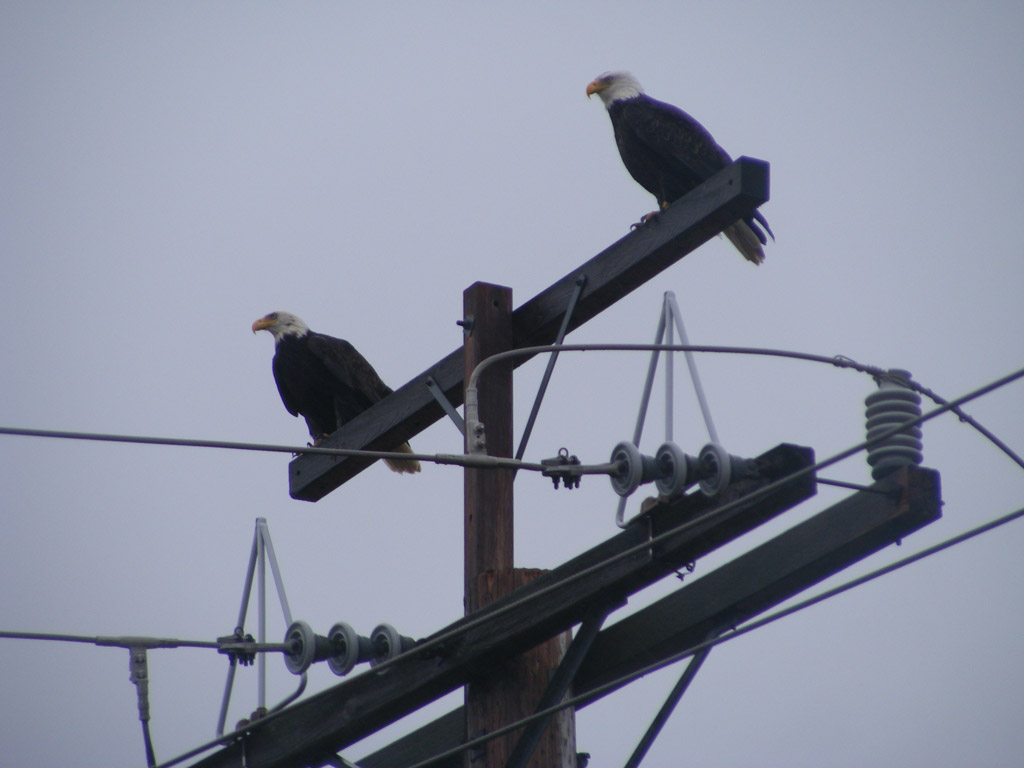
Raptors will always nest on the highest available nesting site.
You see these all over in Florida.
It is because of their wingspan…they can touch two hot wires or a hot and a ground when their wings are extended.
This does not happen in the US anymore.
Just do an image search and you can see the platform types in use.
If this is happening in Spain from power lines, they are far behind us. This was ended as a problem in the US many decades ago.
Platform of one variety:
http://hawksaloft.org/wp-content/uploads/2012/07/P1010003.jpg
Another type of platform using the power pylon or pole, and spikes to prevent roosting where the danger is:
http://www.xenabirddiscourager.com/wp-content/uploads/2012/11/nest747_power-pole-retrofit-1.jpg
Guard of the type that prevents small birds from shorting out equipment in substations and anywhere a problem has been seen:

Some others:
http://www.bcsiteservice.com/wp-content/uploads/2012/06/Bird-spikes-on-pole-lighting.jpg
Perches and spikes:
http://dfwurbanwildlife.com/wp-content/uploads/2014/01/baldeagle-theyreback-011.jpg
Well Said! The giant spinning turbines are basically bird death traps – and often they cut through prime flying space making the carnage even worse.
“No matter how fast the blade is turning, the blade pressure load can #not# be higher than a static blade sitting in the same wind slipstream.”
++++++++++++++++
Nope: If that was true, a wing moving at 30 mph would generate more lift that wing moving at 300 mph. The moving wing generates greater lift by generating greater pressure.
On a rotating blade, this is especially true towards the blade tip, where the 300 mph apparent wind speed at the tip generates a tip vortex that is significantly stronger than when the blade is standing still. This tip vortex on moving aircraft for example can be powerful enough to knock other aircraft out of the air.
The same thing happens on the road. Pass close by a parked semi and you will feel almost nothing. Now pass close by the same semi, but with the semi speeding by in the opposite direction at 100 mph. The semi will throw your car all over the road. The faster the semi is going, the worse the problem. In this case, the semi is duplicating the blade tip.
That wake vortex is why airports have a minimum clearance between departing and arriving planes of several minutes, because planes have crashed when this was not taken into account. It takes a few minutes for the vortex to subside to safe limits.
At the busy airports, wake vortex clearance time is a hard limit on the number of flights that can arrive and take off during the busy part of the day.
Wind turbines tend to attract predatory birds as nesting sites–for a mama hawk, why build a nest on the side of a cliff when there’s a nice flat power-box 100 feet or so up on a wind turbine with a bird’s eye view of flat ground full of prey? But wind turbines have vanes to ensure that they always face upwind, and predatory birds tend to take off upwind (for better lift, as airplanes do) through the path of the spinning blades. If the bird mis-times its jump in a strong wind, it’s bye-bye birdie.