Posted on July 21, 2019 by curryja
by Judith Curry
“The atmosphere bias of climate science makes it impossible for them to see geological forces and therefore, impossible for them to understand the earth’s climate.” – Thongchai
When conducting the literature survey for my report on sea level rise [link; see section 4.2], I became intrigued by under-ocean heat sources.
“Wunsch (2018) identified lower bounds on uncertainties in ocean temperature trends for the period 1994-2013. The trend in integrated ocean temperature was estimated by Wunsch to be 0.011 ± 0.001 oC/decade (note: this rate of warming is much less than the surface warming, owing to the large volume of ocean water). This corresponds to a 20- year average ocean heating rate of 0.48 ±0.1 W/m2 of which 0.1 W/m2 arises from the geothermal forcing. I have rarely seen geothermal forcing (e.g. underwater volcanoes) mentioned as a source of ocean warming – the numbers cited by Wunsch reflect nearly a 20% contribution by geothermal forcing to overall global ocean warming over the past two decades.”
Makes me wonder how much of the TOA radiative energy imbalance calculated from ocean heat content reflects seafloor geothermal heat fluxes?
Climate modelers are beginning to pay attention to seafloor geothermal fluxes. The first such study that I’ve spotted is Adcroft et al. (2012), using a uniform geothermal heat flux of 50 mW/m2 through the sea floor. They found substantial changes in deep circulation to this heat flux.
The GFDL ESM2 Global Coupled Climate-Carbon Earth System Model (2012) [link] states that it incorporates ocean geothermal heat flux following Adcroft et al. I don’t know if this is what the current (CMIP6) version of ESM2 uses.
The most interesting analysis that I’ve spotted on this is Downes et al. (2016) The transient response of Southern Ocean Circulation to Geothermal Heating in a Global Climate Model [link]
Abstract. Model and observational studies have concluded that geothermal heating significantly alters the global overturning circulation and the properties of the widely distributed Antarctic Bottom Water. Here two distinct geothermal heat flux datasets are tested under different experimental designs in a fully coupled model that mimics the control run of a typical Coupled Model Intercomparison Project (CMIP) climate model. The regional analysis herein reveals that bottom temperature and transport changes, due to the inclusion of geothermal heating, are propagated throughout the water column, most prominently in the Southern Ocean, with the background density structure and major circulation pathways acting as drivers of these changes. While geothermal heating enhances Southern Ocean abyssal overturning circulation by 20%–50%, upwelling of warmer deep waters and cooling of upper ocean waters within the Antarctic Circumpolar Current (ACC) region decrease its transport by 3–5 Sv (1 Sv = 106 m3 s−1). The transient responses in regional bottom temperature increases exceed 0.1°C. The large-scale features that are shown to transport anomalies far from their geothermal source all exist in the Southern Ocean. Such features include steeply sloping isopycnals, weak abyssal stratification, voluminous southward flowing deep waters and exported bottom waters, the ACC, and the polar gyres. Recently the Southern Ocean has been identified as a prime region for deep ocean warming; geothermal heating should be included in climate models to ensure accurate representation of these abyssal temperature changes.
This is by no means an exhaustive literature survey on incorporation of seafloor geothermal heat flux into ocean models, but I suspect that the GFDL model is the most advanced one in this regard.
The motivation for this particular thread is an email that I received today, and also some tweets I spotted.
The Miocene
Why the Miocene? This blurb from the current AGU Call for Abstracts provides a good summary:
“The Miocene (23 to 5.3 mya) is a crucial, dynamical interval in Earth’s history that provides unparalleled insights into the functioning of greenhouse climates. At times during the Miocene, Antarctic ice volume was half modern, the Arctic Ocean was ice-free in winter, and extratropical temperatures nearly as warm as in the Eocene. This is an enigma, because the continental configurations and ocean circulation were much closer to modern than in the Paleogene, and atmospheric pCO2 was in the 300-600 ppm range. Taken at face value, this implies either a system highly sensitive to greenhouse gas forcing or the presence of still unexplained forcings and feedbacks.”
A blog post by Thongchai suggests that the mid Miocene warming is caused by solid Earth dynamics [link].
“The general consensus in the bibliography below seems to be that the Mid Miocene warming event is best explained in terms of deep ocean circulation or the so called “oceanographic control of Miocene climate“. Many of these authors who are still in paleo climate research now tend to soft pedal these anomalies and discrepancies in public discourse to present the Mid Miocene warming in terms of the CO2 greenhouse effect although their new improved assessment appears to contradict what they had written twenty or more years ago. In many of the works below, particularly the later papers, it appears that the authors are struggling to relate grossly anomalous situations to the greenhouse effect of atmospheric CO2.”
The list of references is interesting; this is a provocative hypothesis that has been inadequately investigated.
Modern climate
With regards to the impact of geothermal ocean warming, Ron Clutz has a good post summarizing the published literature on this. Some excerpts:
“Little attention is paid to geothermal heat fluxes warming the ocean from below, mostly because of limited observations and weak understanding about the timing and extent of eruptions.”
“There appear to be three major issues around heating of the ocean from below through the seafloor:
1. Is geothermal energy powerful enough to make a difference upon the vast ocean heat capacity?
2. If so, Is geothermal energy variable enough to create temperature differentials?
3. Most of the ocean floor is unexplored, so how much can we generalize from the few places we have studied?”
“Without geothermal heat fluxes, the temperatures of the abyssal ocean would be up to 0.5 C lower than observed, deep stratification would be reinforced by about 25%, and the strength of the abyssal circulation would decrease by between 25% and 50%, substantially altering the ability of the deep ocean to transport and store not only heat but also carbon and other climatically important tracers . It has been hypothesised that interactions between the ocean circulation and geothermal heating are responsible for abrupt climatic changes during the last glacial cycle.”
“Geothermal heating contributes to an overall warming of bottom waters by about 0.4◦C, decreasing the stability of the water column and enhancing the formation rates of North Atlantic Deep Water and Antarctic Bottom Water by 1.5 Sv (10% ) and 3 Sv (33% ), respectively. Increased influx of Antarctic Bottom Water leads to a radiocarbon enrichment of Pacific Ocean waters, increasing ∆14C values in the deep North Pacific from -269◦/◦◦when geothermal heating is ignored in the model, to -242◦/◦◦when geothermal heating is included. A stronger and deeper Atlantic meridional overturning cell causes warming of the North Atlantic deep western boundary current by up to 1.5◦C,”
Lots of interesting material and references in Ron’s blog post.
A series of papers on mid-ocean spreading zone seismic activity and global temperatures have been published by Arthur Viterito [link]. As per personal communication with AV, the seismic data he used is from IRIS Wilber 3 [link]. Note the jump in the late 1990’s.
JC reflections
Our understanding of the link between sea floor geothermal heat flux and climate seems to be in its infancy
There seems to be a sufficient number of publications and observational evidence that lend credence to a link; the issue is the magnitude of the effect. Dismissing such an effect as unimportant given our current state of understanding is misguided.
Since this is a topic that I haven’t spent a lot of time investigating, I look forward to insights and references from the comments.
ah, so the Trades Union of academic researchers finally claims, twenty years behind the curve, that geothermal warming influences global temperature.
Just shows that progress is only about status and money, not about scientific investigation.
In above comments I see hardly any mention of the source of the OHC.
Our deep oceans are hot (~275K, already ~20K above the famous 255K T eff.)
Seasonal solar heating doesn’t penetrate much below ~400m before the water loses this energy again at the surface in the cold season. Inescapable conclusion is imo that the OHC of the oceans below ~500m is 100% of geothermal origin, just as all Earths crust is completely heated from below, except for the upper 10-20m of our continents.
Geothermal flux is ~100 mW/m^2 , capable of warming the average column (~3700m) 1K every 5000 year.
Likewise it takes 1 million km^3 magma cooling in the oceans to warm all ocean water 1K.
The temperature (OHC) of the deep oceans is a balance between this slow heating by geothermal minus cooling at high latitudes, mostly AABW .
For the last 80-90 my this balance has been mostly negative, with Earth slowly cooling and entering an ever deepening ice age.
The warm oceans before ~90 mya can be explained by the balance being on the warming side due to well over 100 million km^3 magma erupting into the oceans, mainly from the Ontong Java event.
Once we accept that the OHC is mostly from geothermal origin, it is possible for the little solar energy that actually reaches the surface (< 50%) to increase the temperature of the mixed surface layer a few degrees.
The atmosphere now only has to reduce the energy loss to space, and we have a balanced energy budget.
We should start thinking of solar energy in MJ/m^2 warming the upper 5-10m directly.
https://www.pveducation.org/pvcdrom/properties-of-sunlight/isoflux-contour-plots
A good sunny day delivers some 20 MJ/m^2, enough energy to warm 5 m water around 1K.
“In above comments I see hardly any mention of the source of the OHC.
Our deep oceans are hot (~275K, already ~20K above the famous 255K T eff.)
Seasonal solar heating doesn’t penetrate much below ~400m before the water loses this energy again at the surface in the cold season. ”
Well, that’s interesting. But tend to ask why ocean is cold if average global temperature is 15 C. I ask such a question, because it has obvious answers.
You say, “Seasonal solar heating doesn’t penetrate much below ~400m” but also geothermal does not heat “much” either.
–Inescapable conclusion is imo that the OHC of the oceans below ~500m is 100% of geothermal origin, just as all Earths crust is completely heated from below, except for the upper 10-20m of our continents.–
One could also say below 500 meter 100% is from polar cold water.
It seems difference of rock and water is with water you get big floods- of warm or cold waters.
So rock is not going cause cold periods like Little Ice Age, nor does rock cause warm periods. It seems water can be churning and it can still water, and rock is mostly solid- and non transparent.
One could say below 400 meters the ocean waters generally are well insulated. But you do have dense warm salty water falling, thinking particularly of near Saudi Arabia, but seems to some extent it could be more widespread. Also wonder about mixing events from perhaps hurricanes, but maybe a bigger effect from piling up of western warm water from El Ninos and also perhaps Antarctic circulation mixing. Perhaps large river run off. And maybe other things- also what about comparative warm water being cooled falling and replaced by warmer water- so in temperate ocean zones, plus evaporative cooling due to wind making saltier cooler water [but still warmer water than deeper water] falling. Also Ocean has all kinds of eddies, whirlpools, etc.
Anyhow, that at 400 meter is insulated from above warming, also insulate from warming from geothermal heating rising. And the geothermal heating in addition to heating is also mixing.
I always think the mixing of entire ocean as warming effect- long term warming effect.
gbaikie July 23, 2019 at 9:18 am
According GH theory the sun warms the Earth to 255K average. The atmosphere increases the surface temperature to ~288K avg. So deep oceans at 275K are ~20K WARMER than the 255K Teff.
Did the atmosphere warm the deep oceans ~20K to their present temperatures?
Geohermal flux is ~100 mW/m^2 for the oceanic crust. Without cooling this can warm ALL ocean water 1K every ~5000 years. So in just 500.000 years the oceans would be boiling without the cooling effect from colder water sinking to the ocean floor, mostly from around Antarctica (AABW)
If water was immobile like the crust, the temperature near the ocean floor would be comparable to crust temperatures at 4000 m deep: 375-425K.
–Ben Wouters July 24, 2019 at 2:04 am
gbaikie July 23, 2019 at 9:18 am
But tend to ask why ocean is cold if average global temperature is 15 C.
According GH theory the sun warms the Earth to 255K average. The atmosphere increases the surface temperature to ~288K avg. So deep oceans at 275K are ~20K WARMER than the 255K Teff.
Did the atmosphere warm the deep oceans ~20K to their present temperatures?–
Well, I think it’s interesting question if you believe in GH theory.
But I believe the transparent ocean increases global temperature.
As in, if put an ocean on Mars, you increase the average temperature of Mars.
And it matters that the ocean is transparent, ie if covered the Earth’s ocean with black plastic it prevents the warming effect of an ocean, and would result in cooling Earth.
So, in my view, atmosphere doesn’t warm ocean, but rather ocean surface warms the atmosphere.
I think ocean warms the land, and land cools the planet.
I think it undeniable fact that average ocean surface temperature is about 17 C and average land surface air temperature is about 10 C.
An my opinion is if ocean temperature was for some reason cooler, than the average surface air temperature of the land would be colder than 10 C.
And if land for some reason had higher average temperature, it doesn’t warm the ocean, BUT ocean would not cool as much [or ocean would need to warm the land as much]. So Land cools and ocean warms.
And I think the temperature of entire ocean determine global climate.
Our entire ocean average temperature is about 3.5 C and that causes the Earth to be in an Ice Age or Icebox climate.
Icebox climate is cold oceans and polar icecaps.
And large part of Earth history has had warmer ocean, +10 C, and that is not a cold ocean and it was not in an Ice Age. Or in our current Ice Age the ocean temperature has been in the range of 1 to 5 C.
But if one were to believe atmosphere warms and the average global was 15 C [or more precisely, the average air temperature over the ocean was about 17 C] why is the ocean not warmer than 3.5 C.
Now I imagine a believer of the greenhouse effect theory, would say the ocean is colder, because we had long time periods of glacial periods. And the air cooled the ocean {or something}.
But I do think the warmed ocean surface does warm the entire Ocean.
And I think the ocean geothermal heat also warms the entire Ocean.
And don’t think the geothermal heat of the Land does much of anything to increase global air temperature or global temperature.
So when climate scientists claim the global warming is lost in the ocean, I do think that is true. I would say “global warming” is lost in the ocean and lost on the Land.
And btw, I am lukewarmer, I think doubling of CO2 could cause some warming- maybe higher levels of CO2 reduce heat loss {probably mostly slows lost of heat from mostly land areas- but land area are only 30% of surface of the planet, and ocean surface temperature controls or is, global air temperature}.
–Geothermal flux is ~100 mW/m^2 for the oceanic crust. Without cooling this can warm ALL ocean water 1K every ~5000 years. So in just 500.000 years the oceans would be boiling without the cooling effect from colder water sinking to the ocean floor, mostly from around Antarctica (AABW)–
Most of history of Earth didn’t have icecaps, and had warmer oceans in polar regions. So you would not have this effect which causes us to be in an Ice Age. So the sinking colder water is not preventing the ocean from boiling, it’s simply causing us to be in an Ice Age.
gbaikie July 24, 2019 at 5:42 am
I believe diagrams like these show otherwise:
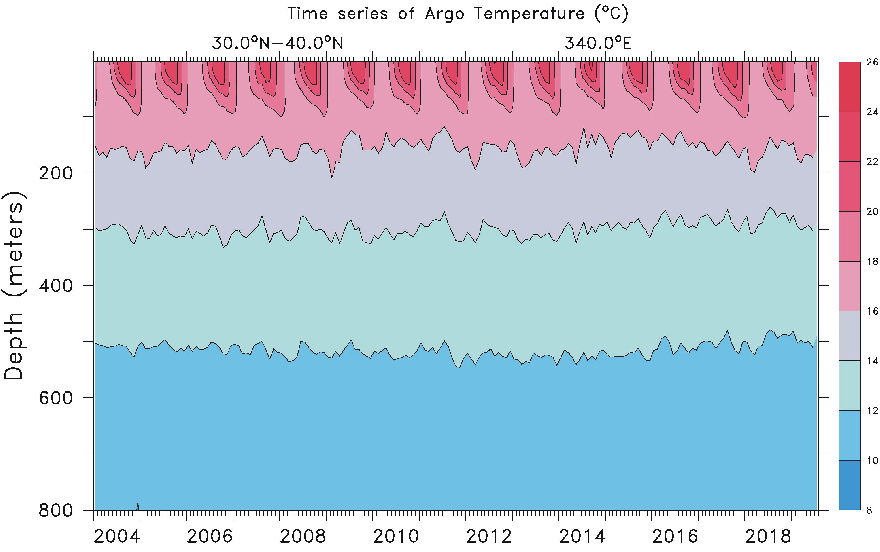
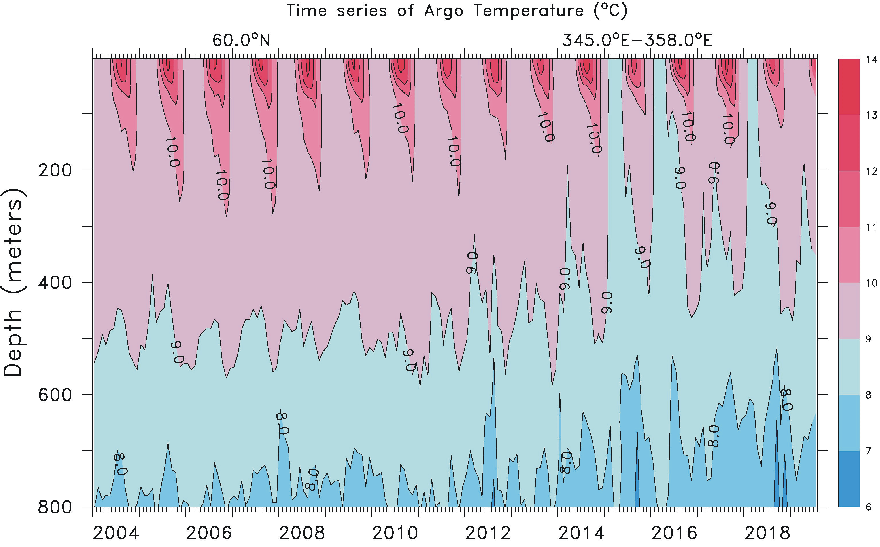
or
https://www.sciencedaily.com/releases/2019/05/190501114549.htm
“A swirling sea
The Great Whirl is a huge whirlpool that forms every spring off the coast of Somalia, when winds blowing across the Indian Ocean change direction from west to east. English geographer Alexander Findlay first described the Great Whirl in his navigational directory for the Indian Ocean in 1866.
…
The Great Whirl’s circular currents extend hundreds of meters downward and can go farther than 1 kilometer (0.6 miles) deep in some areas. The inertia it generates keeps the Whirl going well past the end of monsoon season in September, until typically disappearing late in the fall.”
If I may offer my 2p/2 cents worth, climate, we are told, is a non-linear or chaotic system. It is my understanding that in such a system small changes in one or more parameters can result in large systemic changes. Therefore,to fully comprehend such a system would require that all variables, no matter how insignificant they appear to be, have to be taken into account, as the butterfly wings cannot be identified.
The real problem is that this is all being modelled in the digital domain, which, as the discoverer of chaos theory found, means that rounding errors potentially could produce the “wrong” result. I have wondered whether an old fashioned analogue computer made from op-amps, zener diodes, resistors, capacitors and inductors might be a better option (it would be more fun too).
“The real problem is that this is all being modelled in the digital domain, which, as the discoverer of chaos theory found, means that rounding errors potentially could produce the “wrong” result.”
Add to that: nowadays computers CAN’T produce natural random numbers – there’s no formula, no algorithm till today to produce “natural random numbers”.
So even super computers can forecast what is the world like in 10 years, not to speak about 30 years –
– when we speak of “rounding errors” in a world based on nonlinear coupled systems with chaotic behavior.
That’s why Laplace’s Demon can’t foresee correctly the world’s state, not even for 10 minutes.
There is more unknown than known about the climate on our planet but they are sure there is a consensus and that 97% agree, although nobody can define the universe from which the 97% was identified.
Edwin, here we go:
https://www.ncbi.nlm.nih.gov › pmc
Webergebnisse
The Discovery of New Deep-Sea Hydrothermal Vent Communities in the …
von AD Rogers · 2012 · Zitiert von: 172 ·
03.01.2012 · Since the first discovery of deep-sea hydrothermal vents …. To the north, the Scotia Plate abuts the South American …
https://www.google.com/search?q=study+five+thermal+vents+off+the+SW+tip+of+South+America.&oq=study++five+thermal+vents+off+the+SW+tip+of+South+America.&aqs=chrome.
My fault – electrons –> electromagnetic material:
Edwin “energy lost by the diminishing geomagnetic field has been equal to the energy required to warm the ocean and the atmosphere, as observed”.
Would be a 0 sum game: either a magnetic field works as a “dynamo” producing warmth by accelerating electromagnetic material or existing energie no longer used for holding up the magnetic field is “used / available” directly as energie.
“Svensmark I think suggested that the sun’s influence on the galactic cosmic rays affects the rate of radioactive decay in the core” –
no one and nothing affects the radioactive decay in the core. + what we surface dweller mostly can get is the radioactive decay in Earth’s crust rather then in Earth’s core.
– while our sun doesn’t sport heavy urinium metals: our sun burns hydrogen + oxygen to helium, enough done with that, we have a generation I sun, heavy metals stem from long exploded generation III sun’s.
“Svensmark I think suggested that the sun’s influence on the galactic cosmic rays affects the rate of radioactive decay in the core” –
no one and nothing affects the radioactive decay in the core. + what we surface dweller mostly can get is the radioactive decay in Earth’s crust rather then in Earth’s core.
– since our sun doesn’t sport heavy urinium metals: our sun burns hydrogen + oxygen to helium, enough done with that, we have a generation I sun, heavy metals stem from long exploded generation III sun’s / stars.
Izaak Walton July 23, 2019 at 11:50 am
Geronimo,
So if there are 900000 undersea volcanoes then on average the same number
would be erupting every year.
____________________________________
Izaak, the point is: with 900,000 vulcanoes a year what do we argue tons of CO2.
tar and feathers and the biggest feather in your a$$ could be your costumes at the next Mardi Gras in New Orleans.