Guest eye-rolling by David Middleton
This eye-catching blog post was published in 2017 by “Fuel Fighter“…

Fuel Fighter sells home heating oil in the UK… Yet this has been treated as if it was an actual oil industry source.
It was picked up by Internet “news” sites like Business Insider…
The world’s deepest oil well is over 40,000 feet deep
Jeff Desjardins, Visual Capitalist Mar. 21, 2017, 7:33 PM
In the world’s deepest gold mine, workers will venture 2.5 miles (4 km) below the Earth’s surface to extract from a 30-inch (0.8m) wide vein of gold-rich ore.
While these depths are impressive, mining is limited by the frailty of the human body. Going much deeper would be incredibly dangerous, as limitations such as heat, humidity, logistics, and potential seismic activity all become more intense.
Luckily, the oil industry does not have such human obstacles, and drilling deep into the Earth’s crust is instead limited by a different set of circumstances – how deep can the machinery and technology go before the unfathomable heat and pressure renders it inoperable?
The world’s deepest oil well
Today’s infographic comes to us from Fuel Fighter, and it helps to visualize the mind-boggling depths of the world’s deepest oil well, which is located in a remote corner of eastern Russia.
[…]
Several “sciencey” websites also described it as the deepest oil well in the world and/or reposted the Fuel Fix infographic:
And it generated hilarious comments like this:
Remember folks: oil may be found 13 km deep but oil that’s of biotic origin! Rotten dinosaurs, honest!
Seriously, the Russians were right all along, oil is obviously of abiotic nature. Or at least, ALSO of abiotic nature.
“Cloggie” at Peak Oil
While several of the media reports and the Fuel Fix infographic allude to drilling “sideways” or “extended-reach,” they all seem omit the word “vertical.” And all of them leave the reader with the impression that this is the deepest oil well ever drilled. This isn’t even wrong.
When wells are drilled, the depth is measured from a reference datum, usually the Kelly bushing (KB) of the drilling rig. In vertical holes, the measured depth equals the true vertical depth. In directional drilling, the measured depth is greater than the true vertical depth. The greater the hole angle, the bigger the difference.
- MD = Measured Depth
- TVD = True Vertical Depth

Measured depth is basically how far the well was drilled. True vertical depth is how deep the well was drilled.
The Chayvo wells were impressive accomplishments…
ERD advances push limits on Chayvo wells
Apr 22, 2014
Extended-reach drilling project from onshore rig surpasses previous Sakhalin campaigns, sets world records for MDBy Vishwas P. Gupta, ExxonMobil Development Co; Angel H.P. Yeap, Kyle M. Fischer, Randall S. Mathis, Exxon Neftegas; Michael J. Egan, consultant to Exxon Neftegas
The second drilling campaign at the Chayvo field, located offshore Sakhalin Island, targeted a new reservoir zone using extended-reach wells from onshore. A total of four oil producers and one gas injector were planned to develop the northern portion of the reservoir. To effectively drain the east and west flanks of this reservoir, record-length wells beyond the current extended reach drilling (ERD) envelope were required. Key challenges included high torque and drag, wellbore positioning in a thin oil column, wellbore stability, long horizontal completions, and downhole tool telemetry.
Three of the project wells set ERD records for measured depth (MD). The longest well, Z-42, established records for MD (12,700 m) and horizontal reach (11,739 m). Completion designs were optimized to successfully run an approximately 3,600-m open-hole completion, and the well was finished in approximately 70 days.
[…]
Drilling Contractor
While the Chayvo wells are impressive in terms of measured depth, they aren’t particularly deep.

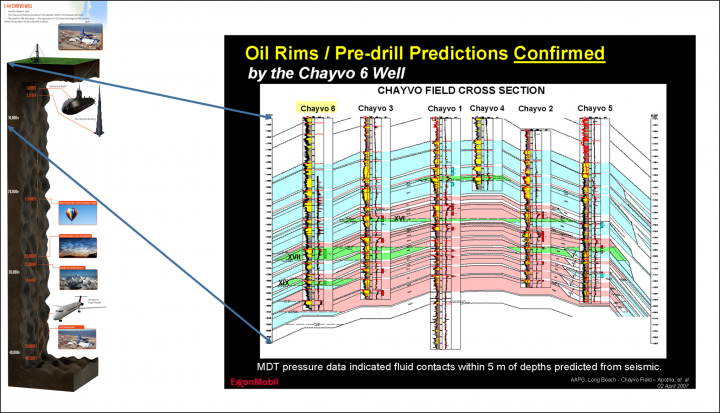
The measured depth (MD) of “the world’s deepest oil well” is over 40,000′. However, the true vertical depth of “the world’s deepest oil well” is only about a very unremarkable 11,000′ deep… The Z-44 well was designed for a horizontal completion, so its measured depth was exceptionally long. It’s not only not “the world’s deepest oil well,” it’s about 20,000′ shy of the deepest oil well in the Gulf of Mexico, possibly deepest in the world. BP’s Tiber discovery on Keathley Canyon Block 102 logged oil pay below 30,000′ TVD. Despite its depth, the bottomhole temperature was only about 280 °F, within the oil window. This discovery has yet to be developed. However, there are quite a few oil wells in the Gulf producing from oil reservoirs at true vertical depths of 20,000′ to 28,000′. All of these have bottomhole temperatures less than 300 °F
Deeper wells have been drilled for natural gas. One of the more interesting was the Lone Star Producing Company’s Bertha Rogers #1 in the Anadarko Basin of Oklahoma.
On April 13, 1974, Bertha Rogers No. 1 reached a total depth of 31,441 feet – where it encountered liquid sulfur. According to Lone Star Producing Company, the bottom hole pressure and temperature were an estimated 24,850 pounds per square inch and 475 degrees Fahrenheit respectively. It required about eight hours for bottom hole cuttings to reach the surface almost six miles above.
“It was the deepest hole in the world until it was surpassed by a well in the Soviet Union several years later,” Dorman reports. “Even so, Bertha Rogers reigned as the deepest well in the United States for three decades, finally exceeded in 2004.”
[…]
Although no gas was produced at its record depth, the well was successfully competed as a natural gas discovery at 13,000 feet. “Like its predecessors, the Bertha Rogers as a business venture was a losing proposition,” he notes. “It cost $7 million but yielded relatively little gas. Some observers classified it as an ultra-deep dry hole.”
[…]
Among the deepest wells in the world have been the “Kola Superdeep Borehole,” a 1989 experimental well drilled the Soviet Union. It reached 40,230 feet deep. In 2008, an oil well was drilled to 40,318 feet in Qatar. In 2011, a 40,502-foot well was drilled offshore of the Russian island of Sakhalin.
American Oil & Gas Historical Society
The MD vs TVD issue even evaded the notice of the American Oil & Gas Historical Society.
Personal connection: Lone Star Producing became Enserch Exploration in 1975 and was my first employer in the oil & gas industry. I worked for Enserch from 1981-1997. Many of the executives had pieces of sulfur that were recovered from the Bertha Rogers well.
The Chayvo oilfield
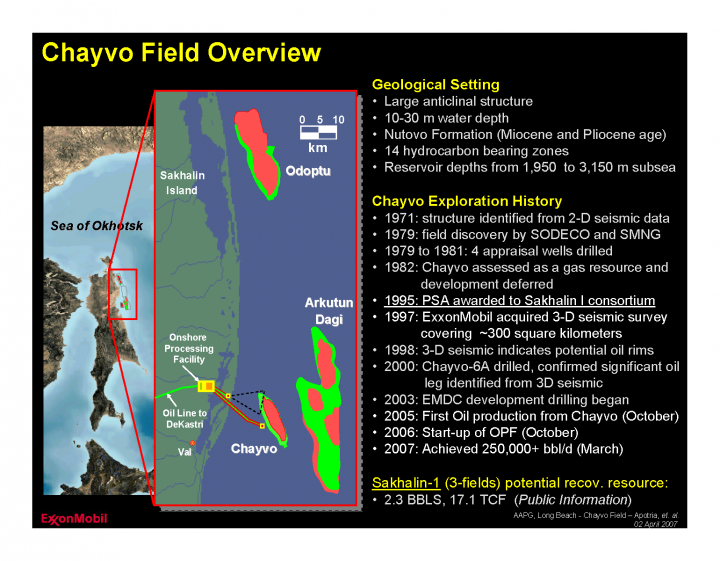
The Chayvo oilfield is very impressive for many reasons; however the depths of the wells and the oil & gas reservoirs are not among those reasons. The reservoirs are relatively shallow, young (Miocene to Pliocene Epochs) and the entire total petroleum system is within the Neogene Period (less than 23 million years old.
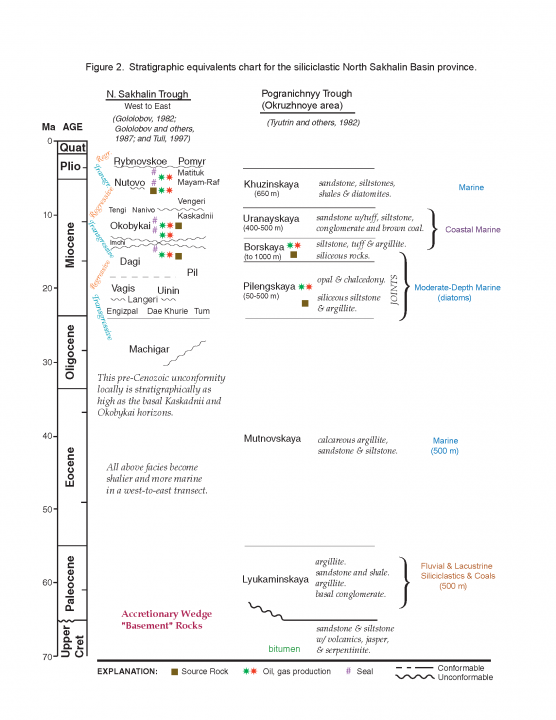
The Chayvo prospect was first identified on 2d seismic surveys in 1971, drilled in 1979 and assessed as a gas resource in 1982. At this time development was deferred. In the mid-1990’s, Russia opened up its oil & gas potential to western companies and ExxonMobil went to work:
Here is the Fuel Fighter infographic at the same scale as a cross-section of the Chayvo oilfield:
References
Apotria, Ted, Poffenberger, Mike, Powell, Rick & Venner, Bridget. (2005). Chayvo Field, Sakhalin Island, Russia: Identification of a Significant Oil Leg From 3D Seismic and Execution of a World-Class Extended-Reach-Drilling Program. AAPG 2007 Annual Convention, Long Beach, California, April 1-4, 2007. 10.2523/IPTC-10573-MS.
Handbook of Texas Online, Jeff Seidel, “ENSERCH CORPORATION,” accessed April 17, 2019, http://www.tshaonline.org/handbook/online/articles/dqe01. Uploaded on June 12, 2010. Published by the Texas State Historical Association.
Lindquist, Sandra J. & USGS World Energy Assessment Team. & Geological Survey (U.S.). Office of the World Energy Resources Program. & Geological Survey (U.S.). (2000). The North Sakhalin Neogene total petroleum system of eastern Russia. Denver, Colo : U.S. Dept. of the Interior, U.S. Geological Survey
If the energy return goes to less than about 12X the energy invested we are in trouble.
The Collapse of Complex Societies by Joseph Tainter – pdf The good stuff starts in Chapter 4.
https://wtf.tw/ref/tainter.pdf
https://youtu.be/GzuviYRse3E – about 3 minutes
EROEI is just about the dumbest concept to ever come out of academia. “Societies” don’t produce energy, businesses do.
1 barrel of crude oil = 5,722,000 Btu
1,000 cubic feet of natural gas = 1,037,000 Btu
Current prices:
WTI = $64.40/bbl = $11.25/million Btu
Natural gas (Henry Hub) = $2.70/mcf = $2.60/million Btu
I could “spend” 2 Btu of natural gas to produce 1 Btu of oil and make over a 2:1 return on capital. The bottom line isn’t denominated in joules, watts or Btu… It’s denominated in $$$.
I don’t spend energy to fill my gas tank. I don’t give energy back to the gas & electric companies in exchange for them being nice enough to heat and light my home. My company doesn’t drill for oil & gas to make energy.
I spend money to fill my gas tank. My company drills wells for oil & gas to make money. My gas & electric bills are paid for with money. My pay check, ChevronTexaco, ExxonMobil & Shell credit card statements and checks to the gas & electric companies aren’t denominated in joules, kilowatts or Btu – They are denominated in $.
I don’t give a rat’s @ur momisugly$$ if 1 barrel of amoeba farts uses less energy to produce than 1 barrel of crude oil… Because the barrel of amoeba farts costs $1,100 and can’t be produced in sufficient quantities to be waiting for me at the Chevron, Texaco, Exxon or Shell station when I need it.
If oil companies (or any businesses) used EROEI to guide their investment decisions, they would go out of business (unless the government was footing the bill).
The Lone Star Producing – Bertha Rogers was a dry hole, drilled near Sayer OK, but the Deep Anadarko Basin has some the deepest productive gas wells in the world. In the Sweetwater Gas field ( Jct 6 & US 283 , north of Sayer, OK ) most of the wells in the field were drilled to 20k 25k ft.
Sweetwater field is also the site of a huge blow out, the Apache – Keys #1, in 1982, when the tree was blown off the wellhead
Bertha Rogers technically wasn’t a dry hole. It was completed as as gas well in the Granite Wash at about 13,000′. It produced until 1997. Did it ever pay out the cost of drilling to 31,000′? Probably not.
Deep drilling in the Anadarko Basin is facilitated by a ~40,000′ thick sedimentary section and the top of geopressure can be deeper than 20,000′.
The zones were layers, about 7 potential zones, the Granite Wash was the last one to test as you came uphole. The layered zones made it practical to dill these very deep wells as a field. Those that hit one of the deep productive zones had an extremely long production life for a gas well, and still had all the remaining upper zones remaining to complete in the future.
The was an even more of a science experiment drilled south of Sayre towards Magnum & Granite.
They drilled assuming it was an overthrust, and tried drilling through the granite
You can see the entire Anardako geological sequence on the road cuts as you drive I35 through the Arbuckle Mountains, the zones are laying sideways
Definitely some cool roadside geology.