
From the University of Alabama, Huntsville. Jan 2, 2019
Global Temperature Report: December 2018
Global climate trend since Dec. 1 1978: +0.13 C per decade
December 2018 Temperatures (preliminary)
Global composite temp.: +0.25 C (+0.45 °F) above seasonal average
Northern Hemisphere.: +0.32 C (+0.58°F) above seasonal average
Southern Hemisphere.: +0.19 C (+0.34 °F) above seasonal average
Tropics.: +0.32 C (+0.58 °F) above seasonal average
November 2018 Temperatures (final)
Global composite temp.: +0.28 C (+0.50 °F) above seasonal average
Northern Hemisphere.: +0.27 C (+0.49°F) above seasonal average
Southern Hemisphere.: +0.30 C (+0.54 °F) above seasonal average
Tropics.: +0.50 C (+0.90 °F) above seasonal average
Notes on data released January 1, 2019 (v6.0)
The global average bulk-layer atmospheric temperature fell slightly in December to +0.25°C (+0.45°F) led by an unexpected dip in tropical temperatures. It seems the warm seawater temperatures in the tropical Pacific have cooled a bit. NOAA has indicated that this warm El Niño episode may be a mediocre one and the current modest changes support that view. Global temperatures at this point (December 2015) in the 2015-16 major El Niño were +0.47 °C and rising, eventually hitting +0.86 in February 2016. At the current +0.25 °C, the global temperature is well below that of the last event. The modest nature of the El Niño is more revealing In the tropics where the December satellite temperature values for the last two major El Niños (1997-8, 2015-6) were +0.72 and +0.64 °C respectively. As noted above, this December’s tropical temperature is +0.32 °C.
The month’s coldest seasonally-adjusted temperature departure from average was located near Altai in Western Mongolia (-3.7 °C, -6.6 °F) and the warmest near Dome Fuji in East Antarctica (+3.2 °C, +5.8 °F).
The monthly map for December 2018 shows the usual hot and cold alternating patterns in the higher latitudes of both hemispheres. This time, the cold regions are found in eastern Russia/Mongolia to Alaska, the North Atlantic and Eastern Europe in the Northern

Hemisphere. The warm spots are roughly in between these, landing in eastern Canada, Western Europe to northwestern Russia and eastern China to Japan. Australia was well above average too. The tropical band has shown a loss of heating with most of the region now near average.
The evidence for an approaching warm phase of El Niño continues according to NOAA, as the equatorial Pacific sea temperatures, both surface and deeper down, are still well above average, though have declined a bit since late November. A good portion of this extra heat should make its way to the atmosphere in the coming months. If this occurs, we should see considerable tropical warming in the atmospheric layer the satellites monitor.
Because this is December, we will also present diagrams for the entire year. For 2018 as a whole, the Northern Hemisphere’s mid-to-high latitudes were dominated by above average temperatures with the exception being regions in northeastern Canada to the northwestern Atlantic and Kazakhstan. Globally, the year was the 6th warmest of the past 40 calendar years as it was subject to a split personality, beginning with a modest La Niña (cold event) and ending with a modest El Niño (warm event).

Ten warmest years of the past 40 for the global lower troposphere.
| 2016 | 0.52 |
| 1998 | 0.48 |
| 2017 | 0.38 |
| 2010 | 0.34 |
| 2015 | 0.27 |
| 2018 | 0.23 |
| 2002 | 0.22 |
| 2005 | 0.20 |
| 2003 | 0.19 |
| 2014 | 0.19 |
Finally, a map of the 40-year trend (1979-2018) indicates most of the planet experienced a modest warming, overall being +0.13 °C per decade. Faster rates of warming occurred in the high northern latitudes, the conterminous U.S., Eastern Europe to the Black Sea and from China eastward to the North Pacific. In the Southern Hemisphere, a band from Brazil to New Zealand warmed faster than the global average. Patches of little warming or cooling are found in the north Atlantic, eastern subtropical Pacific and portions of Antarctica.


Spoiler Alert (Repeated): Well, the time is once again approaching when new changes are required for the currently operating satellites as their performance changes with age. NOAA-18 has been operating for 13 years and is now past its time frame for accurate diurnal adjustments based on initial drifting, meaning the adjustments are adding spurious warming to the time series. On the other hand, NOAA-19 has also drifted so far that it too is introducing an error, but given its direction of drift, these errors are of the opposite sign. The two satellites are almost compensating for each other, but not to our satisfaction. In addition, the current non-drifting satellite operated by the Europeans, MetOP-B, has not yet been adjusted or “neutralized” for it’s seasonal peculiarities related to the diurnal cycle. While these MetOP-B peculiarities do not affect the long-term global trend, they do introduce error within a particular year in specific locations over land. So, all in all, we anticipate generating new adjustments for NOAA-18 and NOAA-19 to account for their behavior of late and shall also modify MetOP-B to account for it’s unique seasonal cycle. This will be part of a coordinated plan to eventually merge NOAA’s new microwave sensor
(ATMS) carried on Suomi NPP and the new NOAA series JPSS. We are hoping that NOAA19 will be the last spacecraft for which drifting adjustments will be required as the newer satellites (MetOP, NPP, JPSS) have on-board propulsion to keep them in stable orbits. With so many new items to test and then incorporate, we are waiting until we are confident that these adjustments/additions are appropriately stable before moving to the next version. In the meantime, we shall continue to produce v6.0.
As part of an ongoing joint project between UAH, NOAA and NASA, Christy and Dr. Roy Spencer, an ESSC principal scientist, use data gathered by advanced microwave sounding units on NOAA, NASA and European satellites to get accurate temperature readings for almost all regions of the Earth. This includes remote desert, ocean and rain forest areas where reliable climate data are not otherwise available.
The satellite-based instruments measure the temperature of the atmosphere from the surface up to an altitude of about eight kilometers above sea level. Once the monthly temperature data are collected and processed, they are placed in a “public” computer file for immediate access by atmospheric scientists in the U.S. and abroad.
The complete version 6 lower troposphere dataset is available here:
http://www.nsstc.uah.edu/data/msu/v6.0/tlt/uahncdc_lt_6.0.txt
Archived color maps of local temperature anomalies are available on-line at:
Neither Christy nor Spencer receives any research support or funding from oil, coal or industrial companies or organizations, or from any private or special interest groups. All of their climate research funding comes from federal and state grants or contracts.
–30—
Updated 12PM PST: Headline added to, plus graph at top of post added, with comparison of Feb 2016 temperature. Graph from Dr. Roy Spencer, UAH.
Siberia, Alaska and Canada are warming since the LIA: the horror!
Actually
I don’t think it is – or it has been – warming in Alaska.
I have reliable data from Anchorage showing a downward trend of -0.01K per annum since 2000,
i.e. -0.2K in total
This means that on average the temperature in Anchorage is 0.2 degrees lower than it was 18 years ago,
In the case of minima, it is even worse. The trend here is -0.045K per annum since 2000,
that is 0.8 degrees C lower now than it was 18 years ago.
Funny. That -0.8, now versus 18 years ago.
I had exactly the same result that I measured here [in South Africa], but that was over 40 years.
https://www.dropbox.com/referrer_cleansing_redirect?hmac=jaP6qK%2BhahWhTzXJ3i7yFHDvVPg1FxldRrQJ2i9JoAw%3D&url=https%3A%2F%2Fwww.dropbox.com%2Fs%2Fh7944heslj7gg7q%2Fsummary%2520of%2520climate%2520change%2520south%2520africa.xlsx%3Fdl%3D0
seems the link that I gave does not work.
I try again:
https://www.dropbox.com/s/h7944heslj7gg7q/summary%20of%20climate%20change%20south%20africa.xlsx?dl=0
I thought it was getting a bit warm around here in South Oz-
https://www.msn.com/en-au/news/techandscience/earth-just-made-its-closest-approach-to-the-sun/ar-BBRLNBW
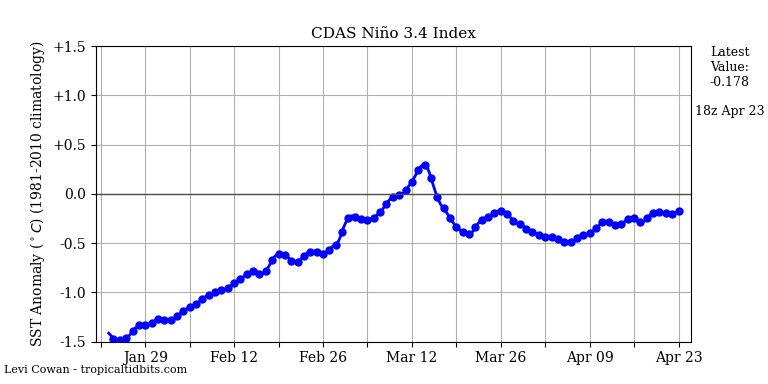
Meanwhile, the temperature in the Central Pacific has dropped.
http://tropic.ssec.wisc.edu/real-time/mtpw2m/product.php?color_type=tpw_nrl_colors&layer=tpw&prod=midpac×pan=24hrs&anim=html5
An interesting weather situation in North America. Lows cumulate around Hudson Bay and southern Greenland.

We’re roughly back at the 2002-2007 temperature level again. What happens over the this year will be very interesting, and will give us a better indication of whether the 2014-2016 El Niño will be followed by a step warming like the 1997-1998 was.
Looks like we could have another little temperature wobble, then a step change as NH winter in December 2020 moves in with a cooler temperature regime.
Darn it! More clouds over the crystal ball. 🙂
So, global warming is confirmed because 2018 was not the hottest year.
I have now read twice that the Satellites Measure from the Surface to the Top of the Atmosphere.
So WHERE ARE THE SURFACE TEMPERATURES?
Why do we only see Lower Trop average -9C and above even colder.
If the satellites can actually measure the surface temperatures why aren’t they published for all the areas where we actually have Thermometers to compare them to?
What is happening in the Trop is NOT what is happening at the surface where we live and where it is important.
@AC Osborn
my experience has been that you cannot rely on the sats because of issues with the degradation of the measuring instruments [when exposed to no atmosphere] and the uncertainty in the exact position of the satellite above earth.
When they knew things had gone wrong, either way, it appears to me that what RSS and UAH have done frequently is to re-allign with some of the terrestrial stations’ data sets –
which as such are unbalanced because there being so much more stations in the nh compared to the sh-
Anyway, they all still seem to believe that earth is still warming when in actual fact the opposite has happenend and this is in fact the reason for many of observed climate change.
Click on my name to read the way I approached the problem.
See my submission here
https://www.dropbox.com/s/tps2cd4kuds8o6g/SUBMISSION%20by%20Henry%20Pool.docx?dl=0
and do something similar IYOB to see whether the place where you live is actually warming or cooling?
Let me know what you find.
Given the strong sub-decadal variability seen throughout the UAH monthly data series, the decline from the record 2016 peak hardly constitutes any noteworthy “global cooling.” Much more noteworthy is the uninterrupted run of positive anomalies from early 2012 onward–by far the longest in the satellite era. It would require a similarly long run of negative anomalies to speak meaningfully of global cooling in any secular sense. Meanwhile, the current anomalies seem disinclined even to register values below ~0.25 C. That’s definitely still in the warm phase of any multidecadal oscillations.
This only indicates the disturbance of the ENSO cycle, which causes the strongest fluctuations in global temperature.
https://weather.gc.ca/saisons/animation_e.html?id=year&bc=sea
Current sea surface temperatures.

Yes it is in the warm phase, thank goodness, but that period is not that unusual.
The period from 2012 to the 2016 el nino running average rises by 0.5C with a plateau at 2013.
The period from 1985 to1988 ( a period of 1 year less) rise by 0.45C
The period from 1993 to1996 ( a period of 1 year less) rise by 0.40C
The period from 2008 to 2010 ( a period of 2 years less) also rise by 0.45C
But you have to remember that it is measuring the heat leaving the earth via the atmosphere.
I was sitting in the front gallery of my house, enjoying the pleasant afternoon warmth provided by – so they say – the sun. When it was time for other regions of the world to receive some energy, it became fresher on my gallery. Not very much, but noticeable. Today, a Friday, I found myself asking:
if human activities affect this tiny blue dot’s climate as much as scientists [quotation marks omitted on purpose] confirm, why didn’t I perceive a, however light, drop in temperature when the industrial hustle and bustle everywhere stops at the the end of the day ? And perhaps more so, at the end of a whole week ? Just a thought…
.-
Current circulation (polar vortex) in the central stratosphere.

Its simple.
It’s warmer in the day than at night because of the Sun.
It’s warmer in summer than in winter, because of the Sun.
It’s been warmer recently than it was a hundred years ago because of the Sun
All else is imagined, no more than superstition. As vast, organised, convinced and corrupt as the Catholic Church an army of the confused study the roons finding themselves ever more confused (but wonderfully rewarded for writing perverse scriptures). Even wuwt is drawn in, quoting those scriptures, debating the sermons of the priests.
The Sun is waning, heretics warn of the coming cold. Best to listen.
@chris
thx. I used some of your argument in my latest post.
http://breadonthewater.co.za/2019/01/06/does-man-made-climate-change-exist/