Nic Lewis skewers that “oceans are warming at unprecedented rates” paper
A major problem with the Resplandy et al. ocean heat uptake paper
by Nic Lewis
Obviously doubtful claims about new research regarding ocean content reveal how unquestioning Nature, climate scientists and the MSM are.
On November 1st there was extensive coverage in the mainstream media[i] and online[ii] of a paper just published in the prestigious journal Nature. The article,[iii] by Laure Resplandy of Princeton University, Ralph Keeling of the Scripps Institute of Oceanography and eight other authors, used a novel method to estimate heat uptake by the ocean over the period 1991–2016 and came up with an atypically high value.[iv] The press release [v] accompanying the Resplandy et al. paper was entitled “Earth’s oceans have absorbed 60 percent more heat per year than previously thought”,[vi] and said that this suggested that Earth is more sensitive to fossil-fuel emissions than previously thought.
I was asked for my thoughts on the Resplandy paper as soon as it obtained media coverage. Most commentators appear to have been content to rely on what was said in the press release. However, being a scientist, I thought it appropriate to read the paper itself, and if possible look at its data, before forming a view.
TREND ESTIMATES
The method used by Resplandy et al. was novel, and certainly worthy of publication. The authors start with observed changes in ‘atmospheric potential oxygen’ (ΔAPOOBS).[vii] In their model, one component of this change (ΔAPOClimate) is due to warming of the oceans, and they derived an estimate of its value by calculating values for the other components.[viii] A simple conversion factor then allows them to convert the trend in ΔAPOClimate into an estimate of ocean heat uptake (the trend in ocean heat content).
On page 1 they say:
From equation (1), we thereby find that ΔAPOClimate = 23.20 ± 12.20 per meg, corresponding to a least squares linear trend of +1.16 ± 0.15 per meg per year[ix]
A quick bit of mental arithmetic indicated that a change of 23.2 between 1991 and 2016 represented an annual rate of approximately 0.9, well below their 1.16 value. As that seemed surprising, I extracted the annual ΔAPO best-estimate values and uncertainties from the paper’s Extended Data Table 4[x] and computed the 1991–2016 least squares linear fit trend in the ΔAPOClimate values. The trend was 0.88, not 1.16, per meg per year, implying an ocean heat uptake estimate of 10.1 ZJ per year,[xi] well below the estimate in the paper of 13.3 ZJ per year.[xii]
Resplandy et al. derive ΔAPOClimate from estimates of ΔAPOOBS and of its other components, ΔAPOFF, ΔAPOCant, and ΔAPOAtmD, using – rearranging their equation (1):
ΔAPOClimate = ΔAPOOBS − ΔAPOFF − ΔAPOCant − ΔAPOAtmD
I derived the same best estimate trend when I allowed for uncertainty in each of the components of ΔAPOOBS, in the way that Resplandy et al.’s Methods description appears to indicate,[xiii] so my simple initial method of trend estimation does not explain the discrepancy.
Figure 1 shows how my 0.88 per meg per year linear fit trend (blue line) and Resplandy et al.’s 1.16 per meg per year trend (red line) compare with the underlying ΔAPOClimate data values.
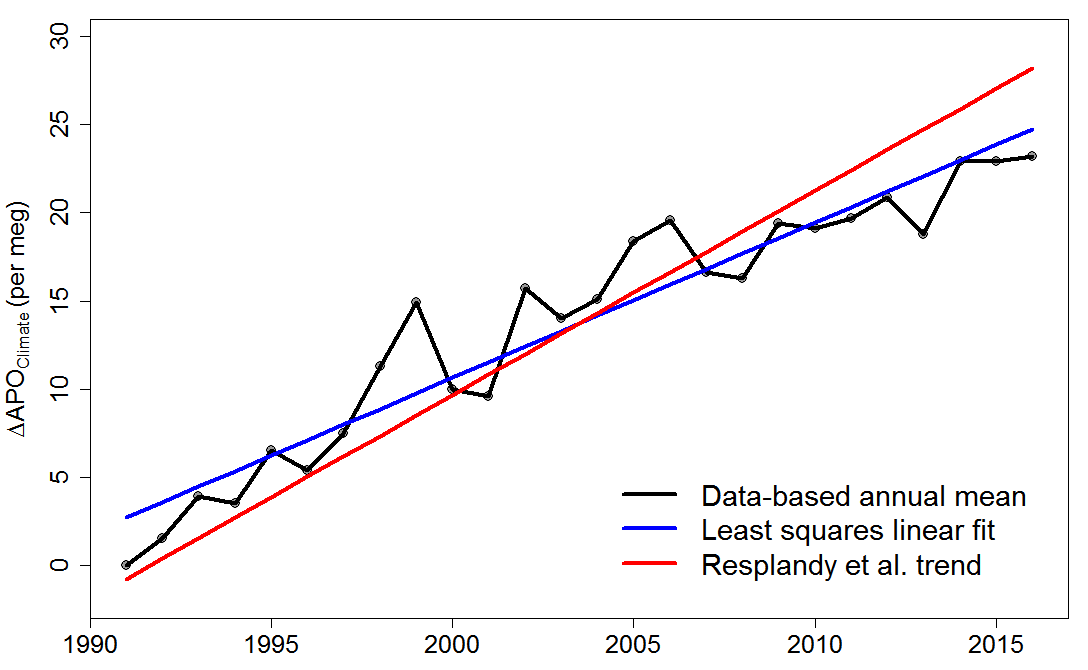
Figure 1. ΔAPOClimate data values (black), the least squares linear fit (blue line) to them, and the linear trend per Resplandy et al. (red line)
Assuming I am right that Resplandy et al. have miscalculated the trend in ΔAPOClimate, and hence the trend in ocean heat content (OHC), implied by their data, the corrected OHC trend estimate for 1991–2016 (Figure 2: lower horizontal red line) is about average compared with the other estimates they showed, and below the average for 1993–2016.
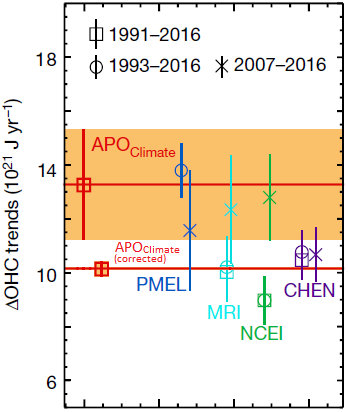
Figure 2. An adaptation of Figure 1b from Resplandy et al. with the
corrected estimate for the APOClimate derived ΔOHC trend added
(lower horizontal red line; no error bar is shown)
I wanted to make sure that I had not overlooked something in my calculations, so later on November 1st I emailed Laure Resplandy querying the ΔAPOClimatetrend figure in her paper and asking for her to look into the difference in our trend estimates as a matter of urgency, explaining that in view of the media coverage of the paper I was contemplating web-publishing a comment on it within a matter of days. To date I have had no substantive response from her, despite subsequently sending a further email containing the key analysis sections from a draft of this article.
Full post here
So much for “peer review” catching mistakes. Nature surely didn’t.
Dr. Roger Pielke did his own analysis and found the trend is wrong, just like Nic:
https://twitter.com/RogerPielkeJr/status/1059914350855507968
https://twitter.com/RogerPielkeJr/status/1060062668520742912
This smells of panic. The climagisterium are resorting to ever more desperate and shoddy fabrications of heat hiding where no-one can see it, as the signs of cooling in the climate actually experienced by people, grow unmistakable.
https://www.iceagenow.info/end-october-snow-in-parts-of-france-not-seen-since-100-years/
https://www.iceagenow.info/ski-resorts-in-the-alps-open-a-month-early/
https://www.iceagenow.info/spain-recovering-sheep-buried-in-deep-snow-video/
https://www.iceagenow.info/snow-in-morocco-far-far-earlier-than-usual/
No matter what constraints you put on humans, there will always be some who use their ingenuity to get around them. That’s why we have law enforcement. How long before AI can be used for peer review?
I am afraid the author is making the classic mistaking of thinking the value of this paper comes from its scientific validity and therefore this matters . But this is climate ‘science’ and this is not mark of quality , in this area what matters is ‘impact ‘ in the press . As this paper got a lot of traction and therefore ‘impact’ and it is therefore a ‘good paper ‘ its scientific validity or lack off means nothing at all .
The authors achieved their objective , the news moved on has they knew it would and their fellows in climate ‘science’ would congratulate them for a ‘job well done ‘ and facts be dammed .
BBC radio 5live (and others I expect) carried this in every news bulletin several times an hour for at least a day and had several special features on it with panting ‘climate scientists’ going we told you so.
Similarly it was all over the BBC TV news channel and national news.
They are probably never going to mention a retraction/correction, let alone give it such blanket prominent coverage.
They will need to put it on auto replay for the next few decades because UAH is headed down and not just from short term effects after super El Nino.
That every media outlet just happened on this study by chance seems highly unlikely, given its rather benign title “Quantification of ocean heat uptake from changes in atmospheric O2 and CO2 composition”
One wonders how such a lame sounding piece ended up as front page news around the world, being pushed and endorsed by cub journalists.
One wonders whether a PR firm was engaged to publicise it, and distill the details for journalists, not that there’s anything wrong with that.
It just seems to have grown a life of its own, on foot of journalists’ reading of it, which seems unlikely given the quality of today’s journalism in general.
“Earth’s oceans have absorbed 60 percent more heat per year than previously thought”
But shouldn’t that mean that sea levels have risen much faster – where did all those atolls go?
The trouble is that the oceans absorb a lot of heat. An increase of 60% requires more heat than is available.
They keep looking for the “missing heat”, since the atmosphere isn’t warming as the models say it should be. Then, wonder of wonders, they “find” it in the oceans. Eureka. Because CO2 heat is tricky that way. You never know where it will turn up – maybe even in your backyard, so watch out.
Whatever happened to Yamal 06?
Did they through it in the ocean?
I had always thought that heat rises and cold falls. So how come the surface of the Oceans have not become very hot, and then evaporated as normal ?
MJE
Maybe they accidentally thought their series started in 1995, conveniently forgetting 1991, thereby taking the time corresponding to the oceanic heat uptake estimate (using outgassed CO2 and O2 proxies) to 12 instead of 16 years.
12/16 = approx. 0.88 / 1.16
Would be a pretty sophomoric mistake, but understandable if the entire team suffers from confirmation bias.
I saw something similar but its hard to believe… Someone looks at APO (climate) of 23.20 +/- and takes a swag dividing by 20 years instead of 25. 23.20/20 = 1.16 and they’re off to the races…
In Figure 3, the data shows that it idoesn’t follow the linear trend but follows non-linear trend. That means later part show a little increase.
sjreddy
Thanks for pointing that out, Dr. Reddy. I enjoy reading your comments.
All the fancy notations aside, when the waters of the planet hold 99.9% of the planetary heat, how can an increase from three CO2 molecules in every ten thousand to four cause the kind of heat release that SSTs have exhibited over the the last 30 yrs?
These alarmist people have no common sense from my perspective.
Sorry, should have said “…ten thousand molecules of the atmosphere to four…”.
You would be surprise how many people, or their brains rather, put that word right in there themselves, as I did.
I also downloaded the data. Sure enough, the slope is 0.88 as indicated by Mr. Lewis.
You don’t need to be a climate scientist to run a linear regression.
From what I have seen, you have to be not a climate scientist to run a linear regression. After all, they have problems understanding fourth grade averages.
So what they are saying is we won’t need to bother with a heated chakuzi on the deck, we’d just get a bag of mushy peas and chips and sit on the beach until the tide came in?
Even if one gets ‘all’ the supporting data, the evidence for proxy work by Mann and notable others is strong that they shoppped the well established statistical methods and didn’t get a convincing result. This would be no surprise when one of the objectives is to disappear the historically well established LIA and the competing MWP. These two disruptive climate events are among the handful of climate swings for which there can be no reasonable doubt.
The failed standard statistical trials will not be archived with the data, of course. For this we have to turn to the likes of Steve McIntyre who showed us what real statistics reveal. In addition, his analysis showed that Mann’s ‘novel’ method had the property of always giving a hockeystick when applied to white noise!