Nic Lewis skewers that “oceans are warming at unprecedented rates” paper
A major problem with the Resplandy et al. ocean heat uptake paper
by Nic Lewis
Obviously doubtful claims about new research regarding ocean content reveal how unquestioning Nature, climate scientists and the MSM are.
On November 1st there was extensive coverage in the mainstream media[i] and online[ii] of a paper just published in the prestigious journal Nature. The article,[iii] by Laure Resplandy of Princeton University, Ralph Keeling of the Scripps Institute of Oceanography and eight other authors, used a novel method to estimate heat uptake by the ocean over the period 1991–2016 and came up with an atypically high value.[iv] The press release [v] accompanying the Resplandy et al. paper was entitled “Earth’s oceans have absorbed 60 percent more heat per year than previously thought”,[vi] and said that this suggested that Earth is more sensitive to fossil-fuel emissions than previously thought.
I was asked for my thoughts on the Resplandy paper as soon as it obtained media coverage. Most commentators appear to have been content to rely on what was said in the press release. However, being a scientist, I thought it appropriate to read the paper itself, and if possible look at its data, before forming a view.
TREND ESTIMATES
The method used by Resplandy et al. was novel, and certainly worthy of publication. The authors start with observed changes in ‘atmospheric potential oxygen’ (ΔAPOOBS).[vii] In their model, one component of this change (ΔAPOClimate) is due to warming of the oceans, and they derived an estimate of its value by calculating values for the other components.[viii] A simple conversion factor then allows them to convert the trend in ΔAPOClimate into an estimate of ocean heat uptake (the trend in ocean heat content).
On page 1 they say:
From equation (1), we thereby find that ΔAPOClimate = 23.20 ± 12.20 per meg, corresponding to a least squares linear trend of +1.16 ± 0.15 per meg per year[ix]
A quick bit of mental arithmetic indicated that a change of 23.2 between 1991 and 2016 represented an annual rate of approximately 0.9, well below their 1.16 value. As that seemed surprising, I extracted the annual ΔAPO best-estimate values and uncertainties from the paper’s Extended Data Table 4[x] and computed the 1991–2016 least squares linear fit trend in the ΔAPOClimate values. The trend was 0.88, not 1.16, per meg per year, implying an ocean heat uptake estimate of 10.1 ZJ per year,[xi] well below the estimate in the paper of 13.3 ZJ per year.[xii]
Resplandy et al. derive ΔAPOClimate from estimates of ΔAPOOBS and of its other components, ΔAPOFF, ΔAPOCant, and ΔAPOAtmD, using – rearranging their equation (1):
ΔAPOClimate = ΔAPOOBS − ΔAPOFF − ΔAPOCant − ΔAPOAtmD
I derived the same best estimate trend when I allowed for uncertainty in each of the components of ΔAPOOBS, in the way that Resplandy et al.’s Methods description appears to indicate,[xiii] so my simple initial method of trend estimation does not explain the discrepancy.
Figure 1 shows how my 0.88 per meg per year linear fit trend (blue line) and Resplandy et al.’s 1.16 per meg per year trend (red line) compare with the underlying ΔAPOClimate data values.
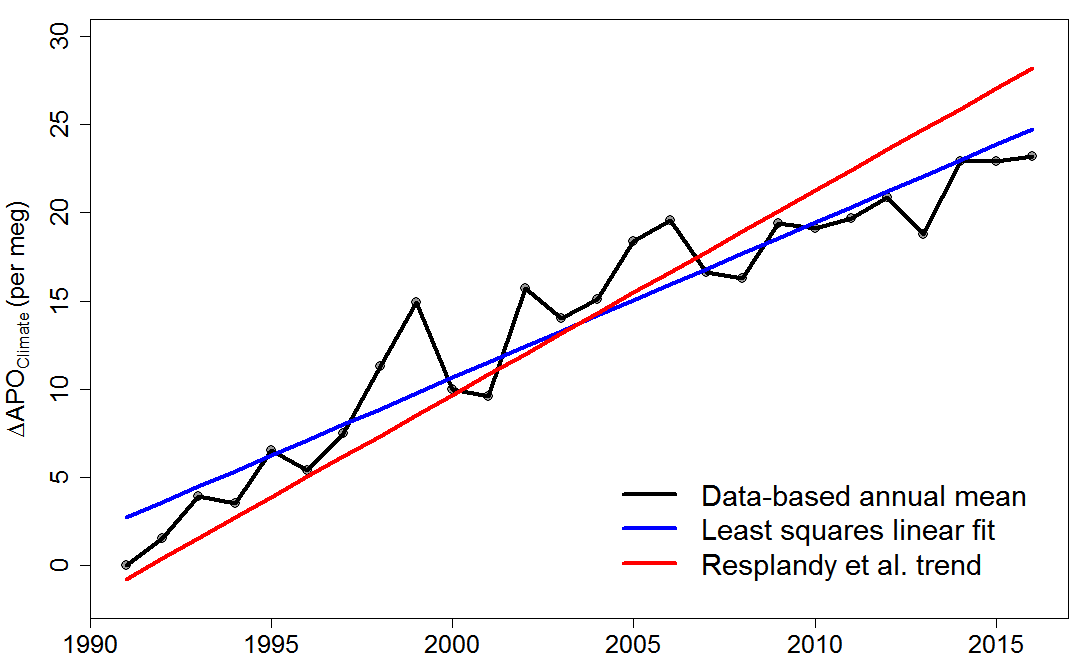
Figure 1. ΔAPOClimate data values (black), the least squares linear fit (blue line) to them, and the linear trend per Resplandy et al. (red line)
Assuming I am right that Resplandy et al. have miscalculated the trend in ΔAPOClimate, and hence the trend in ocean heat content (OHC), implied by their data, the corrected OHC trend estimate for 1991–2016 (Figure 2: lower horizontal red line) is about average compared with the other estimates they showed, and below the average for 1993–2016.
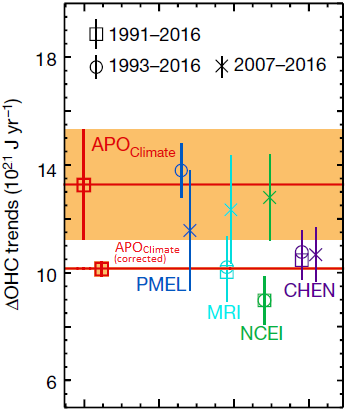
Figure 2. An adaptation of Figure 1b from Resplandy et al. with the
corrected estimate for the APOClimate derived ΔOHC trend added
(lower horizontal red line; no error bar is shown)
I wanted to make sure that I had not overlooked something in my calculations, so later on November 1st I emailed Laure Resplandy querying the ΔAPOClimatetrend figure in her paper and asking for her to look into the difference in our trend estimates as a matter of urgency, explaining that in view of the media coverage of the paper I was contemplating web-publishing a comment on it within a matter of days. To date I have had no substantive response from her, despite subsequently sending a further email containing the key analysis sections from a draft of this article.
Full post here
So much for “peer review” catching mistakes. Nature surely didn’t.
Dr. Roger Pielke did his own analysis and found the trend is wrong, just like Nic:
https://twitter.com/RogerPielkeJr/status/1059914350855507968
https://twitter.com/RogerPielkeJr/status/1060062668520742912
Mistakes are one thing. Fraud is another. Not saying what happened here, but in the agenda-driven world of climate science nothing would surprise me.
As Mdm Cicero of our times had said “What difference does it make?”
No one seems to have picked up on how extremely uncertain the results are. As stated above,
ΔAPOClimate = 23.20 ± 12.20 where the stated uncertainty is only ± one standard deviation. Using the more common two standard deviations, the ΔAPOClimate would be stated as having a range of from -1.2 to 47.6. That doesn’t provide a lot of confidence that the correct value is well characterized. It isn’t much better than an educated guess, despite mathematics being used to arrive at the answer. Further, a correction factor (1.1) is used in the calculations, which itself is poorly characterized, and should limit the final answer to no more than 2 significant figures.
So, two emails to Laure Resplandy essentially saying, ‘get back to me quickly or I’ll publicly expose your mistakes’ and Resplandy does nothing.
I personally can’t imagine what’s going through Resplandy’s mind. “Oh, I’ll just ignore one of the biggest cock ups in climate science history and it’ll all just go away”.
The journal Nature obviously shoulders some responsibility here, not least for a public exposure of the inadequacies of the peer review system. Just wait until Booker and Dellingpole get hold of it, they’ll rip the whole thing to bits in dramatic style.
There will be, rightly so, accusations of incompetence and if the accusations aren’t answered satisfactorily, accusations of collusion to pervert the course of climate science (to coin a phrase).
How much faith will people retain with Nature and the climate scam in general which has been once again, exposed as a monumental fraud.
“What matters more is what you do next.”
…. and crickets from Resplandy, et al suggests what comes next.
This is of course post-modern Climate Science we’re talking about. The consensus within the Climate Priesthood cannot be challenged. Besides, why should Mikey Mann be the only one allowed a Nature Trick?
As an aside:
I had looked into the Resplandy et al paper too. I did not recalc their ΔAPOClimate number as Nic did.
As a trained biologist, I took issue of their ΔAPOAtmD estimate. Essentially they use precision deltaO2 readings to estimate ocean out-gassing of O2 due to the physical chemistry of a decrease in O2 solubility as OHC increases (warmer water can hold less gas, O2 in this case). But this of course is greatly confounded by a greening world due to CO2 fertilization effects both marine and terrestrial photosynthesis greening. Primary production in most of the oceans is slowly increasing under a higher pCO2 effects just as it is happening on land. Looking at the numbers, it appears to me they under-estimate the contribution of ΔAPOAtmD for the period studied by at least 10%. This underestimate of the biological process of O2 creation allows them to attribute more of the measured change to outgassing (physical process).
Due to the arcane nature of everything involved, the hidden, sleight of hand cherry-picking abounds all over Climate Science in order to get published and make a splash.
Evidently, when it comes to supporting climate alarm-ism, it is more important to be first than to be correct.
The authors are PhD’s at the top of their fields and they got a basic linear regression wrong? Pretty unbelievable.
Princeton…. Home to Prin. U, Prin. Env. Inst. and Climate Central whose address places it in the highest rent district in town. Very liberal town with a few exceptions, one of which is Will Happer.
Anthony, maybe the other kids would like you better if stopped pointing out their mistakes. Just kidding, of course… Also, perhaps Nature would publish the paper on the math error in the standard feedback formula if you came to a truce — if they publish the paper, you won’t point out any errors in anything they publish for six months!
Wrong way modeling in medical research leads to retractions, lawsuits, and regulatory actions depending on who did it. In climate science it leads to promotion, media coverage, policy advisement, expert witness jobs, and long-running research citation.
I guess the science quality difference comes down to actual lives at risk versus virtual, modeled lives lost. The virtual lives are easier for politicians to spin with low liability cost and no fact checking.
ARGO says otherwise….
http://climate4you.com/images/ArgoTimeSeriesTemp59N.JPG
I am reminded of the debacle resulting from scientists thinking they had found anisotropy of polarization in the Cosmic Micrwave Background (the BICEP2 experiment in Antartica). Instead of simply reporting this finding they couldn’t resisit jumping the gun and declaring publicly that they had proven the cosmological theory of Inflation was correct (more or less).
This resulted in a big media flurry and the paper’s authors got their 15 minutes of fame. Unfortunately they hadn’t done all their homework and it was later shown that their results were dubious at best. Large bit of egg on their faces. And they didn’t have a large cadre of politically motivated folks there to catch them when they fell.
There’s a good interview with Neil Turok on youtube where he discusses this (about 17:00 in the video).
Unfortunately, this is climate “science”. So expecting a correction, or even a discussion as to why she stands behind her original claim, is just not done.
One of these days I’m gonna wake up and find the models tell me the average temperature is 150 degrees, and I have been living under rapidly rising seas for over 10 years.
Oh crap!
The data plot looks to me to be governed by a logarithmic (more natural) rather than the linear law; If that is the case as I suspect that it might be, then the warming is slowing down and is heading for a plateau.
Has no-one picked up on the weighting of data points yet in the LMS averaging? By weighting the data for uncertainty the later measurements are made less significant letting thevs steeper trend of the earlier year’s dominate
https://mobile.twitter.com/micefearboggis/status/1058817553097785350
Well Done, Nic Lewis!
I would like an explanation of what “meg” is.
The paper says it is explained somewhere, but i have not found it.
I find most of the comments here a little unfair. The work may use wrong trend and/or misstate the used trend type, and the authors have gone PR and policy implications ahead, but most of the crap is due to the fact how media picks up new papers like this before the scientific discussion has been held. Atomsk at Curry’s inadvertently reveals another issue, which is the community’s unwillingness to communicate jnoffically with people from other tribes, leading to sluggish or missing response. Why should I talk to you when you are just trying to find an error from my paper? Publish a comment! (which my team will try to block)
Media cherry-picked possibly a very overly alarmist paper, as usually. That’s the shit. People get a very biased visibility to better-than/worse-than-thought discussion.
It’s fodder for the true believers… “scientists say” .. who cares after the fact whether it was wrong. It becomes centered in somebody’s head. Similar to people who say, ” ________ said it, I believe, end of discussion. ”
It reaffirms the religious belief in AGW lacking foundation or merit.
It’s been the same story now for the last 20 + years. The true believers will trot this out as evidence that the heat is indeed hiding in the oceans. So in response, since the hue and cry in 2001 was ” thermal expansion”, where is it? What can of spin can they put on this that would equate to ‘thermal expansion’ not happening?
Peer review fail “even at Nature” is not new. It’s a product of groupthink
https://tambonthongchai.com/2018/05/06/consensus-science/
The proxy for ocean temperature used involves subtracting relatively large numbers to give a small difference as a result (see Fig.3a of the Resplandy paper)–which should immediately raise a red flag.A competent reviewer would require a very careful error analysis involving both precision and, more importantly, bias errors.As noted already, one sigma is a weak requirement for precision errors, and there is no meaningful assessment of bias errors.The prior comments of Joel O’Bryan and Richard M are very relevant.I also found the paper poorly written, and compliment Nic Lewis for his efforts to examine it carefully–such work seldom earns proper recognition and reward.
Looks to me like its slowing down.
Steep at the start of the data, less steep at the end.
What happens when you try a curved fit rather than assuming linearity…. why linearity anyway ? !!
I’m not 100% sure that a lack of response means much at this stage. There are 10 authors/co-authors, and any response should involve all of them or, at least, give each an opportunity to offer input. Easier said than done.
A quick response might paint the authors into a corner. The safest stratecy is staying silent until they’ve completed their damage assessment/damage control and consulted the editors. If I were Resplandy, I’d be trying to generate enough minor corrections and corrections to the corrections to take attention away from the major errors, and expanding the supplementary material in useful ways. This all takes time.
It’s not Publish-or-Perish; it’s Publish-and-or-Perish. I suspect Resplandy et al were under time pressure.
I went to a physics seminar about “cold fusion” when fame got ahead of the reality. Recall good account of the actual physics and improbabilities therein. Like too many disciplines, got to have your press releases, hypotheses, by definition usually wrong, too often elevated. Not good for long thoughtful analysis necessary for problem solving.
“(insert superlative, greater/lesser/etc.) than previously thought/known.” It’s juvenile, been there, fortunately back in disciplinary days. Walking down the halls of at least some science departments, they look like perpetual displays at meetings. Interesting but overwhelming.