By Andy May
The following is a quote from my book Climate Catastrophe! Science or Science Fiction?
“99.9 percent of the Earth’s surface heat capacity is in the oceans and less than 0.1 percent is in the atmosphere. Further, CO2 is only 0.04 percent of the atmosphere. It beggars belief that a trace gas (CO2), in an atmosphere that itself contains only a trace amount of the total thermal energy on the surface of the Earth, can control the climate of the Earth. This is not the tail wagging the dog, this is a flea on the tail of the dog wagging the dog.”
One would think that this is clear, but to some it clearly is not. A commenter on Amazon.com named “Stephen” thinks it is “Scientific gibberish” and explains as follows:
“Apparently, May believes that the way CO2 acts to heat the earth is by getting hot. Then, the CO2 transfers its heat to the rest of the earth. Since the heat capacity of the CO2 is negligible, the earth’s temperature cannot rise.
This represents a profound misunderstanding of how the greenhouse effect works. The amount of heat contained in the CO2 has nothing whatsoever to do with CO2‘s effect on temperature. CO2‘s effect is to prevent radiative heat transfer from the earth [sic] to space. That is, it keeps the heat in.
Here is a way to think about this. Imagine that you have a pot of hot water sitting on the counter. If the pot is open to the air, it will cool quickly. If the pot is covered, it will cool more slowly. It doesn’t matter if the cover is made out of Saran wrap, which has no heat capacity–it will still keep the water hot. This analogy isn’t perfect since the water may be losing heat mostly by convective heat transfer. But the point is that CO2 is acting by keeping the heat in; it doesn’t actually heat the earth.”
He obviously did not read the book and misses the significance of the large difference between the heat capacity of the oceans and the atmosphere. He also misses the significance of “… control the climate of the Earth.” OMG! I’ve been quoted out of context, that never happens! But, since Stephen does seem to understand a little of the science, I did respond. The version below is edited a bit for this post, the actual answer is on Amazon.com.
What does this quote mean?
As you will see when you read my book, the IPCC AR5 Physical Science Basis report (2013) states on page 667 that “CO2 is the main anthropogenic control knob on climate.” This is also in the title of a paper by Lacis, et al. (2010) cited in the IPCC report. Both works acknowledge that the infrared active CO2 alone does not have enough of an effect to cause problems. But, if the atmospheric CO2 concentration increases, due to burning fossil fuels, the IPCC authors claim the lower atmosphere will warm due to the resulting additional delay in the radiative transfer of thermal energy to space. This warming will cause the amount of water vapor to increase in the lower atmosphere. Water vapor is a much stronger “greenhouse gas” and this will cause the problem they espouse.
In addition, the same IPCC report states on page 7 that they present “clear and robust conclusions … that the science now shows with 95 percent certainty that human activity is the dominant cause of observed warming since the mid-20th century.” Of course, the human effect on climate has never been measured, so the “95%” confidence is based solely upon computer models and “expert” opinion.
There are several problems with these ideas. Most heat transfer in the lower atmosphere, where there is a lot of water vapor, occurs via convection. Water vapor (and water) have a high heat capacity and carry a lot of latent heat, they transport most of the thermal energy near the surface in the so-called atmospheric “boundary layer.” CO2 has a low heat capacity. It is infrared active and absorbs and emits IR radiation, with a small delay, whereas latent heat can be carried by water vapor for weeks before it condenses as rain and emits it as radiant energy. At high altitudes, where there is little water vapor, it is responsible for emitting most of the IR to space as thermal radiation. But, near the surface water vapor does most of the cooling.
The oceans are very cool, with an average temperature of about 4 degrees C. As stated in the quote, they contain 1,000 times the heat capacity of the atmosphere and provide a huge buffer that limits the Earth’s surface temperature. Most of the solar thermal energy that reaches the surface is absorbed by the oceans. The warmest part of the ocean is the surface of the tropical Pacific. Here evaporation limits the temperature to a maximum of 30 degrees C (86 degrees F) according to many sources, but Newell and Dopplick (1978, J. of Applied Meteorology, Vol. 18, page 822) and Newell, Navato and Hsiung (1978 in Pure Applied Geophysics, Vol 116, page 351) are the original sources. In isolated shallow seas, for example the Red Sea or the Caribbean, or close to land in unusual meteorological conditions, sea-surface temperatures may reach as much as 34 degrees. But, in the open ocean the limit is generally 30 degrees. This is the temperature where the thermal energy lost to evaporation is about the same as the energy received from the Sun.
This energy is transmitted all over the world, mostly by ocean currents, but also by wind. It is emitted to space, mostly by CO2, in net emitting areas like the poles and the Sahara, and from the upper atmosphere. Thunderstorms are a main mechanism for transporting thermal energy to the upper atmosphere where it is easily emitted to space. Thus, the point of the quote is that the atmosphere (and thus CO2, a trace gas in the atmosphere) cannot “control” the climate if oceans exist. The oceans are the main control. If they were to completely disappear somehow (unlikely) then CO2 may play a role in long-term climate. But, if they exist, the maximum ocean surface temperature is 30 degrees. Since the oceans cover 70% of the Earth’s surface, this limits the maximum surface temperature.
One last point, in the first quote I state that 99.9% of the heat capacity is in the oceans and 0.1% is in the atmosphere. I ignored the heat capacity of the land because temperature measurements on land are made in the air above the land. Normally at about 2 meters altitude.
(Note – this comment addresses AGW theory, not its consequences. Although the title of the article is about whether GW is a “problem,” it seems that Andy is debating the point that CO2 is a significant driver of the Earth’s energy budget)
If greenhouse gases play no role in keeping heat within the Earth’s atmosphere, what is doing so? Water vapor plays a role, but it doesn’t absorb radiation at all wavelengths, leaving a “window” open through which radiation can escape to space.
“The most important of these ‘water vapor windows’ is for thermal infrared with wavelengths centered around 10 micrometers. (The maximum transparency occurs at 10 micrometers, but partial transparency occurs for wavelengths between about 8 and about 14 micrometers.)
“Carbon dioxide is a very strong absorber of thermal infrared energy with wavelengths longer than 12-13 micrometers, which means that increasing concentrations of carbon dioxide partially ‘close’ the atmospheric window. In other words, wavelengths of outgoing thermal infrared energy that our atmosphere’s most abundant greenhouse gas—water vapor—would have let escape to space are instead absorbed by carbon dioxide.” Peak radiation from the Earth’s surface is around 12.5 micrometers. (https://earthobservatory.nasa.gov/Features/EnergyBalance/page5.php and …page7.php).
IPCC AR5 Physical Science Basis report (2013) states on page 667 that
“Currently, water vapour has the largest greenhouse effect in the Earth’s atmosphere. However, other greenhouse gases, primarily CO2, are necessary to sustain the presence of water vapour in the atmosphere.” I don’t understand how Andy can draw from this that “the infrared active CO2 alone does not have enough of an effect to cause problems.” No one argues that CO2 alone is heating the Earth – it is the sun’s energy that is doing so. Any increase in water vapor is a product of increased temperature, not ultimate the cause of it. Andy’s arguments about evaporation, convection and the oceans are largely irrelevant to the general picture of the Earth’s energy budget, and therefore to the theory of AGW; they only address the outcome.
Perhaps the most important argument is one that he did not discuss: that increased evaporation might lead to increased cloud cover, reflecting more sunlight back to space. As many here know, the relative strength of the positive and negative effects of water vapor is one of the main sources of debate and uncertainty in climate model projections, partly because clouds are so variable and hard to model at current resolutions. Still, this doesn’t change the fact that increased CO2 is the ultimate driver of these effects, and (this is strictly speculation on my part) it seems unlikely that clouds would tend to *stay* in the atmosphere longer or become qualitatively different, reflecting energy enough to compensate for increased GHG effects (unless perhaps if there is for some reason a long-term increase in aerosols).
On page 4 in the above link, there is this preface:
“Determining exact values for energy flows in the Earth system is an area of ongoing climate research. Different estimates exist, and all estimates have some uncertainty. Estimates come from satellite observations, ground-based observations, and numerical weather models. The numbers in this article rely most heavily on direct satellite observations of reflected sunlight and thermal infrared energy radiated by the atmosphere and the surface.”
In other words, the energy balance is not just theoretical or the product of models, it has been measured. True, there is uncertainty to these measurements, and one could argue that “the human effect on climate has never been measured” DIRECTLY, but there are many observations in science that can only be measured indirectly. Who would argue that the distance of stars from Earth cannot be known because we can only measure it indirectly? (For that matter, even temperature is measured [or, in reality, estimated] indirectly, through the use of instruments.) Given a measured imbalance in the energy budget and the fact that it can be accounted for by an increase in the CO2 in the atmosphere that has come from the burning of fossil fuels (and that can be established by isotope ratios), I don’t quite understand how that can be dismissed.
Even if ALL the extra heat were being soaked up by the oceans, that is no argument against AGW, nor does that mean that it’s not a concern.
There are those who accept that the Earth is warming, but attribute it to different causes, such as solar variability or El Nino events. Why is there not a single hypothesis that skeptics can all agree on after all this time unless none of them is good enough to explain the observations? It weakens the argument that mainstream climate scientists should have by now come up with all the answers, and models should be both accurate and precise. Climate is complex and the understanding of it takes time.
It seems to me that in order to reject AGW once and for all, the basic physics of role of atmospheric CO2 in the system would have to be refuted, and no one has done that – if they had, it would be huge news, of the kind that no journal editor in his right mind would try to suppress. Merely asserting that a small increase in atmospheric CO2 would make no difference is not enough. This is why most reputable contrarian climate scientists now focus their skepticism on the long-term effects of global warming rather than its cause.
Most skeptics point out that the effect on temperature of more CO2 is trivial, not that it has no effect. OTOH, the effect of more plant food in the air has demonstrably, significantly benefited terrestrial life.
Compare the pressure of carbon dioxide in the air and the human body.

The alveolar oxygen partial pressure is lower than the atmospheric O2 partial pressure for two reasons.
Firstly, as the air enters the lungs, it is humidified by the upper airway and thus the partial pressure of water vapour (47 mmHg) reduces the oxygen partial pressure to about 150 mmHg.
The rest of the difference is due to the continual uptake of oxygen by the pulmonary capillaries, and the continual diffusion of CO2 out of the capillaries into the alveoli.
https://en.wikipedia.org/wiki/Pulmonary_gas_pressures
An awful lot of misunderstood physics here. First, the entire atmosphere radiates to space, not just CO2. Second, the effect of increased CO2 is to raise the altitude at which the entire atmosphere radiates freely to space. CO2 at some concentration is opaque to outgoing 15-micron IR, corresponding to -80 C, about the temp at the Top of Atmosphere.
So, CO2 is a significant factor to the overall amount of heat in the atmosphere. The only problem is, there is no way to calculate the effect of increased CO2 at the TOA. All the handwaving about ECS and TCS involves very unscientific assumptions that all the temperature change since 1880, or some year, is caused by increased CO2. Quite an assumption, when used as an attempt to justify the destruction of prosperity for us all.
Read a book.
Apparently you Kristi Silber have no fundamental understanding of the physics of these questions. I used to work with people who hoped to learn the physics of carbon fiber by reading magazines about bicycles. If you have not passed University exams concerning the fundamental properties of energy, radiation, heat transfer, thermodynamics, and in particular if you cannot identify the difference between a dipole moment and an induced dipole moment, you should read several books. Huge in the physics here, check it out…
I got an A- in college physics.
Kristy Silber,
You write
How do you know this? This is an assumption, from computer models, there are no observations that support it.
Very few people believe that adding additional CO2 to the atmosphere will have no effect at all. I think it probably has some warming effect, by itself. But, we have no idea of the net effect of all of the possible feedbacks, nor do we know how much effect the additional CO2 (by itself) has. Most will accept, that all things equal (which they never are) the impact of doubling CO2 would result in ~1C of warming. This is not dangerous.
I am of the opinion that energy flow diagrams are interesting, but not very helpful. The error in measuring the energy flows on and above the Earth is larger than any CO2 effect. CO2 is about 2 W/m^2, the error in measuring the energy flows is of the order of several W/m^2. They have been used to “detect” changes in incoming energy and outgoing energy, but the errors in the measurements are so large and the time periods so short that the measurements become meaningless.
Most skeptics, including myself, think the climate varies naturally and that we are observing natural changes, with, perhaps, a small overprint of fossil fuel CO2. We do not believe CO2 “controls” the climate. There is simply no proof of that, certainly no measurements of the effect. Over the last 20 years CO2 has gone up significantly, but average temperature has hardly risen at all. Certainly, the observed rise is much less than predicted. Natural change is the default position, the CO2 hypothesis is what requires proof.
“Natural change is the default position, the CO2 hypothesis is what requires proof”
I disagree. Natural change doesn’t just happen without a physical explanation, and for the position that the changes are mostly natural to be credible it must explain the changes we are seeing. Scientists don’t argue that that natural change isn’t part of it, but rather that increased anthropogenic CO2 overlays natural phenomena like volcanic eruptions and ENSO events, as well as other human effects like increased aerosols and land use changes.
You talk a lot about oceans and water vapor, but for a change in the water cycle to occur there has to be something accounting for it. What are the natural triggers for change in climate trends? One of them is the strength of solar radiation. Others are those agents that control the amount of solar radiation penetrating and remaining within the Earth’s atmosphere. Natural agents would be meteorites striking earth, resulting in a large increase in atmospheric aerosols, another is volcanic eruptions, increasing aerosols and gases. Then there is ice cover increasing albedo to such an extent that reflection of solar radiation off the Earth’s surface overwhelms the greenhouse effect until the solar cycle reaches a point where its radiation becomes strong enough to reverse the effect of albedo.
But what natural variation accounts for the trend we have seen in the last 100 years, one that has raised not only surface temps, but oceanic ones? Since CO2 levels make sense theoretically and empirically, it is up to those who argue that it’s mainly natural to come up with an explanation strong enough to garner the support of the scientific community. “Natural variation” is an answer, but not an explanation.
“Most will accept, that all things equal (which they never are) the impact of doubling CO2 would result in ~1C of warming.”
And how do you know this? Why do you accept this figure and not a higher one? A 70% increase in CO2 has led to about 0.8-0.9 C rise in surface temperature, and that does not count the rise in temps of the oceans, which, as you point out, have a far greater capacity as a heat sink than the atmosphere.
“Of course, the human effect on climate has never been measured, so the ‘95%’ confidence is based solely upon computer models and ‘expert’ opinion”
In this case it is not a matter of using models to project future changes, but to examine the past contributions to observed climate change. The fact that they are performed by computers is not relevant – all statistical models these days use computers apart from the ones done by hand as part of courses in statistics. The models incorporating solar effects are not able to account for observed changes without taking CO2 into consideration, and in this way the effect can be estimated. How do you explain the fact that the great majority of models come up with a higher ECS than 1 C? What is wrong with them, but right with the model showing an ECS of 1 degree? Is that estimate independent of computer modeling and expert opinion? What is it based on, a graph?
Even if it is only one degree, why is that not a concern? Do you suppose that once the atmospheric CO2 reaches 560 ppm, it will simply stop rising? What if it turns out that the water cycle will become the positive feedback that some predict?
There is still a lot of uncertainty associated with outcomes. We are experiencing something never seen before in recorded history. We can do nothing and hope everything works out for coming generations. We can go ape about it and spend trillions based on worst-case scenarios. Or we can settle on a middle ground, doing what we are able to do without endangering people and economies.. This means things like increased energy efficiency and conservation, helping people in developing countries become more resilient to climate extremes (whether caused by AGW or not) and diversifying our energy sources, even if only to make the cheap energy we have last longer. There are likely to be costs whatever we do. Do we start to change now, or leave it to others to pay the price for our waste?
(PS There is no “proof” in science.)
It has been shown through the historical climatic record that CO2 follows the temperature therefore it has no impact.
How much clearer can it be.
There is an essential part of the explanation missing. The heat convected to the atmosphere at the surface is caused by the direct surface heating from solar insolation. The amount is given by Trenberth 2009 as 168 Wattts/m2. Another approximately 168 W that would reach and be absorbed by the surface is intercepted by clouds and GHG’s before it reaches the ground.
Without water vapour and non-condensing GHG’s the direct heating of the air by the surface, from solar insolation, would be at least double what it is now. The air temperature near the surface would be much higher because it would have no radiative cooling mechanism.
Thus the net effect of adding the first few ppm of GHG’s is strong cooling of the air. As the bands become saturated, the cooling effect drops away. For the same reason, and in the opposite direction, GHG’s warm the surface with back radiation.
Those holding that CO2 warms the surface are technically correct but ignore to mention the additional cooling also provided. There is a lot wrong with the usual analysis.
During the winter at high latitudes, stratospheric polar vortex acts to which man has no influence.


In fact, the winter polar vortex develops between the mesosphere and the stratosphere.
It seems that the temperature above the 80th parallel has reached its maximum this year.

El Niño does not develop.
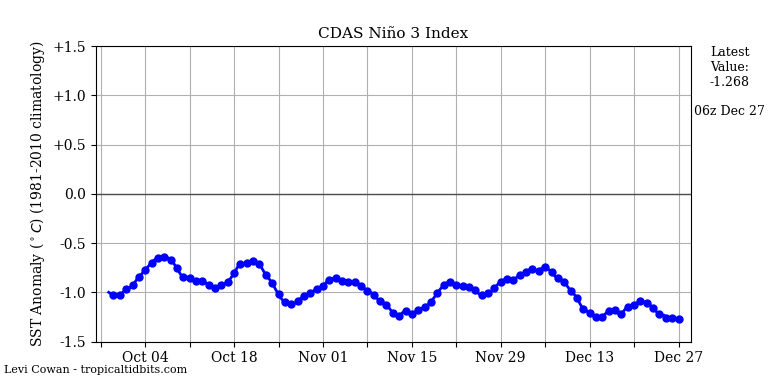
I think that could be correct.
88 F is warm enough for me.
≠=========
Without technology human beings die of exposure at 86 F or lower. 88 F is almost fatal to any human being immersed in water for any significant length of time.
“Ocean warming dominates the total energy change inventory, accounting for roughly 93% on average from 1971 to 2010 (high confidence). The upper ocean (0-700 m) accounts for about 64% of the total energy change inventory. Melting ice (including Arctic sea ice, ice sheets and glaciers) accounts for 3% of the total, and warming of the continents 3%. Warming of the atmosphere makes up the remaining 1%.”
IPCC, 2013.
philsalmon, Thanks for posting this. It is on page 265 of the Physical Science Basis. The Earth has been warming, at least since 1970. They also say “The ocean dominates the change in [retained] energy because of its large mass and high heat capacity.” They also say the Southrn Ocean (where all the oceans meet) warmed at a rate of 0.03 degrees C per decade from 1992 to 2005.
How one can cite those statistics and be worried about “dangerous global warming” is beyond me.
Andy, Indeed – I found the IPCC quote in a recent post at Pierre Gosselin’s “No Tricks Zone” which reports a new paper by Wunsch putting recent warming firmly in perspective:
http://notrickszone.com/2018/07/20/false-alarm-new-study-finds-global-ocean-warmed-by-0-02c-from-1994-2013-with-cooling-below-3600m/
An interesting observation is that recent total ocean warming – a barely detectable 0.02 degrees in 10 years – is slower than ocean warming earlier in the Holocene, seriously questioning whether it is unprecedented or alarming.
philsalmon, I posted this above, but it is relevant to your quote and might be seen by more people here:
surly, I think the comment from “Stephen” (as well as you and Nick) assumed I was discussing the so-called greenhouse effect (GHE) as defined by the IPCC and only looked at the quote in that context. This may all have been a point-of-view problem.
What I tried to do in the quote, was step back from the GHE, and look at the larger picture of recent warming. I don’t care if the GHE contributed to it or not or even how much. I just wanted to show that any effect of CO2 is small in the context of the oceans. All of the retained thermal energy for the past 50 or 60 years, at most, has increased the Southern Ocean temperature less than 0.2 degrees! And this is the ocean where all oceans meet.
Some of recent warming is natural and some is probably due to the CO2 GHE, the warming is obviously due to additional thermal energy being retained. I’m just saying it doesn’t matter. Were it all due to CO2 GHE and the effect lasted another 200 years, the Southern Ocean would warm a whopping 0.6 degrees, whoopee!
None of it is due to CO2.
The mass of the atmosphere is one millionth of the total mass of the Earth. So the atmosphere plays no part in the climate of the Earth. The heat coming from the Earth volcanoes the Sun all play a bigger role in shaping the climate of Earth.
Without the atmosphere, there would be no weather, hence no climate. Without the atmosphere, the oceans would freeze or evaporate.
Of course the surface, both land and sea, play a role, as does internal heat of the planet. But the main influences on the atmosphere are tectonics, the oceans and the sun and Earth’s orientation towards it.
Nic Lewis (in his devastating critique of Andrew Dessler’s critique of the latest Lewis and Curry study on climate sensitivity to doubling of CO2) points up a devastating admission by the climate scientists on their derivation of forcing.
“Indeed, the authors admit, in the second paper,(Dessler, A.E.,P.M. Forster, 2018. An estimate of equilibrium climate sensitivity from interannual variability.) that a key ratio they uses to convert 500-hPa tropical temperature interannual feedback strength into long term forced-response feedback strength “comes from climate model simulations; we have no way to observationally validate it, nor any theory to guide us”.
So what that statement means; is, the whole theory of forcing is built on climate models which we know is a House of cards just waiting for the correct wind to blow it down. To base a key linchpin (positive forcing of more H2O) of global warming on the conclusions of climate models which have always been wrong in projections and to then apply trillions of dollars in carbon trading and carbon taxes on those results is nothing short of MADNESS.
“That is, it keeps the heat in.”
This represents a profound misunderstanding of how the greenhouse effect works. CO2 does not trap heat preventing it from escaping, but simply slows down the rate of cooling. Heat is never trapped, except for a short time by the water in clouds. Take away the Sun and the Earth will cool to about 65K in a few months regardless of how much CO2 is in the atmosphere (65K is from the approximately 1 W/m^2 of internal heat reaching the surface). The energy of any photon absorbed by a GHG molecule will be returned to the surface or emitted into space in roughly equal proportions after no more than a few seconds, except water, which because of its condensing nature may take as long as days before the energy of an absorbed photon reaches its final destination.
I posted this on Anthony’s last open thread, but it gained zero traction. It seems appropriate for this conversation, as well.
Four years ago, MIT released a news piece about findings from the Ceres Instrument on NASA’s Aqua Satellite. From the piece.
http://news.mit.edu/2014/global-warming-increased-solar-radiation-1110
“In computer modeling of Earth’s climate under elevating CO2 concentrations, the greenhouse gas effect does indeed lead to global warming. Yet something puzzling happens: While one would expect the longwave radiation that escapes into space to decline with increasing CO2, the amount actually begins to rise. At the same time, the atmosphere absorbs more and more incoming solar radiation; it’s this enhanced shortwave absorption that ultimately sustains global warming.
“The finding was a curiosity, conflicting with the basic understanding of global warming,” says lead author Aaron Donohoe, a former MIT postdoc who is now a research associate at the University of Washington’s Applied Physics Laboratory. “It made us think that there must be something really weird going in the models in the years after CO2 was added. We wanted to resolve the paradox that climate models show warming via enhanced shortwave radiation, not decreased longwave radiation.””
This seems to run counter to everything we’ve been led to believe about the greenhouse effect. There was something here on WUWT about it a long time ago, but it didn’t address this particular aspect of MIT’s piece.
Anyone have any relevant thoughts on the science?
Ad Joz Jonlin:
Just modeling, but still interesting. Reminded me to the graph of Gymnosperm above: https://wattsupwiththat.com/2018/07/21/stephen-why-global-warming-is-not-a-problem/#comment-2410783
From above: “While one would expect the longwave radiation that escapes into space to decline with increasing CO2, the amount actually begins to rise”.
WR: Warming will (finally) lead to an enhanced radiation, simply because warm objects radiate more. But the mentioned extra absorption of shortwave by enhanced water vapor (which also could result from temporary less ice cover) is interesting.
While one would expect the longwave radiation that escapes into space to decline with increasing CO2, the amount actually begins to rise.
I certainly wouldn’t expect that, I’d expect it to stay the same.
Note that they’re talking about their modeling results.
” At the same time, the atmosphere absorbs more and more incoming solar radiation; it’s this enhanced shortwave absorption that ultimately sustains global warming.”
This is the broken talking point claiming that massive positive feedback from water vapor nearly triples the sensitivity from about 0.3C per W/m^2 up to about 0.8C per W/m^2.
Increased absorption of solar energy by the atmosphere is not supported by the data as this would require increased clouds as only the water in clouds can absorb any significant amount of solar energy. The data actually shows a slight decrease in cloud cover which would lead to less solar energy absorbed by clouds and more surface emissions reaching space.
“Increased absorption of solar energy by the atmosphere is not supported by the data as this would require increased clouds as only the water in clouds can absorb any significant amount of solar energy. ”
No , it is the decreased albedo from feedback that leads to increased SW absorption.
And there is no “data” on that yet – it’s what models come up with and what one would expect intuitively.
From the article…
“Meanwhile, like any physical body experiencing warming, Earth sheds longwave radiation more effectively, canceling out the longwave-trapping effects of CO2. However, a darker Earth now absorbs more sunlight, tipping the scales to net warming from shortwave radiation.”
Decreased albedo increases absorption by the surface, not the atmosphere which is nearly completely transparent (except for clouds) to incoming solar energy. BTW, please look at the quote I was responding to which specifically stated an increase SW absorption by the atmosphere, not the surface.
The ISCCP cloud data shows a small decrease in average cloud coverage over the last 3 decades, but as I said, it could just be noise.
Also, a darker Earth is also more transparent to LWIR emissions by the surface as it’s clouds that make the planet brighter. There is about 40-50% more LWIR emitted into space above clear skies, then above clouds. This is why we can use satellites to measure far colder cloud top temperatures than on the surface below.
“It beggars belief that a trace gas (CO2), in an atmosphere that itself contains only a trace amount of the total thermal energy on the surface of the Earth, can control the climate of the Earth.”
The fact that the author does not believe it does not make it untrue. CO2 being a trace gas is irrelevant to the warming effect of CO2, it is the amount of CO2 that is relevant.
If it was the amount of CO2, Mars should be much warmer than it is.
I don’t know how you come to that conclusion. Anyway conditions on Mars is irrelevant, it is challenging enough to work out all the forcings on earth, let alone another planet.
Mars has far more CO2 in its atmosphere than Earth. The atmospheric pressure is about 0.6% of Earths and consists of mostly CO2. If 0.6% of Earth’s atmosphere was CO2, it’s concentration would be about 6000 ppm.
But it is the “0.6% of Earths” pressure that is relevant here.
Just not enough molecules in the way of exiting LWIR photons to give a sig GE.
“Mars has a very thin atmosphere composed mostly of the tiny amount of remaining carbon dioxide (95.3%) plus nitrogen (2.7%), argon (1.6%) and traces of oxygen (0.15%) and water (0.03%). The average pressure on the surface of Mars is only about 7 millibars (less than 1% of Earth’s), but it varies greatly with altitude from almost 9 millibars in the deepest basins to about 1 millibar at the top of Olympus Mons. But it is thick enough to support very strong winds and vast dust storms that on occasion engulf the entire planet for months. Mars’ thin atmosphere produces a greenhouse effect but it is only enough to raise the surface temperature by 5 degrees (K); much less than what we see on Venus and Earth.”
http://nineplanets.org/mars.html
Except that O2, N2 and Ar are completely transparent to both incident solar energy and LWIR emissions by the surface and nearly all of the increase in Earth’s atmospheric pressure comes from these molecules. They are definitely not in the way of escaping LWIR from the surface. The lack of water on Mars is a factor, but based on 3C per doubling as claimed by the IPCC, the 4 doubling between 400 ppm and 6000 ppm should result in a temperature 12C warmer, which is a larger effect that the water on Earth has.
BTW, the point I was making in response to Harry’s comment:
“it is the amount of CO2 that is relevant”
On a molecular basis, there are at least 10 times as many CO2 molecules between the Mars surface and space, then between Earth’s surface and space.
Except that O2, N2 and Ar are completely transparent to both incident solar energy and LWIR emissions by the surface and nearly all of the increase in Earth’s atmospheric pressure comes from these molecules.
However they substantially contribute to the broadening of the CO2 spectral lines which increases the absorption by the CO2 on earth.
Collisional broadening is a finite, but not very large, influence at atmospheric temperatures and pressures. However; what this actually does is increase the probability of absorption in the wings as it decreases the probability of absorption at the center.
The broadening of the spectrum is what is responsible for the log dependence of the CO2, at significantly higher concentration it would be a square root dependence.
“but based on 3C per doubling as claimed by the IPCC”
That’s for earth only, and the IPCC do not claim it.
I don’t usually bother replying to your comments because you make stuff up. But that statement was particularly bad.
When anyone refers to the “climate science consensus”, they’re referring to climate science as summarized in IPCC reports. The authority alarmists appeal to, whether they know it or not, is the IPCC.
The IPCC claims that the nominal effect from doubling CO2 is 3C. They have more recently buried the wide uncertainty in the presumed sensitivity factor into the various RCP scenarios, centered around 3C per doubling. Look under the hood and the claim is 3C +/- 1.5C per 3.7 W/m^2 of EQUIVALENT forcing from doubling CO2 which translates into a presumed sensitivity factor of 0.8C +/- 0.4C per W/m^2 boosting the next W/m^2 of incident forcing into 4.3 +/- 2.2 W/m^2 of surface emissions.
The usual claim is that impossibly large positive feedback from water vapor ‘amplifies’ a tiny effect from CO2 into a massive climate catastrophe. The feedback fubar initiated by Hansen was crucial to the formation of the IPCC providing it with an absolutely wrong, yet plausible, theoretical foundation.
The fact is that the water related ‘amplification’ on Earth includes the widely ignored cooling by the reflection of ice and clouds which offsets most of it’s GHG warming effects. The amount of amplification needed to support even the bottom of the IPCC’s presumed range just isn’t available or even possible from water.
You also failed to point out that 3C is only for the first doubling, as even the IPCC recognizes that the effect is linear to the optical depth which is proportional to the log of the concentration.
Co2isnotevil,
Atmospheric pressure on Mars’ surface is 636 Pa, surface gravity is 3.71 m/s², CO₂ content in the atmosphere (by weight) 97 %.
That results in 166 kg CO₂ per m².
On Earth there is 6 kg/m² for 400 ppm.
Using the mass per area (in stead of pressure) the amount of CO₂ on Mars would result on Earth to ~11000 ppm.
See “Estimating the Power of Mars’ Greenhouse Effect” (Haberle, 2013).
It’s good to see people are agreeing CO2 is a greenhouse gas. The article is incorrect.
Good job, Andy. I enjoyed reading it.
“Stephen”‘s argument disintegrates after the realization that this planet is warmed from without. The earth does not sit upon a stove top.
Andy, to make your picture. A picture.
https://www.google.at/search?q=co2+percentage+in+atmosphere&oq=co2+percent&aqs=chrome.
I think I may have figured out where the misunderstanding happened that led to Stephen’s comment. He assumed I was discussing the so-called and misnamed greenhouse effect (GHE) as defined by the IPCC and only looked at the quote through that lens. This may all have been largely a point-of-view problem.
A greenhouse warms by restricting circulation and convection, somewhat like your pot with a lid. Adding CO2 to the atmosphere can warm the Earth’s surface by some unknown amount by slowing the cooling of the surface of the Earth, since it absorbs IR emitted by the surface and before it re-emits the absorbed energy it is excited and collides with neighboring molecules “warming” them. The magnitude of this effect is unknown, and it has not been measured, only modeled.
What I tried to do in the quote, was step back from the GHE, and look at the larger picture of recent warming. GHE is not climate and climate is not GHE, it is much more complicated than that regardless of what the warmists want us to believe. In the quote, I don’t care if the GHE contributed to current warming or not or even by how much. I just wanted to show that any effect of CO2 is small in the context of the oceans. The Earth is warming; thus, it is retaining some thermal energy, and as the IPCC says in AR5 (The Physical Science Basis, page 265) the oceans have retained 64% of the energy. All the retained thermal energy for the past 50 or 60 years, at most, has increased the Southern Ocean temperature less than 0.2 degrees (see Wunsch, 2018, Dynamic Meteorology and Oceanography, vol. 70, issue 1)! And this is the ocean where all oceans meet, the deep oceans have cooled since 1990 (Wunsch and Heimbach, 2014, American Meteorological Society Journal, August 2014).
Some of recent warming is natural and some is probably due to the CO2 GHE, the warming is obviously due to additional thermal energy being retained. I’m just saying it doesn’t matter. Were it all due to CO2 GHE and the effect lasted another 200 years, the Southern Ocean would warm a whopping 0.6 degrees, at most, since the effect of CO2 diminishes as more is added. The warming, regardless of the cause is not important or a problem due to the high heat capacity of the oceans. That is the point of the quote.
Nice summary, Andy.
A suggestion. ‘Green House Effect’ and ‘Greenhouse Gas’ pollutes the mind. Wrong images about the climate pollute the minds of people. We should replace them consequently by other words, other images. Instead of ‘Green House Effect’ we could use ‘Absorption Effect’ because that is what happens. And instead of ‘Greenhouse Gas’ we could use ‘Absorbing Gas’. We would leave the idea of a ‘closed system’ a real greenhouse is, a system that we cannot escape.
(I worked in a greenhouse, I know the feeling when it gets hot and the windows are not yet opened. Fortunately the Earth has an ‘open weather and climate system’ that can adapt and mitigate. We should emphasize that open adaptable system, also by our own vocabulary. Like the Warmists did, we must create our own ‘climate world images’. Images that are conform reality: a mitigating system, not scaring)
Second, if the oceans can only warm a 0.6 degrees Celsius in a 200 years, surface temperatures could double, but not far from that maximum. Whether the trend should continue, I have got my doubts: possibly the oceans will correct themselves by creating more clouds, or more winds could develop turning and mixing the layers of the ocean which only can result in cooling, given the high cooling capacity of the ice cold deep oceans and the subsurface layers.
I don’t think it will warm 0.6 degrees in the next 200 years, that is just a linear extrapolation of the highest estimate I’ve seen of ocean warming over the past 60 years. More likely the ocean warming from 1994 to 2013 is a total of 0.02 degrees as estimated here:
http://notrickszone.com/2018/07/20/false-alarm-new-study-finds-global-ocean-warmed-by-0-02c-from-1994-2013-with-cooling-below-3600m/
Which would mean the warming over 200 years is less than 0.2 degrees by a dumb linear extrapolation, and probably much less than that. Point being, nothing to worry about.
As you say, warming oceans should increase cloudiness, resulting in cooling anyway. I agree with your comments on the greenhouse effect. I think we have allowed the warmists to equate climate with the GHE in the mind of the public, which is a shame.
Surface overall oceanic temperatures are what matters when it comes to the climate and they are off .2c since last summer and the trend is going to continue to go lower as long as solar stays in the tank.
Overall surface oceanic sea surface temperatures around +.35c above 1981-2010 means last summer now +.14c above 1981-2010 means.
“… collides with neighboring molecules “warming” them. The magnitude of this effect is unknown …”
The way this is claimed to happen is by transferring small portions of vibrational energy into much lower energy rotational states, which as a degree of freedom should be shared by collisions based on the equipartition of energy principle.
We can observe the transfer of energy into lower energy rotational states as the fine structure on either side of the primary vibrational resonances. Fine structure on either side means that while vibrational state energy can be converted into rotational state energy, rotational state energy can be converted into vibrational state energy and the net transfer from vibrational to rotational is close to, if not exactly, zero.
The only possible ‘thermalization’ occurs in clouds when an energized CO2 molecule is dissolved into a droplet of water or when energized H2O molecules condense within it. This is observed in the emitted spectrum of the planet where CO2 and H2O absorption is largest between about 13u and 16u. The energy measured in that band at TOA is somewhat less than the predicted half of what it would be based on the Planck distribution of energy emitted by the surface. The other half is returned to the surface as the GHG effect.
Note that the absorption of energized molecules by the water in clouds converts the absorbed narrow band GHG energy into broad band Planck emissions by that water in the cloud.
co2isnotevil: “The other half is returned to the surface as the GHG effect.”
WR: Whether any radiation is able to return to the surface depends on the free path of a photon downward. Is there any evidence that photons departing from clouds can reach the surface? In upward direction they are supposed to reach only some meters:
Prof. Robert G. Brown: “CO_2 doesn’t “scatter” LWIR radiation, it absorbs it
(typically within a few meters, the mean free path at atmospheric
concentrations) and the energy is almost instantly transferred to the
surrounding air.”
Source: https://sealevel.info/Happer_UNC_2014-09-08/Another_question.html
“Is there any evidence that photons departing from clouds can reach the surface? “
They don’t have to. The key is Kirchhoff’s law, which says that in any frequency band, emissivity equals absorptivity. IOW, if these are wavelengths where CO2 is strongly absorbing, it is strongly emitting. So photons will be absorbed, emitted etc. Eventually, in highly absorptive frequencies, there will be strong emission coming from a few metres above ground.
This leads to a diffusion like propagation, called after Rosseland. The diffusivity decreases with increasing absorptivity.
Nick, I try to understand this very technical matter.
I understand, emissivity equals absorptivity under the same (!) circumstances. So when radiation is emitted at 25 C (surface) and is absorbed at 10 C (up in the atmosphere), how will that re-emission be: like at 25 C or at 10 C? My guess: like at 10 C, which will be a diminished emission because of the lower temperature. Going downward, emitted photons will be absorbed by ever denser concentrations of absorbing gases (H2O, CO2), suggesting that the downward path of a photon is shorter than the upward path. As a consequence, radiation will always be more successfully moving upward than downward, resulting in a net upward movement of radiation.
That net upward movement of radiative energy has to be so, because the surface of the Earth has to get rid of the energy it daily receives from the Sun. Which implies that in practice (!) consequent (‘second round’) radiation will be different from the original surface radiation and even from absorption. As earlier discussed, temporarily excited absorbing molecules are influenced by the rapid collisions with non emitting molecules that take energy away from the absorbing molecules. The uptake of energy by the non-emitting molecules must influence any consequent emission in a diminishing way. The uptake of energy by the colliding non-emitting molecules can only (later) be replenished by collissions of emitting molecules with lower energy non-emitting molecules.
As a consequence, on Earth any ‘second round emission’ can’t be seen as ‘a simple equal re-emission of ‘first round’ radiated/absorbed energy’ like in the laboratory. As I understand it.
Wm,
Yes, photons in the saturated absorption bands of CO2 and H2O are absorbed by a GHG molecule within meters. That energy is subsequently re-emitted in a random direction within a tiny fraction of a second, often after either absorbing another photon or upon a collision and sometimes at either a slightly higher or lower energy. However; about 23% of the photon energy emitted by the surface pass straight through the atmosphere and into space at the speed of light.
As far as the fraction that doesn’t pass through and gets absorbed by GHG’s and clouds, this energy must either be emitted into space or returned to the surface. Otherwise, the air and clouds will heat without bound. This energy can only be sent into space as radiation and whether this is returned to the surface as radiation or collisions with air molecules is irrelevant, although since the temperature of non GHG molecules of air does not contribute to the radiative balance and arises from physical contact with the surface, those molecules are precluded from further heating the surface, although then can redistribute heat across short intervals of time moderating high and low peak temperatures between day and night.
Brown is irreconcilably wrong about absorbed energy being instantly transferred to the surrounding air unless he means by the re-emission of another photon. There are no relevant mechanisms in Quantum Mechanics that can wholly and directly convert vibrational state energy into the translational kinetic energy of molecules in motion, which is the primary manifestation of temperature by non GHG molecules.
Small amounts can be converted into rotational states of the GHG molecule, which by equipartition, will be ‘shared’. However; that conversion must be accompanied with the emission or absorption of a photon at either a higher or lower energy. The fine structure in the absorption/emission spectrum of GHG molecules tells us that this conversion goes both ways and that the net conversion from one to another is approximately, if not exactly, zero.
The evidence of this is in the HITRAN absorption/emission line data and the observed LWIR spectrum of the planet. If what Brown claims is true, the average energy seen in the absorption bands at TOA would be attenuated by factors of thousands to millions over the average intensity emitted by the surface. Instead, we see a net attenuation factor of only about 2. In the most saturated lines of CO2 and H2O, we see a slightly higher attenuation factor and this is the only evidence of ‘thermalization’ from GHG absorption. This occurs when an energized CO2 molecule is dissolved into cloud water or when energized H2O molecules condense within clouds. These are the only possible mechanisms in the atmosphere that can convert the narrow band energy of GHG absorption into another form.
WR: co2isnotevil, thanks for the reaction. Below my remarks (sorry, a bit lengthy).
co2isnotevil: “Yes, photons in the saturated absorption bands of CO2 and H2O are absorbed by a GHG molecule within meters. That energy is subsequently re-emitted in a random direction within a tiny fraction of a second, often after either absorbing another photon or upon a collision and sometimes at either a slightly higher or lower energy.”
WR: If I understand this discussion well, https://sealevel.info/Happer_UNC_2014-09-08/Another_question.html , no re-emission of absorbed energy will take place. To re-emit, the absorbing molecule must stay long enough in the excited state to be able to re-emit. But by tenths, hundreds or thousands of collisions before emission could take place the ‘absorbed energy’ is taken away by colliding molecules. Only the ‘temperature effect’ (measurable) in the air will stay and any emission will only happen according to the circumstances (temperature and density of emitting molecules) at that location.
If in all cases re-emission would have taken place, no temperature effect would have been measurable. Because emission takes energy away.
co2isnotevil: “As far as the fraction that doesn’t pass through and gets absorbed by GHG’s and clouds, this energy must either be emitted into space or returned to the surface”.
WR: Probably nearly no emission from clouds will return to the surface. The reasons:
1. Most radiation is not space ward or surface ward, but side ward.
Source: https://wattsupwiththat.com/2011/10/26/does-the-trenberth-et-al-earths-energy-budget-diagram-contain-a-paradox/
2. After each sideward emission, consequent emissions will direct more emission up ward than downward.
3. The path length for a photon emitted from clouds is too short to reach the surface, because absorption takes place within meters, or, at higher elevations within 10-100 meter or so. Most radiation of every ‘next emission round’ will again go sideward.
4. Given the short path length many re-emissions will have to take place to reach space. On the average every re-emission in the atmosphere has a net upward effect.
5. Most absorption will take place in high moisture air. High moisture air (on the average) goes upward (because of her light weight). Transporting energy upward.
6. There is always a net energy transport upward, to get rid of the daily added sun energy. All cooling mechanisms show an upward transport. Radiation is one of those cooling mechanisms. In the end all energy has to be radiated to space. Upward transport of radiated energy must (!) outnumber downward radiated transport by far.
7. At lower levels in the atmosphere there is a higher number of absorbing molecules than up in the colder and thinner air: less molecules, less H2O. It is easier for any radiation to go ten meter upward than ten meter downward. Every next emission round is transporting energy upward.
8. Every emission from higher (colder) levels is less effective/intense than emission from the (warmer) surface. Again: up is easier than down.
9. The higher an altitude is reached, the higher percentages of emissions are reaching space. And the less is reaching the surface.
10. As stated in my first comment, it is not very probable that direct re-emission takes place. With lowering temperatures at higher altitudes every emission of radiated energy according to the temperature of that level will be less than the radiation originally sent from surface level.
I cannot conclude else, than that after first absorption most ‘cooling work’ in the atmosphere must be done by non-radiative means of cooling: by latent heat, conduction, convection. Until, somewhere up, the lack of the main absorbing gas H2O does not prohibit unhindered emission to space and spaceward emssion will take place in ever growing percentages. Probably CO2 will emit most energy to space.
co2isnotevil: “There are no relevant mechanisms in Quantum Mechanics that can wholly and directly convert vibrational state energy into the translational kinetic energy of molecules in motion, which is the primary manifestation of temperature by non GHG molecules.”
WR: Excited molecules don’t transmit energy to non-excited molecules? Their high energy state doesn’t enhance the kinetic energy of colliding molecules? How does air that absorbs photons (by the small quantity of absorbing gases present) and consists of more than 99% of O2/N2 molecules get a higher temperature as a whole? Transmittance of energy has to have happened to warm air as a whole.
Wm,
“Their high energy state doesn’t enhance the kinetic energy of colliding molecules? ”
Not in any way that affects the averages. Quantum mechanics requires any transformation to be all or nothing state change and the entire bundle of state energy would need to be converted into the kinetic energy of translational motion, or other forms, in a single event. You can’t convert a little now, a little later and so on and so forth until there’s nothing left, moreover; the energy of a 15u photon is about the same as the translational kinetic energy of an atmospheric gas molecule at STP. Sure, there’s a finite, but tiny probability that such a transformation could happen upon a collision (Quantum Mechanics is funny like that …), but the probability doesn’t start to increase significantly until the kinetic energy of motion becomes much larger than the energy of a state change and those conditions just aren’t present in our atmosphere.
To the extent that any state energy can be converted into translational kinetic energy by a collision, the inverse must be true in equal and opposite amounts. Any net transfer will necessarily be zero, or at least close to zero. Symmetry is another important attribute of Quantum Mechanics.
You’re focused on only half of what’s can potentially happen and it’s shielding you from seeing the reverse conversion. You may claim that the reverse will not likely occur under current energy conditions. You would be right and for the same reason that your presumed transformation is also not very likely. Both are equally likely.
The N2/O2 and Ar in the atmosphere is heated by collisions with the surface as all of these molecules are transparent to the SW and LWIR involved with the transmission of energy through the atmosphere as photons. The average kinetic temperature decreases linearly with altitude based on a lapse rate dictated by gravity acting on the PVT profile of the atmosphere and then starts to increase significantly as the gases becomes rarefied and interact with high energy incident radiation only to decrease again towards TOA. The radiation temperature, that is the temperature equivalent to the average LWIR photon flux passing up decreases monotonically with altitude starting at about 390 W/m^2 (290K) at the surface and ending at about 239 W/m^2 (255K) at TOA. Your explanation would have this start at 390 W/m^2, drop to about 90 W/m^2 (200K) a few meters off the ground only to increase to 239 W/m^2 (255K) at TOA.
Your position that emissions higher up in the atmosphere have an easier time reaching space, which I agree with, is inconsistent with your conjecture that GHG absorption is quickly converted into the translational kinetic energy of air molecules. O2/N2 and Ar do not emit photons in the absorption bands of atmospheric GHG’s.
What’s the source of all of these emissions that are having an easier time getting through? The only possible place they can be coming from are the emissions bands of the GHG molecules themselves which means that either the reverse transformation converting translational kinetic energy into photons is a very high probability event, or the transformation converting photon energy into translational kinetic energy is a very low probability event. The energies involved precludes the former, thus the later must be true.
co2isnotevil (did I write your name well?), not only the surface but also the atmosphere is absorbing a lot of energy straight from the sun. Warming/activating all (!) molecules in the air: kinetic energy. If not to continue the heating up of all molecules in the air (by more sun energy), a transmission of ‘first day’ energy has to take place, just to get rid of that ‘first day energy’. Transmission of energy to radiating molecules has to take place. Or other cooling processes.
If processes are mutual: up in the air CO2 radiates to space, using kinetic energy from non-emitting molecules, cooling all of the air (bringing down the kinetic energy of all molecules). The reverse needs to happen as well. Absorbing molecules must be transmitting energy to non-radiating molecules and vice versa.
Wim
Wim,
Atmospheric gases absorb little solar energy. Most of the solar energy absorbed by the atmosphere is absorbed by the liquid and solid water in clouds. This water may re-emit photons in the absorption bands, but like those originating from the surface, these are absorbed within a few meters of the cloud tops as there are still significant GHG’s between cloud tops and space.
My question is still unanswered.
What is the origin of the absorption band photons observed at TOA which even in the most saturated lines approaches half the flux there would be in the absence of any absorption at all? I contend that the only possible source of these photons are GHG molecules, as HITRAN data describes both the absorption and emission spectra, which are the same.
You are being too loosey-goosey about arbitrarily conflating different forms of energy without accounting for the very specific mechanisms for converting between them. It an over-generalization of equipartition. In fact, state energy is really not even one of the degrees of freedom generalized equipartition applies to, except as to equalize energized states among the population of GHG molecules.
the energy of a 15u photon is about the same as the translational kinetic energy of an atmospheric gas molecule at STP.
Not true only a few percent of the molecules at STP have the energy of a 15µm photon (0.0827eV)
(kT=0.0258eV at 300K)
See Boltzmann distribution below:
https://encrypted-tbn0.gstatic.com/images?q=tbn:ANd9GcTa7f7LaDXUrbXLli7QtgP4OjMbaQ4MgRuG881cp3zNFrWfSs85
Phil,
A 15u photon has an energy given by E = hc/y = 6.626E-34 * 3E8 / 15E-6 = 1.33 E-20 Joules.
A CO2 molecule travels at approximately 500 m/sec and weigh 48AU or about 7.7E-26 kg. Energy = 1/2 mv^2 = .5 * 7.7E-26 * 500^2 = 9.6 E-21 Joules.
Yes, a 15u photon has slightly more energy than a moving CO2 molecule which only makes my case stronger about the lack of direct ‘thermalization’ as the required condition is that the kinetic energy of motion needs to be significantly larger than the energy of a state change.
A CO2 molecule travels at approximately 500 m/sec and weigh 48AU
A CO2 molecule has a mass of 44 AU and its Vrms is about 400m/s at 300K (most probable ~340 m/s). However the most likely collision partner is N2 which has a mass of 28 AU and has a Vrms of ~500 m/s. As I pointed out kT is 0.028eV or about one third of the energy of a 15µm photon so the average energy of the collision partner is ~3x less than the vibrational energy of an excited CO2 molecule. In a collision with a vibrationally excited CO2 molecule which reduced the CO2 to its ground state the velocity of the N2 molecule would increase by about 1.7x or three times its kinetic energy which it would quickly share with its neighbors (~10 collisions/nsec).
The reverse process is not so simple since only a few % of the N2 molecules have enough energy to excite a CO2 molecule to its vibrational excited state and the collision would have to occur at just the right orientation to transfer to the vibrational mode.
The reverse process is not so simple…
I suppose the reverse proces must be equally likely at equilibrium (Boltzmann temperature equals Planck temperature).
Otherwise the Boltzmann temperature would be ~1.7 × 300 = 510 K and almost independent of the Planck temperature.
Phil.
I certainly agree that few if any N2 molecules has enough energy to excite a vibrational state in a ground state CO2 molecule and that only the same few have enough energy to initiate the return of an energized CO2 molecule to the ground state. What makes you think either direction is easier than the other? If this was the case, the system would not be in a steady state equilibrium.
My point is that whatever possibilities of exchange might exist, there’s little to no NET exchange in either direction.
The critical question is still unanswered, which is what is the origin of the significant photon energy at TOA in the absorption bands of GHG’s. Emissions in those bands are absorbed within a meter or so of the surface and no more than dozens of meters from clouds. The only possible source of these photons are GHG molecules high up in the atmosphere whose emissions have an easier time exiting TOA without being intercepted by another GHG molecule. This requires energized states to propagate up the atmosphere in order to get high enough to emit another photon that isn’t intercepted. This also means that energy must be retained along the way so there’s enough to keep energizing other GHG molecules.
To the extent that any energy is lost to translational energy, this can only contribute to the half of the surface energy absorbed by GHG’s and that’s required to be returned to the surface. Theory requires half of the absorbed energy to be returned, but doesn’t specify whether the energy is returned as radiation, by contact with warmed air, warmed rain, wind or weather. Of course, theory also requires all of the latent heat and other non radiative energy entering the atmosphere to be returned to the surface, again without specifying in what form this energy is returned. This is because only radiant energy can leave the planet.
While not necessary, it’s exceedingly likely that non radiant energy absorbed by the atmosphere is returned to the surface by non radiant means and the radiant energy absorbed by the atmosphere and returned to the surface is by radiant means.
I’ll make another testable prediction of my hypothesis, although unlike the test of the spectrum at TOA, I don’t know where the appropriate data for this test might be. Directional measurements pointing up will show LWIR in absorption bands returning to the surface. In the clear sky, most of the returning LWIR will be in absorption bands. Under cloudy skies, there will be significant LWIR outside of the absorption bands and that originated from the water in clouds.
If you want to refute my argument that there’s little conversion of GHG absorbed energy into translational energy, you need to have a testable answer to the above critical question. My answer is testable and testing it has been done by examining the emitted spectrum of the planet at TOA and I’ve offered other tests.
I certainly agree that few if any N2 molecules has enough energy to excite a vibrational state in a ground state CO2 molecule and that only the same few have enough energy to initiate the return of an energized CO2 molecule to the ground state.
Why “the same few”? Any of the collision partners has the ability to increase its translational energy by colliding with the vibrating CO2 molecule. They don’t need ‘enough energy’ to remove the vibrational energy they just need to be accelerated by the appropriate amount. Near the surface an excited CO2 molecule will undergo ~10,000 collisions in its first microsecond of existence, plenty of opportunity to be deactivated.
What makes you think either direction is easier than the other? If this was the case, the system would not be in a steady state equilibrium.
My point is that whatever possibilities of exchange might exist, there’s little to no NET exchange in either direction.
While molecules with enough kinetic energy to excite the CO2 molecule to the first vibrational level exist, as stated above they represent a small fraction of the total. Also such a collision is more likely to transfer translational energy to the CO2, only collisions with a particular orientation would excite the vibrational mode.
Regarding equilibrium the primary means of vibrational excitation is by absorption of radiation, in the lower atmosphere the primary means of deactivation is collisional, the net collisional exchange is from the excited state to the surrounding molecules.
Phil,
“Also such a collision is more likely to transfer translational energy to the CO2”
All collisions exchange translational energy. An energized CO2 molecule colliding with a ground state CO2 molecule may exchange state energy in additional to sharing translational energy. This can not happen when energized GHG’s collide with non GHG gases.
“in the lower atmosphere the primary means of deactivation is collisional”
Except that when the combined kinetic energy of 2 colliding particles is less than it takes to excite a vibrational state, the probability of converting this into translational energy is zero. Rotational modes are much lower energy and can be excited, but again, this is symmetric adding to and removing from translational kinetic energy and the net exchange is close to zero, if not exactly zero. Evidence of this symmetry is seen in the fine structure of the absorption spectra.
I certainly agree that collisions are a significant mode of deactivation, although a bigger one is absorption of a second photon which starts to dramatically increase the probability of spontaneous emissions. Moreover; deactivation means emitting a photon, not converting vibrational state energy into linear kinetic energy.
You still haven’t addresses the elephant in the room, which is if as you claim, all photons emitted by the surface and clouds in GHG absorption bands are captured and converted into translational energy within a meter or of emissions, WHAT’S THE ORIGIN OF THE SIGNIFICANT AMOUNT OF POWER SEEN IN ABSORPTION BANDS AT TOA?
When I say significant, I mean about 1/2 the power that would be seen at TOA in those bands without any absorption at all. The only substance between the surface and space under clear skies or between clouds and space that can emit photons in absorption bands are the GHG molecules themselves. N2, O2 and Ar do not emit photons in these bands.
“Also such a collision is more likely to transfer translational energy to the CO2”
All collisions exchange translational energy. An energized CO2 molecule colliding with a ground state CO2 molecule may exchange state energy in additional to sharing translational energy. This can not happen when energized GHG’s collide with non GHG gases.
Nonsense, if that were true CO2 lasers would not work as well as they do. In the laser the non-GHG, helium, is used to collisionally deactivate CO2 from exactly the same vibrational state (010) via V-T transfer.
Moreover; deactivation means emitting a photon, not converting vibrational state energy into linear kinetic energy.
Vibrational deactivation refers to the non-radiative transfer of energy to the medium via collisions, it does not involve emitting a photon.
Phil,
If this is your definition of vibrational deactivation, then it’s not occurring in the atmosphere to any significant extent.
In a laser, the HE deactivates by causing energized CO2 to emit a photon and it’s these photons that comprise the output of the laser.
https://www.quora.com/Role-of-helium-in-CO2-laser
Once more you have failed to address the question whose answer falsifies your hypothesis. Science doesn’t work by ignoring falsification, it advances by acknowledging falsification. If the hypothesis doesn’t fit the data., you need to adjust your hypothesis.
I will restate the question.
What’s the origin of the photons in absorption bands that are observed at TOA? To be clear, the attenuation based on what the surface emits is only about 3 db (1/2), yet the surface is absorbing 100% of these photons. O2, N2 and Ar don’t emit photons in the relevant bands, so where are they coming from?
Phil,
If this is your definition of vibrational deactivation, then it’s not occurring in the atmosphere to any significant extent.
In a laser, the HE deactivates by causing energized CO2 to emit a photon and it’s these photons that comprise the output of the laser.
You continue to show your ignorance of the phys-chem involved in this process.
For a start the 010 level decays to the ground state so it can’t possibly emit a laser wavelength because it’s not possible to maintain an inversion.
The energy levels involved in the CO2 laser are shown below:

The excitation is by collision with electronically excited N2 which transfers vibrational energy to the 001 state of the CO2 which then lases to either the 100 or 020 levels with the emission of either a 10.6 or 9.6 photon. The 100 or 020 levels are collisionally deactivated to the 010 level which is then collisionally deactivated to the ground state. In order to improve performance of the laser the decay from these lower levels is enhanced by adding helium. The 010 level is the one involved in the atmospheric greenhouse effect.
Phil,
Did you read the paper I pointed you to? It explicitly said that He collisions deactivate CO2 by causing a photon to be emitted. Where do you think the photons coming out of a CO2 laser are coming from? If He collisions turns this state energy into heat, then the efficiency of the laser would be reduced, not increased.
I’ve never said that excitation or deactivation can not be achieved by collisions, in fact I’ve said the exact opposite. All that I’ve said is that at the energy levels found in the atmosphere, this will not occur to any appreciable extent, if at all. Just because something can happen doesn’t mean the conditions for it to actually happen are present.
The energy levels found in a CO2 laser are many orders of magnitude larger than found in the atmosphere. Even photon emissions of atmospheric GHG’s arising from collisions with N2 or O2 (as He does in a CO2 laser) are rare and the primary cause of emitting a photon is the absorption of another absorption band photon which dramatically increases the probability of spontaneous emission.
In order to have enough energy to result in vibrational excitation upon a collision, the velocity of the colliding molecules will need to be reduced to near zero, or even less than zero, which is impossible. This is why the kinetic energy must be significantly larger than the excitation energy in order to excite or deactivate a GHG molecule upon collisions.
You still haven’t answered my question about the origin of photons seen at TOA in the absorption bands of atmospheric GHG’s. Please address the question. If you can’t explain the origin of the massive flux of photons in absorption bands seen at TOA, you have no choice but to accept my assertion that the predominate deactivation mode of energized GHG molecules is the emission of a photon.
Did you read the paper I pointed you to? It explicitly said that He collisions deactivate CO2 by causing a photon to be emitted. Where do you think the photons coming out of a CO2 laser are coming from? If He collisions turns this state energy into heat, then the efficiency of the laser would be reduced, not increased.
Yes I did, it’s not a paper it’s someone’s answer on a website and it’s wrong.
I showed you where the photons come from in the energy diagram I posted. A laser works via a 3 or 4 level system to promote a population inversion. The depopulation of the lower level by Helium collision maintains that inversion and improves the efficiency of the laser. The helium also improves the transfer of that heat to the coolant medium.
Since you clearly don’t understand the Phys-chem behind lasers here’s something for you to read.
https://www.rp-photonics.com/co2_lasers.html
Note what they say about Helium:
“Helium serves to depopulate the lower laser level and to remove the heat.”
I’ve never said that excitation or deactivation can not be achieved by collisions, in fact I’ve said the exact opposite. All that I’ve said is that at the energy levels found in the atmosphere, this will not occur to any appreciable extent, if at all. Just because something can happen doesn’t mean the conditions for it to actually happen are present.
Note that the lower level of CO2 that is being collisionally depopulated in the laser is the same energy level that is involved in the greenhouse effect in our atmosphere.
The energy levels found in a CO2 laser are many orders of magnitude larger than found in the atmosphere.
They certainly are not, the upper level from which the laser emissions occur is at 0.3eV, that’s in the IR range, a wavelength equivalent is ~4microns.
Even photon emissions of atmospheric GHG’s arising from collisions with N2 or O2 (as He does in a CO2 laser) are rare and the primary cause of emitting a photon is the absorption of another absorption band photon which dramatically increases the probability of spontaneous emission.
It’s clear you don’t understand the Phys-chem involved, I suggest you do some reading.
Phil.
The second most significant range of wavelengths absorbed by CO2 is around 4.3u and is distinct from the 1band at 15u. CO2 lasers generally emit photons as the difference in energy between these two states, somewhere around 10u. Where do you think these photons originate from, if not the CO2 molecules?
In any event, how a CO2 laser operates is in no way an analogy for how the GHG effect works in the atmosphere. The required energies are far in excess of what exists. Quantum mechanics is more about probabilities, than possibilities and the probabilities just aren’t there.
Why do you keep deflecting the question at hand? Do you fear what the answer will tell you?
Your hypothesis that the predominate deactivation mode of an atmospheric GHG molecule is by ‘thermalization’ with N2/O2 within meters of being emitted predicts that the emission spectrum seen from space would have no energy whatsoever in absorption bands and extra energy in the other bands, since once absorption is accounted for,’ about 150 W/m^2 of emissions by the planet must come from the atmosphere, accounting for half of what was absorbed, which is even more than the 90 W/m^2 on average that initially passed through the transparent regions in the atmosphere’s absorption spectrum.
Trenberth assumes even more absorption, but when asked where his value comes from, he has no answer other than is was a guess. Mine comes from simulations based on HITRAN data combined with cloud data reported in the ISCCP data set and averaged over 3 decades. Interestingly enough, if the atmosphere absorbed as much as Trenberth claims, the fraction of absorbed energy returned to the surface would need to be less than half and more than half would be required to make up for the planets emissions above and beyond what was not absorbed.
The results of measuring the emitted spectrum falsifies your hypothesis. Even with clear skies between the surface and space, the energy measured in absorption bands at TOA is about half of what it would have been with no absorption at all, even as the atmosphere absorbs 100% of what was emitted in those bands. The only possible source for these photons are emissions from GHG molecules, which means that their can be no net ‘thermalization’ of absorbed energy as enough energy would not be available to be emitted as a photon high enough up in the atmosphere to avoid being absorbed by another GHG molecule on its way out. This is a repeatable test and I urge you to do it for yourself.
At one time, I thought what you do, as this is what is taught and it’s even codified in Perry’s book, although somewhat ambiguously. The guiding principle for any scientist should be that if you limit your understanding to what you are taught, you will never learn, which is where the scientific method comes in. When I applied this simple test, I was somewhat surprised (I was suspicious anyway, hence the test) that the answer wasn’t what it needed to be to conform to what I was taught. I tried to come up with a way for the O2/N2 to emit photons, but the required energies just weren’t there. Like any competent scientist, I modified the hypothesis.
WR: As far as I understand longwave radiation, the following must happen in the atmosphere.
There is full absorption of radiation very near the surface, mainly by H2O, even within some meters (except for the open window part that goes straight into space). Nearly all absorbed energy is transmitted to quickly colliding O2/N2 molecules.
‘Second round’ emission takes place (in the lowest atmosphere) after the uptake of collision energy (mainly from N2/O2) by an emitting molecule. But this ‘second round radiation is mainly ‘side radiation’ and will be absorbed in more or less the same ‘layer’ of the atmosphere. Again some radiation disappears into space using the ‘open window’.
‘Conventional processes’ as evaporation, conduction and convection will transport most of the energy of the by absorption warmed surface air upwards.
As soon as ‘net emission height’ is reached, Outgoing Longwave Radiation (other than ‘open window radiation’) starts to perform.
Just above the ‘net emission height’, only a very small percentage (let’s say 1%) of the emitted energy in the absorbing bands will reach the satellite’s measuring point, the other 99% will be absorbed. At higher elevations (near the satellite) 99% of the locally emitted radiation in the absorbing bands will reach the satellite, because at that altitude there are but a few absorbing molecules left in the thin and cold atmosphere above the emitting molecule (there is hardly no absorbing H2O left). The average non absorbed radiation as measured by satellites in the absorption bands will be: 1% + 99% divided by 2 = 50%.
Given the short attenuation path of photons near the surface, given the accepted existence of a ‘net emission layer’ somewhere halfway the troposphere and given the 50% of expected radiation in absorption bands as measured at TOA (as I read in the comment of co2isnotevil above) this seems to be what happens in the atmosphere.
If I am right, the consequence is that evaporation, conduction and convection do the main work in the spaceward transport of energy in the lowest part of the atmosphere. Above the net emission layer the Earth will effectively cool by radiation by mainly CO2 because H2O molecules (by reason of the very low temperatures at that elevation) mostly disappeared from the air. Up to 80 km altitude CO2 is nearly evenly distributed and well able to emit the by collisions with O2/N2 received energy.
Because of the overwhelming abundance of the other absorbing gas H2O in the lowest atmosphere, some extra CO2 will only slightly affect local temperatures in an upward direction. The high temporary variations in local H2O might easily outnumber any rise in CO2 near the surface.
More CO2 in the atmosphere (also above net emission height) would increase the number of CO2 collisions with non-emitting upper air molecules in the upper air, what will result in a higher net emission from that altitude into space. Cooling stronger the stratosphere and cooling the Earth stronger than would have been the case at lower CO2 levels.
The second most significant range of wavelengths absorbed by CO2 is around 4.3u and is distinct from the 1band at 15u. CO2 lasers generally emit photons as the difference in energy between these two states, somewhere around 10u. Where do you think these photons originate from, if not the CO2 molecules?
I’ve already shown you in the diagram I attached above.
In any event, how a CO2 laser operates is in no way an analogy for how the GHG effect works in the atmosphere. The required energies are far in excess of what exists.
No they are not! As I pointed out in a previous post the energy required to drive the laser is equivalent to a wavelength of about 4microns.
Why do you keep deflecting the question at hand? Do you fear what the answer will tell you?
I’m first trying to correct your misunderstandings about the processes involved, why do you keep making the same mistakes?
The story that the atmosphere heats the planet is the claim that a cold turbulent nitroxy bath, many degrees colder than the light warmed rock it’s chilling, is actually a heater.
And that the light blocking refrigerants in the heater stopping 22% of total energy from entering calculation of Atmospheric temperature are the heart of this fake ”cold nitrogen atmosphere that’s actually a heater,”
first taking 22% of total sunlight out of Earth temperature calculations when sunlight top of atmosphere vs at sea level is separated and only what makes it to the surface counts as warming it.
Then spontaneously generating that 22% of the sun’s energy – out of nothing,
then, spontaneously generating so much energy the entire cold nitroxy bath and planet are warmed 33 degrees.
This by people who can’t even calculate the temperature of the atmosphere and match the International Standard Atmosphere’s known-good temperature for the planet. We calibrate our aircraft, spacecraft, and heat/pressure instruments against that known-good calculated temperature.
The entire proposition of any bath of cold fluids warming something is as ludicrous as the peoples’ reasons for believing it might be possible. Cold nitrogen baths are never heaters, people who can’t calculate Earth temperature and match the known good global atmospheric temperature aren’t scientists.
@Andy May
To me the reason for the current “maximum” SSTs is that the sun can only increase the temperature/heat content of the upper oceans a certain amount above the temperature of the deep oceans.

Let’s assume solar energy is responsible for all heat content above the 2C line.
Solar input apparently balances against energy loss via the atmosphere to space.
Given much higher deep ocean ocean temperatures like eg in the Cretaceous (possibly 15-18K higher than today) the SSTs will be correspondingly higher.
So imo we have at least 3 variables regulating SSTs:
– temperature of the deep oceans
– amount of solar energy entering the oceans
– energy loss of the oceans to space (via the atmosphere)
Exactly Ben.
If we accept that solar only increases the heat content of the upper oceans a few degrees above the “base” temperature set by the deep ocean temperature, do you also agree that the heat content of the deep oceans must have come completely from geothermal energy?
This includes the early oceans sitting on almost “bare” magma, the small geothermal flux through the crust and all kinds of magma eruptions, including large ones like the Ontong Java event (~100 x 10^6 cubic kilometer magma).
If yes, we have an answer to the question why the temperature on Earth is so much higher than solar energy alone could explain, and at the same time the role of the atmosphere is reduced to slowing the energy loss to space, no additional heating required as eg. Lacis et all 2010 claim.
To add: ‘Wind’, as the big ‘mixer of the oceans’. A very variable factor.
Ben, the temperature of the deep water is important, of course. But, the reason the SST cannot get much above 30 degrees is that the heat of water vaporization (also called the enthalpy of vaporization, that is the latent heat taken away from the ocean), at that temperature, equals the thermal energy received by the ocean surface from the Sun. Near land, which can get much warmer than 30 degrees, warm wind can blow off of the land and get the ocean surface a little warmer than 30 before sufficient evaporation can take place to lower the temperature to 30, but this is a temporary phenomenon, evaporation soon catches up.
A good day of sunshine delivers some 20 Mj / m^2 to the oceans. This only slightly increases the temperature of the upper 5-10 m.

After the night this energy is lost again to space (via the atmosphere).
Whether this energy loss is by evaporation, radiation or conduction is less important imo.
We have seen much higher SST’s than 30C in he distant past, like 36-42C in the Cretaceous.
Imo the reason simply being that the deep oceans were much warmer, perhaps 20C for the deepest oceans.
Young oceans were 40C or (much) warmer, obviously not caused by solar energy (Faint Young Sun)
https://news.stanford.edu/news/2009/november9/ancient-sea-temperature-111109.html
Ben Wouters: “We have seen much higher SST’s than 30C in he distant past, like 36-42C in the Cretaceous.
Imo the reason simply being that the deep oceans were much warmer, perhaps 20C for the deepest oceans.”
WR: the right deep ocean temperatures must have been close to the brown line in the Bill Illis graphic below.
And maximum surface temperatures in the past must have been close to present maxima, because of the cooling by evaporation. See Andy’s comment just above: https://wattsupwiththat.com/2018/07/21/stephen-why-global-warming-is-not-a-problem/#comment-2412464
Ben Wouters,
Your reference refers to sea-surface temperatures (SSTs) in the PreCambrian. This was a very different world and Sun.
In the Phanerozoic, there is no evidence that I know of that SSTs have ever been over 30 degrees, except perhaps at the very beginning 500 million years ago. See Christopher Scotese’s Paleomap reconstruction in his monograph “Some thoughts on Global Climate Change” (pages 19 to 22). Look especially at figure 13. The highest equatorial temperature is about 32 degrees 500 million years ago. 30 degrees was reached 400 million years ago and 240 million years ago. But, generally, the temperatures are around 28. Today, the temperature is 25. Equatorial temperatures don’t change much over time, polar temperatures change a lot.
At the equator today, at 30 degrees, the average clear day solar radiation striking the ocean at mid-day is the same as the amount carried away by evaporation as latent heat in the newly created water vapor. The temperature at which deep convection starts (thunderstorms) is about 28-29 degrees. These storms carry huge amounts of thermal energy high into the atmosphere where the energy can be radiated away into space, then the cooler air dives down to the surface to cool it. At higher latitudes thunderstorms can occur at lower temperatures since there is less solar energy striking the surface.
As the power of the Sun changes, these temperatures change over time, but today the effective limit is about 30 degrees. Close to land this can be higher, since land can get warmer than that and drains it’s heat into the ocean and it can do this faster than evaporation can occur. The same applies in the local summer in seas (like the Caribbean and the Red Sea), but these are temporary local phenomena and we are talking climate here. Reference (Sud, Walker and Lau, Geophysical Research Letters, vol 26 #8, page 1019) and Newell and Dopplick, 1978 cited in the post.
@Andy May July 24, 2018 12:39 pm
The referenced article is about rock formation on the ocean floor, being an indication for the deep ocean temperatures. Given the Faint Young Sun (70% of current output?) imo the only explanation for those very high ocean temperatures can be geothermal energy. Since that time the temperature of the deep oceans must have been a balance between warming at the ocean floor (geothermal flux and magma erupting) and cooling at (very) high latitudes.
Realize that water warmed at the ocean floor can’t reach or conduct to the surface where the sun maintains a (much) warmer surface layer.
Cretaceous SST’s :
from https://www.researchgate.net/figure/Comparison-of-key-Late-Cretaceous-bottom-water-and-sea-surface-temperature-records_fig2_263205991
or
https://phys.org/news/2006-02-warmer-hot-tub-atlantic-ocean.html
I’m trying to convey the idea that deep ocean heat content comes solely from geothermal energy.
Solar directly warms the upper 5-10 meters, and by conduction and mixing the upper 200-300m. All that energy leaves again at the surface during surface cooling in autumn and winter.
Once we accept that the deep oceans heat content is governed by geothermal, it is possible to explain how the sun can increase the temperature of the surface layer to the observed values. Atmosphere only reduces energy loss to space, NO surface warming as eg Lacis et al claim.
Thanks for the article Ben, I also found another Tex86 reconstruction with similar results. O’Brien, et al., 2017, Earth-Science Reviews. Generally the Cretaceous was warm, it was a hot-house period. There were no ice sheets on the poles then and the pole to equator gradient was low. If the Sun was hotter then, areas close to land in the low latitudes could have gotten up to 36 degrees. Today, in the summer, areas close to land get to 34, so with a hotter Sun I can see it. It is unlikely any areas in the open ocean got that hot. Also, remember that Tex86 is a new technique and not very accurate. Further, the values they are reporting are outside the Tex86 calibration dataset and extrapolated. In fact the authors in O’Brien, et al. (2017) admit that the Cretaceous SST highest values vary from 18.8 to 44.5 degrees depending upon which calibration method they choose because a significant portion of the data exceed the highest Tex86 value in the calibration datasets. All we can really say is the high values reported are possible.
Andy May July 25, 2018 4:16 am
Andy, first thanks for the reference to the Scotese article. Very relevant to my ideas. Do you know whether the section II has been written or is available? Couldn’t find it.
The sun is supposed to have an increasing output since it started up. I understand ~10% more output every 1 billion years. So in the Cretaceous the output would have been ~1% lower than today.
To me the reason for the hot climate then are some large under sea magma eruptions, totaling > 130 x 10^6 km^3 magma in the period before the peak temperature around 90 mya.
(1 x 10^6 km^3 magma carries enough energy to warm ALL ocean water 1K)
Benthic foraminiforal reconstructions show ocean floor temperatures ~10K-20K higher than today, to me the most plausible explanation for the high temperatures AND the low equator > pole gradient.
see https://agupubs.onlinelibrary.wiley.com/doi/abs/10.1029/2011JC007255
especially figure 9.
Tex86 is a very unreliable proxy. You can produce any wanted temperature (warming) using a proxy like Tex86 – which is not corresponding with a warm sea like the Red Sea.
@Andy May July 24, 2018 12:39 pm
With some wind and wave action the SST’s are close to constant over a 24 hr period.
see eg https://www.terrapub.co.jp/journals/JO/pdf/6305/63050721.pdf
Most solar warming of the oceans is below the surface.
Thunderstorms can start at (almost) any temperature. The deciding factor is the temperature profile of the atmosphere (CAPE) and the amount of latent heat the air contains. With high surface temperatures the air above it CAN contain more water vapor, so if that air rises condensation can maintain the ascent to higher altitudes.
But in eg the high pressure areas in the subtropics convection has little chance of developing or reaching considerable altitudes.
Ben, Thanks for the article. But, it shows that diurnal SST variation is larger than previously thought and can reach 5 degrees. I think in excess of 2 degrees is common. More info on Tex86, it has an error of at least 2.5 degrees. Degradation of Tex86 with time can also cause errors of up to 6 degrees. I agree with most of what you say about thunderstorms, I see no contradiction with the quote you included from my previous comment. In high pressure areas, thunderstorms do not reach as high an altitude as in lower pressure areas for sure, but in low pressure areas thunderstorms in the sub-tropics and higher latitudes do reach very high altitudes (the tropopause) on occasion.
Andy May July 25, 2018 4:45 am
I read the article differently. The diurnal SST variations were considered negligible (0,1 -0,6K)
Satelite observations showed that in exceptional situations (little wind or waves) higher values are possible, when the thin skin layer warms without mixing to deeper waters. Then the 5k value can occur.
I reacted on your 28-29C number for deep convection to occur.
This is more like the temperature required for hurricanes to develop.
Your discussion about greenhouse gas effects is not valid.
There are only 3 ways that a body (the earth) can lose heat: conduction, convection, and radiation. Let’s consider each one. (Your discussion of evaporation, turbulence, etc. is not relevant here, since they do not remove heat from the earth.)
Conduction. Can the earth lose heat by conduction to outer space? No. Conduction would require molecules from the earth transferring energy via collision to the molecules in outer space. Since there are (practically) no molecules in outer space, there can be no conductive cooling of the earth.
Convection. Can the earth lose heat by convection? No. Convection would mean that warm earth molecules are “blown away,” just as heat is convected away from hot soup when you blow on it, by removing the hot air/soup molecules from the vicinity of your spoon. But there is no wind that blows earth molecules away into outer space, so there can be no convective cooling of the earth.
Radiation. Can the earth lose heat by radiation? Yes. The earth emits mainly between 8 and 30 microns in the IR. Water and some other molecules absorb practically all the emission above 14 microns. So the only way for the earth to lose heat is by radiating in the window from around 8-14 microns, which happens to be right where CO2 absorbs. (Ozone absorbs at 9 microns)
Now, at equilibrium, the earth is losing heat at the same rate as it is gaining heat, so we have a balance between heating by radiation from the sun and cooling by radiation, mainly between 8 and 14 microns.
In order to demonstrate that your analysis is not correct, consider the following hypothetical extreme example. Suppose that we put into the air a component (“greenhouse gas”) that absorbs all of the radiation from the earth. What will the temperature of the earth be at equilibrium? Well, if all radiation is absorbed, then the rate of heat loss is zero, and if the earth is receiving a kilowatt/m2 of solar energy, the earth never gets to equilibrium –it just keeps getting hotter and hotter. If our hypothetical greenhouse gas blocks only IR radiation, then the temperature of the earth will rise until visible light is emitted, so the earth would be able to cool that way. Unfortunately, in order for the earth to start emitting significant amounts of visible light it would have to be red hot, say, 700 degrees C.
Stephen Harris July 29, 2018 10:27 pm, it is not clear to whom you are referring to. And to which comment.
It is clear that the Earth loses its energy in the way it receives energy: by radiation. The key question is: where (where at the surface or where exactly in the atmosphere) does the Earth emit effectively to space?
And what are the exact circumstances needed for effective emission? Are there other ‘effective emission’ prohibiting factors than the density of absorbing molecules between the emitting molecule and space?