
Guest essay by Eric Worrall
Another global warming food security study based on unrealistic assumptions.
The global corn crop is vulnerable to the effects of climate change
By ADAM WERNICK
Corn, also known as maize, is the world’s most-produced food crop. But it could be headed for trouble as the Earth warms.
A new study published in Proceedings of the National Academy of Sciences of the United States of America finds that climate change will not only increase the risk of food shocks from world corn production but that these crop failures could occur simultaneously.
“Increased warming leads to global crop failures because plants are not adapted to really high temperatures,” explains Michelle Tigchelaar, a research associate at the University of Washington. “Most of our crops are really well-adapted for our current climate. There is an optimum temperature at which they grow and beyond that their yields decline. Extreme heat has really negative impacts on … the flowering of crops and also increases their water usage.”
…
“So, it really does matter if we have two or four degrees of warming,” Tigchelaar says. “It’s not just ‘any warming is bad’ or “any warming doesn’t matter.” It really matters where on that spectrum we land.”
…
Farmers may be able to find ways to adapt to new conditions. For example, Tigchelaar says her study did not look at the extent to which growing regions could shift. “Already we see that wheat is expanding northward,” she explains. “So, we might be able to soon grow corn in places we couldn’t grow it before. Similarly, farmers might decide to shift their planting dates to avoid the hottest time of the year.”
…
Read more: http://news.wbfo.org/post/global-corn-crop-vulnerable-effects-climate-change
The abstract of the study;
Future warming increases probability of globally synchronized maize production shocks
Michelle Tigchelaar, David S. Battisti, Rosamond L. Naylor, and Deepak K. Ray
Meeting the global food demand of roughly 10 billion people by the middle of the 21st century will become increasingly challenging as the Earth’s climate continues to warm. Earlier studies suggest that once the optimum growing temperature is exceeded, mean crop yields decline and the variability of yield increases even if interannual climate variability remains unchanged. Here, we use global datasets of maize production and climate variability combined with future temperature projections to quantify how yield variability will change in the world’s major maize-producing and -exporting countries under 2 °C and 4 °C of global warming. We find that as the global mean temperature increases, absent changes in temperature variability or breeding gains in heat tolerance, the coefficient of variation (CV) of maize yields increases almost everywhere to values much larger than present-day values. This higher CV is due both to an increase in the SD of yields and a decrease in mean yields. For the top four maize-exporting countries, which account for 87% of global maize exports, the probability that they have simultaneous production losses greater than 10% in any given year is presently virtually zero, but it increases to 7% under 2 °C warming and 86% under 4 °C warming. Our results portend rising instability in global grain trade and international grain prices, affecting especially the ∼800 million people living in extreme poverty who are most vulnerable to food price spikes. They also underscore the urgency of investments in breeding for heat tolerance.
Read more: http://www.pnas.org/content/115/26/6644/
Whenever I see a study like this, I just think – why?
Michelle Tigchelaar to her credit admitted that farmers might be able to adapt to changed conditions, that they are already adapting to changed conditions.
So why try to make the study seem frightening, why claim the world faces the risk of famine, instead of just saying that growing regions might shift a little if the planet warms?
Even if 4C warming actually occurs, a 200 mile shift in growing regions would fix the problem. Even if we ignore what eighty years of advances in genetic engineering will do for crop resilience, there are vast regions adjacent to existing corn belts which are currently too cold, regions which could be brought into production in a warmer world.
There is no chance a 4C warming would cause a net loss of global corn production.
Besides, there’s this; in the last few “hottest years ever” global corn production continues to rise.

From the article:
Since 1990, 56% of the increase in world corn production has been achieved through higher yields, and the remaining 44% has come from increased acres in corn production.
Two factual comments.
1. My very first guest post here in 2011 eviscerated this canard. Has always been based on provably false biological analysis. Whatnwas true then , is still true now.
2. Maize is amazingly adaptable, given a few years. See the illustrated CYMITT Africa (Kenya drought [MAM rains] resistant work as an example in ebook The Arts of Truth.
I was under the impression that Maize is a very resourceful species , genetically , and capable of considerable modification in response to environmental factors . Was it not the plant on which the brilliant Barbara McClintock earned her (very real) Nobel Prize for the discovery of gene transposition.
From what I have read of her work (many years ago in a magazine) part of her genius seems to have come from a humility to observe , reflect and deduce rather than prejudge a problem.
I wonder what she would have made of such studies as reported here.
How many times do alarmists* keep falsely ringing the alarm?
*alarmists (definition)
someone who is considered to be exaggerating a danger and so causing needless worry or panic.
synonyms:
scaremonger, fearmonger, doomster, doomsayer, Cassandra, Chicken Little”
Don’t think Cassandre should be included in that list. Cassandra was cursed to utter prophecies which were true but which no one believed.
The opposite of the 97% of Climate Scientists who utter prophecies which are untrue but believed by a swathe of the establishment.
{deleted botched comment, sorry! -DAB}
{deleted stupid comment, sorry! -DAB}
With the exception of perennials that are very frost-sensitive, almost all important crops are planted over a very wide range of climate zones. The small temperature shifts possible from anthropogenic climate change amount to a fraction of a single climate/planting/hardiness zone. Where I live (NC), 2°F of warming would mean springtime would arrive about a week earlier.
Who really thinks farmers are incapable of figuring out when they need to plant their crops? Farmers are not like climate alarmists. Most of them are not idiots.
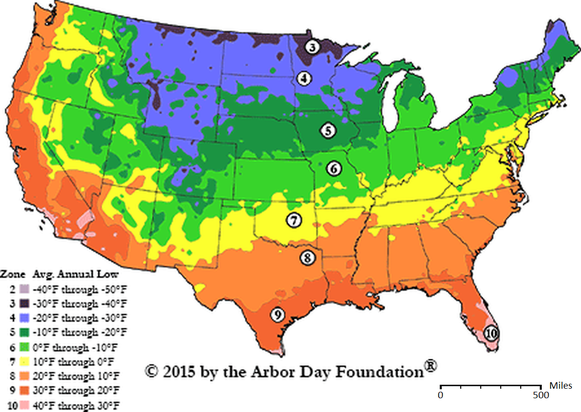
In general, the effect of an increase or decrease in temperature on agriculture and natural ecosystems can be estimated by examination of a growing / hardiness zone chart, like this one for the United States:
http://sealevel.info/zones-2015_129pct.png
If you compare the scale-of-miles to the zone sizes you can see that a 1°F change in temperature is equivalent to a shift in latitude of about 30-40 miles — barely noticeable.
From the rule-of-thumb in Hansen 1988 (“A warming of 0.5°C… implies typically a poleward shift of isotherms by 50 to 75 km…”) we get 34.5–51.8 miles per 1°F change in temperature, which seems a bit high.
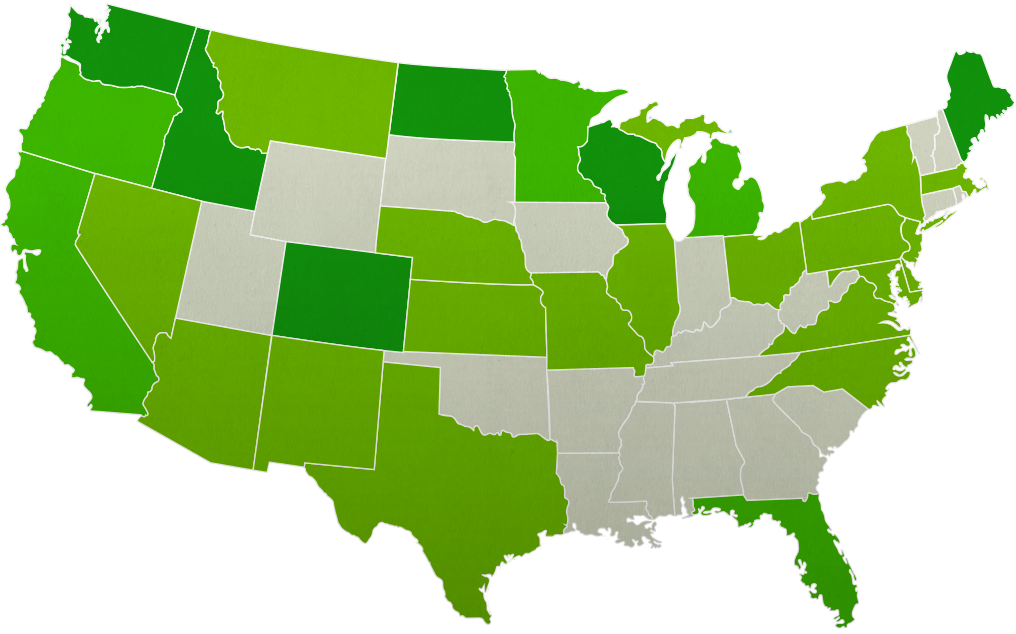
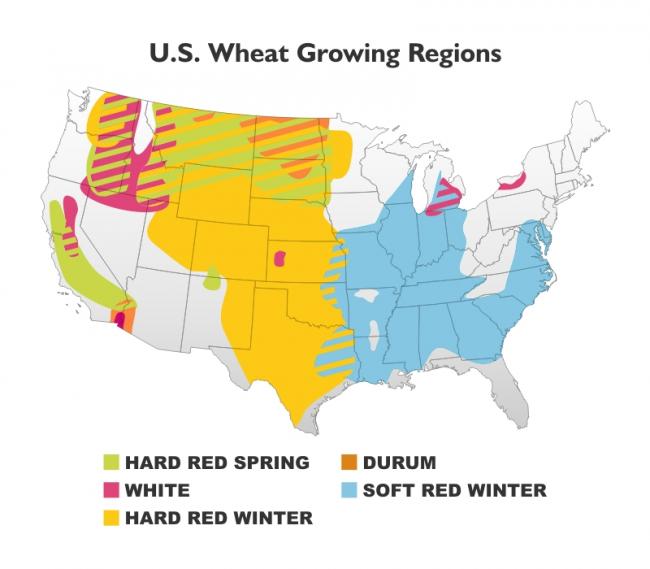
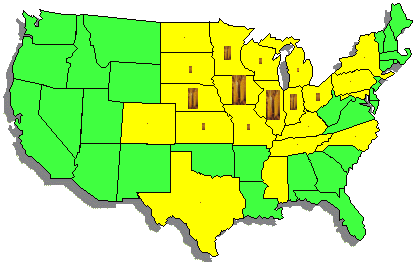
So let’s call it 30-50 miles. Now compare that 30-50 mile isotherm shift to the range of climate zones where most crops are grown…
E.g., potatoes:
http://potatoesusa.com/us-potato-industry/us-growing-regions
http://www.potatoesusa.com/uploads/content-images/growing-regions-us-map.png
or wheat:
http://media.barchart.com/cm/articles/cache/a4e1560a45cce5761e34586e2d100248.jpg
or corn:
http://www.robinsonlibrary.com/agriculture/plant/field/graphics/corn-usmap.gif
Claims that a degree or two of warming will devastate agriculture do not pass the laugh test.
The only really strong trend related to rising CO2 levels is agricultural productivity. It has nearly tripled since the 1960s, in part because of CO2 fertilization.
The dramatic benefits to agriculture of higher CO2 levels have been known to science for a century. Look at this illustration of how potatoes benefit, from a 1920 Scientific American article about the research of Dr. Friedrich Riedel:
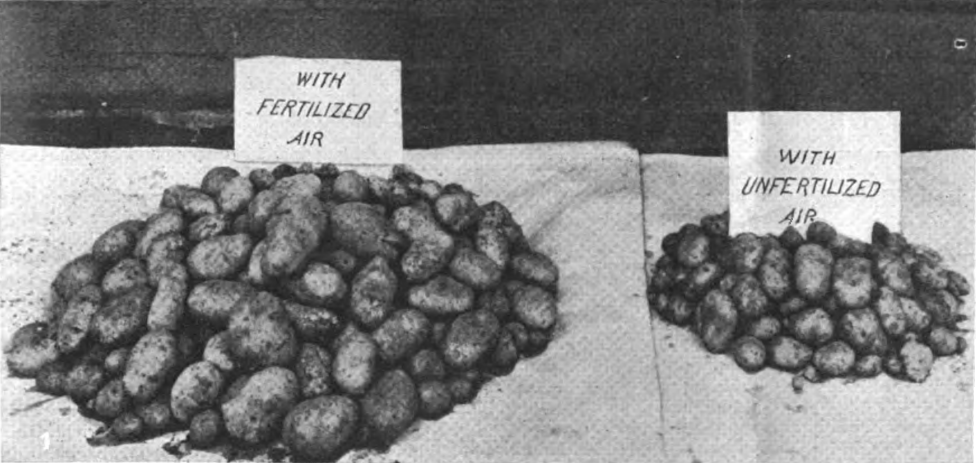
Here’s a similar but longer 1920 Saturday Evening Post article, about how scientists in Germany were using CO2 from blast furnace exhaust to “fertilize” their crops; the wry title is a reference to Germany’s recent use of poison gas in The Great War:
http://sealevel.info/Raising_Bumper_Crops_with_Poison_Gas_The_Saturday_Evening_Post_Oct_1_1921_v16.html
Here’s the English-language abstract of a 1921 German Language book, on the same topic (it’s the 2nd-to-last item on p.618):
http://sealevel.info/2015.29917.Experiment-Station-Record-Vol-44-1921_text_pp_4_247_647.pdf#page=3
Here’s the book:
https://hdl.handle.net/2027/uc1.b3884172
Here’s an article about some people in Holland who are doing the same thing today:
https://sunshinehours.net/2017/11/11/omg-ha-ha-ha-co2-recycling/
The best scientific evidence indicates that manmade climate change is modest and benign, and higher CO2 levels are very beneficial for both agriculture and natural ecosystems. In other words, the “social cost of carbon” is negative.
How far we have come in crop cultivation and production, and there are some who want to revert to food poverty. Brilliant!
On a recent road trip through Canada and the US the corn was definitely higher the further you moved south.
The difference was quite dramatic. Corn likes it hot. Which would explain why corn is a big part of Aztec culture and nowhere to be found in Inuit culture.
You can grow corn in the US and Central America. But in Canada corn only grows along a narrow band on the US border. There are millions of square miles of Canada that are too cold to grow corn. Nowhere is it too hot. Too dry in places. But not too hot.
Farther south, farmers plant earlier.
The “research” which shows that higher temperatures harm crops typically assume that farmers are idiots, and don’t know when to plant their crops.
It’s akin to psychological projection. It’s not the farmers who are the idiots.
seeing as the high temp resilient corn monmongrels grabbed to use and fiddle round with- was an Australian dryland farmers corn to begin with..ie adapted by growing in the area continuously heritage seed! and our corn here wont even beging to get its growth stared till the nights are 20ish and the days 33cand over for decent growth.
I grew some of that stained glass maize last yr:-) very pretty decor not eating. but it did have me wondering if it would head up in time to allow for ripening.
the odd pumpkin will grow here but cucumber watermelon rockmelons are pretty iffy
and we have weeks of 35c but our soil temps are slower to be acceptable to the seeeds.
This prediction should be of great concern for corn farmers since the opposite is likely the case with glut and plunging prices over time.
Using models which are not validated and consistently make wrong predictions to project future temperatures and then using similarly other invalidated models to predict future crops yields in the imagined future. The sicence gods are not pleased.
Funny when I drive around the phoenix metropolitan area, i see very healthy corn fields a plenty. Not like in Iowa where I am originally from, but there is still corn here. And the summers are a bit warmer here than from what I remember living in Iowa. So there must be something else at play than just temperature.
I’ve never seen corn not grow where it’s warm. I have seen it not grow when it gets cooler. If there is a failure in maize production, it won’t be from a warmer world.
Yeah, is heat really the issue, or is the issue irrigation ?
I planted a tiny patch of corn for the first time in my vegetable garden this year. It was hard to get beginning seedlings past the cut worms, but once I won that battle (via three re-plantings and appropriate counter-measures), my little patch is now eight feet tall with young corn developing.
One thing I found out is that this little patch takes lots of water, especially during a string of 90+ degree F days without rain. The ground gets bone dry. I imagine that a commercial field would require immense quantities of irrigation, and so I could see this as a problem on that scale of production.
Really hot days cause greater evaporation, which necessitates lots more water . Who knew? [/sarc]
@ur momisugly Robert,
you are confusing 2 different issues.
It takes water for corn to grow. That’s a given. Years ago the greens wanted to switch out of corn because of the amount of water it takes to grow corn. That issue faded… Politics of water. All the water in the US has an owner. Water rights determines where you can build. Whether you can water your corn. ( or tomatoes, peppers, squash, or what have you) I know first hand the difference in water rights can make on people’s lives. You probably spent more for water than the corn is worth, you have residential rates. It’s like growing flowers, they are pretty and I like them. Cost is not so much an issue.
Corn doesn’t grow when it is chilly no matter how much water you put on it. Warmer weather increases the yield… provided it rains.
Too many issues for me to speculate as to what you were doing growing your corn. I don’t plant corn unless I have sufficient amount of land. I like an acre at least for the corn, different maturity dates and different plant times.
Being a farmer is/was/will be not/never be easy. That’s why farms are going corporate.
As noted by others, since corn is grown from Central America to Canada, a few degrees warmer is NOT going to impact anything. A few degrees COLDER, now that would be a problem. I suggest that the authors of this study (and a few others like Mosher) get out of their air conditioned offices and manicured university environments and take a look at the real world. Maybe look up the concept of “Degree Days” and try to understand why that number is published for every agricultural region in the US and most others world wide. Even a 4C rise won’t hurt most of the corn belt, but a 4C cooling certainly would.
REPLY TO BILL MURPHY
You are absolutely right Bill .I grow ( maize) corn in the North Island of New Zealand at an altitude of 300 feet with little problems from frost but around 1980 there was a widespread frost that damaged large areas on our New Years day with major losses on low lying land When we grew it on an out farm at 600 feet not far away we had it frosted before harvest 4 years out of 12 in April before harvest but it was still OK for silage.
Accumulated heat units is what grows great crops of maize .
Where corn don’t grow:
Don’t you love it when people who have no grasp of the genetic history of Miaze from teosinte to the modern versions declare its eminent failure. For the last 50K years it has been one of the most successful plants on the planet due to its symbiosis with the 3rd chimpanzee. It has thrived though ice ages and multi century droughts none the worse for wear. Even if we were to get 2-4 degrees warming it would be a small bump in the road.
Eric ==> Thanks for the graph and quote at the end of the essay — that’s the real scoop — despite whatever warming (if any) corn-growing regions have seen over the last 30 years, corn production world-wide has continued to increase both through increased yields and increased acreage.
The study is what Dr. Judith Curry refers to as “climate science taxonomy” — research that uses up valuable funds and researcher time without even standing a chance of adding to our store of knowledge.
FYI — last year the United States grew ~ 371 million metric tons of corn.
TO: Eric Worrall
FROM: Eric Koperek, Plant Breeder & Farmer
SUBJECT: Crop Yields and Global Warming
DATE: PM 5:58 Monday 16 July 2018
TEXT:
(1) Most folks do not know how sensitive food crops are to small environmental changes. Slight differences in global temperature have big impacts on crop yields. For example, during the Little Ice Age (1350 through 1850 approximately) global temperatures dropped about 2 degrees Fahrenheit. This was enough to knock 1 to 2 months off the average growing season. The result was mass starvation. Many countries lost 20% to 30% of their population.
(2) Rising global temperatures cause just as much havoc. 1 degree Fahrenheit rise in air temperature is the same as losing 4 inches of rainfall. 4-acre inches of water can mean the difference between harvesting a crop or going bust for the year.
(3) Planting farther north will not resolve the heat issue. Please remember that climate becomes drier the closer you get to the Poles. The Arctic and Antarctic are ice deserts. Shifting the “Corn Belt” 200 or 300 miles north puts you square in the middle of a semi-arid belt where drought is normal. Translation: 25 to 30 bushels of corn per acre is a “bumper crop” in dry land climates.
(4) Most grain crops stop growing at about 85 to 90 degrees Fahrenheit. The plants are too busy sucking water and trying to stay alive. Translation: Yields go down as temperatures go up. Global warming will NOT put more food on the table.
(5) Small grains (wheat, oats, barley, rye, and other cereals) are especially sensitive to air temperature when pollinating. For example, a few days of 90 degree Fahrenheit temperatures kills wheat pollen. No pollination means no crop.
(6) Climate change (up or down) makes weather patterns unpredictable. Rain falls at the wrong time. Growing seasons become unreliable. Farmers do not know when to plant or harvest. Agriculture is dependent on climate stability. A week or two of unseasonably dry or wet weather is sufficient to destroy a crop. Most of the world’s farmers live on the edge of calamity; it does not take much to push them over the cliff. A few degrees of heat or a few inches of rain is just enough to cause region-wide famine.
(7) Be very careful when you make pronouncements about the effects of climate change. Nature is notoriously unpredictable.
ERIC KOPEREK = erickoperek@gmail.com
http://www.worldagriculturesolutions.com
end comment.
Maize over here is doing better than I have ever seen it in the first hot summer for two decades.
Well… my heretic understanding is that at low ppm of CO2 we were on the brink of agricultural collapse due to lack of CO2 (the agricultural yield by weight is proportional to ppm of CO2 up to 400 ppm and then it levels off.. at 800 ppm it increases ~50%).
It seems that if the ‘mainstream’ thought is right and CO2 concentration continue to increase, then we will have an agricultural boon, perhaps the middle east will become the Fertile Crescent again and north Africa and Libia will become the grainary of Europe like it did in Roman times…
If they are off in their predictions and we continue to reduce CO2 emissions we could cause our own famine and agricultural collapse.
“There is an optimum temperature at which they grow and beyond that their yields decline”
According to crop scientists, that optimum temperature is 92F (and yields DON’T decline after that, at least
not immediately; it would have to get well into the triple digits for any negative effects on yield to be seen). That’s the AVERAGE temperature for the day. So even if the max temp got to 102, if the min temp was 82, that’s still an average of 92. Even if global warming continues (resumes?), even if the global average temperature goes up 10 degrees F, there will be very few days when the average temperature, anywhere in the US Corn Belt, exceeds 92F. The July average high and low in Springfield, Illinois, on the southern edge of the Corn Belt, are 86 and 66, for an average of 76. That could go up 16F (about 9C) and still not exceed the optimum temperature for crowing corn. And that’s in the WARMEST part of the Corn Belt. I don’t believe anyone is talking about temperatures going up 9 degrees Celsius, so we don’t have anything to worry about.
Now, if higher temperatures are accompanied by lack of moisture, that can be a problem. But there’s no reason to believe that is any more likely to happen than it is now. In fact, precipitation will INCREASE as temperatures increase. Moreover, the higher levels of carbon dioxide will make crops more drought-tolerant. So again, nothing to worry about.
But why am I worrying about refuting these ridiculous speculations about negative consequences of global warming on crops? There are obvious POSITIVE consequences for crops, ignored by the alarmists, that will beat, by orders of magnitude, even the worst negative consequences imaginable. So let’s look on the bright side:
1. As illustrated above, even the worst imagined global warming will not reach daily average temperatures above 92F in the Corn Belt. Not only does that mean we don’t have to worry about negative effects of higher temperatures (which actually don’t set in until well above 92F), but every additional degree of warmth, up to 92, will IMPROVE corn yields.
2. The central tenant of global warming alarmism is that it’s caused by increased carbon dioxide. But carbon dioxide acts as a FERTILIZER for plants, including crops. So that too will increase yields.
3. Vast areas of Canada and Siberia, which are now too cold to crow crops, will become warm enough with a few degrees of global warming. So in addition to the increased yields in established corn-growing areas, we will have additional acreage in places where corn has never been successfully grown. So that will increase total production.
4. I’ve never actually sat down and done the math on this, but there’s a possibility that some corn-growing areas will be able to harvest TWO CROPS of corn from the same field in the same calendar year, if temperatures rise enough. The length of the “growing season” for corn is strictly a function of how much heat the crop accumulates over time. If you plant it early enough (and you will be able to as winter and spring temperatures increase), and if you get enough heat early in the year (and you’ll be getting more as spring and summer temperatures increase), you could conceivably harvest in June, then immediately turn around and plant another crop. That second crop would get a tremendous growth spurt in July (the hottest month of the year), and be ready to harvest by November. Of course, you would need to add more fertilizer, since the first crop would have pretty much depleted what was there.
(It’s not quite the same thing, but for decades, rice farmers in Texas and southern Louisiana have been getting two cuttings from their crop. It gets warm enough down there (even before global warming started) that the rice is harvested in July, and if you just cut the head off (as opposed to cutting the whole plant down), the head will regrow and put on more grain, that is then harvested in September/October. Imagine if that could be done in Arkansas, which produces half of the US rice crop. Temperatures would only have to go up 3-4 degrees F to make that a reality.)