Guest pondering by David Middleton
NEWS 06 MARCH 2018
Volcanologists warn world is unprepared for next major eruption
A big blast could hobble global trade, communications and financial systems.
Alexandra Witze
The world needs to do more to prepare for the next huge volcanic eruption, a team of leading scientists says.
The devastating Indian Ocean tsunami of 2004 and the Tōhoku earthquake in Japan in 2011 highlighted some of the worst-case scenarios for natural disasters. But humanity has not had to deal with a cataclysmic volcanic disaster since at least 1815, when the eruption of Tambora in Indonesia killed tens of thousands of people and led to a ‘year without a summer’ in Europe and North America. Such world-altering blasts rank at 7 or more on the Volcanic Explosivity Index (VEI) scale of eruptions, which goes to 8.
“The next VEI-7 eruption could occur within our lifetimes, or it could be hundreds of years down the road,” says Chris Newhall, a volcanologist with the Mirisbiris Garden and Nature Center in Santo Domingo, Philippines. But the time to have this discussion is now, he says, so that researchers and government officials can plan and prepare before an emergency strikes.
Newhall is the lead author of a paper published last week in Geosphere1 that explores the potential consequences of the next VEI-7 eruption. His co-authors are volcanologist Stephen Self of the University of California, Berkeley — with whom Newhall devised the VEI scale2 in 1982 — and Alan Robock, a climate scientist at Rutgers University in New Brunswick, New Jersey.
[…]
Newhall’s team says that researchers should start to prepare for a VEI-7 eruption by studying potential effects on crucial communications links — such as how atmospheric moisture and volcanic ash can interfere with global positioning system signals. Others could work to improve their understanding of how large amounts of magma accumulate and erupt, helping scientists to forecast where the next VEI-7 event might occur.
The researchers already have a long list of candidate volcanoes that might be capable of a VEI-7 blast. They include Taupo in New Zealand, site of the world’s last VEI-8 eruption — 26,500 years ago — and Iran’s Mount Damavand, which lies just 50 kilometres from Tehran.
[…]
The Nature article is actually longer and more informative than the Newhall et al. Geosphere1 article:
Specifically, we focus on Volcanic Explosivity Index (VEI) 7 eruptions, which occur 1–2 times per thousand years.
[…]
We suggest and apply criteria to identify candidates for future VEI 7 eruptions, and discuss likely challenges for short-range forecasting of such events. Preparation for such low-probability but high-consequence events is difficult to imagine…
[…]
Yes. It is very difficult to imagine how to prepare for the global impacts of low probability geophysical hazards if the timing and locations of such events are all but impossible to forecast until the eruptions are imminent. Cataloging and monitoring volcanoes capable of VEI 7 and greater eruptions is a good idea. But… serious question: How could anyone actually prepare for the global effects of a VEI 7 eruption?
The Nature article linked to a couple of other interesting articles by Ms. Wiste:
Each article included a cool graphic:

The fact that none of the massive Yellowstone eruptions made the cut provides some context to how truly massive these eruptions were.

The take-away from this graphic is: Don’t live near stratovolcanoes, particularly if they have histories of generating nuée ardente (pyroclastic flows) and/or lahars (volcanic mudslides).
As a geologist, I’m all for monitoring active volcanic fields… But, I’m not sure I see how we could prepare for a massive eruption of any of these.
If and when Yellowstone pops off another Ultra-Plinian (>VEI 6) eruption, the best we can hope for is that we have the resources to clean up the mess…

Most people are probably unaware of the fact that Sunset Crater in the San Francisco volcanic field near Flagstaff AZ has erupted within the past 1,000 years, that the Raton-Clayton volcanic field in NE New Mexico was active as recently as 45,000 years ago or that Los Alamos National Laboratory NM sits just north of a still-active mini-Yellowstone (Valles Caldera). These volcanic fields are not monitored.

Massive caldera-forming volcanoes like Long Valley and Yellowstone are the volcanic equivalent of an ARkStorm flood. Very few have occurred in human history. Of the 22 identified VEI 8 eruptions, none have occurred during the Holocene. The most recent, Taupo Volcano in New Zealand, occurred 24,500 years ago. Of the 128 identified VEI 7 eruptions, only 10 occurred during the Holocene and only 3 during the most recent 2,000 years.
There is a long observational history with volcanoes like Mount St. Helens, Vesuvius, Aetna, Montserrat, etc. It’s possible to predict eruptions with sufficient accuracy to order evacuations. We have no idea how much warning we will have of a major eruption of Yellowstone or Long Valley. No one has witnessed one of these types of eruptions in recorded history. There really aren’t any benchmarks for when to order an evacuation. It’s essential that these volcanoes be closely monitored… But, I don’t think there’s much we can do to prepare for or even mitigate the effects of super-eruptions.
A Plinian or Ultra-Plinian eruption of Yellowstone would be really bad.

What do WUWT readers think? Is there a way to prepare for the global impacts of the next VEI 7+ eruption? Should tax dollars be spent on such preparation?
Bend over, put your head as far back as possible, and. . .
I’d opt for the Hitchhiker’s Guide to the Galaxy version…
LOL, Dave… Put a paper bag over your head!
It’s one of those days. I was about to say we should also prepare for an
The truth is, of course, that we should continue to make ourselves more technologically and economically developed, using the cheapest available forms of energy production. In other words, carry on with what fossil fuels have already done for us. It is poor people in under-developed nations that suffer the most from natural disasters. More wealthy countries and peoples have the resources to cope more effectively. Everyone knows this, except, apparently, global-warmers and various assorted environmentalists.
michael hart “In other words, carry on…”
lol In other words keep the paper bag over your head.
Zazove, I’m sure all those windmills and solar panels will hold up great in the event. Perhaps you’re confusing your paper bag with someone else’s…
michael hart. Love this term “assorted environmentalists”. If we can have assorted chocolates, why not assorted environmentalists? Probably a mix of hard & soft centres, nuts, light & dark chocolate.
I think a greater or as great treath to mankind is neomarxism and postmodernism. That we can do something about.
No matter how you insulate wires or reinforce buildings a VEI 9 eruption of the kind in the 1st list would wipe out anything in its past so everything that you did to prepare would just be a waste of money. Even a VEI 8 eruption like Yellowstone would obliterate everything we hold dear in its path.
Unless we learn to make homesteads underwater. Anyone remember this old movie? ?zz=1
?zz=1
I was actually reading this earlier, my mom linked it to me, I don’t recall seeing any specific recommendations for actions to be taken other than not living near volcanoes which may erupt. I live well outside the predicted fallout limits for Yellowstone, so not much I could do beyond not going to Yellowstone. I’ll finish reading it this afternoon, I have an idea their only solution is to give them truckloads of tax dollars. Seems to always be the “solution” to whatever “problem” crops up.
Yes. When the bloke says
what he actually means is that he should be PAID to talk about it now.
Exactly. This is an appeal for relevance and money. Mostly for money.
Put jam in you pockets because all you’ll be is toast.
Not us preppers.
All of you bitcoin paupers…yup.
Honey might be better.
Since “Volcanic eruptions are triggered by cosmic rays” (Ebisuzaki et al 2011*), REPELLING those rays with tested Laser Plasma Shields, will stop devastating-COOLING electro-volcanic eruptions! 8 institutions announced simulations!** *sciencedirect.com/science/article/pii/S1342937X10001966. **phys.org/news/2017-07-scientists-laboratory-astrophysical.html Princeton, RochesterΝΥ, Michigan, New Hampshire. thewire.in/159826/tifr-tabletop-laser-plasma-omega-parker-aditya
That Mt. St. Helens eruption in 1980 put ash on the front range in Colorado, at least in Loveland, north of Denver. Much farther than the map above shows
Also, St Helen’s dropped ash on my windshield in the college parking lot in Santa Fe, NM. Made for some astounding sunsets though.
That map only shows significant ash accumulations. Traces of Mt. Saint Helens ash landed as far away as Oklahoma…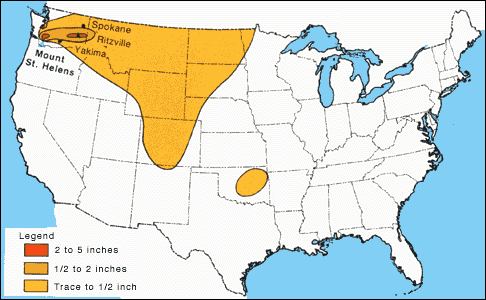
https://pubs.usgs.gov/gip/msh/ash.html
It extended north into southern Canada. Mapmaker had a limited perspective.
The map cuts off at the border… Not the ash fall.
This is all assuming that the next big one will be in the same place where one has gone off before.
Once the ash made it to Canada the bureaucrats wouldn’t allow it in because the permits weren’t signed – thus no record exists of any making it to Canada. (sarc)
The best preparation for whatever event is to be rich. To have machines, vehicles, powerplants, stockpiled energy material & food etc, all this as solid as possible. The richer the better. And it works for just any event, volcanoes, floods, drought, crop failure, earthquake, diseases, and war. And it works for people and for countries.
The best use of tax dollar is to buy back debts, to be a rich country with assets all over the world, so you can buy help when needed.
Duck and Cover!
Wasn’t it, “Duck, roll, and cover?”
M’kay?
Dodge, duck, dip, dive and dodge… The five D’s of dodgeball…
After further review, you are correct. “Duck and cover.”
There are some common sense things that would apply here as well as elsewhere. Just like prudent families have a rainy day fund, try as a society to not live near the edge – i.e. have food reserves available, robust communications and infrastructure, and a rudimentary organizational structure. That way one can minimize the area of impact, retain a semblance of society, and begin the process of rebuilding. We should be able to exist through a year of enforced scarcity, such as a completely disrupted growing season.
Those are the sorts of things we should be doing anyway.
That was my thought. Part of the reason we’re so dysfunctional as a society these days is because we’ve forgotten how to be self-reliant and being part of a REAL community—one which you know your neighbors, are friendly with them, keep vigilance on their property while they’re on vacation and vice versa, etc.—rather than insisting everything is turned over to some faceless, inept bureaucracy of government oversight. We have plenty of examples where communities of ordinary people do far better pulling together after a natural disaster rather than relying on outside governmental assistance to put normalcy back into people’s lives.
Arm yourself. Those unprepared and without assets will try to steal from those prepared with assets.
Not gonna happen. After 4 days, the people in dense population areas will revert to hunter-gatherers and become marauding bands as conditions worsen.
Aka, zombies!
Clearly this is simply a thinly-veiled appeal for research grant money…
Thinly?
Walter
I echo your incredulity.
Auto
Good article David. I like some of the figures and maps. The Columbia River flood basalts were probably produced by a deep melting plume off the migrating Yellowstone hotspot (the hotspot is fixed and the North American Plate travels over it). The south side equivalent is the Miocene Rift basalts in Nevada. Both events are synchronous and have the same tendency to produce gold deposits. As a fellow geologist might we agree that the geophysicists responsible for these geophysical disasters should be identified and sterilized?
As a member of both the AAPG and SEG, I can only half-agree… 😉
https://youtu.be/VQhjkemEyUo
Keep your larder full.
and your firearms ready.
I’m somewhat surprised that some alarmists haven’t suggested studying a method to trigger a 7 or 8 on purpose to reduce the temperature a little
Drill into Yellowstone caldera, widest bore possible.
That might get something happening.
May I correct a typo? It’s Mt. St. Helens (no apostrophe, usually written St., not Saint). It’s named after a 18th-19th century English nobleman, Lord St. Helens, who was a friend of George Vancouver, the explorer who named the mountain.
Fixed. The Saint was my bad. The Helen’s was my PC correcting my spelling.
This entire subject area is like a cheap 1950’5 Japanese si-fi movie.
The only thing saving us is some young scientist running around in a white coat and a blond in a tight sweater (those 2 worked in every is-fi movie ever made).
In my prepper hideout, the girl in the tight sweater is welcome to stay.
I can do my own scientifical hypothesizating.
And you already have a white lab coat!
And if you don’t, a good bathrobe will suffice.
Yes, call Hugh Marlowe, he’ll know what to do.
Hugh Marlowe could handle anything!
Are scientists allowed to investigate real threats? Of course some communist solution will be proffered
We live an hour and a half from Mt Rainer in Washington State. It is one of the most heavily instrumented volcanoes in the world, so I’m hoping for some advance warning. The lahar maps miss our location, but I don’t want to count on that.
I’m 30 miles as the cinder flies from peak of the Stratovolcano, Rainier to my house. I’m well up on a hill, not far from Orting, which is in the path of lahar/flooding/destruction.
Living dangerously….
The lahar maps for Rainier are purposely underdone. The state and King county have managed to keep the most affected part of the potential lahar field open (Electron area), but the rest has fallen prey to the developers, and more of that empty space gets built on every year. Also, the roads in the entire immediate danger zone are woefully inadequate to any kind of evacuation, and in the extended danger zone they’re not even sufficient for rush hour traffic once one gets to Puyallup. Let’s face it, if Rainier goes, few people in and south of Seattle will have much of a chance.
Let me say in advance that, I hope that if one of these were to happen in my lifetime, that it would happen in a remote area with plenty of warning so that there would be no human casualties. That said, it would be really cool. And it would drive the climate change yappers off the front page by making it clear that we humans are just passengers on this bus, and that nothing humans are capable of, at least with current technologies, can have any effect on the environment.
The way to prepare would seem to be to follow the prepper model of having everything a person needs to be self sufficient and well armed and defended in order to avoid starving for as long as possible.
Just don’t rely on the New Orleans Levee Boards to protect you. The same goes for protection from LAPD in the street riots.
Or Broward County Sheriff deputies at an active shooter scene.
I had to look up the date. It was Sunday, May 18, 1980, when St. Helen’s erupted. I was living on the water looking out to the Vancouver harbour. Sometime after 8:32 AM I heard a boom and looked out to the bay to see if a small boat had blown up.
Later in the day learned about the blast. Had the blast gone straight up the distribution of ash would have been greater. That the blast went sideways diminished the distribution.
I still have a booklet published shortly after that outlined how to protect a car from the ash.
I was at Ft Sill OK and we got dusted with ash afterwards. Kinda spooky. Weather was typical Oklahoma spring, otherwise.
I had a professor who was a kid living near the volcano when it erupted. He said that they were at church when they heard it, and when they went outside, ash was falling like snow. People half wondered if it was the end of the world.
Good day not to skip church. 😉
I was getting married. Didn’t find out until two weeks later at airport coming home from Italy. That’s what is called a great honeymoon!
I believe that Damavand sits on a plate boundary. It’s been quiet for a long time, but that means nothing in volcanic lifespans.
Why didn’t these people include the REAL problem, the ongoing eruption of Erta Ale in the Afar Rift Zone in Ethiopia? When a fissure opened in that area in 2005, because the land surface is being eroded by heat from the Earth’s interior, I guessed at a 12 year time span for a full breakthrough and a fillup of Erta Ale’s caldera, which was then about 60 feet deep with a lava lake at the bottom. I was off by about 2 years. Erta Ale is busy producing lava flows and outgassing, and the small rift (8 ft wide, 8 ft deep, 32 feet long) is now nearly 40 miles long and several hundred feet wide, producing all those noxious gases that volcanoes produce.
And the people who cook up these articles act as if they don’t even know it exists. Well, they probably don’t, so how to prepare for big volcanic eruptions?
Simple: keep the pantry and cupboards stocked. If you have room for one, go to an Amish carpenter and ask him to build a Hoosier icebox for you. Learn to cook on a woodburning stove. Try to get off the grid as much as you can. Plant your own garden, because volcanic ash is rich in soil nutrients and aerates garden soil better than anything else.
Otherwise, just stay alert to what is going on in the world.
A mega-eruption is going to kill a huge number of people not only immediately but over the succeeding years. Civilizations are going to collapse. Individuals setting themselves up to survive in the short term is all very well. What we would also need is multiple redundantly stored centers of knowledge sufficient to lift civilization back out of a very dark age. There was a science fiction story about this very thing written many years ago: ‘A Canticle for Leibowitz’ if I remember correctly.
Good book.
I read that in 1974. He rode a morse, a cross between a moose and a horse. He was looking for an analog computer and finally found one.
Get in touch with your local branch of the Society for Creative Anachronism, http://sca.org/. It’s a lot more than bashing your best friends with big sticks. Not only are there blacksmiths and brewers, but people who have refined their own iron to work, and who cultivate their own beer yeasts — you know, old crafts.
And for fun,
Mellyrin, with respect, the last people I would want with me in an apocalypse are members of the SCA,
Politicians don’t have time to bother about ‘minor’ issues. They are too busy enriching themselves …
No surprises, really : we all have to die one day. Get used to the thought – and remember that even if an awful lot of folks die at the same time we only die one death each.
I’ve a feeling that global society – at least the 1st world – is so interconnected that we are a bit like the cliché of the US salaryman as two paychecks from the gutter. A VE8 would knock a lot of bricks out of the edifice. So much of the logistic chain is now just-in-time that it’s fairly fragile.