Guest Post by Willis Eschenbach
Over at the Notrickszone, there’s much buzz over a new paper entitled Molar Mass Version of the Ideal Gas Law Points to a Very Low Climate Sensitivity, by Robert Holmes. The Notrickszone article is headlined with the following quotation from the paper:
“In particular, formula 5 (and 6) as presented here, totally rules out any possibility that a 33°C greenhouse effect of the type proposed by the IPCC in their reports can exist in the real atmosphere.”
– Holmes, 2017
And here’s the abstract:
Abstract: It has always been complicated mathematically, to calculate the average near surface atmospheric temperature on planetary bodies with a thick atmosphere. Usually, the Stefan Boltzmann (S-B) black body law is used to provide the effective temperature, then debate arises about the size or relevance of additional factors, including the ‘greenhouse effect’. Presented here is a simple and reliable method of accurately calculating the average near surface atmospheric temperature on planetary bodies which possess a surface atmospheric pressure of over 10kPa.
This method requires a gas constant and the knowledge of only three gas parameters; the average near-surface atmospheric pressure, the average near surface atmospheric density and the average mean molar mass of the near-surface atmosphere. The formula used is the molar version of the ideal gas law. It is here demonstrated that the information contained in just these three gas parameters alone is an extremely accurate predictor of atmospheric temperatures on planets with atmospheres >10kPa. This indicates that all information on the effective plus the residual near-surface atmospheric temperature on planetary bodies with thick atmospheres, is automatically ‘baked-in’ to the three mentioned gas parameters.
Given this, it is shown that no one gas has an anomalous effect on atmospheric temperatures that is significantly more than any other gas. In short; there can be no 33°C ‘greenhouse effect’ on Earth, or any significant ‘greenhouse effect’ on any other planetary body with an atmosphere of >10kPa.
Instead, it is a postulate of this hypothesis that the residual temperature difference of 33°C between the S-B effective temperature and the measured near-surface temperature is actually caused by adiabatic auto-compression.
Dang … “adiabatic auto-compression” as a permanent energy source. Is it patented yet?
Please forgive my sarcasm, I just get tired of endless claims of endless energy … onwards. Here is a look at the various planetary atmospheres:

And finally, here is his math that leads to his mystery formula. From the paper:
Molar Mass Version of Ideal Gas Law Calculates
Planetary Surface Temperatures
The ideal gas law may be used to more accurately determine surface temperatures of planets with thick atmospheres than the S-B black body law [4], if a density term is added; and if kg/m³ is used for density instead of gms/m³, the volume term V may be dropped. This formula then may be known as the molar mass version of the ideal gas law. The ideal gas law is;
P V = n R T (1)
Convert to molar mass;
P V = m/M R T (2)
Convert to density;
PM / RT = m / V = ρ (3)
Drop the volume, find for density;
ρ = P / (R T / M) (4)
Find for temperature;
T = P / (R ρ/M) (5)
[VARIABLES]
V = volume
m = mass
n = number of moles
T = near-surface atmospheric temperature in Kelvin
P = near-surface atmospheric pressure in kPa
R = gas constant (m³, kPa, kelvin⁻¹, mol⁻¹) = 8.314
ρ = near-surface atmospheric density in kg/m³
M = near-surface atmospheric mean molar mass gm/mol⁻¹
Now, I agree with all of that. Well, other than the strange form of the last equation, Equation 5. I’d simplify it to
T =P M / (ρ R) (5)
But that’s just mathematical nitpicking. The underlying math is correct. That’s not the problem. The problem is where it goes from there. The author makes the following claim:
In short, the hypothesis being put forward here, is that in the case of Earth, solar insolation provides the ‘first’ 255 Kelvin – in accordance with the black body law [11]. Then adiabatic auto-compression provides the ‘other’ 33 Kelvin, to arrive at the known and measured average global temperature of 288 Kelvin. The ‘other’ 33 Kelvin cannot be provided by the greenhouse effect, because if it was, the molar mass version of the ideal gas law could not then work to accurately calculate planetary temperatures, as it clearly does here.
I’m sorry, but the author has not demonstrated what he claims.
All that Robert Holmes has shown is that the atmospheres of various planets obey, to a good approximation, the Ideal Gas Law.
… So what?
I mean that quite seriously. So what? In fact, it would be a huge shock if planetary atmospheres did NOT generally obey the Ideal Gas Law. After all, they’re gases, and it’s not just a good idea. It’s a Law …
But that says exactly NOTHING about the trajectory or the inputs that got those planetary atmospheres to their final condition. Whether the planet is warmed by the sun or by internal radioactivity or whether the warming is increased by GHGs is NOT determinable from the fact that the atmospheres obey the Ideal Gas Law. They will ALWAYS generally obey the Ideal Gas Law, no matter how they are heated.
And more to the point, this does NOT show that greenhouse gases don’t do anything, as he incorrectly claims in the above quote.
Look, we could start up ten million nuclear reactors and vent all their heat to the atmosphere. The planet would assuredly get warmer … but the atmosphere wouldn’t stop obeying the Ideal Gas Law. The variables of density and temperature and mean near-surface atmospheric molar mass would simply readjust to the new reality and the Ideal Gas Law would still be satisfied. You could still use his Equation 5 version of the Ideal Gas Law to calculate the temperature from the other variables, regardless of whether or not the atmosphere is heated by nuclear reactors.
So I’m sorry, but the underlying premise of this paper is wrong. Yes, planetary atmospheres generally obey the Ideal Gas Law, duh, why wouldn’t they … and no, that doesn’t mean that you can diagnose or rule out heating processes simply because the atmosphere obeys the Ideal Gas Law. They will always obey the law regardless of how they are heated, so you can’t rule out anything.
Best of another sunny day to everyone,
w.
MY USUAL POLITE REQUEST: When you comment, please QUOTE THE EXACT WORDS YOU ARE TALKING ABOUT so we can all understand what you have an issue with.
>>
M = near-surface atmospheric mean molar mass gm/mol⁻¹
<<
The unit isn’t right. It’s either gm/mol or gm-mol⁻¹. Sorry, I like to nit-pick units.
Jim
Robert Holmes February 7, 2018 at 5:08 pm
Robert, I believe you can do much better than that. It appears that you don’t understand my objection. I’ll try again.
Let me start with the underlying equation,
PV = nRT.
Or in your equally valid derivation for atmospheres:
PM = ρRT
Now, this law will be satisfied regardless of trajectory, by which I mean the variations in the three variables P, V, and T that led to the current condition. Or in your formulation, P, M, and T.
In terms of your equation 5, it makes no difference whether we add GHGs to an atmosphere or not. It makes no difference if the amount of incoming sunshine varies or not. It is immaterial whether the heating is coming from volcanoes or nuclear reactors. Here’s why.
Once the dust has settled from whatever the heating might be, we will still find that
PM = ρRT
Does this mean, as you claim, that temperature can be calculated from just knowing pressure and molar mass? Sure.
It also means that pressure can be calculated from just knowing temperature and molar mass.
And finally, it means that molar mass can be calculated from just knowing temperature and pressure.
So what? As I asked above, all that means is that gases generally obey the Ideal Gas Law.
But Equation 5 CANNOT tell us how much of the temperature is due to volcanoes and how much is due to nuclear reactors. It can’t tell us the source of any of the heat that got the atmosphere to that temperature.
That’s the problem, and it has nothing to do with CO2. You’ve shown that in an equation with 3 unknowns (pressure, temperature, and molar mass), if you know two of them you can calculate the third, say temperature.
But that doesn’t allow you to conclude ANYTHING about how the planet got to that temperature. Nothing. You can’t say it is or isn’t from volcanoes, nuclear reactors, or GHGs. The Ideal Gas Law will always be satisfied.
I hope this clarifies my objection to your theory.
w.
I had the same objection, but then my reasoning is that we do know that the sun gives an average insolation, and the SB equation functions not at the surface but the effective radiation height(ERH), where(I assume) energy in = energy out. From this height, where the SB temperature exists, the IGL will function to describe downwards the earths surface conditions, and the “greenhouse” warming.
Conversely, the SB equation with that same average insolation and no atmosphere will provide the average global surface temperature(emissivity etc being equal). The authors use of existing P,V, density, will of course give the surface temperature as you say. I agree.. The net temperature difference with the ERH is the “greenhouse warming”.
So far, it works for me. I am not a climate scientist, just a retired Mech Eng.
Willis, what we are saying is that when the when the solar distance variable is factored in, there is little wriggle room for other inputs. Which is how it is in real life. Neptune may be a bit self-powered, IIRC.
Willis,
The point is that if GHGs could successfully heat the surface by creating radiative imbalances then the IGL would NOT be complied with and the atmosphere would be lost.
Planets always observe the IGL because radiative imbalances are successfully neutralised by convective adjustments.
It works for radiative imbalances from material released by volcanoes, it would work for any such imbalances caused by nuclear reactors and it works also for GHGs and any other radiative materials in the atmosphere.
The fact that the IGL is a LAW is itself the demonstration of the truth.
You are on the cusp of realising that with your thunderstorm observations (which were well known to ancient mariners) but you fail to follow the logic through to conclusion.
I do not disagree, if one were to look at one discreet example. Anyone example in itself does not demonstrate where the temperature comes from.
But if temperature had something to do with GHGs, then one would expect to see a difference between atmospheres with high quantities of GHGs (eg Mars that has on a molecular basis more GHGs than Earth’s atmosphere) and those with low quantities of GHGs.
If GHGs were really doing something (whether warming or reducing the rate of heat lost from the surface) it is difficult to understand Mars.
from the NASA website:
1.
Willis Eschenbach
February 7, 2018 at 5:56 pm says:
But Equation 5 CANNOT tell us how much of the temperature is due to volcanoes and how much is due to nuclear reactors. It can’t tell us the source of any of the heat that got the atmosphere to that temperature.
The heat is needed to maintain a gas atmosphere from freezing solid.
T = pM/Rd
T = surface temperatures
p = surface pressure
M = molar mass of gas molecules
d = density of atmosphere
R = gas constant
p is caused by mass of planet
M is mass of gas molecules
d is caused by mass of atmosphere
R is constant
T is caused by mass. The main property of mass is gravity.
T is caused by gravity only
T is not caused by the radiative properties of the gases.
Willis
“PM = ρRT
Does this mean, as you claim, that temperature can be calculated from just knowing pressure and molar mass? Sure.
It also means that pressure can be calculated from just knowing temperature and molar mass.
And finally, it means that molar mass can be calculated from just knowing temperature and pressure.
So what? As I asked above, all that means is that gases generally obey the Ideal Gas Law.
That’s the problem, and it has nothing to do with CO2. You’ve shown that in an equation with 3 unknowns (pressure, temperature, and molar mass), if you know two of them you can calculate the third, say temperature.
But that doesn’t allow you to conclude ANYTHING about how the planet got to that temperature. Nothing. You can’t say it is or isn’t from volcanoes, nuclear reactors, or GHGs. The Ideal Gas Law will always be satisfied.”
.
First you appear to be mixed up. That is not the equation I used, and one cannot find temperature from just pressure and molar mass one need density as well. Are you sure you read my paper?
The formula is; T = P / (R. ρ /M)
You say all it only means is that gases obey the IGL, and I cannot conclude from all this whether GHG caused any warming to a planetary atmosphere or not. I say that any significant warming from the greenhouse gases can be ruled out from this information.
Time for a thought experiment involving two planets!!
Consider; two very Earth-like rocky planets with Earth-like atmospheres orbiting at the same distance (1AU) from the Sun. We provide one with an atmosphere identical in every way to the present Earth’s; let this planet be E1. Now the other planet E2, is going to be identical in every way to E1 except for the composition of the atmosphere. The atmosphere of E2 will be very similar to E1’s atmosphere but will contain no greenhouse gases. It will be an almost identical mixture of the same gases as E1, but these non-greenhouse gases will be designed and mixed in such a way, that E2’s atmosphere possesses exactly the same measured atmospheric pressure, density and molar mass on the near-surface as E1 does.
Clearly the existing greenhouse gas hypothesis for Earth predicts that E1 should have a much higher (33K?) surface temperature than E2 because of its greenhouse gases. The hypothesis presented here, using formula 5, predicts that both planets will have identical temperatures. Notably, the predicted temperature figure for both planets, calculated from formula 5, is the same temperature as that predicted by the greenhouse gas hypothesis for the planet with the greenhouse gases, E1.
How could the possibility be eliminated, that a simple formula such as formula 5, (which contains no reference to the percentage of greenhouse gases in an atmosphere) accurately predicts the temperature of a planet with a very specific percentage of greenhouse gases, such as planet E1? Perhaps it would be informative to have a look at the atmospheres of other planetary bodies, some with up to 96% greenhouse gases in their atmospheres (Venus), and some others with none (Jupiter, Saturn). A simple formula with no reference to greenhouse gases could not be expected to predict the atmospheric temperature of eight such widely differing planetary atmospheres, by the measurement of just three gas parameters. And yet it does.
The only way that is possible, if the greenhouse gas hypothesis is correct, is that changes in the greenhouse gases’ percentage in an atmosphere must alter the pressure/density/molar mass in such a way as to make formulae 5 fit. Yet, it would be theoretically possible to change the pressure/density/molar mass in exactly the same way numerically – by using non-greenhouse gases to reach the same parameter result – and the same predicted temperature.
Therefore, the greenhouse gas hypothesis must be incorrect.
The molar mass version of the ideal gas law is clear in that since these two planets have the same density, pressure and molar mass, they must also have the same temperature. Yet one of them contains greenhouse gases and the other does not. To conclude, either the molar mass version of the ideal gas law is correct (and both planets are the same temperature), or significant net warming from greenhouse gases is correct (and the planet with GHG is warmer) – both cannot be correct.
frolly February 11, 2018 at 10:48 pm:
“We provide one with an atmosphere identical in every way to the present Earth’s; let this planet be E1. Now the other planet E2, is going to be identical in every way to E1 except for the composition of the atmosphere … [and so on].”
That’s a good argument. Now I’m swinging back to agreeing with the gravitationists!
Regarding Stephen Wilde’s argument that an argon atmosphere would convect: here, it seems, is the crux of the confusion, and naturally someone will correct me if I’m wrong. It doesn’t matter if the atoms of argon are isothermal; the atmosphere will not be. The atoms can have the same temperature but the parcel of gas within which they reside, which are less dense as they rise in altitude, are steadily cooling according to the IGL. So they atmospheric layers cannot be isothermal, even though the argon atoms are.
Are we really just getting confused about heat and temperature? The thermosphere is very hot, but it’s also very cold!! The molecules are travelling very fast; there’s also vast distances between them.
Don,
The confusion is over the definition of internal energy. I have indeed seen sources that refer to internal energy as only kinetic energy but that usage is misleading for present purposes.
For the present discussion internal energy is best described as KE + PE and they are interchangeable in rising or falling gases.
Total internal energy stays the same but the temperature changes as convection up or down switches internal energy between KE and PE during uplift and descent.
So, Argon (or any other gas) cools with expansion during uplift with KE converting to PE.
Argon warms with contraction during descent with PE converting to KE.
The radiative theorists ignore convection altogether because they think it will come to a stop but it never can because uneven surface heating is inevitable and that is all one needs.
Frolly, your argument is simple and elegant and irrefutable. It’s a thing of beauty. It was worth it for me to stick with this entire long-winded, sidetracked, and generally confusing discussion just to hear that.
frolly February 11, 2018 at 10:48 pm
So far, so good.
NO!
Planet E1 will get additional warmth from the downwelling IR from the atmosphere, which planet E2 will not get from its GHG-free atmosphere.
This will perforce leave the surface of planet E2 warmer than the surface of the planet E1. Of course, this additional warmth will also warm the atmosphere.
As a result, the characteristics (pressure, molar mass, and density) of the atmosphere of planet E2 will NOT be the same as that of planet E1. Why on earth would they be the same? It is a very different experimental setup, with different energy flows in different locations moving different amounts of energy, so there is absolutely no reason to assume that the pressure, molar mass, and density would be unchanged.
The underlying Ideal Gas Law equation still works, of course, because it works no matter what. But it will NOT give the same temperature as the result of the equation.
w.
PS—Please note the mechanics of the refutation. You identify the key faulty assumption AND YOU QUOTE IT. Then you show why you believe it to be incorrect. Look at the pyramid. I’m right at the top, refutation of the central point:
Well, Willis, I think you need to direct attention to a planet where that actually happens.
What example can you produce where the amount of GHGs makes a measurable difference to the surface temperature predicted from the other variables?
The fact is that the temperature of any atmosphere at the same pressure is much the same after adjusting for distance from the sun regardless of composition.
Willis,
I don’t understand what GHGs could do to alter the calculation according to the gas laws so that E2 becomes warmer.
Please specify what changes to pressure could be caused by DWIR from GHGs for planet E2.
The problem you have is that, regardless of density or volume, pressure is the same at the surface because the same atmospheric weight is still bearing down on the surface however the atmosphere expands or contracts.
Thus, you cannot change pressure without also altering atmospheric mass or the strength of the gravitational field.
According to the ideal gas law only pressure, mass and gravity are needed to calculate temperature and GHGs cannot change any of them.
Also, I think you mixed up E1 and E2 but no matter. My comment assumes E2 as the one with GHGs and DWIR.
“The atmosphere of E2 will be very similar to E1’s atmosphere but will contain no greenhouse gases. It will be an almost identical mixture of the same gases as E1, but these non-greenhouse gases will be designed and mixed in such a way, that E2’s atmosphere possesses exactly the same measured atmospheric pressure, density and molar mass on the near-surface as E1 does.
Clearly the existing greenhouse gas hypothesis for Earth predicts that E1 should have a much higher (33K?) surface temperature than E2 because of its (E1’s) greenhouse gases. The hypothesis presented here, using formula 5, predicts that both planets will have identical temperatures.
Notably, the predicted temperature figure for both planets, calculated from formula 5, is the same temperature as that predicted by the greenhouse gas hypothesis for the planet with the greenhouse gases, E1.”
Willis said;
“NO!”
.
But it must be; YES!
The GHG hypothesis predicts 288K for Earth with the current mix of gases (obviously) – which have the current pressure, density and molar mass associated with them.
Planet E2 has had its non-GHG atmosphere designed so that it has the SAME pressure, density and molar mass as planet E1.
Now – If both planets have the same pressure, density and molar mass then they MUST be predicted to have the same temperature – the ONLY alternative to that is that the molar mass version of the ideal gas law is wrong.
If planet E1 is warmer than E2, then the GHE is correct – but the molar mass version of the IGL has to be wrong.
In this way it is seen that it cannot be possible that both the GHE is correct and the MMV of the IGL is correct. ONLY ONE CAN BE CORRECT!
Willis Eschenbach February 12, 2018 at 9:43 am:
“NO!
“Planet E1 will get additional warmth from the downwelling IR from the atmosphere, which planet E2 will not get from its GHG-free atmosphere.”
OK, let’s grant that argument. So how do we find the temperature of planet E1 according to Frolly’s formula? We take the pressure, molar mass, and density of E1 that has warmed more than E2 because of GHG, plug them into the formula, and we get a temperature. Not a problem; we now have temperature of planet E1 that is, according to Willis, greater than planet E2.
So now we take out all the GHG from planet E2 but we leave pressure, molar mass, and density exactly the same as E1. We can do that, no? We use Frolly’s formula and what to we get? We get the temperature of planet E1.
What’s the problem with the reasoning you presented to us? The problem is that we can’t assume that which we want to prove and then “prove” what we want to prove: we can’t ASSUME that GHGs warm the atmosphere and then use that to prove that GHGs warm the atmosphere. Classic circular reasoning.
Here’s another problem:
When we say an isothermal atmosphere can’t convect, we’re confusing heat with temperature. As a parcel of isothermic gas rises, that parcel MUST cool with decreasing pressure, even though the atoms within the parcel stay the same temperature. Yes or no?
Don,
This is better:
“When we say an isothermal atmosphere can’t convect, we’re confusing energy (KE + PE) with temperature (KE alone). As a parcel of isothermic gas rises, that parcel MUST cool with decreasing pressure, even though the atoms within the parcel retain the same energy. Yes or no?
Stephen: it’s clearer to keep the arguments as simple as possible and focus on the underlying logic, but yes.
Frolly says: “The molar mass version of the ideal gas law is clear in that since these two planets have the same density, pressure and molar mass, they must also have the same temperature.”
If two planets share the same density, pressure and molar mass, they will have the same temperature. Correct. However, the planet with the GHGs will have a lower density because the gas molecules will occupy a larger volume due to its higher temperature.
Frolly says: “[E2] will be an almost identical mixture of the same gases as E1, but these non-greenhouse gases will be designed and mixed in such a way, that E2’s atmosphere possesses exactly the same measured atmospheric pressure, density and molar mass on the near-surface as E1 does.”
Frolly is assuming what he is trying to prove. To see this more clearly, lets put 1 mole of the gases from planets E1 and E2 in a cylinder with a piston. The same pressure is applied to each piston. The density of both gases required to be the same, therefore the volume occupied by both gases must be the same. When P, V and n are the same T must be the same.
Defining the volume of an atmosphere is difficult, because there is no well-defined top. You can characterize the volume of the atmosphere by the altitude of the average molecule.
I thought Anthony disallowed to even discuss the GHE here?!
Then I can not fully agree, neither to Holmes nor Eschenbach on this. You can not completely deny, that the named approach gives quite good approximations, while it is not fully right.
It is all about the definition of “surface”. The solid surface of Venus is certainly not a surface whos temperature could be determined by the Stefan Boltzmann law. I guess only 2.5% or so of solar radiation makes onto this surface. Also only a tiny fraction of its intense surface radiation can go into space.
The question is not so much WHAT heats the atmosphere (the sun obviously), but WHERE. Where is the place, or rather the zone or radial exchange? The Stefan Boltzmann approach will be valid for this region, and this region only.
It should be quite obvious if you think of a gas giant, where the term surface needs to be defined.
Below and above that zone, the adiabatic lapse rate will largely determine atmospheric temperatures, depending on its opaqueness. So the “ideal gas law” approach is essentially not wrong, but very incomplete.
The GHE is a fallacy nontheless, and there are a couple of reasons.
1. The formula is wrong, as it does not take emissivity into account, but only absorptivity, which is completely one-sided and makes things only worse. This error will always indicate a GHE.
2. Consequently we see GHEs thoughout the solar system, on moons and planets which not even hold atmospheres.
3. On the other hand only correcting that main source of error, already gives you much better approximations of surface temperatures of zero atmosphere celestial bodys. That is by assuming absorptivity = emissivty.
4. That approach works even better, if you allow for a) logarithmic averaging of observed surface temperatures (especially with slow rotating, sun-near objects like the moon) and b) conidering, that the surface will be larger by a few percent than that of a perfectly smooth sphere. That factor will reduce oberserved temperatues by a few degrees as compared to the theoretic figures.
5. The GHE on Earth is all about absorptivity = 0.69 while emissivity = 1. A result that can only be achieved by wrongly accounting clouds. The consensus model contradicts itself on that, and that is not just a mistake. It is vital to the claim of a GHE.
In fact there two versions of clouds role within Earths climate system, and they are both “consensus” That chart may illustrate the basic problem.
http://i736.photobucket.com/albums/xx10/Oliver25/cloud%20absurdity.png
The left side illustrates the role of clouds in the total GH-model, the right side illustrates the specific CF to derive their net effect. Note how their reflection of terrestrial IR is denied, how emissions suddenly flip flop, and how the albedo effects shrinks to fit a modest negative CF.
I was with you until your little chart. What is CF? What are the blue and red arrows? What is the left side..right side?
CF = cloud forcing
left side.. “The Earth-Atmosphere Energy Balance” as presented here for instance.
https://www.weather.gov/jetstream/energy
right side..
“Clouds increase the global reflection of solar radiation from 15% to 30%, reducing the amount of solar radiation absorbed by the Earth by about 44 W/m². This cooling is offset somewhat by the greenhouse effect of clouds which reduces the outgoing longwave radiation by about 31 W/m². Thus the net cloud forcing of the radiation budget is a loss of about 13 W/m²”
https://en.wikipedia.org/wiki/Cloud_forcing with reference to the 1990 IPCC report
https://www.ipcc.ch/ipccreports/far/wg_I/ipcc_far_wg_I_full_report.pdf (page 79)
And the whole story is here..
https://www.scribd.com/document/370673949/The-Net-Effect-of-Clouds-on-the-Radiation-Balance-of-Earth-3
What this doesn’t show is that the amount that is emitted by the atm varies by night, trying to balance the Gas Eq as the temps fall, and since the WV was balanced at a higher temp during the day, it radiates as required to balance the surface if it can.
Thanks Leitwolf
I must admit that I find that energy chart very suspect, as the short term day/night, clouds/no clouds, functions to limit insolation, and to spread out the cooling, but so what? That is what every troposphere does. That chart says nothing about the time of action of cooling activities. It thus says nothing about heat, only average thermal fluxes.
It says nothing about the NET change (sensitivity) of the entire system to the doubling of CO2. Spread out the cooling more? Limit some extremes?
So what?
The author of this paper calculates a tiny number. He imo is correct. We will never know, unless some rapid 3 to 5 C warming happens soon. So far, there is no evidence outside of natural variation.
1860 – 1880 0.16 C a 20 year warm burst rate per decade
1910 – 1940 0.15 C a 30 year warm burst, includes the dirty ’30’s
1975 – 1998 0.16 C a 20 year warm burst, which we have just experienced.
Trends source: Interview by the BBC with Phil Jones of the Hadley Center for Climate Change at East Anglia University, which puts out probably the most trusted world wide temperature reconstruction called HadCRUT.
http://news.bbc.co.uk/2/hi/8511670.stm
This is the cross-section of temperature in the troposphere and the stratosphere in winter.
http://files.tinypic.pl/i/00958/rdno1ukmwigx.gif
Willis, about your nitpicking, here am I nitpicking. In the paper, Holmes presents equation 6;
“Alternatively, the molar mass version of the ideal gas law
can be written thus;
T = PM/Rρ”
Holmes forgot the parenthesis though, so yours equation:
T =P M / (ρ R)
is mathematically correct and equal to T = P / (R * p / M).
To prevent further nitpicking the last equation above should be;
T = P / (R * ρ / M)
Yes, that is my preferred equation;
T = P / (R * ρ / M)
So to summarize the extended and not-very-well-organized or moderated argument so far (not a criticism of moderators, but a statement that so far this has been a free-for-all with no attempt to summarize and focus the positions, as if anyone has time to do that) Willis says he’s right and so do those who say that gravity is a source of energy.
But … those who say that gravity is a source of energy don’t say that, do they? I hear a lot of mocking about “‘adiabatic auto-compression’ as a permanent energy source” — Willis’ words– but I don’t believe that anyone has actually claimed that, except those who are opposed to the position that pressure, not GHGs, instigates the lapse rate and is the primary source of the GHE. If so: quote, please?
The source of energy is the sun. Both sides agree on that. When the sun hits the surface of the earth and heats it, that heat is conducted to the atmosphere immediately above it because the atmosphere at that point is under a significant pressure of about 19,000 pounds/square yard/second (someone can surely state this more clearly.) This heat then convects/conducts upward, and as it does so the pressure decreases; as the pressure decreases, the atmosphere is necessarily expanding and cooling. Have I got that right? Correct me or restate this if not. So far I haven’t mentioned anything about gravity being an energy source, and my suspicion is that this is close to a straw man argument– if not exactly one.
Can we confirm this position, please? And then move on from there? Because otherwise we’re not going to be able to collectively think this through, and I’m assuming that rather than start a fight, that’s what Willis intended in the first place.
That is correct as far as it goes.
Next step is to consider the transformation of KE to PE in ascending columns and the opposite in descending columns.
And you should read this:
https://tallbloke.wordpress.com/2017/06/15/stephen-wilde-how-conduction-and-convection-cause-a-greenhouse-effect-arising-from-atmospheric-mass/
Many have noted the general principle of atmospheric mass causing a surface temperature enhancement but the above is the only step by step narrative that I know of.
Not so fast! Do those who oppose the “gravitational theory” (GT?) agree with that basic statement, above, and as far as it goes, of what the GT people are asserting? If not, with exactly what do they take issue?
I’ve heard it said here that the atmospheric temp must be invariant without GHGs; is someone going to assert that again and give some logic behind it? Is someone going to take issue with the apparent fact that an atmosphere under significant pressure must conduct surface heat, regardless of the composition of that atmosphere? If this is true, then is anyone going to take issue with the apparent fact that as surface pressure decreases with altitude, the atmospheric temperature must also decrease, all else being equal, and according to laws associated with the properties of gases? Is anyone going to say that the heating of the atmosphere closest to the surface will not convect?
Is anyone who holds the GT theory willing to elaborate on its application to the above statement of the theory insofar as it goes at this point, and just sticking to the simple scheme of sun-heating-surface-conducting-to-atmosphere-under-pressure?
My suggestion is that we stick with the simple explanation of the theory that I laid out at 11:40 and knock it around just a bit before moving on to the next steps, as SW suggested.
Thank you, SW.
Don132 February 8, 2018 at 11:40 am
Solar energy increases the temperature of the surface. The surface loses energy by radiation, conduction and evaporation. Part of the radiation is directly to space (atmospheric window), the rest of the energy transfer is to the atmosphere.
In a non-convecting situation (static atmosphere) the pressure and density decrease with altitude. The atmosphere is NOT expanding/cooling with altitude. This does happen when air is rising. Now the rising volume of air (parcel) is expanding and cooling with the temperature decreasing according the Dry Adiabatic Lapse Rate or the Moist Adiabatic Lapse Rate when condensation occurs within the rising air.
Thank you, BW.
Is not the atmosphere getting thinner as altitude increases? And this is because gravitational attraction decreases? Or are you claiming that gravity has nothing to do with it? So I’m not sure how/why you say “The atmosphere is NOT expanding/cooling with altitude. This does happen when air is rising.” I should have said that the atmosphere was thinning, not expanding; my bad. The point was that the distance between molecules is increasing as we climb in altitude.
In a desert, with no water vapor, what roles do evaporation and radiation play at the surface? If there is no water vapor, and if N2 and O2 don’t absorb or emit any thermal energy to speak of?
I think what we want to figure out is the origins of the lapse rate so would rather not invoke it just yet but instead just try to reason out what’s going on with the atmosphere mostly nearer the surface. It seems to me to be circular reasoning if we say that air is cooling because of the lapse rate, and the reason for this is the lapse rate. But maybe I misinterpret.
BW: I take it back: the atmosphere IS expanding with altitude, and the proof of this is that the circumference of a circle increase as the circle gets bigger.
Don132 February 8, 2018 at 3:04 pm
Pressure and density do decrease with increasing altitude. Gravitational attraction can be considered constant for at least the troposphere.
Obviously gravity is the reason for the pressure, density and the average temperature profile of the troposphere. This is called the Hydrostatic Equilibrium (HE) against gravity our atmosphere is in.
Seems a lot of posters here are unaware of this very fundamental mechanism.
As long as posters claim that eg the Sea breeze, or even the worse the entire Hadley circulation is driven by convection, we can be sure they do not understand the HE.
.A desert on a hot day can have as much WV per m^3 as on a cold foggy day in London.
It is the RELATIVE humidity that is low in hot desert..
Don132 February 8, 2018 at 3:11 pm
This simple fact was equally true a couple of billion years ago when the atmosphere formed.
Expansion is a dynamic PROCES. Decreasing density vs altitude is a static STATE.
Ben Wouters Feb 9, 2018 @ur momisugly 4:37 pm:
“Pressure and density do decrease with increasing altitude. Gravitational attraction can be considered constant for at least the troposphere.”
You are right and I’m wrong regarding the effect of gravity; the pressure at the surface is due to the weight of the atmosphere, and the pressure decreases as we go up mostly because there’s less atmosphere above, as gravity decreases only very slightly.
Thanks for clearing that up.
Yes, the pressure and density at the surface isn’t just down to a greater force of gravity at the lower height but rather to the weight of the molecules above.
The more relevant relationship is between the downward force of gravity which gives weight to individual molecules and the intermolecular forces which try to keep the molecules apart against the weight from above. At every height those two forces are in balance as long as the atmosphere is at hydrostatic equilibrium.
That is a side issue for present purposes.
Willis has admitted that his ‘proof’ ignores convection and I have shown that that is a non physical scenario so his ‘proof’ is worthless chaff.
Don132 February 9, 2018 at 5:35 am
Good. Once you realize that the surface pressure is “contained” by the weight of the atmosphere above, it should also be clear that the surface pressure is independent of the temperature of the air.
Eg at the North pole surface pressure 1030 hPa and temperature -40 C or in a desert with the same surface pressure and temperature +40 C are both possible. Big difference will be the density of the two columns and thus how far they are expanded against gravity.
Ben Wouters Feb 9 , 2018 5:35 am:
“Once you realize that the surface pressure is “contained” by the weight of the atmosphere above, it should also be clear that the surface pressure is independent of the temperature of the air.
Eg at the North pole surface pressure 1030 hPa and temperature -40 C or in a desert with the same surface pressure and temperature +40 C are both possible.”
If you increase the pressure at the North Pole, say to 2060 hPa, then that does nothing to the temperature?
If you decrease the pressure in a desert to 515 hPa, then that does nothing to the temperature?
PV=nRT; T= PV/nR. That looks like a relationship. W
Insolation varies with latitude as does advection of air from other latitudes.
For the planet as a whole the only three relevant parameters are atmospheric mass, the strength of the gravitational field and top of atmosphere insolation but within a real atmosphere there are multiple potential variations from region to region around the average temperature set by the three parameters.
Don132 February 9, 2018 at 9:11 am
To double the surface pressure you have to double the atmospheric mass or double the gravity or a combination of both. How do you propose to do that?
But given a double surface pressure you can still have (almost) any temperature.
Will still be valid, as long as the gasses behave as ideal gasses.
It would be nice to see a version of that first graph (planets K vs pressure) with an adjustment of distance from sun (source of heat size). Oh Well.
I generally agree with your critique. The premise is not proved. Then again, there’s lots missing. IMHO the Ideal gas Laws (molar or otherwise) must hold. (Modulo any not-quite-ideal issues) so “Global Warming” also doesn’t explain things.
Agreed.
Let’s hear a proper rationale from those who object to elements of the gravitational hypothesis.
Let them start with the points you have helpfully listed.
Here are my objections to the gravitational hypothesis.
w.
https://wattsupwiththat.com/2012/01/13/a-matter-of-some-gravity/
Is it listed under ‘Bad Science’?
Willis,
First of all, I think that the elevator speech you requested in that previous essay had been given, in the first place by Stephen Singer:
“1. Planet with mass and GHG free atmosphere.
2. Planets gravity pulls down on the gas compressing it causing heat near the surface.
3. Convection sets in and gas rises. cools then back to step 2.”
There’s no response to that, from anyone, and although step 2 can be stated more clearly, that’s basically it. I’ve noticed other attempts–without wading through all comments there– but these were for the most part ignored.
Secondly, you gave an example of proof by contradiction:
Willis: “The proof is by contradiction. This is a proof where you assume that the theorem is right, and then show that if it is right it leads to an impossible situation, so it cannot possibly be right.
So let us assume that we have the airless perfectly evenly heated blackbody planet that I spoke of above, evenly surrounded by a sphere of mini-suns. The temperature of this theoretical planet is, of course, the theoretical S-B temperature.
Now suppose we add an atmosphere to the planet, a transparent GHG-free atmosphere. If the theories of N&K and Jelbring are correct, the temperature of the planet will rise.[ Won’t the temperature also rise with GHGs?]
But when the temperature of a perfect blackbody planet rises … the surface radiation of that planet must rise as well.
And because the atmosphere is transparent, this means that the planet is radiating to space more energy than it receives. This is an obvious violation of conservation of energy, so any theories proposing such a warming must be incorrect.”
You assume you are correct and then go on to prove you’re correct– sorry, but this is incorrect. Specifically, you assume that since the atmosphere is transparent (to infrared) that means that it’s radiating more energy than it receives. But there’s another explanation that you ignore, and that is that the planet is radiating exactly as much energy as it receives, as is the earth is, but that the mechanism for this involves a lapse rate set up by gravitational pressure, and not by GHGs.
I would greatly appreciate it if you would calmly point out my errors and not call me an ignoramus or any other such names; I’ll return the common courtesy.
Beyond that, let’s stick with the basic proposition that I laid out at 11:40, and maybe call this “statement 1” so we all understand. What are your specific objections to that? If there are none, maybe we can proceed. If there are, we can still proceed. And, thank you.
Don132 February 8, 2018 at 5:29 pm
I’m sorry, I guess my words weren’t clear. There are no GHGs in the atmosphere. As a result, the atmosphere is NOT “radiating more energy than it receives”, because it cannot radiate.
There is only one thing in the system which can radiate. That is the surface. If the surface is heated by gravity or by any such means above the S-B temperature, the surface will constantly emit more radiation than it is receiving … which is not possible.
Why is it possible on earth? Because the atmosphere absorbs some of the outgoing radiation, and radiates its energy with about half going out to space and about half going back down to earth. So the earth ends up only radiating to space the amount of energy that it receives, despite the surface being well above the S-B temperature.
This is totally unclear. But in any case, if it works as you describe it will leave the surface warmer than the S-B temperature, which will leave it radiating more than it is receiving … not possible.
I hope this makes it clearer. If not, ask again.
w.
Willis, a surface at 288k does not radiate to space at 288k if it is simultaneously passing energy to the atmosphere via conduction. Otherwise there is a breach of the first law since energy cannot be in two places at once.
Due to the circular nature of convective overturning the process of conduction from surface to air never stops so that the surface at 288k can never radiate to space at 288k unless convective overturning stops and at that point the atmosphere falls to the ground.
Have you ever read my step by step description of the entire process?
“I hold that with a transparent GHG-free atmosphere, neither the hypothetical “N&Z effect” nor the “Jelbring effect” can possibly raise the planetary temperature above the theoretical S-B temperature. But I also make a much more general claim. I hold it can be proven that there is no possible mechanism involving gravity and the atmosphere that can raise the temperature of a planet with a transparent GHG-free atmosphere above the theoretical S-B temperature.”
So this this bit: “But I also make a much more general claim. I hold it can be proven that there is no possible mechanism involving gravity and the atmosphere that can raise the temperature of a planet with a transparent GHG-free atmosphere above the theoretical S-B temperature.”
Well I would say ozone is not really a greenhouse gas.
I don’t plan on making the case that ozone does warm earth- but it seems things which aren’t greenhouse gases and things which aren’t even gases can be called greenhouse gases or greenhouse effect. If I bother to prove dust can cause warming- are we going to call solid particles
“greenhouse gases”. And clouds aren’t aren’t gases- whether they are droplets of water in earth’s
atmosphere or clouds of droplet of sulfuric acid in Venus atmosphere- which some call “greenhouse gases”: Ie:
“On the global scale, Venus’s climate is strongly driven by the most powerful greenhouse effect found in the Solar System. The greenhouse agents sustaining it are water vapour, carbon dioxide and sulphuric acid aerosols.”
http://www.esa.int/Our_Activities/Space_Science/Venus_Express/Greenhouse_effect_clouds_and_winds
So does “a transparent GHG-free atmosphere” allow “sulphuric acid aerosols”?
Next let’s go over “above the theoretical S-B temperature”.
One could mean the theoretical S-B temperature means temperature of lunar surface, which is
about 120 C in noon sunlight. Or referring to ideal thermal conductive blackbody sphere which has uniform temperature of about 5 C. Or could referring to Greenhouse effect theory of about -18 C for average temperature of Earth.
At equilibrium temperature non blackbody surface at Earth distance from the Sun can be warmer than 120 C..
And spherical body in a vacuum can have higher average temperature than 5 C.
And planet at earth distance with 1 atm atmosphere without water, or “greenhouse gases” can be have average temperature warmer than -18 C
Pick one which you disagree with?
Willis, in your essay you say “If the total surface radiation remains the same (as it must with a transparent atmosphere)”
It does not.
First, your planet surrounded by suns is a fiction. Infinite suns would gradually heat the planet into a sun.
A one sun planet’s SB temperature is based on 1/4 the insolation. The no atmosphere planet has average temperature T1. The surface temperature is very hot during day, and very cold during night.
A non GHG planet’s atmosphere is warmed by conduction during the day, and cooled by conduction, at night.(mostly) The greater the atmosphre’s density, the greater its heat capacity, the greater the conduction.
During the day, this planet’s OLR, which is a product of T^4, is much less, thus dramatically slowing the planets cooling.
Thus a non GHG planet’s average surface temperature is now above T1, say T2, because the maximum day temperature is less. The greater the atmospheric density, the less is going to be the hottest day temperature, thus increasing T2.
There is your “greenhouse” warming with a non GHG atmosphere. The actual T2 temperature is dependent upon the atmospheric molar density.
Sailboarder
The planets OLR will only drop during the first convective overturning cycle.
Once KE starts to return to the surface when that first cycle completes OLR returns to S-B but the entire surface is left higher than S-B.
Otherwise your comments are broadly correct and Willis needs to answer.
sailboarder February 8, 2018 at 6:53 pm Edit
Yes, and it’s a special kind of fiction called a “thought experiment”. Work with it.
I’m sorry, sailboarder, but I will not play your game. This is exactly why I ask people to QUOTE THE EXACT WORDS THAT YOU ARE REFERRING TO.
In fact, what I said was:
In your mind, you think I’ve said something about “infinite suns”. BUT I SAID NOTHING OF THE SORT! You’ve made up a line of total BS, and you are pretending that I said it.
I will not stand for that, nor will I discuss matters with someone trying to stuff words and ideas into my mouth.
I can defend my own words.
I cannot defend your idiosyncratic misunderstandings of my own words.
You segue from your fantasy about “infinite suns” into a meaningless discussion of night and day, viz:
Day? Night? READ THE THOUGHT EXPERIMENT. See the part where it says “the surface heating is perfectly even”? That means even. No day. No night.
Grrrr … c’mon, folks, up your game! Take a look at the pyramid above, and decide where on that pyramid your proposed comment would fit. If you wish to refute my proof, you can’t do it with handwaving and science by assertion.
w.
wildeco2014 February 8, 2018 at 11:24 pm
Assuming that you are talking about my proof, the atmosphere is at steady-state, with no energy passing between the surface and the atmosphere. This occurs because the atmosphere cannot radiate heat. When the atmosphere can radiate heat, the upper atmosphere can radiatively cool and become cold enough to create the overturning that you describe.
But without GHGs, that cannot happen. The atmosphere stabilizes with the lowest layer at the surface temperature. With no temperature difference between the surface and the atmosphere, there is no conduction.
In my proof, of course there is no convective overturning. The surface is at a constant temperature. The atmosphere is at a constant temperature. There is no convection.
No … but it clearly has nothing to do with my proof, where there is no convection.
Thanks,
w.
Willis: OK, I will tackle your mind game, for what it is worth. (I noticed that you ignored my very correct elevator speech about the IGL working for earth. Too bad)
“We might imagine that there are thousands of mini-suns in a sphere around the planet, so the surface heating is perfectly even”
Incoming heat = 1000’s X ONE SB sun. Outgoing heat required = 1000’s X one SB sun.
Atmospheric temperature is such as to take the molar density below where the IGL functions, but the more like a plasma.
Experimental failure!
Willis..
Your 100’s of suns is bogus as a planet cannot be in orbit around 1000’s of suns.
To be true, you are describing a big rock in our universe, where there are millions of suns.
The temperature is near 0 degrees K
There is no atmosphere.
Experimental failure!
Try again please, or try my planet description above where I have shown how a real planet has a higher average temperature due to a non GHG atmosphere.
Willis @Feb 8, 11:45 pm
Willis answered the question I asked further down and I didn’t see this. Apologies.
Willis:
“Assuming that you are talking about my proof, the atmosphere is at steady-state, with no energy passing between the surface and the atmosphere. This occurs because the atmosphere cannot radiate heat. When the atmosphere can radiate heat, the upper atmosphere can radiatively cool and become cold enough to create the overturning that you describe.
“But without GHGs, that cannot happen. The atmosphere stabilizes with the lowest layer at the surface temperature. With no temperature difference between the surface and the atmosphere, there is no conduction.”
But, you do agree that at the top of atmosphere the atmosphere is necessarily much thinner? It is, because gravity is much weaker. At some point there would be a great deal of space between the molecules at the very top of the atmosphere, which you claim is isothermal. By what law do the topmost molecules retain their heat whilst they’re surrounded by much colder space?
I said the atmosphere is thinner at the top because gravity is weaker at the top. Obviously this is wrong; the reason is that the pressure is less.
Willis Eschenbach February 8, 2018 at 11:45 pm
wildeco2014 February 8, 2018 at 11:24 pm
“Willis, a surface at 288k does not radiate to space at 288k if it is simultaneously passing energy to the atmosphere via conduction. Otherwise there is a breach of the first law since energy cannot be in two places at once.”
If the surface is at 288K it will radiate to space as a 288K source, if an atmosphere is added which is warmed by conduction the surface will temporarily cool down. However the GHG free atmosphere can not lose heat to space so conduction must eventually cease so eventually radiation balance at the surface is achieved as Willis points out.
Since convection cannot be prevented it follows that conduction never ceases.
Instead there is constant conduction from surface to air under rising air and constant conduction from falling air to surface.
Willis appears to be stumped by my request that he explain how he proposes to prevent convection.
Once one has ongoing convective overturning there will be a surface temperature enhancement without the need for GHGs.
Wills: “There is only one thing in the system which can radiate. That is the surface. If the surface is heated by gravity or by any such means above the S-B temperature, the surface will constantly emit more radiation than it is receiving … which is not possible.
“Why is it possible on earth? Because the atmosphere absorbs some of the outgoing radiation, and radiates its energy with about half going out to space and about half going back down to earth. So the earth ends up only radiating to space the amount of energy that it receives, despite the surface being well above the S-B temperature.”
That makes sense to me– so far. But, in a GHG-free atmosphere, you’re saying that N2 and O2, for example, wouldn’t radiate at all, in any frequency?
And, if I may use a colloquialism, what a cotton-pickin’ minute: (W) “If the surface is heated by gravity or by any such means above the S-B temperature, the surface will constantly emit more radiation than it is receiving … which is not possible.” If a surface is receiving (“more”) energy, then what would constrain it from emitting that energy? More importantly, I don’t think that anyone has claimed that gravity is heating the surface– if so, hands up, please, and explain this. Unless I misunderstand, gravity is not heating the surface: the surface is heating the atmosphere immediately above it, primarily by conduction, and it’s doing so because of the very significant (gravitational) pressure that is pressing that atmosphere hard up against the surface. If the surface heating of the atmosphere is in turn heating the surface a bit more, then it must be doing exactly the same thing even if the atmosphere has GHGs.
It might be helpful for some of those who are experts in GT to clarify this. Does anyone contend that gravity is heating the surface?
Warning: major crash of paradigms ahead, each of which proves the other wrong! I almost don’t want to look.
Again, thank you.
Don, as you point out it could be one process or the other but not both, as my full description points out.
The clincher though is that the gravitational solution must work with or without ghgs so if ghgs then doubled the effect the atmosphere would lose hydrostatic equilibrium and be blown off into space.
As I just pointed out to Willis above such duplication would also breach the first law because the same unit of energy could not be in two places at once.
KE at a surface can either conduct or radiate not do both at the same time.
wildeco2014, what you propose is too radical and punches the radiative paradigm straight in the gut and leaves it lying on the canvas for the 10-count.. I propose to slow it down and take baby steps, and see when and how it all gets tripped up. I would like people to think it through rather than jump to defending paradigms.
I know.
Fun isn’t it 👍
Willis at 12:04: “It doesn’t matter if the claim is that gravity is heating the surface, or if the claim is that it is from, what was it … hang on … oh, yes, “adiabatic auto-compression”. Whatever mechanism is claimed, the only energy entering the system is the energy from the suns.
“And if the surface is warmed by whatever theory, with a transparent atmosphere it will perforce be radiating more energy than it is receiving … which is a contradiction.”
Agreed, only energy entering system is from sun.
So Willis is saying, I believe, that a GHG-free atmosphere can’t warm. I don’t see a quote anywhere to that effect, but it seems to be an assumption. Or have I misinterpreted?
We should back up a bit to my “statement 1”: “When the sun hits the surface of [a planet] and heats it, that heat is conducted to the atmosphere immediately above it because the atmosphere at that point is under a significant pressure of about 19,000 pounds/square yard/second …. This heat then convects/conducts upward, and as it does so the pressure decreases; as the pressure decreases, the atmosphere is necessarily expanding and cooling.”
On your hypothetical planet, with a presumed very high surface temperature, what would be the temperature of, say, the one meter of atmosphere directly above the surface? Can we assume the pressure is the same as earth’s? Can we even assume that the atmosphere is made up of argon? If the atmosphere can’t hold any heat, does that mean that the argon is at 0 degrees? What laws would you invoke to support whatever you say the temperature of the atmosphere adjacent to the surface must be? Would those laws be consistent with gas laws?
This is a sticking point so will be important to think it through and not jump to defending paradigms.
Don132 February 8, 2018 at 11:25 pm
If they radiate then they are GHGs, albeit weak ones. I meant GHG-free, as for example an argon atmosphere.
But it’s not receiving more energy. It is receiving the energy from the surrounding mini-suns. Period.
The answer is yes, lots of folks are claiming that gravity is doing it, either directly or in some indirect manner such as you propose. Here’s the thing. IT DOESN’T MATTER! It doesn’t matter if the claim is that gravity is heating the surface, or if the claim is that it is from, what was it … hang on … oh, yes, “adiabatic auto-compression”. Whatever mechanism is claimed, the only energy entering the system is the energy from the suns.
And if the surface is warmed by whatever theory, with a transparent atmosphere it will perforce be radiating more energy than it is receiving … which is a contradiction.
My pleasure,
w.
[Apologies, this comment is posted twice as the first time I wrongly put it before Willis’ comment.]
Willis at 12:04: “It doesn’t matter if the claim is that gravity is heating the surface, or if the claim is that it is from, what was it … hang on … oh, yes, “adiabatic auto-compression”. Whatever mechanism is claimed, the only energy entering the system is the energy from the suns.
“And if the surface is warmed by whatever theory, with a transparent atmosphere it will perforce be radiating more energy than it is receiving … which is a contradiction.”
Agreed, only energy entering system is from sun.
So Willis is saying, I believe, that a GHG-free atmosphere can’t warm. I don’t see a quote anywhere to that effect, but it seems to be an assumption. Or have I misinterpreted?
We should back up a bit to my “statement 1”: “When the sun hits the surface of [a planet] and heats it, that heat is conducted to the atmosphere immediately above it because the atmosphere at that point is under a significant pressure of about 19,000 pounds/square yard/second …. This heat then convects/conducts upward, and as it does so the pressure decreases; as the pressure decreases, the atmosphere is necessarily expanding and cooling.”
On your hypothetical planet, with a presumed very high surface temperature, what would be the temperature of, say, the one meter of atmosphere directly above the surface? Can we assume the pressure is the same as earth’s? Can we even assume that the atmosphere is made up of argon? If the atmosphere can’t hold any heat, does that mean that the argon is at 0 degrees? What laws would you invoke to support whatever you say the temperature of the atmosphere adjacent to the surface must be? Would those laws be consistent with gas laws?
This is a sticking point so will be important to think it through and not jump to defending paradigms.
So far Willis has asserted that a planet without GHGs would have an isothermal atmosphere: “But without GHGs, that cannot happen. The atmosphere stabilizes with the lowest layer at the surface temperature. With no temperature difference between the surface and the atmosphere, there is no conduction. … The surface is at a constant temperature. The atmosphere is at a constant temperature. There is no convection.” (Feb 8, 2018, 11:45 pm)
But, this is impossible. With increasing altitude we have decreasing pressure and we must of necessity have decreasing temperature as the atmosphere expands (the circumference of the atmosphere increases at each hypothetical rise in altitude) until at the very top the atmosphere is so thin that the atmospheric molecules are very far apart. How do those molecules higher up, which Willis maintains are at the same temperature as the surface (unless I grossly misunderstand!) maintain the heat which they acquired at the surface?
It seems to me that we have a temperature gradient; we have a lapse rate; we have convection. It also seems to me that it’s impossible to have an isothermal atmosphere.
What am I missing? Someone will have to explain, in plain English, please, how we can have an isothermal atmosphere.
Once again, please don’t jump ahead and defend any paradigms. Just work with what we have so far.
Don132 February 9, 2018 at 9:57 am:
“How do those molecules higher up, which Willis maintains are at the same temperature as the surface (unless I grossly misunderstand!) maintain the heat which they acquired at the surface?”
I’ll answer my own question, and I’m surprised that no one has stated it simply and distinctly: the atoms of argon (or any non-ghg) have no way of convecting or conducting or radiating energy away.
The only option I see is if the argon has absorbed energy (not IR) from the surface and then emits that energy higher up, and that energy loss is a drop in kinetic energy and hence a drop in temperature. But does that happen? When argon collides with other molecules in conduction, does that collision transfer just some kinetic energy or does it involve absorption of frequencies of, say, UV? I haven’t yet been able to find an answer for that. What if the heated molecules on the surface of the planet radiate in the same frequencies as argon can absorb?
I can look all day and find something I can’t quite understand, or someone can say something according to Descartes (that is, clearly and distinctly) that makes sense of it. Or, someone can point me to a reference that isn’t filled with math. Or, I can look all day.
Don,
You are missing that Ke becomes Pe during ascent and Pe becomes Ke in descent.
That is why convective overturning matters.
All the molecules in an atmosphere have the same total energy (Ke + Pe) but Pe which does not register as heat increases with height and Ke declines with height so for a convecting atmosphere there must be a temperature decline with height even in a non radiative atmosphere.
The radiative proponents must address two critical issues:
i) How to get an isothermal, static atmosphere with no convection when it is impossible to arrange perfectly even surface heating. Even the slightest unevenness will allow less dense molecules to rise above more dense molecules. A declining density gradient ensures that once convection starts it will involve the full height of a non radiative atmosphere because a rising parcel of air only expands as fast as the density of the surroundings declines so that the density differential continues all the way to the top.
ii) How to avoid losing the atmosphere when the upward pressure gradient force in the top half of an isothermal atmosphere will exceed the downward pressure from the weight of the less dense molecules above. In that situation hydrostatic equilibrium cannot be achieved.
Until those issues are properly addressed the radiative hypothesis as applied to a non GHG atmosphere is simply a waste of all our time. All the thermal characteristics of a non GHG atmosphere are non radiative and so the radiative hypothesis cannot apply.
All objects emit thermal radiation proportional to fourth power of temperature.
So if the earth had an atmosphere of purely argon, the amosphere would eventually through conduction and convection warm to ~255 degK, earth’s effective temperature.
At that temperature our imagined atmosphere would radiate ~240 W/m2, same as our current, real, atmosphere with all the GHGs does. Lo and behold, it would also backradiate.
Dang… Stefan–Boltzmann law is for blackbodies and argon is a poor absorber/emitter of thermal radiation. Must try harder.
Because of uneven latitudinal solar irradiance our imagined atmosphere of argon would perhaps not be isothermal and temperature gradients, horizontal/vertical, would form.
The question is, would our imagined atmosphere of argon, being not only a poor emitter, but also a poor conductor of thermal energy evolve to be any sort of thermal barrier, insulator? Would tropopause in it form at a much lower altitude as in our current atmosphere and therefore leave temperatures at the earth’s surface lower than we have now, even with adiabatic autocompression.
It’s hard, this speculation.
Something, -one, eats my comments?
(You keep falling into the Trash bin, rescued one) MOD
I do it piecewise. Is it a word I use that shall not pass?
“… rescued one”
One is enough. Thanks.
Willis,
One cannot suppress convection within an atmosphere around a sphere lit by a single sun because there will always be uneven surface heating causing density differentials in the horizontal plane which is all that is needed to cause convective overturning.
You obviously know that because you tried to avoid the issue by proposing multiple suns in order to arrange perfectly even surface heating. Since that scenario does not exist in nature your ‘isothermal’ description is screwed.
Stephen Wilde February 9, 2018 at 12:16 am
My friend, you clearly do not understand the concept of a “thought experiment”. Here’s one of the most famous ones:
Now, that scenario of chasing a beam of light “does not exist in nature” as you say … but it was still an extremely valuable thought experiment.
In fact, the reason we have thought experiments is that they allow us to understand things when we cannot do real experiments.
w.
PS—And no, I am NOT comparing myself to Einstein. I’m discussing thought experiments, and he’s famous for them.
Unfortunately, your thought experiment does not allow us to understand things when we cannot do real experiments.
Instead, you sought to distract from real world observable evidence of what happens when a surface beneath an atmosphere is inevitably heated unevenly.
Try adapting your ‘proof’ to take account of the unavoidable reality of an unevenly heated surface so that convection ensues.
Strange, I’ve tried to answer Willis three times now but it is not appearing. Maybe they will all turn up at once?
–In fact, what I said was:
We might imagine that there are thousands of mini-suns in a sphere around the planet, so the surface heating is perfectly even.-
If you have 1 thousand suns in sphere around a planet, How could not have more than one sun in the sky at any given time.
And if you have more than 1 sun in sky, then going act as if you have magnified the sunlight.
Or going like using multiple mirror reflecting sunlight from one sun onto one area [which magnifies the sunlight and making that one area hotter- as with a solar tower].
It would work if the light from the suns couldn’t be magnified- or you didn’t have direct sunlight.
Willis, your original top post said this:
“The problem is where it goes from there. The author makes the following claim:
In short, the hypothesis being put forward here, is that in the case of Earth, solar insolation provides the ‘first’ 255 Kelvin – in accordance with the black body law [11]. Then adiabatic auto-compression provides the ‘other’ 33 Kelvin, to arrive at the known and measured average global temperature of 288 Kelvin. The ‘other’ 33 Kelvin cannot be provided by the greenhouse effect, because if it was, the molar mass version of the ideal gas law could not then work to accurately calculate planetary temperatures, as it clearly does here.
I’m sorry, but the author has not demonstrated what he claims.”
OK, I agree, the author did not provide an elevator speech on how it happens, so here again is mine:
A (one sun) planet’s SB temperature is based on 1/4 the insolation. The no atmosphere planet has average temperature T1. The surface temperature is very hot during day, and very cold during night.
A non GHG planet’s atmosphere is warmed by conduction during the day, and cooled by conduction, at night. The atmosphere acts as a heat charge, discharge capacitor.
The greater the atmosphere’s molar density, the greater its heat capacity.
During the day, this planet’s OLR, which is a product of T^4, is much less, thus dramatically slowing the planets cooling.
Thus a non GHG planet’s average surface temperature is higher(T2 > T1), as a function of atmospheric molar density, ie, obeying the IGL.
There is your “greenhouse” warming with a non GHG atmosphere.
Sailboarder
Nearly there but lose the day/night aspect because rotation jumbles up the thermal characteristics of the day and night sides.
Better to refer to the OLR being reduced below rising columns of air and the OLR being commensurately raised beneath descending columns of air.
Then you get OLR out still matching solar energy in but the energy tied up in convective overturning is still locked in all around the sphere which raises the average surface temperature from T1 to T2.
BUT you can only get to that new stable scenario after the atmosphere has formed and the first convective overturning cycle has closed its first energy loop.
During the first convective overturning cycle the temperature of the surface viewed from space will appear to be less than T1 for a while because some of the surface energy is being diverted to conduction and convection instead of leaving to space.
Have you read my detailed description yet?
You are over complicating it. I presented an elevator speech. Please refute it at that level. Others use their own approach: Ned Nikolov, Ph.D. & Karl Zeller, Ph.D.
Ok but you could delete this bit:
“During the day, this planet’s OLR, which is a product of T^4, is much less, thus dramatically slowing the planets cooling.”
which is not needed and which provoked my ‘clarification’ because it isn’t quite right. In reality the reduction in cooling is only during the first convection cycle and not a daily event because after that energy in equals energy out once more.
Sorry Steven, but the atmosphere cools during the night, so it gets heated again during the day, ie, like a capacitor.
Yes but you referred to the planet’s OLR and the planet’s cooling not the atmosphere’s.
You could leave that out and the rest still looks good to me.
Steven
The elevator speech is about a non GHG atmosphere, and it can only cool by conduction. The OLR allies only to the surface. I have described how the surface is heated(T2 > T1) by reduced OLR due to conduction.
I know, but the wording doesn’t look right to me as it stands but it is your elevator speech so go with it if you are happy 🙂
— Stephen Wilde
February 9, 2018 at 6:03 am
Sailboarder
Nearly there but lose the day/night aspect because rotation jumbles up the thermal characteristics of the day and night sides.–
How about a slow rotation is more like this 1/4 of sun, but with Earth rotational speed, the night time is too short to lose all the energy absorbed by sunlight- if planet has enough heat capacity.
And with ocean and atmosphere the surface has very high heat capacity.
A Earth desert mostly just has the 10 ton per square meter of atmosphere with sunlight warming few inches of soil, whereas Earth has 70% ocean which has meters of water at surface which can warm per day of sunlight- or water has about 4 times heat capacity per ton as compare to air- 10 tons of air equals 2.5 meters of ocean.
Whereas the Moon has very low heat capacity and in long daylight hours only absorbs about 1/2 meter depth of soil depth and only few inches get very hot from sunlight and loses this high temperature before late afternoon. And it’s long night allows very low temperatures to reached..
gbaike
The weight of the atmosphere on the surface of the oceans also controls how much solar energy the oceans can hold on to by affecting the energy value of the latent heat of evaporation.
Consequently, the oceans cannot affect the long term planetary average surface temperature set by gravity, atmospheric mass and insolation but since the oceans do have that large thermal capacity with a lot of thermal inertia they can cause a lot of short term variability around the average,
I have tables of different areas, all the surface temperature info you might want for that area, by year and by day, including max Enthalpy, and average wet and dry difference to the following days min the next morning. Insolation, temp, and a bunch of other stuff.
https://sourceforge.net/projects/gsod-rpts/files/Reports/Ver%203%20beta/
That was a good explaination, but
The surface will radiate to space at surface temp 24 hr’s a day. And with no GHG’s it’ll swing between min and max temp daily.
Adding non-condensing GHG’s are like adding color filters, it impacts just that band.
That would cause an increased surface temp based on the increased forcing.
Adding a massive amount of condensing GHG that has a significant Heat of evaporation that is tied to surface air P & T , makes a regulator.
” And with no GHG’s it’ll swing between min and max temp daily.”
No, conduction will reduce the swing.
“Adding non-condensing GHG’s are like adding color filters, it impacts just that band.
That would cause an increased surface temp based on the increased forcing. Adding a massive amount of condensing GHG that has a significant Heat of evaporation that is tied to surface air P & T , makes a regulator.”
No disagreement, but the elevator speech is about non GHG for the moment.
The range will reduce. Dry air is such a good insulator, but it will still swing between min and max 🙂
The falsification of Willis’s explanations, and indeed the GHE itself, comes from the discovery that the temperature at the surface of any planetary body can be described without reference to the composition of its atmosphere. Two planets one with N2 and the other CO2 but equal molar masses will have the same average temperature at the surface, if gravity, insolation and albedo are held constant. Likewise, controlling for albedo and insolation, two planets with differing atmospheric masses will have the same average temperature at the same pressure level ,eg. Venus and Earth. Closer to home, the only reason it is hotter at the bottom of the Grand Canyon than the top is the pressure differential due to gravity. The GHE effect is unphysical as commonly understood because IR absorbed by supposed GHGs is immediately re-radiated and because all planets have open convective atmospheres making the whole heat trapping theory false. See: https://tallbloke.files.wordpress.com/2017/07/new-insights-on-the-physical-nature-of-the-atmospheric-greenhouse-effect-deduced-from-an-empirical-planetary-temperature-model.pdf Holmes doesn’t have it quite right, the basic concept is there. Don’t be a gravity denier. 🙂
Indeed, and Willis agree that the IGL works. So what, as he says, how does a non GHG warm the earth? I explained it in an elevator speech above. There is no need to talk about gravity, as it is embedded in Molar mass density. The term “gravity denier” is a non informative slur.
1.
Willis Eschenbach
February 7, 2018 at 5:56 pm says:
But Equation 5 CANNOT tell us how much of the temperature is due to volcanoes and how much is due to nuclear reactors. It can’t tell us the source of any of the heat that got the atmosphere to that temperature.
The heat is needed to maintain a gas atmosphere from freezing solid. It doesn’t matter how much or where it comes from , sun or from below.
T = pM/Rd
T = surface temperatures
p = surface pressure
M = molar mass of gas molecules
d = density of atmosphere
R = gas constant
p is caused by mass of planet
M is caused mass of gas molecules
d is caused by mass of atmosphere
R is constant
T is caused by mass. The main property of mass is gravity.
T is caused by gravity only
T is not caused by the radiative properties of the gases.
sailboarder February 9, 2018 at 4:49 am
I give up. Your literalism is mind-boggling, as is your refusal to quote my words. And once again you are trying your slimy trick of putting words in my mouth.
I said NOTHING about a planet being in orbit around anything. The word “orbit” DOES NOT OCCUR IN MY PROOF POST. You are LYING about what I said. What I said was:
You’re done with me, sailboarder. Take your sailboard somewhere else. I have asked you before to stop trying to put your misguided fantasies into my mouth. I have asked you to quote my words to avoid such misrepresentation.
You have done neither. Instead, you’ve continued to distort my claims and pretend I said things that I never mentioned once.
Go away. Don’t go away mad. Just go away. You’ve used up all of your free passes. Go away.
w.
The concept of an evenly heated blackbody planet in outer space is a misguided fantasy is it not?
The S-B equation itself recognises and takes account of that fact.
Willis only tries to use the impossible concept of even surface heating to get to his misguided fantasy of a non-convecting, isothermal atmosphere.
When dealing with Willis one needs to keep one’s eyes on the pea but his emotional ranting and personal insults do make that difficult.
The essence of sailboarder’s main contention is correct but a minor bit of verbal or conceptual confusion gives Willis the chance to go off on one to distract from the weakness of his own position.
Stephen Wilde February 9, 2018 at 11:24 am
No, it’s a part of a “thought experiment”.
Good enough for Einstein, good enough for a fool like me …
It. Is. A. Thought. Experiment. All kinds of “impossible” things happen in thought experiments.
Google is your friend.
Wonderful. A man complaining of “personal insults” accuses me of “emotional ranting”. Ouroboros smiles in approval.
Folks, here is a perfect example of what I’m talking about. Without attempting to quote it or define it, Stephen talks about how “sailboarder’s main contention” is correct. None of us know what that “main contention” might be, likely as many answers as commenters.
Having declared (without quotes, definition, or evidence) that some unknown idea he calls “sailboarder’s main contention” is correct, he uses that to berate me for asking for quotations and evidence.
Stephen, you and sailboarder need to up your game. You’re barely mading it up to the second level of the pyramid …
Regards to all,
w.
Willis, you impune my motives, and I had no ill motives. Why do you assume that I did? I used the planet concept because the word “planet” six times in the article up top.
sailboarder February 10, 2018 at 9:28 am
Once again you haven’t quoted whatever I said that you claim “impunes” your motives, so I cannot respond. Get with the picture.
w.
This: “And once again you are trying your slimy trick of putting words in my mouth.” I think it is fair to say that you imply a deliberate nefarious act on my part. I think you owe me an apology.
sailboarder February 11, 2018 at 12:19 am
After being repeatedly asked to quote what you were referring to, you twice tried to convince people that I had said something I hadn’t said, a.k.a. putting words in my mouth.
And yes, trying to stuff words in my mouth is a slimy trick, and yes, you obviously did it deliberately, since I’d asked you twice not to do it. I don’t “imply” you did it deliberately. I accuse you to your face. You don’t ignore two clear requests accidentally, which means that your actions were deliberate.
So I stand by what I said, it is a slimy trick. And if any apologies are owed, you owe me an apology for not complying with a polite request designed to keep you from making both a fool and a pest of yourself by misrepresenting my words.
w.
Steve McIntyre often said something like “Do not assume ill intent when more simple explanations are available” or something like that. I was responding the way I did because I am suspicious of thought models in general as first they must be validated for unphysical assumptions. Hidden unphysical assumptions can lead to erroneous conclusions. I used the expression rabbit hole to describe this effect.
My own test model makes sense to me, and now the issue is will Argon at an identical molar mass density result in the earths temperature. The author said Reverend Badgers explanation was as good as it gets to describe this equality.
I like my model, as I have the heat charge/discharge capacity of the atmosphere to explain the “greenhouse” effect, by its averaging out the temperature. Maybe the author can chime in. Perhaps he is only one more paper away from proving his case. What he needs to do is calculate the stored heat in the two cases(Argon vs GHG atmospheres) for planet earth, and assume that Entropy will be maximized in either case.
sailboarder February 11, 2018 at 5:23 am
And I agree totally. Which is why, if you re-read my comments, you’ll find that they are about your ACTIONS and not about your MOTIVES. I don’t object to your motives. I object to you trying to put words in my mouth. I object to you not quoting what I said.
As to why you do that strange stuff, I fear you’ll have to answer that one. My own motives are often opaque to me, and the motives of others are generally a total mystery.
w.
Don132 February 9, 2018 at 5:13 am
No problem, that happens to us all.
Interesting question. Actually, every atom making up the atmosphere is surrounded by empty space, not just the atoms up at the top of the atmosphere. However, contrary to your assertion, that space is not “much colder”. Space has no temperature at all. Temperature is a measure of the average velocity of atoms and molecules … but if there are neither atoms nor molecules, there is no temperature.
Now, if there are GHGs in the atmosphere the density matters because density affects the odds of a given thermal IR photon striking a GHG molecule before escaping to space.
But without GHGs, the atmosphere by definition CANNOT lose energy to space, because it is not radiating.
Thanks,
w.
Density matters even if there are no GHGs because greater density allows more effective conduction.
We see from the widely separated hot molecules in the thermosphere that have been directly heated by the sun that high temperatures can be reached high up and those molecules are often lost to space because their heat plus their potential energy puts them out of hydrostatic equilibrium. However density at that height is so low that their loss does not affect atmospheric mass much at all.
This is another example of Willis seizing on a badly expressed peripheral point in order to distract from the weakness of his basic position.
Keep your eyes on the pea, chaps.
Stephen Wilde February 9, 2018 at 11:31 am
Another charming gentleman who doesn’t have the cubes to quote what I said when he is accusing me of bad faith …
Stephen, you are destroying your reputation with your insistence on making unsubstantiated, uncited, unsupported, and unpleasant accusations. You barely make it up to the second level on the pyramid. Pathetic.
w.
“Temperature is a measure of the average velocity of atoms and molecules … but if there are neither atoms nor molecules, there is no temperature.”
There is also no temperature when there is less atoms and molecule. There is something like 100 atoms per cubic cm on the Moon, and in Earth’s thermosphere there is more atoms per cubic cm. as compared to the Moon.
And thermosphere, wiki:
“Thermospheric temperatures increase with altitude due to absorption of highly energetic solar radiation. Temperatures are highly dependent on solar activity, and can rise to 2,000 °C (3,630 °F).” and:
“The highly diluted gas in this layer can reach 2,500 °C (4,530 °F) during the day. Even though the temperature is so high, one would not feel warm in the thermosphere, because it is so near vacuum that there is not enough contact with the few atoms of gas to transfer much heat.”
https://en.wikipedia.org/wiki/Thermosphere
So space has no temperature and boundaries of atmosphere where there is fewer atmospheric gas molecules, also have no temperature- though velocities of molecules can be quite high and we say it has it has high temperature- or it radiates at such temperature, but it doesn’t warm or cool things like the dense atmosphere of “room temperature”.
And one could ask,at what air density does the air warm or cool?
With Mars and it’s 25 trillion tons of atmosphere, at it’s surface, it’s said there is an air temperature. Roughly Mars pressure is 1/100th of Earth and Earth’s air density is about 60 times
more than Mars- or about .02 kg per cubic meter.
“Day? Night? READ THE THOUGHT EXPERIMENT. See the part where it says “the surface heating is perfectly even”? That means even. No day. No night.
Grrrr … c’mon, folks, up your game! ”
Obviously the Earth, Moon, Mars and other bodies or planets have higher average temperature at region nearer the equator.
But play the game of having uniform heating of sunlight and have gravity cause warming without
any greenhouse gas in the atmosphere.
Elevator speak is
Planet has checker board of two elevations, the white squares are 4000 meters lower than black squares.
And we will call the white squares sea level elevation- though no water, because it’s becomes a greenhouse gas. But temperature is suppose to be -18 C and water at -18 C is ice.
So let’s put 1 meter of water in white square- which become transparent ice- , just for fun.
And size of checker squares is 100 km square.
And the question is will there be a difference of surface air temperature between white squares and black square?
gbaike,
You don’t need such convolutions as a checkerboard.
You just need rising columns of air and falling columns of air and refuse to accept Willis’s bizarre fantasy of an evenly heated surface.
A checkerboard is quite simple- can’t you solve the puzzle?
The checker board with varying elevation could lower, increase, or have no affect on air temperature as compared to checker board without this varying elevation.
One start with something which should be true, the higher elevation black square will be cooler than the lower white squares. Which the same as saying white squares would be warmer than black square.
But if there wasn’t elevation difference would black square be cooler being at higher elevation as compared to black square being at same elevation?
It seems the higher black square would be cooler.
So if make level checker board have a temperature of -18 C, with elevation difference black square is less than -18 C.
With level checkerboard, one would have 1 atm pressure at surface. And density of air depends
on temperature and with the temperature of minus 18 C, it’s somewhere around 1.4 kg per cubic meter. There was chart I saw recently: -20 F = 1.445 and 0 F = 1.382
https://www.engineeringtoolbox.com/air-density-specific-weight-d_600.html
-20 F = -28.8889 C and 0 F= -17.7778 C
So for 1 atm at -18 C it’s about 1.38 kg per cubic meter
So with checkerboard of varying elevation what is air density of black square, and/or what is
the pressure?
Since one square went up and other when down, 1 atm pressure mid way between the white and black squares. And you could call that “sea level”. So black square is 2000 meters above “sea level” and white square is 2000 meter below “sea level”.
Roughly you could say this, but it depends upon or varies a bit depending on air temperature at “sea level”- but let’s call it close enough.
And if we ignore the 1 meter of ice on white square, the air should be very dry and have lapse rate
of about 10 C per 1000 meter elevation difference.
And we could wildly jump to idea that sea level air was about -18 C and black square was about -38 C and white square was about 2 C, but we aren’t going to do that and instead get back determining by guess what would be the air density of the black square. Which is suppose to colder that black square without elevation difference.
Now if at “sea level” density is about 1.38 kg per cubic meter, what is density 2000 meters higher?
One could also ask at what elevation is half the mass of atmosphere?
Let’s make it more simple, and go back to level checker board, so air temperature is -18 C
air density is 1.38 kg per cubic meter, lapse rate about 10 C per 1000 meter, and have 10 tons of air per square meter at surface and at what elevation is it 5 tons of air above it?
5000 kg / divided by 1.38 kg is 3623 meters and density must lower with elevation so has to be higher 3623 meters, so say around 4000 meters.
Or 2500 kg divided by 1.38 is 1811 meters and has to be higher to have 3/4 of atmosphere above.
Back checker board of different elevations. At sea level, density will increase as go lower, and decrease as go higher. And could average it so that 1000 meter up balances 1000 meter down or
2000 meter up and 2000 meter down as average density of 1.38 [with assumption the sea level air temperate is -18 C]. But 1/2 of this volume is filled with all the black square- hmm- that alters my assumption of where sea level is- it’s not in middle but a bit higher.
Or checkerboard half goes 2000 meter up and half goes down, and more air mass goes down than the air which is displaced by black square going up, though with air being warmer at lower elevation, it lessen this difference.
Anyhow, what’s density at black square- it’s less than 1.38 and probably more than 1.2 kg per cubic meter. Or it’s similar to sea level air density on Earth with it’s average temperature of 15 C.
Or black square which viewed as high [and huge] mountains on earth has air density similar to sea level Earth. Not sure if anyone knows how significant that is.
Really enjoying the debate. Thanks Anthony, Willis and Stephen W.
Don132 February 9, 2018 at 9:57 am
Let me give it a shot.
Suppose we have a non-GHG atmosphere above an evenly heated surface. Remember that this means that the only way the atmosphere can gain or lose energy is by conduction through the surface. The atmosphere cannot radiate energy, either out to space or back to the earth.
And let us further support your idea that the steady-state condition is with temperature decreasing with altitude as you describe. We’ll use that as a starting point.
Now, an atmosphere that is cooler as it goes up as you describe is thermally stable. So your atmosphere won’t overturn. It will be thermally stratified.
HOWEVER:
Air conducts heat, just like any other substance. Oh, it’s slower to conduct heat than say steel or silver or water, but it conducts heat.
AND:
The Second Law of Thermodynamics says that if there is a thermal path between two objects at different temperatures, that heat will flow spontaneously from warm to cold.
THEREFORE:
Heat will flow from the warmer air at the surface to the cooler air above. At the surface, this will set up a surface-atmosphere temperature difference, which means that heat will also flow from the surface to the atmosphere.
Since the flow is spontaneous, and since the atmosphere CANNOT lose heat by radiation, heat will only spontaneously flow until the atmosphere is isothermal from the surface to the top.
And at that point, no further heat will flow either to or from the atmosphere.
Let me recommend once again “Refutation of Stable Thermal Equilibrium Lapse Rates” …
Regards,
w.
That only works if the surface is perfectly evenly heated.
Any infinitesimal degree of unevenness results in density variations in the horizontal plane, regions of less dense gas rising above regions of more dense gas and there you have convective overturning at which point your proposition fails.
“The atmosphere cannot radiate energy, either out to space or back to the earth.”
Then Willis’ atmosphere has no mass with no radiation. No Cp. No weight. No surface pressure. No defined temperature. No convection. No conduction. And…if Willis’ defined atmosphere can not radiate, any sun or other star can not radiate.
Possibly Willis’ really means to debate with the experimental physics of a 77% N2, 23% O2 atm. with terrestrial surface pressure et. al. At least that would be meaningful physics.
Well, atmosphere on earth doesn’t radiate much.
Ozone radiates a bit, and so do clouds.
If you compare amount which is radiated, which radiates more: Earth’s clouds or Earth ozone layer?
gbaikie, which one can melt snow on earth surface? Answering that ought to get you close.
Trick February 9, 2018 at 1:19 pm Edit
Huh? None of the monatomic noble gases, e.g. argon, either radiate or absorb in the thermal IR range. And yes, we’ve been through this question before on WUWT. All SOLIDS absorb and radiate thermal IR over a broad range of frequencies. GASES, on the other hand, either absorb/radiate only in specific often narrow bands, or don’t absorb or radiate at all in the thermal IR range. Monatomic noble gases are the ones that neither absorb nor radiate.
And if you think e.g. argon does absorb thermal IR, please provide a graph showing the frequencies at which it is absorbing/radiating. I ask because this argument is done to death. I don’t care what you learned in physics class about how everything radiates thermal IR. It only applied to SOLIDS.
The physics of a non-GHG atmosphere are very meaningful. They make the question clear.
w.
” Trick
February 9, 2018 at 2:11 pm
gbaikie, which one can melt snow on earth surface? Answering that ought to get you close.”
Rain can melt a lot of snow. If you have heavy snowfall and you then get a lot rain- expect flooding.
“None of the monatomic noble gases, e.g. argon, either radiate or absorb in the thermal IR range.”
Theses gases all radiate in the thermal IR range Willis as distant past testing for their emissivity has shown. Plug in a temperature and a wavelength and you will get a nonzero radiance from the Planck curve and find each gas emissivity from testing as all mass radiates since the atoms all vibrate (oscillate) in an EM field. You will learn more about real atm.s from discussing N2,O2 as then you have testing to rely upon. Trying to build an argument from non-radiating matter is useless. All matter radiates.
”And if you think e.g. argon does absorb thermal IR, please provide a graph showing the frequencies at which it is absorbing/radiating.”
Ar is absorbing/emitting at all frequencies, all the time, at all temperatures. The radiance graph resembles the Planck curve. Just search out the journals where the emission testing from Ar et. al. was reported long ago. I did this in a discussion around here, it wasn’t very hard. I had to actually visit a college library. And went 2 or 3 ancient journals deep, the results are there for those that expend the effort.
“The physics of a non-GHG atmosphere are very meaningful. They make the question clear.”
The physics of N2,O2 atm. are even more clear & readily available. Increasing GHG mixing ratios can then be understood. The Ar atm. isn’t clear until the interested commenter has spent the 7-10 day effort to find and understand the testing of Ar for its radiative data in ancient nearly inscrutable specialist texts and papers.
Trick February 10, 2018 at 12:11 pm
“None of the monatomic noble gases, e.g. argon, either radiate or absorb in the thermal IR range.”
Theses gases all radiate in the thermal IR range Willis as distant past testing for their emissivity has shown. Plug in a temperature and a wavelength and you will get a nonzero radiance from the Planck curve and find each gas emissivity from testing as all mass radiates since the atoms all vibrate (oscillate) in an EM field. You will learn more about real atm.s from discussing N2,O2 as then you have testing to rely upon. Trying to build an argument from non-radiating matter is useless. All matter radiates.
Not true, vibration and rotation leading to emission does not take place in noble gases. The only absorption that takes place is in the electronic spectrum and requires excitation in the UV. The lowest excitation level in Argon is at about 107 nm, deep in the UV.
Phil., as Willis’ notes please provide the top triangle type of comment, as you know I provided the original testing citations for Ar in the earlier discussions. If it didn’t mean anything to you then, there is no reason to believe it will now. I will go with those documented Ar testing results not a comment on a blog.
Trick February 10, 2018 at 2:54 pm
Phil., as Willis’ notes please provide the top triangle type of comment, as you know I provided the original testing citations for Ar in the earlier discussions. If it didn’t mean anything to you then, there is no reason to believe it will now. I will go with those documented Ar testing results not a comment on a blog.
Yes you provided data for Argon excited by an electrical discharge which has nothing to do with argon in the atmosphere absorbing radiation. The only way that Argon in the atmosphere can be excited is by EUV below ~108 microns. The paper you cited has nothing to do with absorption and was a red herring.
“The first spectra of helium, neon, argon, krypton, and xenon, excited by discharges in Geissler tubes, operated by direct connection to a transformer, have been explored in the infrared (12000 to 19000 A).
Phil. February 11, 2018 at 10:55 am
Thanks, Phil. It is quite curious, but Trick seems to think that saying he provided something somewhere “in earlier discussions” is an adequate citation to back up his claims.
I didn’t bother going back as you did to find his original non-responsive citation which you re-provide above. My thanks to you for doing what Trick refused repeated requests to do, back up his claim with a link.
And as you note, his link is about excitation of argon via powerful electrical discharge rather than by the much, much weaker thermal radiation.
I saw this coming, and I tried to head off such evidence-free and citation-free claims about argon by saying when I first mentioned it:
But noooo … Trick lived up to his name by trying to pass off his claims without providing the evidence he said he had. Thanks for stepping in to fill the gap.
w.
“Yes you provided data for Argon excited by an electrical discharge..”
Well, the several 1930s research papers describe the lamps illuminating the Ar gas as being plugged in so I guess you could call that an electrical discharge.
“The paper you cited has nothing to do with absorption..”
This response just about reaches the green level of Willis’ pyramid above. Phil. will have to do MUCH better to reach the top triangle.
“..Trick seems to think that saying he provided something somewhere “in earlier discussions” is an adequate citation to back up his claims.”
It is. The Ar radiation research papers are out there for anyone that has an interest in claims Ar does not radiate. The effort to find and understand them only needs to be expended once.
“Trick lived up to his name.”
Thanks. But this barely reaches the 2nd orange level of your own pyramid. To actually reach the top triangle Willis needs to provide experimental evidence for claims that Ar does not radiate and explicitly refute my central point otherwise it is Willis that isn’t providing the evidence & isn’t climbing the pyramid as he demands of others.
Trick February 11, 2018 at 12:42 pm
“Yes you provided data for Argon excited by an electrical discharge..”
Well, the several 1930s research papers describe the lamps illuminating the Ar gas as being plugged in so I guess you could call that an electrical discharge.
“The paper you cited has nothing to do with absorption..”
This response just about reaches the green level of Willis’ pyramid above. Phil. will have to do MUCH better to reach the top triangle.
I did, I highlighted the part that said “excited by discharges in Geissler tubes”, clearly you don’t know what that is!
“A Geissler tube is an early gas discharge tube used to demonstrate the principles of electrical glow discharge, similar to modern neon lighting. The tube was invented by the German physicist and glassblower Heinrich Geissler in 1857. It consists of a sealed, partially evacuated glass cylinder of various shapes with a metal electrode at each end, containing rarefied gasses such as neon, argon, or air; mercury vapor or other conductive fluids; or ionizable minerals or metals, such as sodium. When a high voltage is applied between the electrodes, an electrical current flows through the tube. The current dissociates electrons from the gas molecules, creating ions, and when the electrons recombine with the ions, the gas emits light by fluorescence.”
”..the gas emits light by fluorescence.” Wiki via Phil.
”The paper you cited has nothing to do with absorption..”
Nothing? Which is correct Phil. you or wiki clip? If the gas emits light by fluorescence as you now comment, the gas must have absorbed light.
Actually, this is the first time I’ve run across the fluorescence term in the context of 1930s Ar radiation experiments. Possible I missed it but I’ll look into what I can find, not interested in re-litigating the earlier thread.
Trick February 11, 2018 at 2:59 pm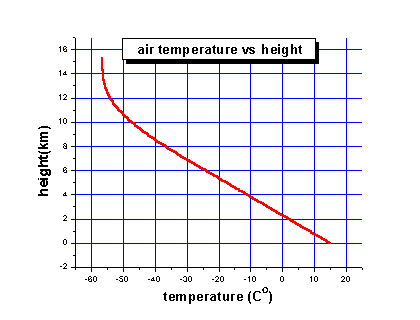
”..the gas emits light by fluorescence.” Wiki via Phil.
”The paper you cited has nothing to do with absorption..”
Nothing? Which is correct Phil. you or wiki clip? If the gas emits light by fluorescence as you now comment, the gas must have absorbed light.
Me of course. In a discharge tube the ground electronic state is excited by the discharge of electrons through the gas, after the excitation the excitation energy is lost by emission of photons. The nearest situation to fluorescence is when argon is electronically excited by EUV and then you get a cascade leading to multiple emission lines.
If we had an argon atmosphere the upper region would absorb EUV leading to the equivalent of a thermosphere, which will be stable like the stratosphere. In the troposphere of such an atmosphere the atmosphere will heat up by conduction, since there is no way that this gas can radiate energy the gradient must reduce until the troposphere becomes isothermal. Rather like the tropopause shown in the following figure.
Ok, Phil. writes wiki using their description of fluorescence as atomic structure absorption of EMR and emission of EMR is incorrect in their discussion of Geissler tubes light being fluorescence: “the ground electronic state is excited by the discharge of electrons through the gas” not absorption of thermal EMR & “Me of course” is correct.
This means the light from a Geissler tube is independent of the temperature of the Ar gas. Obviously then Geissler tube light is not from field of BB thermal radiation. This is the field of luminescence, the light emitted by fireflies and by substances excited by various kinds of subatomic particles like electrons. Ok, I’ll buy that. In the atm., the hot sun & incandescent light bulbs are in play for illumination & not luminescence.
Photons emitted by a body cannot be interrogated as to their origins: luminescence or thermal emission. All that can be measured is total emission. Since the atm. basically is not a Geissler tube, no constant electric current, then the photons from luminescence are zero, and all atm. gas emitted/absorbed photons are thermal radiation dependent on the temperature of the absorber/emitter.
Geissler tubes are thus a distraction in the context of an Ar atm,. since interested only in thermal radiation meaning BB/S-B radiation dependent on the gas temperature for absorption and emission at each wavelength.
To reach the top triangle of Willis’ pyramid Phil. ”since there is no way that Ar gas can radiate energy” and/or Willis ”None of the monatomic noble gases, e.g. argon, either radiate or absorb in the thermal IR range” now need to provide experimental evidence for their assertions to reach the top triangle of Willis’ pyramid. If not, they will be considered “unclear regarding the process for refutation of a claim or a proof.”
I have, at the expense of about 1-2 weeks of digging, found specialist experimental evidence from the 1930s or so, and later 1960s specialist texts referencing them, that Ar radiates (weakly, takes long exposure times to collect the photons) in the thermal IR by vibrational and rotational quantum jumps but have disappointed Willis in being not interested to dig it out again. That is Willis’ loss not mine.
——
”..the gradient must reduce until the troposphere becomes isothermal.”
Since the Ar atm. fluid would be warmed from below in a gravity field, there would be convection. There would thus be a lapse g/Cp, more accurately the Poisson formula. Up to the stratosphere level where the Ar fluid becomes warmed from above and convection ceases to T(z) constant, isothermal.
—-
ALL this becomes a distraction because Willis could just as well invoke 100% N2/O2 atm. for non-GHG discussions.
Trick February 11, 2018 at 5:59 pm
Geissler tubes are thus a distraction in the context of an Ar atm,. since interested only in thermal radiation meaning BB/S-B radiation dependent on the gas temperature for absorption and emission at each wavelength.
Which was exactly my point, but you brought it up in the mistaken idea that it was relevant.
To reach the top triangle of Willis’ pyramid Phil. ”since there is no way that Ar gas can radiate energy” and/or Willis ”None of the monatomic noble gases, e.g. argon, either radiate or absorb in the thermal IR range” now need to provide experimental evidence for their assertions to reach the top triangle of Willis’ pyramid. If not, they will be considered “unclear regarding the process for refutation of a claim or a proof.”
I have, at the expense of about 1-2 weeks of digging, found specialist experimental evidence from the 1930s or so, and later 1960s specialist texts referencing them, that Ar radiates (weakly, takes long exposure times to collect the photons) in the thermal IR by vibrational and rotational quantum jumps but have disappointed Willis in being not interested to dig it out again. That is Willis’ loss not mine.
Read any college level text on atomic spectra, Herzberg was the one that we used and is still available, and you’ll find that Argon only has electronic energy levels, no vibrational or rotational levels.
Here’s a diagram of the lower energy level structure.
http://www.scielo.org.za/img/revistas/sajs/v107n11-12/a11fig1M.jpg
“Stephen Wilde
February 9, 2018 at 11:10 am
gbaikie
The weight of the atmosphere on the surface of the oceans also controls how much solar energy the oceans can hold on to by affecting the energy value of the latent heat of evaporation.”
Not sure what you mean.
The energy value of latent heat changes a bit depending water temperature, but roughly it’s
“The heat of vaporization of water is about 2,260 kJ/kg,”
And amount evaporation of water depends on water temperature and partial pressure of water vapor in atmosphere-
more water vapor but much lower gravity could have a lower partial pressure of water vapor.
Or less water vapor and much higher gravity could have high partial pressure.
But with Earth, water vapor is lighter than dry air, which basically means evaporation controls rather it is controlled. Or basically water evaporates anywhere on Earth and it’s temperature controls how much. Wet clothes will dry out- higher humidity makes drying slower. Though condensation or rain reverses it.
–Consequently, the oceans cannot affect the long term planetary average surface temperature set by gravity, atmospheric mass and insolation but since the oceans do have that large thermal capacity with a lot of thermal inertia they can cause a lot of short term variability around the average,–
Earth oceans control long term and short term planetary average temperature.
And without going in to any detail, 70% of any surface will control the average [100%] of a surface.
Details, the sun controls the surface temperature. Earth’s average ocean surface is 17 C.
The average land surface is 10 C, and the average is 15 C.
More details: average tropical air temperature is 26 C. Tropics has 80% of surface, being ocean.
And tropics is 40% of surface of Earth. And since tropic is warm and earth average temperature is
only 15 C, it’s cold outside the Tropics as go further from it.Or 1/2 of world near tropics is fair warm and other half is pretty cold. And fortunately land regions say at higher latitude than say 30 degrees are warmed by the ocean- otherwise they would be much colder.
Or UK is about 10 C, it would be much colder without the ocean warming it.
Globally gravity and atmospheric mass is near constant- though insolation isn’t.
The amount of energy required to break the bonds between water molecules varies with pressure.
“It is equal to the increased internal energy of the vapour phase compared with the liquid phase, plus the work done against ambient pressure. The increase in the internal energy can be viewed as the energy required to overcome the intermolecular interactions in the liquid”
from here:
https://en.wikipedia.org/wiki/Enthalpy_of_vaporization
So the weight of the atmosphere sets the amount of solar energy that the oceans must accumulate before evaporation can occur. Once evaporation starts the oceans can get no hotter because evaporation just accelerates instead which is why there is a cap on the temperature of tropical surface water as mariners have observed for millennia.
Stephen Wilde February 9, 2018 at 1:03 pm
The amount of energy required to break the bonds between water molecules varies with pressure.
“It is equal to the increased internal energy of the vapour phase compared with the liquid phase, plus the work done against ambient pressure. The increase in the internal energy can be viewed as the energy required to overcome the intermolecular interactions in the liquid”
from here:
https://en.wikipedia.org/wiki/Enthalpy_of_vaporization
So the weight of the atmosphere sets the amount of solar energy that the oceans must accumulate before evaporation can occur. Once evaporation starts the oceans can get no hotter because evaporation just accelerates instead which is why there is a cap on the temperature of tropical surface water as mariners have observed for millennia.
Not true, evaporation of liquid water occurs at any temperature above the triple point (273.16K), the temperature of the ocean will increase as long as more energy is added until the vapor pressure is equal to the applied pressure, at which point the temperature can no longer increase until all the water has evaporated.
Thanks, Phil. As you point out, evaporation takes place at all temperatures between freezing and boiling.
Stephen Wilde, on the other hand, claims:
Sorry, but that reflects a profound misunderstanding of the underlying physics.
w.
Question, on Venus what is the dominate surface?
OK I’m going to take a bit of time to digest all this. There are some very interesting comments. Thanks Willis and Stephen for taking the time and energy to explain your points of view, and others for sharing some really good insights. Thank you everyone for being fairly civil and patient with all this. Thanks Anthony for allowing discussion. For myself, I want to make sure I understand what’s going on before I open my mouth again.
Things now seem to hinge on the guest post by Brown! https://wattsupwiththat.com/2012/01/24/refutation-of-stable-thermal-equilibrium-lapse-rates/
The plot thickens.
OK, here’s a question, directed at anyone who can address it.
All gases radiate; not all gases radiate in IR. If we had an atmosphere of N2 alone, as a parcel of this reaches the top of the atmosphere, what keeps it from radiating its energy out to space so that the energy/motion of N2 slows and the temperature of that parcel of atmosphere decreases? Or are we saying that the motion of the molecules, and hence the heat, is maintained, even as the atmosphere thins?
Naturally I’m having a lot of trouble with an isothermal GHG-free atmosphere. That’s where this is going.
Don132 February 9, 2018 at 3:10 pm
N2 is a very weak GHG, but a GHG nonetheless. So it would radiate, with about half of the radiation going to space and the rest going downwards.
In general, GHGs cool the atmosphere compared to a non-GHG situation. It gives them an additional way to cool.
Do bear in mind that my proof is talking about a non-GHG atmosphere such as argon.
w.
Willis Feb 9 2018 @ur momisugly 4:31pm:
“Do bear in mind that my proof is talking about a non-GHG atmosphere such as argon.”
OK, argon then. Are you claiming that argon doesn’t radiate in any spectrum? Not UV? Not anything? Are you claiming that as the atmosphere thins, argon isn’t radiating at all to space? That it maintains the vibrational excitement that it acquired at the surface through the electromagnetic energy present there, and it doesn’t let that go?
At the surface, the argon molecules are vibrating rapidly and the atmosphere heats. At the top of the atmosphere, how is this energy, in whatever electromagnetic spectrum it exists, not radiating that energy to space, and thus slowing the vibration of the molecules, and thus cooling?
Don132 February 9, 2018 at 5:01 pm
Nope. I’m claiming what I claimed.
Next you say:
Yep.
I have no clue what you mean by “vibrational excitement”.
Nope. There are no argon molecules. As I noted, it is a monatomic gas. That’s why it neither radiates nor absorbs in the IR.
Thermal IR is captured because it makes a molecule vibrate. The more complex the molecule, the more vibrational modes it has, the more frequencies of IR it can absorb
Argon doesn’t form molecules, so there is nothing to vibrate. As a result, it neither absorbs nor emits in the thermal IR range.
w.
You’re right Willis, no vibrational spectra from Argon, no IR absorption (Brett’s faulty memory notwithstanding). Also Nitrogen absorbs from 4 to 5 microns (and is orders of magnitude weaker than CO2), a region of relatively low emission at the earth’s temperature.
Ahhh, Phil. No, you are incorrect. Look up the testing of Ar in the ancient journals and texts. Ar atoms vibrate in an EM field and rotate, so they radiate. Some instruments can boost and actually detect the very weak signals. As we discussed previously.
“Argon doesn’t form molecules, so there is nothing to vibrate.”
Ar in limited cases does form molecules. Ar atoms do vibrate in EM field and rotate so can radiate, the ancient journals measured the feeble amounts & are available in your nearest college library. This issue is just a distraction. If you want to discuss a GHG free atm. just use O2,N2 atm. and go from there. The interested person can learn a lot from N2,O2 basics and then add GHGs and learn what happens with each species as its mixing ratio increases.
Trick February 10, 2018 at 12:25 pm
So your idea of a scientific citation is to unspecified “ancient journals and texts”?
Really?
Mrs. Henniger, my high school science teacher, would have had a field day with her famous red pencil with that one …
Produce the graph showing where the argon absorption lines are in the thermal IR range or don’t bother.
“Ancient texts” … sheesh …
w.
”So your idea of a scientific citation is to unspecified “ancient journals and texts”? Really?”
Oh hell no. My idea of scientific citation is title, journal, volume, date, page, paragraph. Sentence maybe.
”Produce the graph showing where the argon absorption lines are in the thermal IR range or don’t bother.”
Already did in past threads you participated. I used the top triangle of your pyramid based on testing starting with your friend google to generate the ref.s. Then looked them up. You can too. It is easier though just switch to discuss N2,O2 atm., Ar is a distraction.
For Ar it might take 7-10 days of digging to find the 1960s texts and much earlier original Ar gas testing research (unless you are faster than me) to produce the graph (actually list) of Ar lines found – it runs maybe 10 pages long, small type.
Here’s the “ancient text” but I think it’s irrelevant. http://nvlpubs.nist.gov/nistpubs/jres/049/2/v49.n02.a04.pdf
Don, thanks for that ref. This illustrates why it takes so long to find the original testing research detail for Ar in the IR as yours just ref.s the earlier work of Sittner and Peck 1949 for Ar in the IR. So that paper needs to be pulled. And even it may ref. earlier testing as the conclusion notes observing noble gases in the IR over a previous period extending back 30 years from 1952. When I did that work in the last year in a similar debate with Willis and Phil., I found these library journals physically appear aged, brittle, decrepit so I used the word “ancient”. The librarian helping me even found a yellowed library card in one and we both laughed as she said this isn’t exactly in use anymore.
Don132 February 10, 2018 at 1:54 pm Edit
Thanks, Don. It shows that argon indeed has absorption lines … but they are in the near-infrared, not the thermal (far) infrared. It shows exactly ZERO lines in the thermal IR range (typically taken to be something like 5-20 microns).
So no … argon does NOT absorb or radiate in the far (thermal) infrared, which is what we are discussing.
w.
Willis Eschenbach February 10, 2018 at 3:14 pm:
“Thanks, Don. It shows that argon indeed has absorption lines … but they are in the near-infrared, not the thermal (far) infrared. It shows exactly ZERO lines in the thermal IR range (typically taken to be something like 5-20 microns).
So no … argon does NOT absorb or radiate in the far (thermal) infrared, which is what we are discussing.”
Just to be clear, I provided the link for Trick’s convenience. I’m not claiming that argon absorbs in IR, and that is not part of any argument I’m making.
Willis 3:14pm, because Don’s ref. cited Sittner and Peck 1949 reporting on Ar lines specifically in the 1.2 to 1.7 micron range (and notes not all S&P data presented) does not mean there are no Ar lines 5-20 microns. I’d say you are about on the green level of your pyramid “contradiction”. To get to the top triangle like I did previously you need to cite the earlier specialist Ar research using defined long exposure times and photographic plates with sensitivity for 5-20 micron range et. al.
“Don132
February 9, 2018 at 3:10 pm
OK, here’s a question, directed at anyone who can address it.
All gases radiate; not all gases radiate in IR. If we had an atmosphere of N2 alone, as a parcel of this reaches the top of the atmosphere, what keeps it from radiating its energy out to space so that the energy/motion of N2 slows and the temperature of that parcel of atmosphere decreases? Or are we saying that the motion of the molecules, and hence the heat, is maintained, even as the atmosphere thins?”
Molecules of gas don’t slow down when they emit IR.
The temperature of gases in Earth thermosphere:
“The thermosphere lies between the exosphere and the mesosphere. “Thermo” means heat, and the temperature in this layer can reach up to 4,500 degrees Fahrenheit. If you were to hang out in the thermosphere, though, you would be very cold …
:https://spaceplace.nasa.gov/thermosphere/en/
These molecules in thermosphere aren’t slowing down, even though “they can reach up to 4,500 degrees Fahrenheit”
Molecules of gas aren’t hot, or cold or any temperature, but they can go fast, and in the thermosphere they have to go fast and are traveling fast. They have to go fast because they are mass and mass obeys the laws of gravity. It you magical held a molecule up in thermosphere so it’s “not moving” it will be hit by another molecule going fast, and it then goes fast. Or magically held up molecules in the thermosphere are just as “hot” as other fast moving molecules, because they will be hit. Or without being magical held, they fall- and so what stays up are molecules traveling fast.
The N2 molecule cools as it rises because it is part of an expanding parcel of molecules which cools as per the Gas Laws. There doesn’t need to be any radiation for the decline in temperature with height to develop.
The N2 molecule loses no energy but part of its energy is converted to PE which is not heat and does not radiate.
“The N2 molecule cools as it rises because it is part of an expanding parcel of molecules which cools as per the Gas Laws. ”
A molecule doesn’t cool or warm, but a expanding parcel of molecules is cooler.
Molecules traveling with same average velocity but occupy more volume/space
have a lower air temperature. And the reverse is true contracting parcels of molecules
have a higher air temperature if have same average velocity.
“There doesn’t need to be any radiation for the decline in temperature with height to develop.”
correct.
And any radiation transferred either direction doesn’t matter much.
“The N2 molecule loses no energy but part of its energy is converted to PE which is not heat and does not radiate.”
Molecules at higher elevation have more PE.
But molecules don’t have travel up and down and only do this as some kind of wind- Ie updrafts or downdraft. Instead of molecule traveling, the kinetic energy of molecules can transfer to other molecules- or the kinetic energy of molecules can go up and down. Though If there enough of this kinetic energy transfer it does cause wind- does cause molecules [crowd of molecules] to go up and down..
I should mention the creation water vapor [evaporation] causes air masses to be lighter and causes air masses to rise. And evaporation on both land and ocean is primary source/factor related to having winds.
Stephen Wilde February 11, 2018 at 11:29 am:
“The N2 molecule cools as it rises because it is part of an expanding parcel of molecules which cools as per the Gas Laws. There doesn’t need to be any radiation for the decline in temperature with height to develop.
The N2 molecule loses no energy but part of its energy is converted to PE which is not heat and does not radiate.”
So here’s the conundrum: I’ve heard you, Stephen, say that in our own atmosphere radiation takes over at TOA. But in our argon atmosphere, there’s no radiation at TOA, or conduction or convection. There’s no heat loss from the atmosphere. So either the atmosphere is isothermal, meaning that all of the atoms of argon are the same temperature and this is the same temperature as the surface, and it doesn’t matter if there’s convection or not (because where would it be convecting heat to, to radiate away?) or else maybe the planet explodes from the ever-increasing heat.
Even as the IGL holds, that still doesn’t alter the fact that each atom of argon is exactly the same temperature (internal energy) even as the parcel of air “cools.” Heat content goes down; internal energy stays the same.
What do you say?
Heat content and therefore temperature goes down with height because KE declines during ascent. Since that KE does not disappear but instead converts for PE the total internal energy stays the same (KE + PE).
That is entirely consistent with a decline in temperature with height as per real world observations.
Your Argon atmosphere conducts from the surface in ascent and conducts to the surface in descent.
It is then the surface that radiates to space but can only send 255k to space because the other 33k is conducted into the ongoing convective cycle rather than radiated.
Stephen Wilde February 11, 2018 at 2:19 pm:
“Your Argon atmosphere conducts from the surface in ascent and conducts to the surface in descent.”
Now I’m going to say that what you’re saying is impossible. When an argon atom conducts from the surface, there’s no way for it to lose internal energy as it climbs in altitude, so that even when it gets to the TOA it’s the same temperature as it was at the surface, EVEN IF the parcel of gas of which it’s a part has gone down in temperature according to IGL. Since that atom is the exact same temp as the surface, it isn’t conducting anything when it gets back to the surface.
If an argon atom can’t lose heat by radiation or conduction or convection, then how can it lose heat?
Internal energy is KE + PE. PE is not heat. Internal energy stays the same during uplift but KE (heat) declines.
The reverse in descent.
Don132 February 11, 2018 at 2:43 pm
Stephen Wilde February 11, 2018 at 2:19 pm:
“Your Argon atmosphere conducts from the surface in ascent and conducts to the surface in descent.”
Now I’m going to say that what you’re saying is impossible. When an argon atom conducts from the surface, there’s no way for it to lose internal energy as it climbs in altitude, so that even when it gets to the TOA it’s the same temperature as it was at the surface, EVEN IF the parcel of gas of which it’s a part has gone down in temperature according to IGL. Since that atom is the exact same temp as the surface, it isn’t conducting anything when it gets back to the surface.
If an argon atom can’t lose heat by radiation or conduction or convection, then how can it lose heat?
The only way for argon to radiate is to be electronically excited, in the atmosphere the only way that can happen is by absorbing EUV or by an electrical discharge. Otherwise it will just have kinetic energy which it could acquire from the surface, like any other molecule it will exchange that energy with collision partners.
From memory, argon has been measured radiating at just under 2mu in response to NIR light. Why would any molecule vibrating above 0K not produce EMF?
More to our point, our extensive studies show that the GTE builds stars through mass concentration of galactic matter starting at c.3K. There is no other way that I can find, but the presence of some radioactive ‘star stuff’ may complicate matters..
oops I meant atom, because the outer electron shells do the vibrating.
Brett, just under 2 microns is near infrared, the kind that comes from the sun. And argon indeed radiates/absorbs there.
It just doesn’t radiate in the far infrared, also called thermal IR or longwave infrared, which is what is under discussion.
As to your question, ” Why would any molecule vibrating above 0K not produce EMF?”, the answer is, because some of them physically can’t radiate at some frequencies.
w.
Willis seems to like posting rabbit holes for people to go down. Maybe he thinks it is fun, who knows. It is obvious that a uniformly heated sphere will not have a “greenhouse effect”.
The 33 degree extra warming of a rotating planet like earth as compared to an airless planet happens ONLY because of the rotation AND the atmosphere acts as a heat capacitor. The SB equation tells us that the airless planet has soaring daytime temperatures. It is conduction to an atmosphere, with GHGs or not, that moderates that temperature. The net effect is to slow the daytime peak T*4 radiation, ie, it cools less, thus causing net warming. Thats it. Thats all. This effect exists ONLY on a rotating planet. It does not exist in Willis’s rock with a 1000 suns. Lets get back to a real world.
Here is an expanded elevator speech describing the “greenhouse effect” with and without GHGs.
Stefan–Boltzmann law: energy out is a function of temperature to the fourth power T*4
Also the Ideal Gas Law PV=nRT
Here goes:
A planet’s average SB temperature is calculated from 1/4 the insolation (the suns heat input, is on the exposed surface to the sun = 1/4 of the earths spherical surface area).
Base case: A no atmosphere earth using the SB equation has average temperature T1 = 253K. (The surface temperature is very hot during day, and very cold during night. The day time heat output is the area under the T*4 curve, ie, huge. The night time is the area under the declining temperature curve)
Second case: For an earth with a non green house gas atmospher, the atmosphere is warmed by surface conduction during the day, and cooled by conduction at night. The atmosphere acts as a heat charge discharge capacitor.( lets use Argon, it warms/cools by conduction, ie,not radiation)
During the day, this planet’s outbound long wave infrared radiation(OLR), who’s rate is a product of T^4, it is much reduced from the base case.(Some heat is conducted away, thus the surface temperature has to drop, thus a much smaller T*4)
The lower total OLR means that the planet has to warm to T2 until the SB equation is satisfied.(heat out = heat in)
Thus our non GHG planet’s average surface temperature using Argon is higher(T2 > T1)
That is the “greenhouse” warming, without even using GHG’s in the atmosphere.(the term “greenhouse warming is of course wrong, but society is used to that term. A greenhouse warms because the warm air cannot rise out of the greenhouse)
On the real earth, with a real atmosphere with greenhouse gases such as water vapor, CO2, the greenhouse effect is bigger, as the molar mass is higher than Argon, and can be calculated to be T3= 287K, We can see that T3>T2>T1. (the earths atmosphere has a bigger Molar Mass density heat “capacitor”)
As a general principal, the greater an atmosphere’s molar density, the greater its heat capacity.(big fat molecules when they bounce around have more heat energy than small ones, also the more dense it is, the more energy per unit volume)
The doubling CO2 by humans changes the T3 temperature only by the change in Molar Mass density. (CO2 molecules are heavier than N2, O2, but the net change in Molar Mass density is tiny. The net greenhouse temperature change for earth is T3 – T1 = 0.03 C.)
For a deeper understanding:
http://article.sciencepublishinggroup.com/pdf/10.11648.j.earth.20170606.18.pdf
We can relax, as 0.03C is so small that we cannot measure it.
I have done the maths, in case you are interested, but the PDF gets you there. I had to derive the Molar Mass formula myself to feel confident. That gave me the T1 and T3 numbers above.
Enjoy
Thanks for the BB AW, and thanks W for being willing to debate. You both are heros imo.
SB
My apologies to W. His thought experiment was not understood by me. He endeavors to refute the authors hypothesis that the GHE does not exist, that its all about gravity and molar density. If W is correct, which on further reflection, he appears to be, then the 0.03 C warming due to a doubling of CO2 is not correct.
Back to square one for me.
Can’t follow the reasoning there. Please clarify.
The author would conclude that T2=T3, if they both had the same Molar mass density. I would have to agree in that the formula asserts it. However that is a big leap conceptually, which Willis has asserted. Would conduction alone suffice? Quite possibly, and the planets heat equation could be solved to test the hypothesis. The author has another paper to write.