
Guest essay by Eric Worrall
h/t Benny Peiser / GWPF – Former NASA GISS Director James Hansen and current director Gavin Schmidt think nature may conspire of the next ten years to produce the impression of an ongoing pause in global warming. Though of course it may not.
Global Temperature in 2017
18 January 2018
James Hansen, Makiko Sato, Reto Ruedy, Gavin A. Schmidt, Ken Lo, Avi Persin
Abstract. Global surface temperature in 2017 was the second highest in the period of instrumental measurements in the Goddard Institute for Space Studies (GISS) analysis. Relative to average temperature for 1880-1920, which we take as an appropriate estimate of “pre-industrial” temperature, 2017 was +1.17°C (~2.1°F) warmer than in the 1880-1920 base period. The high 2017 temperature, unlike the record 2016 temperature, was obtained without any boost from tropical El Niño warming.
…
Prospects for continued global temperature change are more interesting and important. The record 2016 temperature was abetted by the effects of both a strong El Niño and maximum warming from the solar irradiance cycle (Fig. 4). Because of the ocean thermal inertia and decadal irradiance change, the peak warming and cooling effects of solar maximum and minimum are delayed about two years after irradiance extrema. The amplitude of the solar irradiance variation is smaller than the planetary energy imbalance, which has grown to about +0.75 ± 0.25 W/m2 over the past several decades due to increasing atmospheric greenhouse gases.5,6 However, the solar variability is not negligible in comparison with the energy imbalance that drives global temperature change. Therefore, because of the combination of the strong 2016 El Niño and the phase of the solar cycle, it is plausible, if not likely, that the next 10 years of global temperature change will leave an impression of a ‘global warming hiatus’.
On the other hand, the 2017 global temperature remains stubbornly high, well above the trend line (Fig. 1), despite cooler than average temperature in the tropical Pacific Niño 3.4 region (Fig. 5), which usually provides an indication of the tropical Pacific effect on global temperature. Conceivably this continued temperature excursion above the trend line is not a statistical fluke, but rather is associated with climate forcings and/or feedbacks. The growth rate of greenhouse gas climate forcing has accelerated in the past decade. There is also concern that polar climate feedbacks may accelerate.
Therefore, temperature change during even the next few years is of interest, to determine whether a significant excursion above the trend line is underway.
…
Read more: http://www.columbia.edu/~jeh1/mailings/2018/20180118_Temperature2017.pdf
Will temperatures rise or fall over the next decade? Temperatures could rise, stagnate or even fall (if solar factors prove a little stronger than expected) according to Schmidt and Hansen’s each way bet. Though they claim that real global warming, the planetary “energy imbalance”, will still be occurring under the cover of whatever happens to global temperature.
The latest prediction does extend the period in which Hansen and Schmidt’s theories cannot be falsified by temperature observations. Up, down or sideways, this paper covers their butts.
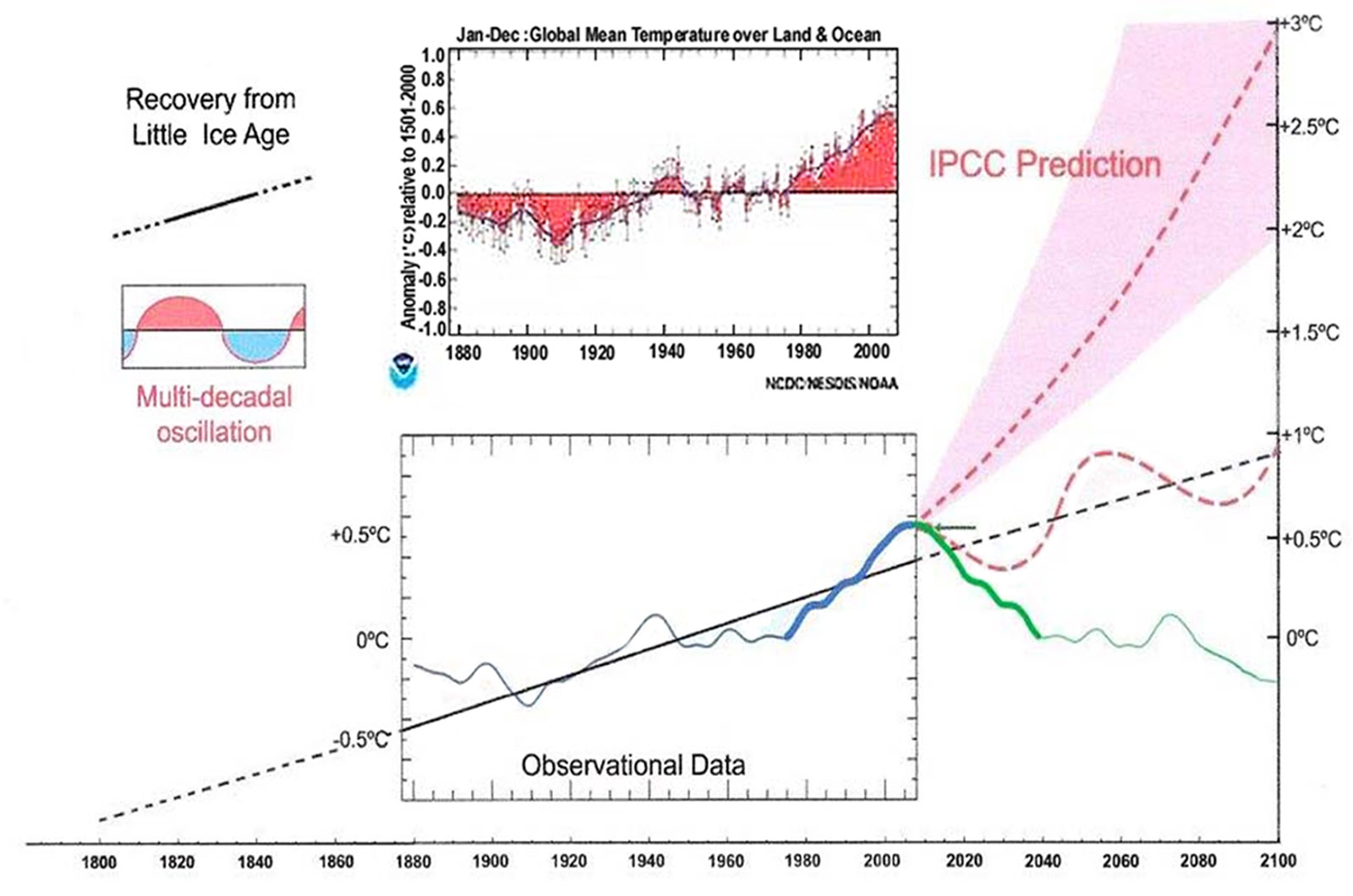
This isn’t the first time Hansen has slipped in a prediction that global temperatures will be forced down, despite CO2 driven warming. The diagram at the top of the page is from a previous Hansen paper J. Hansen et al.: Ice melt, sea level rise and superstorms, in which Hansen predicted a possible abrupt drop in global temperature in the near future, caused by ice melt shutting down global ocean currents.
Is this paper really what passes for “settled science” these days? If I was a Congressman the question I would be asking, is a “settled science” prediction that temperatures could go up, down or sideways really good value for taxpayer’s money?
Why doesn’t the US Government save some taxpayer’s money, ask Punxsutawney Phil for his climate predictions, instead of continuing to pay NASA GISS for their each way bets? Punxsutawney Phil might get it wrong sometimes, but at least the theory that Punxsutawney Phil makes good predictions is falsifiable – Phil’s predictions can be compared to temperature observations.
Punxsutawney Phil might get it wrong sometimes…
Phil is a meteorologist, not a climatologist. Weather prediction six weeks out is imprecise.
I see that reality is beginning to intrude upon the dangerous global warming team. They say ” it is plausible, if not likely, that the next 10 years of global temperature change will leave an impression of a ‘global warming hiatus’.”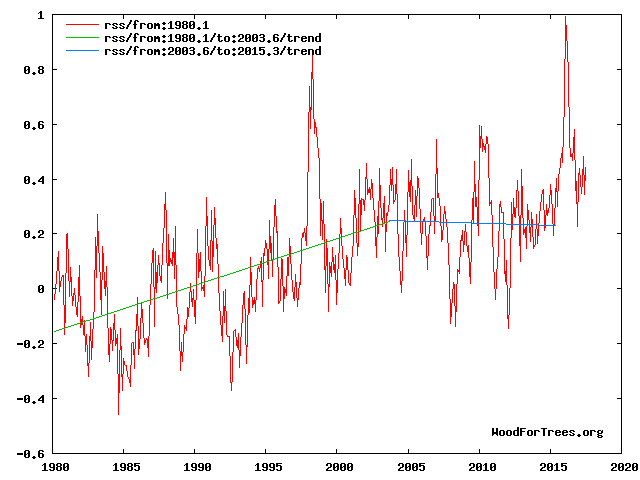
Climate is controlled by natural cycles. Earth is just past the 2003+/- peak of a millennial cycle and the current cooling trend will likely continue until the next Little Ice Age minimum at about 2650.See the Energy and Environment paper at http://journals.sagepub.com/doi/full/10.1177/0958305X16686488
and an earlier accessible blog version at http://climatesense-norpag.blogspot.com/2017/02/the-coming-cooling-usefully-accurate_17.html
Here is the abstract for convenience :
“ABSTRACT
This paper argues that the methods used by the establishment climate science community are not fit for purpose and that a new forecasting paradigm should be adopted. Earth’s climate is the result of resonances and beats between various quasi-cyclic processes of varying wavelengths. It is not possible to forecast the future unless we have a good understanding of where the earth is in time in relation to the current phases of those different interacting natural quasi periodicities. Evidence is presented specifying the timing and amplitude of the natural 60+/- year and, more importantly, 1,000 year periodicities (observed emergent behaviors) that are so obvious in the temperature record. Data related to the solar climate driver is discussed and the solar cycle 22 low in the neutron count (high solar activity) in 1991 is identified as a solar activity millennial peak and correlated with the millennial peak -inversion point – in the RSS temperature trend in about 2003. The cyclic trends are projected forward and predict a probable general temperature decline in the coming decades and centuries. Estimates of the timing and amplitude of the coming cooling are made. If the real climate outcomes follow a trend which approaches the near term forecasts of this working hypothesis, the divergence between the IPCC forecasts and those projected by this paper will be so large by 2021 as to make the current, supposedly actionable, level of confidence in the IPCC forecasts untenable.””
For the current situation and longer range forecasts see Figs 4 and 12 in the links above.
Fig 4. RSS trends showing the millennial cycle temperature peak at about 2003 (14)
Figure 4 illustrates the working hypothesis that for this RSS time series the peak of the Millennial cycle, a very important “golden spike”, can be designated at 2003
The RSS cooling trend in Fig. 4 and the Hadcrut4gl cooling in Fig. 5 were truncated at 2015.3 and 2014.2, respectively, because it makes no sense to start or end the analysis of a time series in the middle of major ENSO events which create ephemeral deviations from the longer term trends. By the end of August 2016, the strong El Nino temperature anomaly had declined rapidly. The cooling trend is likely to be fully restored by the end of 2019.
Fig. 12. Comparative Temperature Forecasts to 2100.
Fig. 12 compares the IPCC forecast with the Akasofu (31) forecast (red harmonic) and with the simple and most reasonable working hypothesis of this paper (green line) that the “Golden Spike” temperature peak at about 2003 is the most recent peak in the millennial cycle. Akasofu forecasts a further temperature increase to 2100 to be 0.5°C ± 0.2C, rather than 4.0 C +/- 2.0C predicted by the IPCC. but this interpretation ignores the Millennial inflexion point at 2004. Fig. 12 shows that the well documented 60-year temperature cycle coincidentally also peaks at about 2003.Looking at the shorter 60+/- year wavelength modulation of the millennial trend, the most straightforward hypothesis is that the cooling trends from 2003 forward will simply be a mirror image of the recent rising trends. This is illustrated by the green curve in Fig. 12, which shows cooling until 2038, slight warming to 2073 and then cooling to the end of the century, by which time almost all of the 20th century warming will have been reversed
The hadsst3 data shows global sst temperatures are now below the pre El Nino trend.

For a nice example of the early 21st century trend switch trend see Fig 11
The pause occurred because global and Tropical cloud levels had stopped declining. Previous decline in cloud levels were nothing to do with CO2 and caused ocean warming by increasing solar radiation into them. Ocean warming warmed the atmosphere giving global warming and therefore the evidence SWR was to blame from the sun.
All linked with the AMO and ENSO so other than data manipulation no room for CO2.
Because of the thermal inertia of the oceans there is a 12 year+/- delay between the solar activity driver peak at about 1991 and the millennial temperature peak at 2003/4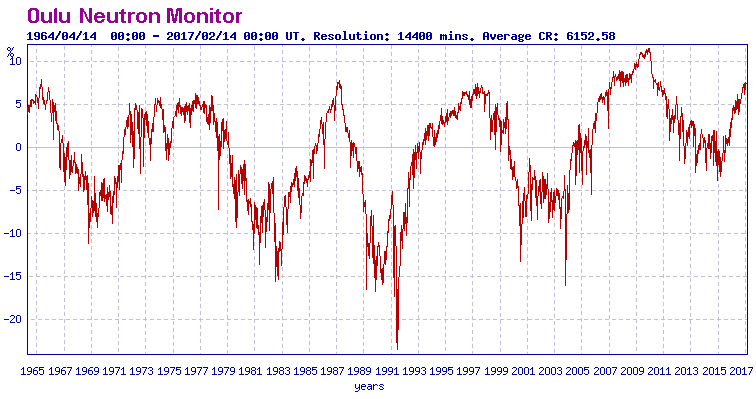
“The pause occurred because global and Tropical cloud levels had stopped declining. ”
You have it backwards.
Tropical cloud coverage decreased because there was a reduction in SST’s due the dominating -ve PDO/ENSO regime during that time.
This amounts to retirement insurance for the scammers.
My thoughts exactly!
“Relative to average temperature for 1880-1920, which we take as an appropriate estimate of “pre-industrial” temperature, ”
The basis for their writing is that they took the average temperature from that period that they deduced as “appropriate”.
I question the veracity of the satellite measurements from that era.
“The high 2017 temperature, unlike the record 2016 temperature, was obtained without any boost from tropical El Niño warming.”
Ranking the individual climate zones, I find for 2017:
North Frigid Zone; Rank 2
North temperature Zone; Rank 3
North Torrid Zone; Rank 3
South Torrid Zone; Rank 4
South Temperature; Rank 1
South Frigid Zone; Rank 10
Note that the South Temperature had experienced the warmest year. May be, this is caused by following event noticed by New York Times, April 6, 2017.
“Making matters worse, meteorologists say, is the arrival of a localized El Niño event, a sudden rise in ocean temperature in the Pacific, which this year has happened off the coast of South America.”
Their “analysis” frankly sounds like two undergrads wondering about climate in the lunchroom.
The chart labeled “Global temperature 250km smoothing w/base period 1950-1980” really blows my mind. That adults can take that chart seriously when no decent temperature station actually replicates that data.
Hansen states that the “global energy imbalance” is 0.75% +/- 0.25%. At most, then, it is 1%. The 2017 total eclipse reduced the total solar irradiance by 7.4% for 90 minutes. That is the equivalent of completely wiping out the energy imbalance for a period of 11 hours. That should surely show up somewhere.
First, they use 1880 as the start of industrialization. Fully 94% of all CO2 produced by man has been produced since 1945. The previous 200 years produced the other 6%. The reason that Hansen and climate alarmist like to use either 1880 or 1979 is that it optimizes the temp rate.
The issue is that even though practically no co2 was being produced from 1880-1945 the temperaturee of the earth soared about as much as it has since we produced the 94% of CO2.
This could be interpreted as a proof of the failure of the CO2 model and everytime they go back to 1880 they are emphasizing to those people who examine it that temperatures mystically went up as much as after we were producing all this massive co2 thus providing an argument that the warming now has nothing to do with CO2. If I were them I would stick to 1945. I realize it is hard to give up half the warming for them. It’s much better to say 1.0C then 0.5C if you want to alarm people although the actual alarm is supposed to happen at 4.0C and that would require a massive explosion of temperatures not another 10 year pause.
One wonders how Hansen expects to get to 3 or 4C in 2100 if we keep having pauses and we’ve only gotten 0.5 since 1945. Clearly instead of the 0.5C we’ve gotten in the last 70 years they need the next 70 years to produce approximately 3.5C or 3C or something like that to scare people. However, even someone a little chalenged in math will realize they are not projecting pause for 10 years. They are projecting that temperatures surge every year by massive amounts (much higher than we’ve seen before) for 70 years in a row with no pause.
Put it this way. For the next 80 years till 2100 to get the 3.2C say that they say will kill the planet and all life or whatever the temperature has to rise at 0.4C/decade. Every decade without stopping. It has been going up 0.05C/decade for the last 7 but nevermind that. We need it to go up 8 times that rate WITHOUT pausing.
Now, if it pauses for 10 more years then there will be only 7 decades to get the 3.2 by the end of the century. That means you need nearly 0.5C/decade for 7 decades in a row to get to where they project. We have only gotten 0.5C in 70 years so far. (Not even that if you just look at satellites and take out scurrilous adjustments) We haven’t gotten 0.5C in a decade ever.
So, missing 10 years of warming would essentially kill what is already killed because there is no way to get 0.4C/decade for 8 decades in a row.
This became a big problem because in 1989 when they started doing this temps were going up during the next 2 decades by 0.2-0.3C/decade and given that back then you had 120 years to get to 2100 you could easily get 3.2C in 120 years at the rate we saw in the 1980s and 1990s. In other words the theory and the predictions could plausibly work. You might disagree but at least it was feasible.
What happened is that by having 2 decades of pause and virtually no temperature increase we have now had a much lower rate of warming we’ve seen and it also means that the rate they need to make their prediction has climbed dramaticaly because there is less time to make the prediction and the missing rise has compounded the failure of the theory.
If Hansen is right and I think he is. The AMO/PDO cycle consistent with solar variations shows a negative cycle now that will not end until 2030. In other words if PDO./AMO continue (which the latest el nino validates is still working) then we will see moderate temp change for another 12 years. After which PDO/AMO will switch to a positive and we will get a double wammy.
While this might seem to argue that we will get massive temps in 12 years when PDO/AMO switch we will likely get pretty large increases but I don’t believe we will see anywhere near the 0.5C/decade they require. Thus the theory is screwed still.
Some might say but didn’t we have an El nino in a downcycle of PDO / AMO and so doesn’t that argue that PDO/AMO are failing? No. If you look at the history I predicted this el nino of 2015 because mid-cycle of every PDO/AMO downward phase there is a big el nino. It happened in 2 prior down cycles 60 and 120 years ago. So, that means in fact it appears to validate that ocean cycles and sun cycles are dominating CO2 (remember el ninos are caused by ocean and sun NOT by co2 so using el nino as argument for how co2 is driving temperatures is blatantly wrong.). My point is that Hansen is right. There is very high likelihood that we will see 12 more years of haitus. No amount of warming after that will save this bogus disproved theory.
It’s either going to stay high or go down. Mark my words!
“…it is plausible, if not likely, that the next 10 years of global temperature change will leave an impression of a ‘global warming hiatus’.”
I see. The next 10 years will only leave an “impression” of a warming hiatus. That’s because they intend to do whatever it takes to adjust the temperature record and get rid of the hiatus. It will then exist only as an impression in people’s minds and not in the “official” temperature records. They will likely do this by cooling the past to make more recent temperatures look warmer. Or they may find another trick to use like they did to get rid of the last hiatus. They did that by replacing ocean temperature readings from modern buoys with less reliable readings from ocean-going vessels. The fact that they knew the buoy temperatures were cooler than the ship temperature data was just a coincidence. When your paycheck depends on something, you will find a way…
‘When your paycheck depends on something, you will find a way…’
Don’t underestimate the importance of propping up one’s world view.
I’ve said many times how insidious Global Warming is. It actually hides it’s presence so it can sneak up on us later.
Aye!
You can’t find it this year or the next, or possibly for the next ten years; but it will be back!
As Bug’s would state, what a pair of maroons.
That a former NOAA Director is involved in this fakery is an embarrassment.
That a current NOAA Director is involved in this fakery is a clarion call for NOAA to be investigated, thoroughly; and held to the US Government’s rigid rules regarding changing historical data, Hatch act activism, abuse of science, etc.
How oddly nearly identical to the recent New York Times data abuse charts and their choice of baseline! A coincidence that strogly indicates more government employees leaking/colluding with activists to defraud people and government.
Hansen/Schimdt, “Mark from the Midwest nails the term Hanschimdt” accurately describing activist mentor/flunkey combination:
• Hanschimdts’ purposely use an impossible comparison, then write about this impossible comparison as if it is legitimate.
• No mention is made of the massive global temperature collecting stations disparities across the time periods in question.
• No mention is made of NOAA’s modern new temperature stations, largely sited at locations heavily affected by UHI influences; e.g. airports.
• No mention of Hanschimdt’s aggressive temperature adjustments throughout the entire period.
• No mention, whatsoever regarding the near total lack of temperature recordings within polar latitudes.
• No mention that NOAA expunged higher altitude, rural and higher latitude temperature stations from their temperature collecting network.
• Unsurprisingly, Hanschimdt fail to use error bars for their alleged comparisons. Unmentioned is the several degree range for the 1880-1920 period and the slightly smaller range for modern temperatures.
e.g. “The GISS analysis1 extrapolates observations as far as 1200 km from measurement points, thus covering practically the entire globe”; Hanschimdt’s analysis ignores the range of errors this type of temperature adjustment forces. Instead, Hanschimdt claims a “more accurate estimate”, an of claim given that their smeared temperatures have proven erroneous time and again. What the smear method does accomplish, is temperatures are driven in a direction preferable to Hanschmidt advocacy.
Evidence of this bias is evident in Hanschimdt’s 2017-2015 temperature graph/charts; N.B the higher 2017 temperatures are all located where NOAA’s 1200km temperature smear adjustment method is operative.
NOAA’s 1200km smear method, allows NOAA to use warmer temperatures from any station, including infilled data, to adjust temperatures up to 1200km away.
Now Hanschmidt are reaching snake oil sales pitch levels.
Remember, Hansen’s final years in NOAA had Hansen predict a “super El Nino” every year. Hansen needed those “El Nino” global temperature surges for his CO2 advocacy. Just as Hansen needed cooked data, turned off A/C, “Hear See Speak no evil” Administrations, and compliant employees
Hanschmidt now introduce “ocean thermal inertia”, whatever that is.
Part of the “Now you see it, now you don’t” snake oil pitch.
N.B. No evidence is given for the “ocean thermal inertia” or the two year delay; Another “the heat is hiding in the ocean” magic claim.
N.B. Nor does Hanschmidt explain how hidden ocean temperatures that are well below atmospheric temperatures cause higher Earth surface temperatures at airports and urban centers to increase; again with Hanschmidt showing where waters cooled while raising Earth’s surface temperature. So much for conservation of energy.
Hanschmidt blame “ocean thermal inertia” and “Total Solar Irradiance” (TSI) for the two year delay in temperatures…
Again, Hanschmidt fails to address why declining TSI influence causes temperatures to rise, as evident in their graph.
When these calculations and claims utterly fail in their many models, put the claims into words and make the same sophist claims in alleged research. Another effect from “doubling down” on falsified claims.
• “Therefore”,
• “because”,
• “plausible”,
• “if not likely”, indeed? “not likely!” Do you get the idea they didn’t carefully proofread?
• “next 10 years of global temperature change will leave an impression of a ‘global warming hiatus’”.
Waffle words, leaps of logic, assumed correlations, distractions…
And, most importantly, Hanscmidt absolutley ignores two critical climate factors!
A) Natural variability. Written records clearly demonstrate a very wide range of natural variability. Hanscmidt’s focus on a very short and highly modified modern period utterly ignores history.
B) History clearly records, and paleo reconstructions sans mannian statistics verify; that much warmer periods have occurred during the Holocene.
– a) Hanschmidt therefore disregard Earth’s climate warming since the depths of the last “Little Ice Age” (LIA).
– b) Instead Hanschmidt greedily assumes natural warming since the LIA is anthropogenic once past 1920-1950.
More shady shuffling.
A) Their trend line, is either a running 12 month mean or a running 132 month mean. Doh!
Nether means’s lines expect current temperatures adherence.
Oops! Running out of room in a flaky research paper; gotta lump in all the other absurd claims.
• “conceivably”
• “not a statistical fluke”
• “rather is associated with climate forcings and/or feedbacks”
• “growth rate of greenhouse gas climate forcing has accelerated in the past decade”
• “also concern that polar climate feedbacks may accelerate”
And pigs fly in NOAA la la land.
What Hanschmidt’s lumping everything else into that final paragraph really verifies is:
A) Hanschmidt acknowledge climate ignorance. Settled science does not exists and this alleged research paper is akin to a gambling addict betting quarters and nickels on bets hoping something wins.
B) Note the vague reference to “greenhouse gas climate forcing has accelerated”!
Global greenhouse gas forcing relies almost entirely upon water. Whether in gaseous, liquid or solid form water’s forcing swamps any ability to measure or identify other GHG effects.
C) “polar climate feedbacks may accelerate”!
This is where that vague GHG accelerating forcing leads to; that atmospheric water vapor increases in polar waters will drive significant warming.
Joe Bastardi has discussed this mechanism several times and presented an old table depicting what water vapor changes mean to temperature.
Since the NASA/NOAA Inspector General has utterly failed to hold NOAA officials accountable; it is time that an independent IG is assigned the task.
I suggest one, or more of the military IGs to field teams and investigate NOAA methods, adjustments, manipulation, advocacy, external influences, etc.
It did leave a global warming hiatus, but you non-scientists changed the data to support your political agenda of greed, power and unlimited funding.
Only admitting defeat, but skeptics knew that for years the alarmists had already lost on science, but have tried to hang on with data manipulation.
Nearly 60 years by then with little warming only means no CAGW with no noticeable harm to life on planet Earth. Therefore no urgent action needed, otherwise power and greed will continue to thrive on the gravy train.
The AMO should change negative over the next 10-15 years and when it does global cooling will take place noticeable. Arctic ice will also increase in this situation towards previous high levels.
The ENSO will change to step down global temperatures like it last did in the 1960’s/1970’s.
The global warming is just resting.
The lamest excuse ever heard.
“in which Hansen predicted a possible abrupt drop in global temperature in the near future, caused by ice melt shutting down global ocean currents.”
That ought to produce a dramatic increase in temperatures around the equator as solar energy input has no place to go, combined with a drop in temperature at the poles. Perhaps the average will stay the same while the habitable zone squeezes into two temperate latitudes. GAT (Global Average of Temperatures) says very little about habitability.
I’ve pulled down the NOAA monthly GHCN temp files, and chosen a few stations that I thought might have very little UHI influence, and had long, good records. Here are the stations, and their per-decade increases:
Station USW00093729, Cape Hatteras AP: 0.02 ± 0.05 over 60 years
Station ASN00015590 Alice Springs AP: 0.3 ± 0.05 C over 70 years
Station RSM00024671 Tompo 0.5 ± 0.05 C over 60 years
Station CHM00057461 Yichang 0.0 ± 0.05 C over 60 years
If well-monitored stations (all part of the GSN as well) , from the US to China to Australia to Russia show such stable temperatures over the past 6 or 7 decades, there must be serious outliers elsewhere to boost the average anomaly to the heights it’s at now. That, or the weighting and other adjustments to the data that goes on causes the result.
It would be very interesting to plot each individual station with its anomalies to see what the world data set looks like before it gets all smushed together into a meaningless average. Maybe I’ll take that on over the next few weeks/months just to see how it looks.
From the abstract: ” Ice melt cooling of the North Atlantic and Southern oceans increases atmospheric temperature gradients, eddy kinetic energy and baroclinicity, thus driving more powerful storms”
Where to begin with this physically and observationally challenged statement…firstly, polar freshwater ice melt is likely WARMER than the supercooled saline water it enters. Secondly, Antarctic ice mass and Southern Ocean sea ice extent are increasing. Thirdly, north Atlantic surface temperatures are INCREASING (possibly, but not likely from warmer freshwater melt), but in any event, running counter to the increased “eddy kinetic energy and ‘baroclinicity’ (pressure gradients)” supposedly responsible for the nasty storms.
Let me understand. The Climate Models that are being used are so accurate that they can forecast temperature to +/- .01C 100 years in the future. So if we are to believe this, then the same models in the late 90’s could not predict the climate pause. But none of these models worked for the pause, but we are to trust the entire world economy on them now.. When the climate forecasters can accurately predict 10 yrs out then the world might consider the 100 yrs predictions. Look back at the Nation Geographic stories in 1975 that predicted the pending ice age. That did not work out for them so they jumped to man made global warming (and all its successor name changes). They even adjusted history to prove their models true. BUT someone forgot to to tell the sun and now we are heading for an extended period of cooling..
“The record 2016 temperature was abetted by the effects of both a strong El Niño and maximum warming from the solar irradiance cycle (Fig. 4). Because of the ocean thermal inertia and decadal irradiance change, the peak warming and cooling effects of solar maximum and minimum are delayed about two years after irradiance extrema. The amplitude of the solar irradiance variation is smaller than the planetary energy imbalance, which has grown to about +0.75 ± 0.25 W/m2 over the past several decades due to increasing atmospheric greenhouse gases.5,6 However, the solar variability is not negligible in comparison with the energy imbalance that drives global temperature change. Therefore, because of the combination of the strong 2016 El Niño and the phase of the solar cycle, it is plausible, if not likely, that the next 10 years of global temperature change will leave an impression of a ‘global warming hiatus’.”
I’m sorta feeling a bit ripped off here, as I had figured out most of their points first several years ago, and talked about it many times here at WUWT as it happened from 2014-2017, and many times in summary long before these much more experienced and well-connected guys finally figured it out. Others have also published work since 2014 that closely resemble conclusions of my research that I discussed at WUWT, like the lag from peak TSI to peak SST, and its relationship to ENSOs.
My comments about my solar-terrestrial research work here were often received with malice and ridicule for several years from self-satisfied sun-earth ‘expert(s)’, but now it must be OK if these official ‘experts’ can talk about the same things without the usual critic(s) carping about these guys saying it.
Maybe my critics have finally gotten it through their heads that I’ve been right all along. Anyway, it is nice to see that others are finally catching on now about TSI. That is the point of my WUWT participation.
But it’s well past time to set the record straight – because I was there, here, before the so-called ‘experts’!
How about that no sunspot low TSI cooling this winter!? Cosmic ray clouds didn’t do that…
The cause of the pause was the cause before the pause, and so it will be again – solar activity.
I’ve been working on something that will provide context to current conditions, and to give people unfamiliar with my work some perspective leading up to posting it at the 2018 Sun-Climate Symposium.
Ouch. Your article is gonna leave a bruise. 🙂
1880 to 1920 as representative of pre-industrial temperatures? That’s a pretty tall glass of water.