Guest essay by David Archibald
Things have improved over the last 25 years according to this recent WUWT post. The future doesn’t look so rosy if you look at a larger data set. The world’s population growth will at some stage hit a resource constraint with dire consequences. How that will play out in detail can be determined from grain production and import statistics. As Chairman Mao said,“Take grain as the key link.” Mao should know with the biggest score of deaths caused by any communist leader. His personal tally was 45 million, mostly from the 1959 famine caused by taking grain from the provinces to pay for imported machinery. He also left a time bomb in Chinese demographics. In 1960, Ya Minchu, then president of Peking University, called for the introduction of population control in China but was exiled to the country because Mao thought that history belonged to the ‘big battalions’. Population control in China wasn’t introduced until the 1980s. China’s population grew from 600 million in 1960 to some 1,380 million now. If they had stayed around 600 million people, they could easily feed themselves and environmental degradation in China would be much less than it is. China now imports 15% of its grain consumption and is vulnerable to potential crop failures in the northern provinces.
There is a strange notion that most countries’ populations are at their ideal level right now and they would be worse off if they were lower, where they had come from. Japan’s population in 1950 was 83.2 million after a few million came back to Japan after World War II. It is now 126.7 million. Young Japanese have reputedly lost interest in sex let alone spending a few years changing nappies. So Japan’s population is falling and the average age is increasing. Japan, though, has chronic underemployment. Japan spends only 1% of its GDP on defence but 6% on make-work schemes in the countryside such as concreting river beds. If Japan’s population fell back to the level of 1950, they would be able to feed themselves from their own efforts and remove a big existential risk to the country. Nobody would want to be a food importer in the next few decades if they knew what was coming.
Let’s try to divine what’s coming from graphical representations of the history of food production and some projections from those, starting with ground zero which is the Middle East.

Figure 1: Afghanistan Wheat Consumption 1960 – 2015
Afghanistan’s recent history is written in its wheat statistics. It was mostly able to feed itself up to the mid-1970s when imports started rising. Production and imports collapsed a few years into the Russian occupation but population growth didn’t fall below 2% per annum. When the U.S. got involved in 2001, Afghanistan’s population was 21 million. The U.S. occupation provided perfect breeding conditions for the Afghans because you don’t want people starving to death while you are trying to do some nation-building. So the population growth rate accelerated and there are now 12 million more Afghans than in 2001. One day the grain trucks will stop arriving and then Afghanistan’s population will fall below its carrying capacity of some 13 million.

Figure 2: Egypt Wheat Production and Imports
Egypt had been the granary of the ancient world. At the time of the Napoleonic Wars, Egypt’s population was 4 million. It is now 96 million with a doubling time of 36 years. They ran out of spare water decades ago so all that population growth is made possible by imported grain.

Figure 3: Egypt Wheat and Corn Production and Imports
More than half of what Egypt eats is imported. Near the end of President Morsi’s period in office, the country was down to three weeks of stocks. That precarious situation was possibly one of the drivers that got the Muslim Brotherhood regime chucked out. The Egyptian government subsidises bread production with price of each type of loaf related to the proportion of corn flour in it.

Figure 4: Egyptian Oil Production and Consumption
Egypt used to pay for its food imports with the revenue from its oil exports. It is now a net importer as well as a major grain importer though the large gas fields being developed will help offset that.

Figure 5: Iran’s Population Growth from 1960 with the Proportion fed from Imports
Iran has reached the limits of its agricultural production system and now approaching having half its population is dependent on imported grain to keep body and soul together. Iranian agents have murdered Jews at gatherings as far afield as Buenos Aries. More recently Iranian proxy forces have been lobbing ballistic missiles from Yemen at Saudi population centres. If they upset enough people, eventually the rest of the world will stop feeding them. This is an option going forward.

Figure 6: Tunisian Wheat Consumption per Capita
The Tunisians are the world most enthusiastic wheat eaters with wheat providing most of the daily calorie requirement. Tunisian population growth is down to one percent per annum but, with imported wheat providing half of what they eat, that won’t save them when some other country with more money wants to bid up the wheat price.

Figure 7: Yemen Grain Consumption
Yemen’s population growth is still galloping away despite the civil war there. What is interesting about Yemen’s situation is that wheat imports took off as soon as the country started exporting oil in the mid-1980s. That was followed by imported corn which is cheaper to feed chickens with. Oil production has been in decline for years and the country could not afford to feed itself with or without the civil war.

Figure 8: Domestic and Imported Grain in the MENA Region
The whole Islamic belt from Morocco in the west to Afghanistan in the east is much the same with imported grain providing more than half of consumption. Israel is no different but Israeli GDP per capita is some eight times that of the surrounding region so they will have a better chance of getting themselves fed. The Israelis are able to grow commercial crops using desalinated seawater. It takes one thousand tonnes of water to produce a tonne of grain. Nuclear power at $0.03 per kWh would produce wheat from desalinated seawater at $700 per tonne, more than three times the current price.

Figure 9: Wheat and Rice Production in India
What is remarkable about India is that their grain production has kept pace with population growth. In fact India is now exporting wheat to Afghanistan through an Iranian port. Their last famine was in 1967 when a drought killed one million people. The Indians are well aware that they are reaching the limits of their agricultural production while population growth is grinding on at one percent per annum. To ameliorate that they intend to apply more nitrogenous fertiliser. This will provide more protein if the crop is not water-limited.

Figure 10: U.S. Grain and Soybean Production
Wheat has the best amino acid profile of the major grain crops and is a near-complete foodstuff for those who do not have allergies to it. The amino acid profile of soybeans complements that of corn with the ideal ratio between them being 30 percent soybeans and 70 percent corn. The reason for this is the essential amino acid make-up of each component. Maize protein is deficient in lysine and tryptophan but has fair amounts of sulfur-containing amino acids: methionine and cysteine. On the other hand, the protein of food legumes is a relatively rich source of lysine and tryptophan but is low in sulfur amino acids. This is a near-complete meal for adults but is not suitable for children without an animal protein supplement. Given that human corn consumption is only limited by the availability of soybeans, US soybean production of 90 million tonnes per annum would allow human corn consumption of 210 million tonnes. US production of wheat, soybeans and corn combined could feed just over one billion vegetarians on the basis of per capita consumption of 350 kg per annum.

Figure 11: U.S. Corn Production by End Use.
The mandated ethanol requirement increased corn production by over 100 million tonnes per annum, showing how quickly US agriculture can respond to a price signal. It is also an indication of further latent potential in the system. The 100 million tonnes of corn going to the ethanol requirement could, if combined with 42 million tonnes of soybeans (just under half of the soybean crop), could feed 400 million vegetarians at a 350 kg per capita rate. The United States has a substantial agricultural buffer over its minimum domestic requirements and it should strive to maintain that buffer. Another way of putting that is that every extra immigrant increases that chance that someone within the continental United States will starve during a climate-driven reduction in grain production.

Figure 12: Mexico Grain and Soybean Imports
NAFTA wiped out three million small holders in Mexico when they could not compete with the more efficient gringos. That suggests though that there might be some latent capacity in the system that might be awakened by a price signal. The Mexican population growth rate of one percent per annum means that their population is ratcheting up at one million souls or so each year, in turn requiring another 300,000 tonnes of grain as adults to keep those souls with their bodies. All this will come across the border from the U.S.

Figure 13: Mexico Oil Production and Consumption
As with a number of countries, Mexico has been able to pay for it grain imports with the revenue from its oil exports but is now close to the crossover where it has to start paying for imported oil and food.

Figure 14: China Grain and Soybean Consumption
China’s economy started taking off from about 2000 and so did its grain consumption as it changed the animal protein to vegetable protein ratio in the Chinese diet. China is at its limit of agricultural production with state subsidies for application of nitrogenous fertiliser wringing the last out of the system. Nitrogenous fertiliser in China uses coal as the feedstock, not natural gas. Chinese coal production is forecast to peak in 2020 after which making things from coal will become more expensive. China’s oil production peaked a couple of years ago.

Figure 15: US and Brazilian Soybean Exports and Chinese Imports
China has the world’s largest herd of swine. Pigs have a protein conversion efficiency of 13 percent, halfway between cattle at five percent and chickens at 25 percent. Pork is so important in the Chinese psyche that the Chinese government keeps an emergency stockpile of frozen pork and live animals. To keep its swine herd fed, China has become a giant vacuum cleaner for soybeans, taking close to 100 million tonnes of the combined U.S. and Brazilian exports of just over 120 million tonnes. Soybeans have three times the protein content of wheat so, in protein content terms, those imported soybeans equate to about 300 million tonnes of wheat. Processed through pigs, imported soybeans provide 20 percent of China’s minimum daily protein requirement.

Figure 16: Russian Wheat Production and Consumption
Under communism, Russian wheat production used to be less than its consumption. After 1990, consumption fell as waste was removed from the system and more food options became available. It took a few years for production to recover as de-collectivisation dragged on, with droughts thrown in. In the last few years though production has taken off suggesting that market signals are extending through the system and Russia’s latent potential has started to contribute. Russia has 40 million hectares of cleared land that is producing nothing. At 2 tonnes to the hectare, wheat production could double from here.

Figure 17: South Africa Wheat and Corn Production and Imports
To make the stuff that white people eat, bread, South Africa is now importing more than half its wheat. The country tends to import more corn when droughts impinge upon domestic production. The staple diet of black South Africans used to be sorghum. It is now corn and that has caused an epidemic of squamous carcinoma of the oesophagus. This is caused Fusarium fungi grow freely on corn, producing fumonisins, which reduce nitrates to nitrites and synthesise cancer-producing nitrosamines. Fusarium fungi do not grow well on sorghum with the production of fumonisin from sorghum being two orders of magnitude lower than from corn. Another Sword of Damocles hanging over South Africa is its HIV rate. which is 13.6% in blacks and 0.3% in whites. In the 15 to 49 year old age group, the incidence is 16.6% of the population. South African life expectancy fell from 62 years in 1992 to 51 years in 2006. It is now 56 years. HIV isn’t the killer it once was because of anti-retroviral drugs. Provision of these drugs costs the South African government US$1 billion per annum and a further $0.5 billion from donor countries. There are localised hotspots of higher infection rates with some schools in the Natal province having 28% of schoolgirls HIV-positive. If the government broke down to the extent that the anti-retroviral drugs weren’t distributed, then the black population growth rate would go negative. It is currently 1.6% per annum. Of HIV-positive mothers, one quarter of the babies they bear is infected with the virus. If South Africa failed as a state, it would be missed. Amongst other things, it produces 68% of the world’s platinum.

Figure 18: Wheat Imports in Some African Countries
Africa now has the world’s fastest growing populations with most of that growth fed by imported grain. There are plenty of projections of Africa’s population exceeding 800 million by mid-century but those ignore the question of where the food is going to come from. A major famine in the Middle East is likely to trigger panic stock-building which will exacerbate the situation. That is when grain ships will stop arriving at African ports with a consequent African population collapse. The Middle Eastern oil producers have the money and so they will get the grain.

Figure 19: African GDP per Capita 1980 – 2015
There is a theory that once a society gets wealthy enough and the women of that society get an education then population growth will fall to the replacement level or below. Africa’s GDP per capita figures suggest that few countries on the continent will reach that escape velocity.

Figure 20: Philippines Grain Consumption
The population growth of the Philippines is still galloping along at 1.6 percent per annum. So with a population of 105 million, another 1.7 million new Filipinos are created each year who, as adults, will consume the equivalent of half a million tonnes of grain per annum. That grain has to arrive in ships.

Figure 21: Indonesia Grain and Sugar Imports
There was a prediction in 1976 of the fall of the Soviet Union based on increased infant mortality rates, indicating a society in decay. Therefore an indication of declining infant welfare in Indonesia deserves close scrutiny. After declining over decades, childhood stunting in Indonesia has increased from 28.6% to 36.4% over the decade from 2005 to 2015. Indonesia’s GDP nearly doubled over that decade so lack of money shouldn’t be the cause of the increased infant malnutrition. Most of the income growth went to a small subset of the population though. McKinsey counts 45 million members of a consuming class with household income of US$7,500 or more. Some 82 percent of Indonesia’s population, 200 million people, live on less than US$4 per day with half of those under US$2 per day. Indonesian rice production has plateaued at about 35 million tonnes per annum from 2003. Domestic rice production per capita has declined from a peak of 171 kg per capita in 1991 to the figure now of 144 kg per capita. Food imports started taking off from the same year as per Figure 21.
The situation is a little more complicated than that in that Indonesia has significant corn production now approaching 10 mpta. A significant proportion of that and the imported soybean meal would be going to conversion to animal protein for the consuming class. While Indonesian per capita foodstuff consumption has increased, for the bulk of the population the quality has declined, as reflected in the childhood stunting statistics. Though the stunted children might be getting an adequate amount of food, they are missing the micronutrients that come with animal protein. The most important organ in the body is the brain with most of the brain cells being created and refined in the first four years of life, so nutrients are prioritised for brain development and the rest of the body misses out. Severe protein deficiency results in kwashiorkor, the symptoms of which include brain damage.

Figure 22: Percentage of Grain and Soybean Consumption Imported
The Asian region is a big net importer of grain and soybeans. Of the larger countries in the region, Malaysia is one of the most vulnerable to supply disruption.

Figure 23: Colombia Domestic and Imported Grain 1990 – 2016
All of Colombia’s population increase has been fed on imported grain. None of the Latin American countries north and west of Brazil are self-sufficient in food.

Figure 24: World Animal Protein Production per Capita
Though it is possible to survive as a vegetarian, we have teeth shaped for cutting flesh. Animal protein consumption has doubled over the last fifty years, mostly in chickens and farmed fish.

Figure 25: Protein Conversion Efficiency by Major Animal Type
The reason for the relative rise in the production of poultry and fish meat production is the fact that these are the most efficient animals for converting vegetable protein into animal protein and therefore produce the cheapest meat. This was aided by the cheap grain of the last 30 years or so. Cheap meat from penned and caged animals made meat from grazing animals less valuable, and the land they grazed on. When grain prices rise again, there will be a ‘grass arbitrage’ making grazing land more valuable. Lactose tolerance developed in Europe and Africa because of the efficiency of cows in converting grass into protein through milk which is eight times more efficient than growing cows to kill and eat them.

Figure 26: World Production of Major Grains
With the world’s population at 7.6 billion, total production works out at an average of about 350 kg per head.

Table 1: World Population Growth relative to Grain Supply
The world’s population growth more than tripled since 1930 but grain prices are at their lowest level in human history. The reason is that grain supply outran population growth by a wide margin with the excess grain converted into animal protein and fats.

Figure 27: Wheat Yields in Developing Countries
The Limits To Growth isn’t discredited, just a couple of generations too early. This is largely due to the efforts of Norman Borlaug who pioneered the development of wheat, corn and rice varieties that didn’t use energy for making stalks more than absolutely necessary so the proportion going to the head could be increased. It seems that all the potential gains from that technology have been achieved with wheat yields in developing countries plateauing from 2000.

Figure 28: Wheat and Corn Prices 1916 – 2017
This graph begins at a time when horses provided motive power on farms. The horses required that 20 percent of a farm’s production was feed to keep the horses going. Much the same holds today if a farm tried to make its own biodiesel for tractors. About 20 percent of the farm’s land area would be required with a consequent 20 percent reduction in food output. Farming only takes two percent of fuel consumption but it is the most vital two percent. This graph ends with what appears to be the first signs that the world’s agricultural system is near its limits. The right price signal will increase the area under grain until the world bumps up against its land area limit. That is mostly 40 million hectare in Russia and possibly another 150 million hectares of as yet uncleared Brazilian rainforest. This might keep world population growth going up until the mid-2030s until that wall is hit.

Figure 29: Wheat and Corn Prices 1784 to 2013
When the current age of abundance is over, the situation will return to what it was like prior to 1916. For most of human history grain prices were much higher and far more volatile. In the graph above, the big spike on the left hand side was due to the eruption of Mt Tambora in Indonesia in 1815. The price of oats, what horses are fed on, in the northeast U.S. went up close to 10 fold. In Switzerland people resorted to eating their horses and then their cats. Climate-caused famines in Europe over the last thousand years have been well documented. A cold period due to low solar activity in the late 17th century killed 30% of the population of Finland with lower numbers further south. A sudden cold snap in Ireland in 1740 killed of 20% of the population. This was 100 years before the better known potato famine.
Why This All Matters
There will be an end to the global warming hysteria at some point. But global warming is only the warm up act to an even bigger monster called the UN Sustainable Development Goals. There are 17 of them. Global warming, now one of the lesser gods, is goal 13. Goal 1 is to end world poverty and Goal 2 is to end world hunger. The UN’s ambition has grown from the $100 billion per year they wanted under the Paris climate agreement. They want to spend $175 billion per year and $267 billion per year respectively on Goals 1 and 2.
There will be no rest.
David Archibald is the author of American Gripen: The Solution to the F-35 Nightmare
What a piece of junk article . Take a bunch of graphs , add a few strawman like desalination in Israel, a few scare stories like cancer in Africa mix them together and pretend it means something. Totally inane.
ironargonaut,
The message that you don’t agree with the author does come across. Other than that, there is little substance to your complaint. One might call it “inane.”
What does cancer in Africa have to do with world hunger? Like I said inane. He pratically admits sorghum is main food source in parts of world but ignores it’s production. Why separate graphs? Why not one? Because then he wouldn’t be able distract with the irrelevant examples.
ironargonaut or did I read Ignorant ,
There are none so blind than those who don’t want to see .
David Archibald has gathered these facts together and what he is showing is that many countries do not grow enough basic staple food to feed their populations and these countries are poor and their populations are still increasing at a fast rate .
People from these countries are becoming refugees and are pushing into developed countries around the world but the birth rates in these poor countries are not dropping and the populations are still increasing .
The problem becomes the wealthy nations problems and David Archibald is pointing this out and asking what could happen if the world grain crops failed by a percentage of say 10% to 20% over 3 years .
The world could feed many more people but a grain shock would create havoc in the short term .
If there is a crop failure in the northern hemisphere more land could be planted in the southern countries but there is the question of available machinery ,land ,fertilizer seed and manpower .These projects take time to organize and adequate rainfall plays a big factor .
Skilled harvester and tractor drivers and travel from the north to the south now .We have drivers from Europe driving for 6 months in New Zealand and Australia and they then return to Europe
Our arable farming would struggle without these drivers and farmers would be unable to plant to plant large extra areas without skilled staff .
I have farmed all my life and have grown maize wheat oats barley and soya beans for grain
I currently run a dairy farm and we grow maize for silage ,fodder beet and turnips
Sorry, did you say something? I stopped reading at the ad hominem attack as it means you can’t argue on substance and are unable discuss civily.
In the Uk where we rely on substantial amounts of imported food to keep the nation well nourished, things are changing. We have precipitated a sharp increase in food prices due to the daft idea to try and regain past imperial glories by leaving the EU. However, there may be a silver lining. If food imports continue to rise due to the falling value of the pound and increasing trade tariffs, it may be a stimulus to increase domestic food production, something the UK is pretty good at once we put our minds to it.
During WW2 substantial efforts were made with great success to achieve similar results. I’m aware that we live in different times with a much higher population, but we now have better crop varieties, technology and a warming climate which should produce higher levels of crops.
Sometimes living on an island in the Notrh East Atlantic with a generally mild wet climate has its advantages.
If the UK Government keeps its nerve and goes through with a proper Brexit, food prices will likely fall. EU agricultural policies have ensured unnecessarily high food prices in Europe for a generation. Sourcing food from the most efficent places makes the most sense, and that’s not Europe. Nor is it domestic production in most cases. We are on a pretty crowded island and, while we are rich enough to do so, many of us would like to see less land ring-fenced for agriculture and instead released for housing or recreation. We can only do this if we trade with the world freely on food products.
Correct, EU’s policies starve people in 3rd world to support inefficient, principally French, EU farmers.
“We have precipitated a sharp increase in food prices due to the daft idea to try and regain past imperial glories by leaving the EU”
Total Remoaner loser drivel.
Mostly, I have high regard for our weather reporters out to 2 days.
Sometimes out to 5 days. Beyond 10 days? No.
With the gloom and doom predictions, change days in the above to years.
Consider peak copper.
Concern about the copper supply is not new. In 1924 geologist and copper-mining expert Ira Joralemon warned:
“… the age of electricity and of copper will be short. At the intense rate of production that must come, the copper supply of the world will last hardly a score of years. … Our civilization based on electrical power will dwindle and die.”
[ https://en.wikipedia.org/wiki/Peak_copper#History ]
Oops!
John F. Hultquist,
Obviously, Joralemon was a minority opinion. If all the mining companies shared his viewpoint, they wouldn’t have invested in further exploration and development. People can be, and often are, wrong. I would suggest that one should examine the arguments and decide whether the person is worth listening to. These kinds of predictions should always be prefaced with the caveat, “With what we know now, and assuming that there are no revolutions in technology, we can expect the following prediction to be valid:” That is the real value of such predictions. They act as a flag for possibilities, and encourage people to engage in long-range thinking about how to forestall what seems probable at the time the prediction is made. That is why understanding Malthus is important. It encourages society to see the potential problems before they become critical.
i found in youtube some videos about technical and engineering catastrophes. Collapses of bridges and whole buildings. This is due mainly to not believing in foreseeable catastrophes, and for disregarding to the construction rules. Some problems are predictable. This could be the case of population growth. But miracles are not foreseeable; that is why Malthus was wrong. He was
unable to foresee the miracle of fossil fuels and machines.
you don’t demonstate how much food can produce a country but importation/production…that s an economical thing….they can’t compete with low prices from high productivity countries .that s all. with money and technology ( and fossil fuel)..some improvments are possibles.
Food for thought indeed.
No mention of European indigenous population decline. No mention of Australia’s potential (apart from commentators), no mention of the beneficial effects of enhanced plant food (co2).
Here in Europe Frau Merkel and her acolytes are ‘solving’ the population hiatus with the import of fast breeding guests.
Perhaps these issues could be addressed in a follow up article?
Otherwise an interesting piece.
Thanks David.
Posted in 2013:
http://wattsupwiththat.com/2013/12/13/over-2000-cold-and-snow-records-set-in-the-usa-this-past-week/#comment-1502081
The scientific understanding of the Sun’s role in climate is imperfect. Many respected scientists say the Sun does not vary enough to be a significant driver of global temperatures. I disagree, although my understanding, and that of the science community as a whole, is less than adequate.
I (we) predicted the commencement of global cooling by 2020-2030 in an article published the Calgary Herald in 2002. That prediction is gaining credibility as solar activity has crashed.
Current Solar Cycle 24 (SC24), predicted as recently as 2006 by NASA to be robust, is a dud, with a projected maximum Smoothed Sunspot Number (SSNmax) of ~65. It is still early in the prediction game, but SC25 is also projected to be very weak, so we will probably experience two consecutive very-weak Solar Cycles in SC24 and SC25.
Here is what we may be able to infer at a macro level about the impact of the Sun on global temperatures:
Very-weak solar activity, as estimated by peak Sunspot Numbers, coincided with two very cold periods called the Maunder Minimum (circa 1700) and the Dalton Minimum (circa 1800).
I have no Sunspot Number data before 1700, but the latter part of the Maunder Minimum had 2 consecutive weak Solar Cycles with SSNmax of 58 in 1705 and 63 in 1717 .
http://www.ngdc.noaa.gov/stp/space-weather/solar-data/solar-indices/sunspot-numbers/international/tables/
http://www.ngdc.noaa.gov/stp/solar/image/annual.gif
The coldest period of the Maunder was ~1670 to ~1700 (8.48dC year average Central England Temperatures) but the coldest year was 1740 (6.84C year avg CET).
http://www.metoffice.gov.uk/hadobs/hadcet/data/download.html
The Dalton Minimum had 2 consecutive weak SC’s with SSNmax of 48 in 1804 and 46 in 1816. Tambora erupted in 1815, one of the two largest volcanic eruptions in the past 2000 years.
Two of the coldest years in the Dalton were 1814 (7.75C year avg CET) and 1816 (7.87C year avg CET). Note the slightly-colder of the two was pre-Tambora.
Now Solar Cycle 24 is a dud with SSNmax estimated at ~65, and very early estimates suggest SC25 will be very low as well – so we probably anticipate two more consecutive very-weak SC’s.
Here is my concern:
IF the Sun does indeed drive temperature, as I suspect, then successive governments in Britain and continental Europe have brewed the perfect storm.
They have crippled their energy systems with excessive reliance on ineffective grid-connected wind power schemes.
I suggest that global cooling probably WILL happen within the next decade or sooner, and Europe will get colder, possibly much colder.
I suggest that Winter deaths will increase in the Europe as cooling progresses.
I suggest that Excess Winter Mortality rates will provide an estimate of this unfolding tragedy.
As always in these matters, I hope to be wrong. These are not numbers, they are real people, who “loved and were loved”.
Best regards to all, Allan MacRae
Turning and turning in the widening gyre
The falcon cannot hear the falconer;
Things fall apart; the centre cannot hold;
Mere anarchy is loosed upon the world…
– Yeats
’Twas brillig, and the slithy toves
Did gyre and gimble in the wabe:
All mimsy were the borogoves,
And the mome raths outgrabe.
I totally agree with you – we are headed for an Ice Age. We shall have to watch as our windmills ice up and cease to turn and because there is very little sun the solar panels will not produce electricity. We are stuffed. Bring in the wood to burn. Montreal had 5 days of hell when electricity failed and rain turned to ice as it fell some years ago. They burned their furniture to stay alive.
Hi Vanessa:
To be clear, I am suggesting moderate global cooling like Earth experienced from ~1940 to ~1975, or a bit more severe. I am not suggesting a full Ice Age, but possibly something more like the Little Ice Age.
Still, this cooling could make the growing season in Canada move ~~100km to the south, due to early killing frosts – such as we experienced circa 1960.
Timing is very difficult to predict, but the probability of moderate global cooling starting anytime from ~now to ~2030 seems more and more probable, imo.
I do hope to be wrong, because both humanity and the environment suffer during periods of global cooling.
Best, Allan
you are right. It is a lot better to be wrong on the dooming predictions
I think on reflection that Uncle Monty phrases it better.
“The older order changeth, yielding place to new. God fulfils himself in many ways. And soon, I suppose, I shall be swept away by some vulgar little tumour. Oh, my boys, my boys, we’re at the end of an age. We live in a land of weather forecasts and breakfasts that set in. Shat on by Tories, shovelled up by Labour. And here we are, we three, perhaps the last island of beauty in the world.”
Or perhaps Danny the drug dealer.
“If you’re hanging on to a rising balloon, you’re presented with a difficult decision – let go before it’s too late or hang on and keep getting higher, posing the question: how long can you keep a grip on the rope? They’re selling hippie wigs in Woolworth’s, man. The greatest decade in the history of mankind is over. ”
We survived the sixties somehow despite missiles etc. we’ll probably come up with a solution to the various challenges that beset us.
Wiki, but about right as far as I know.
Genocide scholar Adam Jones claims that “there is very little in the record of human experience to match the violence unleashed between 1917, when the Bolsheviks took power, and 1953, when Joseph Stalin died and the Soviet Union moved to adopt a more restrained and largely non-murderous domestic policy.” He notes the exceptions being the Khmer Rouge (in relative terms) and Mao’s rule in China (in absolute terms).
Thanks David for the quantitative details on food production vs consumption. That provides clarity on the challenge ahead to continue growing population (and to supply transport fuels and fertilizer.)
On central planning, Stalin committed purposeful genocide against Ukraine by starvation, killing 7,000,000.
Stalin’s Forced Famine 1932-33 7,000,000 Deaths
http://www.historyplace.com/worldhistory/genocide/stalin.htm
Mao’s “Great Leap Forward” 1958-1962 caused an estimated 45 million deaths by consequent famine.
Unleash private entrepreneurship with such graphic details of the needs. Beware central planning.
Is this a population problem or a farming methods problem? The UK can produce as much wheat per year as Canada because it uses farming methods which promote production more intensely.
Canada’s wheat exports are 10 times UK’s. But France (thanks to EU’s CAP) produces 40 million tons against Canada’s 27 million and UK’s 15 million. UK does produce 7 million tons of barley too so maybe it’s possible but what are we going to drink, Vichy water?
“Is this a population problem or a farming methods problem?”
It’s a problem of government interference
UK has a climate problem with cereals. Cereals need a dry summer to harvest. This only occurs if you are lucky in the south of England. Not on the rest. UK is good to harvest potatoes and beets, not to harvest wheat oats or rye. Even for maize is a little cold. If the prediction of cooler weather for the next decades is true, they are going to eat a lot of potatoes and cabbages
Thank you for a thoughtful essay.
My question would be how is this any different from the many many Malthusian failed prophecies of the past?
If you believe that “global warming” is a scam and we are headed for an Ice Age then the food will become even more of an issue. Crops of wheat etc. die in the cold and are unable to produce their “food”. Cattle feed will diminish etc. The world could be heading for a dramatic reduction in population and wars over food will “help”.
I think that “seven billion people” is quite likely as big a lie as global warming. Made up by the same people and for the same reasons. There has never been a global census. No one has ever tried to count the actual numbers in the third world. (The place ,I am told all those extra people are hiding.) I do know that the population in all of the “first world” (the only place they actually count heads) has declined for more than fifty years. So why should I give credibility to proven data fabricators? People who have been proven to lie time and again for political and monetary gain? This , like so much else, smack’s of panic mongering.
Not sure the developed world’s population had been declining since 1960s (‘more than fifty years’). Europe is likely to be the first region in history to see long-term population decline largely as a result of low fertility in Eastern Europe and Russia. Europe’s population is projected to decrease from 740 million to 732 million by 2050. In Australia, Canada, New Zealand, and the United States, continued growth from higher births or continued immigration, or both, are expected, although these countries have not been immune to lower birth rates due to the recession. In the United States, for example, the TFR was 1.9 births per woman in 2010.
From Population Reference Bureau but maybe they’re making up the numbers. It feels right though.
Ray .You sound like an ostrich Head in the sand .
Why do you have to poison an otherwise entertaining Malthusian fantasy with injections of tribalist propaganda, David?
e.g.:
► “Iranian agents have murdered Jews at gatherings as far afield as Buenos Aries.”
=====
Israeli agents have murdered Arabs as far afields as Dubai, using Australian passports for cover, but you nbever complained:
https://en.wikipedia.org/wiki/Assassination_of_Mahmoud_Al-Mabhouh
They’ve also murdered Iranians, and you never complained:
https://en.wikipedia.org/wiki/Assassination_of_Iranian_nuclear_scientists
► “More recently Iranian proxy forces have been lobbing ballistic missiles from Yemen at Saudi population centres. If they upset enough people, eventually the rest of the world will stop feeding them.”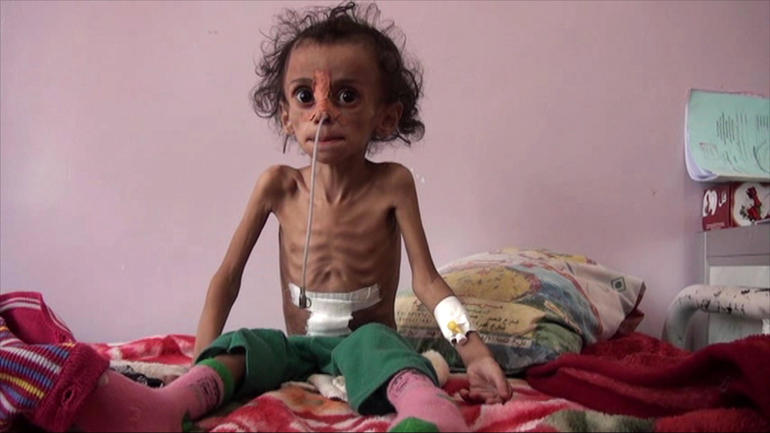
(“Haifa, a seven-year-old victim of Yemen’s famine, weighs just 11 pounds.” CBS.)
* * * * *
“If they upset enough people, eventually the rest of the world will stop feeding them. This is an option going forward.” – David Archibald
* * * * *
2 days ago
“Trump asks Saudi Arabia to allow immediate aid to Yemen” – Reuters
Your “proof” is Wikipedia?
The so-called “Palestinians” (i.e. mostly Jordanians that Jordan doesn’t want) voted Hamas as their government. ‘Nuff said.
Iran’s constitution calls for the total destruction of Israel. ‘Nuff said about that too.
Yemen is run by communist thugs. All communist country’s populations are starving to some degree. Though I do agree Saudi Arabia is at least partly at fault. if Yemen were a democracy their problems would go away.
“Iran’s constitution calls for the total destruction of Israel. ‘Nuff said about that too.”
Plus the destruction of the Great and Little Satans – the US and the UK.
No no no. You don’t get to be satan too. Not even little teeny weeny satan.
““Iranian agents have murdered Jews at gatherings as far afield as Buenos Aries.”
Which is indeed true, as is
““More recently Iranian proxy forces have been lobbing ballistic missiles from Yemen at Saudi population centres.”
“Japan spends only 1% of its GDP on defence but 6% on make-work schemes in the countryside such as concreting river beds.”
Where I live in Japan the local authority has spent three years digging out the foundations of the railway bridges, wiring them with mesh and backfilling with tetrapods and cobbles. This is to prevent the foundations being undercut by floods. And to prevent accidents and deaths
In my town we average 9 metres of snow every winter. I live opposite the station. Here the footpaths are heated by groundwater to stop the snow turning to hardpack. It works. The road authority is extending the expressway system through my town right now. As of today. This message is coming to from the deeply unfashionable north of Tohoku to you via fibre optic cable connected directly to my home courtesy of NTT
David Archibold, you are an ignorant twat. Here the money gets spent on infrastructre, not diversity consultants.
Once more: Hans Rosling’s 200 Countries, 200 Years, 4 Minutes – The Joy of Stats.
https://youtu.be/jbkSRLYSojo
More appropriate … Hans Rosling on population growth …
https://youtu.be/fTznEIZRkLg
We’ve grown up in an unprecedented period of global warmth and adequate energy production to drive the incredible advances in knowledge, medicine, food production, transportation, infrastructure and the high tech marvels folks carry around in their pockets. Yet our governments are collectively pursuing a path that will simply eliminate our ability to perform the simple task of feeding their populations. What is missed in the population projections is the dramatic, one might say devastating, effect of minor changes in the climate caused not by warming but by cooling not to mention the impact of diverting resources to “renewables”.
Even the AGW crowd acknowledges we’re living at the end of one of the Pleistocene epochs interglacial periods of the Quaternary Ice Age (the Holocene) which explains their attempts to change the science by creating a fiction of a human caused warm period. There is nothing that will stop the cold from returning. It’s just a matter of when. The climate is, in fact, changing and in a way that will make food production very difficult or impossible in many regions. A critical production shortage of fertilizer can dramatically reduct food production if renewables, carbon taxes, etc., continue apace.
But cold is the killer. Reports of crops failing due to cold are increasing (example: France’s grapes). Even if one brushes off solar cycles and glaciation timelines, we have thousands of volcanoes that are active and planet tectonics that can create a Tambora or a Krakatoa event every century or so meaning we’re overdue. The volcanic winters that ensued from those events created The Year Without a Summer (aka Year of Poverty) along with chaotic climate patterns for years. One can easily project reduction in food production by 20% in one year followed by 10% reductions in the following years. Even if one simply wishes away the devastating impacts “green” energy, plants simply won’t produce without warmth and, for sure, humans will never be able to warm the planet enough to maintain “normal” growing seasons.
Simply put, when the next volcanic winter occurs, nations that have food surpluses today will struggle to feed their own populations. Those that are in deficit today will simple starve with their populations undertaking migrations that are nothing compared to what’s happening currently in the EU. The buffer described in this article is simply not sufficient to carry the world over these events. The Year Without Summer created a doubling of the death rates in a world where most nations were self-sufficient in food production.
Regardless of what happens to the world population, even if every nation becomes self-sufficient in food production, we would need a much larger buffer than what we have today to carry us over any one of these events. One can only imagine what the numbers would be if we had more than one such event occur back to back. Only an extinction level asteroid strike would be more devastating to the human race.
The “solution” to a food shortage is simple, put democrats in control. Look what it did for Detroit? Fewer people to feed and the ones still there are growing their own food!

Do you have to completely destroy the economy and have one of the highest crime rates first?
It isn’t mandatory, but it helps.
“Do you have to completely destroy the economy and have one of the highest crime rates first?” Yes, a dead polar bear told me that both help lower our carbon footprint. (and dead polar bears don’t lie).
There is always something foolish about saying “Don’t worry, technology will solve our problems,” but I still find it hard to believe there is any great wisdom in Malthus or Limits to Growth. We are not insects or bacteria. Back to a limited number of food sources, no way to increase production per acre dramatically, using a lot of energy just to get daily nutrition? I doubt it. The study on South Africa and corn is from 2005; a 2015 study says it comes down to micro-nutrients, which I gather may be a manageable issue. If you google South Africa cancer corn, you get the scare stories about RoundUp; I believe those stories have been discredited. Selective breeding allowed for tremendous increases in food production, going back (I guess) to the earliest days of agriculture. GMOs, even if there are steps backward, should give us more ability to produce food in the way we want, in amounts we need.
lloydr56,
You said, “I still find it hard to believe there is any great wisdom in Malthus or Limits to Growth. We are not insects or bacteria.” After being an observer of humans for several decades, I have come to the conclusion that most people have great difficulty looking further into the future than the period of time that a weather forecast is reliable. That is, we are a little better than simple life-forms, but not by much. It is the rare person who has foresight and wisdom. That is why wisdom is so revered; it is so rare.
About half of perfectly edible and nutritious food is currently thrown away. Many groceries won’t carry anything but the most beautiful produce, and the rest is put in landfills. Consumers throw out food because they don’t understand what a “sell by” or “best by” date means. Additional food is lost to poor storage or transportation issues.
If we could solve these problems (the first two of which are quite simple), we could solve a lot of hunger.
But the notion of “eliminating world poverty” is faulty, because “poverty” will always be defined as the lowest x%. That is, what counts as poverty today might have been considered luxurious just a couple hundred years ago!
Yes, my son was part of a presentation about this at a work conference, he had the role of ‘ugly carrot’ with an excellent improvised costume.
renbutler wrote, “About half of perfectly edible and nutritious food is currently thrown away.”
The NRDC says, “Up to 40 percent of the food in the United States is never eaten.”
https://www.nrdc.org/issues/food-waste
The NYT says, “The report estimates that a third of all the food produced in the world is never consumed … ”
https://www.nytimes.com/2015/02/26/us/food-waste-is-becoming-serious-economic-and-environmental-issue-report-says.html?_r=0
Food waste in the US is in part due to the school lunch program feeding kids what they will not eat and due to lawsuits over food contamination. Detection of the tiniest amounts of ecoli or listeria result in millions of tons of waste yearly. Millions of eggs were destroyed due to “possible” salmonella contamination, chickens killed due to bird flu, etc. It seems unlikely that anything we citizens toss out due to spoilage comes even close to those two sources of waste. I am tired of being told the black, moldly banana I tossed out constitutes a crime against nature while the schools and lawyers waste 1000’s of times that amount daily.
(I realize food safety is necessary, but when there can be ZERO amount of many substances in the food, there is no way to avoid massive waste. It’s the precautionary principle—the one warmists love—in action. If we use it for climate, we use it for food. Learn to love it.)
I couldn’t find the original reference, but this is close to what was written:
Fully one-third of the world’s population lives in poverty. And thus it has always been so.
From a fellow named Forrester – in 1644!
at the time of this Forrester, hunger was more widespread than it is now.
That’s right. Hunger is not widespread, and I hope would not be in the next 100 years. These are my best wishes. Reality can tell us other news in the future.
And your point is? The article was just another bit of agitrop for AGW. What do you suggest? Bring every American down to Ethiopian levels of food production? The US produces 15-18% of the world’s food, and we use far fewer acreage to produce it.
I recently resigned after 16 years from the volunteer Board of Directors of the largest homeless shelter in North America. We sleep up to 1300 souls per night, and serve about 1.5 million free meals per year.
The big food stores send us their stale-dated food via the Food Bank, and we serve it through our team of volunteers and a very few professional kitchen staff, who provide direction and ensure food safety.
It works, and helps to cut down on food cost and waste..
If you extend or project the rate of change of the world population increase using the current rate of change as it has been recorded so far; it seems that the population will flat line this century at around 10 billion. The number may be even smaller and sooner than projected here. Currently population rate of increase is declining at about .02% per year; and absolute world population may go negative by 2075.
Perhaps our water, crops and natural resources are not in jeopardy after all.
http://www.worldometers.info/world-population/world-population-by-year/
I’ve followed this subject for over a decade. The “experts” are all over-estimated global population growth. We are much closer to “peak” population than they predict. We’re within 2-3 decades of max population (probably 9.5 billion). But, after the peak, if trends continue, the fall in population will be dramatic.
One thing I have managed to learn in my rather longish life is, if you are worrying about something that has not yet happened, you are worried about the wrong thing. While on a trip in my early twenties, I began hearing an ominous clunking from the rear of my Plymouth Valiant. I had no idea what it was. I spent the next half-hour or so listening to it. Was it getting worse? Louder? More frequent? Then I found myself coasting to a stop. I was out of gas. The noise was from a failing rear-differential, which lasted long enough to get home and take to a shop.
There are many possible armageddon-type events that if any one came true, would preclude others from having any consequences. Worrying about any specific one is futile.
I doubt if anyone could give comparative odds on which of these is more likely to happen: nuclear war; asteroid/comet impact; drug-resistant deadly viral epidemic; colder climate; mega-volcano; Carrington event; anomalous solar change; famine/overpopulation; exhaustion of fossil fuels; accidental (e.g., ‘we thought dumping tons of xyz into the oceans would improve the climate’). Those are just the ones that immediately came to mind. There are many other, less likely?, events that could cause extinction or near extinction, like an invasion by LGM, or an ‘expiration’ date on some critical natural constant holding the universe together.
I have looked at the results of this year’s crops and the forecasts for next year. They are more than sufficient for the human population. Next year, look at the numbers again. Until you see an indication of an insufficiency, worry about something else. Or better yet, enjoy what you have today.
“One thing I have managed to learn in my rather longish life is, if you are worrying about something that has not yet happened, you are worried about the wrong thing.”
I don’t care for that. You should always be looking ahead to what’s likely or inevitable, and planning accordingly. Waiting until something bad happens is too late. For example, I’ve been planning 20 years for a retirement that’s another 20 years away, because I already know I’ll have a finite amount of money.
That said, it’s also useful to sort through the predictions that are believable, and sort out the ones that are clearly horse crap (such as climate alarmism).
Mankind will inevitably end. Which scenario are you worrying about and planning for?
I had a friend who worried about his retirement, too. He never married, never took a vacation, he never even bought a car. In the summer, he would stay late at the office and fix his dinner in the breakroom to avoid turning on the AC at home. He saved a great deal of his salary (which was very good). He died of cancer at age 35. True story.
I saved money, too, though not obsessively, and, importantly, not specifically for retirement. I never pretended to know what the money would be used for (some money is in ‘retirement accounts’ because of tax benefits). I never worried about any future event. I’m all for keeping a supply of food on hand, too, but don’t see any scenario that would leave my area suffering a food shortage. Being generically prepared for unexpected events is fine.
Do you have your retirement money in a locked-down account that can only be used for retirement? If so, I would say you are very foolish. You do not know what you will need tomorrow. If you worry about a specific event in the future, you are most likely worried about the wrong thing.
We do not have a food shortage. There is no expectation of a food shortage after next year’s crops. The population growth rate, at the moment, is not exceeding increases in food production. Until something changes, there is no need for action. Food shortages created by population growth would be gradual, allowing for corrective action. Everyone will know of the problem because the price of food will start rising. This would result in more land being cultivated (if capitalism is still legal), buying Man more time, and we can worry about reducing population growth. That worry would not be at the top of my ‘worry list’ even if I had one.
I get so tired of hearing Malthusians predict doom based on extrapolations using last year’s technology.
Vertical farming powered by cheap molten salt nuclear power will provide as much grain, fruit, vegetables as humans will need for any size population ever. This is not even far in the future, it’s becoming reality now.
Vat meat is probably still a few generations away from being better than free range, but it will get there. And when it does it will be cheaper and scalable.
Another malthusian rant, i wonder why it appears on WUWT.
Food is just a commodity, and most nation in the world cannot feed themselves. So what?
Actually nations do not feed themself, people do, and by this metric >97% of western people depend on others for growing their food. Without any trouble.
BTW, do you have any idea of the world food reserve? Last time I checked, it was about a month. If some global disaster stopped food production, some humans would starving on day one, most of them would start in a month, and only a few lucky (and skillful enough to fend off raiders) wouldn’t worry that much.
Nations usually have strategic reserves of oil, I don’t know any of them having strategic reserves of food.
If we drop a couple of degrees in temperature as Archibald believes we will, we will have to move a lot of food around to keep people fed. This will put the squeeze on nations not on good terms with nations that can supply it. Those rogue nations will cause trouble unless they mend their fences.
yes. That is right. The last I had read was about the fall of Rome because of climate cooling.
Yeah. You are right. Watch this video,
David, you are good at the stuff you know. But this is something else, no different than the starvation and drastic depopulation we were supposed to have before 2000. Population has already slowed and we are 80% of peak population right now. Malthusians use the same type of linear bean counting that you have and it not only doesn’t treat human ingenuity enough as a factor but it extrapolates gross population growth on forever – unless it bumps into the disaster this naive type of thinking always foresees. Take a look at your graphs and chop off the last 20 years and you will have an even scarier “future”.
At least Malthus and the Club of Rome didn’t have the data that you have, making your analysis much inferior to theirs. Your climate stuff recognizes the folly of bean counting trends but your foray into demographics and “sustainability” is just as bad. We have a magnificent greening of the planet underway. The chances of a Garden of Eden earth with a stable more prosperous population by the middle to latter part of this century is much more likely than the Armageddon proposed by CO2 worriers. The Sahel (and into the Sahara), Outback, and US southwest will be cropping grains. I wish I could bet, but I wouldn’t be here to collect, having already lived through 7 decades and sampled two more (I aint giving up though, still working with projects in Canada, DR Congo and soon to be South America (won’t identify the country just yet). I’ve also been collecting snippets for a book basically saying stop being afraid!
Whats Up With That seems to be getting too friendly with the human haters of the world that led to the current crop of Catastrophic Anthropogenic Global Warming.
Lovely arguments… The price of crops is at an all time low due to over production. Followed later by… No further gains in yield have happened since 2000. Well, think about that for a moment. Why would you spend massive amounts of money increasing yields when prices are at historical lows and return on investment would likely be negative? You would not.