An eminent atmospheric scientist says that natural cycles may be largely responsible for climate changes seen in recent decades.
In a new report published by the Global Warming Policy Foundation, Anastasios Tsonis, emeritus distinguished professor of atmospheric sciences at the University of Wisconsin-Milwaukee, describes new and cutting-edge research into natural climatic cycles, including the well known El Nino cycle and the less familiar North Atlantic Oscillation and Pacific Decadal Oscillation.
He shows how interactions between these ocean cycles have been shown to drive changes in the global climate on timescales of several decades.
Professor Tsonis says:
“We can show that at the start of the 20th century, the North Atlantic Oscillation pushed the global climate into a warming phase, and in 1940 it pushed it back into cooling mode. The famous “pause” in global warming at the start of the 21st century seems to have been instigated by the North Atlantic Oscillation too.”
In fact, most of the changes in the global climate over the period of the instrumental record seem to have their origins in the North Atlantic.
Tsonis’ insights have profound implications for the way we view calls for climate alarm.
It may be that another shift in the North Atlantic could bring about another phase shift in the global climate, leading to renewed cooling or warming for several decades to come.
These climatic cycles are entirely natural, and can tell us nothing about the effect of carbon dioxide emissions. But they should inspire caution over the slowing trajectory of global warming we have seen in recent decades.
As Tsonis puts it:
“While humans may play a role in climate change, other natural forces may play important roles too.”
Full paper: The Little Boy: El Niño and natural climate change (pdf)

Everybody who cares about climate should read the brief Conclusion that starts on page 15 of the full report. And they should do so with an open mind. Sadly, there are so few open minds around these days — on ALL sides.
I am missing your point. Few people to my knowledge have said that humans have not influence climate throughout history, e.g., cutting down temperate forest in the N. Hemisphere, expanding desert through poor land use, etc. However, I have yet to hear those on the CAGW side admit that natural forces are playing a large and dramatic role in climate change, as those forces have in the past history of the earth. Just like blaming the USA for all the ills of the world they want to blame humans in general for all things that happen in nature that they do not like.
Yes. Every time I mow the lawn (which isn’t often), I am changing the climate of my back yard.
The vast majority of us concede that CO2 can warm the planet. The argument has always been over how much.
The science strongly implies climate sensitivity is below 0.5C. Probably as low as 0.2 to 0.3C.
more CO2 does not make the planet warmer
I checked that…
You are spot on.
“The science strongly implies climate sensitivity is below 0.5C. Probably as low as 0.2 to 0.3C.”
I know that I have a problem posting pictures. Forgive me but I think you will find these interesting. I am confirming what you are suggesting.
https://1drv.ms/i/s!AkPliAI0REKhgZMJVNVavuAXsblTZQ
https://1drv.ms/i/s!AkPliAI0REKhgZMK8IlEc5Y5mQVk8Q
BTW, in an earlier comment that apparently nobody bothered with I show that the Atlantic Basin ACE index is cyclical too. So even hurricanes are indicated to be somewhat cyclical. To hell with CO2.
https://1drv.ms/i/s!AkPliAI0REKhgZMAOFvShMaoucsHWA
The red line is my analysis with 50 cycles and I highlighted a 62-year cycle. How many times have I heard people mention a 60-year cycle?
I know its a pain but look at the earlier comment I posted.
Charles, within your links click ‘ view original’ then right-click image. Select ‘copy mage location’ ?psid=1
Paste.
Charles, never listen to me.
Edwin, I’m an agnostic on AGW, although I believe the evidence leans against the theory that humans are the primary drivers of climate change.
That said, I have indeed seen too many closed-minded people on “our side,” who don’t allow for the possibility that we do contribute a small warming influence. If only the two sides would eschew their fringes and meet in the middle to figure out how much, and whether it’s enough that we should even be concerned, we’d all be a lot better off.
renbutler
There are quite a few of us here who I know have made a serious effort to either prove or disprove that the 100 ppm’s (0.01%)of CO2 that humans added to the atmosphere causes any warming. Myself, I started looking here in my own backyard and I recommend you do the same.
Concerned to show that man made warming (AGW ) is correct and indeed happening, I thought that here [in Pretoria, South Africa} I could easily prove that. Namely the logic following from AGW theory is that more CO2 would trap heat on earth, hence we should find minimum temperature (T) rising pushing up the mean T. Here, in the winter months, we hardly have any rain but we have many people burning fossil fuels to keep warm at night. On any particular cold winter’s day that results in the town area being covered with a greyish layer of air, viewable on a high hill outside town in the early morning.
I figured that as the population increased over the past 40 years, the results of my analysis of the data [of a Pretoria weather station] must show minimum T rising, particularly in the winter months. Much to my surprise I found that the opposite was happening: minimum T here was falling, any month….I first thought that somebody must have made a mistake: the extra CO2 was cooling the atmosphere, ‘not warming’ it. As a chemist, that made sense to me as I knew that whilst there were absorptions of CO2 in the area of the spectrum where earth emits, there are also the areas of absorption in the 1-2 um and the 4-5 um range where the sun emits. Not convinced either way by my deliberations and discussions as on a number of websites, I first looked at a number of weather stations around me, to give me an indication of what was happening:
I subsequently found out that on average the whole of the SH has not warmed at all over the past 40 years.
Hence, since the observed warming is not even and not global I had to let go of the theory that the +100 ppm more CO2 causes the observed warming that is prevalent in the NH.
“Ocean Cycles, Not Humans, May Be Behind Most Observed Climate Change”
My, my, whatever clued you in?
WIth you there kokoda. On a spinning planet with an orbiting moon and both in turn orbiting a star in concert with a whole family of planets, big and small, and an extended family of comets, meteors and bits of stuff all the way down to stardust who would not think about systems responding cyclicly first, second third and fourth?
You only have to look at the long term temperature-CO2 cycles evidencing the ice ages etc and even Michael Mann might start to think ‘duhh, maybe this stuff happens cyclicly’ (until he bangs his head against a bristlecone pine trunk until such thoughts go away.)
Meanwhile the star and its system orbit the galactic center of mass.
Hasn’t Don Easterbrook been saying that for years about ocean cycles?
Yeah, but he’s not a climate scientist, is he?
Yes he is.
Interesting
Thank you
I tweeted it
Of course, in the conclusion to every paper, in order to be read in the warmist community and to ensure further funding, one must declare that this does not disprove accepted dogma.
I call it the “Copernicus” disclaimer 🙂
Here’s all the facts but please don’t kill me for being correct because I’ve included a disclaimer!
Except it does. There are the claims of “robust”, ” settled science” and “what else could it be?”
Correct or not, they will not be winning the Nobel Prize.
The final sentence of the conclusion is not very conclusive and attempts to leave everything up to …”maybe”:
“While humans may play a role in climate change, other natural forces such
as the oceans and extraterrestrial influences such as the sun and cosmic rays may
play important roles too.”
IMHO there has never been any disagreement on this issue. The disagreement stems from the relative contributions to climate change of those factors.
One camp believes humans are the primary cause.
The other camp says human contribution is insignificant.
Not sure ifits just two camps. I personally believe in AGW, but I think it is pure guesswork and in some cases fraudulent to pretend to know the range and associated feedbacks.
This is the warming pulse into the Northern Hemisphere in 2000 that caused the pause.
This is the response in Temp F/Whr per Day (divide by 24 to get the instantaneous rate degree F per W/m^2) at each weather station whose temperature increase is included.
It all goes back to the fact that as the air cools at night, and starts to cycle more water vapor (condense,re-evaporate), water vapor controls cooling, and co2’s 3.7W/m^2 is regulated out in the large amount of energy being exchanged.


Here:
Last of Irma blew through, and it turned clear about 8:00pm. The measured temp differences would have an 180W/m^2 flux from the surface to space.
Part is blocked though from what my meter measures. As shown here.
The inverted spectrum represents the part I was able to measure, so that’s is the temp in those wave lengths. Then you can use the ratio, I figure that’s 35-40% if the surface spectrum that has a pretty clear shot to space as long as there are no clouds, 24×7 btw.
63W/m^2 is radiating from the surface and it does not change all night, SB demands it. With a 70F difference in temp to clear sky (actually the 10u water vapor line, so this changes with absolute humidity, but not rel humidity like the other band do).
From 7 to 8pm, temps drop 8F 4F/hr. Since I didn’t measure temps at 7:00, let’s assume the sidewalk is 72F 2F warmer than air, after a fairly cloudy day, and that sidewalk is in the shade later afternoon anyways.
That works out to 679KJ/hr or 188.78W/m^2 with a Tsky of -4
So 4F/hr at 188W/m^2 everyone follow along?
But at 9:00pm for the next 5 hours, it dropped 4F, 0.8F/hr
So a 10F drop in surface temp changes a 15% difference in the difference between surface and space. made a 66W/m^2 vs 63W/m^2 difference SB emission in the optical window,
somehow made a 5x reduction in the cooling rate! Temp difference changed by 15%, a 5% change in flux rate. But the best part is, it’s all based on air temp and dew point. All of CO2’s, and all the other GHG’s are encompassed in the 4F/hr rate, and deserts cool at much higher rates, remove the water and ghg’s do a poor job of keeping the surface warm. It’s only dew point and it’s relation to air temp that matters.
If you show measured surface net radiation under similar conditions, you see something else is going on in the rest of the spectrum, and it’s all keyed by rel humidity, and that water vapor is releasing latent heat, and that slows cooling, regulating surface temps to dew point.
Then add that the land surface areas are not the same between hemispheres, and air temps over land are higher, so every time the oceans transport warm pools into the NH it warms GMST. El Nino’s are an example of a short term cycle, but same process. Water vapor regulates surface temps.
Some labels and units on your graph axes would help a lot.
Other than the last one’s x-axis, which ones are not marked?
The last one I have tried many, many time, but you can’t read it because it sampled every few minutes for 4 days. And it’s either all black, or it’s worse than this.
My assumption was most people familiar with this topic would be able to suss out the daily temperature cycle for “land markers”.
micro6500,
It looks to me like your two posts should be enlarged, filled with more definitions, and proofread. Consider this: This is the response in Temp F/Whr per Day (divide by 24 to get the instantaneous rate degree F per W/m^2) at each weather station whose temperature increase is included. At eadh weather station? How many are there? Are they displayed? And is that division correctly described?
Some if that’s already here. https://micro6500blog.wordpress.com/2016/05/18/measuring-surface-climate-sensitivity/
There are reports on SourceForge with all that info and more. Yes that’s the right conversion and then multiple by 5/9 For °C.
Oh BTW, there were hundreds if not thousands of stations in some of those slices.
It’s a bit hard to follow all of what you posted. But isn’t the bottom line: water vapor and its latent heat? When in your graph the night temperature gets close to the dew point and the relative humidity increases, would formation of dew or fog release latent heat and counter radiative cooling? It would be interesting to calculate the amount of water removed by condensation or the total water vapor content in the atmosphere at night instead of the relative humidity.
Yes, the release of latent heat at higher rh, counters cooling. The majority of any increased forcing is just radiated away prior to rh changing rate.
And that’s dew point is(total water vapor).
And I have wet and dry enthalpy in my data reports. In sourceforge.
“The findings presented here and in the references support the view that the climate
system consists of distinct subsystems whose interplay dictates decadal variability.
At the same time, these results provide clues as to what these subsystems might be.
As such, while ’weather’ may be complicated (consisting of many parts and difficult
to understand), ’climate’ may be complex but not complicated (with fewer parts and
easier to understand). Moreover, it appears that the interaction between these subsystems
may be largely responsible for observed decadal climate variability. In the
past, this decadal variabilitywas ‘modeled’ as a tug-of-war between aerosols and carbon
dioxide effects. The argument was that in times when aerosols were ‘winning’, the
Earth would cool, while in times when carbon dioxide effects were more dominant,
the Earth would warm. The results presented here refute this arbitrary assumption as
they demonstrate that a dynamical mechanism is responsible for climate shifts. Thus
ENSO and its ‘cousins’ do not tell us anything about human contributions to climate
change. They do, however, underscore the importance of natural variability in climate
change. While humans may play a role in climate change, other natural forces such
as the oceans and extraterrestrial influences such as the sun and cosmic rays62 may
play important roles too.”
Source above in the post.
There is nothing to add from the perspective of a rational man. It is a pity that there are so few rational people.
Unwarranted speculation with the “may be” escape clause.
I believe your use of the phrase “unwarranted speculation” represents mere unwarranted speculation on your part.
He is not using “may be” in the way you are assuming. He is saying that climate is complex but is not complicated.
read as “may well be”.
mschillingxl,
So you agree that the climate system is not complicated? Then why has the proposed sensitivity range for CO2 doubling not been refined after years of scientific effort and billions spent? Why does Judith Curry call it a “wicked problem”?
Phillip Bratby,
I understand the common meaning of “may be”. In common parlance,it is no stronger in likelihood than “may not be”.
Robert,
The reason the climate sensitivity for CO2 has not been better defined is obvious. It is so miniscule that it can’t even be picked out from noise! Look at micro’s charts which show heat loss profiles on short term bases and prove that heat loss on even an hourly scale absolutely overwhelms any effect of CO2.
The warming we experienced up to 2000 was a result of natural variability mostly related to oceanic circulation. Cycles of approximately 60-65 years appear to be pretty obvious in the climate record. Because the climate science mainstream is so atrociously politicized, they studiously avoid looking at the oceans as cause even though a heat content that is 1000 X that of the atmosphere is in contact with said atmosphere 24 hr every day. In any real science this would be laughable!
Look up definitions on “may be” in context.
That’s from IPCC TAR. Is that statement from the august body consistent with the claim that climate is not complicated?
A key part of this paper is the recognition of the complex interaction of multiple actors, at times synchronizing and even coupling in their effects, making it extremely difficult for us to untangle the drivers of climate fluctuations.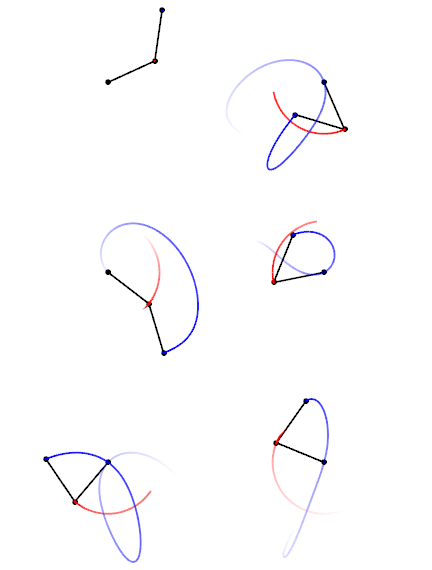
I was alerted to the example of a double pendulum (a slight variation on Tsonis’ point) I will try to post the diagram and some explanation: Trajectories of a double pendulum
A comment by tom0mason at alerted me to the science demonstrated by the double compound pendulum, that is, a second pendulum attached to the ball of the first one. It consists entirely of two simple objects functioning as pendulums, only now each is influenced by the behavior of the other.
Lo and behold, you observe that a double pendulum in motion produces chaotic behavior. In a remarkable achievement, complex equations have been developed that can and do predict the positions of the two balls over time, so in fact the movements are not truly chaotic, but with considerable effort can be determined. The equations and descriptions are at Wikipedia Double Pendulum
But here is the kicker, as described in tomomason’s comment:
If you arrive to observe the double pendulum at an arbitrary time after the motion has started from an unknown condition (unknown height, initial force, etc) you will be very taxed mathematically to predict where in space the pendulum will move to next, on a second to second basis. Indeed it would take considerable time and many iterative calculations (preferably on a super-computer) to be able to perform this feat. And all this on a very basic system of known elementary mechanics.
https://rclutz.wordpress.com/2017/05/01/climate-chaos/
Where is the CO2 molecule that causes this behaviour?
Just kidding.
This is the initialization problem with GCM’s.
That is not all. There are also ‘trip or trigger points’. Simple example: the automatic car. There is a relationship between road speed, engine speed, and engine power. But at certain points sudden and abrupt gear change occurs. The system shifts to a new interactive regime.
I guess you are referring to patterns like this:
That’s fantasy.

this is what was measured
And the temps
what we measured.
They follow the ocean cycles.
Everything else is nonsense.
The glitch in the 70’s is a large change in the number of stations reporting. A drop of about 60% of the reporting stations. The 60’s peaked at about 500k records/year, then dropped down to 170k per year, afterwards it quickly went up to a million, then 2 million daily stations reports per year or there abouts since. Mostly in the NH. Band of warming in the lower lat of the NH, not much in the SH. But there is a cycle


These are the temp change due to the length of day changing across a half year, that slope by year.
Those hikes are due to other factors like people rethinking calibration, automatic observations versus people observations, computerised observations and calculations of averages…
I was replying to ron
Yes, it does this every night, well most nights anyways. Water vapor regulates how cold it get by condensing water, all that radiated latent heat keeps it from cooling as much.
That’s your GHG effect !
🙂
Hans-George capably summarized the basis for the deeply-flawed climate computer models that have led society so far astray::
“In the past, this decadal variability was ‘modeled’ as a tug-of-war between aerosols and carbon dioxide effects. The argument was that in times when aerosols were ‘winning’, the Earth would cool, while in times when carbon dioxide effects were more dominant, the Earth would warm.”
It should be noted that the aerosol “data” that was used to drive the modeled cooling period from ~1940 to ~1975 was fabricated “from thin air”. This is evidence of fraud by the modelers, imo.
Here is some of the evidence, from conversations I had with Douglas Hoyt over the last decade:
http://wattsupwiththat.com/2015/12/20/study-from-marvel-and-schmidt-examination-of-earths-recent-history-key-to-predicting-global-temperatures/comment-page-1/#comment-2103527
Re aerosols:
Fabricated aerosol data was used in the models cited by the IPCC to force-hindcast the natural global cooling from ~1940-1975). Here is the evidence.
Re Dr. Douglas Hoyt: Here are his publications:.
http://www.warwickhughes.com/hoyt/bio.htm
Best, Allan
http://wattsupwiththat.com/2015/05/26/the-role-of-sulfur-dioxide-aerosols-in-climate-change/#comment-1946228
We’ve known the warmists’ climate models were false alarmist nonsense for a long time.
As I wrote (above) in 2006:
“I suspect that both the climate computer models and the input assumptions are not only inadequate, but in some cases key data is completely fabricated – for example, the alleged aerosol data that forces models to show cooling from ~1940 to ~1975…. …the modelers simply invented data to force their models to history-match; then they claimed that their models actually reproduced past climate change quite well; and then they claimed they could therefore understand climate systems well enough to confidently predict future catastrophic warming?”,
http://wattsupwiththat.com/2015/09/28/wild-card-in-climate-models-found-and-thats-a-no-no/#comment-2036857
http://wattsupwiththat.com/2009/06/27/new-paper-global-dimming-and-brightening-a-review/#comment-151040
Allan MacRae (03:23:07) 28/06/2009 [excerpt]
Repeating Hoyt : “In none of these studies were any long-term trends found in aerosols, although volcanic events show up quite clearly.”
___________________________
Here is an email received from Douglas Hoyt [in 2009 – my comments in square brackets]:
It [aerosol numbers used in climate models] comes from the modelling work of Charlson where total aerosol optical depth is modeled as being proportional to industrial activity.
[For example, the 1992 paper in Science by Charlson, Hansen et al]
http://www.sciencemag.org/cgi/content/abstract/255/5043/423
or [the 2000 letter report to James Baker from Hansen and Ramaswamy]
http://74.125.95.132/search?q=cache:DjVCJ3s0PeYJ:www-nacip.ucsd.edu/Ltr-Baker.pdf+%22aerosol+optical+depth%22+time+dependence&cd=4&hl=en&ct=clnk&gl=us
where it says [para 2 of covering letter] “aerosols are not measured with an accuracy that allows determination of even the sign of annual or decadal trends of aerosol climate forcing.”
Let’s turn the question on its head and ask to see the raw measurements of atmospheric transmission that support Charlson.
Hint: There aren’t any, as the statement from the workshop above confirms.
__________________________
IN SUMMARY
There are actual measurements by Hoyt and others that show NO trends in atmospheric aerosols, but volcanic events are clearly evident.
So Charlson, Hansen et al ignored these inconvenient aerosol measurements and “cooked up” (fabricated) aerosol data that forced their climate models to better conform to the global cooling that was observed pre~1975.
Voila! Their models could hindcast (model the past) better using this fabricated aerosol data, and therefore must predict the future with accuracy. (NOT)
That is the evidence of fabrication of the aerosol data used in climate models that (falsely) predict catastrophic humanmade global warming.
And we are going to spend trillions and cripple our Western economies based on this fabrication of false data, this model cooking, this nonsense?
*************************************************
Reply
Allan MacRae
September 28, 2015 at 10:34 am
More from Doug Hoyt in 2006:
http://wattsupwiththat.com/2009/03/02/cooler-heads-at-noaa-coming-around-to-natural-variability/#comments
[excerpt]
Answer: Probably no. Please see Douglas Hoyt’s post below. He is the same D.V. Hoyt who authored/co-authored the four papers referenced below.
http://www.climateaudit.org/?p=755
Douglas Hoyt:
July 22nd, 2006 at 5:37 am
Measurements of aerosols did not begin in the 1970s. There were measurements before then, but not so well organized. However, there were a number of pyrheliometric measurements made and it is possible to extract aerosol information from them by the method described in:
Hoyt, D. V., 1979. The apparent atmospheric transmission using the pyrheliometric ratioing techniques. Appl. Optics, 18, 2530-2531.
The pyrheliometric ratioing technique is very insensitive to any changes in calibration of the instruments and very sensitive to aerosol changes.
Here are three papers using the technique:
Hoyt, D. V. and C. Frohlich, 1983. Atmospheric transmission at Davos, Switzerland, 1909-1979. Climatic Change, 5, 61-72.
Hoyt, D. V., C. P. Turner, and R. D. Evans, 1980. Trends in atmospheric transmission at three locations in the United States from 1940 to 1977. Mon. Wea. Rev., 108, 1430-1439.
Hoyt, D. V., 1979. Pyrheliometric and circumsolar sky radiation measurements by the Smithsonian Astrophysical Observatory from 1923 to 1954. Tellus, 31, 217-229.
In none of these studies were any long-term trends found in aerosols, although volcanic events show up quite clearly. There are other studies from Belgium, Ireland, and Hawaii that reach the same conclusions. It is significant that Davos shows no trend whereas the IPCC models show it in the area where the greatest changes in aerosols were occurring.
There are earlier aerosol studies by Hand and in other in Monthly Weather Review going back to the 1880s and these studies also show no trends.
So when MacRae (#321) says: “I suspect that both the climate computer models and the input assumptions are not only inadequate, but in some cases key data is completely fabricated – for example, the alleged aerosol data that forces models to show cooling from ~1940 to ~1975. Isn’t it true that there was little or no quality aerosol data collected during 1940-1975, and the modelers simply invented data to force their models to history-match; then they claimed that their models actually reproduced past climate change quite well; and then they claimed they could therefore understand climate systems well enough to confidently predict future catastrophic warming?”, he close to the truth.
_____________________________________________________________________________
Douglas Hoyt:
July 22nd, 2006 at 10:37 am
Re #328
“Are you the same D.V. Hoyt who wrote the three referenced papers?” Yes.
“Can you please briefly describe the pyrheliometric technique, and how the historic data samples are obtained?”
The technique uses pyrheliometers to look at the sun on clear days. Measurements are made at air mass 5, 4, 3, and 2. The ratios 4/5, 3/4, and 2/3 are found and averaged. The number gives a relative measure of atmospheric transmission and is insensitive to water vapor amount, ozone, solar extraterrestrial irradiance changes, etc. It is also insensitive to any changes in the calibration of the instruments. The ratioing minimizes the spurious responses leaving only the responses to aerosols.
I have data for about 30 locations worldwide going back to the turn of the century. Preliminary analysis shows no trend anywhere, except maybe Japan. There is no funding to do complete checks.
Ron Clutz; micro6500:
This section from the paper is comparing interaction between multiple oscillating parameters. Quote “In physical terms, coupling is a property of an individual oscillator’s phase relative to the phases of other oscillators. When two oscillators’ phases lock – that is, they retain a fixed relationship for a sufficiently long time – then, regardless of the phase lag between them, those oscillators are considered coupled.
The theory of synchronised chaos predicts that in many cases when such systems synchronise, an increase in coupling between the oscillators may destroy the synchronous state and alter the system’s behaviour.”
However before they reach a state of ‘altering the system’s behaviour’, other factors may kick in, leading to major and drastic changes. The 1930 in Ron’s figure is a mild one, when the Great Plains became a dust bowl. But going back in time 5500bce was the sudden drying of the Sahara (Peter DeMenocal). And there were others. On a long time period, this thread has many examples of trip points: https://wattsupwiththat.com/2017/08/04/paleoclimate-cycles-are-key-analogs-for-present-day-holocene-warm-period/ see fig 1.
That type of mixing is used extensively in electronics, radio mixers, PLL’s.
So each ocean has it’s own circulation period, and they all couple in the Southern ocean, and Atlantic and Pacific also couple in the Arctic. They all get pulsed by the moons gravity adding that period.
Then water vapor created in the warmer latitudes is blown poleward to cool and condense out as rain or snow. Land air temps just follow dew point.
So. The weather is related to the position of the moon. How ingenious. Our Maker is a genius…
Just one of the many clocks that are getting mixed.
Don’t underestimate.
The mixing rate is closely related to the evaporation rate, which determines how much warmth is allowed through the atmosphere
….
?
I’ve seen some data showing the connection between trade winds and sea surface temps, which then get translated into air temps downwind. And the evap rate is Natures flow battery storing Solar during the day to keep the planet warmer at night.
What’s fascinating is the authors discovering that the NAO and ENSO are coupled. This is the first time I came across that idea. From the very beginning, the author(s) assumed that the strength and frequencies of ENSO changes are driven by global temperature variations, and not the other way around (that is, it is ENSO that drives global temperatures).
The plot thickens.
Read the conclusion.
Nothing here for skeptics.
Are you serious Mosher? It’s another nail in the coffin of the incorrect CO2 as temperature regulator theory
His response is incoherent. The conclusion is there not “here.”
Here, at WUWT, there is plenty.
Read the paper. Lots there for sceptics. Might be difficult for non-scientists though.
Mr. Mosher,
From the conclusion: “The argument was that in times when aerosols were ‘winning’, the
Earth would cool, while in times when carbon dioxide effects were more dominant,
the Earth would warm. The results presented here refute this arbitrary assumption ….”
I prefer to concentrate only on this portion of the conclusion and if anybody brings up any other points I will throw out some meaningless cryptic crap that can be interpreted in numerous ways. After that I will put my fingers in my ears and say “nah nah nah nah”. Then, as I am smarter than all else, I will proudly cherish my win.
(you can focus on, “While humans may play a role in climate change …” and then do the same thing as me if you want to.)
Since you think the modern warming is from co2, of course that’s what you’d think.
Unless you don’t really think that.
Anyone paying attention knows the modern temperature record is the results of the water vapor distribution over the surface, not changes to co2.
Which is it Steve?
Is the modern temp record from natural cycles or Co2?
And why do you guys always show forcing for the noncondensing GHG’s, and leave out the condensing GHG(or only show long averages where changes disappear as well), when never in human history has there been a time when there wasn’t vast quantities of the condensing GHG in the atm, acting as a working fluid storing and releasing energy daily.
Nope, nothing at all.
He’s like an old time cop with a body leaking blood all over the ground. “Nothing to see here. Move along”
Micro,
I took some time to examine a previous post of yours in some detail and I was quite impressed with your conceptual breakdown and associated information. Could you explain briefly how your understanding relates to multi-decade cycles in the weather? Also, my take on your material is that daily processes of heat rejection on the nighttime side of the planet are both mediated and accelerated by moisture and its latent heat component, and that this process, in total, vastly overwhelms any heat retention effect of CO2. Could you comment on that, please?
That’s it! Water during the night cycle is many time more powerful than co2, and it varies. And congratulations not many get it.
So basically oceans store warm water, warm waters emit more water vapor, winds blow water vapor pipes are to cool.
Oceans are large capacitors, and have natural gyres, each with its own period, connected to other pools with their own cycles. So you end up with lots of mixing of various periods.
And then you place that water vapor over the different hemispheres, which respond differently because of the very different land masses.
Then you got the Sun…………
Micro
You are right about the scale of the thermal effect of water vapour but that just modifies the thermal effect of convective overturning within an atmosphere.
Descending air warms up adiabatically even if no water vapour is present so the effect of water vapour is simply to make the rate of convective overturning less rapid than would otherwise be necessary to achieve hydrostatic equilibrium within the atmosphere.
No I think you’re wrong, deserts and tropics act very differently during clear calm nights.
The surface behaves very differently but only because of surface cooling characteristics. For deserts with low humidity the surface cools fast and creates an inversion layer but above that layer you still have descending air that is warming adiabatically.
It is the adiabatic warming of descending air that creates the greenhouse effect but water vapour modifies the rate of descent required to achieve hydrostatic equilibrium.
I do not believe that matches the data. Well that could describe what’s happening somewhere overhead, but at the surface it’s all timed with absolute and relative humidities, that would define how many moles of water are condensing/re-evaporating. BTW, grass cools very very fast. In fact frequently below air temps covered in dew.
What matters globally is what happens above the inversion layer.
All that the inversion layer achieves is to divert the descending warming air laterally so that it reaches the surface elsewhere. Horizontal winds neutralise the effect of the inversion layer.
Not most nights, at least inland(neohio). It’s calm. And globally there just under a 98% correlation between min temp and dew point over 79 million station records.
It isn’t calm above the inversion layer, winds there flow laterally.
In tropical regions water vapour prevents or minimises the development of inversion layers because water vapour is lighter than air.
Your water vapour description is correct but only part of the global scenario.
If there were no water vapour speeding up energy transmission to space the rate of convective overturning would have to be faster so that energy in the atmosphere could be returned to the surface fast enough for radiation to space from the surface rather than from within the atmosphere.
That is the only way that hydrostatic equilibrium could be maintained without water vapour.
Mars is a good example. Without water vapour convective overturning has to be more vigorous so that despite low atmospheric mass we see periodic huge dust storms around the planet.
They could very well be blowing. It since work is transporting heat around, we have to be careful how we count, I think we should stick to the surface. Plus there’s impact from the ground, and the cloud layer, it’s all different.
And there’s a lot of enthalpy, actually deserts have half the tropics, but drop twice as much at night.
Oh, it’s the surface, we live here, not in the inversion layer. It’s part of how the surface cools, it’s likely the last point of emission for some wavelengths. But it is likely the hot(cooling) end of a hot pipe.
The surface is within the inversion layer, surely?
I suppose it is, but it’s always like that over the continent, it’s just the warm troposphere.
I’m trying to follow this thread but I have very little time right now and will have to come back to it. I think we have to remember to be careful when talking about adiabatic “warming” or “heating” as an adiabatic temperature rise takes place without any increase in thermal energy/molecule. It is a temperature rise without corresponding heat increase. I honestly don’t think a lot of actual climate scientists understand this. Nor do they seem interested in humidity (relative or absolute)as it relates to enthalpy.
I understand that the recent warming we experienced in many parts of the world from 1980 to 2000 manifested as higher nighttime lows without much in the way of higher daytime highs. I would expect this is very much a product of humidity profiles and very relevant to Micro’s information and analysis.
John, here’s the daily range.
They’re not interested either because that eliminates age, and no wait, that’s it.
Thermal means temperature.
Heat is added in adiabatic descent but energy remains constant. To comply with conservation of energy there is a transformation of PE (not heat) to KE (heat).
Conside how much the height of the atm changes between day and night. So yes, some of this effect I’ve been describing is getting some of the energy from this process. Again, I generate enthalpy data for all 140 million records.
Mosher, you’re going to have to get a real job soon
The CACA jig is up, so soon his gig will be too.
Mowh,
Nothing except precisely what we’ve been saying since 1977.
The conclusion had to include language showing obeisance to the Church of CACA in order to get published. Doesn’t mean a thing. Only the conclusion that natural factors at the very least far outweigh any and all human effects on climate change matters.
Showing that natural cycles drove climate over the last 100 years, not CO2, is nothing?
Mosh is just whistling past the graveyard of his gravy train.
How’s that for mixing metaphors of doom?
Steven Mosher: Read the conclusion.
Nothing here for skeptics.
In the paper there is plenty for skeptics. It represents an important stage in the development of explanations of “natural causes” of oscillations in global temperature measurements.
Nothing here for skeptics, mosh? What’s “here” is that if there is a natural componant to warming, then ECS is nowhere near your beloved 3C. (“nothing here” my a**)…
Read the conditions of the grants that supported this research. Even if only one small grant among the lot states that the research must support efforts to understand AGW and the secretary meaning is to state somewhere that it exists, the author has no choice but to include it. Have you ever gotten a research grant? With conditions? I have read many. And did research with conditions that had to be met because the grant said so.
The average depth of the ocean is 12,100 feet. The total weight of the atmosphere is equal to the weight of 33 feet of that ocean. Since temperature of the ocean abyss is something like 0-3 degrees Celsius what can you say you understand about the earth’s temperature when your primarily looking at surface AIR temperatures. Only a tiny change in the top 500 feet of the ocean would be equivalent to a drastic change in the earth’s atmospheric temperatures. I think it has been thought that the oceans are stable enough to be disregarded when thinking about and modeling Earth’s climate. What’s the evidence for such an assumption? Furthermore where is the energy that sustains the cold of the ocean abyss coming from? I don’t see it in the energy diagrams I’ve been shown.
HankHenry
working everyday at ocean depths in excess of 3,500meters I can assure you that we also know nothing. http://www.treasure-island-shipping.com
If they actually studied the oceans in depth (apologies ) they could no longer use them as an assumed heat sink to explain atmospheric warming that isn’t there!
The author is correct.
Recently I analyzed the Atlantic basin ACE index. I saw this figure on GWPF.
https://1drv.ms/i/s!AkPliAI0REKhgZMBhxNxvW_rfO_o6A
I found the raw data and the first thing I did was use Dr. Evans’ Optimal Fourier Transform (OFT) analysis on it before processing through my own cyclic analysis procedure. I used the output of the OFT as inputs.
https://1drv.ms/i/s!AkPliAI0REKhgZJ_jmMehICaZ8iaSA
After the cyclic analysis I got this.
https://1drv.ms/i/s!AkPliAI0REKhgZMAOFvShMaoucsHWA
Note the 62-year multidecadal oscillation. it’s everywhere. I used 50 cycles to get that result. With only the first nine cycles I got this.
https://1drv.ms/i/s!AkPliAI0REKhgZMCTw6-OE8JetToJA
Here is an abbreviated table of the results. It does look like a lunar cycle is in there too.
https://1drv.ms/i/s!AkPliAI0REKhgZJ-Mbudlen2UL5B1g
Don’t get too excited. I’m suspecting a GTA input into the calculation of ACE.
Is it my imagination or are there more papers and publications on non-AGW causes for “global warming” of late. If this trend continues expect “believers” and those financially invested in AGW will take persecutions to a new level.
“… published by the Global Warming Policy Foundation” Problem is the CAGW crowd’s confirmation bias tell them that anything published by the GWPF is just junk and to be totally ignored. I doubt if they even read it, much less discuss it or reply to it.
But Michael Mann and his accolytes did away with all that inconvenient history, so the temperature is due to CO2 levels only./s
I can’t access thegwpf.org Both google chrome and Firefox report security issues that prevent access.
Firefox:
“The website tried to negotiate an inadequate level of security.
http://www.thegwpf.org uses security technology that is outdated and vulnerable to attack. An attacker could easily reveal information which you thought to be safe. The website administrator will need to fix the server first before you can visit the site.
Error code: NS_ERROR_NET_INADEQUATE_SECURITY”
Google Chrome:
“This site can’t be reached
The webpage at https://www.thegwpf.org/content/uploads/2017/09/Tsonis-17.pdf might be temporarily down or it may have moved permanently to a new web address.
ERR_SPDY_INADEQUATE_TRANSPORT_SECURITY”
They should do something about it.
I can reach the side with both the firefox and the chrome. Perhaps it lies by your searching machine?
Works with Chromium & Firefox for me (I’m running Kubuntu for OS).
NEVER have a problem going to the website,no warning ever posted.
I use Firefox.
It can also be the security. The link works sure, is htpps an no problems are reported:
https://www.thegwpf.org/
A very interesting site.
There is another good news for the further development of the Earth temperatures in 2018 :
http://www.thegwpf.com/la-nina-may-develop-by-fall-or-winter-noaa-says/
And the AGW-Crowd tought, the actually neutral phase would last forever…..
In Chrome, I too got the warning about the GWPF site.
Javier ==> If you can’t access it, send me you email address and I’ll send you a copy: my email = my first name at the domain i4 decimal net. (email obscured to prevent scraping by bots)
No problems either Javier. FFx on Fedora.
I suggest you search that error msg. Plenty of results, may lead to find out what is wrong at your end.
Google simply doesn’t like ‘climate deniers.’
And therefore, I don’t like Google. Reason #855!
The Qualsys SSL Server Test rates this site’s security as A+. It doesn’t get much better than that…
Results are here: https://www.ssllabs.com/ssltest/analyze.html?d=www.thegwpf.org
Nowadays older versions of ALL browsers will fail on an SSL (https) connection because they do not support the newer protocols/ciphers and the host has been set to not negotiate a weaker, more unsecure connections (which is correct but painful for some…).
In 2016 – Mann concluded in a study that the pause was not predictible because the ocean cysles were unpredictible
Like crap – the ocean cycles were showing up promeintly in the temp records since the 1850’s – The “climate – we’re smarter than everyone else Scientists” just would not admit that they ignored what all the skeptics saw.
http://onlinelibrary.wiley.com/doi/10.1002/2016GL068159/full
https://wattsupwiththat.com/2016/05/11/study-by-mann-admits-the-pause-in-global-warming-was-not-predictable-but-lets-models-off-the-hook/
What kind of science is that? Unpredictable means insufficiently understood. To any real scientist, anomalous observational data is a guidepost to a new mystery and better understanding. For these AGW potato-heads, it is bad ju-ju. Here lie monsters!!! Every time they take the field they set new highs in low downness. Pathetic. And Mann is the most pathetic of them all. Agressively pathetic! Think about that!
Same as it should be for any analyst.
“An eminent atmospheric scientist says that natural cycles may be largely responsible for climate changes seen in recent decades. ”
Sure but not the anthropogenic climate change. This can be found in the homogenised data and only in the homogenised data.
Get serious!
He’s Joking!
At last some common sense. Tsonis is a proper scientist at least. His work has been covered at Climate Etc. several times.
When you see a signal that is stronger in one place than another The first place you start looking for the cause it where it is strongest.
The most obvious conclusion to the mysterious “Arctic amplification” of warming would be that the changes in climate originate there, not that they start somewhere else and get bigger as they go along.
Without the “Arctic amplification” the vikings would not have settled on Greenland. The “Arctic amplification” is not a sign of a newer time, but indeed a sign of every natural warming of the northern hemisphere. With this you can explain also the MWP and the opposite, the LIA and also the “modern warming”. But you cannot explain both with CO2. That would have to be thought of?
I agree totally. I believe this is a result of cyclicality of ice coverage in the Arctic due to the insulating effect of ice and the simultaneous protection of the surface from wind. This is probably the only place in the entire climate sytem where there is an actual “tipping point”.
Extensive ice coverage holds in heat in the ocean water and reduces wave action that destroys ice. As heat accumulation under the ice causes the top waters to warm the winter ice accumulation becomes thinner. At a certain point the wind becomes the dominant factor and the Arctic enters a long heat dumping phase.
The ocean cools for years in this mode until the ice begins to dominate again. Once the ice is reestablished it keeps the wind from producing the ice destroying wind. As water from the N. Pacific infiltrates the Arctic, heat begins once again under the ice.
There is ample evidence of this medium term cyclicality in the records and no reason to think the recent warming is anything different. The Arctic is now at reduced ice conditions and thus dumping heat. This is the cause of the pause. I suspect we are close to the end of this phase as ice extent is now in recovery. We may see some cooling once the ice nears maximum extent in the next decade or so.
The pause was from the change in the lower latitudes of the NH, coincident to the AMO going positive
http://la.climatologie.free.fr/amo/amo-english.png
Hey – Micro – Mann did a study showing the cycle was unpredictible and therefore the “climate scientists” couldnt predict the pause – get the story straight (sarc)
i wish more people would look at it from that perspective. i am not the sharpest tool in the box but it constantly amazes me the approach climate science takes.
I saw a documentary that mentioned Antarctic BRINE. Very cold, very salty water that can take thousands of years to travel from Antarctica northward which cools that ocean. Anyone know anything more about this? My limited knowledge would lead me to believe that our CURRENT ocean temps may be due to geologic forced set in motion HUNDREDS if not THOUSANDS of years ago.
The deep ocean is near freezing for a simple reason. As polar sea ice forms in NH and SH winters it exudes salt. The seasonal sea ice is mostly freshwater. This causes the adjacent ocean water to to become saltier, so denser. It sinks to the bottom, at basically the polar freezing point temperature. Every year this cold dense water gets ‘pushed’ toward the equator by the next winter pulse. Osmosis guarantees that the saline gradient weakens with time. The bottom water eventully gets pushed back up to the surface by upwellings along continental shelves. The entire process is called the thermohaline circulation, with a round trip taking about 800 years.
Barbee ==> Did you look at Tsonis’ paper? In it he speaks to systems that manifest coupling and synchronization over decades.
There are certainly factors in the non-linear dynamical chaotic system that is Earth’s climate that are of very very low frequency, oscillating in time scales of multiple-thousands of years, which we see in the very-long-term record as Ice Ages and Interglacials.
If CliSci will get its act together as a field, and quit hobby-horsing on CO2 concentrations, it might find out about some of these factors in a helpful way.
We are, in general terms, in an interglacial period of an ice age. I would suggest that our deep ocean temperatures are quite cold, relative to historical patterns going back beyond 2 mya, when we entered the current ice age. The deep oceans certainly have not recovered in temperature from the last glacial period. There is insufficient excess heat entering the system to have accomplished that in the last 8000 or so years. Heat content of the oceans is truly massive.
The ocean currents are a counterbalance to the earth’s climate and transport heat to the poles, where they are launched into space and transport cold water near the equator. This is a cycle without which the climate on Earth would be much more extreme. But these bunch of currents also involve changes in the thickness and displacement of the currents called the oceano cycles. It is clear from a healthy human understanding that such a change must have an impact on the climate of the earth. Also with regard to the CO2 content, if the main intake areas change, if more or less plankton is formed and, of course, largely for the moisture content of the air, which is to make up according to AGW 2/3 of the global warming.
Barbee, some oceanography 101 that you might find interesting. Sea ice forms in both NH and SH winters. It is mostly fresh water, so the salt is exuded as a concentrated brine. That brine makes the adjacent ocean surface saltier hence denser. The higher density makes that essentially freezing temperature surface water sink to the bottom. Every winter, a new pulse pushing the older pulses toward the equator (and beyond). Now, osmotic diffusion insures the saltier water does not stay so forever, and it will eventually resurface as just cold, nutrient rich seawater in upwellings. This process is called the thermohaline circulation, and it has a round trip time of about 800 years. But because the trigger is the freeze point of ocean water, it actually carries little to no information about past climatic conditions, as we have no way to discern differential upwelling centuries later. Read up on thermohaline circulation for a better understanding than this too brief summary.
I would expect that the 800 year transit time is an average or relates to an area that is better understood. Wouldn’t that dwell time be pretty contingent of the specifics of the pool size at depth and the rate of current flows, etc.?
Harmsworth, the 800 years as represented in ice cores is for the duration of the rising temps coming out of a glacial. Heading back into a glacial, the round trip, as istvan put it, takes thousands of years. This layman’s uncorroborated guess says that as we head back into a glacial the surface waters are progressively cooler relative to upwelling waters. This slows down easterly walker cell trade winds, hence the longer transit time. i have no idea whether or not i’m just ‘blowing smoke’ here, as istvan is also one to say, as i’ve never actually seen this topic adequately broached. Nor has anyone ever challenged me on this (but on that, there’s always hope for the future… ☺).
Interesting that CO2 has an 800-year lag time. Could this be related?
Absolutely Brilliant ! No idea if it is right — but Tsonis starts off right on the theory:
Why must we “first consider…”? Because the Earth Climate System “is a coupled non-linear chaotic system” (h/t IPCC). See my Chaos and Climate series for backgrounding on chaos.
What Tsonis is on about is the coupling and synchronization of four of the chaotic subsystems of Earth’s climate — the Pacific Decadal Oscillation (PDO), the NAO, ENSO, and the North Pacific Index (NPI) — how they are inputs for one another, affecting their individual behavior and thus their collective behavior — which we see as the whole Earth Climate.
I think that Curry and Wyatts “Stadium Wave” theory will be found to be a manifestation of Tsonis’s coupling and synchronization concept.
When Hansen hatched CACA in 1988, climatologists, atmospheric and oceanic scientists didn’t know the PDO existed. It was discovered by a WA fisheries biologist in 1996.
Progress in real climatology has come only slowly thanks to so-called “climate scientists”, ie GIGO computer gamers.
Then darnit, we’re causing the ocean cycles with our fossil fuels!
/sarc, just in case
It’s worse than that. Our use of fossil fuels have also created a distortion in the space-time continuum causing ocean cycles to appear in the distant past where there were none before. Luckily, climate scientists are aware of these distortions and have cooled the past in the official temperature records to make things right again. /sarc
September 14, 2017: NOAA issues La Niña watch: http://www.cpc.ncep.noaa.gov/products/analysis_monitoring/enso_advisory/ensodisc.shtml
In Nicholas Nassem Taleb’s Antifragile he talks about the phenomena of lecturers teaching birds to fly. As in birds know how to fly and humans also know various kinds of knowledge without having detailed theory behind it. Only later to do we fill in the blanks. So quite often organisms and systems can get on doing what they do and we see them doing what they do for many decades and eons without making it obvious what all the whistles and bells are.
The dilemma is what you attribute changes to your pet theory and then go around trying to convince people that you know how it works.
As with most complex systems if you propose to predict changes in output by modifying an input you need to at least make sure you have all the inputs (and feedbacks) first. Otherwise you’re just a gambler. And in climate change science, you’re doing with it with Other People’s Money.
OPM is all Climate Change is really about. The science got bought as natural variability is a penniless pauper for an academic climate modeler.
A cartoon idea for Josh.
Natural variability man is a penniless homeless bum with nothing to offer the hungry PhD climate scientist-Mann. Along comes Mr CO2-demon selling RobberBaron, pockets stuffed full of cash, (think Top Hat Carnegie or Vanderbilt) looking for credibility to purchase.
To Who does the climate scientist sell his credibility?
I’m just an old engineer but many of us have believed for some time that the key variable in the chaotic system we call climate is the 70 % of the earth’s surface which is covered by water to an average depth of 12, 000 ft. It just makes sense. It accumulates energy and over time redistributes it where, when and how it so desires. If we ever figure out the where, when and how we’ll better understand the true thermostat for our climate much better. The multitude of other variables certainly play a part the key has to be the oceans. This paper reinforces that concept.
Here Jim
https://micro6500blog.wordpress.com/2016/12/01/observational-evidence-for-a-nonlinear-night-time-cooling-mechanism/
Water vapor varies it’s forcing at night based on air temp, regulating min T to dew point.
Jim,
It’s Per Bak’s sand pile chaos dynamics. Deterministically predicting which additional sand grain will lead to a collapse (rapid sand re-distribution) of the entire pile Is not possible. As a critical angle is approached, predicting comes down to probabilities.
For the oceans, which additional KJ of heat causes a regime shift (a rapid shift in heat transport) in one circulation pattern comes down to probabilities as critical states are approached. And the oceans are loosely coupled to each other. Its a multi-spring (or pendulum) dynamics problem.
And the 1980’s-1999 warming period was exploited by the Alarmists to push a Socialist agenda. Consensus pseudoscience, with a grant dependency, in climate scientologists now sustains this very human failing.
A very accurate and concise description! Politics and corruption all the way down!
Nothing to do with the paper’s content, only a FYI on the meaning of El Nino. In Spanish, el nino (not capitalized) does mean “the boy.” But when capitalized, which it always is when talking about ENSO related phenomena, it means “The Christ Child.” El Nino was named by Peruvian fisherman who discovered it during the Christmas season and gave it the season’s namesake. It’s bad form to mix up the two meanings, if you ask me.
As the Christ child was a little boy, it was also bad form to name the cooling phenomena that sometimes follows El Nino events “La Nina” as if there is a female opposite of Jesus. In that context, there is no La Nina. It would have been better to called the warm and cool phases, El Nino calor y El Nino frio, (El Nino Hot and El Nino Cold) or perhaps, or El Nino y El Nino Despues (after El Nino).
Getting real pendantic, consider the difference between “la papa” (the potato) and “El Papa” (the Pope).
Mickey ==> Not an invalid point, but as with much of Popular Language, there is no going back once a common usage has become ubiquitous. It is an interesting example of how terminology develops — Little Boy vs. Little Girl — without the Spanish-speaking context of the Christ Child.
M.R., thanks for pointing that out. I’m glad someone has finally said it. And, no it is not OK to writ it off to common usage.La nina was created as part of the PC movement that we are all suffering under.
The potato-head is trying to convince Trump he’s bad on climate
http://www.independent.co.uk/news/world/americas/pope-francis-donald-trump-climate-change-denier-dreamers-daca-us-immigration-catholic-colombia-a7940851.html
Hasn’t everyone caught on by now? The greenhouse gas effect doesn’t exist in any measureable amount in Earth’s atmosphere, pesky laws of thermodynamics and quantum mechanics.
Bingo! So small it is irrelevant. If it exists at all. Zero evidence that it does.
Yes, any greenhouse effect from radiative gases must be zero otherwise they would cause a failure of hydrostatic equilibrium and the atmosphere would be lost.
The greenhouse effect is actually a consequence of gases convecting up and down adiabatically within a convecting atmosphere.
As such the only variables at a given level of external insolation are atmospheric mass and the strength of the gravitational field.
Since the level of insolation can vary as a result of solar induced changes in global cloudiness the surface temperature also varies with solar activity at a given atmospheric mass and strength of gravitational field.
Note that it is the weight of atmospheric mass on the ocean surface that fixes the amount of energy that the oceans can hold at any given level of insolation.
Although many will deny it, that is the answer to the current confusion 😉
‘humans may play a role’
the irony is that humans may play a role but nobody has figured out which one it is, exactly…
My results show cooling where they shopped the trees (e.g. Tandil, ARG) and warming where they changed desert into Greenland (e.g. Las Vegas, USA)
[looking at Minima]
so if you want global warming to stop you have to stop planting crops, grass, trees and whatever you else want to try that is green…..
good luck with that effort!
I have been telling that to poorly-educated alarmists for some time: Want to end ‘man-made’ global warming? Stop feeding half the planet.