
Guest essay by Eric Worrall
A PNAS study claims that crop yields will fall by up to 7% for each degree celsius of global warming, assuming no CO2 fertilisation and no adaption measures.
Climate change will cut crop yields: study
August 15, 2017
Climate change will have a negative effect on key crops such as wheat, rice, and maize, according to a major scientific report out Tuesday that reviewed 70 prior studies on global warming and agriculture.
…
“Each degree Celsius increase in global mean temperature is estimated to reduce average global yields of wheat by six percent,” said the report.
Rice yields would be cut by 3.2 percent, and maize by 7.4 percent for each degree of Celsius warming (almost two degrees Fahrenheit), it added.
“Estimates of soybean yields did not change significantly.”
…
Read more: https://phys.org/news/2017-08-climate-crop-yields.html
The abstract of the study;
Wheat, rice, maize, and soybean provide two-thirds of human caloric intake. Assessing the impact of global temperature increase on production of these crops is therefore critical to maintaining global food supply, but different studies have yielded different results. Here, we investigated the impacts of temperature on yields of the four crops by compiling extensive published results from four analytical methods: global grid-based and local point-based models, statistical regressions, and field-warming experiments. Results from the different methods consistently showed negative temperature impacts on crop yield at the global scale, generally underpinned by similar impacts at country and site scales. Without CO2 fertilization, effective adaptation, and genetic improvement, each degree-Celsius increase in global mean temperature would, on average, reduce global yields of wheat by 6.0%, rice by 3.2%, maize by 7.4%, and soybean by 3.1%. Results are highly heterogeneous across crops and geographical areas, with some positive impact estimates. Multimethod analyses improved the confidence in assessments of future climate impacts on global major crops and suggest crop- and region-specific adaptation strategies to ensure food security for an increasing world population.
Read more (paywalled): http://www.pnas.org/content/early/2017/08/10/1701762114
This is a good example of climate hype.
The authors of the study did the right thing, they explained their study ignored real world factors such as adaption, genetic improvement and CO2 fertilisation. There is a place in science for careful studies which seek to adjust just one factor, to study the impact of that adjustment. But their study has been spun into a narrative of failing crop yields.
In the real world, any deficit is more than compensated by the factors the study excluded.
CO2 fertilisation has a dramatic effect on plant growth. The slight rise in CO2 levels to date has measurably greened the world. Commercial greenhouses take this a lot further; they burn vast quantities of natural gas and discard the heat, just to produce enough CO2 for their plants to maximise growth – usually around 1000ppm, more than double current atmospheric levels.
Genetic improvement, production of species such as dwarf rice, can have a huge impact on yield. The world may be on the cusp of truly decoding the genetic blueprint, of an unprecedented level of understanding and control over crops and farm animals. There is plenty of scope for further advances.
As for adaption – down here on the edge of the tropics, we have a simple adaption we use to grow temperate vegetables which can’t tolerate our tropical Summers; We plant them in Autumn. The vegetables grow happily through our very mild winters, and fruit in Spring, before the Summer heat kills them.
I suspect a lot more global warming would be required to allow temperate Northern Hemisphere farmers to plant tomatoes unprotected outdoors in Autumn.
Edit (EW): The following image demonstrates the dramatic effect of CO2 fertilisation on plant growth.

Rubbish.
IPCC assumes that warming causes more water vapor to enter the air, hence more rainfall. A warmer world is less windy, as well, leading to less evaporative loss of soil moisture.
But even if yield fell, growing seasons would be longer at higher latitudes, producing more wheat.
Yields won’t fall, however, thanks not just to more moisture but from CO2 fertilization and less water lost to transpiration.
farmers will adapt to what they chose to grow . Many plants will have longer warmer growing seasons ( more degree.days of growth ) and growth regions will be displaced slightly north.
Like Eric points out , isolating a single variable is fine. But pretending that this will be a problem because all else does not change is improper use of such a single variable result.
One more time…
Dear PNAS Heads…
http://wattsupwiththat.com/2015/12/07/claim-positive-co2-feedback-from-plants-due-to-warm-nights-will-flood-atmosphere-with-carbon/comment-page-1/#comment-2090368
Another utterly ridiculous paper published by PNAS.
I tried to help these people with their warmist delusions years ago – really!
Here is my correspondence to them from 2012:
http://wattsupwiththat.com/2012/08/08/an-incovenient-result-july-2012-not-a-record-breaker-according-to-the-new-noaancdc-national-climate-reference-network/#comment-1054285
http://www.drroyspencer.com/wp-content/uploads/UAH_LT_1979_thru_July_2012.png
To:
Heads of Departments,
Proceedings, National Academy of Sciences (PNAS)
Dear PNAS Heads:
UAH Global Temperature Update for July 2012: +0.28C,
COOLER than June, 2012: +0.37 deg.
If one wants to argue about GLOBAL warming, should one not look first at GLOBAL temperatures?
Respectfully, Allan
Also won’t more northern land become suitable for growing if warming occurs. Under ideal CAGW conditions won’t Alaska be the biggest banana producer?
Say “Andrew Weaver” 100 times and go to your room. 😉
What they do with their PNAS is their business, as long as they don’t force their PNAS on the rest of us.
This shows that studying 70 previously published crappy papers leads to new crappy conclusions. What a waste of time. They could just as well used a model and gotten the same wrong answer.
Who pays people to read 70 previous papers and write another paper?
Does anyone do real research in the climate change community .
Another question, it seems that most of these claiming the negative impact of global warming fail to mention that very little warming has occurred where people mostly live and grow crops. Does warming in the Arctic affect crop growth at lower latitudes? Note higher warming rates are in the Arctic.
Look how small the warming is at the latitudes where most crops are grown:
http://fs5.directupload.net/images/170304/2x7bkgok.jpg
Oh fart…well that’s it…it’s over….we’re not allowed to adapt
I wonder how we’ll convince the rest of the biosphere to do likewise?
Indeed most iof not all crops benefit from warmer climates. The couple of degrees predicted, even if they were to eventuate would in fact add to production world wide, not decrease it.
“There is a place in science for careful studies which seek to adjust just one factor” Caeteris paribus. Goes nicely with controlled experiments. Unfortunately, you can’t do such experiments with Earth. You have no control Earths and cannot vary one factor only to see what happens. Those are some reasons why climastrology is a pseudo science.
I think you are being way to generous in calling climastrology a pseudo science. It’s more like a religious fanatics superstition. 🙂
in the title . . . Adaptation
Thanks Ted, I would’ve pointed it out if you hadn’t. I’m not normally a grammar n@zi, but that word in the headline is just screaming at me. Please fix it author and/or editor.
Well, it isn’t the only study on those lines, is it?
I think this one featured on ‘Watts’ recently?
http://timesofindia.indiatimes.com/home/environment/global-warming/Climate-change-will-make-food-less-nutritious-Study/articleshow/36202909.cms
As you well know, Griffy, it’s a consensus
You’ll only be happy when everybody’s dead.
Exactly zero of C in CAGW projections have manifested.
That study wasn’t on the effect of temperature, but on the effect of CO2. The “less nutritious” food was the result of fertilization *increasing* yields, spreading nutrients over a larger volume in cases where the nutrients are limited. Since this study claims reduced yields, perhaps it should be spun as “Global warming will make food more nutritious”.
Even apart from ignoring CO2 fertilization, any study that assumes no adaptation is completely unrealistic — and completely irrelevant to the policy issue of whether adaptation or attempted mitigation is a better strategy.
Griff,
another prediction.
Have a look at how dismal previous predictions of crop disasters were since the 60’s
https://aleteia.org/2017/08/10/the-end-of-the-world-is-always-10-years-away/
Then look at the record grain crops in 2016, remember 216, it was the hottest year evah, until 2017 of course. Should have been a disaster for crops, but apparently not.
http://timesofindia.indiatimes.com/india/govt-revises-foodgrain-output-to-record-275-68-million-tonnes/articleshow/60090001.cms
“Then look at the record grain crops in 2016, remember 2016, it was the hottest year evah, until 2017 of course. Should have been a disaster for crops, but apparently not.”
That’s what I was thinking, too. Here we are in the hottest year evah! and crop yields are up. It’s also the mildest year evah! The greater danger to the crops this year would seem to be early freezes.
No he wouldn’t because then there would be no one for him to scare. On the other hand everyone who was dead would have the not to be underestimated advantage of not having to suffer anymore of his extreme alarmist misrepresentations.
Griff’s little rants don’t scare anyone except himself.
It so funny watching him DENY anything that could alleviate his constant chicken-little mentality.
Griff,
Did you read the comments there showing what utter garbage that study was?
Here in the Western Canada grain belt we grow a fair bit of food for the rest of the world. When I was a kid in the 60’s it was not uncommon for late spring or early fall frost to wreck otherwise promising crops. Dry years were not unusual either, and the mid-80’s and mid 90’s were quite hot and dry. I would guess that since approximately the late 1990’s we have had fairly wet weather ( it was supposed to be ongoing drought), almost no crops lost to frost and multiple bumper crops. I read about a year ago that the world had the highest cereal stocks in storage in history. When I was a kid, starvation was taking place somewhere in the world on a massive scale almost continuously. Meanwhile, the population of the earth has grown by about 4 billion people.
This constant doom mongering is just laughable. Somehow, the solution is for governments to throw money down holes. All they do is lie about reducing CO2. They waste billions that real people could use to actually improve their lives. The associated borrowing drives up costs for everything. The taxes they take out of the economy are diverted from more productive efforts. The CO2 they pretend to reduce has no apparent effect on the environment ( 18 years and counting). The free market will do what needs to be done to provide adequate energy at best price. The mechanisms of government are now owned by the left and utterly self serving and incompatible with individual freedom and responsibility.
John Harmsworth – thank you – an excellent post!
A few comments:
a. You wrote:
“They waste billions that real people could use to actually improve their lives.”
Actually, the waste from global warming alarmism now amounts to TRILLIONS of dollars every year.
For a fraction of this amount, we could put clean water and sanitation systems in every village in the world and run them forever. About 2 million children below the age of five die from contaminated water every year. In the three decades that global warming has been a popular obsession, that is ~60 million kids – more than the people of all ages on all sides who died in WW2. That is just one example of this waste.
Radical environmentalists are the great killers of our time, ranking with Hitler, Stalin and Mao. Another example of this criminal malfeasance is the ban of DDT, which has realty increased malaria in the tropics – another global scale holocaust based on false environmental alarmism.
b. You wrote:
“When I was a kid in the 60’s it was not uncommon for late spring or early fall frost to wreck otherwise promising crops.”
I remember this too – these crop failures coincided with the global cooling period that occurred from ~1940 to ~1975, even as fossil fuel combustion accelerated from the start of WW2. We published a prediction in 2002 for moderate global cooling to start in 2020-2030. I hope to be wrong about this cooling, because humanity suffers in cooling climates. However, the weak SC24 and predicted weak SC25 – neither of which were forecast in 2002 – could very well lead to moderate global cooling.
Incidentally, this ~35-year global cooling period proves that climate is relatively Insensitive to increasing atmospheric CO2. The global warming hypothesis is thus falsified.
c. We made eight predictions in our APEGA-sponsored debate with the Pembina Institute in 2002,and all eight have materialized in those states that embraced global warming mania. In comparison, none of the scary predictions of Pembina and the IPCC have happened – the global warming alarmists have a perfect NEGATIVE predictive track record. Hence, nobody should believe anything they say.
d. Here is my take on the current state-of-play in climate science, published in 2015:
https://wattsupwiththat.com/2015/06/13/presentation-of-evidence-suggesting-temperature-drives-atmospheric-co2-more-than-co2-drives-temperature/
Observations and Conclusions:
1. Temperature, among other factors, drives atmospheric CO2 much more than CO2 drives temperature. The rate of change dCO2/dt is closely correlated with temperature and thus atmospheric CO2 LAGS temperature by ~9 months in the modern data record. [published on icecap.us in January 2008]
2. CO2 also lags temperature by ~~800 years in the ice core record, on a longer time scale.
3. Atmospheric CO2 lags temperature at all measured time scales.
4. CO2 is the feedstock for carbon-based life on Earth, and Earth’s atmosphere and oceans are clearly CO2-deficient. CO2 abatement and sequestration schemes are nonsense.
5. Based on the evidence, Earth’s climate is insensitive to increased atmospheric CO2 – there is no global warming crisis.
6. Recent global warming was natural and irregularly cyclical – the next climate phase following the ~20 year pause will probably be global cooling, starting by ~2020 or sooner.
7. Adaptation is clearly the best approach to deal with the moderate global warming and cooling experienced in recent centuries.
8. Cool and cold weather kills many more people than warm or hot weather, even in warm climates. There are about 100,000 Excess Winter Deaths every year in the USA and about 10,000 in Canada.
9. Green energy schemes have needlessly driven up energy costs, reduced electrical grid reliability and contributed to increased winter mortality, which especially targets the elderly and the poor.
10. Cheap, abundant, reliable energy is the lifeblood of modern society. When politicians fool with energy systems, real people suffer and die. That is the tragic legacy of false global warming alarmism.
Allan MacRae, P.Eng. Calgary, June 12, 2015
heh- it’s not a study if it begins with the premise that reality is impertinent, yo
“new study finds that, assuming there is no gravity, MODELS forecast a moar UNPRECEDENTED increase in the number of people who float to the moon than EVER in recorded history!”
So how much did this comedy routine cost?
Priests Need Absolution – Seriously.
Yes, adaptation is an important consideration and those plants that have not fully adapted to the historically low CO2 levels (at least compared to when those plants evolved), will benefit greatly from increased atmospheric CO2. I’ll say it again, once we run out of fossil fuels, our biggest concern will be how to boost atmospheric CO2 levels in order to prevent agriculture from crashing. I foresee the solution being many thousands of cement kilns across the world liberating CO2 from limestone. Of course, we’ll still need cheap electricity to run them …
This article utilizes the “stupid people hypothesis” while simultaneously ignoring fertilizer value of CO2. All that remains is propaganda.
Aye, Lass! You hit the mark, ‘in one’.
…also ignoring the water efficiency increase due to CO2.
2016 was their fantasy projection year with the super El Nino. Guess what; record yields. The earth has already falsified their speculation.
Yeah! 50 years of warming and it just keeps getting better and better!
Great points, other David A. (“A” is my middle initial.)
The first negative feedback loop is warmer oceans means more clouds that cool the planet.
The clouds that we see in the sky
is really the reason for why
we will not overheat;
Shields us from solar heat.
A feedback on which we rely.
The second negative feedback loop is organic. More CO2 means more plant growth. According to NASA there has been a significant greening of the earth, more than 10% since satellite measurements begun. This results in a cooling effect everywhere, except in areas that used to be treeless where they have a warming effect. The net effect is that we can now feed 2 billion more people than before without using more fertilizer. Check this picture from NASA, (now they can publish real science again) showing the increased leaf area extends nearly everywhere.
In addition, more leafs changes the water cycle, increases evapotranspiration, and more trees and vegetation reduces erosion and unwanted runoff. Good news all around.
In short, taking into account the negative feedback occurring the earth will warm up less than 0.5 degrees from now, not at all in the tropics, and less than 3 degrees at the poles. Without the Paris agreement there will be no increase in the death rates in the cities, except from the slight increase of city temperatures due to the urban heat effect. With the Paris agreement we will have to make draconian cuts in our use of electricity, meaning using much less air conditioning and even less heating, and life expectancy will decline.
More https://lenbilen.com/2017/07/20/rising-co2-more-clouds-a-blessing-or-a-curse-a-limerick/
The authors forecast declines in crop yields due to future warming if other real world factors are ignored. Do they at least note that the real world effect of past warming has been the opposite?
Meanwhile in the real world crop yields continue to inexorably increase. Better methodology, better equipment, better tech’, better practices. How inconvenient.
Better climate too….
OT, but saw this today, another benefit of anthropogenic CO2, : “Tsar Bomba had other effects. Such was the concern over the test – which was 20% of the size of every atmospheric test combined before it, von Hippel says – that it hastened the end of atmospheric testing in 1963. Von Hippel says that Sakharov was particularly worried by the amount of radioactive carbon 14 that was being emitted into the atmosphere – an isotope with a particularly long half-life. “This has been partly mitigated by all the fossil fuel carbon in the atmosphere which has diluted it,” he says.
” – an isotope with a particularly long half-life”
So that means is it very LOW activity. If you have a lump of plute, there may be enough mass concentrated in a small volume for this to still be highly active and dangerous.
At the height of airborne testing C14 was about double typical natural background levels.
Isn’t there a term in agriculture called: “growing degree days” where higher temperatures are a GOOD thing? By this model, higher temperatures would imply that crops would mature a few days earlier.
http://www.farmwest.com/node/936
Yes, plants will thrive in the hottest parts of the word, as long as sufficient water is available. Consider tropical rain forests as a typical example of how much plants like hot and humid, yet many associated heat with deserts. While global rain increases with increased temperatures and evaporation, deserts are more a consequence of topography then temperature. For example, Antarctica is considered the biggest desert on the planet.
What categorizes an area as a “desert” is the amount of annual precipitation, not whether there exists water (or ice) on the ground.
Want to calculate it – GDU Calculator – (1) Enter postal code for field location. (2) Move the green slider to set plant date. Results show total GDUs and Year-To-Year Comparisons change by date. (3) Move the brown sliders to set daily, weekly, monthly or annual accumulations. (4) Click on any graph line for number estimates. (5) Click on any graph bar for daily details.
GDU Calculator
https://www.pioneer.com/home/site/ca/agronomy/tools/gdu/
http://corn.agronomy.wisc.edu/Management/pdfs/A3265.pdf
Map shows just across Wisconsin, south to north a variation from 2500-2600 to less than 1800-1900 GDD.
Under the heading of “weather is not climate, but…”
I, as are most people in the south central United States, are living through a big, real world example of why most average people don’t take weather predictions very seriously anymore. 3 days ago, the forecast for today was sunny and 95 degrees f. But instead, its 71 degrees f and raining – hard! And the thing is it’s been cool and rainy all month long – this is about to be the coolest August in anyone’s living memory.
So here we all are, supposed to be suffering from ever increasing “Global Warming” that’s going to make it “too hot for humans to live!” and what do we see when we look out our windows? The coolest, nicest summer that most of us have ever seen. Hot Summers? Oh yeah, we had that 6 years ago, and then it cooled back down. Almost like these things are cyclical, imagine that.
Oh I know, some warmist is about to jump up and say “Weather is not Climate! IN fact Global Warming is what Makes it Wetter and Cooler!!!” And then he will proceed to prove it by a lot of “uhm”, “don’t you see”,
“errrr”, and “the statistics say”. This will be accompanied by a great deal of waving of hands in the air.
Thank you, I’ll believe in what I can see.
That sounds like the same thing Lobell & Field did: they assumed farmers are idiots.
Lobell & Field claimed that a 0.7°F (0.39°C) increase in temperature over the period 1981-2002 should be expected to have reduced crop yields, not overall, but compared to what the yields otherwise would have been, everything else being equal. They admitted:
Read that again. It means that their estimate is not based on any measured reduction in crop yields. It’s based on their assumptions about what a +0.7°F temperature change would do to productivity in the absence of other factors, like CO2 fertilization, improved crop varieties, changes in cultivar choices by farmers, etc., etc..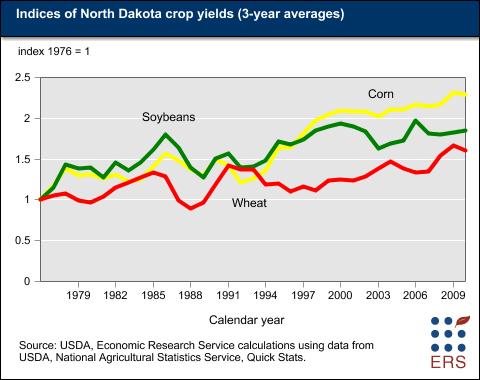
In the meantime, in the real world, farmers are not idiots, so they grow the crops which grow best in their local climate. In the real world agricultural productivity is soaring. According to World Bank data, global crop yields have almost tripled since chilly 1960. One of the reasons is CO2 fertilization. For example:
U.S. Wheat:
https://www.ers.usda.gov/topics/crops/wheat/usda-wheat-baseline-2015-24/
Wheat, soybeans & corn in ND:
Here’s a recent article:
http://brownfieldagnews.com/news/2016-u-s-corn-soybean-crops-biggest-ever/
Excerpt:
1 °C of warming is roughly equivalent to moving about 50 miles south, in the United States, or about 500 feet lower in elevation. If you think that could be a problem, then ask yourself this: are the farms 50 miles south of me less productive than the farms at my latitude? And are the farms 50 miles north of me more productive than the farms at my latitude?
The chronic shortage of CO2 is the primary factor limiting plant growth on planet Earth. It is possible to contrive growing conditions in which something other than CO2 limits plant growth and health, or in which a shortage of some soil nutrient causes better crop yields to be accompanied by reduced levels of some micro-nutrient, but such contrived conditions are easily avoided through normal fertilization practices. Under real-world conditions, additional CO2 is dramatically beneficial for agriculture, even to CO2 levels far beyond what we can ever hope to reach in the outdoor atmosphere, and the nutrient value of crops grown with extra CO2 is not significantly different from other crops.
Well Duhh! If someone plants a cultivar of maize adapted for Minnesota in Jalisco, the yield might be terrible , and vice versa.
Indeed.
C4 plants are generally thought of as warm warm climate plants. Zoysia & Centipede grass are examples, and as everyone around here knows, they brown in the winter. Sugar cane (also technically a grass!) is another, and of course it grows only in very mild climates.
But the most important C4 plant (also technically a grass!) is corn, and look at its distribution:
Of course, it is only grown in the summer, up north.
Here in Western Canada, dry conditions have not been unusual during the last 140 years or so that grain farming has been common here. After the dry years of the 1980’s many farmers changed practise to zero till or at least minimum tillage. Tillage is one of the major factors that exacerbated the drought and crop losses of the 30’s. So we are now wetter, but also better positioned to continue to get good crops in dry years if they ever return. And they probably will.
“It’s based on their assumptions about what a +0.7°F temperature change would do to productivity in the absence of other factors,”
I think this is ridiculous. Plants are not that sensitive. If the temperature in the room you are sitting in increased, or decreased by +0.7°F, you probably wouldn’t be able to tell it. I don’t know how this small temperature change would be detrimental to crops.
Eric, your post is especially ironic given the one I’ve scheduled to go live in 10 hours. Check back for the joke.
[edit]Nevermind. It’s published now[/edit]
Yep 🙂
Reduce CO2 and see what disasters are certain, not merely theoretical.
Notice that many of these studies require that you pay to read their lies.
You’d think that these studies would be available at no charge, just as a measure of transparency to allow the largest possible audience to assess them.
How clever — keeping the detailed methodologies of the lying process behind a pay wall.
… and another thing, Without CO2 fertilization … what? … no implication that each degree rise is BECAUSE of more CO2, hence CO2 rise that ACCOMPANIES (in fact, CAUSES) the temperature rise, hence UNAVOIDABLY causes CO2 fertilization?
So, what is the study suggesting? — the possibility of temperature rise WITHOUT CO2 rise?
Okay, is THIS sort of temperature rise caused by humans too? Are we supposed to somehow fix ALL instances temperature rise, regardless of whether our CO2 causes the rise?
I don’t get it — what is the subtext of this study? If not global warming is caused by human CO2, then what? — Global warming is caused by humans, but we’re not really saying how, but it’s still up to humans to stop global warming anyway??
CO2 should be spelled BOO!
Typical marketing. If there is very little value in the product you can imply value in the price. This works very well for unwary shoppers.
They should pay us to read them and then mail out an apology.
Would it be reasonable to presume that most of the studies were funded by public money, thereby making this practice of limiting access to the study reports less tenable?
IMO , it is time to call out these kinds of “studies ” as the lies they clearly are .
Propaganda . ” Pure ” and simple…
Do they say if yields would improve if temperatures fell?
Nothing kills yield like winter kill from frost. Worse when there is less snow to insulate the wheatlings.
So called experts report global warming will be caused by anthropogenitic co2 emissions resulting in additional growth. CO2 is a fertilizer used to increase growth of plants. If warming trend is supported by nature that would open additional land for farming. No reason to expect a reduction in overall farm productivity.
Global warming alarmists have a frightening future to sell supported by invalid climate models that has made the bell ringers wealthy and society poorer.
Macpherson
In the spring farmers try to plant crops the earliest they can without the emerging plants being damaged by frost. In the fall they plant so that the crop is up and hardy prior to the first frost. If climate warms, farmers will plant earlier in the spring and later in the fall. A warmer climate would make it easier for temperate climate farmers to make two crops in a single growing season.
If you are fond of the term “green blob”, then I might suggest the term “blobaganda” to describe this particular kind of propaganda.
Climate change will cut crop yields…


http://i90.photobucket.com/albums/k247/dhm1353/RiceFAO.png
http://i90.photobucket.com/albums/k247/dhm1353/CornFAO.png
http://i90.photobucket.com/albums/k247/dhm1353/worldcereals.png
http://i90.photobucket.com/albums/k247/dhm1353/FAOSTAT.png
Climate change will cut crop yields… When this happens again:
David Middleton
Illustrations and text that even a thicko like me can understand, thank you for that.
I also read somewhere that most Cathedrals in Great Britain, and across Europe were built during the MWP. Food was plentiful so people didn’t have to spend their time grubbing around for minimal sustenance, instead they could afford time to work for money on major projects of the time.
Ya, forget minor things like the highs are not getting higher, the northern latitudes would get more temperate opening up huge tracks of land that can’t be cultivated now. More BS even if the premise was correct.
Yes, most Gothic cathedrals were indeed built during the High Middle Ages, c. AD 1130 to 1492 (for Spain; the Middle Ages ended at different times in other countries). Seville was begun during Medieval time, but not finished until the 1520s. I don’t know the last Gothic cathedral, but at least one of the latest was Segovia, built 1525-77. By that time, the style was old hat in most of the rest of Europe.
The end of the Medieval Warm Period is variously dated, but arguably lasted until 1400. The 14th century had a mixed climate, during the transition from WP to the Little Ice Age. Population crashed from the Black Death of 1347, et seq. Hard to think of a better LIA cathedral than new St. Paul’s in London, built after the Great Fire of 1666.
Sixto Vega
Thank you, I continue to learn.
De nada.
First Gothic cathedral was begun in Paris at the Basilica of St. Denis (an abbey church rather than cathedral), c. 1130 and finished c. 1144. From France, the architectural style spread to England, Germany, Eastern Europe, Italy, Portugal and Spain, where it seems to have lingered longest.
Some credit England with the key innovations, however.
The building work was started with great enthusiasm, hundreds of workmen on site but in many cases the work slowed during the late 13th – 14th centuries and the buildings were never completed to the original ambitious plans — crossing towers west front spires etc. — due to civil strife and the like, examples: Chartres, Amiens, Laon, Beauvais.
Chris Hanley
from what I can gather from Sixto Vega and some of the reading I did on the period, much of the building work might have been disrupted by climate change (moving from the MWP into the LIA when the weather was disruptive) the plague (which it seems was a recurring event as the climate worsened, [coincidence?]) and the 9th Crusade, followed by the Scottish war of independence.
Chris,
You are surely right about Beauvais, which was built in fits and starts over centuries, both due to structural and financial issues. No to mention war, famine and pestilence.
The others IMO however were all finished in the 13th century, albeit perhaps not to original plans, if such ever existed. I could of course be wrong about that. Some had design problems, too.
The 14th century has with some merit been called the worst century. It began with famine, continued with the 100 Years’ War and Black Death, then finished off with peasant revolt, proto-Protestant rebellion and usurpation.
HotScot,
The Scottish Wars for Independence (1296–1328; 1332–57) don’t seem to have interfered much with the English Gothic cathedral building program.
As you know, Scotland has no Gothic cathedral, although St. Magnus on Orkney was built in the 12th century.
It might however have been divine intervention which caused the ferocious and highly competent King Edward I to die en route to Scotland in 1307, leaving the wars in the incompetent hands of his foppish son Queen Edward II. Hence, Bannockburn, 1314. The effeminate Fast Eddie however can’t be blamed for the Great Famine of 1315.
If this global warming keeps up, we’ll be up to our armpits in food! Terrible problem!
Climate models do not regionally downscale. Therefore any crop impact esrimates are pure speculation. That statement is true for all 72 papers. I dug into corn, where there are two prominent negative impact papers. One uses a glaringly faulty statistical model to analyze US county level data. The other analyzed CIMMYT data for Kenya on test plots trying to develop drought resistant corn. Its flaw is that none of the test plots had optimum conditions, so the null hypothesis is flawed.
Did research in Kenya myself. Can’t list all the ways that research findings may be flawed or deliberately manipulated in that environment, though to be fare, I found those working on agricultural work were perhaps more rigorous than our medical research.
I recall a rangelands paper from that area ca. 1960’s that acknowledged
“the local witch doctor, who, being both potent and resident next door, added greatly to the experimental error”
The CIMMYT yeild data is probably pretty good. Norman Borlaug’s Institute. The egregious error made by Stanford’s Lobell in analyzing the data was not recognizing that all Kenyan corn is grown under suboptimal moisture conditions. The MAM (March April May)rainy season is a month shorter than the 4 month minimum for rapid maturing maize cultivars. So all Kenyan corn is drought stressed. Corn does fine in high heat IFF it has enough water. This is never true for part of the Kenyan growing season.
Total nonsense with respect to their conclusions and implied risks to agriculture. Models and limited field warming studies do not account for the expansion of arable land with warming as agricultural belts expand toward the poles, the increased water efficiency of crops with increased CO2 or the increased growth rate of plants with increased CO2 and longer growing seasons. The study also seems to ignore real world experience which suggests just the opposite conclusions. Such a report gives the distinct impression of a scary conclusion around which they tried to build a study.
Grant money in search of a preferred conclusion. Par for the course in Climate “science”.