The important thing to remember is: People will die!~ctm
First published: 2 July 2017 Full publication history
ABSTRACT
Understanding causes of polar bear (Ursus maritimus) attacks on humans is critical to ensuring both human safety and polar bear conservation. Although considerable attention has been focused on understanding black (U. americanus) and grizzly (U. arctos) bear conflicts with humans, there have been few attempts to systematically collect, analyze, and interpret available information on human-polar bear conflicts across their range. To help fill this knowledge gap, a database was developed (Polar Bear-Human Information Management System [PBHIMS]) to facilitate the range-wide collection and analysis of human-polar bear conflict data. We populated the PBHIMS with data collected throughout the polar bear range, analyzed polar bear attacks on people, and found that reported attacks have been extremely rare. From 1870–2014, we documented 73 attacks by wild polar bears, distributed among the 5 polar bear Range States (Canada, Greenland, Norway, Russia, and United States), which resulted in 20 human fatalities and 63 human injuries. We found that nutritionally stressed adult male polar bears were the most likely to pose threats to human safety. Attacks by adult females were rare, and most were attributed to defense of cubs. We judged that bears acted as a predator in most attacks, and that nearly all attacks involved ≤2 people. Increased concern for both human and bear safety is warranted in light of predictions of increased numbers of nutritionally stressed bears spending longer amounts of time on land near people because of the loss of their sea ice habitat. Improved conflict investigation is needed to collect accurate and relevant data and communicate accurate bear safety messages and mitigation strategies to the public. With better information, people can take proactive measures in polar bear habitat to ensure their safety and prevent conflicts with polar bears. This work represents an important first step towards improving our understanding of factors influencing human-polar bear conflicts. Continued collection and analysis of range-wide data on interactions and conflicts will help increase human safety and ensure the conservation of polar bears for future generations. © 2017 The Wildlife Society.
Polar bears (Ursus maritimus) have evolved to exploit the biologically productive Arctic sea ice niche by using it as a platform to prey upon marine mammals (Amstrup 2003). Before European exploration, this habitat specialization likely kept them separated from most people, and thus helped reduce human-bear conflicts. However, the extent of human-polar bear interactions began to change in the sixteenth century with the advent of widespread maritime exploration. Historical records provide some insight into the nexus between human and bear behavior and help inform current efforts to reduce human-polar bear conflict.
Although the Arctic has been inhabited by Indigenous people in relatively low numbers for thousands of years, the first recorded polar bear attack we found dates to 1595 when 2 members of William Barent’s second expedition were reportedly killed and eaten by a polar bear in the Russian Arctic (de Veer 1876). The incident occurred on 6 September on an islet near Vaygach Island. Two men were lying in a wind-free depression resting, when:
“a great leane white beare came sodainly stealing out, and caught one of them fast by the necke, the beare at the first faling vpon the man, bit his head in sunder.” The ship’s crew rallied, and tried to drive the bear off of the victim: “hauing charged their peeces and bent their pikes, set vpon her, that still was deuouring the man, but perceiuiug them to come towards her, fiercely and cruelly ran at them, and gat another of them out from the companie, which she tare in peeces, wherewith all the rest ran away (de Veer 1876:63).”
Eventually the crew was able to again rally, and finally killed the bear as it continued to devour its victims. The vivid account provided by de Veer demonstrates the potential danger of polar bears, and is consistent in many respects with what we have learned from more recent attacks.
Continued European expansion into the Arctic led to increased conflict with, and exploitation of, polar bears (Conway et al. 1904). For example, a commercial expedition to Svalbard in 1610 reported killing 27 polar bears and catching 5 cubs (Lønø 1970). Commercial polar bear hunting continued through the centuries. In the early decades of the twentieth century, hundreds of bears were harvested on Svalbard annually. In 1924 alone, at least 901 polar bears were harvested on Svalbard (Lønø 1970). The widespread use of fossil fuels further accelerated human access to remote areas of the Arctic, resulting in significant hunting pressure on polar bears throughout their range after World War II. As a result, by the 1960s, the most significant threat facing polar bears was over-hunting, and populations in some areas were considered to be substantially reduced (Larsen 1975).
To address these and other conservation concerns, in 1973 the 5 polar bear countries (Canada, Denmark [on behalf of Greenland], Norway, the former Soviet Union, and the United States) signed the Agreement on the Conservation of Polar Bears (1973 Agreement). The 1973 Agreement requires the 5 signatory countries (the Range States) to restrict the taking of polar bears and manage polar bear subpopulations in accordance with sound conservation practices based on the best available scientific data (DeMaster and Stirling 1981, Prestrud and Sterling 1994, Larsen and Stirling 2009). It also allows harvest by local people using traditional methods in the exercise of their traditional rights and in accordance with the laws of that Party (1973 Agreement). Subsequent to 1973, measures implemented by the Range States, such as increased research and monitoring, cooperative harvest management programs, and establishment of protected areas, were presumed to have either stabilized, or led to the recovery of, subpopulations that had experienced excessive unregulated harvest (Amstrup et al. 1986, Prestrud and Sterling 1994). Today, polar bears are legally harvested by Indigenous peoples in Alaska, Canada, and Greenland, and harvest levels in most subpopulations are well managed and occur at a rate that does not have a negative effect on population viability (Obbard et al. 2010, Regehr et al. 2015).
However, polar bears now face a new and unprecedented threat due to the effects of climate change on their sea ice habitat (Stirling and Derocher 1993, 2012; Derocher et al. 2004; U.S. Fish and Wildlife Service 2008; Atwood et al. 2016a). Although the current status of polar bear subpopulations is variable, all polar bears depend on sea ice for fundamental aspects of their life history (Amstrup et al. 2008), including access to their primary prey, ice seals (Stirling 1974). Arctic sea ice extent and thickness have declined over the last 4 decades (Stroeve et al. 2014, Stern and Laidre 2016), leading some to conclude that the Arctic Ocean in summer may be largely ice free (i.e., <1,000,000 km2) as early as 2020 (Overland and Wang 2013).
In some parts of the polar bear range, diminishing summer sea ice has resulted in the increased use of terrestrial habitat by polar bears (Stirling et al. 1999, Schliebe et al. 2008, Gleason and Rode 2009, Cherry et al. 2013, Rode et al. 2015b). Longer ice-free periods (Stern and Laidre 2016) shorten polar bear hunting opportunities during the critical hyperphagic period of late spring and early summer (Ramsay and Stirling 1988), when hunting conditions are most favorable (Stirling and Øritsland 1995), and extend the duration of the on-land period through which polar bears must survive on finite stores of body fat (Cherry et al. 2013). The resultant increased fasting has significant negative effects on polar bear body condition (Stirling et al. 1999, Rode et al. 2010a) and the increasing ice-free period has been linked to declines in survival (Stirling and Derocher 1993; Stirling et al. 1999; Regehr et al. 2010, 2007; Bromaghin et al. 2015). Longer periods of fasting and increased nutritional stress (Cherry et al. 2009; Molnár et al. 2010, 2014; Rode et al. 2010a; Regehr et al. 2010) have also been attributed to incidents of infanticide, cannibalism, and starvation in some polar bear subpopulations (Lunn and Stenhouse 1985, Derocher and Wiig 1999, Amstrup et al. 2006, Stirling et al. 2008a), although Taylor et al. (1985) suggested that cannibalism is not an uncommon phenomenon in polar bear biology. When on shore, some nutritionally stressed bears are highly motivated to obtain food however they can, and appear more willing to risk interacting with humans as a result (e.g., Stirling and Derocher 1993, Derocher et al. 2004, Stirling and Parkinson 2006, Towns et al. 2009). Increased frequency of hungry bears on land due to retreating sea ice, coupled with expanding human activity in the polar bear range, is expected to result in a greater risk of human-polar bear interaction and conflict (Stirling and Derocher 1993, Derocher et al. 2004, Stirling and Parkinson 2006).
To date, polar bear attacks on humans have been rare. When they do occur, they evoke negative public reaction, often to the detriment of polar bear conservation. In some communities, those negative reactions can persist for decades and result in less social tolerance for polar bears and increased defense kills (Löe and Röskaft 2004, Voorhees et al. 2014). Recurrent conflicts not only undermine the well-being of people and wildlife (Madhusudan 2003), they also negatively affect local support for conservation (Naughton-Treves et al. 2003). Therefore, the effective management of human-bear conflict is an essential precondition for the coexistence of bears and people across the Arctic (Madden 2004).
A primary management goal of the Range States is to ensure the safe coexistence of polar bears and people. In 2009, the Range States recognized the need to develop comprehensive strategies to minimize human-bear conflicts resulting from expanding human activities in the Arctic and a continued increase of nutritionally stressed bears on land due to reductions in sea ice (Directorate for Nature Management 2009). However, one of the difficulties in understanding and managing human-polar bear conflicts is that they are often poorly documented, particularly at the circumpolar level (Vongraven et al. 2012). Although considerable attention has been focused on understanding black (U. americanus) and grizzly (U. arctos) bear-human conflicts (Herrero 2002), there have been few attempts to systematically collect, analyze, and interpret available information on human-polar bear conflicts across their range (but see Fleck and Herrero 1988, Stenhouse et al. 1988, Gjertz and Scheie 1998, Dyck 2006, Towns et al. 2009). As a result, the public is left with misconceptions and misinformation regarding polar bears and their behavior, most of it driven by sensational media coverage. For example, it is commonly asserted that polar bears are the most aggressive of bears and polar bears are the only large predator that will actively hunt people (e.g., The Daily Mail 2008). An important factor that fuels such common folklore is that only a small fraction of the interactions between polar bears and people are reported; the exceptions are attacks that lead to human injuries or death.
To address these knowledge gaps and public misperceptions, the Range States tasked the United States and Norway with leading an effort, in collaboration with other polar bear experts and managers, to develop a system to collect and analyze data on human-polar bear conflicts (Directorate for Nature Management 2009). The result was the Polar Bear-Human Information Management System (PBHIMS), a database designed to document, quantify, and help evaluate human-bear interactions and other information relevant to bear management. We analyzed data entered into PBHIMS to characterize the occurrence of polar bear attacks on humans. We used this information to suggest methods to minimize the risk of future polar bear attacks to promote both human safety and polar bear conservation. We also identified data needed to best inform future management of conflicts. Although the PBHIMS includes other types of data that can be used to mitigate conflicts, we initially focused on attacks because they are the most extreme and undesirable encounters between humans and polar bears.
HT/Cam_S and Neo
There have been two deadly attacks by wild polar bears in N. America. Both were in Churchill, Manitoba in November and because of a late freeze up.
https://news.google.com/newspapers?id=tMcyAAAAIBAJ&sjid=0-wFAAAAIBAJ&pg=3690,17103
Strangely, the ice extent for1968 was greater than any November in the last 20 years.
https://nsidc.org/cryosphere/sotc/sea_ice.html
Ice coverage at the end of October was the highest in 1983 since 1981
It might make sense that a late freeze up means hungrier polar bears coming through town but there seems to be a distinct lack of evidence for it.
Seem to have missed one in 1975 in January in MacKenzie Delta BC Canada. Plenty of ice at the time (which is actually bad for seal hunting) and the bear was tranquilized three times and removed from the area before the attack.
And a little more searching and it appears 6 since 1965 in the Canadian Arctic. Interestingly, 3 people have died since then studying the bears, two scientists and their pilot.
Wife and I used to visit family in Alaska when it warmed up. Anchorage Daily News at the time ran a small front page box score on the number of grizzly attacks in the state for the year. May still (don’t know). Now bears–grizzly and black–seem to be rummaging Anchorage.
From the Alaska Dispatch:
‘Really odd’: 2 fatal maulings in 2 days by Alaska black bears
https://www.adn.com/alaska-news/2017/06/19/really-odd-two-fatal-maulings-in-two-days-blamed-on-alaskan-black-bears/
https://www.adn.com/alaska-news/2017/06/20/bear-attacks-are-still-rare-in-anchorage-but-the-dynamics-of-sundays-fatal-mauling-stand-out-from-history///www.youtube.com/watch?v=2EqdA5FFpqM
Other pieces:
July 5 — Black bears attracted by trash shot and killed in Anchorage area. In a separate incident, a black bear lured by food and garbage climbed onto a tent in Anchorage’s Centennial Park, police said.
June 30 — Man reportedly walks away unscathed after black bear attack along Juneau trail. The bear eventually left the area, and a Fish and Game official credits the man’s fighting back for the outcome.
June 29 — “Mom, Dad, there’s a bear in my room!”: A broken window, a dark figure beside the bed “My first reaction was, ‘You must be having a bad dream,’ ” said Zach Landis’ mother. The Anchorage 11-year-old whose room the black bear smashed into was unharmed.
If you do a search, you will find that tourists in Svalbard regularly get attacked by polar bears.
When I lived in Olso around 1991, a group of Italian tourists on Svalbard were standing on an ice flow, I polar bear was on a neighbouring ice floe. The tourists were busy chatting and filming the bear. The bear jumped in the water and swam to their floe, clambered up and devoured one of the tourists in front of the others.
People are so naive it is beyond my comprehension. These bears are strictly non-vegetarian.
Non-vegetarian and mean! I guess sharks don’t even mess with them.
What were they doing in Polar Bear country without a rifle? This is actually illegal in Svalbard. Today the survivors would have been heavily fined for it.
By the way Polar Bears are not strictly non vegetarian. Some polar bears eat considerable quantities of cloud-berries in summer.
Polar bears are going to eat us all!
We’re doomed.
And they are only the ones that don’t fall out of the sky onto us.
Actually there is no need for this type of “research”. It is actually quite simple. If a Polar Bear is not hungry he is harmless. In contrast to grizzlies they are non-aggressive and non-territorial. If a Polar Bear is hungry he is quite dangerous since humans are just food.
PS One more thing never get between a female Polar Bear and her cubs.
Well, recent years have seen the formation of ice on Hudson Bay moving to later in the year, leaving the local bear population stuck on shore without the food resource they need for longer periods…
Also bear populations along the Beaufort Sea have been sticking on land scavenging from Inuit Bowhead whale kills, rather than moving out onto the ice, as the sea ice has rapidly retreated far offshore.
Scope for human/bear conflict in both areas, I’d say.
And how did the Polar Bear population on St Matthew island survive back in the 1870’s in an area which is ice-free about 5-6 months a year?
http://www.gi.alaska.edu/Alaska-Science-Forum/missing-polar-bears-st-matthew-island
By the way the ice in the Beaufort Sea hasn’t retreated offshore yet. And the ice in Hudson Bay hasn’t melted yet either:
http://www.ec.gc.ca/Glaces-Ice/default.asp?lang=En&n=542306E5-1
As usual Griff is talking out of his azz and doesn’t know what he is talking about. “Granted, the population numbers have been startling. Research from 1984 to 2004 showed that the western Hudson Bay population, which includes the Churchill bears, had declined from 1,194 to 935. The trend lines from that study suggested that by 2011, the population would fall to as low as 676.
Fast-forward to today and a new study, which reveals that the current polar bear population of western Hudson Bay is 1,013 animals. Wait … what? More bears than there were 10 years ago? Nearly double the prediction? “Polar bears are one of the biggest conservation success stories in the world,” says Drikus Gissing, wildlife director for the Government of Nunavut. “There are more bears here now than there were in the recent past.”
From Canadian Geographic.
Or any other kind of female bear and it’s cubs!!
So the observation that more people are being killed by polar bears than before because of Co2 goes hand in hand that more people are being killed by Co2 asphyxiation since the advent of fossil fuelled engines .
Causation and Correlation.
Is Greenland is cooler?
http://nsidc.org/greenland-today/
…. polar bear kills a schoolboy, then the group leader kills the bear.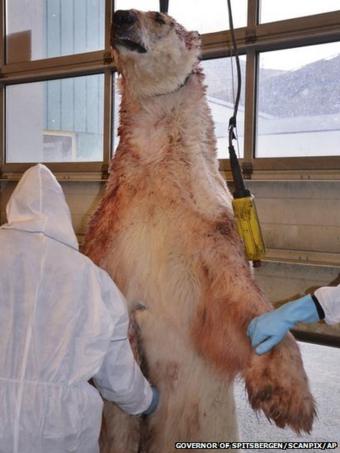
It was not either bear’s or schoolboy’s but the group leader’s fault.
Horatio Chapple, 17, from Salisbury, died while on an adventure holiday to Svalbard with the British Schools Exploring Society in August 2011.
The Eton schoolboy was was killed by the bear as he emerged from his tent.
http://www.bbc.co.uk/news/uk-england-28376733
According to the BBC article it was an accidental issue with the trip wire system. Further the article reveal no blame to the leader, quite the opposite. But it is surely a sad story anyway.
For a bunch of school kids trip wires are cheep solution and a lousy protection, pair of good dogs with an armed guard on the watch at 24/7.
http://i.dailymail.co.uk/i/pix/2014/11/20/235313A100000578-2842348-The_dog_whose_job_it_is_to_pull_sleds_through_the_snow_in_Church-97_1416486209063.jpg
By Norwegian law every party outside Longyearbyen city limits is required to be armed.This particular party had a german WW II Mauser 98K (Yes, the model year is 1898) with old ammunition that misfired repeatedly.
When my sister-in-law got her first teaching job in the north she has to carry a 303 every time she ventured out of doors. The reason? Bears. No take-um-chance. They don’t like loud noises – just scare them away.
“To date, polar bear attacks on humans have been rare. When they do occur, they evoke negative public reaction, …”
That’s what I like, groundbreaking scientific research.
I can see BS articles being written now, NYTs or Guardian, on how AGW causes angered disenfranchised polar bears to attack humans as retribution for being victims of Climate Change.
(When any real explanation for an attack would be the large increase in polar bear population and greenies stuck in ice on Arctic trips taking photographs.)
http://www.theblaze.com/wp-content/uploads/2014/03/climate-change_3.jpg
This year, the amount of ice in Greenland will increase significantly.
http://www.dmi.dk/uploads/tx_dmidatastore/webservice/b/m/s/d/e/accumulatedsmb.png
Reply
I haven’t had time to read the paper in depth, but just skimming it raises red flags about bias and idle (and somewhat thoughtless) speculation. Of course there are few records of people being killed by polar bears. One only has to look at the human population density of their range and the difficulty of finding missing hunters in such terrain before the age of satellite phones to find the obvious reason.
The polar bear (whom some biologists now consider a recent variant of the brown bear) is almost completely carnivorous. Native tradition suggests that polar bears have always hunted people as part of their normal behavior. And so far, being hunted by humans doesn’t seem to have deterred them a bit.
The article frequently cites the work of Steven Herrero, who has distinguished himself by maintaining that brown bears are not dangerous to humans in the field if only people take a few simple precautions (travel in groups of four or more, make noise). He knows better, having been attacked in the company of four Park Wardens in Waterton National Park in September of 1983, and yet has implanted this dangerous dogma into the advice given by Waterton guides, and probably other guides in the Rocky Mountain Parks.
I certainly don’t want to see Polar Bears exterminated. But neither do I want people to be deprived of adequate protection against them. And I see no evidence in this report that improving the bears’ climactic conditions will in any way curb their interest in human flesh.
Having read through the report now, my first impression is well confirmed. It consists of a collection of arbitrary and largely useless pseudo-statistics that serve mostly to confuse the reader. For example, the following list of victim behaviours is said to have “contributed” to the attacks in “30 of 51 attacks”:
“…was unarmed, carried inadequate firearms, or was inexperienced with the firearms carried…”
How this contributed to the attacks is not clarified. Presumably, the bears are thought to have sensed whether the person was armed, and whether the arms and the victim’s mastery of them were adequate…
Data that would help the reader make sense of this, such as the type of firearms carried, their caliber and case capacity, whether sidearms or long guns, or both, or even how the “researchers” established the adequacy of the firearms and the skill of their owner, are not given.
In short, this report is a sad reflection on what passes for wildlife management science these days. And this sort of pseudo-science was in the making long before “climate change” became the rallying cry of environmental science.
No Brown Bears in Waterton NP, only Black Bears (which are almost harmless) and Grizzlies, which emphatically are not.
Brown Bears are almost harmless. In Sweden for example four people have been killed by bears in the last 200 years. Three of those were hunters who had previously shot and wounded the bear. Both moose and wasps kill more people.
@ur momisugly tty
You’re badly misinformed. Grizzlies ARE Brown Bears . There is only one recognized species that encompasses all the brown bears in the world. It’s Ursus Arctos. And, as I said above, there is some evidence that polar bears are just another recent regional variant of the species, and are still capable of interbreeding with brown bears.
As for their dangerousness,
Read the book, The Bear’s Embrace
https://www.amazon.com/Bears-Embrace-True-Story-Survival/dp/0375421319
This has a detailed account of the 1983 Waterton grizzly mauling which Steven Herrero investigated (inadequately armed, BTW – there was reportedly one scoped rifle among the four Park Wardens he accompanied, and the rifleman got one lucky shot off at fifty feet). The grizzly was a young 200 lb female with a sheep kill near the hiking trail, and charged the group from close cover.
The author’s brother was Superintendent of Banff National Park (as of 2015). And despite his sister’s faultless tragic encounter (only Park Wardens are allowed to carry firearms for protection in Canada’s national parks) he has always been a staunch defender of the Parks Canada/Steven Herrero party line – that grizzlies are not dangerous…
She lost an eye and half her face, endured more than a dozen operations, and was left with a shattered life and body.
There have been several more horrific grizzly maulings in the Canadian Rockies since then, including two hunters stalked, killed, and partially eaten while field dressing an elk in the Palliser region of British Columbia, and an experienced hiker whose face was ripped off by a grizzly in the West Castle drainage of Alberta. These three victims were possibly also “inadequately armed”, since Canadian police administrative policy (despite the law) denies both hunters (including bow and crossbow hunters!) and hikers the right to carry protective sidearms.
Imagine being attacked by a grizzly at dusk while field dressing a large animal, with a scoped rifle as your only weapon, or in your hiking tent at night, with the same rifle at your side. I can’t imagine what sort of training you would need to “adequately” master these situations…
As for black bears being “almost harmless” – there have been far more recorded attacks by black bears over the past century and more fatal ones. A 27 year old mountain biker was killed and partly eaten on the slopes of Panorama Ski Resort West of Invermere, B.C. a few years ago. And there have been several black bear maulings of joggers within the Banff townsite over the past decade , none associated with cubs, BTW. But I guess this could be counted in the “contribution by running away” category, since the bear obviously can’t be expected to know that the humans are not fleeing it.
“Species” is a rather loose term, with fuzzy boundaries. Grizzly and Polar bears are mostly separate breeding populations, as are wolves and coyotes. WUWT has had discussions on “red wolves” in the recent past, and I think getting too arbitrary on definitions is a lost cause.
CharlesTM, you should include an excerpt from Susan Crockford’s report on this paper. She states what is wrong with this article and the harm it can do.
https://polarbearscience.com/2017/07/12/polar-bear-attacks-are-extremely-rare-says-new-study-but-the-data-is-incomplete/
“Increased concern for both human and bear safety is warranted in light of predictions of increased numbers of nutritionally stressed bears spending longer amounts of time on land near people because of the loss of their sea ice habitat.”
——————————————————————————–
Logic would suggest that increased concern would be due to increasing encounters between humans and bears due to the fact that bear populations quintupled over the past 60 years.
Polar bears are the only true predators of the bruin clan. They will quite readily hunt humans, even having never seen them before. Kind of a result of living in regions dominated by polar ice where any bit of protein is fair game. Polar bears are among the last large carnivores you’d want to encounter in the wild.
It’s always been the case. Nothing to do with Climate Change.
@ur momisugly Tom Halla
July 17, 2017 at 11:25 am said
‘“Species” is a rather loose term’.
Not really. It’s a valuable term that’s been loosely/carelessly used by many, unfortunately.
But the generally accepted meaning puts all animals capable of producing fertile offspring together in the same species. And nowadays that’s fairly easy to test.
What’s fuzzy about that?
What’s fuzzy is our accepted list of species, and biologists’ sense of priority.
With coyotes and wolves, they are different species by some criteria, but clearly interfertile when they do breed. The reproductive isolation, as far as I know, is that wolves do not tolerate coyotes when the wolves are sufficiently abundant to control a territory. Where wolves are fairly scarce, one ends up with “red wolves” coyote/wolf crosses. It is not a hard line.
Tom Halla
July 17, 2017 at 3:42 pm said
“With coyotes and wolves, they are different species by some criteria, but clearly interfertile when they do breed”
see:
http://www.karmatics.com/docs/evolution-species-confusion.html
“interfertile: two animals are interfertile if they would be able to produce an offspring, if they were allowed to mate or were artificially inseminated. If they are both the same sex, they are interfertile if each could produce an offspring with the appropriate sex parent of the other.”
By this definition, donkeys and domestic horses are “interfertile”, so are lions and tigers.
the page’s author goes on to say:
“…Also, you’ll notice the definition I provided does not have the qualification that the offspring be fertile”.
a sidebare adds:
“Taxonomic distinctions between species can be arbitrary.
The gray wolf, coyote, red wolf, and domestic dog can all freely interbreed with one another, will produce fertile offspring…The coyote is rather arbitrarily considered a separate species from the gray wolf…
The domestic dog lost its recognition as a separate species in 1993, and is now considered a subspecies of gray wolf.”
So there you have it, there is a meaningful definition of “species”, and an arbitrary, confusing one, based on historical usage. Since the historical usage is widely varied by region and language, the potential confusion is vast.
Coyotes and wolves are not separate species by any criteria, unless it were that they don’t normally interbreed. But if we accept that as a scientific indication of “species”, then many human populations would have to be reclassified as separate species.