Monster minimum or short solar cycle?
Guest essay by David Archibald
This recent post was on the fact that the Sun’s EUV emissions had fallen to solar minimum-like levels well ahead of solar minimum. The implication was that the Solar Cycle 24/25 minimum was either going to be very deep and prolonged, or that Solar Cycle 24 would be very short, which in turn would be strange for a weak cycle.
The indicator of the EUV flux is the Lyman alpha index. To recap, this chart shows the index over the last three cycles, starting from solar minimum:

Figure 1: Lyman alpha index Solar Cycles 22,23,24
Figure 1 shows that Solar Cycle 24 has reached solar minimum-like levels three years ahead of minimum, if Solar Cycle was going to be 12 years long. What happens at solar minimum is that the proportion of EUV as part of Total Solar Irradiance falls. For the 23/24 minimum, the extent of the fall was a surprise, with the density of the thermosphere shrinking 30%. The following figure plots up the ratio of the F10.7 flux, less its activity floor at 64, and the Lyman alpha index, less a presumed average floor of activity of 3.5:

Figure 2: F10.7 Flux/Lyman alpha ratio 1980 – 2017
The peak associated with the 23/24 minimum that surprised atmospheric researchers is quite evident. Also evident is a smaller peak associated with the 22/23 minimum. Nothing much seemed to happen prior to that. How that plots up with the F10.7 flux, and thus the solar cycles, is shown in the following figure:

Figure 3: F10.7 Flux/Lyman alpha ratio 1980 – 2017
As Figure 1 showed, the departure of the Lyman alpha index to minimum-like levels seemed early. But just how early is it if everything else is normal? That is shown in the following graphic:

Figure 4: F10.7 Flux/Lyman alpha ratio aligned on solar maximum
Figure 4 aligns the F10.7 Flux./Lyman alpha ratio on solar maximum for solar cycles 21 to 24 to two years beyond solar minimum, with the maxima being:
- Solar Cycle 21 December 1979
- Solar Cycle 22 November 1989
- Solar Cycle 23 November 2001
- Solar Cycle 24 April 2014
Based on the normal cycle tail from solar maximum, Solar Cycle 24 might have another three and a half years to go. So what is going to be: a monstrous minimum with a shrunken thermosphere and all the climatic effects associated with that, or a strangely short cycle?
We know when a solar cycle is over when the heliospheric current sheet flattens. The current state of the heliospheric current sheet is shown in the following figure:

Figure 5: Heliospheric Current Sheet Tilt Angle 1976 – 2017
The heliospheric current sheet tilt angle is 10° off the apparent floor of 3° but, based on the prior solar cycles, could still take a few years to get there. If Solar Cycle 24 does turn out to be short, then there is one person who predicted that: Ed Fix. Ed Fix, a retired B52 pilot in Ohio, sent me his planet-based solar model in 2009. He was inspired to created the model because the oscillation of the solar cycle reminded him of the ideal spring in mechanics. This is how the model plots up (red) and the historic sunspot record in green:

Figure 6: Ed Fix’s solar activity model
The model has the Solar Cycle 24/25 minimum in 2017. Solar Cycle 25 is predicted to be weak and short also. If events of the next year or so prove Ed Fix’s model to be correct, then it will be as significant as the results of any of the expeditions to observe solar phenomena over the last three centuries, but we get to watch in real time.
David Archibald is the author of American Gripen: The Solution to the F-35 Nightmare
Meton was right. Herschel was right.
Only today’s educated idiots would imagine that CO2 and not the sun, with its activity modulated by earth’s orbital and rotational mechanics, is the control knob on climate.
I’m fairly sure earth doesn’t have a significant effect on the sun. If anything planet was to effect the sun it would be Jupiter (with it’s enormous size) or Venus (with its close proximity).
I’m guessing that the comment indended to say the received insolation was modulated ….. , not the sun’s output.
Earth’s orbital mechanics and rotation do indeed have a great effect, such as in causing ice ages.
It’s interesting that the sunspot cycle seems to be about the same as the orbital period of Jupiter. Perhaps when Jupiter and Saturn are on the same side of the Sun, tidal forces acting on the fusion core are at a maximum and when they align on opposite sides it’s at minimum. Not exactly sure which would generate more Sunspots, but my guess is that when the core is tidally stretched it would lead to more sunspot activity owing to non uniform fusion reaction rates, while with tidal effects minimized, the reaction rate is more uniform throughout the core.
This effect would also be modulated by the variability in the orbits, both of which are quite elliptical. For example, the largest tidal effect would be when Jupiter and Saturn align on the same side and both are at perihelion and the smallest when both are at aphelion and on opposite sides. The question becomes how long before an effect acting on the fusion core finds its way to the surface? Would the space between the fusion core and the photosphere be alternating layers of symmetric and anti-symmetric plasma propagating from the core to the surface?
You are on the right track. William Arnold also saw the link with Jupiter, Uranus and Saturn. The smaller planets also weigh in …
Occam’s razor
co2isnotevil July 11, 2017 at 2:45 pm
” The question becomes how long before an effect acting on the fusion core finds its way to the surface?”
I believe that Leif has stated that to be a couple of hundred thousand years.
All the planets have some effect on the Sun. Some more, some less.
CO2 Cools
Given that increases in CO2 lags global warming, and high CO2 concentrations precedes ice ages. Is it that once CO2 passes a certain level, the cooling attributed to CO2 drives the lowering of global temperatures? And, because CO2 hangs around a long time, it takes longer than the warm up for levels to drop enough for warming to begin the cycle again.
The ice age records support this. Warming starts when CO2 levels are low, and cooling begins when CO2 levels are high. The opposite of what the GHG theory predicts.
If I remember my 4-H club Atomic Spectra Physics, the Lyman alpha line is the lowest energy in the Lyman Series of the Bohr atom model, so the Lyman series are all in the UV.
The discovery of the simple (mathematical) series of frequencies of the hydrogen atomic spectrum lines seen in the solar spectrum, is one of the neatest discoveries of modern Physics.
That’s just my humble opinion of course so don’t go quoting me in your PhD thesis or you will be rejected by the bunch of judges or whatever goes for a selection process in your club.
G
PS And I could be all wrong about the above.
Hard to tell what this will do to climate. It seems reasonable that solar variation would affect climate, but the actual instrumental measurements do not seem to have much correlation, at least over the last few solar cycles.
Climatic phenomena correlate strongly with solar cycles and with their longer-term supercycles. And of course with Milankovitch cycles, ie the effect of earth’s movements on insolation.
Link, please.
I could provide 200 years worth of links. Name a climatic phenomenon, it is correlated with solar activity. I’ve posted many here over the years. Here is just a sampling of recent papers:
Indian summer monsoon
http://www.sciencedirect.com/science/article/pii/S1364682614001370
ISM rainfall
https://www.cfa.harvard.edu/~wsoon/Hiremath2012-d/HiremathMandi04.pdf
Brazilian rainfall
http://www.geofisica.unam.mx/unid_apoyo/editorial/publicaciones/investigacion/geofisica_internacional/anteriores/2004/02/Almeida.pdf
ENSO
https://www.sciencedaily.com/releases/2009/07/090716113358.htm
Rainfall and trade winds
https://www2.ucar.edu/atmosnews/news/810/solar-cycle-linked-global-climate-drives-events-similar-el-ni-o-la-ni
My initial reply contained too many links, so is in moderation. Maybe these to the East Asian monsoon will be few enough to pass prompt muster:
Robust Response of the East Asian Monsoon Rainband to Solar Variability
http://journals.ametsoc.org/doi/full/10.1175/JCLI-D-13-00482.1
https://www.researchgate.net/publication/256146174_Solar_Cycle_Signature_in_Decadal_Variability_of_Monsoon_Precipitation_in_China
It’s ludicrous to imagine that the solar cycle and solar activity in general have no effect on terrestrial weather and climate.
SST and air pressure:
Relationships between solar activity and variations in SST and atmospheric circulation in the stratosphere and troposphere
http://www.sciencedirect.com/science/article/pii/S104061821501143X
The influence of solar activity on action centres of atmospheric
circulation in North Atlantic
http://www.ann-geophys.net/33/207/2015/angeo-33-207-2015.pdf
“Link please”
Is this a trick question? Umm..night and day.
Gabro, thank you for the links provided. I looked only at two articles; sorry, the don’t look good. The NCAR news release finds “that, as the Sun’s output reaches a peak, the small amount of extra sunshine over several years causes a slight increase in local atmospheric heating.” They find it in models. The Hiremath article analyzes Indian monsoon rainfall data, totally unconvincingly to me. There is a strong evidence for so-called 11 year solar cycle. If there is a correlation with a climatic phenomenon, I would expect to find the same cycle in that phenomenon. Show me. I see plenty of words and graphs, but nothing relevant.
CG,
Just what evidence would you find convincing? I’m guessing none, since it’s clear you’re a True Believer for whom scientific evidence doesn’t matter, only blind faith in your cult.
Solar activity, cosmic rays, and Earth’s temperature: A millennium-scale comparison
http://onlinelibrary.wiley.com/doi/10.1029/2004JA010946/pdf
An evidence of a 11- or 21-year periodicity in a climate phenomenon would be convincing.
CG,
Climate requires a minimum of 30 years, so what would be required with respect to the solar cycle is evidence of a climatic effect from the long-term variations in the ~11-year solar cycles.
And there is ample evidence of this, for the Gleissberg and other cycles.
THE SOLAR WOLF-GLEISSBERG CYCLE AND ITS INFLUENCE ON THE EARTH
Shahinaz M. Yousef
http://www.virtualacademia.com/pdf/cli267_293.pdf
Dr. Easterbrook, who comments here often, could enlighten you as the even longer-term, periodic solar cycle fluctuations.
https://wattsupwiththat.com/2011/06/17/easterbrook-on-the-potential-demise-of-sunspots/
http://www.drroyspencer.com/wp-content/uploads/TSI-est-of-climate-sensitivity2.gif
Curious, this is from one of dr roy’s posts: detrended, smoothed three years to round out enso, with early 90s pinatubo cooling removed. Graphs like this one should be all over the web. (one wonders why they are not)…
Graphs like this one should be all over the web. (one wonders why they are not)…
Because it is well-known that the solar cycle variation of the temperature is of the order of 0.1K. Just like it is not necessary to remind people all the time that the Earth is round.
No, it is not well known. People are constantly saying that the 11 year cycle is not represented in the temperature data. If more (and better) graphs than this one were available, then the misinformation would be stopped in its tracks. As it is, folks keep going over the same old ground. i feel very fortunate to have stumbled across this one. One can eyeball graphs like the one weber has and see it, but it’s much better to have something definitive like this to put it all to rest. Besides, i’d like to see other graphs like this done. Particularly removing el ninos altogether, just to see what the numbers come to. In this graph of spencers, two of the minimums during the period in question have large el ninos. It would be nice to see how the numbers shake out without them. We can NEVER have enough data…
People are constantly saying that the 11 year cycle is not represented in the temperature data
People who don’t know what they are talking about [and there are so many of those] may say so constantly, but every atmospheric scientist worth her salt knows this. I [e.g.] have preached that for decades. It is trivially true.
Cycles in Rainfall
Rainfall data is critical for arriving at a reasonable conclusion. Different groups use different averages to present relative variations that affect the conclusions drawn from such series.
Though India receives around 78% of the annual rainfall during the southwest monsoon season [June to September], they are highly variable over different parts of the country. (late) Dr. B. Parthasarathy [a close friend of mine] compiled rainfall data sets [monthly, seasonal and annual] for 32 sub-divisions [India was divided into 32 met sub-divisions]. He sent me a copy of the published booklet containing this data in 1995. “Using this data series” I analyzed for possible cyclic nature for all-India southwest monsoon and Andhra Pradesh [comprising three met-subdivisions] which receives rainfall not only in southwest monsoon but also during northeast monsoon [October to December] and cyclonic activity in Bay of Bengal. I presented these results in my book “Andhra Pradesh Agriculture: Scenario of the last four decades” [2000].
All-India Southwest Monsoon Rainfall presented a clear cut 60-year cycle – by simply plotting 10-year averages. Here, one must keep in mind that different groups used different data series to represent all-India Southwest Monsoon rainfall series and thus averages differ. Also, as the data presents a cyclic pattern, any truncated data may present biased average based on which part (s) of the cycle the data represents.
I tried to correlate this cycle to global average temperature anomaly. Later somebody published the 60-year cycle superposed on trend [1880 to 2010] – this I presented in my 2008 book “Climate Change: Myths & Realities”.
The annual rainfall data series of Mahalapye in Botswana presented 60-year cycle with sub-multiple of 30-, 20- & 10- years [published in 1981]. Durban annual rainfall in South Africa presented 66-year cycle with sub-multiple of 22 years [published in 1984]. Eretria [in Ethiopia – now separate country] presented 22 year cycle in annual rainfall [1993 book].
In the case of Andhra Pradesh, southwest monsoon rainfall data series presented a 56-year cycle. Though northeast monsoon data series also presented 56-year cycle, but in opposite phase. The cyclonic activity in Bay of Bengal followed the northeast monsoon pattern. Catuane in Mozambique presented 54 year cycle with sub-multiple of 18 years [published in 1984].
I collected dates of onset of southwest monsoon over Kerala Coast [starting point of monsoon] and studied and this data presented 52 year cycle [published in 1977]. Fortaleza precipitation in Brazil presented 52 year cycle with sub-multiples of 26, 13 & 6.5 years [published in 1984].
All these suggest that the cycles show a systematic trend with latitude. General circulation patterns change them or overlapping of two cycle zones also present different pattern.
Astrological significance
See few inferences from my paper “Rainfall prediction for agriculture: past, present and future” – Proc. International Conference “Agricultural Heritage of Asia”, Asian Agri-History Foundation, 2004, pp:147-154:
The science of Astrology started with the understanding seasons and weather in relation to movements of extra-terrestrial bodies, known as planets. All, or most, cultures have developed a form of astrology such as Indian Astrology, Western Astrology, Chinese Astrology, Mexican Astrology, Celtic Astrology, etc. The Western Astrology is solar-based, the Chinese Astrology is lunar based, and the Indian Astrology is luni-solar based.
A lot of the ancient lore lost it s glory with industrialization, as the family tradition in astrology lost its shine. When we look into these studies in terms of weather prognostication, two important aspects emerge: the onset of rains and the total seasonal rains. The former is linked to the wind direction before the onset of rains and the later is linked to the phases of the Moon and Nakshatras (constellations) and this is integrated with the movement of other planets in terms of cycles. The recurring changes in the position of the Sun during the day – events on the Sun – the periodic waxing and waning of the Moon, the regular appearance and disappearance of the planets, all unmistakably projected a cycle of events that were gradually woven into the socio-religious fabric.
I observed a clear relationship between the onset of the monsoon over the Kerala Coast and the zonal component of wind at 50 mb level over Singapore, an equatorial station in the month of May. If the winds are westerly then the monsoon is early; if the winds are easterly, the monsoon is late.
The Chinese Astrology has a 60-year cycle, based on a combination of five elements and twelve animal signs. The current 60-year cycle began in 1984/85. In Indian Astrology [current starting year is 1987/88], the calendar system claimed to have been revealed is the same as or similar to what is called the 60-year cycle – the cycle of the Sun (6-years) and the Moon (10 years), i.e., 6 of 10 years, or the cycle of Jupiter – a cycle of five 12 years, similar to the Chinese 60-year cycle. The Indus Valley Civilization, which was before the Vedic period , used the 60-year cycle. The Aztecs noted that 5 Venus years equal to 8 Sun years. These cycles only repeated after 65 Sun and 104 Venus years, i.e., once in 520 years. The number 104 is the longest period in Mexican time keeping, and was called one “old age”. The Mexican Century was 52 years. Around this zone even the rainfall presents a cycle of this nature – Fortaleza in Brazil.
Southern Oscillation [ENSO]
1880-2006 – 126 years data of southwest monsoon rainfall: number of years
D BN N AN S Total
El Nino 7 5 5 0 1 18
Normal 14 13 37 14 6 84
La Nina 0 0 7 7 10 24
Total 21 18 49 21 17 126
D = deficit, BN = below normal, N = normal, AN = above normal and E = excess
However global solar radiation presents sunspot cycle and its multiples.
Dr. S. Jeevananda Reddy
Sure, that goes without saying, but i’d think that would be true for any number of things that the general public wouldn’t readily know. We’ve got graphs for just about EVERYTHING. Why not that?
(my comment is in response to you, dr svalgaard… dr reddy’s comment wasn’t there when i posted my comment. his must have been held up in moderation)
You can avoid this, by always [as I, most of the time anyway] citing first the words you are objecting to.
So Curious George would find an 11 or 21 year cycle convincing.
So I venture he would be ecstatic to find agreement to say eight significant digits, between observed measurement, and theoretical derivation.
But one such theoretical derivation of the value of the fine structure constant (alpha) , was pure poppycock; and simply mucking around with numbers; with NO connection to the physical universe whatsoever. Yet it agreed with the best experimental value to about 30% of the standard deviation of that experimental value.
So be very careful what you believe just because it seems to fit.
G
Yes, george, true, but at least it is there in the data (complete with the one year lag). Most folks don’t even get that far…
A very simple Black Body calculation suggests that the observed (measured) solar cycle variation in TSI could account for about 70 mK change in earth Temperature. My 4-H education suggests that’s the most it could cause.
So Dr. Leif is being generous when he says that anybody knows it’s about 0.1 deg. And I have to agree that anybody with a smattering of knowledge about thermal things would start with a table cloth BB calculation.
Leif has mentioned the magnitude many times here at WUWT, so no excuses for readers here.
And I would swear on a stack of Farmer’s Almanacs that Leif has even given the 70 mK number right here at WUWT himself, because I know that I first calculated it when I saw his post on it. I don’t check to corroborate; just to get a better understanding of why.
G
george e. smith
I think you have a somewhat simplistic idea on what is happening here on earth
hints
1) we are protected here by the sun’s most harmful radiation/ particles, by our atmosphere. Hence my advice: don’t go to Mars…before you have created an atmosphere.
2) In its turn, the ozone, peroxides and N-oxides formed by these particles from the oxygen, nitrogen and water vapor, filter out certain UV radiation reaching the oceans…
3) If the solar magnetic field strengths varies, the amount of energy going into the oceans varies.
TSI is a red herring
You have to measure via / via to see what is really happening.
3) If the solar magnetic field strengths varies, the amount of energy going into the oceans varies.
TSI is a red herring
The sun’s magnetic field does not do anything as such, but its variations cause variations of TSI and hence of the amount of energy reaching the Earth to go into the oceans.
Thanks for your reaction, but please, do tell me where and how ON and IN earth TSI is measured, exactly?
[remember I am from the school that don’t trust the sat’s]
TSI is measured very accurately by several spacecraft orbiting within a million miles from the Earth’s surface. We can easily correct for the varying distances to get what actually hits the Earth.
Good heavens. You honestly believe that what happens a million miles on top of us is a fair representation of what happens with T right on top of my own head???
Get real.
You honestly believe that what happens a million miles on top of us is a fair representation of what happens with T right on top of my own head
Indeed yes, as there is nothing to stop the energy flow to the top of the atmosphere [not your head which may need some examination…]. In fact, I believe that what happens 93 million miles away is a fair representation of the energy hitting the Earth.
I rather trust my own head, thx.
There is such a thing as ‘learning’…
I have studied and learned the daily data of 54 weather stations. 27 for each hs. For the past 40 years.
Min. Max. Mean.
How many figures are that?
Not sure now. Is it me or is it you with a learning problem?
But you don’t seem to have learned much. There is more in this world that 54 weather stations. For example, there is that big globe in the sky that gives us the heat that makes life possible. And which energy output we carefully measure and study.
It is the distribution of particles released that matters. Especially the fraction with a lot of energy which seem to get more when the solar polar fieldstrength drops. Total energy stays the same?
In my hay days they simply called TSI the solar constant.
Are you saying it is not constant anymore?
Anyway. What effect would you predict from the moving north pole?
See previous comment.
It is the distribution of particles released that matters
Not at all.
Are you saying it is not constant anymore?
So you have not even learned that it actually varies a tiny bit.
What effect would you predict from the moving north pole?
None.
Not just correlation of course, but many causation mechanisms are known as well.
Gabro,
Thanks.
Amid all the uncertainty, we will soon be told that, actually, the science is settled.
Probably by a politician with a knife to grind.
And it is not pellucid whether we will warm or cool – let alone how much.
Myself, I don’t like hot weather – the ‘hot’ (27C/81F, but humid, and I have to commute . . . . .) spell in Southern England broke today; 20C/68F, and rain, thank goodness! – but gentle overall warming is to be preferred.
Many fewer deaths from (reduced) cold versus a very few more from the (increased) heat.
Will we get it?
‘Ah, there’s the rub!’
Auto
I don’t like either hot, as now, or cold, as past winter, but that’s what I get for living in a continental climate zone, with a temperature range from -35 to 118 degrees F. But so far this summer we haven’t yet hit 100 F. Close, though.
Which is why most winters I spend in South America.
ENSO is actually measured based upon relative air pressure, compared between Darwin, Australia and Tahiti. What causes the trade winds to weaken or even reverse at the onset of an El Nino is often described as “mysterious”.
My hypothesis is that the sun is responsible not only for the build up of warm water in the tropical WestPac, but also for the strength and weakness of the trades. My testable hypothesis would be a correlation between the time integral of the solar cycle and ENS oscillations. Also specifically UV flux and its effect on ozone. A volume of air is warmed by having more O3 in it, hence affecting air pressure, thence wind speed.
the ‘hot’ (27C/81F, but humid, and I have to commute . . . . .)
==============
27C/81F is lethal without technology.
The human body generates about 150 watts internally to maintain body heat. At temperatures around 27.5C/82F and below, the naked human body begins to radiate more than 150 watts, leading to death by exposure.
That’s with or without the thumbs on the scales?
Jeanparisot, I am judging temperature trends since 1979 by UAH, which seems to vary with El Ninos, but generally flat since 1998. That covers parts of two cycles, and temperature has not been declining with the solar cycles.
So, it should be cold now, and for quite some time.
Not only that, it should have been cooling since 2014. Lo and behold – the opposite has happened according to every soruce I am able to access.
This is zombie junk form a junk peddler.
From a link in the post:
“These seemed to confirm his belief: when the sun has spots, the weather tends to be wetter and rainier.”
This is what David appears base all his climate ideas on. It’s the ‘belief’ of someone called Meton who aparently live in ancient Greece. WTF!
The whole thrust of this post and every other that I have read from this bloke is based on a massive “if”.
“If events of the next year or so prove Ed Fix’s model to be correct, then it will be as significant as the results of any of the expeditions to observe solar phenomena over the last three centuries”.
Or some variation of: if this happens then I’ll be proven right afterall.
If my autie was a man she’d be my uncle.
I guess Archibald actually belives this stuff – he has been peddling it for years and he is not alone. It’s time a few more of the sensible viewers on this site stopped letting him get away with it and not just leaving up to Leif as captain zombie-slayer.
Tony, svalgaard doesn’t even believe that the oceans are warming. OHC increasing? Nah. Sea level rise of 1.1mm/year due to thermal expansion? Nope. How can you have any faith in a guy like that?
tony – try using both spell and grammar check ‘if’ you ‘beileve’ it ‘could’ help with your credibility, or some variation of it.
I haven’t seen him nailing those positions to the mast (not saying he hasn’t), but you have to admit he is tireless in slaying what I agree with him is a TSI zombie.
Tony, problem is that if he did believe that the ocean is warming, then he would also believe in feedbacks relating to a warming ocean. As he does not, his analysis then is flawed…
afonzarelli, his analysis may have flaws but I thinks his flaying of these solarists is entirely justified. The variations in TSI are so minute, in the order of 0.001%, they are not going to show up in years or even decades. Massive gas pulses that rapidly alter atmospheric thermal properties on the other hand do – but that conflicts with the bias.
“Or some variation of: if this happens then I’ll be proven right afterall.”
Wherein Tony McPlod following years in the trackless wilderness of total unfalsifiability discovers what a testable hypothesis is. Bravo! Congratulations Tony.
Once again, McClod tries to pretend that the recent El Nino never happened so that he can attribute all of it’s warming to CO2.
Regardless, McClod also wants to pretend that there is no such thing as thermal mass.
As always, the warmists ignore physics.
So cephus0 you’re in the hokes camp? What: socialists? Chinese? Rich Gore types? Sneaky scientists?
Who’s the problem? Or is it the massive 0.001% delta TSI that’s causing the ice to halve in volume in 30 years?
Measured from the highest point in the last couple hundred years, arctic sea ice levels have dropped.
Ho hum.
Of course the loss of arctic sea ice is a massive negative feedback that results in lots of extra heat being lost to space. But who cares, we’ve got people to scare and money to rip off.
Tony,
That’s a “non-sequitur.” You are assuming climatic changes due to solar variability must be due to variations in TSI. Science is exploring other possibilities that you have chosen to ignore, like changes in stratospheric pressure, temperatures, and/or ozone content and distribution.
Building your own TSI strawmen to shoot down is also a fallacy. Your approach to solar variability effect on climate is tainted with bias.
Tony,
That graph is not real ice, but modelled ice. Real Arctic sea ice is doing this:
As this article explains:
https://wattsupwiththat.com/2016/10/07/evidence-that-multidecadal-arctic-sea-ice-has-turned-the-corner/
The past behavior of Arctic sea ice has been explained in several articles and it is linked to the AMO.
Javier
100%
Excellent cherry you picked there Javier. Note in a longer term plot of September Arctic sea ice how 2007 is a low point relative to years before and after.. Try starting in 2006 or 2005 and see how your trend line changes!!!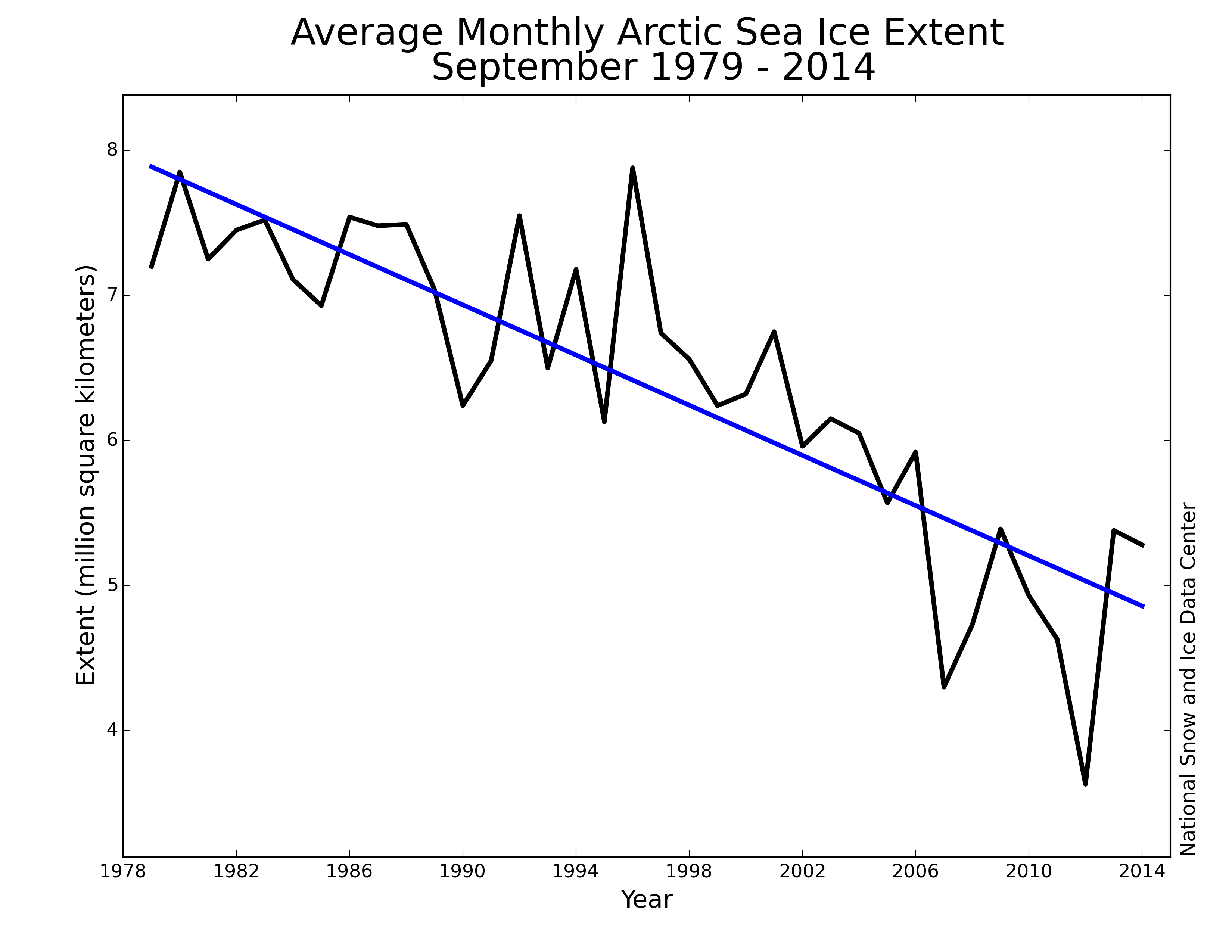
..
Michael,
Still more September Arctic sea ice than 10 years ago. Do you have an explanation for that? Because I have three scientific articles that say that it is due to AMO. And all three predict this Arctic non-melting is going to continue for quite a few more years.
Arctic alarmism is taking a serious beating.
Your graphic is misleading.
…
If you go here: http://nsidc.org/arcticseaicenews/charctic-interactive-sea-ice-graph/
…
1) Then add in 2007, you’ll note that currently we are at exactly the same level today as in 2007.
2) You have to wait two more months before you can say: “Still more September Arctic sea ice than 10 years ago.”
3) How do you explain the long term trend since 1978?
So you say, but it is clearly labelled and the source of the data indicated.
Do not move the goal posts. We were told the Arctic was to become ice-free in the summer. The minimum month is September. The extent on July 12, or May 26 is not relevant if the minimum doesn’t go down.
I am equally happy with 9 years until then.
Explaining is not a problem. I can think of several different explanations. Demonstrating is the problem.
It is clearly not CO2 since these cycles existed when CO2 was much lower.
It is likely not temperatures, as we have had record temperatures for like 4-5 years since 2007, although temperatures might contribute.
That leaves the atmosphere or the ocean. I am more inclined to the second one as the main factor, since the AMO has been implicated.
Meanwhile here you have a graph of polar temperatures this year to mull over:
http://ocean.dmi.dk/arctic/plots/meanTarchive/meanT_2017.png
For over two months temperatures have been below the 1958-2002 average North of 80º. That’s correct, 1958-2002 average.
You are funny. First you say: “Do not move the goal posts.” Then you move the goal posts by saying: “We were told the Arctic was to become….” This is not a discussion about predictions, so leave them out. The extent on July 12, or May 26 is relevant if it sets a record low, being lower than any September low. Now, you know 9 years or 10 years doesn’t make a “trend”
….
Now you are claiming the AMO as the cause of the variation in your graph? Sorry, you can’t take a 9 or 10 year slice of data to illustrate a 60-80 year cycle. A 9 or 10 year graphic doesn’t “demonstrate” anything.
….
Lastly you posted a graphic of “temperatures”…. Did you look closely at what you posted? It says “ECMWF operational model” …That’s right, you’re posting MODEL output and claiming it’s real??????
Obviously it doesn’t. Every year September has the lowest extent.
Of course it does. It is a 9-year trend.
I am not. Do you have a problem finding and reading bibliography in the link above? I’ll make it easier for you:
Miles et al., 2014
http://folk.uib.no/ngftf/CV/PDF_Furevik/miles_et_al_grl_2014.pdf
Wyatt & Curry, 2014
http://cdn.cnsnews.com/documents/Curry,%20Wyatt%20paper.pdf
Artun et al., 2017
https://www.nature.com/articles/ncomms15875
They are the ones claiming it.
Do you have an idea of what ECMWF ERA is? That’s reanalysis which means real temperature data from surface stations and satellites is being assimilated every few hours. That is what produces weather forecasts every few hours and lives depend on them. An international effort from 34 countries. Much better than those silly adjusted databases that get changes every month.
That the Arctic is colder than in previous years during the melt season is a fact. Go look it up.
A model is a model is a model is a model.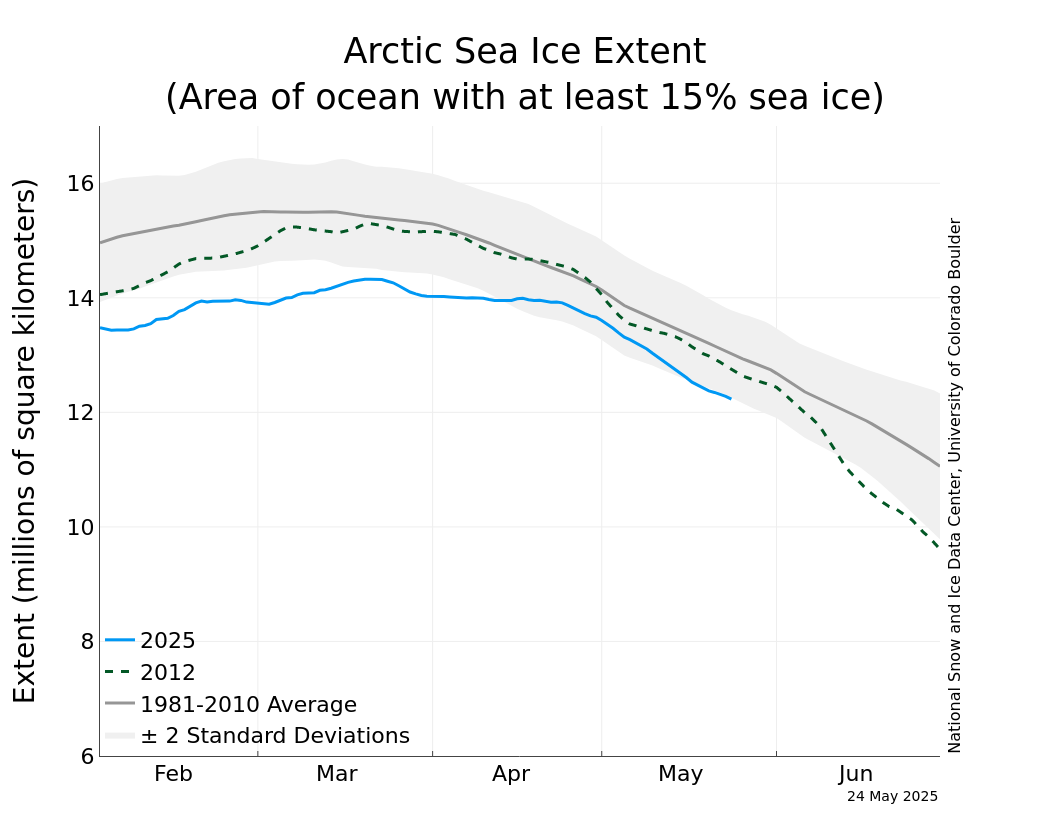
…
Sortta like this?
…
I hope you understand what 2 standard deviations mean.
..
Oh, and 9 years out of 60 is not a “trend”
PS : “That is what produces weather forecasts”
..
BINGO, models produce forecasts!!
The Arctic is still not melting after 9 years, Michael. We were told less ice means less albedo, more irradiation, higher temperatures and less ice. We were told the Arctic was in a death spiral. We just went through the warmest years ever registered. The warmest years in centuries. The years with highest CO2 levels in hundreds of thousands. The Arctic didn’t melt further.
Do you have an explanation for that, Michael? Some bibliography that can explain it? Why did the Arctic melt more rapidly when it was colder, with less CO2 and had more ice, than now that is warmer, with more CO2 and has less ice?
“The Arctic is still not melting after 9 years, Michael”……… you must be immune to data. I posted NSIDC graphic that shows a 40% decline over the course of 38 years. The long term trend says something completely different than your 9 year trend line. You do understand that long term trends are more significant that short term ones, right?
Trends change. Pauses and cooling periods happen. There was a very clear trend change in 1976 well recognized in several publications. If you have a linear understanding of climate and extrapolation is your only tool you won’t understand what is going on. Another change in trend has taken place but you are too blind to see it. Read those papers I linked. Their authors do recognize the recent change in trend.
You might need another 20 years to see the change in trend. Others can see it already and are reporting it in scientific publications. By the time you accept a change in trend has taken place a new one might be underway.
Ed Fix’s model
========
it makes a whole lot more sense to publish the model now rather than later. publishing a prediction after the fact cannot be trusted as proof of anything.
as to the prediction of the current cycle ending this year, that would certainly qualify as an “unexpected” result, which is one of the criteria for acceptance of a new theory.
Now it could be said that publishing unproven predictions is a waste of time and money, which argues strongly that the billions of dollars spent on climate models is wasted.
At least in the case of Ed Fix’s model, the jury is still out. In the case of climate models, they predicted accelerated warming. What actually happened is that the rate of warming accelerated in the opposite direction to what was predicted and we got “The Pause”.
Having failed to predict climate, climate science has responded by adjusting the historical climate records to better match the models. Even RSS appears to have gotten into the act, adjusting the satellite data to match a model.
True
tony mcleod July 12, 2017 at 7:20 am
Except Arctic sea ice won’t be gone in September. Its extent then will depend upon whether there are cyclones in August, as in other lower than usual ice years. Minimal sea ice this year should be between the 2012 low and 2009 high of the past decade, ie 2007-16.
Do you promise never to comment here again when you’re shown ludicrously wrong, yet again, as always?
See you in September, then buh-bye!
“There was a very clear trend change in 1976 well recognized in several publications.” There was? You mean they spliced the satellite data with some other kind of data? Wasn’t that what Marcott did?
…
“You might need another 20 years to see the change in trend.” But but but but…your graphic was 9-years?????
Michael,
The pre-1979 satellite data aren’t spliced. They are satellite observations, which started in the 1960s, before there was a dedicated sea ice satellite. They show that 1979 was the highest sea ice year since the 1960s and probably for the past century.
Gabro, the SMMR was not flown until 1978, so yes, anything prior to that date would be a “splice.”
For example Gabro:
…
With the following posted with the graphic: “Mean sea ice anomalies, 1953-2012: Sea ice extent departures from monthly means for the Northern Hemisphere. For January 1953 through December 1979, data have been obtained from the UK Hadley Centre and are based on operational ice charts and other sources. For January 1979 through December 2012, data are derived from passive microwave (SMMR / SSM/I).
….
SPLICE !!!!!
Here ya go Gabro, read this: http://nsidc.org/data/g10010
It is satellite observations “spliced” onto satellite observations, which is not remotely like “splicing” tricky tree ring “data” onto cooked book thermometer “data”.
Gabro incorrectly says: “It is satellite observations ‘spliced’ onto satellite observations”
…
Check out “Table 1” for data sources: http://onlinelibrary.wiley.com/doi/10.1111/j.1931-0846.2016.12195.x/full
Javier, typing: “Real Arctic sea ice is doing this” and then posting a cherry-picked time period that reveals your bias is either disingenuous or incredibly gullible. ?w=1200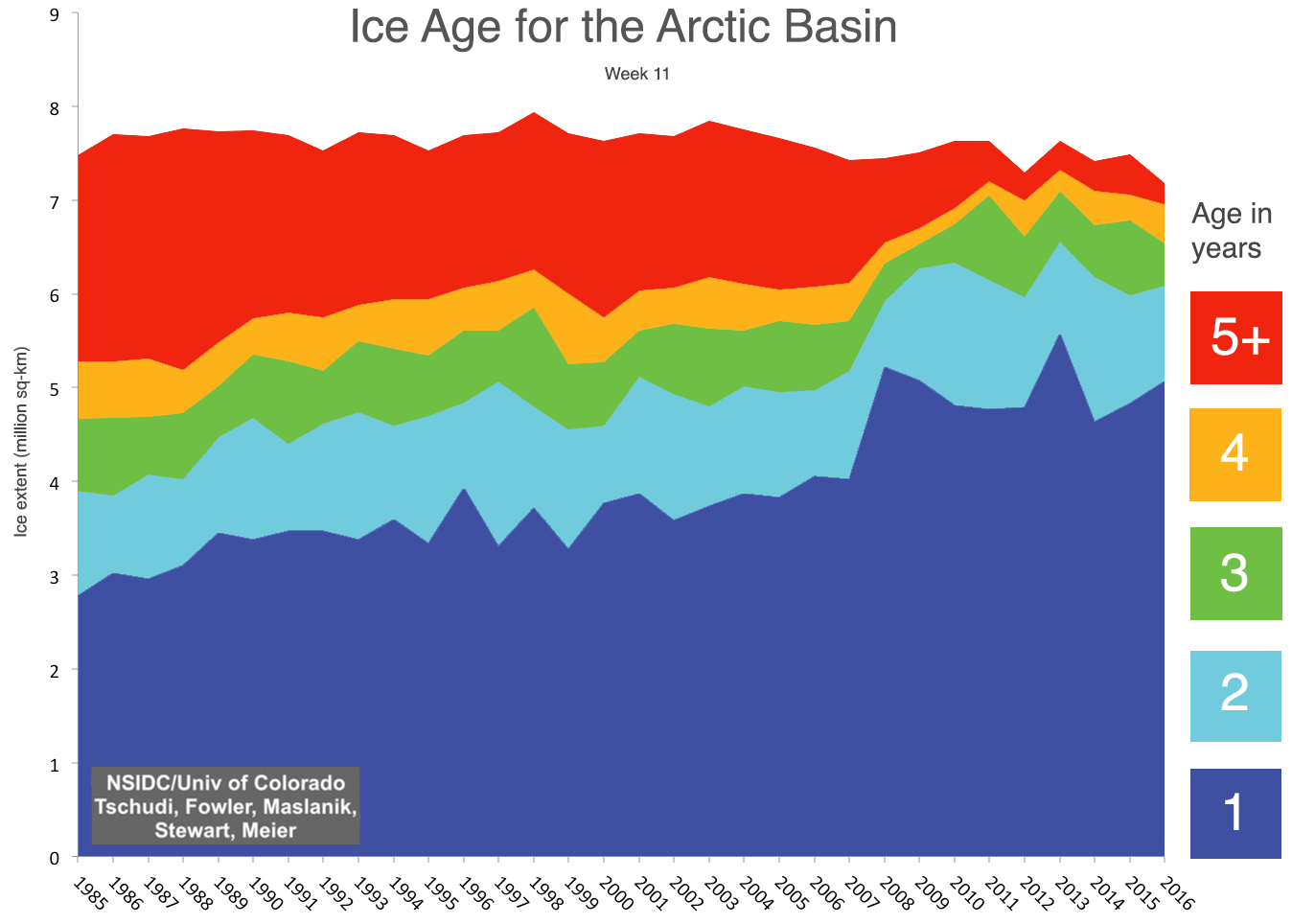
Are you really trying to argue that the Arctic sea-ice is not in steep and rapid decline?
Extent and area are useful metrics but volume, although more difficult to calculate, is far more revealing.
As far as multi-year ice goes:
There is no yoga position you can twist yourself into that is going to make those graphs appear to head north.
Is the AMO having some effect? Quite possibly, but sheesh…
Point taken.
Ah, models. Trump surrounds himself with models, but they don’t model Arctic ice.
Thanks for the graph Tony , I had no idea that the arctic only had sea ice since 1985 !
We are definitely doomed , I can see 1000 feet of sea rise in a few short years at that pace .
That’s point taken James.
Oops my bad , since the 1980s.
Hmm, as per figure 6, the model presented anticipates SC25 slightly more active than SC24, and SC26/SC27 > SC24/SC25.
It is unclear where the monster solar minimum approaching prediction comes from. Ed Fix’s model predicts activity going up, not down.
It appears that David refers only to the minimum for this cycle, not a grand minimum. Ed does indeed forecast increasing activity for the next three cycles.
The monster minimum would be a standard length cycle, with the low section starting now and continuing for a few years. Ed Fix’s model is an alternative, the ‘short cycle’ in the title of the post. The strength of the coming cycles is irrelevant to those choices, but would be relevant to evaluating the Fix model.
As a side note, Ed Fix’s model doesn’t show 25 and 26 to be more active than 24 has been, it predecticted SC24 to be even weaker than it actually was. The cycles aren’t predicted to be stronger than observations for 24 until SC27.
a very short cycle being the opposite on deep and long it looks like this is saying today will either hot or cold. Take your pick but keep your options open !
Personally I think the solar cycle has a big effect but the oceans buffer it so much, the actual impact is hard to determine.
I am writing software to take the binary RSS dataset of the lower stratosphere and break it into a month vs latitude graph. And then use a deconvolution algorithm to remove the annual cycle from each latitude band. Then generate a frequency spectrum for each latitude band to see if the 11 year cycle shows up in the remaining data at any latitudes, if it does then a case could be made that solar variability has in fact been detected in the climate system. The point is, that the Stratosphere should be somewhat decoupled from the buffering of Earth’s oceans. Stay tuned…
yes
the data always follow the sun…
and the sun makes no sense unless you look at it long term, and even very long term
some of us – Javier and others know –
http://oi65.tinypic.com/2u8axl5.jpg
Interesting initiative LT. Some comments on the method.
Why deconvolution. All deconvolution methods introduce distortions, this seems like unnecessary degradation. Why not low-pass filter?
Use daily data if possible , monthly averages are improper resampling without using an anti-alias filter. This just muddies and corrupts the data. I don’t know whether RSS give daily data but UAH does. Suggest using UAH.
If this daily data is too big for your frequency analysis to run in a convenitent time. Do a low-pass filter at say 54 days and then resample at 27 day intervals ( proper anti-alias ). I suggest 27d because this is the solar equatorial rotation. You may try some other periods like 732d filter and 365 resampling.
Try doing your frequency analysis without filtering. The annual will be large but may not drown out the rest. Suck and see.
Please don’t use running means ( which is in effect what monthly averages do ). This distorts the data in horrible ways and does not correctly deal with any periodic components in the data. ( eg 27 solar cycle, 27 and 29d lunar cycles , which you should at least assume may be present.
See this article about running means and find links to a number of options for well-behaved LP filters with code provided. You should be able to adapt to whatever language you use.
https://climategrog.wordpress.com/2013/05/19/triple-running-mean-filters/
hope that helps. Keep us posted on what you find. Even if it is nothing. A rigorous nothing is a powerful result. 😉
before I get shouted down : monthly average is the same as running mean followed by a monthly resampling. Thus it is a distorting filter which is only half of the length required to properly anti-alias the data.
Climatology is hugely into monthly means which would only be valid if you can be sure that all variation below 60 days is totally random. It is pretty certain the both lunar and solar periods shorter than 30/31 days could be present making monthly averages totally bad for the job.
Here’s why you want to avoid runny means as a filter.
If you look for the magnetic 21.5 year periodicity you will find it without any difficulty. It is there in both land and ocean surface temperatures.
http://www.vukcevic.talktalk.net/5Spectra.gif
21.5 is the correct solar cycle.
Hale and Nicholson understood this. Schwabe is the half cycle. Gleisberg is 86.5 years.
DeVries is 210. Beyond that… who knows??
henryp, that is the most mindless
fit i have ever witnessed.
True. I was hoping there for more than o.5 correlation.
Must overlay with solar parameter. I m sure you will see a fit then. That was my point.
Greg,
The annual cycle has +/- 90 watt deviation (because of earths 1 million mile elliptical orbit) and we are looking for a difference of just a couple of watts over two decades in a 2 solar cycles, so there is a process we use in seismic processing called predictive deconvolution used for removing echoes in the subsurface. So this process uses only the first N-Samples of the autocorrelation of the signal to compute the prediction filter, and convolves the prediction filter with the time series to get the predictable portion, and then subtracts it from the original signal. This is a more robust process than simply convolving the inverse filter with the time series. But it needs the toeplitz matrix to properly partition the energy, so it is not a very common process among most industries, but in the seismic business, we truly have some of the most advanced signal processing algorithms available.
rbabcock, I think you are a genius. Any effect is going to be a slow gradual nudge in one direction or the other. It likely would require a prolonged solar quiet period to have any noticeable effect. But once the effect was noticeable, it would have a ton of momentum and would result in dramatic changes.
Agreed. If ocean mixing gives a 30 year filter with a 15 year lag then it really doesn’t matter if there is an 11 year cycle – what matters is the long term trend. It would be interesting to see correlation coefficients between the temperature trend vs. average sunspot number for varying time constants (correlation 1 year, 5 year, 10 year etc).
The cross-correlation function does that for ALL lags. An example for Tahiti looks like this :
https://climategrog.wordpress.com/tahiti_ssn_slpmatsst_cc/
It should be noted that the correlation is very small, meaning that only a very small amount of the variation matches SSN.
PS. Since this is daily data, and the annual component of earth variables will not correlate with SSN, this graph does not suffice to say SSN is negligible. As some have suggested in the past.
Apologies, that was based on monthly data, not daily as stated above. Sloppy work not properly labelling the x axis.
Greg,
Is it possible to get daily data from the satellite record? I would think it would take days of orbits to get a single global sampling.
It looks like that spike is driven by just the last month of data. I would like to see at least 6 more months of data before getting too excited about what might happen next
Most predictions show solar cycle 25 to be relatively normal but cycle 26 will be extremely quiet.
where can i read
these predictions?
How is this a surprise? Zharkova-model predicted this minimum. And much larger minimum from the mid-20s.
The surprise would be that she is actually correct.
The Fix model seems to be at least a good deal of the picture however what would be interesting to see is the model running back to the early 1600’s. Sun spot records go back nearly that far but I suspect the model might have difficulty dealing with events like the little ice age. If there is a mismatch at that point, there is a second factor that needs to be considered.
Dena, the model I played around with a few years ago is a simple resonant spring equation excited by the changes in the sun’s chaotic orbit about the barycenter of the solar system. It was only ever meant to be a proof of concept exploration of whether some resonant process could be excited by a the sun’s orbit to produce something like the sunspot cycle. Really nothing more.
When I saw David’s post about a possibly shortened cycle, my immediate thought was, “Oh no, he’s not going to mention my model again, is he?” I was kinda hoping to just watch the sunspot cycle for a few more months. If it seems to start an uptick in the next year or so, I could pop up and say, “see, I predicted that”, and if not, just stay quiet. Oh, well.
The model is a dynamic simulation, and each step is determined only by the current state of the oscillator and an input force derived from the sun’s orbit; specifically the radial acceleration of the sun relative to the barycenter.
Clearly, whatever’s going on in the sun is much more complex than a simple damped spring, so there is no possibility that the model could mimic the sunspot cycle long term. Whatever happened during the Maunder Minimum to disrupt the sunspot cycle is absolutely not in this model, so no, it doesn’t replicate the Maunder Minimum.
Incidentally, the model can’t be “run back” to the 17th century. It’s a dynamic model (with cause and effect) and can only run forward. However, I can start it in the 16th century and run it forward, and that’s how I confirmed it does not replicate the Maunder Minimum.
To set the spring, force, damping, and mass constants for the spring equation, I started with the sunspot cycle around 1750, starting from a known maximum, and adjusted the constants to produce something like the real sunspot cycle. I use a version of the Hale cycle, treating half the familiar sunspot cycles as the “negative” half of a sinusoid. Briefly, I did that because the sunspots of alternating cycles have reversed magnetic fields, so the familiar 11 year cycle seemed to me to be a rectified (absolute value) sinusoid. I just added a sign.
I have already had two predictions validated. After I set the parameters so the model produced a sunspot cycle-like output starting from a known initial condition, I set the starting point in the year 1500 with the initial conditions all set to 0. When the simulation got to 1750, it’s phase and amplitude closely match the real thing. That, I reasoned, couldn’t happen unless I had the parameters of the forcing function essentially correct.
In mid 2008, the modeling effort had progressed to the point that I predicted that if the sunspot number stayed very low through 2008, it would not start increasing again until the beginning of 2010. In fact, it started picking up in Dec. 2009. Close enough.
The model shows something very peculiar (unprecedented in the record) going on with the transition from cycle 24 to 25. I’m waiting to see if something like that happens.
Because it’s based on such a simple oscillatory process, I have no faith in the model’s ability to predict anything long term, and would be ecstatic if it predicts anything over the next cycle or so. The odd transition it seems to predict from cycle 24 to 25 seems to be a great test.
Thanks for that insight; the insider view.
Ed Fix July 11, 2017 at 6:52 pm
Now Mr. Ed, best you reconsider the above, simply because it is a well-known fact that there are numerous “simple oscillatory processes” than can, do and/or will result in dramatic changes or results, ,,,,,, intended or otherwise.
The loss of a counter-weight on an automobile tire or a “balance” wheel will create a simple oscillatory process that will continue to deteriorate if not corrected. And don’t forget about Galloping Gertie, the 1940 Tacoma Narrows Bridge — https://en.wikipedia.org/wiki/Tacoma_Narrows_Bridge_(1940)
And remember, “The term vibration is precisely used to describe mechanical oscillation.”
And Ed, there is another naturally occurring “simple oscillatory process” that is, IMLO, directly responsible for the bi-yearly cycling of an average 6 ppm in/of atmospheric CO2 quantities, as well as the dramatic changes that occur in opposite phases in the Northern and Southern Hemispheres, ……. and that “oscillatory process” is commonly referred to as the changing of the “seasons”, …….. aka: spring and fall equinoxes, …… that occurs when the Sun’s zenith passes over the earth’s equator on September 23rd and March 21st.
Failure to see or recognize the dramatic effects of said “simple oscillatory processes” is akin to those persons who “can’t see the forest because of all the trees”.
Sam C
Good morning, Sam
What I meant by that “simple oscillatory process” statement is that the model is a one-dimensional model that mimics a three-dimensional process, and it has no provision for nonlinearity, or threshold effects. Therefore, its predictive ability is bound to be weak, at best.
The spring model I used is really just a place-holder to test the premise that some oscillatory process, forced/excited by changes in the sun’s chaotic orbit about the solar system barycenter, could produce something like the sunspot cycle.
Hate to nit pick, but…..
“He was inspired to created the model” ….Create ? ( no d ?)
Hate to nit pick, but…..
Then don’t
+100
Should start cooling any minute now. . .
http://www.huffingtonpost.ca/lawrence-solomon/global-cooling_b_4413833.html
circa 2013) (three record warm years ago)
And a huge El Niño. cant really tell what you are implying, but leaving out the fact that at least two of those so called record warm years were due to a big El Niño. Don’t know that co2 played any role at all.
And they weren’t anywhere near “Record Breaking” either for the Thermometer records, not when they have cooled the 1997/98 temperatures by 2.9 degrees C.
Clearly
minimum is imminent
within a year from now.
http://services.swpc.noaa.gov/images/solar-cycle-sunspot-number.gif
When I look at that graph, I can see minimum in three years, not one. Current smoothed sunspot value is roughly equal to early 2006 and minimum occurred in 2009.
e.g looking at ssn 25
the decline from a year ago is much steeper than the decline from 2006 toward that mininmum ?
hint
look at the rate of decline
HP: Hint if slope is much steep we are farther from the minimum. I’m with Tucker. more like 3 than 1.
Greg
Compare the current rate of decline with those of previous cycles.
Henry, I think it deals with exactly where you’re looking. The smoothed average did drop faster during 2005 than during the portion of 2016 for which it is shown, supporting your contention. But from November 2005 to Feb 2006 there was a sharp decline which is unlikely to be seen once the smoothed average is filled in for the corresponding months of 2016-2017.
The past few months the number has been hovering just above ten, about the same as eleven years ago in 2006. At the beginning of 2016, the smoothed average is near 35, eleven years ago it was about 35.
Start of 2015, between 50 and 55, 2004, between 50 and 55. I believe these are the figures that Tucker and Greg are referring to.
Just looking at the last 6 months and comparing it to the trend line, it looks like the trend line is going to level out for awhile.
At the end of SC23, the “97%” consensus was that SC24 would be similar to SC22 and 21, but a few “deniers” said SC24 would be weak. So who were the non-conformists and what are they predicting for SC25?
The (C-AGW) Klimate Khange people call us deniers who refuse to admit that CC is anthropogenic. The Sun does not change and hence cannot be the cause of climate variations.
So then many of us here are double deniers, both CC deniers and solar in-variable deniers!
I would be proud to be included in the double denier cohort!!!
During winter and during periods of low solar activity, ionizing radiation in the lower atmosphere rises.
http://sol.spacenvironment.net/raps_ops/current_files/rtimg/table.png
Some explanation needed for Fig. 6 in the blog. The green graph is called a historic sunspot graph. Sunspot number cannot be negative and it looks like it has passed the minimum. This conflicts with the graphs of real sunspot number of henryp above. Is the original graph available somewhere?
Gladly.
https://www.mediafire.com/folder/4x54o0ju31v9m/Solar_Simulation
The PDF is a paper published in 2010, and the zip file is all my spreadsheets. Caution: BIG spreadsheets.
The sunspot cycle I used is akin to the Hale cycle. In each successive 11-year cycle the magnetic polarity of the sunspots is reversed (mostly) from the previous cycle. I represented the reversed polarity as a negative number in the graphed sunspot numbers.
Ozone production is declining.
http://www.cpc.ncep.noaa.gov/products/stratosphere/strat-trop/gif_files/time_pres_TEMP_ANOM_ALL_EQ_2017.png
As would be expected.
No. Why?
Consider solar polar fieldstrength rather than ssn as a function of release of more or less energetic particles that form ozone, peroxide and N oxides TOA
Because the highest energy UVC makes and breaks ozone. UVB does to a lesser extent, but some of it penetrates farther into the air, so that its effect can be felt in the troposphere. The vast majority of UV reaching the surface is UVA.
My comment disappeared down WP black hole, i’ll take liberty and repost.
There is not much new here.
As it happens Dr. Svalgaard and some of us were discussing forthcoming solar downturn some 8 or 9 years ago, at the time when the NASA’s top man was predicting opposite.
BTW, as long ago as 2003, I completed paper on exactly what we are observing currently and may indeed occur in next decade or two.
The NASA’s man said impossible. A Nobel prize Astrophysicist, the JPL solar expert and another solar theoretical physicist all reserved their judgement until the SC24 peaks.
So what was the result ?
I called it an ‘incredible coincidence’, the SC24 peaked within a decimal point of what the equation calculates (details are here )
Re fig 1: it’s pretty clear that solar cycle 24 (SC24) has seen a lot less total solar irradiance (TSI) from the sun reaching the earth than in the previous 2 solar cycles.
Despite this, the period covering SC24 has been by far the warmest continuous period since instruments began measuring temperatures on earth or in its atmosphere.
It’s pretty clear then that TSI isn’t the dominant influence on surface temperatures that David Archibald seems to believe it is.
Something else is, but what?
Who is guarding the guards? It is already cooling since ca. 2000
Says I
Henryp
You’re entitled to your opinion and to your say of course Henry; but every global temperature data set we have, whether surface or satellite, says different.
Even UAH, the coolest of the global temperature data sets and a measure of the lower troposphere rather than the surface in fact, shows warming at a rate of 0.11 C per decade since 2000. In RSS, which measures the same thing as UAH, the warming reported since 2000 is 0.17 C per decade.
Just saying that there has been ‘no warming since 2000’ is okay as an opinion, but it doesn’t actually stack up with the facts, which some people are sticklers for.
In science. Trust no one but yourself. Have you checked out T min in your own backyard over the past 20 years? What does it tell you?
Actually the statement does stack up to observations, upon which it’s based.
There was no warming between the two super El Ninos of 1999 and 2016. If any so-called “data set” shows some, then it’s totally “Mann-made”, not anthropogenic.
Henryp
I have done so intermittently Henry; however I am keenly aware that my own back yard is not representative of the globe.
Gabro
How do you know there was “no warming” between 1999 and 2016 if you don’t trust any data set? There’s no way you can say that definitively if you don’t trust any of the global data sets, whether surface or satellite.
I didn’t say I didn’t trust any data set, only those which show bogus warming.
Those which show cooling or no statistically significant warming, I trust.
You seem to have misinterpreted my comment.
Gabro
We’ve already confirmed that all global temperature data sets show warming since 2000.
There aren’t any. Your bar is a temperature data set that shows no warming or else cooling since 2000 even though no such a temperature data set exists.
Heh.
That is called data selection and considered a serious bias.
Gabro July 11, 2017 at 2:54 pm
Those which show cooling or no statistically significant warming, I trust.
What’s the difference between that and this:
Those that confirm my bias, I trust?
+100
USCRN shows cooling since its inception. Current anomalies are below the nClimDiv anomalies from ca. 2000.
So, the question about your own backyard thermometer is well posed, especially for those of us who live in the United states.
DWR54 July 11, 2017 at 2:18 pm “You’re entitled to your opinion and to your say of course Henry; but every global temperature data set we have, whether surface or satellite, says different. ”
Which of course is not really true.
All of the Raw Ground (Thermometer) datasebases show cooling, as I said above, the final NOAA set 1997/98 final temp has been reduced by 2.9C since 1998/99.
The Satellites are not measuring the same thing at all as they are measuring the heat leaving the Surface via the Atmosphere (ie cooling), which is not what we experience.
You only have to look at the last few months where NH cold temp records have been broken all over the place and yet the Satellites show the SH Anomaly as colder.
This sort of descrepancy has been apparent for years.
Javier July 11, 2017 at 5:14 pm
No bias at all. Simply rejecting alleged “data” invented in violation of the scientific method, in favor of actual data, it observations.
That should be: “It’s pretty clear then that TSI isn’t the dominant influence on [the observed changes to] surface temperatures that David Archibald seems to believe it is.”
________________
The sun is of course the main contributor to earth’s surface temperature. Sorry.
but not to changes in it.
Crackers,
Changes in solar activity do indeed influence surface and air temperature. Dramatically.
CO2, not so much.
Agreed. The changes to TSI, during solar cycle 24, which consist of a small reduction in the amount of solar energy received from the sun on earth compared to previous recent cycles, have had no cooling impact whatsoever on observed global surface and atmospheric temperatures.
Contrary to David Archibald’s past predictions, there has not been a reduction in temperatures as a result of this decreased solar irradiance, indeed, the exact opposite has occurred. Temperatures in the surface and lower troposphere data sets have reached record new warm extremes during solar cycle 24; whereas Archibald was predicting a slide into a new ice age!
So something is badly wrong with the solar models David Archibald has been working with this past decade. Even he must see that. So what are his explanations for the clear failures of his previous predictions? Alas, we are never told.
TSI is still in 1361.75 W/m2 range. The last solar minimum was down to 1361.6 W/m2 for a good 1 and a half years so we are still not down the lowest TSI number which is the one measure which impacts the climate more than any other. It is several Orders of magnitude higher energy higher than all the other measures shown in this post. And it is TOTAL solar irradiance so it is the total solar energy received.
http://lasp.colorado.edu/data/sorce/total_solar_irradiance_plots/images/tim_level3_tsi_24hour_3month_640x480.png
Sorry image doesn’t update to the current values which is here.
Oviously there is far more involved with the solar cycles than TSI
dWR54 …… bajesus ….. why oh why do people keep saying “warmest eva ” in the context of forcing while omitting the impact of the El Niño? R ya just so biased that you can’t say it?
I personally don’t think we r capable of accurately calculating the “global temperature” …. but it doesn’t matter because “global” is meaningless. However, this assertion that the last three years have been the warmest eva without defending the El Niño is just plain disingenuous !
TSI is important but so is its spectral composition.
There is a lag in solar effect on climate, since the key is the time integral of solar output. It takes a while for the climate system to get rid of heat from higher solar activity.
But the effect of lower solar power in the current cycle indeed has been felt and is reflected in stagnant to falling temperatures. The 2016 super El Nino blew off a lot of heat, as did the 1999 super El Nino.
No surprise if the 20th century featured the warmest intervals (1930s and ’90s) in the instrument record, since that record began during the Maunder Minimum in the depths of the Little Ice Age.
“TSI is important but so is its spectral composition.”
Gabro, I’ve had some thoughts on this and would value your comments on whether I’ve missed something or if I’m completely off track on this as I’m trying to improve my understanding.
My understanding is that when the Sun is active EUV is high and when it is quiet EUV is, relatively speaking, low. And yet there is not that much variance in TSI.
This seems to suggest that there might be an overall change in the spectral composition of the Sun between active and quiet resulting in a downward shift across the Solar spectrum.
Now EUV interacts with Oxygen and Nitrogen and if my understanding is correct the upper atmosphere is virtually opaque to it.
This would mean the fraction of the TSI’s heat energy entering different parts of the atmosphere would vary, according to the level of the Sun’s activity and might have a larger effect than might be expected from TSI variance alone.
So if the Sun is less active, as it is now, we might expect to see not only less energy imparted to the upper atmosphere but at the same time more energy getting through to the lower atmosphere.
If so this could result in higher air temperatures in the lower atmosphere and the surface of the oceans due to more energy being received there resulting in more active weather in spite of the lower TSI.
However, coupled with this, changes in the jet streams that occur when EUV is low would result in more heat being transported to the poles and would presumably offset any lower atmosphere and ocean heating resulting in the overall effect of cooling over time. (I’m saying this because that’s what we seem to be happening.)
Michael,
Since to some extent lower UV correlates with lower TSI, Dr. Svalgaard argues that spectral composition doesn’t matter. I’ve commented that it does, because the climatic effect of UV is qualitatively different from lower energy wavelengths in sunlight. And besides, UV fluctuates much more than does TSI.
The highest energy UV (UVC) is indeed 100% absorbed by the atmosphere, in which it makes and breaks ozone. The vast majority of UVB is also absorbed. The UVA which reaches the surface however is also climatically important because it penetrates seawater farther than visible and IR light.
Your hypotheses about the climatic and meteorological effects of differing spectral bands sound convincing to me, and should be subject to test.
Bad measurements?
Imo, the dominant influence of surface temps is the oceans. The Sun feeds the oceans, and the oceans are the main control know of the climate.
Two confounding factors.
Thermal inertia and a super El Nino.
All this makes next month’s total solar eclipse all the more interesting – as if these eclipses can ever not be interesting!
Forty years ago Jack Eddy in his landmark paper on the Maunder Minimum noted lack of florid descriptions of the solar corona during eclipses in that period of the 1600s, concluding that there simply may not have been the lovely corona as we know it from recent eclipses. More about this on this comment I made to one of David’s earlier posts:
https://wattsupwiththat.com/2017/07/01/thus-it-begins/#comment-2539983
So if you eclipse chasers are disappointed in next month’s corona, you heard it first here.
But if, more likely, the corona is normally spectacular – and I think it will be, with the Grand Minimum a cycle or two away, maybe – you also heard that first here.
But don’t let it stop you from going to the eclipse!
I’ll certainly be there!
Ed, where?
I’m heading a few hours north to Glendo, Wyoming.
clear skies!
Richard, I’m thinking western Nebraska, but I’ll be checking the weather in the days leading up, and won’t decide exactly where until the day before or so.
I, and a dozen friends, will stay in Cheyenne the night before, to get a head start on the northward rush from Colorado on eclipse morning. We have passes for Glendo park, and will go there unless the morning’s weather says elsewhere – E to Nebraska or beyond Glendo to Casper.
Try to be in an area where there are birds. I have witnessed two total eclipses and on the both occasion there was a sudden cool breeze with a dawn chorus couple of minutes later.
what is the climate’s
sensitivity to changes in the
Lyman alpha index? dT/dLai?
A relationship between the Solar Cycle and the Climate must be based on all cumulative Solar Energy reaching the Earth’s surface since year 1650. Year 1700 was the end of the Maunder Minimum. This is the beginning of the Earth’s Oceans warming. This is important since the Oceans store the heat from the Sun.
Now, the Solar Energy obviously comes from the Sun, but the radiation of the Earth’s stored energy [heat] leaves from the North and South Poles. This should be obvious, since the temperature difference between the Equator and the Poles is about 80 to 180 degrees Fahrenheit. Now the energy radiation control is indicated by the Ozone Layer. Ozone layer thick expands the upper atmosphere so much that NASA monitors it to help satellite operators, so they can move their satellites into a higher orbit.
A thicker atmosphere reduces energy flow to space. A thinner atmosphere allows energy flow to space.
The 10.7 Flux is a good indication of the amount of Ozone being formed: Lots of Flux, lots of Ozone; little Flux, little Ozone.
This is the smoking gun of Earth’s Climate control switch.
Presently, we have warm Oceans and low Flux [translates to cooler land]. As the Oceans give up stored heat, the Global temperature must decline!
Please see my comments on ozone above. Thanks.
PS: Atomic weight of CO2 is 44, but of O3 48.
It is also not always appreciated how important O3 was in Earth’s first atmosphere. The young sun produced on the order of 10,000 times more UV than now, while the early atmosphere contained a lot or H2O. Hence, plenty of ozone was made.
Ozone is generally thought only to have become common in the air after the evolution of cyanobacteria, which release oxygen as a waste product of photosynthesis. But ozone abounded during the Hadean and Archean Eons as well, during the emergence of life on Earth.
So the climate of our planet has often, if not always, been influenced by ozone.
sorry, but heat does not leave
the earth by just the N and S poles
I don’t understand Figure 6. It appears as though Mr. Fix or Mr. Archibald think that the sun swaps magnetic polarity at the low point of the sunspot cycle. My understanding is that the swap takes place around the maximum of the sunspot cycle.
What am I missing here?
w.
My bad. The graph shows the solar cycle with every second cycle negative, equating to the oscillations of a spring.
IIRC, the y-axis units are ‘polarized sunspot number’. The model is barycentre based and does not address hysteretic magnetic cycle evolution.
The magnetic polarity of the sunspots (actually sunspot pairs) swap at the sunspot minimum. The global magnetic field of the sun swaps around the maximum.
Ed, that’s true … but what you’re counting is sunspot numbers, which vary with the global magnetic field of the sun. As you point out, this swaps around the maximum … but your graph shows it swapping at the minimum.
Best regards,
w.
some confusion here:
there really isn’t something called the ‘global magnetic field’ of the sun.
There is the ‘toroidal magnetic fields’ [east-west] which switch at minimum [sunspots] and ‘poloidal magnetic fields’ [north-south] which switch at maximum.
Dr. Svalgaard, thanks for the info and clarification.
Willis, individual sunspots, and east-west-oriented sunspot pairs, have their own local magnetic fields. The sunspot pairs of one cycle generally have the one polarity (eg. magnetic north to the east, and magnetic south to the west), and sunspot pairs of the next cycle generally have the opposite polarity.
So the answer to your question is that the (cycle to cycle) alternating local magnetic polarity of the sunspot pairs was the basis for the negative sign I assigned to alternating sunspot numbers. The choice of which polarity was positive and which negative was entirely arbitrary.
The origin of the term “Hale Cycle”, consisting of two 11 year (Schwabe) cycles came about because Dr. G. E. Hale first observed that sunspots have magnetic fields (paper published in 1908) and, during the next cycle that the magnetic polarity of the sunspot pairs was reversed (published 1919). Time and time again, during my literature search for my paper, I found people referring to the Hale cycle and citing the 1908 paper–published long before he had a chance to observe the polarity reversal in the cycle that began in 1912. Makes me wonder if the people citing huge lists of publications actually read any of them.
It is best to always use the terms toroidal and poloidal fields that say precisely what they are.
I am glad to see someone else coming at it a different way, and reaching the same conclusion about the length of the 24/25 trough that my time series analysis shows. I have identifies over 200 statistically significant cycles in the 1749 to present sunspot data set, with five of those being major oscillations in the 10 to 12 year range which make up what other people call the 11 year cycle. Those five alone would be a major finding if it can be confirmed by understanding of the physics of the sun that the 11 year cycle is not itself an actual stand alone single oscillation. By projecting these over 200 cycles into the future, the result shows that beginning in the summer of 2018 and lasting for 3.5 to 4 years, there will be virtually no sunspots. Again during the 25/26 trough the numbers will be low, mostly near zero, for a similarly unusually long time compared to historic averages.
For what it is worth, here is a screen shot of the graph of my amateur work, adding these oscillations together in visual form: The top section is continuous from 1749 to sometime past the end of this century. The bottom section is just a blowup of the latter part of the chart. The cycles identified are derived from the actual data, so of course they match fairly closely up until the present, which will only continue into the future if the work is reasonably good.
Well, the link to the image did not appear. See if this works.
http://i.imgur.com/h3f8ueT.png
If the link does not appear, you can go to it manually with “http://i.imgur.com/h3f8ueT.png”
Which sunspot series is this based on?
You might find this interesting: http://www.sidc.be/silso/spotless
The series is version 1.0 of the data collected, I believe originally by the Swiss. I acquired the data in pre-internet days from the Foundation for the Study of Cycles and kept it up from their update until it became readily available on the internet. Times have changed.
I also have done the calculations on version 2.0 after the revision of the early data (something of which I was suspicious) but the results are very close to the version 1.0 results.
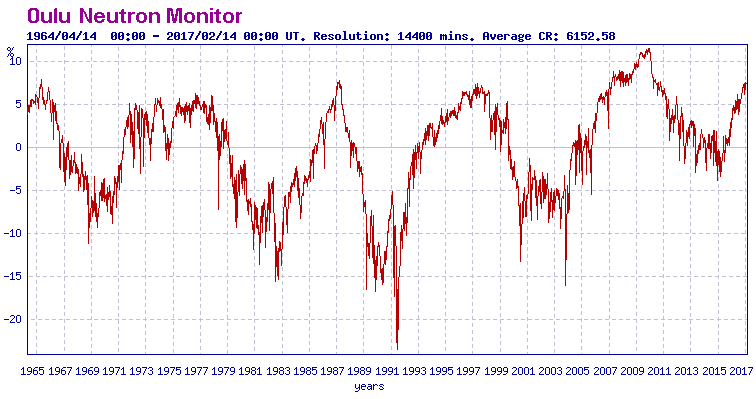
There is a 12 year +/- delay between the solar activity maximum at about1991 and the millennial temperature maximum at about 2003.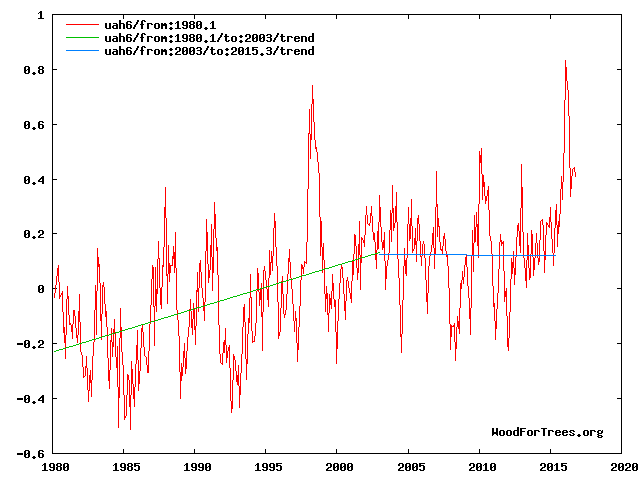
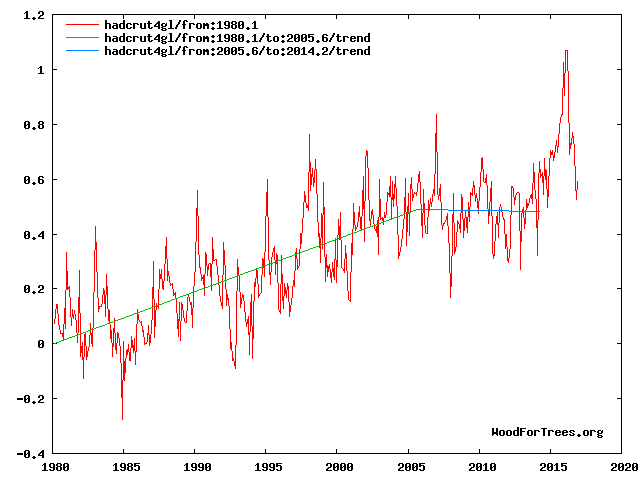
Climate is controlled by natural cycles. Earth is just past the 2003+/- peak of a millennial cycle and the current cooling trend will likely continue until the next Little Ice Age minimum at about 2650.See the Energy and Environment paper at http://journals.sagepub.com/doi/full/10.1177/0958305X16686488
and an earlier accessible blog version at http://climatesense-norpag.blogspot.com/2017/02/the-coming-cooling-usefully-accurate_17.html
Here is the abstract for convenience :
“ABSTRACT
This paper argues that the methods used by the establishment climate science community are not fit for purpose and that a new forecasting paradigm should be adopted. Earth’s climate is the result of resonances and beats between various quasi-cyclic processes of varying wavelengths. It is not possible to forecast the future unless we have a good understanding of where the earth is in time in relation to the current phases of those different interacting natural quasi periodicities. Evidence is presented specifying the timing and amplitude of the natural 60+/- year and, more importantly, 1,000 year periodicities (observed emergent behaviors) that are so obvious in the temperature record. Data related to the solar climate driver is discussed and the solar cycle 22 low in the neutron count (high solar activity) in 1991 is identified as a solar activity millennial peak and correlated with the millennial peak -inversion point – in the UAH6 temperature trend in about 2003. The cyclic trends are projected forward and predict a probable general temperature decline in the coming decades and centuries. Estimates of the timing and amplitude of the coming cooling are made. If the real climate outcomes follow a trend which approaches the near term forecasts of this working hypothesis, the divergence between the IPCC forecasts and those projected by this paper will be so large by 2021 as to make the current, supposedly actionable, level of confidence in the IPCC forecasts untenable.”
The current situation is seen in Figs 4 and 5 in the linked blogpost and paper.
Fig 4.UAH6 trends showing the millennial cycle temperature peak at about 2003 (14)
Figure 4 illustrates the working hypothesis that for this UAH6 time series the peak of the Millennial cycle, a very important “golden spike”, can be designated at 2003.
The Hadcrut 4gl data trends are very similar to the UAH6 data trends with the millennial peak at 2005.3 in Fig. 5 (15).
Fig. 5 Hadcrut 4gl trends showing the millennial cycle temperature peak at about 2005.6
The UAH cooling trend in Fig. 4 and the Hadcrut4gl cooling in Fig. 5 were truncated at 2015.3 and 2014.2, respectively, because it makes no sense to start or end the analysis of a time series in the middle of major ENSO events which create ephemeral deviations from the longer term trends. By the end of August 2016, the strong El Nino temperature anomaly had declined rapidly. The cooling trend is likely to be fully restored by the end of 2019.
Noteworthy that UV cratered during the Maunder. The following graph is from Shapiro et al 2011:
This Shapiro Figure fits well with my suggested millennial activity peak at 1991.