Paleoclimatologists Rock -Two million years of radical climate change is significant.
David C. Greene writes:
“The smoking gun of the ice ages” is the title of an article in the Dec. 9, 2016 issue of Science, the journal of the American Association for the Advancement of Science. The author, David A. Hodel, is listed with the Laboratory for Paleoclimate Research, Department of Earth Sciences, at Cambridge University in the UK.
Hodel cites a 40-year-old paper in Science, 194,1121 (1976). In that paper, Hays, Imbrie and Shackleton reported that their proxies for paleo sea surface temperatures and changing continental ice volumes exhibited periodicities of 42,000, 23,500 and 19,000 years, matching almost exactly the predicted orbital periods of planetary obliquity, precession and eccentricity. They also found that the dominant rhythm in the paleoclimate variations was 100,000 (±20,000) years.
Other climatologists have identified 20 glacial/interglacial oscillations over the past two million years with glacial parts of the cycles lasting about four times as long as the warm, interglacial parts. The last glacial maximum was about 18,000 years ago. We have been enjoying the present warm interglacial for about 12,000 years.


At glacial maxima, sea levels have been about 400 feet below present sea levels and sea surface temperatures about nine degrees C (14.4 degrees F) lower than present temperatures. The movement and conversion of 400 feet of ocean water to ice located in the higher latitudes required large and long-lasting influence from outside the Earth. The persistence and the magnitude of the above-described changes cannot logically be ascribed to mankind’s combustion of fossil fuels. Furthermore, in the terminations of the glacial eras, rising temperature preceded rises of CO2 by several centuries, absolving CO2 as the cause of the preceding temperature rise.
I cannot identify the cause(s) of the Earth’s quasi-repeatable climate excursions during the past two million years. However, the data provided by the paleoclimatologists makes sense to me as a physicist with three semester-hours of astronomy. My candidate for responsibility is an orbital influence on the amount of energy Earth received from the Sun as the Sun slowly danced around the center of mass of the entire solar system, with Jupiter being the weightiest of the Sun’s planetary dancing partners.
“with glacial parts of the cycles lasting about four times as long as the warm, interglacial parts..”…
well, you could say the set point is a lot lower than now…
Knowing that…we should be pumping everything we’ve got into the air
…or not
“rising temperature preceded rises of CO2 by several centuries”
Is it possible to figure out the start of a new glacial period?
Sure, ±20,000 years.
Aren’t we just about there?
Clive Best, in a curve fitting exercise, extrapolated that the next ice age will start in 1000 years
http://clivebest.com/blog/?p=5388
Fig 3: Next Ice Age due to start in ~1000 years time.
orbital influence on the amount of energy Earth received from the Sun as the Sun slowly danced around the center of mass of the entire solar system
No, that is not the reason.
So, what is the cause?
Planetary perturbations [mainly Jupiter’s] alter the orbital parameters of the Earth leading to different regions receiving different amounts of TSI. This has been discussed ad nauseam here on WUWT. Go look and you’ll find.
Doc, I think these orbital parameters you talk about with Jupiter/Saturn applied to the Sun orbiting about the outer planets/Sun Barycenter centre of gravity, not directly implicating Earth except of course the well known Milankovitch Cycles which is a different set of ‘cycles’. Sorry for mentioning that. Yes, according to that hypothesis, Earth gets a differential amount of TSI as a result, supposedly the hypothesis stated that differential amounts of cosmic rays were based upon cycles of sunspot activity caused by these orbital fluctuations by the outer planets on the Sun orbiting that centre of mass in the solar system. Somehow, he made predictions of timing and varying intensities of sun spots and cosmic rays leading to more or less cloud cover, which he stated has a significant cause to climate change on a century basis. I don’t know if his hypothesis is correct or even close, but it changed my view on global warming that day.
I recall the first day I got my first computer in 1992, this was the first scientific paper I ever downloaded and read. By some obscure German scientist I don’t remember or have the original paper anymore. Unfortunately he died many years ago, and I remember Wiki said 10 years ago the guy was an astrologer for the way he wrote his scientific paper. Of course Wiki also refers to this WUWT Blog as a site for dimwitted deni@rs, which is why I never visited this site until last year because of that writeup in Wiki about this blog. Since when, I found out only half the people or less, are dimwitted. So I cancelled leaving Wikipedia any of my inheritance, that ignorant beggar Jimmy Wales who is always begging for money.
Ron,
You probably refer to Dr. Theodor Landscheidt. He had several articles at the late John Daly’s web site about the influence of solar cycles (induced by the larger planets) on e.g. El Niño episodes like here:
http://www.john-daly.com/theodor/co2new.htm
With several references to other articles by him.
I suppose that Leif is right that the larger planets influence the orbits of the other planets, including the position of the sun in the centre. Thus a common cause, not the sun as cause.
Thus I am agnostic about his findings, but if someone with more ambition can check if his findings still uphold in current times, I am always interested…
lsvalgaard May 23, 2017 at 1:57 pm
Hi Doctor lsvalgaard I have a bit of a wild question. Alpha Centauri our neighbor, a three star system. Has anyone taken a look to see if the changing locations in that system influence our system?. Now please don’t jump all over me. I don’t think gravity from the thee stars is enough. I’m thinking Oort clouds and the movements of stuff way out on the system edges. We have been finding some good size non planets out there. In sum is it possible that the outer areas of our solar system and Alpha Centauri’s inter react ?
Out of left field I know, but has it been looked at one way or the other.
Michael
Thanks Ferdinand for that…yes I now recall that name. Hopefully I can retrieve that original scientific paper after 10-15 years and re-assess it in why it had such a significant effect on me 25 years ago changing me from a dyed in the wool ‘carbon’ convert, to a mild skeptic.
Leif, I don’t believe I’ve missed many of the ad nauseum discussions, and it strikes me you are selling out way below your usual standards on this. Sure, 41kyr is a fundamental beat, but there are way too many overrides for this to be a satisfying explanation for glacial/interglacial periodicity. Periodicity is only…period, and there is also amplitude to explain. Not only did the apparent period change at the mid Pleistocene transition, the amplitude increased considerably.

There is no doubt that Shackleton’s plankton are Milankovitch canaries. Below is some sort of measurement of phytoplankton distribution.
Your guess is as good as mine as to why this is so skewed to the northern hemisphere.
Given they are lightyears away, and they don’t orbit our system, their effect is small (really really astronomically small), but believe me, if you got the idea, someone has calculated an estimate as soon as the distance was first measured. It probably (can’t remember any more) is something students of astronomy do as an exercise during the second year of their studies or something. Course named “planetary motions” and part of a lesson about perturbations caused by passing stars.
The Cloud Mystery
Prof Svensmark
Oh, my, my, ….. now these two brash statements really have me confused, befuddled and aghast, …. To wit:
lsvalgaard May 23, 2017 at 1:57 pm
Ferdinand Engelbeen May 23, 2017 at 3:51 pm
In order to lessen or eliminate my confusion, befuddlement and aghastment, ….. I need someone to explain to me how it is heavenly possible for the larger planets [mainly Jupiter] to alter the orbital parameters and/or influence the orbit of the Earth, …….. yet after all these thousands of thousands of years of “orbital adjustments” ……… the earth’s orbit is still pretty much the same as it has always been?
Is it the gravitational attraction of Dark Matter that re-adjusts earth’s orbit, each and every time, ….. back to what it was before Jupiter adjusted it?
heavenly possible for the larger planets [mainly Jupiter] to alter the orbital parameters and/or influence the orbit of the Earth, …….. yet after all these thousands of thousands of years of “orbital adjustments” ……… the earth’s orbit is still pretty much the same as it has always been?
Because all those perturbations are themselves cyclic, so things pretty much return to earlier values from time to time. This is not controversial, your incredulity notwithstanding.
>>Your guess is as good as mine as to why this
>>is so skewed to the northern hemisphere.
It is skewed to the northern hemisphere because the key to ice age modulation is albedo. And since all the major land masses (and ice sheets) are in the northern hemisphere, it is the northern hemisphere Milankovitch cycles that control ice age modulation.
See my paper below.
ralfellis May 25, 2017 at 2:12 am
Ralph
Samuel C Cogar May 24, 2017 at 11:34 am
A little physics would help. The basic fact is that every mass interacts with all other masses. They interact proportionately to their mass and inversely with distance. The barycenter of the earth-moon system falls inside the earth’s crust, but it results in the earth and moon having a secondary motion like a spinning, very lopsided dumbell that is in addition to the moons orbital motion around the earth. The individual interactions of the sun and all the masses in the solar system are the same.
See this:
https://en.wikipedia.org/wiki/N-body_problem
Who says its total tsi as the driving mechanism? It is the total energy that reaches the surface and its consequential effect that is the determinant. It has to pass through the atmosphere with the possibility of various interactions all the way down to the surface.
The orbital wanderings also influence the amount of solar wind and such like which clearly affect the earth (the aurora’s being one effect). Effects on cloud formation and hence albedo is one mechanism I have heard mentioned. Not my field of expertise but I look at the temperature record and just want to do a Fourier analysis of the noise to see what might be there. After all we are talking about the surface temperature of a spinning planet with an orbiting moon in turn orbiting the sun in concert with a suite of other planets and a whole heap of other detritus from asteroids to dust particles with various periods and barycentres. I certainly don’t rule out CO2 as a component but nor does it seem there are no significant or even dominant cyclical inputs with the possibility of ‘beats’ and all the other interactive combinations.
Experts were utterly convinced that stress and spicy food caused stomach ulcers until not that long ago and that tectonic plate theory was a bit whacko. I remain skeptical of scientific ‘concensus’.
Who says its total tsi as the driving mechanism?
I do, for one. TSI is the energy that is available.
Your quote is not what I said prof. read and quote the next sentence. Shallow smartypants rhetoric it seems to me and the sort of rhetorical shuffle that keeps me skeptical. The TSI is the total incoming energy sure but what is at issue is how much of that shows up as surface temperature, i.e as ‘global warming’, how much is reflected/radiated back into space, how much is absorbed into chemical bonds etc etc. All that coal/oil/gas in the earths strata represents absorbed solar radiation and a planet load of water cycle action with its cooling effect. Cloud albedo represents reflection into space, water vapour represents LHV absorbed plus a ‘greenhouse’ effect and so on.
What gets through the atmosphere is actually a function of the climate so you are putting the cart before the horse.
You say you don’t rule out CO2 as a component. A component of what? Warming? If so, rule it out! It isn’t warming! Hasn’t for almost 20 years! It is in fact cooling at present. CO2 is still rising so I can’t rule out CO2 as a component of cooling!
Since the weather appears identical to the 1970’s so far as I can tell, I can only conclude that natural variation must be a more powerful component than anything the 97% of a bogus sample of “climate fakirs” postulate.
40 years of warming and we’re right back to 1977!
real strange,
thumbs up!
lsvalgaard!
Thanks for the post. You say:
No, all of that makes almost no difference to the total energy received by the earth. The only influence is tidal, and that is tiny.
w.
True, tilting the Earth from 22.1 deg to 24.5 deg may not matter as to the total annual energy received by Earth, but it does matter on how the Earth heats and cools during the seasons, especially above 65N and below 65S. Same with precession.
Does less energy hitting the Arctic during summer put the lack of summer ice melt past the tipping point and ice starts accumulating setting off an ice age? Same amount of total energy hitting the Earth, but maybe a big difference in how the polar regions respond.
The amount of total solar energy received at Earth distance varies little throughout the ice age cycles and it never matches the ice ages at all. For example, the maximum total solar irradiance in the last ice age, actually reached its peak about 120,000 years ago, just as temperatures were crashing at the start of the ice age. Peak global TSI, ice age starting. So the more circular orbit plays no part at all really.
But two things do vary a lot:
– Summer solar irradiance at high northern latitudes (65N June 21 solar irradiance varies from a high of 540 W/m2 to a low of 430 W/m2); and,
– the overall Albedo of the Earth based on how much ice builds up (which varies from about 29.7% non-ice age Eemian conditions to about 33.5% last glacial maximum conditions).
So, drop solar irradiance at 75N down to 430 W/m2 which is not enough to melt the winter snow and sea ice over the summer AND then have the glaciers build up increasing the amount of sunlight reflected and that is what an ice age is about.
Global Temp Non-ice Age = ([1361.5 W/m2 / 4 * (1-29.7%)]/5.67e-8)^0.25+33C= 287.8K = 14.7C
Global Temp Ice Age = ([1361.0 W/m2 / 4 * (1-33.5%)]/5.67e-8)^0.25+31.5C= 283.3K = 10.1C
Change is: -4.5C
–> -0.02C from less total solar energy received by the Earth due to less circular orbit;
–> -1.0C from lower GHGs because it is colder and the carbon cycle has absorbed CO2 out of the atmosphere (calculated at 1.5C per doubling); and,
–> -3.5C from a higher global Albedo because of all the extra sunlight reflected by snow and ice.
= Ice age does not START until ice builds up and reflects more sunlight and then it gets colder and GHGs drop but mainly more sunlight gets reflected and temps drop by -4.5C.
= Ice age does not END until ice melts from the mid-latitudes first and ending in the high latitudes. It takes a lot of time to melt out 3 km high glaciers. I takes two or three good milankovitch up-turns to break the back of the ice ages.
Albedo is the big make or break factor and that does not change until 75N summer solar irradiance falls below 440 W/m2 which is not enough the melt the winter snow during the summer high period.
Bill Illis
How do you make the calculation that drops the insolation that much at those latitudes? (Average, I assume, per day TOA radiation based on the usual flat-earth plate model at a nominal earth orbit? But what is the rest of the math?)
Albedo is going to have just a tiny bit more influence than barycentres. Especially rapidly changing albedo.
With the current configuration of the continents on the surface of the planet, the tilt also changes the percentage of the TSI that is striking land areas versus the percentage that is striking open water. This results in a variation in the planet’s albedo.
Bill Illis May 23, 2017 at 6:12 pm
Here is a proxy graph that depicts the most recent of the aforesaid “break the back of an ice age” event but didn’t terminate it, …..which began at approximately 21,000 years BP, resulting in the current interglacial, ….. to wit: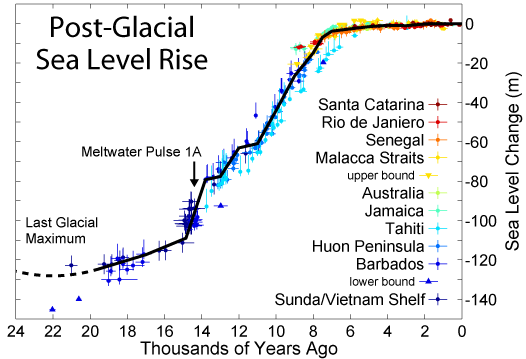
So, we have “terminations” of ice ages ….. and ….. we have “interglacials” within ice ages, … and what are the forces in nature that are responsible for the seeming two different types of events?
Or are the forces the same that initiates both events, but one event is terminated before all the ice and snow is melted and glacial conditions return anew?
So the barycentre of the Jupiter-Sun system is actually outside the sun. link In that regard the sun could be said to dance around the Jupiter-Sun barycentre.
However, the earth orbits the Sun and Jupiter has little effect on how far the Earth orbits from the Sun. link
It’s a mistake to think everything orbits the same barycentre.
There is zero (none) mass in the barycenter. It does not attract anything. You could as well say that daily temperatures dance around an average temperature. They do, but not because the average temperature attracts them.
CB, that solar Jupiter barycenter is by calculation. The ‘correct’ barycenter is for all the planets together relative to the sun. That is well inside the sun, for simple reasons having to do with the accretion disk from the then inner Ortt cloud that eventually formed all the planets.
The barycentre is likely within the mass of the sun, but is constantly changing due to different planet orbital times and I presume that is part of the Milankovitch Cycles. What happens internally to the Sun? Are plasma masses sloshing around inside the Sun? Is this the cause, or at least a participant, in the 11 year (average) solar cycles? Look at the glacial/interglacial cycles for the last 2 million years, these are strong signals that significant forces have control of the thermostat here on Earth. SUV’s and Cow Farts are pushing us to a tipping point? Not possible.
Are plasma masses sloshing around inside the Sun?
Of course not. The Sun is in free fall as are all the planets all well, thus feels no forces, except for absolutely negligible tidal forces.
Something is causing the planets (and moons, asteroids, comets, etc.) to not continue moving in straight lines, as it seems to me their mass/momentum would tend to cause them to do, if they were not being acted upon by a force of some other kind, it seems to me, lsvalgaard. Are you calling the balance between inertial and gravitational forces “freefall” ?
John.
The term “free fall” has a specific meaning in physics.
In the Newtonian domain, free fall is any motion of a body in which gravity is the only force acting upon it.
In the context of general relativity, in which gravitation results from a space-time curvature, a body in free fall has no force acting on it, but moves along a geodesic.
Chimp,
“In the context of general relativity, in which gravitation results from a space-time curvature, a body in free fall has no force acting on it, but moves along a geodesic.”
Yet, a heavier (or lighter) body will not follow the same geodesic, right? A balance of forces is definitely occuring therefore, don’t you figure?
Scratch that, I think the geodesic is independent of the mass of a given body . . but is dependent on the speed . .
Ron Long, the barycenter is quite often outside the Sun, more than one would imagine.
See:
http://zidbits.com/2011/09/the-earth-doesnt-actually-orbit-the-sun/
absolutely negligible tidal forces.
=====================
And yet Venus always presents the same face to Earth at closest approach. the tidal effect of Earth on Venus is negligible, but the odds of this happening by chance are also negligible. Somehow, as yet unexplained, the rotation of Venus is synchronized with the Earth’s orbit.
And if it was not for the deep sea cores we would have discarded Milankovitch years ago, precisely because TSI doesn’t come close to predicting the past. All we can show is that there is correlation.
The evidence strongly argues for a hidden variable.
Tidal Forces are mass interactions and are discernable where the mass has something less than absolute rigidity, ie, is somewhat viscous or plastic. If the barycentre is sometimes outside the mass of the Sun this means the mass interactions are even more likely to promote sloshing of plasma inside the Sun. I am in no way a Star expert, for instance I use the term “sloshing”, but the Sun certainly deforms as the planets align (reinforced net mass vector) or go their own way for awhile. Since the orbital periods of the planets are reasonably regular, there is certainly a cyclic nature to all of this.
lsvalgaard
“The Sun is in free fall as are all the planets all well, thus feels no forces, except for absolutely negligible tidal forces.”
What, if anything is not in “freefall”, as you use the term there?
See, I am part of this planet, and I feel gravitational force (honest ; ) and I’m pretty sure the chair I’m sitting on does too (after a fashion ; ) and the house the chair and I are in, and the ground beneath, etc, etc. which to my mind means virtually the whole planet “feels forces” all the time, and, I suspect that all the material of the Sun similarly “feels forces” constantly. (And, I think those gravitational forces keep it from suddenly expanding rapidly and destroying the Earth and so on, for one thing…)
And as I said earlier, I don’t think the planets would continue to travel around in circle like paths, if the did not “feel” the forces of gravity . . So, what did you mean?
free fall means that the only force you feel is gravity. Astronauts on the International Space Station are in free fall [around the Earth] and so is everything around them, so they don’t see any difference between them and their surroundings [“they are weightless” and can float around]. When you are sitting in your seat flying in an airplane there are two forces acting on you: gravity pulling you down and the electromagnetic forces in the seat pushing you up [“reaction” = “action”]. The two forces are equal and opposite so you stay put, and are not in free fall. If you get up and jump out of the plane, you remove the reaction from the seat and you fall ‘free’ [ignoring the air resistance] until you hit the ground and feel the upward electromagnetic force of the ground and you will again stay put [perhaps in not so good shape as before]. Solid bodies [the seat, the ground] are solid because of the extremely strong electrical attraction [and repulsion] between their atoms.
Thanks Lief . . I thought that’s what you meant.
Oops . . Lief ; )
Willis: I’ve read your various analyses of this, and am unconvinced. It is mostly because I don’t believe your analyses take enough into account.
However, your Fourier analysis may not be the right tool for parameter identification. You might try wavelet analysis. I’ve studied it, sort of, for a while. But until I ran across Bob McGinty’s amazing continuum mechanics website, I never really understood it. Check this out, and make sure you read to the end. http://www.continuummechanics.org/wavelets.html
Also, read his explanation of Fourier analysis. It’s better than any I’ve ever seen. For that matter, so is his description of the Navier Stokes equations.
Thanks, Michael, I’ll take a look.
w.
Willis – Eccentricity does affect total annual energy input from the sun.
Total annual insolation goes like 1/(1-e^2) so when eccentricity is high, insolation is high. It is pretty obvious intuitively once you learn that the semi-major axis of the orbit is constant. Therefore higher eccentricity means that the semi-minor axis shrinks, and the planet gets closer to the sun on average.
If you look at the charts in the root post, you can readily see how peaks in temperature tend to correspond to peaks in eccentricity, though the other orbital factors complicate the picture.
Sorry, SQRT(1/(1-e^2)). Here is a document: http://www.robles-thome.talktalk.net/Milank1.pdf ?dl=0
?dl=0
and here is a picture
and here is an OLS curve fit using all orbital parameters to match temperature, explained in the document. ?dl=0
?dl=0
Where ‘all orbital parameters; means obliquity, precession, and eccentricity or the earth’s orbit…
RR-T,
And something else w/ a period of ~400k yrs (by eyeball)
B
Comets have a high eccentricity, so they must be red hot…
RERT – remember that the planet moves fast when close to the Sun. It spends most time far from the Sun.
Russel.
Look at the scale on your graph. The forcing due eccentricity is minuscule.
Ralph
Ralfellis – I know, the implied sensitivity is very high. But I don’t have to be able to explain it for it to be valid data. I think its visually highly compelling that Eccentricity Forcing is a major contributor to climate.
If you don’t trust my eyes and want a statistical test: there are 79 independent 10-thousand year intervals in the data. In 49 of them the direction of eccentricity forcing change matches the direction of temperature change. In 30 they differ. There is about a 2% chance of 30 or fewer heads in 79 tosses of a fair coin. In five minutes, doing nothing clever, that establishes a clear connection, at least until someone corrects my maths!
Willis, claiming the “only” influence is tidal is a rather dogmatic statement. I would also say it’s unproven. There have been plenty of papers discussing how the orbits of the planets of our solar system affect each other and how there are various resonant frequencies resulting from the orbits. Quite a few years ago, Ian Wilson suggested that planetary orbits affected the length of earth’s day, which in turn affected ocean currents. I thought then and think how that this mechanism makes a lot of sense. If you have a rotating planet, such as earth, that is significantly covered by water, and you change the speed of rotation, the currents will be effected. So the effect is not tidal, but inertial, and ocean currents clearly have a huge effect on climate. Also, there must be a reason for the approximately 22 year solar cycle. I agree that the tidal effect is minuscule, but the inertial effect could have a similar on the sun, which is a rotating mass of plasma. It makes a lot of sense that even if the tidal and inertial effects of the sun are minuscule, acting over the 4.6 billion year lifetime of the solar system, they could be the cause of the length of the solar cycle.
Leif will be along here any minute now to tell us that TSI variations are much too small to account for the reconstructed temperature changes over geological time frames. That is true if the Earth is considered to respond to solar energy as a simple gray body. In fact, that was the initial obstacle to the acceptance Milankovitch’s thesis.
One needs to consider, however, the very significant changes in the response characteristics produced by the manifold hydrological cycle, which alters not only the albedo of land and atmosphere, but strongly modulates the rate of evaporation from the oceans. It’s in that ADAPTIVE interaction that one should search for the “global thermostat.”
that ADAPTIVE interaction
===
evolution argues that life should evolve to dampen climate change.
Clearly, Leif is a much faster typist than I am.
knee-jerk reflexes are FAST.
Jimmy-John’s is REALLY FAST.
Considering the “ice ages”; nowhere is Mark Twain’s observation more accurate: “It ain’t what you don’t know that gets you into trouble. It’s what you know for sure that just ain’t so“.
Ice age researchers had to make repeatedly decisions about they thought that the geologic records and proxies told them, using a limited scope of logic, lacking the big picture. But all these decisions are inherent “affirming the consequent” fallacies.
The big picture is that the 100ky cycle including the CO2 cycle is not a climate cycle, but an earth tectonic cycle, while the real climate cycle is only the 41k year obliquity cycle.
It’s a long story.
Here’s my off the wall idea: What if, the main control on average Earth Temperature is the temperature of the Oceans? What if, we have not accounted for heat flowing from the oceanic crust into the ocean and the variations that occur when there is a anomalous amount of tectonic activity. Consider that the stresses may build up in the plates in the oceans and have long periods of relatively non-tectonic periods. The Earth could gradually cool and sink into an ice age – that would be ended with an active tectonic period at every ~125,000 years or so?
PJ, tectonics does not work that way. Very dubious idea. Go read up some and you will learn why.
How many orders of magnitude would solar energy influx be over terrestrial heating? Probably counts for a small fraction of oceanic heating, but no where close to the Sun shining 24/7 for ever.
I heard another idea for ice ages was periodical influence of recurring comets crossing earths orbit. There is that possibility, but what if some miss every 100,000 years. There goes that hypothesis. Probably there is such a thing, but doesn’t cause ice ages. Maybe just wipes things out locally for a 1000 years if it is big enough…and hits an ice sheet 12,900 YBP.
Ron,
There is no valid evidence of such an impact 12,900 YBP. The Younger Dryas is no different from the Older and Middle Dryas cooling events, and the dozens (at least) of similar events during prior deglaciations.
There is evidence. Whether valid or not is not for me to say:
Petaev, Michail I., et al. “Large Pt anomaly in the Greenland ice core points to a cataclysm at the onset of Younger Dryas.” Proceedings of the National Academy of Sciences 110.32 (2013): 12917-12920.
http://www.pnas.org/content/110/32/12917.long
Moore, Christopher R., et al. “Widespread platinum anomaly documented at the Younger Dryas onset in North American sedimentary sequences.” Scientific Reports 7 (2017): 44031.
https://www.nature.com/articles/srep44031
Javier,
The authors of the Greenland study concluded that such a small impact of an iron meteorite is “unlikely to result in an airburst or trigger wide wildfires”, as proposed by the YD bolide impact hypothesis.
The later study attempting to piggyback on this discovery found traces of platinum at sites in North America poorly dated and generally no higher than background. That’s why, IMO, there is still no valid evidence for the conjectured impact of air burst at the YD.
Maybe some of the sites are sufficiently elevated to have been caused by parts of the small meteorite en route to Greenland, but it’s clearly way too small and in the wrong place to fit the fantasists’ bill.
The plates mover faster or more slowly, but they have always been moving since tectonics got started on earth.
On the learning list you will also need to get up to speed on the time scales involved in tectonics. Think slow
There isn’t any 125 000 tectonic cyclicity. By the way the curren “long” glacial cycles vary from 80 000 to 120 000 yers.
It’s not a smoking gun, its a fuming volcano! IMSO. Most of the above is simpy looking in the wrong place, atmospheric energy. As with renewable enrgy, there isn’t enough of it at the rate erquired when it’s needed. I suggest the atmosphere is a conseqi uence of what the r core, rock and oceans of the planet are doing, bi ut primarily the core and rock, plus the Sun, but not it’s radiance.
It appears to me, on the energy scale of things, that volcanic/tectonic activity is by far the most likely trigger for interglacials, and any move away from the stable albedo levels of the last few ice ages.
But trendy climatologists, who canot easily measure the deep ocean activitiy anyway, simply look at the wrong thing because they want to account for everything with their bogus temperature tracking atmospheric models they tweak to track reality when it proves them wrong again, inside the noise. I suggest, for significant change, that the atmosphere simply responds to and is a function of much larger forces, it does not control them.
Atmospheric forces are insignificant compared to the Volcanic Gorilla in the room. But climate scientists can only see their own cherished computer models of atmosphere, that are set within a miniscule fraction of an insignificant peak in climate time, an interglacial maximum, predicting the noise in an interglacial step function. But its how they make a living, through climate Science, not joined up science..
Volcanic activity is never mentioned, yet is more powerful than they can possibly imagine, and a more likely cause for the rapid and sudden interglacial warmings than the atmosphere, which contains a tiny amount of energy relative to the oceans, which in turn contain a tiny amount of enrgy relative to Earth’s nuclear reactor iron and Heavy Metal core, also check out the enrgy involved in the pull of Solar gravity on Earth. in planetary.
I was surprised to see a BBC documentary on the role of gravity in causing Volcanic activity and plate tectonics, and the impact of that on climate (Earth has plates, Venus doesn’t), which made me put these thoughts together.
It is also now believed our CO2 and water levels levels, at the levels good for human and plant life, are controlled by volcanic release and re-absorbtion under tectonic activity. Have you seen how Io is a molten ball of volcanic rock kept that way by Jupiters gravity pulling it around.? Or the massive Volcanos of the tectonic plate free Venus, which may have led to a CO2 heat death for water/Carbon based life? Worth a watch.
The gravtational force on the Earth from the Sun is 180 times greater than the moon at 3.6×10^22 Newtons. Check that force against yer climate models. Moon is 2.04×10^20.
During Milankovtch cycles that varies from ZERO % per annum at minimum eccentricity, about now, to 30% pa at maximum, along with solar radiation, on the inverse square law – so in 50K years from now. I assume the precession and obv liquity and not significant on te gravitational effect? That’s a lot of push and pul, on core and mantle and crust. Plates may well move more, etc. Volcanoes erupt, lots more CO2 for a start, but MOST under the sea, into the sea.
Someone should measure this, Plate bounday movement versus Milankotich cycle periodicities.
Most of the plate boundaries and tectonic reated hot spots are under the ocean, so If the gravitational stresses at maximum eccentricity are enough to cause increased plate mobiity and resulting leaks, AKA vulcanism, then there is an easy way to account for the clearly rapid rise in Ocean temperature at an Interglacial, and then a more gradual decline back to the long term stable high albedo state as the leaks heal, the p[lant stops being ratteled around, ready for the next energy pulse in 100K years.
Catt’s hypothesis, if you like. © Brian RL Catt 2017
SUMMARY: Ice age cycles, or any serious climate change, are more likely to be caused by larger forces than atmospheric variations or solar radiance on that atmosphere, which are just too small relative to the actual chages observed.
The energies involved within our planetary structure and its core are so much greater than atmospheric energies. A volcanically active period, triggered by the gravitational stress of a Milankovitch maximum eccentricity, releases a massive amount of heat by vulcanism, mostly into the seas where it can be held for several hundred years, which is passed to the glaciers by the sea directly, and by the the atmosphere on land, and the ice melts, simple. What is the causal effect? The gravitational drag on the planet’s mobile surfacet and molten core varies by 30% at maximum eccentricity, from around zero now, to create the necessary volcanic activity. The atmosphere follows. I may update this quick draft. E&OE, typos included.
Brian RL Catt CEng, CPhys.
Amen
http://milesmathis.com/season.pdf
We know from ice cores that CO2 lags delta T by about 800 years (a bit fuzzy, see essay Cause and Effect for more details). That makes sense, because the period of thermohaline circulation is also about 800 years and the oceans are a major CO2 sink based on Henry’s law in physical chemistry. The deep stuff doesn’t get to come in or out until the water re-emergs at the sirface mixed layer. Gore got it wrong. But that by itself says nothing about anthropogenic CO2 in the past century. See recent guest post ‘Is Salby Right’ for discussion of the past few decades.
The Milankovitch theory for glaciation may or may not be right. There is much slop on the edges, and it most definitely does not explain the pleistocene shift from ~41ky glaciations to ~100ky glaciations about 1mya. The Pleistocene onset itself is explained by the tectonic closing of the isthmus of Panama ~2.2mya; major changes in ocean circulation resulted.
The simplest disproof of the warmunist core belief is modeled on Lindzen 2012 testimony to UK Parliament. The warming ~1920-1945 is essentially (statistically as well as optically) indistinguishable from the warming ~1975-2000. Essay cAGw illustrates this. (It cooled ~1946-1974, and hasnt warmed since 2000 except by Karlization). But IPCC AR4 WG1 SPM figure 8.2 convincingly shows the earlier period was NOT mostly AGW; not enough increase in atmospheric CO2. Well, episodic natural warming did not miraculously stop in 1975, the hindcast period for CMIP5 model parameter tuning. Which is why they now run hot by 2 (Santer 2016 paper) to 4 (Christy 2017 congressional testimony) times in the tropical troposphere.
Getting most skeptics re-iterating a few key irrefutable soundbites can be a powerful political counterforce to warmunism.
The apparent coincidence of the average lag of CO2 relative to T (sic!) in ice-core data and the “period of the thermohaline circulation” is quite illusory. Eminent oceanographers entirely dismiss the notion of any “great conveyor belt” that vertically transports water masses without turbulent mixing and attendant changes in temperature and salinity. In seeking an oceanic effect upon surface temperatures, one has to look elsewhere.
eminent oceanographers entirely dismiss the notion of any “great conveyor belt”
=======================
those must be the ones that sit in ivory towers and never get out on the water. cross the oceans in small boats and then tell us if there are rivers in the ocean. the equatorial counter current is a prime example. how can such a narrow river of water flow for thousands of miles just below the surface and not break down in turbulence.
replace “eminent” with “ignorant” and you’ve hit the nail on the head.
fredberple:
You’ve got it totally backwards. It’s precisely”the ones that sit in ivory towers and never get out on the water” that came up with the illusory notion of the “great conveyor belt” in the first place. And they’re not even oceanographers of any description, but rag-tag “climate scientists,” expressing their grossly unrealistic schematic view of very sluggish thermohaline circulation. Total oceanographic laymen tend to believe in picture-book depictions of coherent, turbulence-free transport; experienced oceanographers know that all ocean currents, including the ECC, develop tongues and narrow strands that promote mixing.
1sky1: Horizontal layering in water masses has been known for nearly two centuries. These layers move in coherent and consistent ways without mixing until they are forced to rise (or lower) and mix by well-known mechanisms. This is demonstrated in many phenomena: the Humboldt current being one. The creep of deep, cold, nutrient-rich water, driven by the Antarctic ice cap melt, surfaces in the Northern Hemisphere resulting in the rich fisheries in that part of the globe. Even ancient Polynesians knew better – they used the consistency of wave and water directional movements as a current compass to assist in their long-distance navigation. They had many words and expressions for the angle that their craft could take in relation to these directional currents;.The boundary between these masses is amazingly sharp, as indicated by colour, temperature and salinity. So, how can you claim that such massive currents of seawater are not responsible for the transfer of heat? And the lag of CO2 fluctuations behind those of temperature seems to be very well established, and is thus better science than the poor correlations and even worse predictions used by uncritical proponents of anthropogenic climate change.
Isthmus of Panama formed closer to three million years ago than two. Assume the ~2.2 mya is a typo.
On the closing of the Central American Seaway
Link
The intensification of glaciation happened about 2.6 mya (MIS 98-100, Praetiglian glaciation)
Ristvan
Delay of 800 years?
This exists in some systems, but Javier showed convincingly in his recent post at Climate etc. that obliquity drives interglacial timing witha consistent delay of 6,500 years:
https://judithcurry.com/2017/04/30/nature-unbound-iii-holocene-climate-variability-part-a/
This is due to thermal inertia applied by ocean circulation.
Ristvan – The Milankovitch theory for glaciation may or may not be right. There is much slop on the edges, and it most definitely does not explain the pleistocene shift from ~41ky glaciations to ~100ky glaciations about 1mya.
Could this be they are using the current variance in ‘Net Polar Wander’, instead of what it really was.
Polar wandering and the forced responses of a rotating, multilayered, viscoelastic planet
Roberto SabadiniDavid A. YuenEnzo Boschi – http://onlinelibrary.wiley.com/doi/10.1029/JB087iB04p02885/abstract
Sabadini and Peltier [1981] have constructed a physical model in which they found that a net polar wander could occur as a result of the periodic forcing by active glaciation and deglaciation. This phenomenon is illustrated in Figure 1. Previous work by McElhinny [1973] and Jurdy and van der Voo [1974] have concluded that the amount of true polar wander (TPW) during the last 55 m.y. has been quite small, about 2ø. However, recent reanalysis of paleomagnetic data by Jurdy [1981] and Morgan [1981], using a reference frame based on hot spots, have revealed that TPW of between 10ø to 15ø had occurred since the Cretaceous. Furthermore, Morgan has proposed boldly that, in fact, 5ø-10ø of this polar wander must have taken place in the last 10 m.y. Copyright¸ 1982 by the American Geophysical Union
As to Peter Jones – “heat flowing from the oceanic crust into the ocean” & doesn’t work that way.
What if you put a lid on a pot of water on the stove. Takes less heat to boil, Bit like Ice Caps on the ocean down to 45 degree. Slow heat in, less volume and not much out, will still warm the deep oceans.
Ice Ages – he Cause
We are circling the centre of the galaxy.
As such we pass through the Dark Matter that makes up most of the Galaxy. It isn’t likely to be uniform in density – nothing is. And there is no reason to think it is revolving at the same speed as ourselves. We have more interactions and therefore different rotational energy, probably.
Denser Dark Matter regions will accumulate more dust due to their gravity.
Dust dims the Sun.
Hence Ice Ages.
This hypothesis is trademark me, completely unsubstantiated and as legitimate as any other explanation for the periodicity of Ice Ages.
well actually dark matter would only make sense if it was revolving at the same speed as the rest of
matter in the galaxy. The standard assumption about dark matter is that it only interacts with ordinary matter through the gravitational force. Hence it obeys the same law of gravity as ordinary matter and so if the galaxy is stable then it must be rotating at the same rate as everything else.
Correct. But there may be no ‘dark matter’. Only more and more massive black holes made from ordinary matter than thought. Passes the Occam’s razor test.
Yes, it must rotate at the same rate as everything else, on average. But the density of Dark Matter need not.
The oceans circle the Earth at the same rate as the land. But the Oceans have waves.
Rotational energy (interactions that translate inertia into spinning matter) were mentioned because they can perturb the smooth mathematical average.
If everything in the galaxy is rotating at the same rate, then how do we pass through (in and out of) the spiral arms as described by Shaviv? He clearly describes our movement through the arms as different from our movements above and below the galactic plane.
I’ve never understood this.
ristvan, I agree that it is a false conjecture to believe that ‘dark matter’ is an exotic and undiscovered force when we know that the universe is full of non-luminous bodies (mass) that could provide the ‘missing’ gravity. However, is it necessary for this ‘dark matter’ to be comprised of black holes or is it possible that ordinary matter is the source. I ask because it has been determined that our solar system is surrounded by the Oort Cloud of which the actual size and mass is unknown. Also, there is no reason to believe that our solar system is typical; might not other systems have greater non-luminous ordinary mass that contributes to the missing gravity? I ask not as a challenge to your assertion but as a sincere question. Thank you.
The big bang is still only a theory…hence the need for dark matter in first place. Or so I recall.
Read the Mcgaugh paper, university of Maryland. There may well be no dark matter as presently theorized.
Here’s a thought experiment about dark matter.
Imagine you had a black hole with a large amount of only dark matter in it’s accretion disk. Would there be jets streaming from the poles? What would they “look” like? You run into theoretical trouble partly because of this. The idea of a black hole was derived completely from the properties of baryonic (“normal”) matter.
The other Mark W – I think Nir Shaviv’s ideas are based on the solar system being outside the galaxy’s spiral arms. Effectively we rotate within the galaxy in a plane parallel to the plane of the spiral arms, but at a different rate. That’s just my recollection, I suggest you go looking in Nir Shaviv’s work for confirmation.
Evidence of the existence of dark matter is even less than for global warming. Just a hypothetical fig leaf placed over an embarrassing ignorance.
Dark matter doesn’t really cluster on those scales, but you might consider looking up “dark matter caustics”.
On the other hand, many years ago on this site there was a convincing argument made for the glacial periods corresponding to when the sun moved into the spiral arms of the galaxy and was exposed to more cosmic rays.
Like Ristvan above, I doubt we can be so sure of the nature of Dark Matter.
All we know is that there is extra gravity from somewhere. That would be easier to see on large scales… measurement bias?
But I do remember that cosmic ray article. It was excellent.
Just thought I would try to give a new idea for the joy.
Cosmoclimatologists argue that the apparent 150 million year regularity in ice houses corresponds with the solar system bobbing below, then back above the plane of its orbit around the galactic barycenter.
IMO, axial tilt adequately explains the 41,000 year glaciation cycle, as per Javier, affecting insolation at high northern latitudes (high southern latitudes having already been glaciated since ~34 mya). The mid-Pleistocene shift may have occurred simply because climate got colder the longer the NH glaciations lasted. This could have caused more of the incipient interglacials to be stillborn, producing glacial intervals of roughly 82,000 and 123,000 years, which averages to around 100 ky.
I thought that the ice age cycle had always been the 41,000 year cycle before about 1 million YBP. And then it started to change over to the 100,000 cycle about 800,000 YBP?
I think the 41K Tilt cycle is the hammer when the eccentricity orbit is right for freeze -up, and to a lesser degree the Precision every 26,000 years. It sure looks like there is a lot of false starts and stops in the graphs, which show that everything has to line up perfectly. And maybe then even needs a volcanic trigger to really get it going.
Ron,
Eccentricity will get a test in the next 10,000 years. If the Holocene lasts as long as proponents of eccentricity predict, then we’re in for the longest interglacial on record, ie up to 50,000 years. Much of Greenland’s Southern Dome will melt, hence natural “catastrophic” global warming.
IMO precession (axial wobble) has little effect, but what do I know?
Chimp, I too am having troubles visualizing Precession as being very significant in the scheme of things, but then as I say I am having trouble trying to figure how that changes anything, except maybe for the difference in Earth/Sun distance on the equinoxes. My gut is telling me that since the earth precesses westward at 1 degree per 71.6 years, that possibly no given year is the same as the last until 26,000 years until the wobble returns to square 1. That is a human lifetime, and the distance of precession is equal to the width of two full moons. It is definitely a seasonal thing to when and where the background of the stars is in relation to the spring equinox. And that is always changing, but maybe it is only the view of the stars, and which star is the north or south pole star. Definitely a seasonal thing as per when your birthday was, at 72 years old the position of the Sun on your birthday will out by a full day as compared to your birth year where the background stars were. That will have moved one full degree westward.
However, one thing we know for sure, is that the concept of modern day astrology can only be about 2300 years old since that was when constellation Aries was on the ecliptic March 21st, and now it is at the end of the constellation Pisces and soon regressing into Aquarius. So everything is off by one constellation for a literal interpretation of said subject.
Chimp
The eccentricity low amplitude mode now is repeated every 400,000 years and is nothing new. So this 50,000 year Holocene is nonsense. In fact the opposite is true: when eccentricity has its nodes of minimum amplitude, that is when the interglacials are sharpest and most cleanly defined. By contrast at maxima of eccentricity amplitude you get ragged and double-headed interglacials, e.g. 200,000 and 600,000 years ago.
Here is a graphic from Clive Best showing TSI, eccentricity, and obliquity, with EPICA temps,co2 and dust. Ice volumes are from the delta O18 benthic stack. Its a bit busy, but worth a long look. There is a definite correlation of TSI with obliquity on the 41ky beat. Eccentricity is a bit more complex, but note the similarity of the present interglacial with -400,000 (name escapes me at present). Javier has has explained many of the details of these forcings on other threads here.
http://clivebest.com/?attachment_id=7092
Maybe this will work…
http://clivebest.com/?attachment_id=7092
http://clivebest.com/blog/wp-content/uploads/2016/03/Euan-study-1.png
>>WB Wilson.
That colourful image was kindly provided by Clive Best for my paper.
It is the final illustration of this paper:
Modulation of ice ages via precession and dust-albedo feedbacks.
http://www.sciencedirect.com/science/article/pii/S1674987116300305
http://clivebest.com/blog/wp-content/uploads/2016/03/Euan-study-1.png
Yes Ralf, and I’m sorry I didn’t reference that. I think there is a lot of merit to idea that dust plays a role in ending the glacial intervals. I know you and Javier are in some disagreement on that point, but it seems to me that it takes a confluence of many factors to bring us back from the brink of icy CO2 death.
Ray in SC, your conjecture is as good as mine. Maybe both are true. Basic science point is simple. Lots of ordinary mass is not luminous on galactic scales.
There are plenty of other potential explanations for the data Dark Matter is conjectured to account for. Yilmaz postulated that gravity, like the other forces, created gravity, and thus disposed of singularities. De Broglie, Bohm, and current Pilot Wave theory also not only dispose of singularities, but Dark Matter, and Schrodinger’s Cat, as well as providing an ontological basis for the particle/wave duality (although I do not recall it accounting for observer effects).
Regarding tectonic potential to affect climatic cycles, it is apparent that we are quite theoretical in our grasp of subcrustal fluid dynamics, and that seafloor volcanic events remain grossly indetectable (only recently a study that placed various instruments off the Oregon coast did not detect volcanic activity that actually buried some of the instruments, until researchers physically went there, and saw the fresh lava), and clearly the nature of episodic, constant, and cyclical seafloor vulcanism are very incompletely understood. The nature of potential turbulence in magma and what cycles might exist is hardly considerable as cast in stone, so to speak.
It is certainly possible that cycles of subcrustal turbulence-caused seafloor vulcanism create episodes of accelerated evaporation of water, that then provides significant raw material for polar accumulation of snow, causing ice ages to begin.
Frankly, there are so many potential contributors to climatic periodicity that are poorly understood, and probably several that aren’t known, or even hypothesized at present, that we can hardly characterize climate science as anything other than nascent, certainly not mature, and definitely not nailed down.
I also want to say thanks to all contributing here for the best discussion of climatology I have read.
It’s not humans, it’s, it’s um, dark matter. Yeah, dark matter.
The post records that Hays, Imbrie and Schackleton found three periods of 42,000, 23,000 and 19,000 years and that they are due to “obliquity, precession of the equinoxes, and eccentricity”. But in fact the last two periods of 23,000 and 19,000 years are two “shoulders” of the precession period. The eccentricity cycle is closer to 100,000 years. Since the latter was the cycle observed in the Vostok core, the authors had the problem of fitting their three cycles of 42k, 19k, and 23k into a 100k framework. (They felt that the eccentricity cycle alone was not sufficient to explain the 100k cycle.) So they came up with the idea of the pacemaker, which itself does not have a rhythym of the heartbeat but leads to that rhythym. Thus the name of their article. It was probably later that it was discovered that before the 100k period of the last 1.2 million years, there was indeed a 41k period for the previous 1 million years, which rather supported the authors’ feeling that eccentricity alone was not a sufficient cause and that obliquity and/or precession would be more likely to be linearly related.
Me thinks that the solution to the problem lies in the phase relationships of the three major periodicities. That is, they aren’t independent, but can constructively and destructively interfere to change the apparent periodicity of the resultants — glaciation and interglacials.
+1 Clyde Spenser…
So how does “consensus” climatology explain past variations ? Or does it even admit that colossal variations occur without CO2 being involved?
The only thing they admit is that “something” triggers a climate reversal, and then CO2 takes over. Weird science.
Bruce, CO2 takes over. Except when we are going down into the glacial time. Highest CO2 now starts the Ice Age? Must be short in the CO2 Control Knob for that to work.
Garbage “science”!
CO2 was involved. Afterwards. Hundreds of years afterwards.
But I agree with at least one contribuor above. I suggest most significant atmospheric variations AKA climate are a consequence of whatever actually causes the warming, an effect, not a primary cause. What the atmospheric cliamte models are predicting is Noise i ona ludicously short time sacle versus actaul periodicites. And attribting change to forces that are unlikely far too weak to produce them, without any real understanding of real atmospheric scieence from their numerical computer models. .No scientific laws are provable from such data about a unique planet..
Just watched the BBC Horizon on Space Volcano’s, more episodes to come, so gravitationa variation now has top credibility as my go to serious climate change agent, just on the effect gravity has had on molten Io and massively volcanoed and gassed out Venus (with no plates on Venus either). I now prefer the serious science with relative cause and effect scale that needs no dodgy guesses about forcing, Also seems most of our water and CO2 comes from volcanoes (what happened to the meteor bombardment story?), and plate tectonics recyles it, or you end up like Venus without the tectonics.
Io, in deep space, is a semi molten ball of volcanoes, created by gravitational stress from Jupiter alone. If you want to talk forcing, I propose the heating caused by increased volcanic releases from volcanic activity of the 30% gravitational variation of a MIlankovitch extreme. Most of that goes into the oceans. Gloabl climate is maninly a response to the amount of heat entering the system from volcanicity,, the noise if from solar variation, humans, unscheduled Super Volcanos. etc..
Forcing is a randomly parametered massive gain assumed in the climate models to claim the atmosphere can do anything remotely significant due to CO2 variation leveraging water vapour content. Really?
Why not look elsewhere, where there are serious forces conveniently to hand that can interact at a planetary scale and can do this directly? No gain required. The smoking crater/fumerole, as it were.
I now much prefer this quite likely, and well big enough to do the job, volcanicity as a more likely major causal force of real climate change, versus the 5 minutes of noise within the hour or two of an interglacial peak currently classified as climate science for grant purposes.
Thor’s hammer versus fan waving inadequates. Nuclear furnace versus wind and water power, literally. And the atmosphere not significant as a primay cause of its own change at all.
That’s not a perturbation, THIS is a perturbation.
The more I think about it as an engineer, the dafter climate science gets as a primary factor, considered in isolation from the much larger forces involved. I prefer to believe, on the energy physics, that the atmosphere is a consequence of other things more powerful, kept warmish by the Sun once there. Balanced by natural effects of vegetation, oceans and albedo, which we can do without altogether (the ice that is) , that vary to correct imbalances and extremes in one or another, but whose effects tail off asymptoticallly, don’t run away at all, negative not positive feedback in this system, which is stble inside a tight range of absolute temperature, +/- 12 degrees on the -273 in deep space between intergalcials and ice age minima. That’s pretty stable. Not running away. anywhere.
All the evidence is for a self regulating planet between two temperatures for the last 1 milion years or so, and not a lot of variation outside that. Gaia.
Real climate change must deliver a huge amount of heat to the high capacity oceans that can directly deliver the step function required to resuscitate us from an ice age every main Milankovitch cycle or so. It needn’t be precise, plenty of other factors on a planetary scale are involved.Not even sure how the effect of what season it is in which hemisphere when closest/futhest from the Sun matters. Same energy overall but more extreme seasons in one hemisphere, less the other, etc.?.. But solar radiation’s effect on the atmosphere, even at 30% pa variation it shares with gravitation in Milankovitch extremes, is inadequate to trigger major change such as climagedddon or the end of an ice age, compared to core leakage of heat from our on board nuclear reactor into the oceans that the gravitational changes could cause, now that’s a forcing.. Probably. Watch that programme on Space volcanoes before you comment that gravitational stress is unimportant.
Whenever the discussion of Milankovich cycles comes up I wonder why glaciation didn’t happen (or didn’t happen often) after the Carboniferous period… until the Pleistocene? Did the earth’s orbit change? Solar output change? Planet got hit with more cosmic rays causing clouds and global cooling?
Joining up of South and North America
It is thought that the closing of the Isthmus of Panama is principally responsible for a major reorganization of ocean currents, principally the Japan Current and the Gulf Stream, which probably redirected the massive atmospheric flows of moisture towards North America and Europe which had then grown cooler because of the closing.
The Quaternary glaciation, also known as the Pleistocene glaciation or the current ice age, is a series of glacial events separated by interglacial events during the Quaternary period from 2.58 million years ago to present. Which is about the same time as Panama closed up.
The Cenozoic Ice House actually started in the Oligocene Epoch, ~34 Ma, when Antarctic ice sheets rapidly built up, following the formation of deep oceanic channels between that continent and South America and Australia. Then ~3 Ma, the Americas joined, interrupting tropical ocean circulation and strengthening the Gulf Stream, initiating the Pleistocene Northern Hemisphere glaciation.
Seem the link I gave above at 9:26 pm
Javier, please comment about this.
In the meantime, here are two of Javier’s posts at Climate Etc.
https://judithcurry.com/2016/10/24/nature-unbound-i-the-glacial-cycle/
https://judithcurry.com/2017/04/30/nature-unbound-iii-holocene-climate-variability-part-a/
Here is full set:
“Impact of the ~ 2400 yr solar cycle on climate and human societies” *by Javier Posted on September 20, 2016
https://judithcurry.com/2016/09/20/impact-of-the-2400-yr-solar-cycle-on-climate-and-human-societies/
“Nature Unbound I: The Glacial Cycle” by Javier Posted on October 24, 2016 | 269 Comments
–https://judithcurry.com/2016/10/24/nature-unbound-i-the-glacial-cycle/
Insights into the debate on whether the Holocene will be long or short.
Summary: Milankovitch Theory on the effects of Earth’s orbital variations on insolation remains the most popular explanation for the glacial cycle since the early 1970’s. According to its defenders, the main determinant of a glacial period termination is high 65° N summer insolation, and a 100 kyr cycle in eccentricity induces a non-linear response that determines the pacing of interglacials. Based on this theory some authors propose that the current interglacial is going to be a very long one due to a favorable evolution of 65° N summer insolation. Available evidence, however, supports that the pacing of interglacials is determined by obliquity, that the 100 kyr spacing of interglacials is not real, and that the orbital configuration and thermal evolution of the Holocene does not significantly depart from the average interglacial of the past 800,000 years, so there is no orbital support for a long Holocene.
“Nature Unbound II: The Dansgaard- Oeschger Cycle” by Javier Posted on February 17, 2017
https://judithcurry.com/2017/02/17/nature-unbound-ii-the-dansgaard-oeschger-cycle/
Dansgaard-Oeschger (D-O) events are the most dramatic and frequent abrupt climate change events in the geological record. They are usually explained as the result of an Atlantic Ocean salinity oscillation paced by internal variability. Available evidence however supports that they are the result of an externally paced oceanic-sea ice interaction in the Norwegian Sea. A lunisolar tidal cycle provides an unsupported hypothesis that explains all of the known evidence for the 1470-year pacing and the triggering mechanism for D-O oscillations.
“Nature Unbound III: Holocene climate variability (Part A)” by Javier Posted on April 30, 2017
https://judithcurry.com/2017/04/30/nature-unbound-iii-holocene-climate-variability-part-a/
First in a two part series on Holocene climate variability.
Summary: Holocene climate is characterized by two initial millennia of fast warming followed by four millennia of higher temperatures and humidity, and a progressively accelerating cooling and drying for the past six millennia. These changes are driven by variations in the obliquity of the Earth’s axis. The four millennia of warmer temperatures are called the Holocene Climatic Optimum which was 1-2°C warmer than the Little Ice Age. This climatic optimum was when global glaciers reached their minimum extent. The Mid-Holocene Transition, caused by orbital variations, brought a change in climatic mode, from solar to oceanic dominated forcing. This transition displaced the climatic equator, ended the African Humid Period and increased El Niño activity.
+1
This was all put to bed by Javier, but here we are having yet another “50-blind-dates” discussion of the Milankovich cycles.
“… proxies for paleo sea surface temperatures and changing continental ice volumes exhibited periodicities of 42,000, 23,500 and 19,000 years, ”
All I can say is duh. The first thing I looked at when deciding whether to jump on the CAGW bandwagon or determine that it is complete garbage was the periodicity in the ice cores. Even the RMS rate of change in long term averages is about the same as the change in short term averages observed today, even ignoring all the data manipulation.
Beside the strong 40 & 100 Ky ice ages cycles, we often hear about a (much weaker) 1000 year climate cycle.
Spectral analysis of two apparently unrelated sets of (both 7000 years long) data shows presence of a strong component with periodicity just below 1Ky.
http://www.vukcevic.talktalk.net/Stein2-Vuk.gif
which could be but unlikely a coincidence.
Existence of 1Ky cycle apparently is not present within solar activity, but it may be that the source is another less pronounced wobble in the earth’s axis of rotation.
…. “the fluid nature of the Earth’s core and oceans” are two factors contributing to the “Chandler wobble or variation of latitude is a small deviation in the Earth’s axis of rotation relative to the solid earth”
Two global fluids (oceans and the molten core) from time to time hit the natural resonance in the region of 1Ky, via angular momenta ‘crosstalk’ resulting in:
– increase in the oceans currents strength (volume and / or velocity) and by doing so enhancing transfer of the equatorial heat energy polewards
– increase in the the molten core circulation boosting magnetic field’s strength.
I find it extremely optimistic that here (and on other sites) the ideas relating to the effects of gravity on climate are getting greater recognition every day. These ideas about cyclic effects in the solar system causing climate fluctuations on Earth are just the same as those discussed by the WUWT antichrist (Do*g Cott*n). Can it be simply a matter of time before Anthony allows these ideas to be discussed in more detail i.e. NOT just the gravity that makes the planets move but the gravity that keeps the atmospheres of all planets in place?
“I cannot identify the cause(s) of the Earth’s quasi-repeatable climate excursions during the past two million years.” Well then it is CO2 wut dunnit. The science is settled. QED.
From the Baker paper that was discussed a few posts ago
https://www.nature.com/ngeo/journal/vaop/ncurrent/extref/ngeo2953-s1.pdf
They appear to have just used the discrepancy between known forcings to estimate GHG forcing as in Fig S5 (supplementary) rather than admit that necessary knowledge is missing.
Not just ignoring the elephant in the room but getting it to sit on the scales.
The start of long periods of no pole reversal roughly coincides with large changes, 2.6, 1.78 and 0.78 M years ago. Could it be that it coincided with large changes in the crust (not as big as Drake Passage opening or Panama Isthmus closing) and ocean currents, which themselves were the result of changes deeper in the Earth. Now the science. What to look for to test it.
How do we know the eccentricity of the Earth 1,000,000 years ago? Is there a decent proxy for this? Or do we just have “faith” in the computer simulations? I really do not know – I am asking.
Also, how do we know the wobble of the Earth around it’s axis from 1,000,000 years ago? If there is an ice age, wouldn’t that effect the wobble, and maybe slow down or sped up rotation a bit? All that water (in ice form) would have to have an impact, and what if the weight is not distributed at all evenly.
And how do we know the albedo in an ice age? Is that just another estimate? I would assume it would have to be. So if the northern hemisphere were covered in significant ice and the southern hemisphere had significant water, then the southern hemisphere would be warming more, right?
If cosmic rays do increase cloudiness, how do we account for those 1,000,000 years ago. I assume their might be some decent proxies for this – isotopes created by cosmic ray collisions. But is that the only reaction creating the isotope? (I really distrust proxies, its hard to know just how accurate they are).
I don’t see how anyone sorts these estimates out with any degree of certainty, so how can you make predictions from it? The best one can do is look for a combination that MIGHT explain the ice ages. And then how do you test it?
Meanwhile the climate scientists just make up whatever they want.
We can calculate the relative positions of the solar system planets with extraordinary precision. This is what allows our satellites reach other planets, comets, and so on. We can then project them back even 200 million years ago. The accumulated error will still be relatively small. Every test done so far indicates the back projection is quite correct. For example matching past interglacials from 2 million years ago to extrapolated obliquity cycles. Within dating error they match.
The Hays, Imbrie, and Shackleton article is a classic that anybody interested in the glacial cycle should read. In a way it solved the mystery of glacial periods by matching the until then discredited Milankovitch glacial cycle theory of changes in insolation due to orbital variations, to the then recently found evidence on multiple glacial/interglacial periods dated at about 100 kyr intervals. At the same time it is also a classic example on how a myth can reach the status of consensus and then become almost impossible to dispel despite blocking the advance to a better understanding. This is the 100 kyr cycle myth.
In a way this was the final triumph of those that defended that climate was not operating in an unpredictable manner (chaotic we say), but according to cycles that could be predicted to a certain extent. Until then the people that talked about climatic cycles beyond the seasonal cycle were laughed at. Yet it is a pity that at that moment of triumph the community would accept quasi religiously the 100 kyr cycle for which there was some evidence but no proper mechanism. The eccentricity forcing, by itself, is very small. The 100 kyr cycle created far more problems that it solved.
Scientific consensus still has not gotten around the 100 kyr myth despite being already solved. I did it on my own by first correctly identifying all interglacials. Unknown to me at the time a group of Pleistocene experts had already got to the same task and reached the same conclusion: There are 11 interglacials in the past 800 kyr (do the math, there is no room for a 100 kyr cycle).
Past Interglacial Working Group of PAGES. Interglacials of the last 800,000
years. Rev. Geophys. 54, 162–219 (2016).
https://www.repository.cam.ac.uk/bitstream/handle/1810/252679/Berger_et_al-2016-Reviews_of_Geophysics-VoR.pdf?sequence=5&isAllowed=y
Afterwards is very easy to determine that interglacials have always responded and still respond to the 41 kyr obliquity cycle as a first order factor. Since the world got so cold at the Mid-Pleistocene Transition, obliquity is no longer enough by itself, and requires the participation of second order factors. One of them is the 23 kyr precessional insolation cycle, and the other a group of feedbacks that create ice sheet instability as the ice sheets become bigger with the passing of glacial time.
After posting this at Judith Curry’s blog last October:
https://judithcurry.com/2016/10/24/nature-unbound-i-the-glacial-cycle/
I had the satisfaction of seeing P. Tzedakis et al. publish the same findings in Nature last February:
Tzedakis, P. C., et al. “A simple rule to determine which insolation cycles lead to interglacials.” Nature 542.7642 (2017): 427-432.
http://eprints.esc.cam.ac.uk/3856/1/nature21364.pdf
You would think that after showing that the consensus is wrong, and the 100 kyr cycle is actually an artifact of mathematical averaging and does not exist, the consensus would change. However changing a consensus view is difficult even when you show it is incorrect. A lot of people that have read my article and know about Tzedakis et al., 2017 paper still believe in the 100 kyr cycle. Eventually the scientific community will come around, but it will take many years before the 100 kyr cycle disappears from textbooks, if it ever does. Don’t underestimate the power of consensus.
And by the way, cycles do exist in climate. From the daily cycle to the 150 myr ice-ages cycle. Cyclophobics had to swallow the Milankovitch cycles and they will have to swallow several more as the evidence becomes better and better. But not all cycles are real. The 100 kyr interglacial cycle is not.
Javier is much too modest. Here are links 4 of his lengthy posts at Judith Curry’s site:
“Impact of the ~ 2400 yr solar cycle on climate and human societies” *by Javier Posted on September 20, 2016
https://judithcurry.com/2016/09/20/impact-of-the-2400-yr-solar-cycle-on-climate-and-human-societies/
“Nature Unbound I: The Glacial Cycle” by Javier Posted on October 24, 2016 | 269 Comments
https://judithcurry.com/2016/10/24/nature-unbound-i-the-glacial-cycle/
Insights into the debate on whether the Holocene will be long or short.
Summary: Milankovitch Theory on the effects of Earth’s orbital variations on insolation remains the most popular explanation for the glacial cycle since the early 1970’s. According to its defenders, the main determinant of a glacial period termination is high 65° N summer insolation, and a 100 kyr cycle in eccentricity induces a non-linear response that determines the pacing of interglacials. Based on this theory some authors propose that the current interglacial is going to be a very long one due to a favorable evolution of 65° N summer insolation. Available evidence, however, supports that the pacing of interglacials is determined by obliquity, that the 100 kyr spacing of interglacials is not real, and that the orbital configuration and thermal evolution of the Holocene does not significantly depart from the average interglacial of the past 800,000 years, so there is no orbital support for a long Holocene.
“Nature Unbound II: The Dansgaard- Oeschger Cycle” by Javier Posted on February 17, 2017
https://judithcurry.com/2017/02/17/nature-unbound-ii-the-dansgaard-oeschger-cycle/
Dansgaard-Oeschger (D-O) events are the most dramatic and frequent abrupt climate change events in the geological record. They are usually explained as the result of an Atlantic Ocean salinity oscillation paced by internal variability. Available evidence however supports that they are the result of an externally paced oceanic-sea ice interaction in the Norwegian Sea. A lunisolar tidal cycle provides an unsupported hypothesis that explains all of the known evidence for the 1470-year pacing and the triggering mechanism for D-O oscillations.
“Nature Unbound III: Holocene climate variability (Part A)” by Javier Posted on April 30, 2017
https://judithcurry.com/2017/04/30/nature-unbound-iii-holocene-climate-variability-part-a/
First in a two part series on Holocene climate variability.
Summary: Holocene climate is characterized by two initial millennia of fast warming followed by four millennia of higher temperatures and humidity, and a progressively accelerating cooling and drying for the past six millennia. These changes are driven by variations in the obliquity of the Earth’s axis. The four millennia of warmer temperatures are called the Holocene Climatic Optimum which was 1-2°C warmer than the Little Ice Age. This climatic optimum was when global glaciers reached their minimum extent. The Mid-Holocene Transition, caused by orbital variations, brought a change in climatic mode, from solar to oceanic dominated forcing. This transition displaced the climatic equator, ended the African Humid Period and increased El Niño activity.
I think everyone has been looking in the wtong direction to explain the ice ages and interglacial periods. I agree with thevauthor that the energy change required to end an ice age iis difficukt to explain with orbital variations. Why cannot large scale periodic sub-oceanic magmatism be the explanation ? The earths natural temperature balance is glaciated, and every 120k years there is a massive pulse of mid ocean ridge magmatism that forces us into an interglacial, from which we decline back towards the glaciated state as the magmatism dies away.
“Smoking gun” on ice ages revisited
Anthony Watts / 6 hours ago May 23, 2017
Thanks Anthony and all those who posted above.
You’all left out one thing (or more) about our solar systems free fall through its galaxy.
The interstellar background changes, it is not consistent. Above the galactic plane in galaxy’s forward direction, (inter-galactic cosmics) will be different than below the plane. And changes at the crossings would be different..
The galaxy is a Messy place. Much progress on the subject below is currently being made.
Cloud Tripping Through the Milky Way
https://jila.colorado.edu/news-highlights/cloud-tripping-through-milky-way
Our solar system is currently sprinting around the center of the Milky Way at a speed of 26 km/sec. But, we’re not just hurtling through empty space, according to Fellow Jeff Linsky and former graduate student Seth Redfield (now assistant professor of astronomy at Wesleyan University). We’re surrounded by 15 “nearby” clouds of warm gas, all within 50 light years of the Sun. Three of the nearest ones are shown in the figure. Together, the Local Interstellar Cloud (LIC) and G clouds cover 70% of the sky. Linsky says that a collision between the two massive clouds is likely responsible for the filamentary shape of the Mic cloud, which is being squished between them.
These turbulent clouds were formed several million years ago by the winds from young, massive stars and supernova explosions in the Scorpio-Centaurus Association. Earth has already flown through at least one of these clouds — and countless others like them during our solar system’s cosmic journey around the Galaxy during the past four billion years.
For instance, a dense enough cloud could push in on the solar wind and pollute the interplanetary medium, decreasing the Sun’s intensity and cooling the Earth. A very dense cloud could even produce an ice age on the Earth. Luckily, the G cloud isn’t dense enough to cause an ice age. It would only cool the earth a little relative to the environment we’re in now. Still, Linsky says, it’s only a matter of time until we encounter a cloud that is dense enough to radically alter our climate.
The solar system is currently in between the LIC and G clouds, which cover about 70% of the sky around the Earth. A collision between these two clouds is producing the filamentary Mic cloud, as shown here in an all-sky map. The map is in galactic coordinates with the center of the Milky Way at the center and the north galactic pole at the top. Credit: Seth Redfield
An oldie but goody Dr. S…
An oldie but goody Dr. S…
No, no goody. The solar wind keeps the interstellar clouds at bay, unless they are extraordinarily thick. And there are none such in the solar neighborhood.