Guest essay by David Bennett Laing
In 1900, Knut Ångström concluded from a famous experiment that very little warming results from a doubling of atmospheric CO2. Although no similar experiment has been performed since, there is a simple and accurate way to tell by observing hard data from the real world. My approach in this is synthetic and not analytic, and I feel strongly that the integration of a variety of empirical data from the Earth system is essential for a good understanding of how things actually work in Nature.
Here in figure 1 is the Keeling curve, showing the steady increase in CO2 from 1959 to the present, as measured at the observatory on Mauna Loa, Hawaii:

Notice that there is an annual cycle (small squiggles) superimposed on the general increasing trend. If you average the monthly records for these cycles for each year, you wind up with the curve in the inset, which shows that, on the average, CO2 reaches a maximum concentration in the month of May in the northern hemisphere, when the CO2 from the winter’s decaying vegetation has warmed up and can enter the atmosphere, and a minimum in September-October, when photosynthesis during the summer has used up some of the CO2 in the atmosphere. The difference between the maxima and the minima is about 6 parts per million (ppm).
I have reproduced this inset curve for CO2, peaking in May, in the following graph as figure 2 (blue curve, all values in percent):

I took the NOAA record of northern hemisphere temperature anomalies (red curve, above) and gave it the same treatment for the 24-year period 1975 to 1998, when the globe warmed dramatically by nearly one degree centigrade. Notice that the temperature anomaly has its maximum value in March, two months before the maximum of the CO2 curve.
Now, if variations in the concentration of CO2 in the atmosphere had any effect on temperature, you would expect that the peak in CO2 would occur with or before the peak in temperature, but it actually occurs two months afterward, which shows that variations in atmospheric CO2 cannot possibly have a significant effect on temperature. Notice, however, that there is a very small up-tick in the temperature anomaly in June, showing that in fact CO2 actually does have a slight effect on temperature, but not a significant one.
What does the green curve represent? I gave the same treatment to the record of ozone depletion from Arosa Switzerland, for the same 1975 to 1998 period of rapid warming. Notice that it peaks in March, the same month in which temperature peaks. Both these peaks are sharp, suggesting a strong relationship between the two (the correlation coefficient between the red and green curves is 0.92, i.e., very high).
This means that there is a strong probability that it is ozone depletion, rather than CO2, that is really responsible for global warming. The interval 1975 to 1998 also happens to be the period during which chlorofluorocarbons (CFCs) were introduced to the atmosphere by spray cans and leaky refrigerators, as is shown by the graph below (effective chlorine means all anthropogenic sources of chorine and bromine):

As is well known, CFCs break down in March (in the northern hemisphere) on polar stratospheric clouds, and the chlorine and bromine thus released cause ozone depletion, including the ozone hole. The Montreal Protocol took effect in the ’90s and stopped the ongoing destruction of ozone, but because chlorine and bromine destroy ozone catalytically, most of these chemicals are still up in the stratosphere and are still destroying ozone, as the graph above shows. It will therefore take until at least mid-century for temperature to return to normal.
But why should ozone depletion cause global warming? That happens simply because the ozone layer shields Earth from Sun’s ultraviolet-B radiation (UV-B), which is 48 times hotter than Earth’s infrared radiation. When ozone is depleted, more UV-B can penetrate to Earth’s surface. In the late 20th century, however, everyone was concerned about this causing genetic damage and sunburn, but no one thought it could cause global warming as well. Apparently, it can, however, as is shown by the second graph.
All this very nicely explains why temperature rose so fast in the late 20th century, and why it leveled off again in what has been called the “global warming hiatus” (as if Earth were doing something wrong relative to the climate models!), but why did temperature jump up again in 2015?
This probably happened because from mid-2014 to early 2015, one of Iceland’s non-explosive volcanoes, Bardarbunga, underwent the largest basaltic eruption since Laki in 1783. The erupted lavas put chlorine and bromine into the atmosphere as hydrogen chloride and hydrogen bromide, which had the same effect on the ozone layer as CFCs from spray cans. They depleted the ozone layer and admitted more solar UV-B. Now that this event is over, things can, and probably will, return to “normal,” i.e., to “hiatus” conditions.
It should be noted here that explosive, andesitic volcanoes are well known to produce global cooling because they put a lot of sulfuric aerosols into the stratosphere, which reflect away sunlight. Together, explosive andesitic and non-explosive basaltic volcanoes have been causing global cooling and warming, respectively, throughout much of geologic history, as a careful review of the geologic record attests.
The bottom line is that the demonization of carbon dioxide is probably a mistake, and is unnecessary, as is the plan to replace all kinds of fossil fuels with less efficient, more expensive, environmentally destructive, non-renewable energy sources at great expense and socioeconomic disruption. The probability is that in going after CO2, we are going after the wrong target, and it will do no good. It seems far more important to make sure that the Montreal Protocol is assiduously followed, and that CFCs are closely monitored, going forward.
For the record, I am a dedicated progressive and no friend of any of the fossil fuel industries, in which I have no investments whatsoever. I am simply concerned with doing science right and (to borrow a metaphor from Cervantes) with saving us from falling flat on our face by tilting at the wrong windmill.
Note from Anthony: when I first received this essay, and saw the title, I thought perhaps it was another one of those “slayer” arguments. But after reading it, and looking into the background of the author, I’ve decided it has merit and is worth discussing. I did add one word to the title “significant” since the author notes in his essay that some warming is noted. From his personal page:
DAVID BENNETT LAING
Author, geologist, Earth systems scientist, ecologist, botanist, professor, sailor, alpine skier, retired, Aspie, Dartmouth ’62, Harvard ’72, progressive online activist, Penobscot Bay, Maine, Charlotte Harbor, Florida, Rio Bueno, Jamaica, park ranger, forest ranger, folksinger, copy editor, Seafarer 38 ketch, house/barn/cottage on 3.5 acres with ocean view, no debts, no regrets
The phrase putting the cart before the horse comes to mind. The fact that CO2 lags the temperature increase simply indicates that plants don’t start growing until it warms up. If you could somehow subtract this effect then maybe you could come up with some conclusion on CO2 vs. temperature throughout the year.
Regardless the cause of the CO2 concentration anti CO2/temp correlations are evident. For 2 months CO2 anomaly goes up and temp anomaly goes down. Max CO2 anomaly corresponds to 50% max temp anomaly and a steep negative temp slope.
Precisely, John Franco. Thank you!
And the slope of the yearly temperature anomolies and co2 ppm are the same while co2 production continues on an ever upward path. Explain that ? It not simply a variation, it’s every year since 1960 at least. Except for the last 5 where NOAA determined to fix the data.
rishrac: Need I remind you that correlation is not causation? Furthermore, I didn’t ask that question. I only asked if any variation in the monthly record of atmospheric CO2 from 1975 to 1998 could cause significant variation in the curve for monthly temperature variation during the same period, and my graph shows clearly that it could not, since temperature variation peaks two months earlier. As I mentioned, it looks as if there is a small effect in June.
I was replying to John Franco concerning the fluctions of co2.
Of course correlation is not causation. I’m just pointing out a graph that you will never see from the IPCC and friends. If they added the co2 ppm per year to the graph with the heavy blue line showing total co2, they’d see the yearly co2 ppm bounces along with the temperature, the correlation is that co2 follows temperature, and from that there has been an overall warming trend for the rise in co2. Cosmic rays and solar activity as it tends to also have an influence as well. One can easily pick out the solar cycle activity from the cycles from different time periods when co2 ppm/year reached a peak, then declined, then reached another peak coinciding with the start of another solar cycle. The connection between cosmic rays and co2 can be seen from a departure from norm during the early 1960 s.
I’m not saying anything here that can’t be confirmed independently. Including that NOAA changed some of those numbers in the last year, and the pattern is still present.
1998 – 2.93ppm, 1987 – 2.29ppm, 1977 – 2.10ppm … and the prolonged quite staring in 2010… 2.42, 1.88, and 2. 65 ppm. Nothing higher in between, add in the fluctuations of cosmic rays and the pattern becomes very clear. Not just temperature. But co2 does lag, not lead.
Subtracting that effect would nullify the analysis. My question was “Do variations in atmospheric CO2 concentration cause ambient temperature to rise?” I used the averaged monthly variation evident in the squiggles of the Keeling curve as the variations in atmospheric CO2 concentration, and I observed that, over the interval 1975 to 1998, when global temperature shot up by nearly 1 degree C, the mean monthly maximum of these natural variations in CO2 occurred in May, two months after the maxima in the mean monthly variations in temperature (March) during the same interval, and hence could not possibly have caused them.
Your CO2 curve shows that about 90% of the drop occurs in about three months. At the north pole, where NO trees grow, the P_P cycle is 18-20 ppm, not six, so about 16 ppm drop in three months at the north pole, where no trees grow.
So at that rate, an excess of 120 ppm (400 -280) can be eliminated in about six times three months or a year and a half, so that is the order of the removal time constant. So a removal of 120 ppm excess by 99% can happen in about 7 1/2 to 8 years.
So any 200 year residence time is total BS.
Incidently the arctic sea ice melt starts about the same time as the CO2 starts to drop, and the CO2 drop stops at the same time as the refreeze begins in October.
This suggests that it is sea water freezing and excluding CO2 from the solid phase, that releases a bunch of CO2 to an already Henry’s Law saturated arctic sea water, so it is immediately exhaled to the atmosphere, and in March-April, when the ice starts to melt, there is a bunch of CO2 free fresh water added to the arctic ocean which then extracts it Henry’s Law amount of CO2 from the atmosphere.
It has nothing to do with trees since trees don’t grow in the arctic ocean.
G
George,
The extra CO2 near the poles is blown in from the mid-latitudes by the Ferrel cells. The measurements at Schauinsland (top of a 1000 m hill in the Black Forest, SW Germany) show a higher summer-winter amplitude…
You can’t calculate the decay rate of CO2 from seasonal changes, as the growth and wane of CO2 in vegetation is ~60 GtC in and out between the seasons (and similar for the oceans), but what ultimately remains absorbed (the extra growth of vegetation) is only about 1 GtC/year (~3.5 GtC in the oceans)…
That is a perfect summation for how confirmation bias models get programmed. They start with someone’s “what if” idea, regarding if numbers or data are added to modify other data.
Eventually they’ll develop a model that proves their concept. Only models are not proof; nor can they provide data in lieu of real observations.
Yes, plants grow when it warms up. Organic material also decomposes faster when it warms up.
Humidity also rises.
As the global climate models have proven; the causes and effects of climate are incredibly complex. It is very unlikely that man has discovered all causes or effects.
ATheoK, thank you for recognizing my attempt to create a model that would answer a question, and you are quite right in pointing out that such models don’t prove cause and effect, but in this case, the model that I created does, in fact, not prove but eliminate one cause-and-effect relationship, namely that variations in atmospheric CO2 concentration cause corresponding variations in temperature. If the mean monthly peak in CO2 variation had preceded the mean monthly peak in temperature variation, then that relation would have been possible, but it was the other way around, which renders the association not possible, unless a ten-month lag is invoked, a very unlikely scenario. Therefore, my graph does, in fact, answer in the negative the question I posed of it at the outset: “Is any variation in atmospheric CO2 actually reflected in corresponding variations in ambient temperature?”
David Bennett Laing:
My error for not being clear.
My confirmation model bias model comment was in reply to tomcourt’s plant/CO2 lag concept.
David:
Yes, you have proposed another example of how the alleged CO2 model doesn’t hold up in the real world.
Unfortunately, the alarmists’ who are desperate to keep their unlimited grants flowing avoid such clarity at all times.
Which is a partial explanation for their insisting on Global temperature averages and anomalies. Only by insisting on averages for a disgusting bad temperature stations distribution and installations.
Combining nearly invisible field temperatures while infilling ‘average’ temperatures or smudging temperatures from as far away as 1200km into the missing data, also allows them to ‘adjust’ legitimately recorded temperatures for not matching the new data records.
Specific locale testing for definitive CO2 impacts would theoretically allow a weather service to notify residents that expected nighttime cooling will be minimal; or humidity changes due to CO2.
The alarmists in positions of temperature control have completely ignored all negative CAGW research, including ignoring research that rebuts or invalidates CAGW foundational documents.
Following up on your warming caused by UV radiation should be a no-brainer. UV packs farm more thermal wallop when absorbed.
Connecting local ozone losses to increased UV-B penetration would also be interesting as that would affect local temperatures. Industrial and urban ozone by products would help answer that increased UHI heat puzzle that NOAA and UEA try to minimize.
While you have shown a disconnect between CO2 and temperature, It is just another uninvestigated lack of correlation in our CAGW focused world where alarmists insist their theory is the null, (existing) hypothesis. A circular argument presented here by literally legions of crank trolls.
Should that lack of correlation be investigated, yes!
I agree that the troposphere is well mixed. I still have doubts that big heavy molecules reaching the stratosphere without being destroyed along the way by troposphere ozone.
Bromine and chlorine have been proved by air flight samples, to reach the stratosphere where they are reduced to more stable states by ozone. Your friend Peter Ward may indeed be correct in his volcanic emissions scenarios. Again, the reminder that mankind still does not know the actual age or status of ozone holes. Given the recent maximum ozone hole state, it looks likely that ozone holes are normal; and may even contribute to speciation increases.
Summary:
Validate UV contributions to temperature.
Validate local ozone depletions to increased UV.
Verify the lack of CO2 to temperature alignment beyond the influences of oceans, plant life, decomposition.
Nail that dang CAGW coffin shut!
So what is “progressive” about denying readily available energy from reliable sources, to the untold millions on this planet, whose lives could be enhanced dramatically with little more than a small fraction of the reliable energy that is available in the developed world.
In my view, “progressives” whether activist or not are just about the most regressive force in today’s complex world.
Grow up.
G
George: I agree with you there.
Yes, the annual data is polluted by photosynthesis and shows nothing about temperature and CO2 (which is a GH gas and will raise averagge temperatures).
See my comment to tomcourt, above.
It is worth noting that he is retired and thus not chasing federal grants for research. It will be interesting to see what the experts commenting here think of his theory.
Having read a longer version of DAVID BENNETT LAING’s biography online, I was exhausted just reading about all that he has accomplished in his life.
However the author said:
“For the record, I am a dedicated progressive and no friend of any of the fossil fuel industries”.
That sentence is proof of weak thinking ability, so I would take his article with a large grain of salt.
And he appears to be a “progressive” who does not demonize CO2 — that’s strange — remember that the progressives are now selling their big government socialism, and the resulting slow economic growth, by claiming they are trying to “save the Earth.
I call it “Save the Earth from CO2 Socialism” — based on the bizarre desire for slow economic growth … which is claimed to be good news, because economic growth/fossil fuels are allegedly killing the planet.
Anyone who demonizes fossil fuels MUST hate poor people — at least 1.2 billion poor people NEED fossil fuels to improve their unhealthy, electricity-free lives. …
… meanwhile Mr. Laing, with his “Seafarer 38 ketch, house/barn/cottage on 3.5 acres with an ocean view”, could not care less about the poorest people on our planet, desperate for better, longer, healthier lives using fossil fuels.
More important:
(1) The cause of climate change is unknown.
(2) Earth’s climate has been changing for 4.5 billion years.
(3) CFCs definitely had nothing to do with climate change in 99.9999% of the past 4.5 billion years.
(4) Climate change in the past 135 years has been nothing unusual, based on everything we know about climate history.
(5) There is no reason to introduce a new variable, CFCs, when there is nothing unusual happening, other than to speculate.
(6) Let’s not forget that the average temperature claimed to have stayed within a 1 degree C. range in the past 135 years — does anyone think that was abnormal climate?
(6) If I am wrong, and the climate HAS been abnormal in the past 135 years, then I’d say the only thing “abnormal” … was that the average temperature was abnormally stable in the past 135 years.
(7) Since the average temperature is always changing, and our planet is not in thermodynamic equilibrium, there is no reason to assume a 1 degree C. change is anything more than a meaningless random variation — probably combined with measurement errors
(8) The climate in 2016 is better than it has been in at least 500 years, based on the and “health” of humans, animals and plants on our planet.
(9) The past 135 years, with a mere 1 degree C. of climate change, was the most prosperous and healthy 135 period ever for humans on this planet.
My climate blog for non-scientists
Free
No ads
No money for me
A public service
Leftists should stay away or risk high blood pressure
http://www.elOnionBloggle.Blogspot.com
Richard, Perhaps I should have said “old progressive” (I’m 76), which basically translates into a fair deal for everyone, and no special favors. Steal from the rich (privileged) to give to the poor (disadvantaged) sort of thing. I “like Ike” (he was the best president I can remember), I bought my 1974 Seafarer ketch for the same amount I sold it for a couple of years ago to pay some medical bills, ($15,000), and I live on a fixed income of a little less than $1400 a month. Basically I agree with almost everything you say, so why can’t we just get along?
Outside of Richard Greene’s negative impressions of David Bennett Laing, I quite agree with him.
Let’s rephrase the charts and data presented.
• A theory is presented. Ozone concentrations match temperature changes.
• • Actually there are a number of smaller assumptions or included theories.
• • a) Incoming UV-B radiation causes the warming.
• • b) Loss of ozone allows more incoming UV-B
• • c) CFCs and halon gasses cause the ozone reduction.
• • d) The Montreal Protocol is fixing the ozone loss
This theory represents a leap from one assumption to another; most of which are untested and unproven.
Man discovers an ozone hole.
• The truth is, man is assuming the ozone hole in new.
Man claims to discover a cause for an ozone hole.
• An ozone hole of unknown cause and/or age
• Laboratory tests highlight CFCs and Halon can cause ozone loss.
• Chlorine and Bromine are often mentioned as if they are man caused; but the ocean is a primary source.
• There are zero tests to prove that some of the heaviest gas molecules ignore gravity and float up through the stratosphere. Especially when there is plenty of ozone within the lower atmosphere.
• There is a claim that certain CFCs act on ozone catalytically. Only ozone is strongly reactive and more than happy to use CFCs in finding a lower state.
• An ‘estimated’ graph of CFCs and halons titled as linked to the Montreal Protocol is shown. Estimations are just that, they are not accurate global measurements. A critical factor as refrigeration and air conditioning spread throughout the world; most of which is not very accurate in reporting inconvenient data.
Man claims that higher UV-B levels cause higher temperatures. Rough graphs using ozone as a proxy show good correlation.
• Correlation is not causation.
• Correlation is not demonstrated with UV-B.
• Ozone is reactive and therefore subject to many influences.
• UV radiation is one source for causing ozone.
Let’s just say that I’m interested in the concept that UV radiation is a factor in causing increased temperatures; but we are a long way from solidifying any part of that theory. Even after divorcing it from ozone, cfcs, halons, chlorine and bromines.
Richard Greene, you are quite right in pointing out that there are a lot of assumptions built in to assessing the cause of ozone depletion, but I did not go there. Assumptions aside, what my graph does is two things: 1) it indicates that variations in atmospheric CO2 couldn’t possibly cause variations in temperature because the latter precedes the former by two months, and 2) that ozone depletion, as calculated from the measured values in Dobson units at Arosa, Switzerland, COULD be a cause of temperature anomaly variations, because they peak in the same month (March) and the curve is well-correlated (r^2=0.92) with the temperature variation curve. This suggests that it would be a good idea to investigate ozone depletion as a POSSIBLE cause of temperature variation. Do you know of anything that gives a closer correlation with temperature variation than r^2=0.92?If so, we should look at that, too.
Two points:
1) The troposphere is well-mixed, and there is no reason that even heavy CFCs could not be carried upward to polar stratospheric clouds, where they could be photodissociated by Sun’s UV-B radiation.
2) Non-explosive (basaltic) volcanoes emit HCl and HBr in significant quantities. They do not produce eruption clouds, and therefore do not produce sulfuric stratospheric aerosols that could contribute to global cooling. My colleague, Peter Ward, thinks that they contribute to warming through ozone depletion, and this should be properly investigated.
Okay Laing you have turned the tables and created great sympathy for yourself.
You progressives are still backwards thinkers who live for bumper sticker slogans / platitudes such as “Pay Your Fair Share” … and then you never define “fair share”.
Last time I looked at data, the top 1% paid about 40% of all federal income taxes paid … and that percentage would be higher if earned income credits were counted as negative income tax revenue.
If 40% is not enough, then tell us the precise percentage that is enough !
You smarmy progressives never provide a number.
Because you don’t want a debate.
And how dare you write: “Basically I agree with almost everything you say …” ?
Everyone knows the internet was originally designed as a practical joke by computer nerds to promote vicious arguments among strangers, culminating with the two berserk “debaters” TYPING ALL CAPS and comparing each other to Hitler.
Of course we could get along … but that would be no fun.
NASA reported that from September 7 through October 13, 2015, the Ozone Hole reached a mean area of 25.6 million kilometers, the largest area since 2006 and the fourth largest since measurements began in 1979.
The ozone hole remains large, despite the fact that world ODS consumption disappeared a decade ago.
Still not sold on CFCs affecting the ozone layer. I always get wary when I see the words “as is well known.” Is it? Online research into the research is confusing. Many bright, poorly designed web pages are involved.
Same here. I have no problem stating that massive releases of CFCs does… something … to the environment, but I’m still not convinced that a bunch of leaky refrigerators and foot high hairdos across America caused the antarctic ozone hole.
My question is: how do heavier-than-air CFC’s get into the stratosphere?
Paul, That is a good question which I think there is a lot of confusion.
My explanation is that given enough time, all gasses mix uniformly in a nominal size container regardless of density of the gas, the behavior in a large atmosphere may be different. Looking at it another way gases mix according to their individual partial pressures not the total partial pressure of the container, while gases are a fluid they do not stratify permanently as liquids do as they separate into a layer like oil/water according to their density, assuming they do not mix as alcohol/water do . Of course the partial pressures are lower at high elevations so it is more complicated
If anyone has a different explanation I would welcome a correction.
I’ve always had a problem with the CFC hypothesis for ozone depletion. Perhaps a reader can put me straight on this. Briefly, if CFCs are being photo-dissociated in the stratosphere and thus destroyed, how come they are still there decades later? I understand that the process of ozone destruction is catalytic in atomic chlorine, but I can’t see how these atoms are still present after such a long time. All chain reactions terminate eventually. Manufacture of these compounds was banned over a quarter of a century ago, so there should be no more release to the atmosphere to replenish the supply.
For Graemethecat: True, the CFC are dissociated…but they are not destroyed. The carbon and hydrogen components go to CO2 and H2O readily enough, but the chlorine just lingers around as a catalyst. Catalysts are not consumed. What becomes of the chlorine ultimately…who can say? If there is a process that brings further chlorine to those altitudes, in order to have a stable equilibrium there is probably a diffusion of chlorine back to lower altitudes, where it may combine with other elements to form salts.
Paul:
It’s attractive indeed to think of the molecule’s mass as being important. CFCs are massive, so ‘should’ be lower in the atmosphere. But continue to apply that thinking. H2O is very light, 18 amu, N2 is light, 28 amu, average (dry — non-H2O) air is about 29 AMU, O2 is 32, CO2 is 44, Freons 50-120. If your idea of heavier gases being lower in the atmosphere were correct, there should be no water vapor in the lower atmosphere, and people near sea level should be breathing mostly CO2 with perhaps some Argon (40).
The thing is, as any of us who have seen a strong thunderstorm gust front, or strong frontal boundary, pass through and kick leaves (way, way more massive than mere molecules!) several stories up — the lower atmosphere is turbulent. There is far more than enough kinetic energy around to stir mere molecules. Consequently, it is observed that the lower atmosphere is well-mixed (uniform composition in the unreactive gases that don’t have large surface source/sinks).
You can then ask the observations just how far up this ‘well mixed’ property extends. Answer is 80-100 km. Above that gases do separate by molecular mass, O2 being mostly down near that boundary, N2 extending farther, and He leaking off to space.
Graemethecat: It isn’t CFCs that destroy ozone; it’s chlorine photodissociated from the CFCs by sunlight on polar stratospheric clouds when Sun returns to the northern hemisphere in late spring. The chlorine then destroys ozone by taking one of the the oxygens from the triatomic ozone molecule forming a normal oxygen and chlorine monoxide (ClO), which then combines with monatomic oxygen to form a normal diatomic oxygen and releases the chlorine to destroy more ozone. The cycle repeats indefinitely.
I tend to agree. Whilst a lack of correlation (CO2) certainly dismisses any claim of cause and effect, an apparent correlation (CFC/ozone) does not (on its own) lend any weight to a claim of another cause and effect.
It’s certainly good to be skeptical, Christopher. I’ll let you hash that one out with Mario Molina.
Very interesting and persuasive.
IPCC shd concentrate its efforts on banning ‘bad’ volcanos and promoting ‘good’ ones.
Tx, Ross! How about another Toba (VEI=8)?
Interesting hypothesis, but a pain to test.
That’s precisely what I did with this graph, Tom.
David, thanks for an interesting analysis. I agree with you that CO2 has little effect on global temperatures.
However, I do not think you’ve demonstrated what you claim. Yes, in the short term, the variations in temperature and daylight length cause corresponding variations in atmospheric CO2. I think of it as the annual cycle being like the daily cycle—for something around half the time the plants and soil are taking up CO2, and for the other half they are emitting CO2.
However, this is a very different physical situation and different question from the long term relationship of CO2 and temperature. Short-term, the change in atmospheric radiative balance is small. The CO2 concentration varies by about ± 3 ppmv over the course of the year. That’s a variation of less than 1%, and is lost in the noise.
But when the CO2 doubles, that’s a change of 100% … and you simply cannot extrapolate from one situation (a ± 1% change in CO2 concentration) to the other situation (a doubling of CO2). Different physics comes into play, the two situations are not at all comparable.
Best regards,
w.
It depends on which 1% you’re talking about. Given that the effect of CO2 is logarithmic, the first 1% change will have a relatively larger effect than the last 1%.
David L, I agree with Willis. Over a seasonal cycle, there are other factors which affect temperatures much, much more strongly than do the slight seasonal changes in CO2 and O3 levels. So I don’t think it is reasonable to conclude that the phase relation between them and temperature means O3, rather than CO2, is what is driving temperatures.
However, the rest of what you wrote is very interesting, especially the correlation between effective chlorine concentrations and temperature rise through the 1980s and early 1990s. Thank you for giving us some things to think about.
what David Laing has discovered here is that short term CO2 variations bear a strong similarity to changes in SST suggesting that a significant portion of that change is due to outgassing of the oceans. This has been pointed out a number of years ago by Allen MacRae and others.
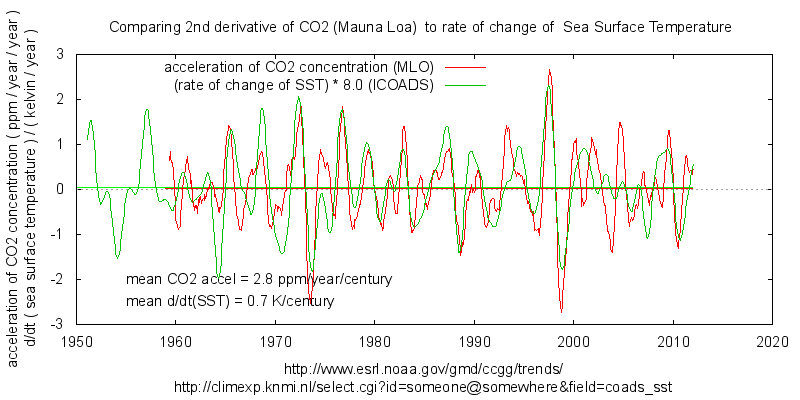
This can been by plotting the rate of change of CO2 against SST:
Or taking further derivatives of both quantities:
These comparisons show a rate of change of 8ppm/year/kelvin for inter-annual variation. This is the out-gassing of the well mixed surface layer of the oceans. Isolating the biggest spike in the record : the 1998 El Nino gives a similar 9ppm/year/kelvin sensitivity to temperature change.
This does not necessarily show the same thing is responsible for longer term changes, so some of the claims in the article are unsubstantiated.
BTW the scaling of the first graph was chosen to align the interdecadal changes and there is a ratio of about 3 ppm/year/kelvin rather than the stronger changes of the inter-annual scale. So the short term swings are seen larger than the swing in SST. It still allows to see the similarity.
The correlation is strongest during the late 20th c. warming.
Again, the phase of the annual cycle does not really justify this claim, though David is right to point out the importance of ozone. However, the attribution of the changes to CFC et co. is largely spurious as is the follow on conclusion that the Montreal Protocol is saving the world.
The temperature of the lower stratosphere , where the ozone layer resides, reveals the true cause of the late 20th c. loss of ozone: major stratospheric volcanic eruptions.
https://climategrog.wordpress.com/uah_tls_365d/
The subsequent recovery is largely due to natural regeneration and the lack any major eruptions since 1991. Sorry, UN, you did not save the world that time either. Try as you may to spin it.
Greg,
While the graphs show the correlation between temperature change and CO2 change, it is not the release from the oceans which causes the peaks in CO2 rate of change, it is mainly tropical vegetation as that is very sensitive to temperature and related droughts during El Niño conditions. That can be seen in the opposite CO2 and δ13C changes. If the releases were from the oceans, the CO2 and δ13C changes would parallel each other:
http://www.ferdinand-engelbeen.be/klimaat/klim_img/temp_dco2_d13C_mlo.jpg
The extra release followed by extra sinks (during La Niña’s and Pinatubos) in the tropics only forms a small variation of +/- 1.5 ppmv around the trend of 70 ppmv since Mauna Loa started.
Ferdinand:


For the last several years NOAA has an OCO-2 satellite measuring global CO2; a fact that NOAA strenuously avoids. Given the recent example of RSS, NOAA is likely pressuring staff to ‘control’ the OCO-2 data.
January 2015 to Feb. 15th 2015
Feb 16th to March 31st 2015
April 1 to May 15th 2015
May 16th to June 30th 2015
July 1st to August 15th 2015
August 16th to Sept. 22th 2015
showing CO2 over the entire year from September 2014 to October 2015
Forests and jungles may contribute most of a net CO2 increase over the course of a year; but there are significant movements of CO2 from and into the oceans over the courses of the seasons.
ATheoK,
Based on oxygen, δ13C and CO2 changes, one can deduce the main movements:
Vegetation: ~ 120 GtC (day) uptake and ~120 GtC release (part night release, part continuous decay).
The nightly expiration from leaves and soil and daylight photosynthesis are good measurable and especially under inversion. CO2 levels in a forest can reach 500-600 ppmv and higher at night. In daylight that rapidly drops to slightly below the bulk of the atmosphere, depending of stirring up the near-ground air layers by warming them up.
Most of the day/night change doesn’t reach the bulk of the atmosphere, only the daily difference, which over a season reaches ~60 GtC uptake (spring – summer – fall) and ~60 GtC release (fall – winter – spring).
The remainder is what rests at the end of the year: ~1 GtC more uptake than release.
The oceans have opposite movements: ~50 GtC release in summer months and ~50 GtC uptake in winter.
Besides that, there is a continuous flux of CO2 between upwelling deep ocean waters near the equator which are warming up and downwelling cold waters near the poles of ~40 GtC release and uptake.
The seasonal change in CO2 is entirely of the oceans surface, which currently takes ~0.5 GtC/year out of the atmosphere in winter more than it releases in summer, while the continuous flux is hardly influenced by temperature and removes ~3.5 GtC/year into the deep oceans to return some 1000 years later, if not mixed with the bulk of the deep oceans…
Globally, most of the CO2 changes in vegetation are in the NH, most of the SH changes are in the oceans. As both land and ocean and NH and SH show opposite CO2 movements, the net result is a global change of ~10 GtC (~5 ppmv) amplitude for a global (seasonal) change of ~1 K, most of it over land from vegetation in the NH.
My impression is that there are still a lot of problems with the satellite:
– The satellite measures only in daylight, rapid movements like photosynthesis are only momentary sampled (around midday) and underestimate average CO2 levels in forests.
– In general, the satellite measures levels, not fluxes.
– Even so there are quite large discrepancies: the largest sink into the deep oceans is in the N.E, Atlantic, where the Gulfstream ends and the THC sinks. According to the satellite, the yearly average levels there are one of the highest.
That is opposite to ocean measurements, where the calculated flux, based on local measured pCO2 differences between water and atmosphere and wind speed, the uptake is maximal and the CO2 levels in the atmosphere should thus be minimal… See:
http://www.pmel.noaa.gov/pubs/outstand/feel2331/mean.shtml
and the sea – air flux map:
http://www.pmel.noaa.gov/pubs/outstand/feel2331/images/fig06.jpg
Again Ferdinand?
You are living in a world of estimates which are mostly guesses (WAG).
Richard P. Feynman:
1) First it’s Ferrell cells move all of the CO2 to the poles, nearly instantly. But satellites do not sense the CO2 during movement. yeah right.
2) Then it’s don’t trust the satellite data, because it is only observations during the day.
3) Then it’s in forest measurements respiration increases CO2 concentrations at night, but photosynthesis will remove all the respired CO2 and then some the next day.
4) Then it’s “δ13C and CO2 changes” baffle gab; another estimate based on someone’s theory.
Etc. etc…
Anything but reality, huh?
The satellites represent the best method, and especially the best overall global method for sampling CO2.
Another climate “What if” dream model where people make models dance and sing their favorite CO2 movements.
Models are just some programmers best understanding of what the client wants; not world shaking data producers in lieu of reality.
Estimates are some deskbound bean counter’s best guess for what to tell the boss when asked. Estimates do not replace reality, ever.
ATheoK,
I suppose that we may agree that the satellite measures levels of CO2, not fluxes.
The ocean fluxes are calculated by measuring the pCO2 of the oceans (over three million samples up to now) and calculating the flux, which is directly proportional to the pCO2 difference between ocean waters and atmosphere. The other factor is wind speed, as simple diffusion of CO2 in water is very slow and wind speed makes that it mixes (much) faster. The wind factor was derived from:
In my opinion, that is not a best guess or estimates or theory, but theory tested in large lab conditions and adjusted to what it was in the real world.
The calculated flux in the N.E. Atlantic is based on real, observed data pCO2 data in water and air, where the wind factor also is based on observed real world data.
Even if the factor is wrong, fact is that the pCO2 difference in the N.E. Atlantic is the highest of the world (and wind speeds there are often extreme). It is the main sink for surface water into the deep, taking lots of CO2 (~40 GtC/year) with it.
That does conflict with the satellite data which averaged over a year show one of the highest CO2 levels in that area. Thus one of these two must be wrong. In my opinion the satellite, as higher levels in that area are impossible, as it is one of the largest sinks of CO2 in the world.
By looking again at the graphs, there is a possible cause, as mentioned in an earlier discussion about the OCO-2 data: in winter the main sink place is in the dark, thus not measured by the satellite. That can skew the yearly average results towards more CO2…
“Different physics” when co2 is doubled?
What is different?
It is all about heat transfer, isn’t it? Since all claims of absorption and temperature in the atmosphere are arguments about heat transfer?
A strange thing about any level of co2 is that its absorption of energy, and especially increased absorption, makes the temperature go up. This is the opposite of what we learn in heat transfer. If absorption of thermal energy increase, one of two things havet happened: either the hotter body got hotter or the colder body got colder.
The only thing that increase the transfer is bigger difference in temperature. Absorption of thermal energy is heat transfer, co2 is no exception. The claim is that increased absorption cause high temperaturen, this is the opposite of what physics tell us.
If absorption increase the temperature difference has increased, regardless of why absorption increased. De know that irradiation is constant so the change must be caused by the atmosphere getting colder. If the atmosphere got colder rather than the surface warming first, the larger delta T will result in higher rate of transfer from the surface to air, that will also lower surface temperature. A radiative imbalance is a result of either cooling of the atmosphere or heating of the surface. Never both. The system can only do one thing at a time, heat up or cool down. Increased absorption is equal to more transfer of heat from the surface. That will only cool both bodies.
There is reason for using non-absorbing gasses instead of co2 when making insulating Windows. An absorbing gas will transfer heat. Ir-absorption in a gas always transfer heat away from the heat source to a colder location. Absorption of IR in any gas above the surface will cool it, because any absorption of heat by anything else than the surface will heat the gas instead. And move the heat to a colder place, which is the opposite direction than towards the surface.
sludge,
Please read something about CO2 lasers: their temperature may go up to some 100°C. Despite that low temperature the IR beam does melt steel at 1200°C. Simply because one has laoded a lot of energy into the CO2 molecules which send that energy outwards as IR light, no matter its own temperature.
The same for the earth’s surface: that is heated by sunlight and that heat gets out as IR radiation, of which CO2 picks a part and distributes that in part to the neighboring O2 and N2 molecules, thus heating them up…
Still at height the air is colder than near ground, thus physics still hold: heat flows from warmer to colder objects and no energy is created or destroyed…
The CO2 laser analogy is bogus. You are comparing apples and oranges. How in the world can one compare a powered laser with the atmosphere? There is no comparison whatsoever. What’s next? An analogy of cool microwaves heating your dinner to 350 degrees F?
Try standing in an ice cave. Your body is being bombarded by a huge amount of IR radiation coming off the ice. Are you going to warm up?
SkepticGoneWild,
The analogy is apt for what sludge said: it is impossible that absorption of energy does increase the temperature of the atmosphere. That is simply wrong as good as expecting that the lower temperature of the laser will not cut steel…
Even in the case of standing in an ice cave: your body receives less IR from the ice than you emit yourself, so you are cooling down, but less fast than when you were standing in a fully transparant (for all wavelengths) box in space…
Sludge and SkepticGoneWild, go back to the books. Photons have no “temperature,” and you just go daffy trying to draw conclusions from a false concept. The CO2 in the atmosphere doesn’t get warmer from the IR: it both absorbs and RE-RADIATES infrared photons. No net change in temperature, so long as equilibrium conditions prevail. It would help if you think of the “greenhouse gases” as being a big beam-splitter for certain bands of the IR spectrum, casting half the photons back to the ground and the other half up into space. It is an insulator. The Earth’s SURFACE warms accordingly…and heats the atmosphere by contact and conduction.
Oh, yes. The ice cave. It is fair to say that your body is bombarding the ice with more IR than the ice is bestowing on you. You are getting cold and (maybe) the ice melts.
And high-powered lasers and the atmosphere? They interact very strongly. I should know; I designed laser weapons for a living.
SkepticGoneWild,
The comparison was apt for Sludge as he wrote:
The only thing that increase the transfer is bigger difference in temperature. Absorption of thermal energy is heat transfer, co2 is no exception. The claim is that increased absorption cause high temperaturen, this is the opposite of what physics tell us.
That is simply wrong as heat transfer by radiation may or may not be related to temperature. All depends of the existence or absence of an external source of energy. In the earth’s case the sun. That heats up te earth’s surface and that emits IR, depending of its temperature. When part of that IR is absorbed by CO2 in certain wavelenghts and if there are sufficient collusions with other moleculres (O2, N2), that part of the atmosphere heats up, regardless of its temperature of that moment. The same as what happens when steel is hit with the CO2 laser beam… Opposite, higher temperatures in the same layer may induce more energetic collissions with CO2 molecules, which increases the posiibility of exitation and sending out a photon. The balance then is a question of ratio between IR hits, sending IR out and collissions both ways… In general, GHGs heat the troposphere and cool the stratosphere.
If I stand in an ice cave, I do receive less IR from the walls than I emit myself, so I will cool down, but I will cool down less fast than when I am in a fully transparant (for all wavelengths) case in space, far away from the sun…
Michael,
What the hell? I did not draw any conclusions. I pointed out the lunacy of comparing heat transfer with a CO2 “powered” laser, and “non-powered” heat transfer in the atmosphere due to IR emitted from the earth’s surface.
If you actually read my post, I did not say photons had a temperature. And you accuse me of being daffy?
Ferdinand Engelbeen
October 11, 2016 at 11:31 am
“Please read something about CO2 lasers: their temperature may go up to some 100°C. Despite that low temperature the IR beam does melt steel at 1200°C. Simply because one has laoded a lot of energy into the CO2 molecules which send that energy outwards as IR light, no matter its own temperature.”
Ok, you should go back to making lasers again.
Do you seriously mean that a laser puts out more energy than goes in? Because that is what the claim is about co2. That the earth only gets 240W/m^2 and co2 is part of the reason that the surface suddenly has 390W/m^2. How do you do; 240W=390W with a gas that is cold as santas ass?
“The same for the earth’s surface: that is heated by sunlight and that heat gets out as IR radiation, of which CO2 picks a part and distributes that in part to the neighboring O2 and N2 molecules, thus heating them up…”
I know the theory. But there is a spectrum showing how co2 only absorbs. It is very clear, co2 absorbs and the intensity is drastically lowered in those wavelengths. A decrease in intensity does not cause heat anywhere.
“Still at height the air is colder than near ground, thus physics still hold: heat flows from warmer to colder objects and no energy is created or destroyed…”
Of course. Can you please give a reference to experimental studies showing how co2 increase the temperature of the surface heating the gas. Not a study that shows absorption, it has to show how temperature increase from the introduction of co2 in a system. Absorption is obvious, but I havent found a single study showing how co2 increase the temperature in a system by absorption.
Sludge:
It is very clear, co2 absorbs and the intensity is drastically lowered in those wavelengths. A decrease in intensity does not cause heat anywhere.
Sorry Sludge, the decrease in intensity is measured at the top of the atmosphere, that is where the outgoing energy is measured: less energy is leaving the earth in the wavelengths where CO2 is active. That means that the less energy going out is retained in the atmosphere where CO2 absorbed it and either distributed it to the other (non-GHG) molecules, thus heating up the atmosphere, or sent it out in all directions, including the surface, thus heating up the surface…
What is removed from the outgoing wavelengths must have been used somewhere to heat up something, or you are destroying energy…
Not a study that shows absorption, it has to show how temperature increase from the introduction of co2 in a system.
That was already proven by Tyndall in 1859… See;
https://en.wikipedia.org/wiki/John_Tyndall
and enlarge the picture. Heat waves were send through a gas mixture and if no IR is absorbed and re-emitted, nothing is sent back. If you add water vapor or CO2, some of the absorbed IR is sent back and heats a thermocouple which is what was read out.
The gas mixture itself also heats up, but as far as I remember, that wasn’t measured in that experiment.
SkepticGoneWild: My apology. It is difficult for me to scroll through these exchanges and tell who is on first base, and I mistakenly lumped you in with Sludge. But I think you are all laboring under a serious misconception that the CO2 in the atmosphere is “absorbing” the IR radiation and is heated thereby. What you have to realize is that the CO2 is emitting (or “un-absorbing”) as fast as it absorbs, and there is no net heating of the CO2. As I said above, this results in CO2 (and all other greenhouse gases) functioning as a beamsplitter, sending half the outbound radiation (in that spectral band) back to the surface of the Earth, to heat it up a little more than it would otherwise be. The atmosphere gets its temperature from the Earth’s surface, through conduction and convection. And, finally, it is perfectly fair to compare the physics of laser propagation with radiative heat transfer; it’s all the same thing. But not everyone understands how to apply the physics.
Sludge: I didn’t mention it before (hasty work), but the reason gases such as argon are used to fill insulating windows is because they are good thermal insulators. It has nothing to do with their properties regarding IR absorption.
I beg to differ, Willis. I think I did exactly what I set out to do, which was to answer the question “Does variation in atmospheric CO2 content cause corresponding variation in ambient temperature?” I wasn’t looking at long term trends, at all, and it would have made no difference if I had used a different time interval. The reason I chose 1975 to 1998 was that a) global temperature shot up during that interval by nearly one degree C (i.e., there was a very good likelihood that some sort of effect among the variables would show up during this interval), b) the Keeling curve was available for this period, and c) this was the time interval during which anthropogenic CFCs were massively introduced into the atmosphere. So, I was looking at month-to-month variability, and the annual cycle of CO2 production and use in the Keeling curve was an excellent example of that. I reasoned that if variability in atmospheric CO2 concentration affected temperature, then these monthly variations, just like variations that had any other cause, would show up in the annual temperature curve. I used averaged monthly values over the time period because I could then tell whether or not the average monthly value of atmospheric CO2 followed or preceded the average monthly value of the temperature curve. If the former preceded the latter (or was coincident in the same month with it), then my interpretation would have been that “yes, variations in CO2 could well be the cause of variations in temperature.” If, on the other hand, the peak in monthly average CO2 followed the monthly average peak in temperature, as in fact, it did, and by two months (March to May), I would have concluded that “no, variability in monthly average CO2 concentration could not possibly have caused corresponding variations in average monthly temperature,” which I, in fact, did. Sure, the variation over the annual cycle was only 6 ppm, but the point is that ANY variation in CO2 should have shown up in the temperature curve. Long term trend had nothing at all to do with it. I was only looking at immediate effects.
David Bennett Laing October 11, 2016 at 6:48 pm
Thanks for the reply, David. However, it appears you misunderstand my point. You have shown that in the short term (less than a year) the temperature both leads in time and causes the variation in CO2 levels. As you point out, this is due to the growth and decay cycles of plants, and has nothing to do with atmospheric absorption of longwave radiation..
What you have emphatically NOT done is to demonstrate whether or not in the longer term “variation[s] in atmospheric CO2 content cause corresponding variation in ambient temperature”. Not only have you not demonstrated that, you have presented no evidence at all regarding the effect of the change in atmospheric absorptivity on temperatures.
Best regards,
w.
No, Willis, I did NOT misunderstand your point, which is completely irrelevant to my analysis. I was NOT asking the question, “…whether or not IN THE LONGER TERM (my emphasis) ‘variation[s] in atmospheric CO2 content causes corresponding variation in ambient temperature’.” I was asking “Is ANY variation in atmospheric CO2 concentration reflected in temperature variations?” The annual respiration/decay cycle is one such variation, and I chose to use it as a convenient example. My analysis actually removed any long-term trends from the data sets I used, concentrating, instead, on the IMMEDIATE effects.My conclusion is that this particular sample I chose, from 1975 to 1998, when temperature shot up, indicating that “something was happening,” showed very little connection between this kind of variation in atmospheric CO2 and variations in warming. This is critically important information, which can then be applied to long term trends: “since it has been shown that CO2 has little effect on temperature (during the averaged annual cycle), i.e., that the two are essentially uncorrelated, then how can it be inferred that there is actually a LONG TERM trend between CO2 and temperature?”
David Bennett Laing October 12, 2016 at 4:30 am
Thanks, David. Let me try again.
You say “I was asking “Is ANY variation in atmospheric CO2 concentration reflected in temperature variations?” Perforce this must include the long-term effects as well as the short-term effects.
You also say “The annual respiration/decay cycle is one such variation, and I chose to use it as a convenient example.”
The problem is that you can’t simply extrapolate from one single convenient example of variation to “ANY variation” as you have done. You can’t generalize because often the short-term effect of something is quite different from the long-term effect. Let me give you an example that may clarify things.
The short-term effect of methamphetamine use is a feeling of strength and power and general well-being. Given that, can we conclude that long-time meth users will feel exceptionally strong and powerful and full of well-being?
To the contrary. Long-term meth use leads to fear, isolation, and paranoia. The long-term effects of meth use are very different, and operate on different principles, than the short-term effects.
And the same is true of CO2. The short-term effects are the increases and decreases in CO2 resulting from the annual temperature-related changes in growth and decay. But the long-term effects of CO2, whether large or small, are quite different. They result from changes in atmospheric absorption of upwelling longwave, an entirely different physical mechanism from that of the short-term variations.
So you cannot simply extrapolate from the short-term to the long-term. Your argument is the same as that of some first-time meth user insisting that “Meth can’t possibly be bad for me in the long run, because it makes me feel so good right now!”
I hope this clarifies my position,
w.
Willis, thank you for clarifying, I see where you’re headed, now. The problem with this is that, as I understand it, the relation originally devised by Svante Arrhenius in 1896 doesn’t differentiate between short- and long-term effects. It was simply a statement that a doubling of atmospheric CO2 concentration produces so many degrees of temperature rise. This is what Knut Angstrom tested in 1900, and he didn’t differentiate between short- and long-term effects, either; he simply tested the assumption as I rendered it above, and found very little effect. I’m doing the same with my graph, and simply addressing the question stated in my previous email: “does increasing CO2 have a warming effect (short- or long-term not differentiated) on air?” Again,as did Angstrom, I came out with very little effect.
Now, if there are, indeed, short- and long-term effects, you are alone in suggesting this differentiation, as far as I know, and it may be true, but it isn’t considered in my analysis, and further, I think that it needs to be established that there is, in fact, such a differentiation. If there is, then my analysis wouldn’t cover it, but if there is not, then my analysis should stand as the only hard data-based analysis of the question, as stated above, that exists since Angstrom, and it should be considered on that basis, i.e., without respect to the kind of differentiation that you imply. In short, I think that you, or someone, should make a data-based analysis designed to test the proposition that such a differentiation actually does exist.
Finally, I think that it is incumbent on you (or someone) to demonstrate that, for whatever reason, short-term effects are represented in my graph, but long-term effects would not be, and why this should be the case. Of course, you can do this on theoretical grounds, without experimentation or use of hard data, but I’m not sure that the above analogy with the effects of methamphetamine on the human body is sufficient.
Willis (second posted reply; the last one got lost for some unknown reason), I now see what you’re driving at. Neither Knut Angstrom nor Svante Arrhenius, as far as I know, differentiated between short-and long-term effects of CO2 on temperature, and therefore, my graph doesn’t take long-term effects into account, focusing instead on immediate ones.
If you think that there is, indeed, such a difference between short- and long-term effects, then I think this should be established by hard evidence before my graph and my conclusions can be faulted for not including both. Of course, your analogy with the effects of methamphetamine on the human body is interesting, but I suspect that some more pertinent proof of the differentiation would be in order!
Willis: In my first “lost post,” I was being thoughtlessly hasty, and I suggested that it was incumbent on you or someone to show why long-term effects weren’t represented in my graph. I can do that! Of course long-term effects aren’t represented, because I removed them. What I should have said appears in the second “lost post” (or in my third, if it ever shows up), and in the last sentence of my response to your first comment, “I was only looking at immediate effects.” Sorry for the confusion. My wife and I had just come home from leaf-peeping (glorious!), and I hadn’t yet had a chance to exchange my ball cap for my thinking cap!
Willis, this is a THIRD attempt to reply to your latest post! I now see what you’re driving at. First, my graph doesn’t take long-term effects into account, focusing instead on immediate ones, as did, as far as I know, Svante Arrhenius, Knut Angstrom, and more recently, Suki Manabe. Second, again, as far as I know, you’re the first to suggest that there’s a difference between short- and long-term effects, and the validity of that really needs to be established with hard data before my analysis can be reasonably faulted for leaving it out.
David,
What you don’t take into account is the magnitude of the effect of CO2 on temperature.
Temperature has a large effect on CO2 levels: short term (seasonal, year by year) 4-5 ppmv/K up to 16 ppmv/K over glacial-interglacial periods. The changes in CO2 follow temperature changes with a variable lag, months to millennia, depending of the source/sink of CO2 (yearly leave growth and wane, deep ocean warming/cooling).
Based on absorption bands, a doubling of CO2 (280 to 560 ppmv) gives an increase of 1 K in temperature, before any positive or negative feedbacks. That makes that an amplitude of 6 ppmv over the seasons is good for a temperature change of maximum 0.02 K in 6 months. In fact less, as that is a transient response and a full response in ocean waters needs far more time.
Moreover, the maximum CO2 levels are at minimum temperature and the minimum CO2 is at maximum temperature. Your graph shows a seasonal amplitude of about 11°C in the NH. All what the 6 ppmv CO2 amplitude may have done is a reduction of the original amplitude from 11.02°C to 11.00°C. Nobody can measure that difference in the real world for a whole hemisphere, including a year by year variability of several degrees…
In contrast, the long term change in CO2 is far higher (+110 ppmv) or theoretically already a 0.5 K increase in temperature over a period of 165 years. Long enough and high enough to be measurable (if there weren’t lots of confounding factors)…
Ferdinand Engelbeen: You seem to be arguing both sides, on the one hand talking about the temperature effects on CO2 (decreasing solubility in warmer water, presumably) and on the other, the effects of CO2 on temperature (the Arrhenius paradigm, apparently), but my graph considers only the question, “can variations in atmospheric CO2 content cause variations in temperature?” and the answer is no, it can’t because the regular May peak in variability due to organic activity occurs two months later than the maximum peak in temperature anomalies (March), but that ozone depletion could drive the latter because its maximum also occurs in March. It doesn’t consider magnitude of effects, which is what you seem to be talking about.
David,
I was only looking at the effect of 6 ppmv CO2 amplitude on temperature, which is -theoretically- 0.02 K, if you give it enough time to get in equilibrium. That is simply not measurable with the current equipment, not at all from ground stations and even not by satellites in the monthly noise,,,
Thus the fact that you don’t find any influence is no wonder, as it needs much more CO2 increase and much longer periods to be measurable…
On the other side, an increase in temperature early in the year will increase the decay of debris of the previous year(s) ánd increase the growth of vegetation, thus making the whole carbon cycle faster.
It would be nice to see the real figures for temperature and CO2 level anomalies i.s.o. percentages, so that the real influence of the increased temperature can be seen.
David,
In addition, human emissions are spread over a full year, somewhat higher in NH winter months than in summer months. If (winter) temperatures increase, the total increase in human CO2 shifts a little towards later months, thus increasing the CO2 anomaly to the right…
The bear peering through the buckwheat stalks is that there is no empirical evidence that atmospheric warming follows an atmospheric CO2 increase at any time scale. The lags increase in magnitude with increased time spans until looking at Antarctic and Greenland ice core data, there is an apparent lag of roughly 800 to 1,000 years. In fact the present increase in CO2, though presumably not the shifting stable-isotope mix, is a predictable out come of the Medieval Warm Period based on the empirical evidence from the ice cores. We have a serious conflict between apparently sound laboratory results and apparently sound empirical observations that have generated conflicting yet apparently sound laboratory data, and until that is explained, we will continue to hear this debate.
Duster: Right, but the problem is, and the reason why I constructed my graph, is that my colleague Peter Ward and I were unable to find, in a careful search of over 10,000 peer-reviewed articles relative to global warming, ANY experiment testing the Arrhenius relation that CO2 causes warming except for the well-known 1900 Angstrom experiments, in which little effect was found. In other words, the scientific community and the world at large have been taking the purely theoretical Arrhenius relation purely on faith, and that is a scientific no-no. I decided that the easiest and most straightforward way to test the theory was to take month-to-month variabilities in the hard data from the northern hemisphere from the period 1975 to 1998, when temperature shot up by almost 1 degree C, and see whether or not, due to their relative timing such variabilities in CO2 were capable of producing variations in temperature. Since the maximum in CO2 variability occurred two months after that in temperature, I therefore concluded that Angstrom was right in saying that there is little effect of CO2 variability on temperature.
This is rubbish. Obviously the seasons drive seasonal variation in both temperature and CO2. Obviously CO2 concentrations are lagging in Hawaii (partly because that is not where they are being produced and the gas isn’t mixed instantly across the globe). It is the underlying trend that needs to be investigated.
CFCs – what’s the proposed warming mechanism?
I would expect this level of analysis from warmists.
The warming mechanism in this hypothesis is additional high energy UV-B penetrating through to the surface due to reduced ozone in the stratosphere. It assumes increased CFCs have caused reduced ozone high in the stratosphere, it assumes more UV-B is penetrating to the surface, and is assumes that increasing low troposphere temps are evidence this hypothesis. If the temp record is evidence, then it’s very poor evidence. I think this hypothesis deserves a real measurement of the alleged drop in ozone, the alleged increased UV-B and the alleged increased CFCs. Until we see those measurements, count me skeptical.
It wasn’t in the article, but I was thinking the mechanism would be more O3 being formed lower in the atmosphere would create more nuclei for clouds to form around. And that would increase the temperature-moderating effect.
Mickey, see the article linked under my TLS graph just above , that addresses most of your questions.
“alleged drop in ozone”:
As attractive as this hypothesis may be to sceptics it fails miserably, because Ozone in the Atmosphere did NOT go back up with the banning of CFCs, in fact it has steadily been decreasing since 1957 with no obvious changes around the time of the ban or since.
Ozone levels are available just like CO2 levels, but no one ever talks about them as it proves what a waste of time banning cfcs was.
Plus of course they are lying about it having fixed the Ozone hole, which is much the same size as it ever was within it’s natural variations.
Phase can be informative, though it does require a deeper understanding that is displayed in the article.
The trouble with the Keeling curve is that it is basically a cumulative integral, this makes is rather flat and hides most of the information that it contains about nature and cause of the variation. We need to look at the rate of change to understand the changes causing that accumulation.
Note the pesky ‘plateau’ in d/dt ( CO2 ) , seems that the decadal scale rate of change also settles around an average of 2ppmv / year along with temperature stagnation.
conversely temperature is not rising in accordance with it being driven by CO2 since the accumlation of CO2 has not stagnated.
This leaves open the question of how much of the 2ppmv / year background rate is the residual of human emissions ( which are about twice that value ) and how much is longer term out-gassing from deeper ocean water which is not in equilibrium with the CO2 concentration at the ocean / air surface?
Soils deserve a lot more respect. They cover nearly 1/4 of the planet and represent a ONE WAY input to the atmosphere of 60 GtC/yr. Humans muster a one way atmospheric input of 10GtC/yr. Ocean/atmosphere CO2 flux is enormous, ~120 GtC/yr, but it goes BOTH WAYS, and the ocean appears to be currently a small net sink.
Greg,
The phase distribution and opposite CO2 and δ13C changes do show that vegetation is the main cause of the year by year variability of CO2 uptake (see the graph above), but the biosphere as a whole (plants and all animal life) is a net sink (~1 GtC/year) for CO2 as the oxygen use shows, thus is not the cause of the CO2 increase in the atmosphere. See:
http://www.bowdoin.edu/~mbattle/papers_posters_and_talks/BenderGBC2005.pdf
The oceans do absorb the rest of the difference between human emissions and what remains in the atmosphere (as quantity, not the original molecules), that is some 3.5 GtC/year, thus neither are contributing much CO2 to the atmosphere, except a small part due to warming oceans (~16 ppmv/K).
Well he does mention that he’s a “progressive,” so…
He also mentions that the most important thing to him is getting the science right, so less bigoted comments would be welcome. If more “progressives” were that objective we would not have a problem
A C Osborn
No, ozone has NOT been ‘falling steadily’ unless you are dumb enough to try to draw a straight line through it and that would be your failure, not anyone else’s.
It went down mainly in two hits caused by the two stratospheric eruptions. There has been some mild recovery since 1995 due to the slow process of natural replacement. This is the basis of disingenuous trumpet blowing by the UN calling Montreal the most successful international agreement ever and thus we must follow them now with Paris.
” no one ever talks about … ” , hardly.
Ad hominem. There’s plenty more to look at here than that.
Greg: The decline in total column ozone (TCO) in the lower stratosphere “in two hits,” as shown in your earlier post, above, is tentatively explained by my colleague, Peter Ward, on pp. 121-2 of his book “What Really Causes Global Warming?” He notes, as you do, that the “hits” were coincident with the massive eruptions of the stratovolcanoes El Chichon in 1982 and Pinatubo in 1991, but he also notes that both eruptions occurred within the period when CFCs were liberally sprayed into the atmosphere as propellants for hair spray, paint, etc. (1970-1998). He therefore attributes the general decline in total column ozone to two factors, 1) the emission of chlorine and bromine (as HCl and HBr) by the volcanoes, causing the “hits” and the steps, and the release of anthropogenic CFCs, causing a general downward trend in TCO, which was stopped during the ’90s by the Montreal Protocol (see the third graph in my post). This behavior of El Chichon and Pinatubo contributed to his conclusion that all volcanoes deliver Cl and Br to the lower stratosphere, causing thinning of ozone and consequent cooling of the lower stratosphere and warming of the troposphere by solar UV-B, but that sulfuric aerosols produced by explosive volcanoes overwhelm the warming effect, so that the net effect is that explosive volcanoes cool Earth, but that non-explosive ones warm Earth. This relation appears to hold rather well throughout Phanerozoic time.
I resemble that remark (that it’s rubbish). I was using the natural variation in atmospheric CO2 concentration caused by the photosynthetic activity and decay of plants in the northern hemisphere as an example of seasonal variability in the dataset against which to compare similar seasonal variations in temperature anomalies over the interval 1975 to 1998. I made the reasonable assumption that if a CO2 peak occurred in a preceding, or the same month, as a peak in temperature variability, then there is a strong possibility that the CO2 variability could have caused the temperature variability, but if it should occur in some later month, it certainly could not have caused an effect in a month prior.
CFCs accumulate on polar stratospheric clouds through the winter. In the northern hemisphere, sunlight returns in March to photodissociate CFCs, releasing chlorine, which depletes ozone catalytically. A thinner ozone layer admits more solar UV-B to Earth’s surface, and UV-B is 48 times hotter than Earth’s own infrared radiation, so it is therefore quite capable of causing warming.
It seems to me that most warmists accept the judgment of a large consensus of pedigreed climate scientists. As we all know, consensus is a tool of politicians, and it has no place in good science. In the Earth system, something either is or it isn’t, consensus be damned.
Unfortunately, you would have a hard time explaining how this nonsense about the hole in the ozone layer, which is over the South Pole, results in a steady average temperature in New Zealand of 12.6 degrees C for the last 150 years.
New Zealand is the the South Pole, isn’t it? Certainly seems to be from a Brisbane perspective.
@RoHa
October 10, 2016 at 6:29 pm: Always good to have the Oz perspective. Praise be for the Tasman Sea.
You seem to be ignoring the biggest players in all of this, the sun and the oceans. If CO2 really did affect climate one would expect that the increase in CO2 over the past 30 years would have caused an increase in the dry lapse rate in the troposphere but that has not happened.
Why would one expect that the increase in CO2 over the past 30 years would have caused an increase in the dry lapse rate?
Hi Roger, I think willhaas is following the line of thinking (not that I’m suggesting he believes it) set out by Manabe and Strickler, that a non-radiating atmosphere would be isothermal. If follows from that, that GHG concentrations affect the lapse rate, the old ‘warm the lower, cool the upper’ and hence modify the lapse according to total long wave opacity, even though there is no evidence to support this.
Correct. In this analysis, I was only concerned with the question of whether or not variations in atmospheric CO2 concentration could cause corresponding variations in temperature, and I concluded that they could not because their average monthly maxima occurred two months after the maxima in monthly temperature variation over the period of the study (1975 to 1998).
Interesting post
Your link between declining ozone in the NH and CFC’s, and then bringing into the argument the Ozone hole above Antarctica is presumptuous. The so called ozone hole was recorded and blame attributed to CFC’s more to do with commerce than science. There is no historical record of comparison or trend.
The loss of ozone above Antarctica is closely related to the AMO cycle. No more no less.
ozonebust: My analysis was concerned solely with the northern hemisphere, where the bulk of humanity is located, and therefore did not involve the southern hemisphere or the ozone hole over Antarctica.
“I took the NOAA record of northern hemisphere temperature anomalies…”
Is this really the best option? The anomalies have already had the monthly average subtracted out of them, and therefore any seasonal component has already been removed. I presume the average that was subtracted out was for the period 1950-1980, or something similar. This would explain why you are left with anything that resembles an annual cycle.
If I missed something, please someone point it out.
Also why is it hottest in March and coldest in October? In the Northern Hemisphere?
I always thought it was hottest in Summer and coldest in Winter [whichever hemisphere].
A perfect example of nonsense from correlation used as causation.
Just like AGW.
Still, correlations are fun.
Great article!
It’s the first one that I read that puts very clearly and reasonable cause for the anomalous increase in N. Pacific temperatures in 2014 and, later, created the coupling of heat pools to the surface to form the powerful El Nino of 2015.
This (big ENSO and temporary depletion of icecaps in both poles) happened despite the not so strong solar radiations of the present cycle, IMO, for two reasons:
/1/ the first peak of the cycle in 2011-12 had similar intensity as the second but it was relatively short lived, while the 2nd peak in 2014 and 2015 not only lasted longer but also had a very strong short range component, in particular in 2015,
http://sol.spacenvironment.net/~spacewx/data/e107_trend_plot.jpg
(where E10.7 is the integrated extreme ultraviolet flux from 1-105 nm),
from
http://www.spacewx.com/solar_cycle_trends.html
and
http://www.spacewx.com/e107_current.html
The relatively intense 2nd peak, I believe, importantly affected the Pacific temperatures and the Arctic ice – now we know, due depleted O3 in this period.
In this case, 2016 was just a natural consequence of the two previous years, if we only could “read” the facts properly then.
/2/ The eruption of Bardarbunga was in my mind also as one possible component of the overheat of the Pacific in 2014-15, but I didn’t have the data and analysis of the figure.1 of this article relating CO2 (I’m skeptical #1 about this gas), O3 (this is a gas that I had an intuition it could be behind the great oscillations of Earth’s climate, but had not connected the right dots) – and the seasonal variation of NH temperatures, which is the logical line connecting the various events of recent climate as following O3 but not CO2, as this article explains.
Again, great article, thanks to David Bennett Laing for taking the time to write it and share with us, and Anthony Watts for bringing it to our attention.
If I had to add anything to the analysis would only be with respect to the specific nuances of the present solar cycle, with a relatively strong 2014-15 2nd peak.
This is the first serious attempt that I have seen to explain the ‘pause’. Even if it is wrong, it has created a good discussion and I would like to see more such attempts.
I agree. This is Science, even if, perhaps especially* if, proven wrong.
* given the lock-step credulity of present day “climatologists.”
Thanks! Things do make sense when you look at all the data. Very glad to have your corroboration on this.
There is a problem with this hypothesis. The rate of warming from 1910 to 1940 was the same as 1975 to 1998.
There were no refrigerators then.
So???
“There is a problem with this hypothesis. The rate of warming from 1910 to 1940 was the same as 1975 to 1998.”
That’s my question, too.
CFC’s or CO2, it’s the same argument. Not a factor in the 1910-1940 era, yet the same amount of warming as 1975 to 1998.
Well, this is a nit, because I don’t disagree with your point, but the Frigidaire refrigerator was introduced in 1923, and R-12 refrigerant about a decade later.
http://bigchill.com/wp-content/uploads/2016/06/icebox-763×1024.png
Good point. Any explanation of a warming for two or three decades has to work for both the warnings of the 20th Century.
Both Ozone and CO2 work in both directions. If the ozone was decreased the energy in and out would both be affected.
The ozone hole over the Antarctic causes a lot of cooling. It is strongly affected by GCRs. I don’t see that presented in the article. While the hypothesis is interesting, it seems to be contradicted by the rather well-proven hypothesis of Prof Lu in Waterloo on ozone formation and destruction. The oceans play a major part in it because it is a major source of bromine.
Refrigerators became popular and common in the US, and a few other western countries, well before 1920 (perhaps in the 1880s?). CFC s were developed through a major industrial effort, I think around 1920, because the refrigerants then in use were very toxic. People, entire families, were killed in their homes from leaks and large numbers were becoming afraid to have refrigerators in their homes.
CFCs turned out to be totally non-toxic to every life form and completely non-reactive (within the troposphere, anyway): they react with nothing, a perfect environmental solution.
According to the story accepted even through today, the south pole ozone hole is seasonal. It only occurs – within the south polar vortex – in the early spring. Ozone levels quickly return to ‘normal’ once late spring temperatures rise and the polar vortex breaks down.
In site of all the publicity about extra UV and potential damaging results, I have never seen any mention of measurements of UV levels at the surface, which I look for in every article I come across talking about the ‘problem and/or its solution. If life is more dangerous because UV level became higher, other than over the pole, it should be simple to put a number on how much more UV reaches the ground relative to some other time (UV levels could be measured long before the southern ‘hole’ was discovered), but none of that crowd ever goes near such a question.
Were volcanos oozing + and – then too?
There was a series of non-explosive basaltic eruptions in the Pacific Rim during this interval, which is thought to have instigated, among other things, the Dust Bowl event in the western US. The warming during this interval ties in very nicely with the above analysis, including the persistence of relatively high temperatures due to the persistence of monatomic chlorine in the lower stratosphere. See the last illustration in the article.
David asks: “Do variations in CO2 actually cause significant global warming?”
If one really wants an answer to this question, it doesn’t make sense to study the planet earth to find an answer! Global temperature (anomalies) change 0.1 degC or more within a month. This is called unforced internal variability. ENSO caused unforced changes of this size or larger over many months in a row. The AMO appears to produce an oscillation of amplitude 0.2 degC over 60 years. The LIA, MWP, Roman periods don’t have obvious explanations either.
The place to learn about CO2 and radiation is in the laboratory, where WELL-CONTROLLED experiments have been performed long before the hysteria about AGW began. Those experiments (plus observations of our atmosphere) show that doubling CO2 should reduce radiative cooling to space by about 4 W/m2 (or 1.5%). If nothing else changed, our planet would need to warm about 1 degC to emit an additional 4 W/m2 to space. Of course, other things do happen. Given the extremely slow rate of change in CO2, the difficulties in measuring GMST, forced variability, and the other things (forcing) that might be occurring (the existence of “ozone-depleting gases doesn’t tell us how much ozone has changed), amateur efforts to assess the effect of CO2 on temperature are hopeless. Read Lewis and Curry (2014) and Otto et al (2013) for the best analysis of how much warming forcing likely produces. The former says 1-4 degC/doubling of CO2 or about 0.25-1 degC/W/m2 of forcing.
At a minimum, read these papers and explain why your approach is superior.
A lab experiment says little about the real atmosphere. For example, if the daily formation of clouds of all types advances by 3 minutes due to the CO2 trapped heat, and lasts 3 minutes more into the evening, who would notice? The maximum high temperature could remain the same. The profile would change, that’s all. We do not measure the daily profile, so we cannot average of the daily profiles. How about the nightly profiles? Nope.
My opinion is that the amount of warming will be no more than 1/2 of the lab amount. The natural system will simply adjust slightly. I doubt that we will ever separate the ‘natural’ from the ‘human caused’ temperature changes. The models have already been established as useless towards that end.
“For example, if the daily formation of clouds of all types advances by 3 minutes due to the CO2 trapped heat, and lasts 3 minutes more into the evening, who would notice?”
The CO2 does not “trap” heat. Nor does it “trap” radiation. Trapping heat is impossible (well known from the laws of thermodynamics). Trapping radiation (non-ionizing radiation like visible light, IR, microwaves, Terahertz waves, etc.) is possible. It simply requires a Faraday Cage (if you own a microwave oven you own a Faraday Cage). For a Faraday Cage to function is must have NO openings (dimensional or spectral) larger than 1/2 wavelength of the radiation. Any holes will allow the energy to eventually escape (to space in the case of the Earth).
The “Radiative Greenhouse Effect” merely forms a very very leaky Faraday Cage which simply delays by tens or hundreds of milliseconds the flow of energy through the Sun/Atmosphere/Earth Surface/Atmosphere/Energy Free void of Space. The energy alternates between visible (and some UV) light arriving at the surface then IR light leaving the surface and IR light returning again and again and perhaps again to the surface. All happening at the speed of light over distances of a few tens of miles.
As seen in all unbiased observations there is simply no correlation (or causation) between CO2 concentrations forcing (causing) higher average temperatures at a future time.
So, this analysis has moved the time frame forward from centuries and decades to a yearly analysis. The next step is to follow photons through the system on a nanosecond time scale. Once this is done it will be quite clear that “Greenhouse Gases” have no effect on the average temperature at the surface of the Earth.
Cheers, KevinK.
Thanks Kevin.
I like the term ‘trapped heat’ myself. The slight increase in back radiation most likely excites some water vapor molecules. Thus the heat gets captured.
So how does it escape? Same as before, through convection mostly, but just a bit earlier in the day etc. No thermodynamic laws being violated here.
Kevin K
“For a Faraday Cage to function is must have NO openings (dimensional or spectral) larger than 1/2 wavelength of the radiation.”
You have the right idea. The holes have to be less than 1/4 of a wavelength.
“As seen in all unbiased observations there is simply no correlation (or causation) between CO2 concentrations forcing (causing) higher average temperatures at a future time.”
Spot on.
KevinK wrote: “For example, if the daily formation of clouds of all types advances by 3 minutes due to the CO2 trapped heat, and lasts 3 minutes more into the evening, who would notice?”
Why will CO2 cause changes these changes in clouds?
I never said CO2 “traps” heat. I said the radiative flux to space will be reduced. You can use any laboratory IR spectrophotometer to demonstrate how CO2 reduces the amount of radiation that passes through it.
A Faraday cage is made from an electrical conductor. The atmosphere is not a electrical conductor. Water vapor and carbon dioxide in the atmosphere to do absorb infrared radiation.
Numerous records prove that CO2 is not the only factor that changes our climate. Laboratory experiments suggest that the changes in CO2 over the last half century should produce a modest change in temperature that is difficult to detect against the background of other changes that we have seen in the past (ENSO, LIA and MWP, for example). AR1 (1990) said that the expected warming from rising GHGs was comparable changes in temperature the planet had routinely experienced in the Holocene. After another 0.25 K of warming, AR4 said that at least 50% of observed warming was very likely due to rising GHGs.
Simple calculations show that a 1 W/m2 radiative imbalance (1/4 of a doubling) warms the atmosphere and mixed layer of the ocean (50 m) at an initial rate of 0.2 K/year. At the current rate of increase, 1/4 of a doubling takes 25 years. In the meantime, that rate slows down as the planet warms (Planck feedback) and as heat is transported below the mixed layer.
Seasonal, yearly and even decadal changes in temperature can not tell us anything useful about how much warming will occur after CO2 has doubled.
Suppose you careful tracked local temperature and the angle of the sun every day in July using the shadow of a very tall object. In most Julys, you would conclude that there is no relationship between the height of the sun above the horizon and local temperature. Nevertheless, you could prove from the daily change in radiation that the angle between the sun and the horizon should be important to temperature. If you continued your measurements into August, you might begin to see the relationship between seasonal changes in temperature and seasonal changes in local temperature. The nature of that relationship would still be obscure because maximum temperature lags solar insolation by about 1 month in the center of continents and more near and over the ocean (due to their heat capacities). The current situation with GHG-mediated climate change is currently analogous being in the middle of August with such measurements. The theory that the sun’s angle makes a difference to local temperature seems sound, the direction of the trend in temperature is become clear, but you don’t have a good idea of how cold it will be in winter. Only an idiot would claim that data from July proves winter doesn’t exist
The lab experiments don’t capture all of the various feedback loops involved.
@ECB
October 10, 2016 at 6:45 pm: But the hypothesised WV is not there. Nor the Hot Spot. Study Maxwell’s ‘Theory of Heat and referenced work. However, the daily water cycle you use is our thermostat. As an aside, I remember how our Supermarine Schneider Cup winners found evaporative cooling to the air to be the best system for efficiency overall. In the 1920s-30s.
Lab experiments hmmm.
Just 2 hrs ago I saw a program where they were experimenting on coral they had harvested from the Great Barrier Reef to see what added heat would do.
They intended to up the water temp in the coral-tanks by about 4 degrees.
Of course, seeing the tanks, it occurred to me, where is the current/ the waves/the new symbionts (symbionts provide 90% of the energy coral uses)?
And how do you deal with the effects of being harvested?
How reliable are lab experiments if they don’t include every variable?
Another similar example of bad experiment involves vitamin C and cancer last century. One researcher found it reduced the spread of cancer and another ‘replicated’ his experiment and found otherwise, so the use of vitamin C was rejected by the medical profession.
Of course the ‘replication’ gave the subjects the vitamin C orally for convenience whereas the original treatment gave it intra-venously.
You wonder what kind of medical ‘scientist’ would regard the digestive process as having no effect on nutrients.
Lab experiments hmmm.
ECB wrote: “A lab experiment says little about the real atmosphere.”
Frank replies: Seasonal changes in CO2 and recent decadal changes in ozone-destroying substances don’t tell us anything useful about CO2 and warming!
The laboratory experiment tells us how CO2 and ozone interacts with radiation. Radiation is the only way for heat from the sun to escape to space. Therefore CO2 plays an important role in warming the planet. Guaranteed. There is still plenty of room to argue about climate sensitivity – how much warming one might expect from doubling CO2. Laboratory experiments can’t tell us that.
The laboratory experiments tell us that seasonal changes in CO2 won’t produce enough change in radiative cooling to space to cause a detectable change in temperature. The seasonal change in CO2 is only 6 ppm, about 1/50th of a doubling (1.015^50 is about 2). If we expect 1-4 K of warming per doubling of CO2, we expect seasonal changes in CO2 to produce warming of 0.02-0.08 K, an amount which is much too small to reliably detect on a planet with huge local seasonal changes (10 K) in many locations – in addition to larger unforced variation in temperature (by chaotic processes like El Nino).
And we only expect to see that 0.02-0.08 K of warming at equilibrium, not immediately after the change in CO2. It is trivial to calculate that a 1 W/m2 radiative IMBALANCE warms the atmosphere and mixed layer of the ocean at an initial rate of 0.2 K/year. So the annual 6 ppm increase in CO2 will warm the planet at a rate of about 0.0013 K per month (with some enhancement from feedbacks).
4 ppm of each 6 ppm seasonal increase in CO2 goes away each summer in the NH, leaving a permanent 2 ppm increase that accumulates year after year. So while a transient 6 ppm change in CO2 can cause an undetectable change in temperature after six months, a 2 ppm/yr increase can build up over many decades – and slowly warm over many decades – to produce a change in temperature. Looking at historical data, Lewis and Curry estimate that a 1% annual increase in CO2 for 70 years (a doubling) will produce 1.3 K of warming. (The current increase is only 0.5%/yr.) None of the information in this post contradicts that conclusion.
Let me repeat. The best place to learn about CO2 and radiation – the only way HEAT enters and leaves the planet – is in the laboratory. Once one understands that process, one has a chance of properly interpreting phenomena one encounter in the real atmosphere. Without this background, cause and effect are impossible to correctly analyze amid the numerous processes that produce forced and unforced (chaos) changes in planetary temperature.
Frank (Oct 11): Laboratory experiments are simply substitutes for hard data from the Earth system. They are always simplifications of reality. The problem is that they are usually conceived on the basis of theory, such as the Arrhenius theory that a geometric increase in atmospheric CO2 produces an arithmetic increase in warming. If a laboratory experiment were devised to test this, it would be designed on the basis of this theory. With raw data from the Earth system, you can simply ask the question “Do variations in atmospheric CO2 actually cause variations in temperature?” and see what the CO2 and temperature data say about the matter. I did that and found that they cannot because in the real world, variations in atmospheric CO2 content follow peaks in temperature variability by two months, end of story.
Now, let’s ask another question: “Does greenhouse warming actually warm Earth?” The answer is no, because no object can warm itself with its own radiation. If it could, such an object would spontaneously warm up and quickly vaporize. Greenhouse warming is supposed to work because half of Earth’s infrared radiation that is absorbed by CO2 is radiated back to Earth, where it is supposedly absorbed, causing warming. The fact is that only radiation that is hotter than Earth can be absorbed (by the second law of thermodynamics), and Earth cannot emit radiation that is hotter than itself (by the first law). If greenhouse warming did work, it could only slow the rate of heat loss from the planet, just as a blanket can only slow the rate of heat loss from the human body. Because the human body has its own, metabolic heat source, such a blanket can only result in preventing heat loss up to 98.6 degrees F and no further. Therefore, if greenhouse warming did work, it could only heat Earth up to the temperature to which solar radiation heats the surface and no further. Model predictions of “runaway heating by CO2!” are therefore absolute nonsense.
The conclusion that greenhouse warming doesn’t work is therefore fully consistent with my graphic analysis.
Bravo David Bennett Laing:
You have just summed up the thermodynamic arguments of many of the “Slayers” on why the Arrhenius radiative greenhouse effect “doesn’t work,” and which is indeed consistent with your graphical analysis.
hockeyschtick: Tx!
Related new post today demonstrates a large gravito-thermal greenhouse effect in Earth’s atmosphere
http://hockeyschtick.blogspot.com/2016/10/new-paper-demonstrates-large-gravito.html
Sure, because it completely sidesteps the assumptions of virtually untested theory (such as Arrhenius’s assumption, disproven by Angstrom in 1900 by his WELL-CONTROLLED laboratory experiments, that CO2 causes warming, used by Lewis and Curry and Otto) and looks at only the raw data from the Earth system, which show that CO2 couldn’t cause significant warming, but that another driver, effective chlorine, could. We should reserve theory for a synthesis of what Earth’s data show us, not the other way around.
The foregoing comment is a reply to Frank, Oct 10, 3:26 PM.
Since Mr. Laing’s personal page shows he is the same earnest and idealistic progressive who tweets at https://twitter.com/DavidBLaing , he must be either a remarkably brave human being or perhaps even rarer, a free spirit with little interest in opinions, emotions, or possible defamation and abuse coming from persons he does not really know personally. Seafaring will do that for you.
I’m pretty sure he understands that no matter how scientifically open and accepting he may be of criticism from the climate science establishment, he is now and will be forevermore a Climate Change Denier, a traitor to the earth and generations unborn, a tool of big oil, and a persona non grata to the entire progressive movement including 90% of the media and professoriate. Why? Because earnest and honest or not, he has reached the wrong conclusion.
On the other hand, looking at his Twitter postings — not updated in a year — Mr. Laing appears to identify quite warmly with his fellows in the progressive movement, with only a minor faux pas in linking to a video on the ozone depletion warming theory — but of course that’s just a link. This essay may produce a radical change in the emotional climate of those associated with his progressive activism: an irreversible cooling.
The temperature anomalies are most pronounced with the rise in November through to March, primarily as the result of atmospheric transport into the high NH latitudes and Arctic region. There are papers describing this effect.
If the mid to high NH CO2 site annual curves are looked at with an enquiring mind, it will be noted that the profile stops rising and has a near flat table top from late Novemeber through to March, at a time where human outputs are highest. These sites are not recording an accumulation, they are recording a continuous transport into the Arctic vortex. It is this transport that takes temperature, also affecting sea ice area. There is also a flow southward into the Equatorial area.
A problem. The warming from about 1920 to about 1945 is essentially indistinguishable to that from about 1975-2000. The former cannot have been caused by rising CO2 comcentration (even IPCC AR4 SPM figure 4 said so). And it cannot have been caused by CFCs since those had not been invented yet. So there is provably a large natural component this analysis does not account for. Which cannot be assumed to have miraculously disappeared in the later period.
A second problem. The actual spectral energy contribution of UV-B is small. Yes, the wavelengths have higher energy than visible light and can cause sunburn. But there is much less of it than visible light energy. Look at any spectral intensity graph.
Refrigerators became popular and common in the US, and a few other western countries, well before 1920 (perhaps in the 1880s?). CFC s were developed through a major industrial effort, I think around 1920, because the refrigerants then in use were very toxic. People, entire families, were killed in their homes from leaks and large numbers were becoming afraid to have refrigerators in their homes.
CFCs turned out to be totally non-toxic to every life form and completely non-reactive (within the troposphere, anyway): they react with nothing, a perfect environmental solution.
According to the story accepted even through today, the south pole ozone hole is seasonal. It only occurs – within the south polar vortex – in the early spring. Ozone levels quickly return to ‘normal’ once late spring temperatures rise and the polar vortex breaks down.
In site of all the publicity about extra UV and potential damaging results, I have never seen any mention of measurements of UV levels at the surface, which I look for in every article I come across talking about the ‘problem and/or its solution. If life is more dangerous because UV level became higher, other than over the pole, it should be simple to put a number on how much more UV reaches the ground relative to some other time (UV levels could be measured long before the southern ‘hole’ was discovered), but none of that crowd ever goes near such a question.
Genuine question – how much chlorine gas was released during WW1, how long could this have remained in the atmosphere and could this account for any of this? Are there any other substances released from large scale artillery usage?
SteveT
During WWI, it was not unheard of for a million rounds of artillery ammunition to be expended in a day or two, during a particular offensive. I’m fairly sure this was “smokeless” powder, which had fewer particulates when exploded. Probably released a lot of nitrate gases, plus CO2 and H2O, maybe some CO. At 10# explosives average per shell, and figuring 3:1 dry weight to gas formation, that would be ~15,000 short tons of gases given off per million rounds. Plus particulates–fine shrapnel, unburnt filler, dirt from craters, bits of Tommy or Fritz, and various amounts of lead, arsenic, mercury, and zinc. The French “Red Zone” of WWI contaminated soil is still about 50 sq. miles, last I heard. Don’t drink the water, there. Or eat the plants or wildlife. Or kick any metal objects sticking up out of the soil.
One key difference is that UV penetrates deep into the ocean and does not just heat the two micron layer which will likely evaporate instantaneously. Absorption happens one photon at a time and heats one molecule at a time. Any excited molecule is going to have a higher probability of escaping the surface. Much of the energy from absorbed IR will be transfered almost instantly to the neighbouring air and be wisked away by wind and contribute to an increase in atmospheric convection: the same energy finds a different route to the tropopause where it will cause a corresponding increase in cloud.
A few people have raised the question of whether it is even possible to heat well ventilated water with infra-rouge radiation.
AFAIK, this have never been properly addressed or tested experimentally.
ristvan,
No matter the quantities of chlorine (and NOx in a mix with chlorine), that didn’t reach the ozone layer as it is readily washed out by rain. But indeed there are several natural components that do reach the ozone layer and are responsible for the natural decay of ozone between the equator – where most is formed – and the poles.
Methylchloride, although largely destroyed before it reaches the ozone layer is produced in such huge quantities by wood rotting fungi that a part effectively comes high enough to be the main natural destructor of ozone…
The main boom in CFC use was in WWII when lots of experiments were done in the deserts and airco was necessary to keep people at work…
Ferdinand, when you say most ozone is formed near the equator and decays towards the poles, I presume you are speaking of stratospheric ozone. Yet surface ozone seems also strongly concentrated at the equator, at least according to Modtran. Modtran even has a special input variable for it. Assuming that tropical concentration of stratospheric ozone production means strong attenuation of UV before it reaches the surface, why doesn’t fungal methyl chloride, which seemingly should also be concentrated in the tropics; eat this up?
gymnosperm,
Methylchloride itself, as far as know, doesn’t destroy ozone (but ground based ozone may help destroy methylchloride by attacking the hydrogen in it…), chlorine needs to be split off first and that happens more and more at higher elevations. In general the split of of chlorine is minimal in the troposphere, and most organic chemicals are destroyed before they reach the stratosphere, but methylchloride is produced in such huge quantities that part of it still reaches the stratosphere… See:
https://www.ncbi.nlm.nih.gov/pubmed/12738255
ristvan (Oct 10): Not a problem. You are, of course, correct that the warming wasn’t caused by CFCs. There was unusual basaltic (non-explosive) volcanic activity on the Pacific Rim during that time, which delivered effective chlorine (see my third graph for definition) to the atmosphere. One of its effects was the dust bowl in the western US, and another was global warming during that interval, according to this model.
Your second point is not a problem, either. solar UV-B is 48 times more intense than Earth’s IR absorbed by CO2, and hence of much greater effect. The actual amount of UV-B delivered is shown in a graphic by Sasha Madronich in a 1993 paper. See graph #5 in https://ozonedepletiontheory.info/primary-cause-of-warming.html.
This appears to be straight from Peter ward site..http://ozonedepletiontheory.info/ozone-distribution.html
A better place to for impact ozone has Erl happ site. https://reality348.wordpress.com
Cheers.
Macha, yes, the basic argument seems to come straight out of Peter Ward’s voluminous writings on the subject (https://ozonedepletiontheory.info/publications-ozone-depletion.html). However, I don’t recall Laing’s Figure 2 analysis in Ward’s publications.
I edited and troubleshot the whole work (“what Really Causes Global Warming?”, I wrote the Foreword, and my graph appears on p. 150.
Since the anomalies already take out about 6 degrees of seasonal variability (caused by greater land mass in northern hemisphere), wouldn’t they also be taking out any regular seasonal variability you are trying to pick up with your analysis?
So filter out the annual cycle and you find much the same thing on inter-annual scales. See my graphs above.
The greater land mass in the northern hemisphere does not cause the variations in CO2, ozone depletion, and warming. They are caused by the bioutilization of CO2, by introduction of monatomic chlorine to the stratosphere by CFCs and volcanoes, and probably by monatomic chlorine, respectively. I used the records of these variables from the northern hemisphere because the CO2 variability record coincides with the most complete ozone record, that for Arosa, Switzerland, and because the northern hemisphere record for temperature would be expected to respond to one of these variables, not the southern, in which the CO2 variability is six moths out of phase with the northern, and because most of the anthropogenic influence on climate is in the northern hemisphere, which has most of Earth’s landmasses.
Interesting indeed, but as pointed out above, correlation seems tacitly to be assumed to be causation. Nevertheless very interesting ideas. I shall have to try to find the original monthly atmospheric concentration data for the other gasses mentioned and run my own analyses – as I always attempt to do.
This may help:
https://climategrog.wordpress.com/uah_tls_365d/
Good. I tried to make it clear that my analysis proved nothing except the impossibility of any significant effect from CO2 on temperature.
“When ozone is depleted, more UV-B can penetrate to Earth’s surface.”
More vitamin D. There’s that.
yam
My skin specialist is a happy man, he has more business on hand and coming down the pipeline. I am trying to steer my grand children in that direction. I have not met a poor one. In New Zealand it is really noticable. Travellers from the NH come and get sunburnt, not realising the fierce nature of the sun.
Today the Nor westerlies / westerlies are prevalant and rattling the doors and windows. The flow of atmosphere from the NH to the south is very noticable in October and November.
Fierce sunlight for thin atmospheric ozone?
Correct. I live on the East coast mid way up the South Island. The ocean flows up from the South, even in winter I personally wear a wetsuit. The wind comes off the ocean and is very cooling giving a false sense of temperature. When standing with no shirt on in summer, the cold wind can turn you blue on one side and the hot sun red on the other (burning). Slight exageration but you get the meaning.
Should be “even in summer” – winter I stay out of the ocean
@Ozonebust
Thanks. Not an abstract issue to you, I guess.
Yep, South Island is much nearer Antarctica than Europe. How “fierce” was the sun in 1930?
All the CFC / ozone bullshit now means that we are not allowed to work outside without a T-shirt according to frigging EU health and safely regs.
My skin is now no longer allowed to increase its natural protection , melanin, during the spring time ready for the summer. It has to stay winter white all year round.
Butt out !!
My understanding is that UV-A is actually more damaging to the skin than UV-B, and UV-A penetrates glass. I also understand that daily MODERATE UV-B exposure (less than causes sunburn) is protective against actinic keratoses, largely because it stimulates the body to produce Vitamin D.
Adding some context to the experiment of Angstrom, with reference to the 1900 paper
http://members.casema.nl/errenwijlens/co2/angstrom1900/index.html
BTW, the 15 micron absorption curve on the page is a model, not a measured spectrum
Tx!
If a man-made cause for late 20th century warming, whatever there actually was, be sought in our emissions or lack thereof, then look no farther than pollution controls which reduced particulates in the air, especially of the NH from the 1970s, followed by the liberation of Eastern Europe from Soviet anti-environmentalism. That is until the Chinese and Indian economies took off and started to reproduce the dark, Satanic, coal-fired Dickensian mills of the 19th century.
Chimp: Why don’t you do a study on the effect of this on temperature, similar to mine? Your results would be interesting, to say the least.
Interesting hypothesis perhaps worth of more investigation, though as others have said there has to be some large natural component in the warming over the first half of the 20th century.
It would be interesting to track the eruptions of Pinatubo-like explosive stratovolcanoes and “Cowabunga”-like non explosive volcanoes over the period…
Lucius: As I commented above, several natural, non-explosive, chlorine- and bromine-releasing eruptions occurred early in the century.