Guest opinion: Dr. Tim Ball
We create crude global wind pattern maps (Figure 1). The problem is they are theoretical and based on a false premise known as the three cell global circulation pattern.

Figure 1
The empirical evidence does not support the three cell system, yet, like the greenhouse analogy, it still appears in most textbooks. Figure 2 is from NOAA’s “Fun for kids” current website.

One of the best recent (1997) reconstructions shows the complexity (Figure 3).

What effectively disappeared in the better approximation, or at best is a seasonal phenomenon, is the Ferrel Cell. The diagram indicates its transitory nature by labelling it the “indirect” Ferrel Cell. Again the diagram shows average conditions for both Hemispheres, but there is a considerable difference between them because of the different land water configurations. The Southern Hemisphere structure is more basic because the Antarctic continent effectively occupies all the area within the Antarctic Circle and is surrounded by ocean. That situation provides some limited information about conditions along the edge of the massive continental glaciers that existed during the Pleistocene.
Figure 4 shows the extent of the glaciation in the Northern Hemisphere. Just from the albedo differences alone, it indicates a world dramatically different than today. Then, consider the extent of the seasonal snow and sea-ice cover, which we cannot retroactively recreate. In fact, we are unable to agree on the extent of Arctic sea-ice even from satellite images.

The glaciers grind and erode the surface as they move, especially when the base layer encapsulates rocks and boulders. This leaves a smooth surface exposed when the glacier melts (Figure 5). The glacier grinds much of the material down to what is called “Rock Flour” (Figure 6a) and 6b shows it spilling into a pro-glacier lake. It all washes out in front of the glacier onto the outwash plain.

Figure 5: Author’s photograph of Fur Trade explorer Samuel Hearne’s graffiti scratched on the glacially smoothed rock at Churchill Manitoba. Note the individual striations from the glacier that indicate the direction of ice movement.
Here the rock flour and finer material are picked up and blown away from the retreating glacier by very powerful winds. These are created by katabatic flow, that is created by the cold air drainage from the glacier. The material is deposited downwind in vast areas called Loess (Figure 7).


I know about katabatic winds from flying Search and Rescue in Arctic Canada and around the glaciers on Ellesmere and Baffin Island, but especially during trips into Thule on the northwest coast of Greenland. These winds are very strong. Cape Dennison in Antarctica has monthly mean wind speeds of 24.5 m/s (88 kph) and annual mean of 19.3 m/s (70 kph). Imagine the strength of the winds blowing out from the combined Laurentian and Cordilleran ice sheet, which was larger in surface area than the current Antarctic ice sheet and up to 3.2 km thick in northeastern Canada. That depth is estimated from isostatic adjustments, but the ice thickness overall is far less certain, making model reconstruction more difficult.
How would all this alter global wind patterns? Both the North American and Scandinavian-Siberian ice sheets are in the zone of the prevailing westerlies and the polar easterlies. These winds, including the Polar Jet, determine the weather patterns for the middle latitude zone from 35° to 65° latitude. The katabatic flow is predominantly north/south at right angles to the overall west/east circulation
We are unable to model the global wind and weather patterns today because of lack of basic weather data like temperature, precipitation, and atmospheric pressure. It is obvious they cannot recreate the conditions when the global wind patterns were disturbed by the conditions prevailing when these massive ice sheets existed.
A major failure of the computer models is they were never validated. It used to be called hindsight forecasting. It requires running the computer back to a known climate period and accurately recreating that condition. The modelers claim they can recreate past conditions, but what they do is simply tweak the model until it matches what they think were the conditions.
You don’t need to go back 20,000 years to see the problem. Early in the climate war, when skeptics identified the lack of data, the inaccuracy of the record, and the inability of the models to recreate previous climates, there was the problem of the cooling from 1940 to 1980. The models could not recreate those conditions. The problem was made worse for the AGW proponents because the pattern of known data for the historical and 20th century record was inverse to their hypothesis. For the historical record, it forced them to produce false data, like the ‘hockey stick.’ In the 20th century, contrarily, the greatest warming occurred from 1900 to 1940 when human CO2 production was low. During the cooling from 1940 to 1980 human production of CO2 increased the most.
The tweaked solution was to increase sulfate levels until the model results matched the cooling. As with most of what they do, the answer must have a human cause and sulfates from industrial production were ideal. The problem is after 1980 sulfate levels continued to increase but global temperature started to increase.
We have insufficient data to build or validate the models in the modern record. There is even less to validate them for the peak of the Ice Age. We end up with the bizarre situation that we can’t prove with validation that today’s models don’t work. However, it doesn’t matter because we know they don’t because of their failed forecasts. Frighteningly, none of this stops the Intergovernmental Panel on Climate Change (IPCC) and our governments telling us they work. No wonder people are rejecting leaders and politicians of all stripes on all matters. They confirm the comment that you can tell when politicians lie because their lips are moving.
To the author, who said: “The empirical evidence does not support the three cell system, yet, like the greenhouse analogy, it still appears in most textbooks.”
The reason it’s still around is simply because it provides a convenient starting point for understanding large-scale circulation for those new to the concepts involved. However, when I was being taught this model in grade school back in the 70s-80s we were told “This is NOT how it actually works, but this will give you an idea.” (A college-level idea of similar usefulness is that of wet- & dry-air lapse rates: NO air mass is purely dry, nor purely saturated, but it still demonstrates the principles involved.)
In the real world, the middle of the “ideal” diagram is disrupted by a number of natural, well-understood processes to the point of rendering the model useless… and so we were told even back in the day. Whether they still tell folks this or not, who knows, but anyone still using the 3-cell model as the basis for even general
predictionsprojections is doing it wrong.“..there was the problem of the cooling from 1940 to 1980. The models could not recreate those conditions.”
UAH lower trop shows the north pole cooling from Dec 1978 to Mar 1995. No doubt because of a positive NAO regime. The models say that rising greenhouse gases increases positive NAO, yet negative NAO increased from the mid 1990’s, which when taken to its logical conclusion implies that total climate forcings have actually declined since 1995.
http://www.ipcc.ch/publications_and_data/ar4/wg1/en/ch10s10-3-5-6.html
“Shows North Pole cooling ….”
That’s interesting – I can only find reference to “Globe” “NH” “SH” and “Tropics” – and besides UAH only “measures” between +\- 85 deg.
Well, there is only 1 Mkm^2 area between 85 north and the pole, so that :coverage to 85 degrees” means 512/514 Mkm^2 of the earth’s surface IS adequately and continuously surveyed by the satellite. Even at sea ice MINIMUM of 4Mkm^2, the air temperature over 3/4 the arctic sea ice IS measured properly by today’s satellites. At arctic sea ice maximum, air temperatures over 13/14 of the arctic sea ice IS measured properly. And, of course, ALL of the antarctic sea ice “air temperatures” are measured all of the time.
That still does not explain how Ulric extracted dat from the North Pole out of the NH data.
And re data over the poles this is what RSS say…..
“We do not provide monthly means poleward of 82.5 degrees (or south of 70S for TLT) due to difficulties in merging measurements in these regions.”
Northern polar ‘region’, not literally the north pole. The column marked ‘NoPol’…
http://www.nsstc.uah.edu/data/msu/v6.0beta/tlt/uahncdc_lt_6.0beta5.txt
UAH lt NoPol Ocean Dec 1978 to Mar 1995:
And NoPol Land: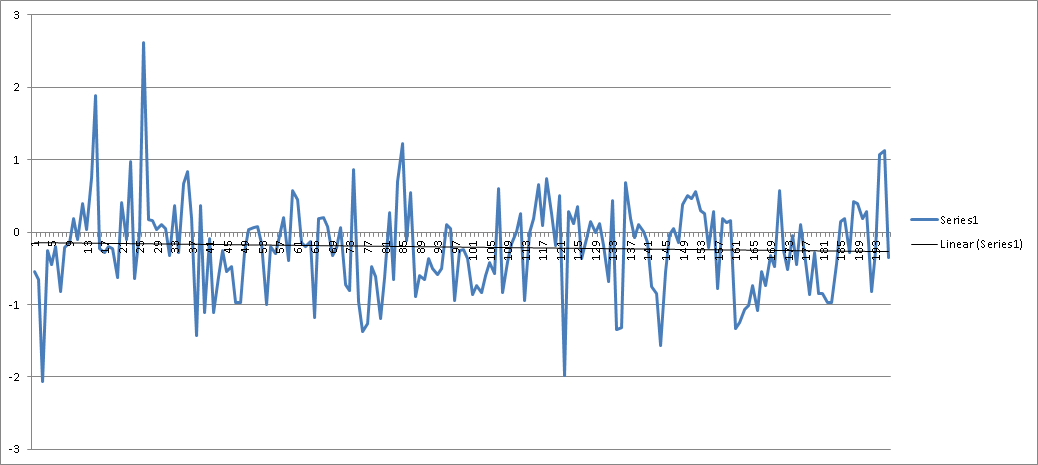
Thank you Ulric.
And we can’t prove that Bertrand Russell’s Cosmic Teapot does not exist.
About the greatest warming period of the 20th century being 1900-1940: I just tried WFT, choosing HadCRUT3 because it has less modern warming than HadCRUT4 and GISS. What I plotted is at: http://woodfortrees.org/graph/hadcrut3gl/from:1900/to:1940/plot/hadcrut3gl/from:1970/to:2000/plot/hadcrut3gl/from:1900/to:1940/trend/plot/hadcrut3gl/from:1970/to:2000/trend
While I’m at it, how about comparing 1900-1940 to the most recent period of the same length starting with a year that is a multiple of 10 to make the comparison apples-to-apples?
http://woodfortrees.org/graph/hadcrut3gl/from:1900/to:1940/plot/hadcrut3gl/from:1970/to:2010/plot/hadcrut3gl/from:1900/to:1940/trend/plot/hadcrut3gl/from:1970/to:2010/trend
Or you might even try to start each segment at the point where the actual warming began (1915 and 1975)
http://woodfortrees.org/graph/hadcrut3gl/from:1915/to:1945/plot/hadcrut3gl/from:1975/to:2005/plot/hadcrut3gl/from:1915/to:1945/trend/plot/hadcrut3gl/from:1975/to:2005/trend
But of course an apple can only end on a zero.
Notice by the way how uncannily similar those two segments are, even to the number and location of short-term dips and peaks. The main difference is that the very long but less intense 1939-42 Nino does not show up as strongly as the short, sharp 1997-98 one does.
If we adjust those charts to put the highpoint of the 1930’s, and the 1998 highpoint on the same horizontal line, then we will have a much more accurate picture of the real surface temperature chart profile.
According to the Climate Change Gurus, the 1930’s were hotter than 1998. Which means we have been in a temperature downtrend since the 1930’s, which continues to this very day.
So sad to read this stuff. So sad. Cold front 9 km thick such as in Figure 3…
I don’t know why you say that. The average height of the PFJ is around 30,000 ft and an active CF can certainly be that thick. At least in layers and with embedded Cb.
The cold air mass behind the front is not 9 km high.
The tropopause is at 9k marking the top of the polar air.
You have little clue about the lower tropospheric circulation… Try satellite and measures of the thickness of these polar air masses and come back.
LOL
Tom now you are being rude. Bless.
I was meteorologist with the UKMO for 32 years.
I’m pretty sure I’ve forgotten more about lower troposheric circulation than you know.
You don’t get to brief RAF aircrew otherwise my friend.
http://ddata.over-blog.com/xxxyyy/2/32/25/79/Leroux-Global-and-Planetary-Change-1993.pdf
NASA defines top of atmosphere as 100 km and the location of the radiation flux balance.
http://earthobservatory.nasa.gov/IOTD/view.php?id=7373
Could some please offer some perspective on a related point? Mike Maguire posted far above ( 09/17 @ur momisugly 6:39 pm) in his summary of some video that low level humidity is increasing. The whole panic over climate feedback depends on this. Yet I have read very credible reports that humidity measurements from balloon do not support increasing humidity. For the little data I looked at about 20 years ago I had noticed a trend of rising humidity in surface stations from Western North America (why I was interested in this I can explain if anyone cares). Could someone please summarize what measurements actually show?
There is this paper….
http://www.metoffice.gov.uk/hadobs/hadth/McCarthy_2009.pdf
Which says in part in the abstract…..
“Adjusted trends, accounting for documented and undocumented break points and their uncertainty, across the extratropical Northern Hemisphere lower and midtroposphere show warming of 0.1–0.4 K decade21 and moistening on the order of 1%–5% decade21 since 1970. There is little or no change in the observed relative humidity in the same period, consistent with climate model expectation of a positive water vapor feedback in the extratropics with near-constant relative humidity.”
Interesting paper to be sure. Thanks. They do spend a lot of time discussing how problematic the data set is, and how they go about correcting these problems. This brought to mind a thought. There are stories aplenty about researchers building apparatus, and hiding the internal workings even from themselves in hopes of avoiding bias. In this paper the researchers almost immediately begin discussing “spurious drying trends” and, while I am not disputing their thinking, and the need for the adjustments they propose, it is true that they expect, in advance, a moistening trend and probably prefer to find one as well. Looks like plenty of room for spurious corrections to enter their efforts.
In the 20th century, contrarily, the greatest warming occurred from 1900 to 1940 when human CO2 production was low.
===========
Ice ages begin (cooling) when CO2 is highest and they end (warming) when CO2 is lowest.
What the paleo record tells us is that high CO2 causes cooling and low CO2 causes warming. Or, that CO2 is not the cause, but rather the result.
There is no other alternative, given that the past record of temperature and CO2 is correct. Either the GHG theory is wrong, or the theory confuses cause and effect.
http://alanbetts.com/image/1/284/0/uploads/vostok3curves-1276876924.jpg
Dr Ball,
You correctly highlight that the role of continental icecaps in altering the pattern of wind flow is the crucial climatic difference between ice age and inter-glacial times. This Wikipedia Commons map shows the high average elevation of the modern icecaps of Greenland and Antarctica. The former icecaps would clearly have had a similar elevation and climatic impact.
You mention having personal flying experience of the power of katabatic winds and consider the effect of that these winds from the former ice domes over North America and Northern Europe had in creating loess dust deposits. Katabatic winds clearly also had a role in creating the ice raft events seen the sedimentary record of the North Atlantic ocean and may also explain the temperature instabilities inferred from these records.
Another curious feature of the ice age world is that the average elevation of all the continental land surfaces is effectively increased by 120 metres due to the lower sea level datum at the last glacial maximum. Consequently the average surface temperature for all areas will be decreased by 0.75C, assuming a standard environmental lapse rate applies.
TLMango September 17, 2016 at 12:10 pm ?w=884
…Tim, you’ve got it absolutely right.
It is all about shifting atmospheric mass and pressure.
Erl Happ is doing this same topic today. Folks can get a double
dose of great science. reality348.wordpress…
———————————————————–
Yes, Erl is doing a very similar topic today…very interesting. Something Ren has been trying to tell us for some time now, too.
Figure 2 indicates that as the neutron count increases surface pressure falls away in high southern latitudes. The surface pressure response appears to lag the neutron count by about a week. It is inferred that ionisation by cosmic rays enables the production of ozone that in turn absorbs long wave radiation from the Earth, enhancing differences in the density of the air and driving polar cyclone activity that is responsible for shifts in atmospheric mass.
https://reality348.wordpress.com/2016/09/12/39-influence-of-cosmic-rays-on-the-global-circulation-of-the-atmosphere-and-surface-temperature/
Thank you,Dr.Ball. I to have flown SAR from the B.C. Rockies to Coppermine to Frobisher Bay (Iqualit) to the North Pole, and have walked on many,many miles of it. Remote,hostile,and totally unfriendly to what us modern day humans call livable. Yet life abounds. At Eureka,you never walked from your Quonset hut 30 feet to the mess hall without a rifle(Arctic wolves love fresh food). I have pieces of petrified wood from Ellsmere Island dated by UofA at over 30 million years old. I have pieces of “rose stone” only found in two places on earth,the Canadian island of Ellsmere and Siberia. Things and our world was way different 300 million years ago. Indications seem to say we a bit further south then now.
Funny thing about air that circulates – it totally negates the Greenhouse effect. Rising air cools significantly according the the Gas Laws in what Thermodynamics call the Adiabatic Process.
I like the idea of a global average surface windspeed, and how it could be shown to have increased/decreased …. to ‘prove’ global warming. One could do the same with a global average surface pressure, and also a global average rainfall.
Of course nobody would take these numbers as having any real meaning, yet some believe that a global average surface temperature number really does have significance ….