Guest essay by George White
Feedback is the most misunderstood topic in climate science and this misunderstanding extends to both sides of the debate. This is disturbing because the theoretical support for substantial warming cause by man’s CO2 emissions depends exclusively on the ability of positive feedback to amplify something small (3.7 W/m2 of forcing from doubling CO2) into something large (a 3C surface temperature rise).
What makes a 3C temperature increase relatively large compared to the forcing asserted to cause it is the difference between the equivalent emissions of a black body surface at the approximate average temperature of the planet (287K) and the equivalent emissions of a surface 3C warmer. Based on the Stefan-Boltzmann Law, the difference in equivalent emissions exceeds 16 W/m2 and for that surface to emit this much more, it must be receiving an equal amount. Independent of the specific origin of the more than 12 W/m2 of required surface input in excess of the 3.7 W/m2 of input forcing, the amplification required exceeds a factor of 4. One thing that’s clear is that the atmosphere has no internal sources of power, thus all of the power driving the 12 W/m2 of additional surface emissions must be coming from feedback. This fact alone is sufficient to falsify claims of a high sensitivity since it’s impossible for 3.7 W/m2 of stimulus entering a passive system to result in more W/m2 of feedback than it provides as input unless Conservation of Energy is violated. Climate science obfuscates this contradiction by considering only temperature and not the equivalent emissions of a temperature, thus a sensitivity of 0.8C per W/m2 sounds plausible, yet in terms of joules, 4.3 W/m2 of incremental surface emissions per W/m2 of forcing does not, especially considering that each W/m2 of incident solar energy results in only 1.6 W/m2 of net surface emissions.
Theoretically, positive feedback can provide the required amplification, but only if the system being modeled conforms to the many assumptions that predicated Bode’s control theory, originally developed in the 1940’s as a tool for designing linear amplifiers using vacuum tubes.
Hansen was the first to apply Bode’s analysis towards quantifying climate system feedback in his 1984 paper. Schlesinger quickly followed with a paper to ‘correct’ some of Hansen’s errors but actually made it worse. This faulty analysis has been canonized by the IPCC since AR1 and the few related papers that followed simply restate Schlesinger’s analysis using different variable names. An example is Roe’s 2009 paper on climate feedback which will be referred to below.
While Bode’s analysis provides the framework to achieve the required amplification, it can only do so under the specific conditions outlined in the first two paragraphs of his book. One of these conditions is the requirement for linear behavior between the input and output of the modeled network and another is the presence of linear vacuum tube elements with an implicit power supply that provides active gain which add energy to the output above and beyond what’s supplied by the input stimulus.
It should be self evident that the Hansen/Schlesinger mapping to Bode violates both of these preconditions. First is that the input to the feedback network is forcing, expressed in W/m2 while the output is in temperature, expressed in degrees K and that the relationship between W/m2 and degrees K, as given by the Stefan-Boltzmann Law is very non linear. When the relationship between the input and output of an amplifier becomes non linear, Bode’s formulation no longer applies and the gain becomes a function of the input rather than being strictly a function of the open loop gain and feedback. An example of this is when an audio amplifier starts to clip. The open loop gain and feedback remain constant, yet the closed loop gain steadily decreases as the input increases.
If a stimulus is applied to a complex, yet completely passive RLC circuit, all the nodes will wiggle, but this can never be considered equivalent to the behavior of an active system. Bode’s assumption of active amplification is not relevant to the climate either. Many confuse the dynamics of weather as an indicator of an active system, but in the context of Bode, active and passive have very specific meanings. Passive means that there are no other sources of input other than the stimulus, which for the climate is the W/m2 of forcing arriving from the Sun, while active means the system has powered gain driven by an implicit, internal power source. An important result of Bode’s analysis is that a passive system is unconditionally stable which precludes the possibility of runaway positive feedback.
The difference between a passive system and an active system is like the difference between manual steering and power steering. Manual steering is a passive system that achieves force multiplication (gain) by a combinations of gears, levers and pivots as energy is conserved between the steering wheel and the tires. Power steering is an active system that positively reinforces arm muscles by adding energy to the system from a hydraulic power source driven by the engine. The climate is a passive system that manifests surface temperature amplification by delaying surface emissions and returning them to the surface some time in the future where they are combined with new incident power from the Sun. It’s these joules of energy being delayed and returned back to the surface that comprises the physical manifestation of climate system feedback. This feedback is tangible, which for the climate is expressed in W/m2 which are added to the new input from the Sun also quantified as W/m2. Watts are joules per second and first principles requires joules to be conserved.
Bode’s feedback model removes the requirement of Conservation of Energy between the input and output of the system. This is the result of assuming an external power supply will provide as much output as required. This isn’t valid for a passive system like the climate where solar input is the only source of power and thus COE must be accounted for. Unlike an active amplifier which measures the input and feedback to determine how much output to deliver from an unlimited source, a passive system consumes its input and feedback to produce its output. Disconnecting the input and output from the requirements of COE makes sensitivities that violate COE seem plausible and this is the only reason that such an unreasonably high sensitivity can be accepted. When COE is added to the analysis, the maximum possible sensitivity becomes less than the lower limit claimed by the IPCC.
Technically speaking, the model proposed by Hansen called the system input a change in forcing and its output a change in surface temperature. For the linear systems modeled by Bode’s equations, the absolute and incremental gain are the same and independent of the magnitude of the input or output. For the climate system feedback model, this is an invalid assumption owing to the non linearity between W/m2 of input and degrees K of output, where the ratio of a change in output temperature per change in input forcing depends on the starting temperature. To get around this, it’s asserted that the system is approximately linear, but the feedback formulation sets the reference temperature to 255K and while the relationship between power and temperature is approximately linear on either side of 255K, the current surface temperature of 287K is too far from the reference for the assumption of approximate linearity to be approximately true.
The reason its been so hard for climate science to get this right is that there are many co-dependent and reinforcing errors in the mapping from Bode to the climate system which confuses many into thinking that the model is reasonable. However; without these errors, Bode’s model simply can not support the required amplification. Without this support for substantial climate change caused by man, the IPCC and the self serving consensus driven by its reports collapses and to many on that side of the argument, this is an unfathomable consequence, especially given the political ramifications.
In addition to failing to honor the prerequisite assumptions made by Bode, there are other errors regarding how Bode’s variables were mapped into climate related variables. This led to an arithmetic error that provided faulty support for a potentially high sensitivity which was never questioned due to confirmation bias. This arithmetic error has to do Hansen’s failure to understand the difference between the what Bode calls the feedback fraction and what he calls the feedback factor and this 3 decade old error is still with us today.
The feedback fraction is the fraction of output fed back to the input and is a dimensionless fraction between -1 and 1 spanning a range from 100% negative feedback to 100% positive feedback. The 100% limits arise because you can not feed back more than is coming out of the system in the first place.
Bode defines the feedback factor as the reduction in the open loop gain that arises as the result of feedback. This arises from Bode’s gain equation which he states as,
ER = E0 μ/(1 – μβ)
Where E0 is the input to the system (forcing), ER is the output of the system (the surface temperature), μ is the open loop gain (reference sensitivity, λ0 per Roe, 2008) and β is the feedback fraction which corresponds to feedback coefficients expressed with units of W/m2 of feedback per degree K. Bode labels the closed loop gain eθ which is calculated as eθ = ER/E0 = μ/(1 – μβ) and calculates the feedback factor as eθ/μ = 1/(1 – μβ) which is the reduction in μ that results from the application β. The most important aspect of this equation is the μ on both sides of the equals sign. Bode then makes a simplification assuming that μ >> 1 and β < 0, both of which are true for linear amplifiers and asserts that μβ by itself can also be considered the approximate ‘feedback factor’. Modern amplifier design ignores this altogether as the effective μ of modern amplifiers is on the order of many millions and as μ approaches infinity, μ/(1 – μβ) approaches -1/β (the feedback fraction) and the feedback factor becomes infinite.
To adjust the gain equation for COE, the power applied as feedback, Erβ, must be subtracted from the output since feedback power can not also contribute to the available output. The gain equation that is applicable to the climate becomes,
ER = E0 μ/(1 – μβ) – Erβ
Climate science incorrectly considers λ0 times an empirical coefficient, c1, as the metric to quantify feedback, considers their product to be equivalent to Bode’s μβ and calls this the ‘feedback factor’. Again, Bode’s assumptions were not honored since the climate system μ is very close to 1, and in fact is exactly 1 for an ideal black body, thus the feedback factor would really be 1 – λ0 c1. While a compensating error added the 1 back to the equation, it didn’t fix the misunderstanding that led to the arithmetic error in the first place.
The arithmetic error arises when to get the units to line up and ostensibly conform to Bode, Roe defines the feedback factor f = λ0c1 (per Hansen and Schlesinger). If the sum of the input and feedback (the input to the gain block) is J, the output of the gain block is J*λ0. Roe’s assignment of the feedback factor infers that that c1 = f/λ0. Multiplying the output of the feedback network by f/λ0 (c1) produces a feedback term equal to Jλ0f/λ0. The λ0 cancels leading to a feedback term quantified as Jf, where f becomes equivalent to Bode’s β when μ is 1 and quantifies both the fraction of output and the fraction of J returned as feedback. The specific arithmetic error is assuming that the open loop gain is both λ0 and 1 at the same time. This is illustrated in figure 1.

 |
‘
Figure 1
To illustrate the problem further, what μβ is actually quantifying is the post feedback influence of the input of the gain block, J, since the μ term amplifies the input while β takes a fraction of it and returns it as feedback. Conventional climate system feedback assumes that μβ is quantifying the effect feedback has on the output which is only true when μ is 1 and the input and output of the gain block are the same. A more accurate block diagram that represents the consensus climate science feedback model is shown in figure 2.
 |
Figure 2
Since the relevant open loop gain is a dimensionless 1, the output of the feedback network must be dimensionally the same as the input otherwise the input plus some fraction of the output can not be summed. The result is that what climate science calls the pre-feedback sensitivity, or the open loop gain, λ0, is no more than a scale factor applied to the required output in W/m2 converting it to a change in temperature. In other words, λ0 is outside of the feedback loop and unaffected by feedback, positive or negative. Calling λ0 the sensitivity before feedback is incorrect because it has nothing whatsoever to do with the feedback loop being modeled whose gain (sensitivity) is what’s being quantified.
This leads to another error which is with Roe’s calculation of the system gain, which he considers equivalent to Bode’s closed loop gain, eθ. He calculates this as the ratio of two sensitivities. The post feedback sensitivity divided by the zero feedback sensitivity. This implies that feedback amplifies the sensitivity which is not what Bode’s model is modeling. It models the amplification applied to an input stimulus to produce an output, where the input is forcing and the output is temperature. While feedback and gain are related, this is a fixed relationship and its the result of this fixed relationship that Bode is modeling. Climate science unfixes this relationship and considers Bode’s analysis to apply.
The justification for calculating the closed loop gain in this way comes from Schlesinger, who rationalized that gain could have dimensions because the ratio of gains is dimensionless. Of course, this assumed that the feedback network was modeling a sensitivity input and a sensitivity output, where feedback was modifying the resulting sensitivity while what is actually being modeled is how the surface temperature is affected by incremental forcing and not how feedback is affecting the sensitivity.
Had Hansen and Schlesinger gotten this right in the first place, CAGW would be a footnote warning about jumping to premature conclusions and not an extremely expensive and divisive political issue with either a for or against position in nearly every political platform in the world.
In conclusion, there can be no doubt that the mapping from a Bode feedback system to the climate is irreconcilably broken. Without the ability to claim amplification from large positive feedback, the IPCC looses the only theoretical basis it has for its overstated sensitivity and unless someone invents new physics that transforms 1 W/m^2 of forcing into 4.3 W/m^2 of surface emissions and that doesn’t violate Conservation Of Energy, claims of catastrophic effects from CO2 emissions will become as quaint as an Earth centric Universe.
References
1) IPCC reports, definition of forcing, AR5, figure 8.1
2) Bode H, Network Analysis and Feedback Amplifier Design
assumption of external power supply and active gain, 31 section 3.2
gain equation, 32 equation 3-3
real definition of sensitivity, 52-57 (sensitivity of gain to component drift)
2a) effects of consuming input power, 56, section 4.10
impedance assumptions, 66-71, section 5.2 – 5.6
a passive circuit is always stable, 108
definition of input (forcing) 31
3) Hansen, J., A. Lacis, D. Rind, G. Russell, P. Stone, I. Fung, R. Ruedy, and J. Lerner, 1984: Climate sensitivity: Analysis of feedback mechanisms. In Climate Processes and Climate Sensitivity, AGU Geophysical Monograph 29, Maurice Ewing Vol. 5. J.E. Hansen, and T. Takahashi, Eds. American Geophysical Union, 130-163.
4) M. E. Schlesinger (ed.), Physically-Based Modeling and Simulations of Climate and Climatic Change – Part II, 653-735
5) Michael E. Schlesinger. Physically-based Modelling and Simulation of Climate and Climatic Change (NATO Advanced Study Institute on Physical-Based Modelling ed.). Springer. p. 627. ISBN 90-277-2789-9
6) Jerard Roe. Feedbacks Timescales and Seeing Red, Annual Review of Earth Planet Science 2009, 37:93-115
Discover more from Watts Up With That?
Subscribe to get the latest posts sent to your email.
Feedback systems are absolute pigs for human minds to comprehend – the classic being chickens and eggs. Which came first, what created what?
The temptation is always to break open the feedback loop and see what happens. This always results in disaster as it unleashes the huge open loop gain inside the system which promptly shoots off and destroys itself.
[In electronic systems (maybe a UK thing) we talk about ‘magic smoke’. This is stuff contained in all electronic components and stay there when they are working correctly and is released when something goes wrong. Is carbon dioxide ‘magic smoke’?]
Positive feedback for alarmists happens whenever they take a bath/shower or maybe visit a sauna.
If you leave your brain outside in the hallway, it is entirely obvious in those places that warm temperatures are synonymous with high humidity. Hence some warming of ‘the planet’ creates more water vapour etc etc, we know the rest.
But the positive feedback there comes from using the same energy twice (as Willis does in his steel greenhouse and other places). Some amount of energy will raise the temp or it will evaporate some water – it cannot do both – not least when dealing with water because of its huge latent heat capacity. Evaporating water always cools things because there is nothing else in the known universe with such a high heat capacity. The problem with water is that it is too common.
So, heat radiates up from the dirt into the sky. It interacts with GHG substances and returns to the dirt where it raises the temp. (Note: no mention ever that the dirt cooled when the heat left – see another fail in the thinking)
then the GHG substance sends the heat back down and it warms the dirt. Seems plausible. But, it cannot do any warming unless the GHG substance is warmer than the dirt. It is the quality of the radiation that matter, not the quantity. The alert amongst us will wonder why the heat bothered going up into the sky, why did it not just stay down here among the dirt and make it hot? Also,every time this up-going radiation interacts with a GHG molecule, it is a tiny heat engine, turning heat into mechanical motion. In the absence of an infinite heatsink at zero Kelvin, these interactions are always less than 100% efficient. IOW the upwelling photons are being smashed to bits as they go up. They become more numerous but each of lower energy/longer wavelength = colder, further reducing their chances of returning to the dirt and raising its temperature. By the time they are smashed/degraded to below the cosmic background, we haven’t a hope in he11 of seeing them. Does CERES see that far down.
And so to the biggest feedback fail of all.
Is it not obvious that the actions/amount/availability of water in any given place controls the climate of that place. Totally obvious over the ocean.
Over land, plants control the water, while alive above the surface but even more so when there is 10 times more dead plant material in the top 2 feet of dirt.
Water/plants control the climate and climate determines what weather you get. weather being daily and annual temp extremes/ranges, wind and cloud amounts.
Weather thus determines temperature and (as we’re hearing a lot about Planck and Boltzmann recently) temperature determines radiation. LONG WAVE RADIATION DOES NOT PRODUCE CLIMATE
The confusion comes because SOLAR radiation seems to have something to do with it.
EVERYTHING in the climate debate is ass about t1t.
Oh but you say, what about deserts? They have cr4p climate so no plants grow there.
Wrong.
The place is a desert because there are no plants there and the lack of plants creates the desert, its ensuing weather systems and what we all imagine to be its ‘climate’
Plants historically were in all the deserts, they just exhausted the local rock of all the required nutrients, that’s why deserts are always made of sand.
Just like the ozone debacle. Maybe ozone does protect from ultraviolet but it is actually produced by UV acting on diatomic (ordinary) oxygen.
Again, the cart there was put before the horse and so it is here…
I am a sceptic, but I gain the impression (from the comments on this article and other articles in the last few weeks on feedbacks and ECS) that many sceptics misunderstand the so called positve feedback.
The positive feedback is nothing more than a reduction in the strength of what remains in summation a negative feedback operating on the climate system.
Thus warmists may claim that say clouds are a positive feedback.Whether that claim is true or not, what they are claiming is that the effect of clouds is to reduce what remains still in summation a negative feedback acting on the climate system.
It is important to bear in mind that we are talking about the reduction in strength of a net negative feedback, not the appearance and application of a net positive feedback on the system
RV, well said. The feedbacks are the first derivative with respect to T (and indirectly therefore with respect to log delta CO2) of the primary effects of water vapor (warming) and clouds (cooling) with the net ~balanced at Earths absolute temperature circa 1950, with cloud albedo providing the necessary primary damping function at that temperature.
Richard,
The best way I’ve found to consider feedback is as the delayed return of surface emissions back to the surface to be combined which are then combined with new solar energy. This return of joules is the physical manifestation of feedback and joules must be conserved, therefore joules returned as feedback can not also contribute to the joules of ultimate output until they pass through the ‘gain block’ again. This is the missing COE constraint.
The atmosphere is kind of like a badly terminated transmission line, where some fraction of the energy entering from the surface is bounced back to the source as a standing wave manifested by delay and the rest ultimately finds its way to the other end and exits into space.
We used to say that electronics runs on smoke. Haven’t you noticed that whenever you let the smoke out, it stops working.
As a sceptic (which is a 2 way street), i am so glad that Nick Stokes has a very different style to that of Stephen Mosher.
There was a time when I used to look forward to reading SM’s responses but these past few years his response is usually little more than drive bys and adds little if anything to the debate. His comments, however, on Climate etc (Judith Curry’s site) are more informative. A pity he does not adopt the same style here.
Nick Stokes on the other hand almost always brings something of substance to the debate. His comments are always well worth reading and considering.
This site is all the better for warmists, like Nick Stokes, who are prepared to take up the debate and I would like to thank Nick Stokes for the time and effort he puts in. Long may it continue.
I appreciate Nick Stokes’ input, too.
He’s got more on the ball than a fadeaway in the stretch.
===============
“I would like to thank”
Thanks, Richard Verney
yep, sorry. This just won’t do. The appeal to CoE constraints as somehow invalidating greenhouse theory is 100% wrong. Only if you accept the wrong premise is it worth going beyond the first para. Nick S has a handle on why.
And this is a skeptic talking.
Yes, in my opinion wrong assumptions about feedbacks are where it all falls down ( and the basic 1deg +/-0,2 deg due to CO2 greenhouse alone won’t frighten anybody at all, despite the pointless verbiage from evcricket and others at the top of the thread ) but this piece adds nothing to our understanding.
ps – entirely endorse Richard Verney’s comment on the nature of the debate, including his assessment of Nick’s contributions and S. Mosher’s
mothcatcher,
How do you come up with thinking that I’m trying to invalidate greenhouse theory? I’m only invalidating the use of Bode to support the possibility of large amplification from positive feedback. It just happens that without this support, the case for CAGW falls apart.
If you consider each of the 239 W/m^2 of average incident power from the Sun to be treated equally, each results in only about 1.61 W/m^2 of surface emissions consequential to its equivalent temperature and while equivalent and actual temperatures may differ, they are close enough for the purposes of this discussion. GHG’s and clouds are making the surface warmer than it would be otherwise, where do you think the extra 0.61 W/m^2 of surface emissions is coming from?
What you should have learned is exactly how climate science has misused Bode’s analysis to support an otherwise unsupportable sensitivity.
Based on the Stefan-Boltzmann Law, the difference in equivalent emissions exceeds 16 W/m2 and for that surface to emit this much more, it must be receiving an equal amount. Independent of the specific origin of the more than 12 W/m2 of required surface input in excess of the 3.7 W/m2 of input forcing, the amplification required exceeds a factor of 4. One thing that’s clear is that the atmosphere has no internal sources of power, thus all of the power driving the 12 W/m2 of additional surface emissions must be coming from feedback
Totally false. The source of power is the sun, which drops IIRC around 100W/sq meter on the earth, and all that is required to modulate the temperature of the earth is to retain somewhat more, or somewhat less of it.
The AGW proposition is simply that CO2 allows a little more to be retained. So in terms of equivalent black body radiation, the surface us a little warmer, and the ‘radiating surface’, theoretical or otherwise, is a little cooler.
In principle all that is needed to do this, is to put a tinfoil hat on the earth and keep it over the night time side of the planet. Same daytime radiation in, almost no night time radiation out at all.
A warming earth would be showing *less* radiation to space and orbiting satellites than a cooling one.
A warming earth – for a constant sun input, has to have a cooler radiation spectrum emission. The whole point is that implies some kind of intervention in the atmosphere, between hotter ground, and – say – infinitely cooler cloud tops.
The earth is not a closed system it has radiation in and out. Neither is it homogeneous. Obviously overall what comes in must match what goes out for temperature stability, but even that is an issue, because the earth still retains its heat of formation, after billions of years. But in essence all that s required for climate change is that the thermal content of the atmosphere changes its distribution. WE have for example a colder S Pole and a warmer N pole. Perhaps we have a warmer surface at the expense of a colder stratosphere. Or a warmer sea surface at the expense of a colder deep ocean.
Leo
What we don’t have is confirmation of the required hotspot.
Surface layer warming (atmosphere) is supposed to be due to more IR photons from a higher layer of the atmosphere (roughly the same stuff). How could this happen unless there is an increase in atmospheric temperature aloft.
But the increase in temperature of the atmosphere results in more photons both upward and downward. So the rise in temperature aloft exceeds the rise in the surface layer. This demands extra power from within the atmosphere to maintain the increased temperature: where does this energy come from. The Enhanced Greenhouse Effect is an exercise in creating energy from nowhere.
@ur momisugly Leo Smith
September 8, 2016 at 3:02 am: It is because it is not a closed system, and of the Gas Laws, that CAGW is not discernable. Never possible, so not even a Dead Duck.
Leo,
The solar power is the explicit input to the model, also referred to as the stimulus and the forcing. It’s not the implicit infinite supply powering the gain assumed by Bode’s analysis. Bode assumes vacuum tube gain elements complete with an implicit, infinite source of power to supply the required output. This unrecognized assumption is the only reason that such an absurdly high sensitivity can be accepted by the IPCC.
From Bode:
The first sentence in chapter 1 of Bode’s book states,
“The networks to be considered consist of ordinary lumped
inductances, resistances and capacities, together with vacuum tubes.”
It goes on to say,
“For purposes of discussion the tubes will be replaced by equivalent
structures consisting of ordinary circuit elements connected between
the accessible terminals, together with a source of current or voltage
to represent the amplification of the tube.”
The first sentence of the second paragraph states,
“It will be assumed throughout that all the elements are linear.”
George
The post claims that the Earth system is passive. This is not the way I see it. To me the Sun is a constant current source and the Earth system can be modeled with passive components like resistors and capacitors. However, the values of those components change as the albedo changes. Over the planet as a whole, the albedo is fairly constant, but in any specific location it is highly variable. By itself, that makes the system active.
In addition, while the Sun acts like a constant current source, at any specific location it turns on and off daily and the noon time strength at the surface changes with the seasons.
Add to this the obvious nonlinearity of the T^4 relation and the climate system is obviously non-passive with a net negative feedback.
To be clear, my definition of “passive” is that the values of the component parts are fixed. If you model the atmosphere as a capacitor being charged thru a resistor – that would be passive. But when the amount of the greenhouse gases change, that changes the value of the resistor, similar to how the voltage on the base of a transistor changes the current flowing through it. Therefore, since the values actually do change, it is inappropriate to try and use a passive model.
The charging capacitor model is probably accurate. That’s not what this post is saying. There are no equivalent active gain blocks available to the atmosphere, only the passive systems you describe. Changing the time constant of your circuit will change the temperature day by day, which is what it is doing. More CO2 changes the RC value and keeps more energy stored in the atmoshphere. The point is, is that it can’t change the temperature enough to get the ‘Catastrophic’ 3C warming needed to generate alarm. For that, the models use the active element with positive feedback gain. It should come as no surprise then when the models don’t match reality because there is no such thing as a ‘passive active feedback amplifier’. In the simulations they have the active feedback but in reality it is only the RC circuit you describe. So you can only vary the current source (sun) or the RC constant (atmosphere) to control the temp.
Robert
“To me the Sun is a constant current source”
No, a constant current source is an active device. It’s power output will vary indefinitely to maintain the constant current. You could create a schematic diagram for a constant current source (like those in the above post), where the input is a set-point (target current) and the output is the delivered current. The feedback loop would be a measurement device. The forward element (mu in the above diagrams) would be a dirty great big amplifier device with sufficient power to deliver whatever voltage is required to achieve the target current. This is an active component: the mere existence of the active component turns it into an active system.
Solar insolation is nothing like this. Solar insolation is the dissipation of the power in photons that have left the sun. It is purely dissipative: a passive process in its own right.
“No, a constant current source is an active device”
The Sun is active. But it is indeed a current source. The characteristic of that is that it supplies the same current regardless of resistance. Nothing that happens on earth changes TSI.
Nick
Saying “the sun is active” is meaningless.
A passive process is purely energy dissipative. Energy conserved for the inputs and outputs under consideration and the energy in a passive system can be no greater than the energy of its inputs.
An active process does not have this constraint. Energy is not conserved for the inputs and outputs under consideration. This does not breach COE because practical active process have auxiliary energy transfers, but these are not considered for the inputs and outputs we happen to be examining.
An amplifier is active can turn a small energy input into a large energy output, when we are not interested about where the energy is coming from. Switch off the auxiliary power source and the system behaviour will be completely different because it is back to the COE constraints of a passive system.
The sun is a constant power source. If W/m^2 are considered for an arbitrary perpendicular surface, we get constant watts. This is a passive device because it cannot modulate power – TSI is all we can get, there is no auxiliary source of energy. This is a key point for arguments about amplification (small energy inputs resulting in larger energy outputs).
You compare the sun to a constant current source. This provides I = P/V = constant. If we change the circuit characteristics (change V), the power will modulate to compensate and maintain the same I. It must have an auxiliary energy source to call upon, and makes it an active device. But it is nothing like the sun (constant P).
The comparisons with familiar electric circuits fall down on this point time and time again.
Jordan
” But it is nothing like the sun (constant P).”
No, in this analogy flux is current, temperature voltage. And the sun provides constant flux.
Absolutely NOT!
Consider this – a constant current source and a resister. Questions
– What temperature is the resister?
– What happens if I change the value of the resister?
Power used to heat the resister is computed by multiplying the current squared by the value of the resister.
P = I2 * R
With a constant current source, the power dissipated in the resister increases if the value of the resister increases. But the current in is still equal to the current out! The voltage across the resister changes, not the current.
For *most* materials (definitely not all), when the temperature increases that causes the resistance to increase. When that happens, the power dissipated in the resister will increase until the device is destroyed. This is why we use heat sinks, and why we design systems with constant voltage sources instead of constant current sources.
Watts (joules per second) is more like amps (coulombs per second). When coulombs (electrons) collect in a capacitor, they produce a voltage. When joules collect in matter (as heat), it produces a temperature. Both of these can be described with an integral and a simple proportionality constant.
To extend this to the Earth
* When the albedo changes, the resistance controlling the current absorbed by the surface changes
* When the amount of water available for evaporation changes (irrigation, dry lakes), the rate of heat transferred to the atmosphere changes
* And so forth – there are many more examples, including CO2, methane …
When any change in something causes a change in something else, then that is an active system. In a passive system, the inputs (forcings) may change, but the values of the components never change. For the Earth, the only input is the sun (the constant current source) and it is the values of the active components that change.
Nick
“No, in this analogy flux is current”
Consider:
Voltage*Current = power = Solar Flux [J/s/m^2] * Area [m^2] = consant
We can agree that solar flux is more-or-less constant around about the Earth (a fixed value for the area of any perpendicular surface).
Compare this to a circuit where we change resistance. For a constant current source, changing the resistance will change V, and therefore I*V changes. A constant current source is not a constant power source. This will be a flawed starting point for comparison of electrical devices with TSI.
I know what you are getting at when you say that temperature is analogous to voltage. But I understand the “across variable” and “through variable” classification breaks down for thermal systems, and I’m not convinced your analogy will hold true. But not something to debate.
In the context of Bode, active and passive have very specific meanings. Active means in internal source of power that can add joules to the output above and beyond the joules supplied as input. This is not present with the climate.
Don’t confuse dynamic with active. If you apply a signal to a complex RLC circuit, all the nodes will wiggle, but it will not be an active circuit until you add some powered gain elements like vacuum tubes, transistors and op amps. It’s these powered gain elements that are missing from the climate.
co2isnotevil, please provide a reference for your definitions – my search found no difference between “active” and “dynamic”.
In active circuits, a FET can be configured as a variable resister. I see that as analogous to changing parameters in the climate system. It is also possible to use voltage controlled current sources – not unlike temperature (to the 4th power) changing the amount of energy radiated as described via the Stefan-Boltzman equation.
Dr. David Evans has discussed this in a 27 article blog post at sciencespeak under climate-basic. I quote the entroduction which discusses the Force Feedback Model.
“The FFM has serious architectural errors.2 It contains crucial features dating back to the very first model in 1896, when the greenhouse effect was not properly understood. Fixing the architecture, while keeping the physics, shows that future warming due to increasing carbon dioxide will be a fifth to a tenth of current official estimates. Less than 20% of the global warming since 1973 was due to increasing carbon dioxide.”
So, in simple terms of this analogy, if there is an amplification feedback, it has to take in power from somewhere else to drive the alleged global temperature increase?
What is proposed for this battery, which, by the way, has to cool because it I providing warming elsewhere and it has no regenerative mechanism. Are we looking, yet again, at a mere redistribution of existing heat?
Another question, this about the 5 km high emission surface concept. As one goes higher and higher, the density of air decreases and every square metre has fewer molecules to power the forcing of heat to irreversible space. Are there really enough molecules 5 km up to transmit the calculated heat? Is this decreasing density calculated in models by using an agreed lapse rate, or is it more sophisticated? Sooner or later in ascending, the conductor must become overloaded and fail with a bright blue flash. Would that not be Heaven?
GS, your first sentence goes to the essence of this post’s serious confusion. GHE requires no energy input, that comes from the sun. GHE is simply a reduction of radiative OLR cooling, which means Earth’s absolute T will rise until sufficiently more OLR is radiating to space to recreate the balance at TOA.
Thanks Rud,
I was trying to identify the players. What entity is losing heat (like say ocean) and what entity is gaining heat (like say ocean)?
You need to identify players because you need pathways between them involved transfer rates, capacities, second and third order interactions with other players etc?
I don’t accept the black box with heatbin heat out and balance at TOA. That armwaving happens butvwe need mechanisms and pathwaysbanf their properties.
There is that added complication of subtraction of two large measuredbnumbers energy in and out, to derive that balance. Fertile pasture for bias errors that we are still refining to see if the sign is neg orvpos?
Point is, this mess being sorted has already been used to influence policies. That is not science, it is propaganda.
New FUBAR arises. Hi Josh, nowvit is optionally FARTY UNICORNS BIAS ASSESSMENT REPORTS.
Geoff
ristvan,
Actually, the source of the energy involved with GHE are primarily photons emitted by the surface and the re-emission of that energy as gets delayed along its path through the atmosphere, some of which is ultimately returned to the surface in some form, mostly photons, to be combined with incident solar power. It all came from the Sun originally and this is where COE needs to be applied, between the input to the model (forcing) and the output (surface temperature) or more precisely, the output should be the equivalent emissions of some output temperature.
It starts and ends with the sun and any changes the sun undergoes will impact the climate. The tricky part is there is noise in the climate system which will obscure slight solar changes however if solar changes are extreme enough and long enough in duration the solar impacts will over come the noise in the climate system and thus impact it.
This is what I expect going forward as this prolonged solar minimum intensifies and the solar parameters I feel are needed to have an impact on the climate materialize.
CO2 the GHG effect is a result of the climate and the historical climatic record shows this to be the case.
Somehow historical climate data in this argument of AGW is thrown out the window.
Once the proxy evidence revealed that CO2 lags temperature change that ought to have been the end of CAGW.
Of course, proxy evidence always needs to be viewed with caution, since uncertainties can be great and are often not sufficiently well known.
However, the totality off the evidence is that there is no correlation between CO2 and temperature on any time scale, albeit that there are some episodes of similarities and to the extent that there are similarities it appears that CO2 change is a function of temperature change, and not a driver of temperature change.
Further, there is no satisfactory explanation why if CO2 drives temperatures and leads to increase water vapour (indeed increased water vapour would occur irrespective of the reason for high temperatures), there has not been a runaway climate state. The fact that there has not been this runaway establishes that net feedbacks always remain negative, and the positive feedback (if any which in any event is really a lessening of the negative feedback associated with clouds) must be small.
CAWG cannot withstand scientific scrutiny of the historical climate data and this is why the warmists ignore it.
“Once the proxy evidence revealed that CO2 lags temperature change that ought to have been the end of CAGW.”
No, that doesn’t bear on AGW, which says that if you dig up C and put a whole lot of CO₂ in the air, warming will follow. No-one has ever done that before. In the past, CO₂ increases have been caused by outgassing that follows temperature rise. The new mechanism is quite different.
A basic question.
If CO2, a greenhouse gas, has a positive feedback loop with regards to water vapour,
then why does H20, a greenhouse gas, not have a positive feedback loop with regards to water vapour.
In other words, why is the earth not covered by a hot and humid tropical rainforest.
Ignatz –
You have a very important question indeed, and it is what brought me into the skeptic camp.
The feedback claimed initiated by CO2 and which acts on water vapour does indeed act solely through its raising of temperature.
But don’t get too carried away ..
CO2 has a thoroughly diffused (“well-mixed”) distribution in the atmosphere, both spatially and vertically, whereas water vapour has a very ‘lumpy’ presence. So although the net effect of CO2 on WV in the oceanic tropics, where water is abundant in the atmosphere, should be close to zero because there is already a limiting feedback, the same cannot certainly be said of the high latitudes, and here there is scope for some positive effect.
Looking at it in this top-down way is pretty instructive, especially for those with limited grasp of the climate models, and with long experience in observing the biosphere. I have tried to engage with the warmist camp from this opposite viewpoint, but I’ve been either ignored, or referred to bottom-up calculations based on models, based on radiative physics I’m happy with the physics, in its purest form). I’d be really pleased if Nick Stokes or some other guy I can respect could tell me how it is that CO2 is SPECIAL in the way its greenhouse effect operates. I can follow simple math if I am walked through it, though I’m definitely not a master of it like many here, so I’m prepared to listen. I’m sure many of us would like to have the warmist view on this explained in a little detail.
“I’d be really pleased if Nick Stokes or some other guy I can respect could tell me how it is that CO2 is SPECIAL in the way its greenhouse effect operates.”
What is special about CO₂ is that we are forcing it. Burning gigatons of carbon. To answer Ignatz’ basic question, it isn’t that water couldn’t have a feedback loop. If water were being forced, there would be a feedback response. There isn’t, because there isn’t a signal to amplify.
People sometimes say, what about all the steam we create. The usual answer given is that water is condensable, and any wv we emit is rained out within days, while the CO₂ we emit lasts for decades. Another way to see it is to compare any wv emission we might make to the source from the ocean. The CO₂ we emit in a year raises atmospheric by about 2 ppm. Average rainfall on earth is about 1 metre. The evap to create that would, without rain, raise wv in air by about 100,000 ppm per year. Rain removes that, and would certainly wash out any CO₂ sized contributions we might make.
In EE terms, it’s as if the input node for water had a short to earth (condensation) which is not there for CO₂ .
But it is also a high impedance source trying to out power the low impedance sources it’s feeding into. The medium impedance to space, low impedance nonlinear water vapor, and low impedance oceans storage.
Nick – thanks very much for responding. I may be pretty slow, but I’m still not really getting it…
You say – “If water were being forced, there would be a feedback response. There isn’t, because there isn’t a signal to amplify.”
But surely there IS a signal to amplify, and that signal is produced by the greenhouse warming from every wv molecule just as it is by a CO2 molecule. You say wv is not being forced, but actually there is a limitless supply of water available which, for our purpose here, can act the same way as a ‘forcing’ of CO2 (whether you call it a forcing or not). Yes, we are adding CO2 to the atmosphere, but just because it is man that’s doing it doesn’t change the basic physics, surely? Yes, the wv cycle is in some kind of equilibrium, and it is probably right to argue that CO2 isn’t (Salby and Humlum notwithstanding), but that’s really my point. Warmer air holds more wv Doesn’t matter WHY the air has been warmed, the warming still increases the greenhouse. But with wv, we know it must limit itself, because we observe that it does, whereas you say that with CO2 it doesn’t. I’m prepared to accept that CO2 does have an effect, but surely there has to be an appeal to the non-uniformity of wv distribution in the atmosphere, compared to CO2, or you can’t explain the background warming from CO2 that you need to destabilise the system.
“But with wv, we know it must limit itself, because we observe that it does, whereas you say that with CO2 it doesn’t.”
It’s the lack of the original driver, not any self-limiting of feedback. If there’s an amplifier sitting there with wv feedback, it will amplify any warming signal. There is one from CO₂, virtually none from H₂O. If the closed-loop gain got to 1, then yes, even a tiny H₂O fluctuation would set it off. But otherwise it is a finite gain amplification of very little. With CO₂ it’s the same gain, but a much stronger input. If someone could figure out how to put extra wv in the air and make it stay there, that would be different.
The thing that damps (no pun intended) wv is condensation. Only temp rise can keep it in the air, and that is part of the feedback mechanism. Anything else just makes more rain.
Nick –
“With CO₂ it’s the same gain, but a much stronger input. If someone could figure out how to put extra wv in the air and make it stay there, that would be different.”
Isn’t it the warming that puts wv into the atmosphere and ‘makes it stay there’? Of course, wv cycles much more rapidly than CO2, so it’s not the same molecules that are there, but it is exactly equal ones. I sure must be missing something! Funny nobody else is coming in here. I have to assume that my conceptual problem here is something that is either not shared by others, or else the answer is obvious to everyone but me?
I thought that you would tell me that the answer lies in the polar regions, or with polar heat transport, where the hydrological cycle is very different, because I had assumed that is what the models, working all this out cell-by-cell from first principles, find. Both sides of the argument seem to agree that warming is/will take place primarily at high latitudes.
Global water vapor content in the atmosphere does have a positive feedback on itself, but the gain is short of causing instability.
But it is also has the negative feedback of nightly cooling, pushing rel humidity up near it’s limits, this removes water nightly.
micro6500: Your comment makes no sense. It’s not even wrong.
Tom, you must have never been outside at night and noticed everything is wet, even though it hasn’t rained and the sky is clear? I can explain that for you. It’s called dew. And it comes from moisture in the air when it cools off after the Sun goes down, when it cools relative humidity goes up, but it can’t exceed 100%, This removes water from the air daily, limiting positive water vapor feedback daily.
Any positive feedback is inherently unstable. Unless there is another limiting factor.
micro6500: Your point is irrelevant to long term global warming. On average, day and night temperatures are increasing due to CO2 increasing. Those increased temperatures day and night allow more water vapor to stay in the air. Less precipitates as dew at night, because the night air temperature is higher. Humidity at night increases over the long term, which causes a long term increased insulation. Indeed, nights are warming faster than days: http://www.skepticalscience.com/The-human-fingerprint-in-the-daily-cycle.html
Not true, it cools slightly more at night that it warms the day before.
Just no one looks at the data other than over a calendar day, which is stupid.
MarkW: Positive feedback runs away only if its gain is greater than or equal to 1. That is a mathematical fact that you can prove for yourself by creating a simple spreadsheet. Go ahead, make a very simple spreadsheet that has an initial value in one cell–for example, 1. In the next cell, add the previous cell’s initial value (1) plus a forcing of any number–for example 1 which means this second cell has a value of 1+1=2. In the next cell, add to the previous cell’s value (2) a feedback of any percent of that forcing–for exampled 50%, which makes the third cell 2 + .5×1 = 2 + .5 = 2.5. In the fourth cell add the feedback on the previous cell’s feedback–2.5 + .5x.5 = 2.5 + .25 = 2.75. Continue adding feedback in each subsequent cell, and observe that the feedback converges on zero. Read the Basic, then Intermediate, then Advanced tabbed panes here: http://www.skepticalscience.com/positive-feedback-runaway-warming.htm.
Let me rephrase my earlier comment. If the gain is less than one, than by definition it is a negative feedback.
The statement positive feedback greater than one is redundant.
The statement positive feedback less than one is wrong.
MarkW, that is not the definition of “positive feedback” by anybody. Look in any textbook. Ask a professor. Ask a student. Search the internet. https://en.wikipedia.org/wiki/Positive_feedback
“In other words, why is the earth not covered by a hot and humid tropical rainforest.”
Simple answer……
Because H2O precipitates out and does not accumulate in the atmosphere beyond the absolute humidity that is allowed for that temperature.
What makes CO2 the control knob of atmospheric temp is that it accumulates WITHOUT precipitating. And lingers for decades/centuries – whilst still wielding its GHE ……. and causing more atmospheric water content ….. causing more GHE …… causing more … etc
Except it’s wrong. Nightly cooling is temperature regulated by water vapor limited by relative humidity, but what this causes is a high cooling rate at first, until rel humidity starts going up into the 80’s and 90%, then cooling slows down. even though the sky is still fridge and the Sun has not gone up.
This is nonlinear cooling, temperature regulated by water vapor, the interesting part is any excess heat from Co2 will be lost to space in a few minutes at the high cooling rate (co2 controlled portion of temperature regulation), before the air temp drops triggering the water vapor limited cooling regulation.
This explains night time cooling for deserts, temperature zones and the tropics.
Well CO2 is highly soluble in water.
So every night when H2O precipitates out, so does CO2.
So CO2 is no more permanent in the atmosphere than is H2O. Both of them are coming and going constantly, so neither remains for ever.
G
Yeah, and CO2 doesn’t condense out, but it precipitates out as the bones of tiny sea critters, an accelerating process. Oh, what I would give for a coccolithophore.
==============
“Except it’s wrong. Nightly cooling is temperature regulated by water vapor limited by relative humidity, but what this causes is a high cooling rate at first, until rel humidity starts going up into the 80’s and 90%, then cooling slows down. even though the sky is still fridge and the Sun has not gone up.”
Except that’s wrong.
Night-time cooling that you talk of is caused via conduction in the boundary layer as the Earth’s surface cools by radiation. Yes, the RH will increase and that inhibits cooling (in part due to the release of LH by condensation). However, I was talking of the atmosphere as a whole and not the first few hundred feet over night-time land. If a Fog develops and really sits on the surf temp – the fog TOP still radiates to space (provided skies are clear enough) and a marked inversion de lost there the cold air aloft of the fog then mixing down slowly to further thicken the fog.
Additionally, and more importantly, 70% of the Earth’s surface is ocean and the vast proportion of that warms air, not cools, even at night.
“This explains night time cooling for deserts, temperature zones and the tropics”
Deserts cool greatly at night because they are dry, have a stable LR, generally clear skies, v light winds winds, and soils sandy ( insulation of ground heat flux to surface). Tropical zones cool less due high humidity, cloudier skies, proximity of warm ocean (sea breezes) and conditionally unstable LR.
Neither has anything to do with CO2 on any one night, except that the desert environment will have a great GHE from CO2 is more efficient due to less WV in the atmosphere.
Sort of right, but a good illustration, Co2 is suppose to, has to slow/reduce the energy radiating to space, and deserts show that co2, and all of it’s back radiation from the high daily temperatures, do not matter, air temps drop like a rock if air temps are not near dew point temp. It’s only when air temps near dew point.
Also, surface matters. I’ve measured my grass almost 10F lower than air temps at night, while my asphalt driveway was still 10F warmer than air temps.
A 120F driveway radiates 75W/m^2 more than a 100F driveway. That’s 20 times 3.7W/m^2 from Co2.
George E. Smith:
Well CO2 is highly soluble in water.
Depends of pressure, temperature and kind of water: hardly in fresh (rain) water, 10 times more in seawater. 3.3 gram/liter at 1 bar CO2 pressure and 0°C in fresh water, 2.0 g/l at 15°C, 1.3 mg/l at 0.0004 bar CO2 pressure (~400 ppmv) and 0°C…
That makes that where rain drops are formed (some 400 m3 air for 1 l rain) the CO2 drop is undetectable and where it falls the CO2 increase is undetectable… Moreover, where most water vapor is continuously formed in the tropics also most CO2 is continuously released and reverse near the poles… So in balance that is a (near) zero operation…
Kim: the coccoliths did do a lot of work, but don’t underestimate the time frame: during the Cretaceous they made layers of some 0.1 mm/year, still going on until several domes in south England were hundreds of meters thick, but that did cost a lot of time…
“So every night when H2O precipitates out, so does CO2.
So CO2 is no more permanent in the atmosphere than is H2O. Both of them are coming and going constantly, so neither remains for ever.”
There is some precipitation out as weak carbonic acid rain but otherwise the carbon cycle transfer takes place at the interface of the oceans plants. A molecule of H2O is in the air barely 10 day before falling as rain, and is condensed out as it becomes a liquid over a vast depth of the atmosphere. CO2 can’t do that and accumulates as Earth’s sinks can only handle around half of the extra above Earth’s natural sources.
You only have to look at global CO2 concentrations to see it’s accumulation, up 40% sine ~1850. What’s more – we know it comes from fossil burning due to the greater 12C/13C content (declining 14C) in the record.
http://earthobservatory.nasa.gov/Features/CarbonCycle/page5.php
Thanks, Ferd; I suspect this carbon sink is growing, even accelerating. There are other sources of the carbonates growing now, too. And why wouldn’t known sinks be increasingly recruited? Why wouldn’t unknown sinks come into play?
=================
Well I learn something new every time I visit. WUWT.
Here I thought that the solubility of CO2 in water (H2O) ; ANY water, was one of the fundamental constants of Physics, and never varied for any reason.
Now Ferdinand E. informs me, that it ” Depends “.
Wow; I never would have guessed.
In my view, if freshly fallen (on the ground) water droplets, do NOT have a pH of 7.000, and the dissolved impurity is CO2, that is prima facie evidence that CO2 is highly soluble in H2O. Well assuming that the droplet errs in the acidic direction.
Rain always contains dissolved CO2. No reason whatsoever that it shouldn’t be the Henry’s Law equilibrium amount. People claim that H2O molecules take 10 days to precipitate out as rain (or dew or fog, or mist), and equilibrium CO2 concentration is probably reached in microseconds or less, from the time it’s a water droplet. It doesn’t take 200 years for CO2 solubility inb H1O to equilibrate.
G
The problems with CliSci maths are many — this being one of the major ones. I recently wrote here about the S-B equation, used in climate models, being strongly non-linear — but then used in climate models as if it were linear — using a simplified version to eliminate the non-linearities.
Using Bode — a model from modern electronics — as an analogy to illustrate a theory about climate is acceptable (even if one’s theory is wrong) — but it is entirely unacceptable to actually apply it mathematically to a system like the climate — where it’s applicability is entirely spurious. There simply isn’t any logical reason to assume that what applies to electronics applies to a “coupled non-linear chaotic system” like the Climate.
This all is an extreme example of ““Propter nomen” — Because of the name“, in which climate people, wishing to express their hypothesis that warming could cause more warming used the word “feedback” and googled “feedback”, found Bode, and decided it must be the same things they meant — because both used the word “feedback”. I can not express how scientifically nutty this is…..
The general public, even most of the climate science world, accepts this because people are extremely easily fooled, taken in, by Propter Nomen arguments.
Kip,
For sure, consensus climate science has misapplied this and they do explicitly reference Bode as the source, but is it possible to come up with a mapping that is much more consistent with the constraints of Bode. The assumption of approximate linearity still has to be made, but the system can be far more approximately linear than it is when forcing is the input and temperature is the output. What is often referred to as chaos is not chaos in the final state, but chaos in the path from one state to another. We need to focus on the more easily quantified final states rather then be dazzled by the chaos in the path from one state to another. Much of the observed non linearity is from SB, which if we analyze in the energy domain becomes far more linear.
Temperature and emissions can be freely interchanged using the SB Law. We do this implicitly when we talk about an average surface temperature derived from weather satellites (the color temperature of emissions seen from space) or when we talk about the equivalent temperature of the planet being 255K when we really mean 255K is the equivalent temperature of the radiation received from the Sun which is actually radiating at a far higher color temperature. COE dictates superposition in the energy domain. That is, if 1 joule can do some amount of work, 2 joules can do twice as much. So the natural output of the model should be in the same energy units as its input so a fraction of it can be fed back and added to the input. If the input is forcing in W/m^2, the natural output is equivalent emissions, also in W/m^2.
To adjust for COE, we need to adjust the gain equation to compensate for the fact that output of the gain block fed back to the input is not available as system output until it passes through the gain block again.
‘ which climate people, wishing to express their hypothesis that warming could cause more warming used the word “feedback” and googled “feedback”, found Bode, and decided it must be the same things they meant’
Well, Hansen and Schlesinger weren’t googling. But despite my asking often, what we don’t have in all this rambling is a quote of what they actually said. It wasn’t anything like what is claimed here.
Nick,
Please pay attention. The fundamental error occurred when Hansen invoked Bode and called what was really the feedback fraction the feedback factor, where the 2 are only equivalent when you assume unit open loop gain. Schlesinger then introduced a non unit open loop gain model but didn’t correct the original assumption of unit open loop gain made by Hansen which he buried in his definition of the feedback coefficients. It was this mistake that gave him the latitude to use different units for the input and output of the system because he incorrectly thought the units cancelled by considering that feedback amplified sensitivity, rather than feedback affecting gain which amplifies forcing, when in fact, his ‘open loop’ sensitivity that he thought feedback was amplifying was the same as Roe’s lambda and outside of the feedback loop.
It’s not me who originally applied Bode to the climate. It was Hansen and he did so incorrectly which was made worse by Schlesinger and subsequently canonized by the IPCC since AR1. Why do you have such a hard time understanding this?
“Why do you have such a hard time understanding this?”
Why do you have a hard time giving an actual quote. What did they say?
Nick,
Hansen 1984, in the Introduction section starting with
“We use procedures and terminology of feedback studies in electronics (Bode. 1945) to help analyze the contributions of different feedback processes. We define the system gain as the ratio of the net feedback portion of the temperature change to the total temperature change …”
Up to the always dubious phrase, “it follows that …”,
and then he cites an incorrect equation.
f = 1/(1 – g)
which should really be g = 1/(1 – f) when you assume unit open loop gain. Otherwise, if G is the open loop gain, it should be g = G/(1 – fG).
In Schlesinger, 1985,
“we define the feedback gain ratio …[as the ratio of delta temperatures]”
Gf/Go = 1/(1 – f)
WRONG: The gain is deltaT over deltaQ based on how he established the model. It only worked out because he assumed Bodes mu was 1 on the right hand side and G0 was also the open loop gain the left, but since the real open loop gain (G0) is only 1, Gf/G0 = Gf = deltaT/deltaQ
He then defines f = GoF (which is the same as Roe’s f = c1λ0) and incorrectly calls it the feedback factor referring to (Bode 1972 pg.32). 1972 was a reprint of the original 1945 edition, but this is the same page reference as in the 1945 edition.
Roe 2009 (2010)
“In the electrical-engineering literature and the control-systems literature, both c1 and c1λ0 are
referred to as the feedback factor (e.g., Bode 1945, Graeme 1996, Kories & Schmidt-Waller
2003). The above choice is preferred as a nondimensional measure of the feedback. However,
it should be borne in mind that, in so choosing, the feedback factor becomes dependent on the
reference-system sensitivity parameter. “
co2,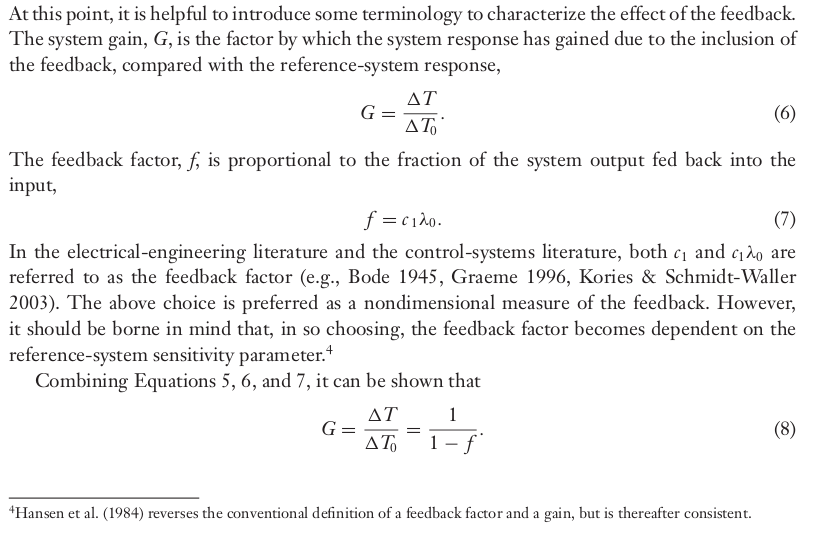
You’ve quoted Hansen as saying he’s using the procedures and terminology of electronics, giving Bode as a reference for that. That doesn’t mean he’s solving the same problem as in Bode chap 1. In fact, he just sets out the simple maths correctly:
Define net feedback factor f: ΔT_eq=f ΔT₀ …(4)
where ΔT₀ is change without feedback
Define system gain: g = ΔT_feedbacks/ΔT₀ .. (5)
where ΔT_feedbacks = ΔT_eq – ΔT₀ … (6)
It follows that (yes, it does): f=1/(1-g) … (7)
Just simple and correct algebra. Doesn’t depend on anything in Bode.
And same with Schlesinger, who doesn’t claim to be following Bode at all.. But he points out that in Bode, p 32, Hansen’s “system gain” is Bode’s “feedback factor”, and he uses R_f instead of f. Hansen’s terminology is not the same as Bode, but that is just notation. They are both defining feedback in a way that is dimensionally consistent.
And Roe just comments on the relation of his algebra to what is done in Bode and elsewhere. He doesn’t say that he is following that. He does point out that in EE literature there are two uses of feedback factor, and he is choosing the non-dimensional one, consistent with Hansen and Schlesinger. That solves the dimensionality problem, which is essential. Otherwise you have to stick with dimensions and get them right.
Here is what Roe says:
NIck,
I’m encouraged by the fact that your best argument against mine is your insistence that Bode isn’t being used to explain Hansen’s concept of climate feedback which tells me that you have no real science to dispute anything I’ve said. If you don’t think Bode provided the framework for his process and methodology ‘justifying’ that massive positive feedback can provide massive amplification, what does? If This can’t be justified with Bode, then it can’t be justified at all.
George
Nick ==> Only exemplary — of course they didn’t actually Google it….but somehow, it seems they thought that “feedback in climate” would actually, mathematically, physically be the same as in feedback per Bode in electronics…..that cognitive error — Feedbackelectronics = Feedbackclimate — because the word is the same — is what I mean by Propter Nomen.
There is no other ready explanation for confusing electronics with climate and following through and conflating the two mathematically.
Kip,
For heavens sake, quote what they actually said. Otherwise you’re off on a cloud of your own.
Speaking very much as a layman it’s clear the positive feedback & amplification theory is a complete dud because (as others regularly observe) earth has had much higher CO2 levels in the past and yet here we all are, not being roasted alive by the runaway warming effect. If positive feedback was an issue it would have triggered thermal Armageddon. It didn’t, hasn’t and won’t. Game over right there.
Positive feedback runs away only if its gain is greater than or equal to 1. That is a mathematical fact that you can prove for yourself by creating a simple spreadsheet. Read the Basic, then Intermediate, then Advanced tabbed panes here: http://www.skepticalscience.com/positive-feedback-runaway-warming.htm.
CO2 is not at all the only determinant of global temperature. When CO2 levels have been higher in the past, other factors compensated for CO2’s warming forcing. Read the Basic tabbed pane and then the Intermediate one here: http://www.skepticalscience.com/co2-higher-in-past.htm
By definition, a positive feedback is one where the gain is greater than one.
Anything less than one is a negative feedback.
MarkW, that is not the definition of “positive feedback” by anybody. Look in any textbook. Ask a professor. Ask a student. Search the internet. https://en.wikipedia.org/wiki/Positive_feedback
So where were those catastrophic positive feedbacks when CO2 was so high? Oh wait…what’s this we see…another moving of the goalposts. When CO2 is up a few ppm then it’s an absolute planet-threatening calamity – except when it’s up many times over and was in the long gone geological past in which case – surprise!!! – ‘something else compensated for it’. Why of course. Absolutely it did. Silly me. Just for a moment there I thought the Sacred Theory was in danger. Phew, what a skeptical-science saviour you are.
@ur momisugly Tom Dayton
September 8, 2016 at 9:27 am: Another pseudo-scientific troll sooled on us armed by the likes of the falsely-named Sceptical Science. All very full of what ‘must be factual’ in rote recitation. Yes, I’ve met you before, and will waste no more time feeding you. Bye bye.
Tom,
If you look at Bode’s gain equation, it can be reformed as 1/mu = 1/e^theta + beta
Climate science ignores the 1/mu term because it unknowingly assumes mu is 1. Actually it assumes the open loop gain is both 1 and lambda0 at the same time and this is the primary arithmetic error.
When there is active gain and mu is 1, 1/e^theta is zero, meaning an infinite closed loop gain. Without active gain and assuming mu is 1, the closed loop gain is constant for all feedback between -100% and +100%, which is exactly what you would expect for a passive system.
The climate system has non unit open loop gain which is a consequence of delayed return to the surface of energy absorbed by the atmospheric. If we set the open loop gain (mu) to 1.6, then we need 0% feedback (beta == 0) to predict the behavior. If we set it to be less than 1.6, we need net positive feedback (beta > 0) and if we set it to be more than 1.6, we need net negative feedback (beta < 0).
The point is to not get bent out of shape about whether the feedback is positive or negative as you can make the sign whatever you want it to be by properly selecting an open loop gain. In any event, both the open and closed loop gains are small enough that even it if there was active gain, the relative stability does not change based on the sign of the feedback, as long as the open loop gain is adjusted to compensate to produce the required closed loop gain of 1.6. Of course, the fact that there is no active gain means that the system is unconditionally stable (see Bode pg. 108).
The point is not that we are “being roasted alive” – we were never expected to be at this stage … But that the change in climate regimes, rising sea levels, ocean acidification etc will have a distruptive/expensive impact on humanity.
Good thing none of those things that worry you, are happening.
None of things listed are worrying. There has been no change in climate regimes since Koppen first set out his classification, and even if there was to be a change, why would that be bad.
Sea Level rise has not accelerated, and is trivial circa 6 to 8 inches per century. For most, Sea Level rise will have no impact whatsoever.
There is no compelling evidence that ocean acidification is happening, and it has never been a problem; in the past the oceans absorbed high quantities of CO2. There is no evidence that it will have any serious impact upon marine life in general.
A warmer world would be godsend for bio-diversity. A world with more CO2 likewise as it is greening the planet faster than man can deforest.
The world is both too cold and lacking in CO2. Manmade output of CO2 is a good thing, and if by some happy chance it brings with it some warming then that is a win win scenario.
What is most sad about AGW is it has side tracked all of us as this article is so indicative of , of wasting our time trying to defend or dispute AGW THEORY which is a fraud ,instead of having the study of climate directed toward what really causes it to change and why.
Progress in this field will stay at a standstill until this AGW theory is considered no longer valid. It is wasting the time of so many of us who are in the climate arena.
These articles keep coming one after the other. A waste.
Why don’t you publish your certainly per definitionem excellent results, Mr Del Prete?
In all this world’s skeptic blogs on reads your comments about AGW theory being a fraud.
I read “… instead of having the study of climate directed toward what really causes it to change and why“.
Why don’t you actively contribute to that process?
I myself couldn’t.
So I don’t criticize people having presented scientific results in a domain I have nothing really substantial to tell.
…. Are we negating a source of heat entirely??
“One thing that’s clear is that the atmosphere has no internal sources of power, thus all of the power driving the 12 W/m2 of additional surface emissions must be coming from feedback.”
We know the physical earth is cooling. The core is losing heat (surely down from Gore’s ‘millions of degrees’) thru volcanic activity at the very least, both above ground and undersea. How much does that heat influence atmospheric temperature? Should we assume that heat transfer to be a constant… and is it?
I can’t help but think, without benefit of meaningful scientific data, that forcing is a bit muddied by this heat source I never see discussed.
fizzissist, energy escaping from the Earth’s interior is rarely mentioned because it is known to be tiny: http://www.skepticalscience.com/underground-temperatures-control-climate.htm
It’s tiny and unchanging over any time frame that matters to mankind.
fizzissist ==> When Tom Dayton says “tiny” he means almost entirely unmeasured and generally unconsidered, despite the attempt at [un]skepticalscience to pooh-pooh the other major source of heat energy into the climate system. Heat from the Earth’s core has been heating the waters off the Antarctic Peninsula for a long time, creating anomalous warming there, which then has follow-on effects.
Underwater volcanoes and faults create zones of direct heating of ocean water that, when new, alters local ocean currents and local surface water temperatures, rising water increases layer mixing, etc.
Generally, it is dismissed as an input to changing climate because it doesn’t change that much — assumed to be at long-term equilibrium. Dismissing local heating, such as new volcanic inputs and heating up of volcanic plains, especially under the oceans, is probably a mistake. Fultz and Hide demonstrated long ago that heating one spot of a spinning fluid system causes far more change than we would have thought.
There is an idea floating around that the unexplained warm spot in Siberia may have this source.
The planet’s core has a lot of heat energy to dissipate. I wouldn’t write if off so easily.
General reply, from a circuit perspective this is the wrong circuit.
The Sun is the power supply, not the input. The input is self-biased and has multiple dampers, and the active device controls the energy flow to the surface, there’s plenty of energy.
Now, if you could describe all of the control signals, and their outputs, you could write a transfer function that perfectly describes the climate for that spot, tie a bunch together in a grid, and you could model it. What they have attempted in gcm’s.
The rub is describing all the signals and their output transfer functions accurately.
micro6500 ==> I think that might not be correct. If the sun were the power supply, then the Earth’s climate could draw more power from it at will/at demand based on the circuit. This obviously is physically incorrect — the Earth can not get more power from the Sun than the Sun supplies (more at less at this time – the Sun’s output is fairly steady — and not dependent on Earth’s climate.)
It can, it just has to have fewer clouds.
“If the sun were the power supply,”
The sun is obviously the power supply (what else?). He didn’t say it was a voltage source. In fact, it’s a current source. And provides ample to cover the fluctuations we are talking about with amplification.
Gentlemen ==> The way a power supply works in an electrical circuit is that it supplies power as demanded by the system — like your little plug-in phone charger. When no power is demanded by the system, the power supply doesn’t supply any (it just sits around and wastes a bit of electricity getting warm — but hardly any.) When you plug in a demand — like your phone or tablet — the phone or tablet demands power and gets it — usually less than the power supply is rated to deliver — but if you try to draw more than it is rated, like my tablet does with an old phone charger, the power supply can not upgrade itself to meet the demand, it just does its best at its rated level. When your phone is charged, it quits demanding power and the power supply quits delivering.
Does that sound like what the Sun does in the climate system?
No – it does not.
The Sun is the Power Source — but does not act like a Power Supply electrically — the Sun is uninterested in the Earth’s demand and does not change its energy output to match the Earth’s use — the Earth uses or wastes what it will, absorbing or reflecting, re-emitting etc.
Kip,
” the phone or tablet demands power and gets it — usually less than the power supply is rated to deliver”
You’re describing a voltage source. That is the custom in electronics; it tries to provide a prescribed voltage, which suits the design of the receiving equipment. It tries to be a zero impedance source. To the extent it fails, the voltage drops as the current drawn rises, and your equipment is designed to cut off if the voltage drops below a certain level. That is the finite impedance effect.
But it doesn’t have to be that way. You could charge your 5V battery from 100V mains source. You’d have to put a large resistance in the way. A near constant current would flow into the battery, and you’d have to make sure to switch it off when the battery was charged, else it would start electrolysing the contents in ways you didn’t want. That would be a high impedance source, close to a current source. It’s not a good idea for the way batteries are designed, but it would work.
Voltage is analogous to temperature, as a pressure wanting to equalize itself, trying induce a current.
Power supplies and loads have an impedance, and you get maximum transference of power when source and load have the same impedance. A constant current source has to be able to drive the current into whatever the load is. But a high load impedance would require high drive voltage, and maybe it doesn’t go that high.
But the basic circuit is the Sun coupled to earth ground through an adjustable shutter (A fet) the atmosphere, or to a big pool of water and ice. It’s self biasing, the fet is bidirectional and has different passbands each direction. Loads are between the shutter and the Sun, shutter and Ground, shutter and water, there’s bias from the Sun to the gate, from the output to the gate , from the ground, water and ice to the gate.
However one giggles the analogy — the Sun’s output is a constant — the Earth receives an almost infinitesimally small bit of that energy simply by being in the way. The amount thus received by the Earth doesn’t change — the amount that hits the Earth’s sphere of influence — with very small exceptions dealing with the orbits of the planets. Lots of things happen to that energy once it is in the Earth system that determine how much stays in the system for how long.
Stretching an analogy, like Bode, to fit a disparate system and then deriving principles from that is not scientifically sound — it is barely logically sound.
It is obvious that things that change in the climate system can cause changes in other parts of the climate system, some of them seemingly additive, some subtractive.
If we get a bit more real climate science done, we may begin to understand all this better.
At toa it doesn’t change.
But below that it does, this part is what they try to model, modeling it as a transfer function, describing how that energy is varied before it gets to the surface. That is the start of a climate model.
micro ==> Yes, that’s the part we agree on…what happens below TOA is what Climate Science is meant to study — we best get on with it.
Yes, My point is that if one can describe the function of the atm from closely to exactly, we can model that as a transfer function, an electronics circuit, which at the model level is just a bunch of predefined transfer functions, you could take a pretty good stab at modeling the atm like this, and even build hardware, but as such, it would be really slow to run in software, and hardware would be a nightmare. But, you can use it to describe how it is all tied together, in a language a lot of people understand.
micro ==> They only part I disagree with is the shifting the analogy to derive physical principles of climate.
Out of control feedback processes will not occur in the climate system — it is too well bounded, in my opinion, and protected by the stability implied in the study of dynamical systems.
There’s no reason to believe otherwise. If it was ever possible, we would not be here to worry about it.
If you consider voltage equivalent to temperature, you can get voltage gain without power gain and this is what transformers do. But the power coming out of the transformer will always be slightly less than the power going in. The apparent temperature gain of the Earth is the result of surface emissions previously absorbed by the atmosphere returning to the surface to be combined with new solar input energy.
While temperature and stored energy are linearly related (1 calorie, 1cc water, 1C), as the temperature rises, the emissions increase as T^4, thus each additional degree of temperature requires more joules of energy to sustain than the last since it will be loosing energy at a faster rate than previously.
The biggest problem in the climate debates appears to be the English Language. Sigh
I have postulated that we do not yet have language capable of understanding or explicating climate, yet.
=================
I appreciate the discussion involving feedback here, but it is only somewhat pertinent. This comes on the heels of my complaints about zero dimensional models from several days back. These supposedly simple zero dimensional models appear to settle things very little if at all.
A figure of merit for a solar collector, which is what the Earth is, is (solar absorptivity)/(IR emissivity). The effect of some additional CO2, or other IR active gas in the atmosphere is to change the denominator of this system and increase the figure of merit. Thus the earth would warm some, but we have little idea how much because both the numerator and denominator are functions of temperature, and other factors as well. However, the idea that having no internal source of energy will limit temperature rise from changing the figure of merit is true only within wide bounds. The surface temperature of the sun is 5800K, and this is also the limiting temperature of a solar collector of very high merit. The lower temperature is the background temperature of the universe of 3K which is where we would tend if solar absorptivity were to tend to zero. Again I appreciate the effort, but we have no hard physical principle here to limit the possible outcomes.
I commend George White’s interesting perspective on the climate system. It brings focus, to me, on a pet peeve I have with the CAGW clique, and that is their promiscuous use of the word “forcing”. But for a few milliwatts per square meter of heat coming from the earth’s core, the one and only “forcing” on the climate is the sun. All the other so called “forcings” are simply factors influencing a passive system. These factors can influence energy flow from one responding system to another, but it’s hard for me to assume anything but a stable, damped response to perturbations in the influencing factors. I appreciate that the time constants may be very long, and the influences may be very non-linear.
I appreciate Willis’ generous description of “forcings” as a “term of the art” among the clique. I say, though, leave art to the artists and science to the scientists. Few forcings influence the climate, and the quantity is likely but one. A number of complex factors do. A change in the language might “force” the artists to better define their science.
“Many confuse the dynamics of weather as an indicator of an active system, but in the context of Bode, active and passive have very specific meanings. Passive means that there are no other sources of input other than the stimulus, which for the climate is the W/m2 of forcing arriving from the Sun..”
From my frame of reference that neglects the solar indirect forcings that ENSO and the AMO are acting as strongly amplified negative feedbacks to.
@Nick Stokes
When at Penn State, I probably spent more time climbing Mt Nittany, and playing piano in the girl’s dorms than studying physics and chemistry, etc. That’s why I got D’s in physics.
But I do have common sense in other areas…
IPCC Third Assessment Report
Chapter 14
Section 14.2.2.2
Last paragraph:
“In sum, a strategy must recognize what is possible. In climate research and modelling, we should recognize that we are dealing with a coupled non-linear chaotic system, and therefore that the long-term prediction of future climate states is not possible.”
This information was not included in the Summary Report for Policymakers given to the press and public.
If the climate is indeed a coupled non-linear chaotic system (who can doubt the IPCC) then there is no rational or scientific basis to make a definitive statement about a future state of the climate.
At this point the coupled non-linear chaotic nature of the climate makes scientific observations academically interesting but they have no relevance in predicting the future state of the climate. The climate is a system which means the relationships among these observations are what is important not the observations themselves.
All the public discourse regarding the future state of the climate has been based on the false premise that the current climate models are predicting the future state of the climate when in fact the models are merely projecting these states.
Predictions are the purview of science. Model projections can only agree with predictions when the models duplicate the real world.
To base public policy on an unknowable state of a system defies common sense. However, too much money and political power is at stake for the Central Planners to do otherwise.
I would argue that the Climate Model True Believers are the ones taking an unscientific approach to the subject.
In January 1961 President Eisenhower in his Farewell Address identified the situation in which we find ourselves today:
“Akin to, and largely responsible for the sweeping changes in our industrial-military posture, has been the technological revolution during recent decades.
In this revolution, research has become central; it also becomes more formalized, complex, and costly. A steadily increasing share is conducted for, by, or at the direction of, the Federal government.
Today, the solitary inventor, tinkering in his shop, has been overshadowed by task forces of scientists in laboratories and testing fields. In the same fashion, the free university, historically the fountainhead of free ideas and scientific discovery has experienced a revolution in the conduct of research. Partly because of the huge costs involved, a government contract becomes virtually a substitute for intellectual curiosity. For every old blackboard there are now hundreds of new electronic computers.
The prospect of domination of the nation’s scholars by Federal employment, project allocations, and the power of money is ever present and is gravely to be regarded. Yet, in holding scientific research and discovery in respect, as we should, we must also be alert to the equal and opposite danger that public policy could itself become the captive of a scientific-technological elite.
It is the task of statesmanship to mold, to balance, and to integrate these and other forces, new and old, within the principles of our democratic system — ever aiming toward the supreme goals of our free society.”
Another relevant publication is: “The True Believer” by Eric Hoffer.
To be honest, I’m each time wondering a lot when I see such people writing without any problem their “How climate is fubar” where they simply state, without great scientific explanations, that a long sequence of authors simply all had wrong.
I read – a bit diagonally, évidemment – the papers of Hansen & alii and Roe.
Maybe genious George White manages to tell us why he didn’t publish his stuff in a journal.
There is something strange about so many people writing guest posts on Internet blogs, criticizing lots and lots of authors, but… without the need for any substantial proof of what they claim.
Is that really Science?
They’re putting their opinions in the public domain. All you’re doing is criticising them for putting their opinions in the public domain. Any chance YOU can rebut their guest pieces yourself? Go on, the floor is yours.
NO, CheshireRed: you are completely wrong, and… I guess you know that. You were here turning the arguments by 180 °.
What I criticize is, as I have written above, that these people by no means solely are putting their opinions in the public domain: they contradict scientific work without having to give any substantial proof of what they claim.
When, for example, Willis Eschenbach addresses a critique on a scientific result, he manages to underpin that with something really valuable.
It could be. There was a fabled time when fellows the likes of Albert Einstein, working in obscurity in a patent office, could write an absolutely brilliant paper, have it published in a fine technical journal, and then remain in obscurity for quite a bit longer time. A few decades later a fellow of physics at a top university could not publish a paper in certain journals at all because science had become politicized in the heart of Europe. We are today closer to the later circumstance than the former, but the internet has democratized science, and I think that is a good thing.
You are relying too much on the gatekeepers of science to maintain its integrity, and they have proved themselves inadequate to that task. Have you had to deal with them personally? I have several times in the past two decades, and they will resort to any illogical excuse to marginalize certain ideas and observations that may upset the status quo–and moreover I have been in this fight in climate science on one hand and in archaeology and history on the other– exact same bad behavior from the insiders in both cases.
I agree with Mr. White that the use of these feedback models from a linear systems dynamics standpoint are likely in error in ways; so I appreciate his adding food for thought on this topic. Yet, as I said in my comment above, this isn’t very pertinent. The most important technical question with respect to climate warming to resolve is what sort of warming can we expect, and these simple models provide no useful limits at all. In some cases they actually work against clarifying the issue.
Wow. Now I see somebody starting to compare Mr White with Albert Einstein at his beginnings! That’s really a bit too much for me…
Did you ever read even one of the so called “Annus Mirabilis papers” ?
Bindidon, that was not what I said and you know it perfectly well. I now see you are a liar and not worth responding to at all.
Kevin Kilty, I’m all you want but a liar. Nevertheless I am myself the origin of your opinion. I have misread your comment, and clearly apologize for that.
Science is subject to far more objectively rigorous review when it appears in a blog that it would if it appeared in a journal, where most review is far too incestuous to be rigorous.
“There is something strange about so many people writing”, etc
Well, yes, it is interesting from a social science perspective, and may appear “wrong” if you have certain presuppositions about who belongs in the science “arena”.
But consider this: if you think of modern science as beginning when arguments from authority were no longer considered acceptable, climate science is very much a latecomer to the party–it is in its infancy, really. And from my perch as someone who knows a little of the history of science, it seems to me that we are still in the phase of trying to establish exactly who belongs in that arena: which disciplines, which methods, how to “credential” people, etc. We are seeing this in economics, as well. In econ, one generally cannot run experiments on the economy: all you get is reams of data of varying quality, models, and assumptions. In econ, the people who have the most impact sometimes come from outside the ranks of the highest-credentialed.
I believe that that climate science has the same thing going on; look at the impact of Steve McIntyre, a 1) RETIRED 2) GEOLOGIST. Although he “lives in blog world”, he opened all our eyes to the defects of the “hockey stick” graphs, and exposed the weakness of the work done by the authorities in paleoclimate.
Plus,it never hurts to go back and check our maps, so to speak. Are we in the right forest? The amateurs keeps the pros honest.
Admittedly it was the Bode tube amp references that pulled me in here, and the math I can follow most of, but not all. The comments, past the first rote profanity, I have to say are superb on the whole. So, while I have nothing substantive to add, thank you for letting me learn.
Glad to see George White take the time here to expose in considerable depth the gross misapplication of well-founded principles of feedback systems to misguided climate analysis. Without getting distracted by the dimensional weeds that grow out of the standard formulation of climate sensitivity, the take-home message is that true feedback requires what the climate system obviously lacks: an independent source of power (usually supplied by an operational amplifier). The customary explanation of the workings of the climate system in terms of various hand-waving notions of “feedback” is prima facie evidence of the lack of analytic competence endemic throughout “climate science.” A far more tenable model would be a multi-tiered capacitive system operating without any feedbacks, but adaptively modulating the TSI–with both input and output expressed in the same units of power.
Your comments on the conservation of energy are correct. Another assumption in simple linear amplifier theorey is that the feedback does not alter the forward network. I’m not sure that this is true.
The view of climate “feedback” being equivalent to that in linear systems is completely simplistic and wrong
Robert,
Refer to Bode page 108 (his book is freely available on line).
“The second and third of these conditions are evidently merely consequences of the principle of conservation of energy, in combination with the fact that a passive system cannot contain a source of power.”
This is where he also introduces the proof that a passive system is unconditionally stable.
George