Solar variations affect the abundance of clouds in our atmosphere, a new study lead by DTU Space suggests. Large eruptions on the surface of the Sun can temporarily shield Earth from so-called cosmic rays which now appear to affect cloud formation. A team of scientists from the National Space Institute at the Technical University of Denmark (DTU Space) and the Racah Institute of Physics at the Hebrew University of Jerusalem has linked large solar eruptions to changes in Earth’s cloud cover in a study based on over 25 years of satellite observations.
The solar eruptions are known to shield Earth’s atmosphere from cosmic rays. However the new study, published in Journal of Geophysical Research: Space Physics, shows that the global cloud cover is simultaneously reduced, supporting the idea that cosmic rays are important for cloud formation. The eruptions cause a reduction in cloud fraction of about 2 percent corresponding to roughly a billion tonnes of liquid water disappearing from the atmosphere.
Since clouds are known to affect global temperatures on longer timescales, the present investigation represents an important step in the understanding of clouds and climate variability.
”Earth is under constant bombardment by particles from space called galactic cosmic rays. Violent eruptions at the Sun’s surface can blow these cosmic rays away from Earth for about a week. Our study has shown that when the cosmic rays are reduced in this way there is a corresponding reduction in Earth’s cloud cover. Since clouds are an important factor in controlling the temperature on Earth our results may have implications for climate change“, explains lead author on the study Jacob Svensmark of DTU.
Very energetic particles
“Since clouds are an important factor in controlling the temperature on Earth our results may have implications for climate change”
Galactic cosmic rays are very energetic particles originating mainly from super novae.
These particles generate electrically charged molecules – ions – in Earth’s atmosphere. Ions have been shown in the laboratory to enhance the formation of aerosols, which can serve as seeds for the formation of the cloud drops that make up a cloud. Whether this actually happens in the atmosphere, or only in the laboratory is a topic that has been investigated and debated for years.
When the large solar eruptions blow away the galactic cosmic rays before they reach Earth they cause a reduction in atmospheric ions of up to about 20 to -30 percent over the course of a week. So if ions affect cloud formation it should be possible to observe a decrease in cloud cover during events when the Sun blows away cosmic rays, and this is precisely what is done in this study.
The so-called ‘Forbush decreases’ of the cosmic rays have previously been linked to week-long changes in Earth’s cloud cover but the effect has been debated at length in the scientific literature.
The new study concludes that “there is a real impact of Forbush decreases on cloud microphysics” and that the results support the suggestion that “ions play a significant role in the life-cycle of clouds”.
Arriving at that conclusion was, however, a hard endeavor; Very few strong Forbush decreases occur and their effect on cloud formation is expected to be close to the limit of detection using global atmospheric observations measured by satellites and land based stations. Therefore it was of the greatest importance to select the strongest events for study since they had to have the most easily detected effect. Determining this strength required combining data from about 130 stations in combination with atmospheric modeling.
This new method resulted in a list of 26 events in the period of 1987-2007 ranked according to ionization. This ranked list was important for the detection of a signal, and may also shed some light on why previous studies have arrived at varied conclusions, since they have relied on events that were not necessarily ranked high on the list.
Possible long term effect
The effect from Forbush decreases on clouds is too brief to have any impact on long-term temperature changes.
However since clouds are affected by short term changes in galactic cosmic radiation, they may well also be affected by the slower change in Solar activity that happens on scales from tens to hundreds of years, and thus play a role in the radiation budget that determines the global temperature.
The Suns contribution to past and future climate change may thus be larger than merely the direct changes in radiation, concludes the scientists behind the new study.
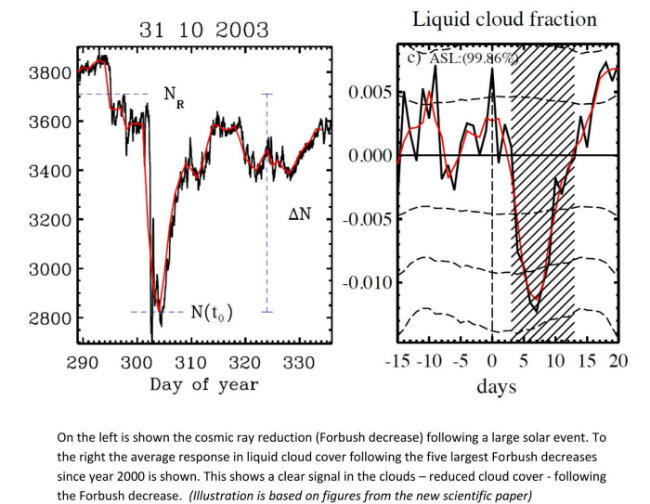
Source: http://www.dtu.dk/english/News/Nyhed?id=b759b038-66d3-4328-bbdc-0b0a82371446
The full reference to the new paper is: J. Svensmark, M. B. Enghoff, N. J. Shaviv, and H. Svensmark, “The response of clouds and aerosols to cosmic ray decreases”, Journal of Geophysical Research – Space Physics, 2016, DOI: 10.1002/2016JA022689.
Click here or here to access the abstract and full scientific paper.
Related: (via the Hockey Schtick)
Solar physicist Dr. Leif Svalgaard has revised his reconstruction of sunspot observations over the past 400 years from 1611-2013. Plotting the “time integral” of sunspot numbers from Dr. Svalgaard’s data shows a significant increase in accumulated solar energy beginning during the 1700’s and continuing through and after the end of the Little Ice Age in ~1850. After a ~30 year hiatus, accumulated solar energy resumes a “hockey stick” rise for the remainder of the 20th century, followed by a decline beginning in 2004, all of which show remarkable correspondence to the HADCRU3 global temperature record:

“The most obvious way for warming to be caused naturally is for small, natural fluctuations in the circulation patterns of the atmosphere and ocean to result in a 1% or 2% decrease in global cloud cover. Clouds are the Earth’s sunshade, and if cloud cover changes for any reason, you have global warming — or global cooling.”
ulriclyons August 25, 2016 at 6:26 pm
Try to explain the phase shift on this one…
http://www.woodfortrees.org/graph/esrl-amo/from:1880/mean:13/plot/sidc-ssn/from:1880/normalise
______________________________
I can’t explain the phase shift Ulric. But, coincidentally over the same time period as the Atlantic Multidecadal Oscillation (AMO) phase shift. This and that (see below) is occurring.
APRIL 8, 2016
NASA Study Solves Two Mysteries About Wobbling Earth
A Sharp Turn to the East
..”’Around the year 2000, Earth’s spin axis took an abrupt turn toward the east and is now drifting almost twice as fast as before, at a rate of almost 7 inches (17 centimeters) a year. “It’s no longer moving toward Hudson Bay, but instead toward the British Isles,” said Adhikari. “That’s a massive swing.” Adhikari and Ivins set out to explain this unexpected change.
Scientists have suggested that the loss of mass from Greenland and Antarctica’s rapidly melting ice sheet could be causing the eastward shift of the spin axis. The JPL scientists assessed this idea using observations from the NASA/German Aerospace Center Gravity Recovery and Climate Experiment (GRACE) satellites, which provide a monthly record of changes in mass around Earth. Those changes are largely caused by movements of water through everyday processes such as accumulating snowpack and groundwater depletion. They calculated how much mass was involved in water cycling between Earth’s land areas and its oceans from 2003 to 2015, and the extent to which the mass losses and gains pulled and pushed on the spin axis…”’
http://www.jpl.nasa.gov/news/news.php?feature=6332
Also note from the Magnetic field article I posted above concerning the same time period.
..”’These changes have occured over the relatively brief period between 1999 and mid-2016.
Note to me.
From wiki-The Atlantic Multidecadal Oscillation (AMO) is an ocean current that is thought to affect the sea surface temperature of the North Atlantic Ocean based on different modes on multidecadal timescales.
In the case of the ocean to take into attention cycles of the moon.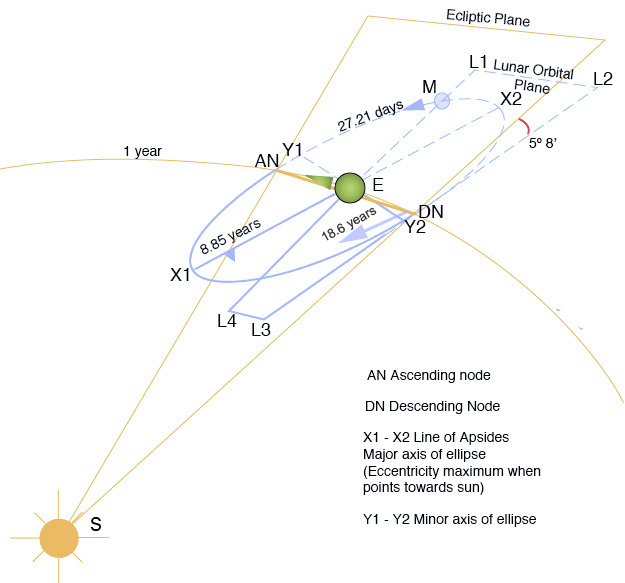
Every 18.6 years, the angle between the moon’s orbit and the earth’s equator reaches a maximum of 28°36′ (the sum of the Earth’s inclination 23°27′ and the Moon’s inclination 5°09′). This is called major lunar standstill. Around this time, the moon’s latitude will vary from −28°36′ to +28°36′. 9.3 years later, the angle between the moon’s orbit and the earth’s equator reaches its minimum, 18°20′. This is called a minor lunar standstill.
the lunar influence causes more \ or less “mixing” of the warmer waters with cooler waters
in turn this would either delay or advance the Gleissberg either way
but, at the end of the day, what comes in is what counts…
https://wattsupwiththat.com/2016/08/25/svensmark-publishes-solar-activity-has-a-direct-impact-on-earths-cloud-cover/#comment-2289147
what do you think of my comment there?
This is also the same period of time that we see the most dramatic changes in the Solar Polar Magnetic Field decreases. More so in the North Solar Polar Field.
http://wso.stanford.edu/gifs/north.gif
http://wso.stanford.edu/gifs/south.gif
Interesting times indeed…
I hope you can see that you can draw quadratics, hyperbola north and parabola south, that would represent the average field strengths?