La Niña expected to contribute
From the Daily Star, 14 August 2016
Climate boffins believe the UK’s topsy-turvy climate is in for a chilly twist within the next few years as three major forms of climate change trigger “substantial cooling”.

Drastic changes in ocean conditions, greenhouse gases and a weakening of the sun threaten increasingly worsening winters of blistering blizzards and severe snowstorms for years to come.
This cocktail of climate threats, paired with “hasty climate policies”, could mean “rolling blackouts” in the UK over the next few years, plunging the country into long period of darkness.
These “worse case scenario” climate threats will hit the elderly hardest, leaving “some pensioners alone in the dark” on a freezing nights resigned to a “lonely death”.

An intense La Nina weather front could wreak havoc on the UK’s climate, photo Getty
It is thought these will be brought about for the most part by a massive decrease in solar activity, meaning fewer “sunspots” and solar flares to warm up earth.
Scientists recently warned the sun’s activity is at its lowest for 100 years, meaning earth is experiencing eerily similar conditions to the period when the last mini ice age hit.
This drop in sunspot activity leads to a so-called Maunder Minimum, which is believed to be responsible for the cripplingly cold winters Europe experienced three centuries ago.
The last time Britain entered a Maunder minimum period was in the 1600s, when temperatures sunk so low, London’s river Thames froze over.
Drawing on 400 years of sunspot observations, experts believe we are heading for a similar temperature “minimum”.
However, Grahame Madge, meteorologist for the Met Office, told Daily Star Online although a “grand solar minimum” is expected, it will do little to counteract global warming caused by man-made change.
Another major factor in the predicted cool down could be the switch from an usually strong El Nino to a La Nina weather front in the pacific ocean.
Meteorologist for AccuWeather Tyler Roys told Daily Star Online La Nina could contribute to the chilly mix.
He said that the onset of La Nina – which is associated with cooler temperatures – has a much more drastic effect on weather in the British Isles and could spell a climate cool down.
He said: “Looking at the similarities of 1998 to last years El Nino event, one can assume there could be such a drop off.” La Nina has more of an effect on the weather for the British Isles than El Nino does.
“A La Nina that is based over the eastern Pacific Ocean tends for favour a cooler and drier then normal weather pattern for much of western Europe.”
The Met Office said the onset of La Nina from 2017 is likely to “buck the trend” in terms of record breaking global temperature averages, predicting a cool down across the globe.
Scientists recently warned the sun’s activity is at its lowest for 100 years
Whenever we have such lows, they are followed by increased solar activity. The next solar cycle already looks to be a bit stronger than the current one.
“… a massive decrease in solar activity, meaning fewer “sunspots” and solar flares to warm up earth…”
I have never seen anything suggesting that sunspots or solar flares do anything to warm up the earth.
‘From the Daily Star’.
Like ‘From the National Enquirer’, but with pictures of poor unfortunate young ladies who struggle to afford clothes.
The ‘Mirror’ it ain’t. And the ‘Mirror’ ain’t much of a newspaper . . . .
Auto
auto August 15, 2016 at 12:25 pm
The pictures are to ensure the print version ‘readership’ know which way up to hold the paper.
“I have never seen anything suggesting that sunspots or solar flares do anything to warm up the earth.”
I can’t vouch for its accuracy, but here’s the first thing that came up when I did a search for “what do more sunspots mean?” Do you have anything scientific to counter it?
http://www-das.uwyo.edu/~geerts/cwx/notes/chap02/sunspots.html
Jeff, now at least you’ve seen something suggesting that sunspots warm up global temperatures.
Thanks to ever-increasing Global Warming, the young ladies do not need clothes. This is, of course, incontrovertible proof that the warming is Man Made.
I grow weary of headlines about climate predictions based on models.
I believe the causation run like this: decreases in sunspots is symptomatic of a weaker solar wind. A weaker solar wind is less able to protect the earth from high energy cosmic rays coming from deep space. As more cosmic rays pass through the atmosphere, more atmospheric molecules are split into ions. These extra ions are seed for increased cloud formation. Greater cloud formation reflects more solar radiation away from earths surface, and hence cooling. See: https://wattsupwiththat.com/2016/08/25/svensmark-publishes-solar-activity-has-a-direct-impact-on-earths-cloud-cover/
Real time solar activity is like a trickle charger, while the AMO is the grid-scale battery. There is no comparison in short term observations and models. So the better question is whether the last 70 years of solar activity matters, not the trickle charger.
http://www.climate4you.com/images/AMO%20GlobalAnnualIndexSince1856%20With11yearRunningAverage.gif
http://www.climate4you.com/images/NOAA%20SST-NorthAtlantic%20GlobalMonthlyTempSince1979%20With37monthRunningAverage.gif
Solar activity has reached the same level in every century [not yet the 21st, of course] since observations began 400 years ago http://www.leif.org/research/The-Waldmeier-Effect-Levi.pdf
If we looked at the stock market and the economy with century averages, we would come up with even more failed prediction models than the current crop.
The South polar field appears to be making a move back toward zero. Too early to know how far it will correct or this is just a random fluctuation. The North polar field has done little strengthening since reversal. So it looks to me like we’re at least 5-6 months away from any decent predictions for SC 25 to see where the south polar field strength tracks.
http://www.leif.org/research/WSO-Polar-Fields-since-2003.png
Further evidence that making SC25 predictions at this point is dicey is how fast SC24’s SSN and F10.7 are decaying relative to Predictions.
http://services.swpc.noaa.gov/images/solar-cycle-sunspot-number.gif
http://services.swpc.noaa.gov/images/solar-cycle-10-cm-radio-flux.gif
The South polar field appears to be making a move back toward zero. Too early to know how far it will correct or this is just a random fluctuation.
Because the sun’s axis is tilted with respect to the Earth’s orbit, the south pole cap is now becoming less visible and the magnetic field thus decreasing. This is the expected and observed behavior. Similarly, the north polar cap was less visible during the first half of 2016, resulting in a smaller observed magnetic field.
You can see the same behavior of the polar fields leading up the previous minimum. In short: the fields have now stabilized and can be used for prediction.
http://www.leif.org/research/Solar-Polar-Fields.png
Still way weaker than the last 2 or 3 cycles.
“Solar activity has reached the same level in every century”
That statement doesn’t recognize the “area under the curve” is most definitely not the “same level” in each century. By the way what is your prediction for Cycle 25 since you say it is going to be higher than 24? I don’t know if Zharkova et al 2015 implies a lower SSN for Cycles 25 and 26 compared to 24, but I’m guessing it does.
The area under the curve for the 18th century is on par with that of the 20th, within the uncertainty of the estimates, but it is not a given that the climate must have a 100-year response time, and if it did, then there would not be ‘substantial-cooling-predicted-within-the-next-few-years’.
Zharkova et al 2015 implies a lower SSN for Cycles 25 and 26 compared to 24, but I’m guessing it does
since Zharkova et al. can’t hindcast the past, their prediction of the future is irrelevant.
It is a bit premature to give a more precise number for SC25, but if I must, I would guess 10-20% higher than SC24, as the current cycle still has time to further increase the polar fields.
“the next solar cycle already looks…”, Leif? What part of it are you seeing that you can say that? Certainly no sign of it on your (sadly neglected) solar pages.
You shouldn’t neglect the pages, but instead read them carefully.
On the evolution of the polar fields: http://www.leif.org/research/Comparing-HMI-WSO-Polar-Fields.pdf
Also take a look at http://hmi.stanford.edu/hminuggets/?p=1657
and http://jsoc.stanford.edu/data/hmi/polarfield/
and http://wso.stanford.edu/gifs/Polar.gif
Judging from past cycles it is likely that the polar fields will strengthening further, although probably not by much.
Thanks Leif, that Fig 1 of your 1st Stanford cite is very interesting — signs of cycle 25. But as for neglected pages, I’m hoping you will bring your pages up to date soon — much less interesting when they are 6 months out of date, as your solar activity and active region count pages are.
The sun changes so slowly that a few months don’t make a difference, but it is nevertheless time to update them.
So what are you basing that on?
If you would care (what a concept) to read my comments on that, you would learn on what.
“…since Zharkova et al. can’t hindcast the past, their prediction of the future is irrelevant.”
We have a most excellent chance to see if you are correct in about 9 years. You are higher, she is lower. I’ll set my alert timer for 9 years from now. That’s the beauty of reality, it trumps ego every single time, although sometimes it takes some time to bubble to the top.
If she is right it will be for the wrong reason as her theory doesn’t work as shown by her being wrong on the past.
What an odd statement, because you were wrong in the past you cant be right now. Wish I was perfect, it must be great.
Yes, regional warming caused by solar cycle changes is always followed by regional cooling caused by solar cycle changes.
The foundation of science is that fundamental theoretical beliefs can and are proven incorrect by new observations.
The warming in the last 150 years has caused by solar cycle changes, not by the rise in atmospheric CO2. The rise in atmospheric CO2 was caused by increased planetary temperature and an increase in deep earth CH4 emission which is low in C13, not by anthropogenic CO2 emissions.
It is no surprise that global warming will be followed by cooling. The paleo record shows that has been 342 warming events in the last 250,000 years in the southern hemisphere with the same periodicity of the warming events in the northern hemisphere. The warming events correlate with solar cycle changes and all were followed by cooling events which also correlate with solar cycle changes.
http://wattsupwiththat.files.wordpress.com/2012/09/davis-and-taylor-wuwt-submission.pdf
http://www.nyu.edu/about/news-publications/news/2012/07/09/researchers-create-mri-of-the-suns-interior-motions.html
Solar Cycle 24 is not particular peculiar, being similar to SC14 and others in the past.
The foundation of science is that fundamental theoretical beliefs can and are proven incorrect by new observations.
Often those ‘new’ observations are premature, misinterpreted, or simply overhyped. The ones you mention are good examples of that. The Sun is behaving quite normally.
The Hanasoge paper is badly worded. Here is what Hanasoge explained to me by email:
“I now realize it’s a bit of a confusing statement because it’s a slightly technical concept. The “rapidity” of solar rotation is defined in our context through the Rossby number: the ratio of convective velocity to the speed of rotation. It is largely thought that the Sun, in the context of Rossby number, is a slow rotator, i.e. that Coriolis forces play a very weak role in influencing convective motions. However our results show that the convective motions are substantially weaker than previously thought, which means the Rossby number is very low and convection therefore is strongly influenced by rotation and Coriolis forces (much more so than previously thought). In that sense, the Sun is “fast rotator”.”
He is talking about a particular form of motions [overturning of convective cells, e.g. as seen in the granulation, not about ‘plasma motions’ in general. This has nothing to do with the solar dynamo and the maintenance of solar activity.
“Whenever we have such lows, they are followed by increased solar activity. The next solar cycle already looks to be a bit stronger than the current one.”
Not according to Professor Valentina Zharkova (Northumbria University) and colleagues, …
https://wattsupwiththat.com/2016/08/09/solar-physicist-sees-global-cooling-ahead/
As I have pointed out repeatedly, her theory has been thoroughly debunked as it disagrees with observations of past solar cycles.
There’s something cheering (as well as sobering) in the fact that sloppy thinking and ignorance can be turned in any direction at any moment. The reporter talked to “climate boffins” and got the idea that sunspots warm up the earth!
mmm, like you guys did such a marvellous job of the prediction of the last cycles,Huh?
yes, indeed we did: http://www.leif.org/research/Cycle%2024%20Smallest%20100%20years.pdf
“Sunspot cycle 24: Smallest cycle in 100 years”
Leif, we know you did a fine job. It is the other ‘official’ predictions that we laugh at.
Why do observed values for ENSO in the graphic finish in May? I would expect to already have data for MJJ…
Click on the chart to update it
Doesn’t work; the pic is from a WUWT store. The latest ENSO prediction is here:
http://iri.columbia.edu/wp-content/uploads/2016/07/figure4.gif
It seems it needs a https prefix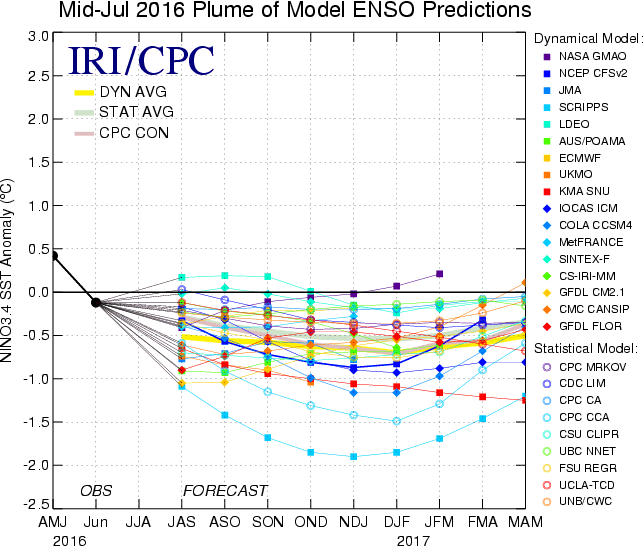
http://www.cpc.ncep.noaa.gov/data/indices/sstoi.indices
Well, if July is -0.49 the July plume looks a little optimistic.
August is likely -0.7 or less. This would make the Mid May prediction plume more accurate.
@Nick: and even that mid-July chart is now out of date. The latest Australian BOM El Nino wrap up suggests even a weak La Nina is only an outside chance….
http://www.bom.gov.au/climate/enso/#tabs=Outlooks
http://www.bom.gov.au/climate/enso/#tabs=Overview
https://www.bom.gov.au/climate/enso/#tabs=Outlooks
Climate boffins ‘buffoons’?
Sorry, Never heard of the Brit. slang, ‘boffin’ before, assumed it was a typo.
ROLMAO!
Its a compliment.
From Wikipedia – which is pretty good for this kind of non-controversial trivia:
You have to be careful with British English, especially when you speak American English and you think you know what they are really saying.
@RACookPE1978
Interesting etymology. It is not in my Webster’s Third New International Dictionary, 1976.
“It is not in my Webster’s Third New International Dictionary, 1976.”
What on earth are you doing with that? You should only consult the One True Dictionary.
http://www.oxforddictionaries.com
Ignore the Atlantic and the AMO decline from a “grand maximum” at your own peril.
I agree Solar is falling off but it is physically impossible to cool down to the levels of the LIA in very short period of time unless a major volcanic eruption occurs, asteroid hits or Mankind starts a nuclear war.
Every past warm period took as long to cool as it took to warm.
I am not jumping on the Dramatic Global cooling scare train, I am a realist..
Look.
https://mobile.twitter.com/NJSnowFan/status/765209505974157313
Clouds can cool the Earth very quickly. I think we will soon get a real time demonstration of this effect.
If we are lucky it will be over in 25 years. No problem.
Unless you are dependent on windmills to keep the lights on the furnace lit. I think I should put a thermoacoustic generator in my furnace to keep the fan going. Hmmm… [Thinks]
I thought that thunderstorms and tropical cyclones did the heavy lifting. Clouds increase albedo and slow warming. The updraft of warm moist air that condenses in the upper troposphere lifts energy up to the tropopause, from whence it can radiate into space.
nighttime can cool the earth by 10C in 12 hours.
http://rjh.org/~rjh/brisbane/brisbane-weather-ll.html
day night day night etc
25 15 25 15 25 etc
Is this somehow imagined?
Unfortunately, it is possible for heat to be lost from the system in very short order. For example, according to RSS data, the temperature anomaly fell from +0.9 degC to – 0.1 deg C (a change of about 1 deg C) in under a year and half between 1998 and mid 1999. See:
http://woodfortrees.org/plot/rss/from:1998/to:2000
The land thermometer data suggests a more mooted response but still in the order of about 0.6deg C.
It is possible for temperatures to drop very quickly but whether temperatures will drop quickly (or at all) will depend upon conditions. Given our lack of knowledge and understanding, no one can predict the future; it is a mugs game.
I guess a cooler East Pacific (c. one sixth of the Earth’s surface would have most of the atmosphere blow over it in a year or so. With water’s vastly greater heat capacity, fast cooling could be explainable? Brett
Yes, clouds can cool the land mass but it must take a decade or more to cool the oceans. That’s a lot of water to lower the heat content.
I do wonder where this discussion will go. Solar cycling is apparently hard to measure, as Dr Svalgaard will swear, but something that looks like it has apparently been going on to produce cycling faster than the Milankovich cycles.
‘Solar cycling is hard to measure’. Only when it suits Svalgaard’s agenda!
The Daily Star? Really?
+1…..lowering the intellectual tone a little with that tabloid, and I don’t mean from papers in general, I mean amongst all those publications which mix news with bobs. …
Lol……B00Bs
Indeed, how times change. And, you be hard pushed to call it msm in its print heyday! Is it like food. It’s not the restaurant, it’s the chef. Though I’ve never heard of the author of the piece before. I have heard “the ice age is coming!” before.
Whatever may happen to the real temperatures, we know that NOAA and NASA have everything under control to show that every year from now on, will be the warmest year in recorded history.
It is always useful to look back at earlier predictions and weigh them against present real measurements.
Some of you may remember this prediction by David Hathaway at NASA regarding cool temperatures by 2022.
http://science.nasa.gov/science-news/science-at-nasa/2006/10may_longrange/
Since the cycle sunspot number is actually lower than Hathaways prediction, see WUWT’s link to Nasa’s solar page:
http://services.swpc.noaa.gov/images/solar-cycle-sunspot-number.gif
I wonder now, how David Hathaway views the Sun’s conveyor belt attenuation bottoming out spots circa 2022. Has he changed his opinion?
I am still insulating my home until further notice.
Why do you cherry pick an old, wrong prediction? Hathaway is totally on board with our polar field-based correct prediction method.
Hathaway has been as wrong as can be in his solar predictions
The best part regarding adding insulation to your home, it makes sense in either case – if it warms or if it cools! Less purchased energy to cool/heat your domicile interior.
Just sayin’….
Regards,
MCR
In real time,
here in Hamburg Germany, last night we had a fire in the fireplace, Global warming has given us rain,and inside temperatures of 12c
I’ve noticed the N.E. Atlantic seems to have negative anomalies which have been affecting Europe.
I agree with that
Neither Hathaway nor NASA mentioned or predicted cooler temperatures. That is your invention.
Oh no…
https://www.nasa.gov/topics/earth/features/coolingthermosphere.html
In any event insulation will make a cold weather or hot weather cheaper to remedy.
oh no..
http://news.nationalgeographic.com/news/2011/06/110614-sun-hibernation-solar-cycle-sunspots-space-science/
(See “Sun Oddly Quiet—Hints at Next ‘Little Ice Age?'”)
“We have some interesting hints that solar activity is associated with climate, but we don’t understand the association,” said Dean Pesnell, project scientist for NASA’s Solar Dynamics Observatory (SDO).
Also, even if there is a climate link, Pesnell doesn’t think another grand minimum is likely to trigger a cold snap.
“With what’s happening in current times—we’ve added considerable amounts of carbon dioxide and methane and other greenhouse gases to the atmosphere,” said Pesnell, who wasn’t involved in the suite of new sun studies.
“I don’t think you’d see the same cooling effects today if the sun went into another Maunder Minimum-type behavior.”
oooodeeeeoooodeeeeooooohhhh
cooling the thermosphere is not the same as cooling the surface climate.
“Drastic changes in ocean conditions”?
The sea temperature will remain in the current range (-2 to +36 ° C), the salinity will remain between 3.3 to 3.7%, the pH will be between 8.0 and 8.5, the waves will be between 0 and 100 m high (including rogue waves), the currents will continue to flow, mostly in the directions in which they are currently flowing (pun intended), tides will rise and fall, and geothermal effects on temperature, composition, and flow will continue to be unaccounted for.
What will be ‘drastic’?
+1
Grahame Madge, meteorologist for the Met Office, told Daily Star Online although a “grand solar minimum” is expected, it will do little to counteract global warming caused by man-made change.
Mr Madge’s problem is that the “global warming caused by man-made change” is so much smaller than he thinks it is based on flawed climate models. We may be able to ask him to eat his hat in a year’s time.
I may not live to see the next maximum… so?
The last three maxima were 1000 years apart, so unless you plan on getting as old as Methuselah, don’t plan on seeing the next maxima.
Après moi le déluge. So to speak.
We live in an exciting age. We have the tools to observe the Universe and everything around us with incredible detail….as well as the understanding to interpret the empirical data.
Sometimes our preconceived notions cause us to jump to conclusions before all the evidence is in but thanks to technology and modern science, the evidence will continue to pour in with increasing accuracy and better interpretation(s).
Our understanding of the past gives us general ideas to use in speculating about the future. Measuring and interpreting the present, still leaves some questions unanswered…….for a while, but makes being an objective scientist fun in today’s age.
Think how boring it would be to go back just a few hundred years and be a scientist in that age……..the scientifically challenged in today’s world have access to far more authentic science than the scientific elite of a couple centuries ago!
Dunno about the solar minimum. Do know about LaNina short term, AMO and PDO longer term, and stuff like Akasofu’s Arctic ice cycles and the Curry stadium wave hypothesis. Suggests we will see global temperature stasis or slight cooling, and Summer Arctic ice recovery, until about 2030-2035.
Now follows a reduction in water vapor and temperature drop.
http://www.pmel.noaa.gov/tao/jsdisplay/plots/gif/sst_wind_anom_5day_ps32.gif
Like Joe Bastardi, I’ll probably be castigated by some on “my side” for calling it as I see it. But the newspaper story is the “global cooling” equivalant of “global warming” sloppy/biased journalism. “the Young Dryas”? Seriously?
If I was really cynical, I’d say that it was planted, to create bad publicity for skeptics. This article will get torn to shreds by our opponents. It uses ***OLD*** data and forecasts. Note that the “observed” data on the graph only goes through April. The plume forecast chart was issued in mid-May, 3 months ago. Since then, almost all forecasts have backtracked significantly.
* JAMSTEC http://www.jamstec.go.jp/frsgc/research/d1/iod/sintex_f1_forecast.html.en and select “El Nino index” from the “Parameter:” dropdown menu. The forecast has basically flat-lined at neutral. For a comparison, select “May 2016” from the “Start date:” dropdown menu, and compare. That forecast was calling for a La Nina.
* There has been a similar backtracking at Scripps. Compare their May ENSO3.4 area forecast http://meteora.ucsd.edu/~pierce/elnino/pictures_made_2016-05.html with their August forecast http://meteora.ucsd.edu/~pierce/elnino/pictures_made_2016-08.html
* The observed ENSO3.4 anomaly has flatlined the past several weeks, invalidating most of the wild mid-May forecasts in the chart in the article. Here it is, for weeks centred on Wednesday. Source http://www.cpc.ncep.noaa.gov/data/indices/wksst8110.for
We need to be more careful before latching on to any article that seems to favour our side. BTW, I’m retired, so it’s not a problem for me, but there seems to be a lot of NSFW content on the paper’s website. With friends like that…
Surface analysis – Daily.
http://www.tropicaltidbits.com/analysis/ocean/nino34.png
Is that a cached copy of CDAS Nino 3.4 Index? Clicking on your image gives me data to August 15th image, versus July 12th on the image in your reply. Weird.
Sea level anomalies.
http://www.cpc.ncep.noaa.gov/products/analysis_monitoring/ocean/weeklyenso_clim_81-10/wksl_anm.gif
Walter, see the notes at the top of https://wattsupwiththat.com/reference-pages/sea-ice-page/ about what WP is doing via-a-vis caching images. It’s not pretty.
I’m still astounded that they continue to assert, in one way or another, that if the source of incoming engergy (the sun) is decreased that the existing source of positive feedbacks will continue in such great force as to overwhelm the reduction in energy.
overwhelm the reduction in energy
The reduction is minuscule and would, if it even happened, reduce temperatures by less than a tenth of the degree. Hardly a ‘big chill’.
The figure of a tenth of a degree, is it based on the change of TSI?
If there are longer solar minimums in general wouldn’t they cause cooler conditions for the British isles?
And if the Sun causes El nino events, how does this ‘tenth of a degree’ hold true?
It is based on the energy we receive from the sun. Longer minima would not relate to the claim of the article:
“big-chill-substantial-cooling-predicted-within-the-next-few-years”
There is no evidence that the Sun causes el Nino events and in any case do last long enough to match your ‘longer minima’.
If +0.7 K is a threat to survival of life on Earth, then “big chill” seems fairly proportional claim for 0.1 of cooling.
The latest spike in El nino has already fallen, are you expecting temperatures not to plummet around the British isles due to this up coming solar minima? there is plenty of evidence that winter temperatures do plummet during weak solar periods and solar minima, taking the last solar minimum for example, in 2010 near the end of one of the longest recent solar minimums, the British Isles had one of it’s worst winters in decades, hundreds of thousands of people queued for hours in the cold to get fresh water as their pipes froze and burst, the largest lake in the UK partially froze over which had not been seen in over 60 years, Ireland and much of the UK had its coldest summer on record and in some cases over 60 years or 100 years was recorded, there was record snowfalls and fatalities from avalanches which was unheard of.
There is already the weakest sunspot cycle in over 100 years taken place, along with an El Nino putting extra moisture in the air and a long solar minimum an its way could see huge winter snowfalls coming up over the next few years, that’s my opinion, of course many colder winters over the British isles wont effect the global anomaly for some reason??.
And as you already know it is my opinion that the Suns poles striking the Earth’s oceans cause El nino, both on the 11 year period and higher enso spikes are produced around the 22 year period when the polar configuration changes.
Another Fact is, winters and summers have been getting colder around the British isles not warmer, snow and Ice have been killing scores of thousands of cattle in recent years as well as destroying crops, snow and Ice have been deeper and lasting longer in the mountains too.
I think it is dangerous to downplay the seriousness of colder winters coming up due to weakening solar effects (known or unknown), it could leave millions unprepared and cause a lot of needles suffering and death.
People comparing forecasts of a cooling period with the likes of “man made global warming” is disgusting, surviving freezing cold winters in the UK is incomparable and nothing like having a warm summer or a string of warm winters, there have been a rise of homeless people freezing to death on the streets since 2008, that’s not even the amount of suffering that the freezing cold can bring.
Agree that cold is bad, but there is no ‘actionable’ evidence that it will be cold.
It will be cold because it decreases the amount of water vapor in air (increasing rainfall).
bleakhouses, it’s because our sun is a near-constant-output star, fortunately for us.
They’re right. The visible light coming at us from the sun changes hardly at all. That won’t be the cause of any temperature change.
There seems to be an association between long periods of low sunspot numbers and decreased temperatures. An example would be the Maunder Minimum.
One theory is that the sunspot count is correlated with the Sun’s magnetic field, which reacts with the Earth’s magnetic field, which lets in more cosmic rays, which provides nucleation for clouds, which reduces the amount of solar radiation that reaches the planet’s surface.
Some folks are predicting a mini ice age. If that happens, it may put an end to CAGW theory. It will or won’t happen, we’ll see.
It doesn’t matter. They have a backup plan. The atmosphere is losing oxygen four times as fast as it is gaining CO2. We may have trouble breathing in as few as a couple of thousand years. We must quit burning fossil fuels. We must give up our comfortable life styles. We must erase humanity from the face of the earth. Think of all the cute little critters who will also have trouble breathing. etc. etc. etc. [/sarc]
I make no predictions, but one should not overlook ongoing changes in the Earth’s magnetic field when discussing the point you raise.
For a longish time I’ve been threatening myself to look into orbital variations more closely for patterns in planetary alignments that might perturb things enough to make a difference in energy received from the Sun. Quite a few folks who study insolation have made claims the Sun’s output doesn’t change enough to explain major climate shifts, but they clearly have happened. If a “grand solar minimum” isn’t enough to cause an ice age, what causes them? ‘d think perhaps moving the Earth a bit further away might help.
Okay then …
The sun’s radiation doesn’t change much – about 0.2%
Insolation refers to the solar radiation that actually reaches the surface of the Earth. It changes a lot.
Grand solar minimum refers to sunspots and solar flares. It could affect how much solar radiation reaches the Earth’s surface by the process I explained above.
Orbital variations have a big effect. The Earth’s orbit is not circular. It is closest to the Sun about January 3. That means the planet receives more radiation during the northern hemisphere winter. link
There are also long term orbital variations called Milankovitch cycles. They are thought to cause ice ages.
There are lots of variables that might have an effect on the climate. I recommend that everyone, who hasn’t done so, should take a gander at the WUWT Potential Climatic Variables Page. It has lots of references to the Earth’s orbit. 🙂
I suspect the Brits are no better prepared for snow events that they were when I lived there in the early 1980s. The basic approach was to wait for the snow to melt. Nothing like active snow removal existed then.
It’s not economically viable in the UK to maintain the sorts of snow clearing vehicles that places like Russia, Canada or Finland might employ. We simply don’t get big snow events often enough. In my childhood, we had no snow on the ground in NW London from New Year 1971 to December 1979, save one freak overnight storm in May 1975 (which of course melted within 12 hrs). In the 1980s there were more snowy winters, then it returned in the 1990s to fewer. We’ve had a few cold snowy ones since 2010, but last winter was one of the mildest ever.
I am embarrassed to have such a report on a prestigious site such as WUWT. It is not a newspaper, it is titillation for the masses. Sorry Anthony, I don’t know what the American equivalent rag would be, The National Enquirer perhaps? In the UK, The “Daily Star” has even less credence than “The Sun” and even the “Sunday Sport” provokes more interest (WWII German Bomber found on the Moon being a classic). Still, it’s provoked a discussion which has been interesting even if the source material has as much scientific credibility as “Plan 9 From Outer Space”
It was reported in other UK newspapers.
It is a story doing the rounds. Whether there is any merit in the point it was seeking to make, only time will tell.
Since cAGW is a PR game, any news is relevant.
Where else has it been reported, Richard? Any chance of giving a link? Thanks!
“It was reported in other UK newspapers.”
I see a report in the Express. As noted below, the source seems to be a Guest Post by John Hardy at WUWT. So when th Express starts:
the “experts” are a Mr John Hardy writing a guest post at WUWT. Echo chamber stuff.
It’s an echo chamber? you’re confusing a current event topic with the antics of paid for “man made global warming” awareness campaigns…
Winters can be more deadly for the British isles than anything global warming can cause despite the disproportionate alarm.
Hope there is no positive gain in this loop, or eventually the only thing WUWT and the Daily Star will be reporting is this article!
We Brits are unprepared for everything. That is what makes us Brits.
Yes, but you are past masters at ‘muddling through’. That’s the other half of what makes you Brits.
Polar (SH) vortex at an altitude of about 27 km.
https://earth.nullschool.net/#current/wind/isobaric/10hPa/orthographic=-213.37,-31.90,600
Temperature at a height of 3.5 km.
https://earth.nullschool.net/#current/wind/isobaric/700hPa/overlay=temp/orthographic=-213.37,-31.90,600
Distribution of ozone at an altitude of 27 km.
http://www.cpc.ncep.noaa.gov/products/stratosphere/strat_a_f/gif_files/gfs_t10_sh_f00.png
That link had a lot of swirly colors in it Ren. On a side note, I saw a wind speed of 520 km/h at 10 hPa.
Compared to many, may be most, countries UK barely has any weather at all. It is never really hot (>100F), really cold (100MPH), no tornadoes, no tropical storms, but one inch of snow can bring London to a halt.
That and polling
Looks like this post completes a circle. The Daily Star doesn’t give a source or name these “climate boffins”, except in an odd way. It mentions “John Hardy” twice, without saying who he is; the second mention says:
‘John Hardy said it would be “extremely unfortunate” if the UK were to be hit by a Younger Dryas magnitude event.’
Now on July 28th, WUWT published a Guest Opinion by John Hardy, also giving no details of who he is. And sure enough, the quotes like “hasty climate policies” and “some pensioners alone in the dark” come straight from this article. It looks very like the “climate boffins” are Mr Hardy writing on WUWT.