Guest Post by Willis Eschenbach
I’ve spent a good chunk of my life around, on, and under the ocean. I worked seasonally for many years as a commercial fisherman off of the western coast of the US. I’ve frozen off my begonias setting nets in driving sleet up in the Bering Sea. I’m also a blue-water sailor with a Pacific crossing under my belt, and a surfer, and both a sport and a commercial diver.
Plus I’m eternally curious, so I have read about and studied the ocean all my life.
Based on both my experience and my knowledge, I have written a number of posts regarding what I see as the astounding responsiveness and adaptability of the creatures that live in the ocean (links below). I’ve said repeatedly that the minor neutralization of the oceans due to more atmospheric CO2 was meaningless, that the oceanic creatures would not be bothered by such a change.
So I laughed out loud when I saw the latest study in Science magazine, which involves coccolithophores. These are calcifying plants, which form the most delicate and intricate skeletons out of calcium carbonate which they precipitate from the seawater.
 Coccolithophore. Image Source
Puts me in mind of the old song, “A wheel in a wheel, way up in the middle of the air”. Beautiful.
The study says that coccolithophore abundance in the North Atlantic has increased by about ten-fold in recent years. In other words, instead of finding coccolithophores in ~ 2% of their plankton trawls, they now find them in about 20% of the trawls. They did a multi-variable analysis, and their conclusion was that increases in CO2 are a main cause of the increase in coccolithophore abundance. The study is entitled “Multidecadal increase in North Atlantic coccolithophores and the potential role of rising CO2”, paywalled here.
This study is important because the state of the ocean is one of the latest targets of the serially failed climate doomcasters. The alarmists’ claim is that the slight neutralization of the ocean will make it harder for calcifying organisms to form their calcium shells, substrates, and skeletons. However, the study shows that for coccolithophores, this is not the case. From the magazine:
Passing an acid test
Calcifying marine organisms will generally find it harder to make and maintain their carbonate skeletons as increasing concentrations of atmospheric CO2 acidify the oceans. Nevertheless, some types of organisms will be damaged more than others, and some may even benefit from higher CO2 levels. Coccolithophores are a case in point, because their photosynthetic ability is strongly carbon-limited. Rivero-Calle et al. show that the abundance of coccolithophores in the North Atlantic has increased by up to 20% or more in the past 50 years (see the Perspective by Vogt). Thus, this major phytoplankton functional group may be able to adapt to a future with higher CO2 concentrations.
Science, this issue p. 1533; see also p. 1466
Abstract
As anthropogenic carbon dioxide (CO2) emissions acidify the oceans, calcifiers generally are expected to be negatively affected. However, using data from the Continuous Plankton Recorder, we show that coccolithophore occurrence in the North Atlantic increased from ~2 to more than 20% from 1965 through 2010. We used random forest models to examine more than 20 possible environmental drivers of this change, finding that CO2 and the Atlantic Multidecadal Oscillation were the best predictors, leading us to hypothesize that higher CO2 levels might be encouraging growth. A compilation of 41 independent laboratory studies supports our hypothesis. Our study shows a long-term basin-scale increase in coccolithophores and suggests that increasing CO2 and temperature have accelerated the growth of a phytoplankton group that is important for carbon cycling.
I’ve said it before, and I’ll say it again. Regarding the ocean I have a rule of thumb;
In the ocean, chemistry doesn’t rule life—instead, life rules chemistry
And this rule of thumb has a corollary:
Life is sneaky and will find a way to grow through stone
This is a perfect example. Life has a habit of making chemical reactions go in unexpected directions and at speeds unseen anywhere outside of living creatures. Despite the chemical reality of increased CO2 making the precipitation of CaCO3 slightly harder, the coccolithophores pay little attention to how steep the energetic hill is. They just keep cranking, and in this case, even speed up.
I find this very important because according to the study, coccolithophores are estimated to be responsible for about half of all precipitation of calcium carbonate (CaCO3) in the ocean. Half. That’s a lot.
And following that chain of effects to its next logical step, the rate at which CO2 is precipitated from the ocean as CaCO3 has an effect on the amount of neutralization of the ocean due to increased atmospheric CO2.
Paraphrasing Mark Twain, my conclusion is that the rumors of the oceans’ death from increased CO2 are greatly exaggerated.
My best wishes to all of you,
My Usual Request: If you disagree with me or anyone, please quote the exact words you disagree with. I can defend my own words. I cannot defend someone’s interpretation of my words.
My Other Request: If you think that e.g. I’m using the wrong method on the wrong dataset, please educate me and others by demonstrating the proper use of the right method on the right dataset. Simply claiming I’m wrong doesn’t advance the discussion.
Previous Posts On This Topic:
The Electric Oceanic Acid Test 2010-06-19
I’m a long-time ocean devotee. I’ve spent a good chunk of my life on and under the ocean as a commercial and sport fisherman, a surfer, a blue-water sailor, and a commercial and sport diver. So I’m concerned that the new poster-boy of alarmism these days is sea-water “acidification” from…
The Reef Abides 2011-10-25
I love the coral reefs of the planet. In my childhood on a dusty cattle ranch in the Western US, I decorated my mental imaginarium of the world with images of unbelievably colored reefs below white sand beaches, with impossibly shaped fish and strange, brilliant plants. But when I finally…
The Ocean Is Not Getting Acidified 2011-12-27
There’s an interesting study out on the natural pH changes in the ocean. I discussed some of these pH changes a year ago in my post “The Electric Oceanic Acid Test“. Before getting to the new study, let me say a couple of things about pH. The pH scale measures…
The Reef Abides … Or Not 2014-07-06
I’ve written a few times on the question of one of my favorite hangouts on the planet, underwater tropical coral reefs. Don’t know if you’ve ever been down to one, but they are a fairyland of delights, full of hosts of strange and mysterious creatures. I’ve seen them far from…
pH Sampling Density 2014-12-30
A recent post by Anthony Watts highlighted a curious fact. This is that records of some two and a half million oceanic pH samples existed, but weren’t used in testimony before Congress about ocean pH. The post was accompanied by a graph which purported to show a historical variation in ocean…
A Neutral View of Oceanic pH 2015-01-02
Following up on my previous investigations into the oceanic pH dataset, I’ve taken a deeper look at what the 2.5 million pH data points from the oceanographic data can tell us. Let me start with an overview of oceanic pH (the measure of alkalinity/acidity, with neutral being a pH of…
I have a truly dumb question: If the calcium is not bound to carbonate, what other form does it take in Nature?
I means its all very well to have an organism that binds CO2 to form calcite, but where does it get the calcium from and what gets released as a byproduct? I.e., if it’s calcium sulphate or calcium chloride you would expect sulphur/chlorine (rather acidic) to be released, etc.
probably hydroxide
lots of O and H in water
Calcium ions (Ca++). Since they are just bouncing around in the sea water solution, they aren’t bound to any particular anion unless and until the solution they are in becomes so concentrated that the Calcium starts to precipitate out as some solid. Calcium compounds that sometimes precipitate in nature include Calcium Carbonate (two crystal forms–aragonite and calcite), Calcium Sulfate (gypsum), and Calcium-Magnesium Carbonate (dolomite).
Leo Smith: First, calcium is ubiquitous. It occurs in hundreds of minerals which make up major rock units on land which are being broken down by mechanical and chemical weathering eventually to reach the sea. Limestone and dolomite is one of the most abundant of sedimentary rocks on land and in the ocean (sea muds, coral reefs, etc.). Basalts make up oceanic crust and are continously being discharged by volcanoes around and under the sea. Basalts average 10% CaO. There is no chance of a shortage of calcium for reactions in the ocean, although this fact seems to be conveniently not mentioned by the worry warts.
Basalts average 10% CaO.
===================
interesting. CaO is a predicted end product from the reduction of limestone in the presence of iron to produce natural gas. Lending support to the theory that natural gas is not from decomposition, but rather from subduction of limestone. the limestone.
CaCO3 + 2Fe + 2H2O === CH4 + CaO + 2FeO2
Since the limestone is largely created by an organic process, it is technically correct to say that natural gas is a fossil fuel. But it is not the result of decomposition. It is a much longer process, whereby the fossilized CO2 rocks of the ocean are subducted and reduced by iron to yield hydrocarbons.
FB, most natural gas is biogenic, from thermal catagenesis of marine kerogen (algal remains). Abiogenic gas is known. There are some proven seeps in Spain, Italy, and Turkey. Not commercilizable. The only major abiogenic deposit known is the methane clathrate on the floor of the Framm Strait. The result of unusual geology there (slow seafloor speading, iron rich basalt intrusion). Not commercializable.
Abiogenic oil is a myth. The Swedish experiment was trace drilling mud contamination from the mud pumps. The so called Russian discovery in the Ukraine was simply mistaken geology, missing the complex igneous overthrust.
Thanks for that.
ristvan, Certainly, most natural gas served up to customers is biogenic simply because people who are going to invest millions of dollars in drilling a hole almost always drill where geologists say hydrocarbons are likely to be found which is mostly into the same sediments where other people are finding gas and oil. I should think that (almost) all oil would be biogenic if for no other reason that the high temperatures of crustal rocks at depth will tend to crack long chain hydrocarbons down to gas given enough time. (“oil window”). I do think that abiogenic gas seeps from basalts in the deep ocean basins might be hard to detect without an intensive and sophisticated search effort. My bet would be that if they exist, they probably will have little or no commercial value unless there is some reason for the gas to collect in large, exploitable pockets.
Great post, Willis…
I often wonder if the authors of these papers ever took any courses in stratigraphy and carbonate geology.
This was built by coccolithophores over 60 million years ago…
http://www.discoveringfossils.co.uk/dover_geological_panoramic.jpg
Nothing built by man will ever compare to this.
When presented with abundances of CO2, the oceans precipitate carbonate rocks.
http://i90.photobucket.com/albums/k247/dhm1353/Cretaceous.png
The more CO2, the faster the process…
For a more in depth discussion of microbial lime muds and climate change, see Yates & Robbins, 2001.
When presented with abundances of CO2, the oceans precipitate carbonate rocks. The more CO2, the faster the process.
================
exactly. adding CO2 to the oceans creates more limestone (shell) not less. the worry warts have their chemistry backwards.
“When presented with abundances of CO2, the oceans precipitate carbonate rocks.”
No, when presented with an abundance of dissolved carbonate, the oceans precipitate rocks. Converting CO2 to carbonate requires an abundance of some base. Not so easy.
” according to the study, coccolithophores are estimated to be responsible for about half of all precipitation of calcium carbonate (CaCO3) in the ocean. Half. That’s a lot.”
Moreover, if they are in ascendancy, it must be surpassing more than half as we speak. These critters are the inconvenient truth regarding OA. I hate it that they give these AGW characters earth science accreditation and they don’t seem to know about the enormous production of limestones during periods of……elevated CO2 in the atmosphere!!!
The ‘ocean acidification’ and other terminal diseases are what come to ‘light’ when ignoramus activist sit around and speculate all day long on how to tie CO2 to our worst nightmares because the UN enviros have asked for the vilification of CO2. That’s all it is. Speculation. When the ‘pause’ was the problem, speculation gave us 60+ reasons for it and finally, the true nature of the beast arose and they simply cancelled the pause.
Oops! My rant took over. I had intended to thank Willis for another of his gems. This was one was short and sweet like a knock on the head that makes you see.
Coccolithophores are not technically plants, but phytoplankton, ie algae. The common Ehux is for example a single-celled, photosynthetic organism. Not all members of the groups to which they belong form shells.
They’ve been around for well over 200 million years, so have survived waters much warmer and CO2 levels much higher than now.
IF you are young you believe in AGW, socialism, communism, Hitler, Che Guevara, UFO’s.ect… as you get older you don’t. Fortunately!
I must apologize to the crowd for my lack of chemistry knowledge, unfortunately I can’t add much to the discussion other than to display my ignorance.
I would like to thank Willis for his gem of a post, very stimulating.
I would also like to thank all the commenters for their inciteful comments, they are very illuminating.
Anthony, you should be pleased as this is an illustration of what a well informed and expert readership you have.
…And now for the Sunday Funnies……more great science talk from the liberal left !!!
http://video.foxnews.com/v/4722257009001/rapper-bob-insists-earth-is-flat-in-series-of-twitter-posts/?#sp=show-clips
Thanks, Willis. What an informative post.
“coccolithophore abundance in the North Atlantic has increased by about ten-fold in recent years.”
And this is a sign of other kinds of algae anthropogenic extinction by CO2?
This CO2 warming cult is even more versatile than CO2 itself.
Willis, thank you for the post. I recall reading an article many years ago about the tropical ocean bubbling on a still hot night. Have you ever seen or heard about this action?
We can not find understanding from the pages of the NY Times. An article on ocean accidification was supposedly the result of expert input from a NOAA scientist. However, a FOIA request showed that the scientist specifically told the NYT writer that no evidence existed of OA damage – a message which did not appear in the article.
https://notalotofpeopleknowthat.wordpress.com/2015/12/23/fois-reveal-how-noaa-spin-lies-about-ocean-acidification/
Coccolithophores are responsible for 50% of CO2 drawdown from the ocean.
And now there are 10x more coccolithophores.
So that means a 500% increase in CO2 drawdown from the oceans.
OK if it’s only the North Atlantic, and the oceans account for only half of CO2 drawdown, then the increase will be less than 500%.
But it’s still a big increase. On the face of it a nice negative feedback acting against CO2 increase.
Inless of course their data is a load of crap.
“On the face of it a nice negative feedback acting against CO2 increase.”
But CO2 is increasing.
Exactly. So something doesn’t quite add up.
Thank God or Man for that!
Another 120 ppm increase would be even better for life on our planet.
Hansen, et al., 2013
Nick, yes but the plankton haven’t closed shop (see picture of Cliffs of Dover for what actually happens). If the coccos are now taking up half of the CO2 and they are expanding in number, then we are on our way to 60%, 70%… I know you know better but I’m always surprised in general at the simple concepts that seem to not make the cut in peoples’ thinking. The other one is, you have the planet recently and notably greening, both older forest growth but more significantly NEW PLANTS around the fringes of arid regions like the Sahel. This promotes concentric ‘fringing’ inwards as it changes the micro-climate of the fringe. This looks like an exponential function of carbon uptake to me.
I would suggest that the bulk of the observed increase is due to more accurately counting coccolithophores. Does the paywall article explain any differences in counting methodologies?
belousov wrote, “On the face of it a nice negative feedback acting against CO2 increase.”
Yes: CO2 increase -> coccolithophore increase -> CO2 reduction
i.e., a classic negative (stabilizing / attenuating) feedback.
That doesn’t surprise me, but the magnitude certainly does.
About ten weeks ago, the AP’s most notoriously extreme resident climate alarmist, Seth Borenstein, wrote an article ranking U.S. Presidential candidates for their conformity with the Revealed Truth about Climate Change. He recruited a list of eight climate scientists, starting with Michael Mann, and asked them to rate the correctness of the candidates’ statements on climate change. I didn’t know much about some of the scientists, so I did some googling, and concluded that, of the eight scientists, the only one who appeared to be doing more serious science than alarmist activism was Prof. Louisa Bradtmiller of Macalester College. In the course of that searching, by happenstance I stumbled across something she’d written about a topic I was interested in (quantification of the “greening” effect of anthropogenic CO2, esp. relative to ocean absorption of CO2), and I emailed her about it. She replied helpfully & cordially, and I followed up with a question about the then-breaking coccolithophore story. Some here might be interested in that exchange, so here it is.
I asked Dr. Bradtmiller:
She replied:
daveburton January 31, 2016 at 11:59 am
What is it with these worried scientists?
Me, I look at the complex systems and ecosystems of the climate that have kept it within bounds for a half-billion years, I’m comforted.
They look at the complex systems and ecosystems of the climate that have kept it within bounds for a half-billion years and they go on about how little we know and how the models are too conservative and baaaad things might happen and IT’S WORSE THAN WE THOUGHT!™
Spare me, please. Dr. Bradtmiller seems like a nice, pleasant alarmist … but an alarmist nonetheless.
Regards,
w
PS—What is an alarmist? I just thought up a new definition, in honor of Dr. B.:
An alarmist is someone who looks at the Egyptian Grand Pyramid of Cheops that has stood for thousands and thousands of years and warns people to stand well back away from it, because of how little we know about the complex Egyptian construction methods, and the resultant possibility that rapid pyramidological change might put viewers in grave future danger …
“Me, I look at the complex systems and ecosystems of the climate that have kept it within bounds for a half-billion years, I’m comforted.”
Things did get pretty ugly 250 million years ago around the end of the Permian, when 96% of all marine species died off. https://en.wikipedia.org/wiki/Permian%E2%80%93Triassic_extinction_event Personally, I think humanity would have some difficulty pulling that off today even using nuclear weapons. But I suppose it does support the argument that life may not be infinitely resilient
Don K
OK, I guess that any day a mass extinction could break out. However 250 million years ago there was at least one contributing factor: half of modern day Russia was a continuous open volcano – the Siberian Traps, the biggest flood basalt volcanism in earth’s history. And no – this was not anthropogenic.
In any case five mass extinctions over the Phanerozoic gives a one in 100 million chance per year. This means every morning a 1 in 40 billion chance of a mass extinction. Is this small enough to justify getting out of bed in the morning? (Well I’m still in bed here in Europe).
Willis – I like the pyramid analogy. It would be even more accurate if moving the tourists back from the pyramid just happened to herd them right close to a row of souvenir shops owned by the alarmed person’s old school friend.
the good doctor may want to examine the temperature trend in the north atlantic over the same timescale for possible clues as to the changing plankton demographic as measured by the continuous plankton recorder project.
just like el nino , the fish populations of the various ocean regions give the biggest clue as to what is happening at any given time. the gadoid outburst was a good example of this.
Willis, you say “…In the ocean, chemistry doesn’t rule life—instead, life rules chemistry…”
Indeed! A friend of mine, a physical chemist, brought me a short article from Science about ten years ago, probably, regarding some bacteria thriving in an environment at pH of -40 or something. Now, a pH of -40 sounds impossible as a pH of zero brings to mind a bowlful of protons–how could there be a greater concentration? I think the paradox is resolved by looking at pH as a measure of proton activity not concentration. These bacteria use some enzyme with a highly active but very specific protonating purpose. Life runs some reactions that look absolutely silly from the standpoint of inorganic chemistry.
A pH of -40 is impossible, that represents a [H+] of 10^40 mole/L, higher than the density at the center of a black hole!
At least Science magazine got one thing right,
“Coccolithophores are a case in point, because their photosynthetic ability is strongly carbon-limited.”
But they missed the big picture that all life that relies on photosynthesis and which is not CO2 limited is limited by either the lack of water (desert) or lack of sunshine (polar).
You would think that the UN/IPCC would be on board with increased agricultural productivity to help feed the world, except that the benefits of CO2 contradict their agenda of pursuing redistributive economics under the guise of climate reparations.
‘co2isnotevil’ is correct as usual. The UN had a clear choice to make: either tell the truth, and acknowledge that the rise in CO2 is a net benefit, with no observed downside, or prevaricate with the cAGW narrative.
They chose the narrative. That choice will cause increased suffering by those least able to afford it. But no matter, you have to break a few eggs to make the omelet, no?
The UN’s agenda is revealed in its actions; the ‘dangerous man-made global warming’ scare requires the demonizing of harmless, beneficial CO2. So that’s what they do.
I attended a lecture recently in which the speaker discussed the effect of CO2 in Puget Sound on geoducks (huge clams with penis-like necks). A pH of 8.2 is optimal for spawning, and the water was 7.9 so the spawn failed. The speaker runs a hatchery and the water in our neighborhood was 7.9 as well. He brought seawater into the vat added some algae and nutrients. Four hours later the pH was 8.3. It’s amazing what a little alga can do. His spawn rate was phenomenal.
Clearly there is an impact of increased CO2 concentrations in the oceans. Unfortunately, the cataclysmic-hysteria gets in the way of an honest systematic evaluation, and the development of minor mitigation that could be implemented.
Clearly there is an impact of increased CO2 concentrations in the oceans.
That is a local effect. The intake pipe for the Monterey bay aquarium is located well offshore. It monitors pH, among other variables. There has been no increase in ocean pH since the aquarium opened for business many years ago.
It would require more than a one part in ten thousand rise in CO2 in order to see a change in ocean pH.
The tail doesn’t wag the dog. Oceans affect the atmosphere much more than vice-versa. Any local change in pH is being caused by something other than the rise in atmospheric CO2. Otherwise, the change in pH would be observed everywhere.
You are correct, it is a local effect not a global one. Given Puget Sound with its 40 inches of rain (pH of 5.6) and our 140 inches of rain but closer to the open ocean it is not surprising that we have seawater that is less alkaline than water not that far off shore. Nonetheless, it does have an effect on spawning shellfish.
sometimes a bigger effect is removing raw effluent and waste from the waterways ,an enhanced source of nutrients that have increased biodiversity by orders of magnitude over those naturally occurring in some localised areas. in one case (the clyde estuary) quite a large localised area. removing these sources (along with the necessary removal of industrial waste) has had the opposite effect in some areas to that which was originally intended.
“The alarmists’ claim is that the slight neutralization of the ocean will make it harder for calcifying organisms to form their calcium shells, substrates, and skeletons. However, the study shows that for coccolithophores, this is not the case.”
Is the success of one species a reason to dismiss the threat from ocean acidification. I’d quote from the abstract from Impacts of ocean acidification on marine shelled molluscs (PDF Download Available). Available from: https://www.researchgate.net/publication/236597535_Impacts_of_ocean_acidification_on_marine_shelled_molluscs
“The effects of ocean acidification on the growth and shell production by juvenile and adult molluscs are variable among species and even within the same species, precluding the drawing of a general picture. This is, however, not the case for pteropods, with all species tested so far, being negatively impacted by ocean acidification.”
Your conclusion, drawn from a study of one type of marine organism, that “the rumors of the oceans’ death from increased CO2 are greatly exaggerated.” misleads in two ways.
It overemphasises a study of one species, and misleads the public as to what exactly the impact of ocean acidification has been predicted to have.
It is hardly a reason for you to draw a general picture from the success of one organism.
NB, Willis’ pictured E. Huxleyi is but one of many such species. And you also overlook the major recent Nature comment on a paper showing many “ocean acidification” aquarium studies have severe methodological problems. Your comment amounts to GIGO.
The fundamental assumption of IPCC AR5 Figure 6.1 Carbon/CO2 balance is that they cannot locate any natural source/sink processes (they are/have been static for millennia) that explain the increased atmospheric CO2 concentration between 1750 and 2011 therefore the increase must be attributed to anthropogenic sources.
On the other hand IPCC AR5 Table 6.1 tabulates the partitioning of anthropogenic contributions by those same sources/sinks that couldn’t explain the increase, but can explain the 57%/43% sequestered/retained anthropogenic contribution. The uncertainties associated with this partitioning range as high as +/- 50%.
This sudden discovery of the ocean’s ability to source/sink carbon/CO2 pretty much refutes the entire assumption that natural source/sinks can’t explain the 1750 to 2011 increase.
What else do they have yet to discover?
Nicholas,
The oceans are proven net sinks for CO2. The biosphere as a whole (plants in oceans and on land and plant eaters all together) is a net sink for CO2. Humans emitted about twice the amounts of CO2 which are measured as increase in the atmosphere…
Thus in what way is the CO2 increase in the atmosphere not caused by human emissions?
My point is that considering the huge uncertainties in the reservoirs/sources/sinks as tabulated in IPCC AR5 Table 6.1 and Figure 6.1 the CO2 concentration increase between 1750/2011 could easily fall within the boundaries of natural variability. Basically nobody really knows.
And IMHO IPCC dry lab-bed the partitioning of the anthropogenic contribution among the sources/sinks to make the sequestered/retained, 57%/43%, coincidentally and most conveniently exactly match the increase. Make the data fit the desired results, verdict first, trial later.
See my other postings: 1) anthro CO2 is trivial, 2) CO2 RF is trivial, 3) GCMs are useless.
F E,
Please explain what happened in 1965. If this new sink had existed in 1965 CO2 would have diminished since then. A sink which grows/proportionately increases in step with emissions, wow, what could it be???
The oceans are not proven net sinks for CO2 and you know this.
Do you make money for denying this mystery?
Why are you constantly on here?
When the oceans cool, they are net sinks. When they warm, they are net sources. The most clear recent evidence for a net sink period is for ca 1945-1960. See MacFarling-Meure, 2006.
“The oceans are proven net sinks for CO2.”
When you run the numbers on Fig 6.1 prior to 1750 there was balance, no significant net sink or source.
I was born and grew up in an area where ‘karst’ is predominant rock. My family owes a large plot of land with a hill about 200m high from the base. According to local legend, (I am a bit doubtful about that) in the Roman times the top was covered by oak forest which was cut down for various purposes, and never re-established itself. Subsequently rain erosion got rid of all the soil, with only rocks and deep crevices left exposed. During centuries past rain water dissolved rock to such an extent that most of them are now covered with incredible sharp ridges and grooves up to 10 cm deep.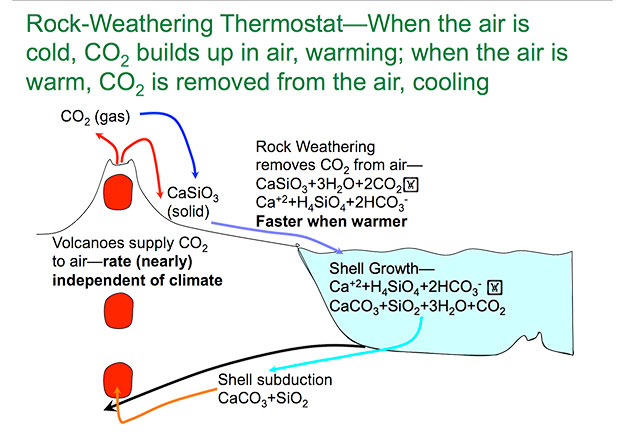
Very similar to this
http://media-cdn.tripadvisor.com/media/photo-s/02/4a/f6/4b/small-stone-forest.jpg
After the last summer visit to the area I was intrigued about whole process and after short search came across this illustration
looks interesting and plausible, but I am sceptical about the atmospheric CO2 role.
It would be appreciated if any of the experts in the field might wish to comment.
Thanks
Vuc, a karst landscape or terrain is essentially chemically weathered carbonate rock –limestone or dolomite formed in the marine environment by calcifying organisms like coccoliths, then tectonically upthrust to become continental rock. The chemical weathering is simply because rainwater is acidic, pH around 5.6 in the absence of additional NOx and sulfate aerosol pollution, which makes it more acidic (‘acid rain’ is slowly dissolving the Parthenon in Athens, since it was constructed from the metamorphosed limestone known as marble). Rain is acidic because rainwater is partial pressure CO2 saturated (Henry’s law). The dissolved CO2 forms carbonic acid.
Karst formation is part of what replenishes ocean calcium, allowing coccoliths to continue doing their thing.
Thanks, I will look further into the processes you describe, despite the chemistry wasn’t my forte.
Karst isn’t upthrust, it’s just flat land that started getting sinkholes, then eventually you had more sinkhole than flat land, leaving the spiky terrain. The Arecibo radio telescope in Puerto Rico was built on Karst terrain.
Thanx again, halite (salt rock, sodium chloride) is apparently one of the more common minerals. Would you know how often it appears as a volcanic sublimate?
V. Halite volcanic? Never. Thick salt geological beds are always associated with evaporation from shallow cut off seas or equivalent (Great Salt Lake in Utah being an example of the later, as is the US Salton Flats). Shallow and cut off thanks to plate tectonics. Salt thanks to andesitic rock chemical weathering over billions of years.
vukcevic January 31, 2016 at 10:32 am
“My family owes a large plot of land…”
—————-
That’s a typical scenario for “owning” a large plot of land in this country, too.
the little ‘n’ makes difference between being OK or broke. Fortunately, plenty of woodland left, and vineyards have done extremely well on the lower slopes, i.e. the ‘n’ is in.
Vuc:
You should import a few Crowned Lemurs from Madagascar and create a tax-exempt wildlife preserve.
Eulemur coronatus
Willis, have a look at what’s happening to the diatom populations. If mankind has increased the dissolved silica runoff then the ocean spring bloom should have a longer diatom run until the silica is exhausted. If that is the case, the biology of the diatom carbon fixation pathway* has some intriguing implications.
JF.
*C4-like
Paraphrasing a farmer friend, “every time I bust the crust, I’m losing soil to the ocean”. The US agriculture industry recognizes my friend’s truism and is turning more and more to low till/no till agriculture. Whether diminished ag erosion supplants increased erosion due to construction, etc., the topic bears examination.
Willis thankyou for your post. As always fun to read and a wealth of information in the comments as folk mull over what you’ve said. It’s sort of like sitting around the campfire at a truly interesting science retreat.
Phytoplankton blooms in the Arctic spring melt is a major factor in controlling the annual cycle of atmospheric CO2 concentrations. They will consume all the CO2 that they can get. This makes the unfrozen Arctic ocean an unlimited sink that absorbs nearly all the CO2 that is delivered to it’s surface. Phytoplankton have “inorganic” shells of carbonates or silicates with an organic inner body. In their growth, they separate the 12 and 13 isotopes, The organic portion is lighter than sea water while the shell is heavier. While the organic portion is alive, it keeps the shell afloat near the surface to get sunlight. They travel with the currents, some of which deliver them to the tropics where they may die.
They then decay releasing 13 C depleted CO2. The shell with the higher concentration of 13 C falls as the observed“snow” in the deeper tropical oceans. It becomes the zero standard used in calculating the 12/13 index. So higher production of phytoplankton in the Arctic can contribute to greater emissions of CO2 in the tropics as well as emissions of more negative 12/13 index values. So how much do anthropogenic emissions contribute to this cyclic process? Possibly about 5%.
fhhaynie,
You have the order of what happens with CO2 and the δ13C levels over the seasons in the NH in reverse: in spring most of the extra CO2 uptake is by land plants, as good as the increase in δ13C levels:
http://www.ferdinand-engelbeen.be/klimaat/klim_img/seasonal_CO2_d13C_MLO_BRW.jpg
If the algal growth was the cause, the ice melt in Antarctica would give at least as much change in CO2 and δ13C levels over the seasons, but the levels hardly show any change in the SH. the NH is 70% land with a lot of forests while the SH is 70% oceans…
Moreover the overall carbon balance from the biosphere is more CO2 uptake than release, thus the biosphere as a whole increases the δ13C levels…
A warm AMO significantly reduces CO2 uptake for the North Atlantic.
http://www.nature.com/ngeo/journal/v6/n2/abs/ngeo1680.html
“We used random forest models to examine more than 20 possible environmental drivers of this change, finding that CO2 and the Atlantic Multidecadal Oscillation were the best predictors, leading us to hypothesize that higher CO2 levels might be encouraging growth. A compilation of 41 independent laboratory studies supports our hypothesis. Our study shows a long-term basin-scale increase in coccolithophores and suggests that increasing CO2 and temperature have accelerated the growth of a phytoplankton group that is important for carbon cycling.”
Unless there’s a new species of flying phytoplankton, it must be due to temperature, as the North Atlantic is a weaker CO2 sink when warmer.
I assumed that CO2 fertilizes the growth of the shelled creatures of the oceans in the same way it fertilizes photosynthetic plants. I live in Northern Illinois. Underneath me are Ordovician carbonates hundreds of feet thick. Based on this I think the earth must have a great capacity for extracting CO2 from the atmosphere. There is a reason that there is a measly .04% CO2 in the air.
Ii mentioned this study a few weeks ago at ClimateEtc, when it first was published in the paper edition. I am happy to see that it is getting a good press. Like all studies, it requires replication before it acquires believers.
Love the discussion of carbonate sequestration in sediments, possibly awaiting return to the atmosphere through the process of subduction and subsequent volcanic activity. Unfortunately, the earth eats CO2 and packs it away with impressive finality (all those massive carbonate beds and coal and lignite beds on the continental terra are not going to be subducted; it’s only sea floor sediments that get that treatment). Also, one suspects that 4 BY on from the initiation of plate tectonics, that the rate of that process is rather slower than initially, and beginning to enter into a long-term decline (it has been a long time since komaiites have been erupted on the earth’s surface). Thus, there is a real chance that CO2 depletion will become the killer of life as we know it here. Fortunately, just next door, in astrophysical terms, we have a fantastic ore deposit, as it it were, of CO2: the atmosphere of Venus. Great subject for a science fiction novel – siphoning off the atmosphere of Venus to save the world.
Correction: “komatiites” not “komaiites”.
Thank you Jimmy for your comments.
As I wrote above:
“My impression is that Volcanism may not suffice, since atmospheric CO2 concentrations have been trending downwards for millennia…”
As I wrote in 2009:
“Since life on Earth is likely to end due to a lack of CO2, should we be paying energy companies to burn fossil fuels to increase atmospheric CO2, instead of fining them due to the false belief that they cause [dangerous] global warming?”
Here’s a thought:
Instead of importing CO2 from Venus, maybe we should continue to burn fossil fuels as a source of energy AND CO2 for our carbon-based-life-rich blue-water planet.
In their misguided attempts to “fight global warming”, it is ironic that our politicians are spending trillions of dollars of scarce global resources to degrade our energy systems AND also attempting to counteract the hugely beneficial impacts of increasing atmospheric CO2.
The following numbers are from the 2015 BP Statistical Review of World Energy, for the year 2014:
http://www.bp.com/content/dam/bp/pdf/energy-economics/statistical-review-2015/bp-statistical-review-of-world-energy-2015-primary-energy-section.pdf
Global Primary Energy Consumption by Fuel is
86% Fossil Fuel (Oil, Coal and Natural Gas),
4% Nuclear,
7% Hydro,
and 2% Renewables – largely intermittent, unreliable wind and solar power.
Conclusions:
Cheap, abundant reliable energy is the lifeblood of civilization.
Fossil fuels keep our families from freezing and starving to death.
More atmospheric CO2 is good; within limits, a lot more is better.
It IS that simple.
It is truly remarkable how so many politicians, scientists and business leaders could get it so wrong.
When misinformed politicians fool with energy systems, innocent people suffer and die.
Regards to all, Allan
Allan MacRae:
You suggest
For sake of argument I will assume that is necessary.
If it be necessary then please don’t forget release of sequestered CO2 by cement manufacture.
Cement (mostly calcium oxide: CaO) is made from limestone (calcium carbonate: CaCO3) by heating it in a kiln to ‘drive off’ CO2.
Portland cement is manufactured by crushing, milling and proportioning the following materials:
Lime or calcium oxide, CaO: from limestone, chalk, shells, shale or calcareous rock
Silica, SiO2: from sand, old bottles, clay or argillaceous rock
Alumina, Al2O3: from bauxite, recycled aluminum, clay
Iron, Fe2O3: from from clay, iron ore, scrap iron and fly ash
Gypsum, CaSO4.2H20: found together with limestone
Richard
Thank you for your comment Richard, It led me to revisit the Chicxulub (Yucatan Mexico) impact that reportedly caused the K-T extinction event 66 million years ago. One of those “really bad days” for the dinosaurs.
My comment concerns timing – Earth probably experienced a low-CO2 near-extinction period during the last Ice Age, which only ended about 10,000 years ago. We are going to enter another Ice Age, probably in a few thousand years or less – less than “the blink of an eye” in geologic time, and probably experience another such low-CO2 period.
Meanwhile, our “world leaders” and “great thinkers” are obsessing about too much atmospheric CO2, in the false belief that climate sensitivity to CO2 is ten or more times higher than the evidence suggests.
Global warming alarmism has taken on the qualities of fantasy and farce.
It is frustrating to see climate scientists begin to dabble into subjects which they appear to know little about, under the mistaken assumption that they are breaking new ground. In fact these disciplines already have a well established theoretical understanding developed over decades of study.
Steve, this is why I encourage people to quote or otherwise identify what they are discussing. For example, you say:
Which “climate scientists” are you referring to? Which subjects are they “beginning to dabble” in? How do we know that they are clueless about these subjects?
Without knowing the answer to any of these questions, I fear your comment has no real meaning.
Examples, quotations, and links are extremely important in our ability to understand you. Without them we simply can’t begin to unravel your meaning.
Best regards,
w.
Willis,
Good point…One that I should have caught with even a cursory proofread. In general, I was bemoaning the relatively recent concern that CO2 is going to acidify the worlds oceans.