Guest post by David Middleton, featured image borrowed from Meadow Heights PTA.

Global warming caused by fossil fuel emissions is blamed by scientists for intensifying storms, raising sea levels and prolonging droughts. Now there’s growing evidence of a positive effect: we may have delayed the next ice age by 100,000 years or more.
The conditions necessary for the onset of a new ice age were narrowly missed at the beginning of the Industrial Revolution in the 1800s, researchers at the Potsdam Institute for Climate Impact Research near Berlin wrote Wednesday in the journal Nature. Since then, rising emissions of heat-trapping CO2 from burning oil, coal and gas have made the spread of the world’s ice sheets even less likely, they said.
“This study further confirms what we’ve suspected for some time, that the carbon dioxide humans have added to the atmosphere will alter the climate of the planet for tens to hundreds of thousands of years, and has canceled the next ice age,” said Andrew Watson, a professor of Earth sciences at the University of Exeter in southwest England who wasn’t involved in the research. “Humans now effectively control the climate of the planet.”
[…]
“However, our study also shows that relatively moderate additional anthropogenic CO2-emissions from burning oil, coal and gas are already sufficient to postpone the next ice age for another 50,000 years,” which would mean the next one probably won’t start for 100,000 years, he said.
“The bottom line is that we are basically skipping a whole glacial cycle, which is unprecedented.”
[…]
Words fail me. I won’t even bother to point out that we are living in an Ice Age which began back in the Oligocene…

Nor will I bother to point out that the current atmospheric concentration of carbon dioxide doesn’t even break out of the Cenozoic noise level…

By “ice age,” the author probably means “glacial stage”… The climate is barely warmer than the coldest period of the current interglacial stage…


The subject of the Bloomberg article is Ganopolski et al., 2016…

Abstract…
The past rapid growth of Northern Hemisphere continental ice sheets, which terminated warm and stable climate periods, is generally attributed to reduced summer insolation in boreal latitudes1, 2, 3. Yet such summer insolation is near to its minimum at present4, and there are no signs of a new ice age5. This challenges our understanding of the mechanisms driving glacial cycles and our ability to predict the next glacial inception6. Here we propose a critical functional relationship between boreal summer insolation and global carbon dioxide (CO2) concentration, which explains the beginning of the past eight glacial cycles and might anticipate future periods of glacial inception. Using an ensemble of simulations generated by an Earth system model of intermediate complexity constrained by palaeoclimatic data, we suggest that glacial inception was narrowly missed before the beginning of the Industrial Revolution. The missed inception can be accounted for by the combined effect of relatively high late-Holocene CO2 concentrations and the low orbital eccentricity of the Earth7. Additionally, our analysis suggests that even in the absence of human perturbations no substantial build-up of ice sheets would occur within the next several thousand years and that the current interglacial would probably last for another 50,000 years. However, moderate anthropogenic cumulative CO2 emissions of 1,000 to 1,500 gigatonnes of carbon will postpone the next glacial inception by at least 100,000 years8, 9. Our simulations demonstrate that under natural conditions alone the Earth system would be expected to remain in the present delicately balanced interglacial climate state, steering clear of both large-scale glaciation of the Northern Hemisphere and its complete deglaciation, for an unusually long time.
They basically developed a model relating insolation to atmospheric CO2. If I am reading it correctly, they are asserting that insolation drives changes in atmospheric CO2 which then drives the glacial-interglacial stages.
Then they go on to say “that under natural conditions alone the Earth system would be expected to remain in the present delicately balanced interglacial climate state, steering clear of both large-scale glaciation of the Northern Hemisphere and its complete deglaciation, for an unusually long time.”
So, it’s actually “worse than we thought”… Earth is naturally delicately balanced between a Late Pleistocene glacial stage and the Paleocene-Eocene Thermal Maximum. So, no matter what we do, George Carlin was right…
CO2 does nothing to temperature. These bastards blame every natural weather event on CO2. Warming. Cooling. Sunshine. Clouds. Drought. Flood. Rain. Hurricane. Tornado. Wind. They call it climate change. They are terrified because they know Trump is going to have them FIIIIIIIIIIIIIIIIIIIIIIIIIIIIIRED!
The work is flawed due to the falsity of two initial assumptions.
1. While previous interglacials were warm, the word “Stable” cannot be applied to them.
2. There is zero evidence that the climate is now or ever was “delicately balanced”.
These flaws indicate an underlying belief system that natural systems are delicate rather than robust and inherently stable. People with this belief system will invariably talk about a “Balance of nature”, and since nature never has and never will be in balance (climate change and evolution see to that) they demonstrate a belief system founded in fantasy and not reality.
Since the models will reflect the basic assumptions of the model makers, the models will be flawed and all results from them invalid to the point of sheer uselessness.
“Delicately balanced” was my sarcasm.
Accuracy? Unscientific.
John Christy’s testimony to Congress (Dec. 2015) showed how those climate models predict “only” 400% too hot for the signature “tropical tropospheric temperatures” compared to actual temperature over the 35 year satellite era since 1979.
The probability of their accurate prediction on predicting descent into the next glaciation? Zilch to none.
Accuracy is not an issue in science anymore. The funding for research is distributed on the basis of sensational or apocalyptic value and the public attention is acquitted, but of course, on the basis of entertainment value. Look at the most publications in physics – no error bars on the measurement graphs!
Lacking conscience and moral law, the “Descent of man” thus leads to the “Descent of science”.
relatively high late-Holocene CO2
But for the second half of the Holocene rising CO2 had accompanied falling temperature. The “control knob” apparently worked in reverse.
I won’t believe they are even close to understanding glacial inceptions until they can convincingly reproduce recent glacial-interglacial-DO event history, including the Mid Pleistocene Revolution (transition from 40 kyr to 100 kyr spacing of interglacials).
When they can do that – then they have something to say.
Hold on. I’m confused. Global Warming is Bad. Ice Ages are Bad. So if one stops the other, is that Bad or Good?
And how doomed does that make us?
Very doomed indeed?
Moderately doomed?
Doomedish?
Or [gasp!]
Not doomed at all?
Face it, we’re doomed and it’s all our fault, so we must be made to pay. Pay up!
So… if we don’t pay up, are we then doubly-doomed?
We all come to the same end, so be sure to enjoy the time you have left.
Depends on what’s being funded at that time…
Bad, good, partially bad/partially good, doesn’t matter; we will need Al Gore and his buddies to manage the scenario for us, for our own good, and we should thank him for giving up his time and energy for our benefit.
One of the graphs reminded me that I was looking for some literature regarding the relationship between different plant types ie grasses, trees mosses etc and their different requirements for CO2 levels. I vaguely remember that below a certain level of CO2( not much below 200ppm I think) the higher plants start failing and only the simpler ones can survive. Can anyone point me in the direction of anything relating to this?
I recall 150ppm being mentioned as a threshold, below which an ecosystem based on plant life will be doomed. Sorry, can’t give a reference though.
one place to search – http://defyccc.com/search/
look up C3 and C4 plants
good reading – http://www.nipccreport.org/reports/ccr2b/ccr2biologicalimpacts.html
wander through here for sure – http://co2science.org/
Alan, an interesting question. Plant growth is important for the albedo of the earth. Recent rise in CO2 is already changing the vegetation pattern. All vegetation zones are producing more biomass, but from the satellite maps is it best visible in semi-dry regions like the Sahel in Africa. They are already ‘greening’ with a 30%. And so lowering the albedo. But grass is in the same time going to be transformed in savanne, savanne in light tropical forest, light tropical forest in tropical forest and so on, by every change diminishing albedo. So my first thought is: greening the earth by CO2 is diminishing the albedo. So is creating some warming and, perhaps, preventing a next glacial?
My second thought is this: when ocean animals continue to sequester CO2 for making their shells, CO2 in the atmosphere will continue to go down. When after an interglacial the earth is cooling down, CO2 from the atmosphere will disappear into sea and so lowering the amount in the atmosphere itself. Because of THIS process, the albedo will rise because the reverse process from above is working – and create an extra impuls for cooling. And, referring to your question, some types of plants (the most sensible for lowering CO2) will strongly be diminished or even disappear – and again, by doing this, they are helping to rise albedo – to a next snowball earth?
Perhaps it is THIS PROCESS of changing vegetation belts, created by rising CO2, which can be decisive in eventually preventing the next glacial. So, even without modelling we can logically reason that CO2 can help in preventing a next glacial. But in another way as expected above. The earth has many ways to balance. In this view by bringing CO2 back in circulation, man is bringing the balance back to the point where vegetation can both increase and in the future can CONTINUE her role in balancing the earth – without becoming extinct. I think this is the real green vision. Nice for men, good for plants and animals.
This map of Roy Spencer gives you a good view of the changing of the vegetation belts by more CO2: http://www.drroyspencer.com/wp-content/uploads/co2_growth.jpg
Article: http://www.drroyspencer.com/2014/05/greening-of-planet-earth-a-little-crowdsourcing-project/
This report gives you some additional information: http://www.thegwpf.org/content/uploads/2015/10/benefits1.pdf
Have a look at the pictures on page 9!
You are correct, CO2 and vegetation do control albedo and the modulation of ice ages. And your proposal for the prevention of an ice age through increased vegetation is entirely possible.
However, the reverse is also true. During an ice age CO2 levels reach such a low level that there is a widespread die-back of all C3 vegetation. This causes desertification, dust storms, dirty ice sheets, and low albedo. And it is the low albedo that allows the melting of the ice sheets, and the formation of an interglacial warming era.
So it is not only high CO2 that causes warming (through vegetation albedo), but low CO2 can do this too, by killing off all plant-life (and causeing low ice sheet albedo). See this paper on ice age modulation:
https://www.academia.edu/20051643/Modulation_of_Ice_Ages_via_Precession_and_Dust-Albedo_Feedbacks
Ralph
Ward, J.K., Harris, J.M., Cerling, T.E., Wiedenhoeft, A., Lott, M.J., Dearing, M.-D., Coltrain, J.B. and Ehleringer, J.R. 2005. Carbon starvation in glacial trees recovered from the La Brea tar pits, southern California. Proceedings of the National Academy of Sciences, USA 102: 690-694.
http://i90.photobucket.com/albums/k247/dhm1353/GeoCO2.png
Thats great, thanks a lot for that. My background is Forestry and here in the Scotland the Forestry Commission is a fully paid up member of the CO2 bad camp, so this will be useful to me and my contacts inside the FC.
When, oh when, will the media catch on to the climate alarmist fantasies?
When liberals no longer benefit from them.
Here’s a great benefit for those of us that LOVE science . I’m sitting on the tailgate of a truck, on my farm and it’s cold and wet outside. This makes chores more uncomfortable than usual. I want the warm weather to return fast! I think it’s a human condition to desire warmth. Bring on the warming, people will benefit.
Cancelled the ice age huh?
Wow, and wow agin.
Next, Lets see if mm CO₂ can turn the world on its head? Um, no not really: CO₂ increase still lags rises in Temperature………
Well that’s sorted then, get ready for a big FREEZE!
A much wealthier and a much more free society is required to handle the next glaciation period. Wasting significant amounts of money on the fantasy of CAGW is a threat to dealing with the prospect of an expected ice age.
John
If they are saying that insolation drives changes in atmospheric CO2 which then drives the glacial-interglacial stages then they may be a step closer to the truth. They just need to cut out the bit about CO2 doing anything other than aiding plants and they will be right there. All their ‘models’ seem to be pointing to some very good news but they are not smiling, as a loss of Alarm in the general population would possibly lead to a cut in funding.
the next glacial advance will happen when Momma Nature decides it’s time, and not one (geologic time scale) before. May or not happen while our puny little species is still on the field–Momma always gets to bat last, and will still be playing long after we are gone.
An “ensemble of simulations generated by an Earth system model of intermediate complexity” from the apparatchiks at PIK. One gets the feeling we’ve seen another model of similar complexity before.
were narrowly missed at the beginning of the Industrial Revolution in the 1800s…
First “they” declare the LIA ended in 1850…
…then they declare that all warming after that was man made
Never mind, it’s unprecedented…
…er…
…I think my mind is going. What was I saying?
Never mind, it’s unprecedented…
…er…
LOL. Good, you’re paying attention. 🙂
Most climate scientists believe that glaciation cycles require a cold trigger to initiate northern hemisphere ice retention, and that cold trigger is solar insolation changes induced by Earth’s orbital cycles. The ~100 thousand-year (kyr) cycle predominates, but the ~40 kyr and ~21 kyr cycles modify the effect, by addition and subtraction. We are near the minimum of the 100 kyr cycle and of the 40 kyr cycle as well. That implies there will be no significant glaciation for at least 50 kyr, likely longer. The temperature and solar insolation maximum occurred about 9 kyr ago in the early Holocene, and since that time insolation in the northern hemisphere has decreased by about 40 watts/m^2. We are currently near the minimum of insolation for the 40 kyr cycle, and no ice age.
All these effects are independent of what the CO2 concentration is.
I don’t disagree, but I need a little clarification. What makes one a climate scientist? Was Milutin Milanković a climate scientist? Was Stephen Schneider (a mechanical engineer) a climate scientist? Is Rajendra Pachauri (a railway engineer) a climate scientist? Is Dr. Michael E. Mann (a condensed matter physicist) a climate scientist? Can a person with no academic credentials be a climate scientist?
This cycle existed when there were no ice ages.
What has changed are three things: the continents are all migrating basically towards the North Pole and…the sun may be changing into a variable mode rather than steady mode…and Panama rose up to cut the Pacific off from the Atlantic ocean except next to Antarctica.
Oh, and when Antarctica slipped to exactly the south pole region and then iced over nonstop, this altered the climate, too. Whenever the continents collide and end up mostly on the equator, we get warmer climates.
Coming from Canada its great news that we can now set the global thermostat and forestall another ice age. Continental ice sheets in the northern hemisphere are extreme bad new. They would cause mass starvation and a possible human extinction event. Perhaps we can start to grow grain north of 60 in another few decades.
David Middleton,
Mmmmm …actually … not just in; Archer and Ganopolski did this in 2005 and reached similar conclusions: http://geosci.uchicago.edu/~archer/reprints/archer.2005.trigger.pdf
Anthony covered it in 2013: http://wattsupwiththat.com/2013/04/27/good-news-elevated-co2-may-extend-interglacial-prevent-next-ice-age/
… and his parting argument was: Not having mile thick ice sheets crush northern hemisphere cities is a good thing, don’t you think?
My answer is, “yes, obviously that is a good idea.”
Yeah that’s kind of how I’m reading, “Here we propose a critical functional relationship between boreal summer insolation and global carbon dioxide (CO2) concentration, which explains the beginning of the past eight glacial cycles and might anticipate future periods of glacial inception.”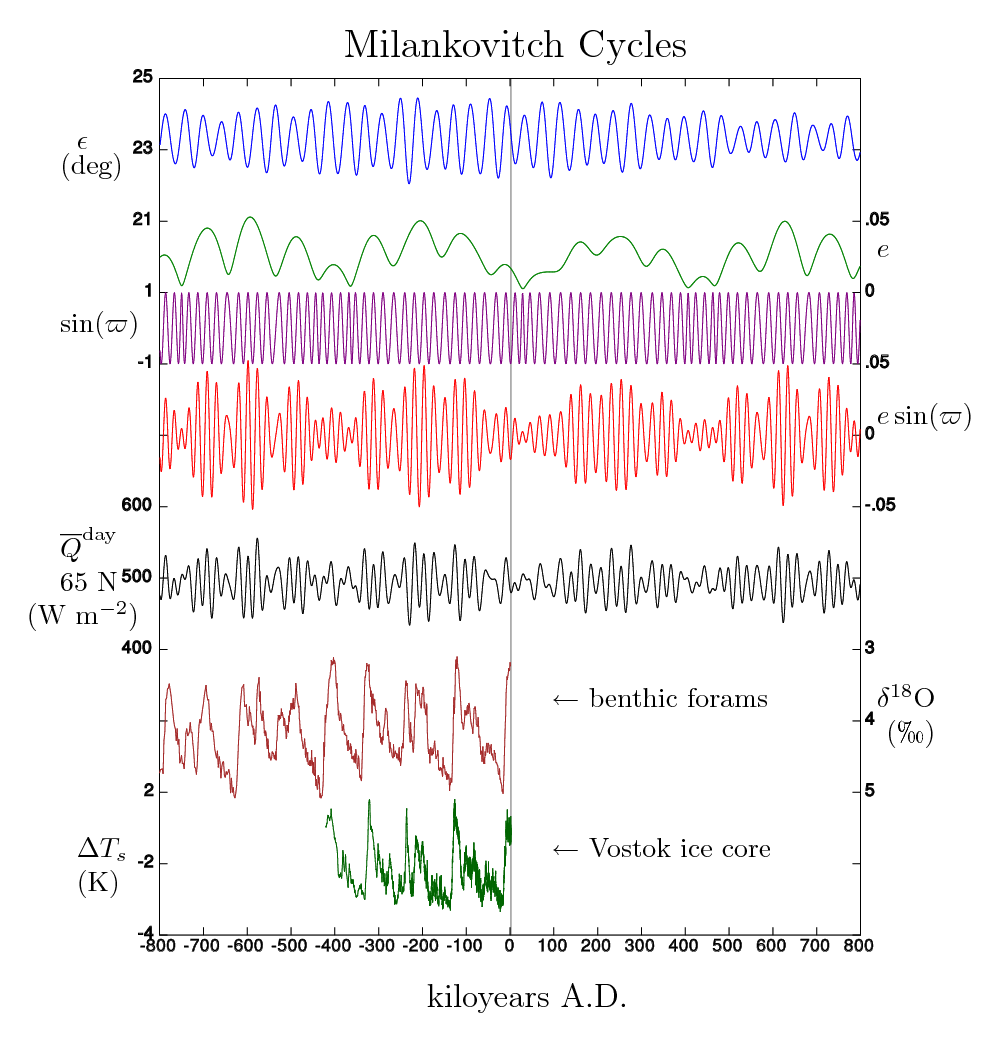
Which strikes me as not quite right, but I have a bigger problem with this statement further up in the abstract:
The past rapid growth of Northern Hemisphere continental ice sheets, which terminated warm and stable climate periods, is generally attributed to reduced summer insolation in boreal latitudes1, 2, 3. Yet such summer insolation is near to its minimum at present4, and there are no signs of a new ice age5. This challenges our understanding of the mechanisms driving glacial cycles and our ability to predict the next glacial inception6.
Emphasis added. Reference 4 is: Berger, A. & Loutre, M. F. An exceptionally long interglacial ahead? Science 297, 1287–1288 (2002): http://www.climate.unibe.ch/~born/share/papers/eemian_and_lgi/berger_loutre02.sci.pdf
The one figure in that paper does indeed show insolation at a local minimum at present. However, a longer view of boreal summer insolation at 65 N …
… shows that we are nowhere near previous or predicted insolation minima. Berger certainly understands this — he first did the insolation calcs in 1978 — and that’s pretty much the point of his paper with Loutre in 2002.
No, it’s actually better than it has been for at least the past 800 kyrs, and is likely to be starting ~100 kyrs from now on the basis of orbital forcing alone.
Ruddiman also published an ice age postponed paper back in the early 2000’s.
“This just in” referred to the Bloomberg article about Ganopolski’s new paper.
Good point about the insolation claims.
Here is the Ruddiman paper
http://courses.washington.edu/holocene/Ruddiman-Holocene_Carbon_Cycle_Anthropocene-ClimChange03.pdf
David, phil; thanks for the Ruddiman paper, I did not know of it. Looks to be an interesting read.
For once we agree. Yet those dips say, “that under natural conditions alone the Earth system would be expected to remain in the present delicately balanced interglacial climate state, steering clear of both large-scale glaciation of the Northern Hemisphere and its complete deglaciation, for an unusually long time.”
This is apology speak for, “Well, our premise is totally wrong according to the orbital forcings the premise is based on, but we toss this crap out anyway because we get a publication in NATURE.”
Brandon, this whole thing is just another apology. Now they are trying to abandon the orbital forcing they embraced to wholeheartedly to bail themselves from out of the clear temperature dependence of CO2 for the majority of the ice core data to move the interglacial/glacial transition backwards towards the preset.
Get used to it. Co2 don’t do much. Didn’t do much in the last 18 years. Didn’t do much in the Pleistocene. Didn’t do much in the Phanerozoic. Strike three, it’s out.
gymnosperm,
Hell freezing over is one prediction of AGW you know.
No, that’s science-speak for, “we need to better understand what the natural factors are so that we can quantify the magnitude of our own contributions, and how much we might expect things to change in some future scenario”.
Or in more abstract terms, paleoclimate data are the control, instrumental-period data are the experiment. One thing I can say with absolute certainty is that in the modern era, temperature is clearly lagging CO2 in stark contrast the pre-industrial past 800 kyrs.
Oh, and by the way, it’s notoriously difficult to get published in Nature because they don’t have a habit of publishing crap, and also reject a lot of good papers due to the volume of submission they get. IOW, they’re choosy because they have a reputation for being a premier journal which publishes quality work, and as a for-profit publisher I’d bet the house that’s the way they want to keep it.
Mmm, no, they’re not abandoning orbital forcing. From the abstract: Here we propose a critical functional relationship between boreal summer insolation and global carbon dioxide (CO2) concentration, which explains the beginning of the past eight glacial cycles and might anticipate future periods of glacial inception.
That doesn’t read exactly right to me since it skips over my understanding of what causes the CO2 response, which is temperature change due to ice-albedo feedback. Of course, CO2 itself is a feedback mechansim as well (plus methane, water vapor, etc.), amplifying temperature rise up to the insolation peak, and damping cooling response after the insolation peaks. The expected result is the sawtooth-shaped temperature curves seen in this figure:
Even so, orbital forcing is still cited as the ultimate causal mechanism. Just because they don’t mention the intermediate steps in the abstract does not mean it isn’t covered in the body of the paper (which I have not read because it’s paywalled). I can check their references though:
Petit, J. R. et al. Climate and atmospheric history of the past 420,000 years from the Vostok ice core, Antarctica. Nature 399, 429–436 (1999)
That one almost had to be there, and there is a full version available here: http://www.jerome-chappellaz.com/files/publications/climate-and-atmospheric-history-of-the-past-420-000-years-from-the-vostok-ice-core-antarctica-38.pdf
There is a close correlation between Antarctic temperature and atmospheric concentrations of CO2 and CH4 (refs 5, 9). This discovery suggests that greenhouse gases are important as amplifiers of the initial orbital forcing and may have significantly contributed to the glacial–interglacial changes 14–16. The Vostok ice cores were also used to infer an empirical estimate of the sensitivity of global climate to future anthropogenic increases of greenhouse-gas concentrations 15.
Greve, R. A continuum-mechanical formulation for shallow polythermal ice sheets. Phil. Trans. R. Soc. A 355, 921–974 (1997)
Weertman, J. Milankovitch solar radiation variations and ice age ice sheet sizes. Nature 261, 17–20 (1976)
Abe-Ouchi, A. et al. Insolation-driven 100,000-year glacial cycles and hysteresis of ice-sheet volume. Nature 500, 190–193 (2013)
Elderfield, H. et al. Evolution of ocean temperature and ice volume through the mid-Pleistocene climate transition. Science 337, 704–709 (2012)
So, it looks like all of the physics I know about as an interested layperson are probably in there.
I feel almost silly reminding you that CO2 isn’t the only determinant of surface temperature. I don’t feel at all silly reminding you …
http://climexp.knmi.nl/data/itemp2000_global.png
… that judging a book solely by its cover is often a Bad Idea.
Ok then, how much do you think it did, and why?
I don’t pretend to know how much it did, nor how much it is currently doing. In good company on this. I do believe CO2’s function as a GHG is compromised to the tune of 50% or more by the saturation we previously discussed. I believe this handicap is the reason it does not perform as expected in the models, the reason warming has slowed to a crawl in the last human generation in spite of immense and accelerating human production of CO2, the reason CO2 is virtually the slave of temperature in the ice core data, and the reason there seems no meaningful correlation at all between temperature and CO2 in the super high concentration deep time of the Phanerozoic.



This is what I see:
In the above the Vostok ice core CO2 data is plotted against a worldwide compilation of ODP benthic 18O. This global series can be thought of as the planet’s EKG for the last 5 million years as we descended into the Pleistocene. There is every reason to expect that the relationship shown here extends back the entire record, far longer than any ice core.
Above we zoom in and find the limitations of my cartoons, but the relationship is clearly just as it is in the ice core/ice core data with CO2 predominantly the slave of temperature.
Monckton’s work above covers the recent divergences.
The obvious question is, when was CO2 ever anything more than a feedback? The irony is that the climate models treat water as feedback only. I believe these guys are hanging upside down. Water is the forcing and CO2 is feedback only as a result of its saturation handicap.
I was having some fun as many here know I am no fan or orbital forcing and the guys start their paper with a proclamation that there is general agreement.
Firstly, while there is no general agreement on the reason, it is generally agreed that in the middle of the Pleistocene there was a shift from forty or so to 100 or so kyr periodicity. Weird, no? You can see it in the benthic cores.
This sort of transition will not result from greenhouse gasses.None of the orbital parameters change significantly across this transition.
The spectral power of various periodicities varies considerably from place to place with sometimes 100kyr shining and others 40kyr, but never the 23kyr.
Bottom line I look at orbital forcing the same as CO2. There must be some effect in both cases, but if it were a predominant effect, it would show up in the data. It doesn’t.
gymnosperm,
C’mon now, this is your full statement to me previously: Get used to it. Co2 don’t do much. Didn’t do much in the last 18 years. Didn’t do much in the Pleistocene. Didn’t do much in the Phanerozoic. Strike three, it’s out.
Emphasis mine, which reads to me as, “CO2 didn’t do nuffin'”.
False: http://onlinelibrary.wiley.com/doi/10.1029/2012GL051607/full
Forcing, feedbacks and climate sensitivity in CMIP5 coupled atmosphere-ocean climate models
I certainly don’t dispute that water vapor is the single greatest instantaneous contributor to radiative forcing in atmosphere (60% for wv vs. 26% for CO2) but, IIRC, your proposed saturation mechanism stated that once LW from the surface is absorbed within the first 3 meters of emission it stays put and doesn’t come out until being released near the tropopause, hence there is no more radiative effect to be had anywhere else in the air column.
One wonders why water vapor should be an exception to your proposed saturation mechanism?
As far as water vapor being the present primary change driver and CO2 being the feedback, consider this common chemical reaction:
http://www.processtechacademy.com/wp-content/uploads/2015/08/chemrxn.gif
The rule for complete combustion of an unbranched alkane like propane is that for every n carbons in the chain, we will get as reaction products n CO2 molecules and n+1 water molecules. When we consult the history of human hydrocarbon combustion activity …
… and compare that to the recent history of CO2 atmospheric concentration …
http://climexp.knmi.nl/data/ico2_annual.png
… and finally compare both to the recent history of atmospheric specific humidity …
http://www.climate4you.com/images/NOAA%20ESRL%20AtmospericSpecificHumidity%20GlobalMonthlyTempSince1948%20With37monthRunningAverage.gif
I give you credit for allowing that orbital forcing and CO2 must be having some effect; however, there are still some problems with your argument:
Just because your eyeballs don’t see it does not mean it isn’t there.
Dominance of a given effect is sensitive to the sum total of physical interactions within the system, which is in turn sensitive to the physical configuration of the system, which is demonstrably not constant. For an extreme example, the aptly named Hadean eon which extends from about 4 billion years ago back to the Earth’s formation about 4.6 billion years ago includes an interval of time when the “oceans” were molten rock — clearly a different climate, and one in which I would not expect temperatures and CO2 levels to relate to anything seen over the past million years.
So, while me might reasonably assume that the laws of physics have not changed since the onset of the Phanerozoic eon [1], it does not necessarily follow that any single identifiable climate “driver” must be “dominant” over that entire interval. 550 million years is a lot of time …
http://palaeos.com/paleozoic/images/Continents.gif
… and a lot of things can change over that kind of interval.
Bintanja and van de Wal (2008) take a shot at explaining the past three million years with an ice/ocean/atmosphere/orbital forcing model constrained by the limited paleo data available: http://www.nature.com/nature/journal/v454/n7206/abs/nature07158.html
Article is paywalled, but the freely available supplemental contains some good information: http://www.nature.com/nature/journal/v454/n7206/extref/nature07158-s1.pdf
The the output of model is available here: ftp://ftp.ncdc.noaa.gov/pub/data/paleo/contributions_by_author/bintanja2008/
… with this note in the file:
DESCRIPTION:
A comprehensive ice-sheet model and a simple ocean-temperature
model were applied to marine benthic oxygen isotopes (LR04 stack)
to extract three-million-year mutually consistent records of
surface air temperature, ice volume, and sea level.
The reconstructed atmospheric surface air temperatures apply to
all subarctic to arctic land masses (including continental shelves)
north of about ~45N.
The reference for the marine benthic foraminifera d18O stack is Lisiecki and Raymo (2005), the data are here: ftp://ftp.ncdc.noaa.gov/pub/data/paleo/contributions_by_author/lisiecki2005/
Regressing the surface temp reconstruction from Bintanja against the marine benthic data from Lisiecki, I get an R^2 value of 0.81, which is like, not shabby.
I’ve also regressed Petit et al. (1999) Vostok ice core temps (scaled 50% to account for polar amplification) against CO2 data from same, 65 N June insolation from Berger, and the calculated combined ice sheet area from Bintanja (2008). After twiddling lead/lag for insolation and ice area, my best fit regression (R^2 0.85) returned a climate sensitivity of 2.86 K/2xCO2. [2]
Bottom line: it looks to me like we can do some reasonable modelling of paleoclimate over the past 3 million years, it need not be mysterious or incomprehensible, and we need not shy away from guessing the component contributions of various known parameters to temperature response. We just need to be willing to combine observation with theory and math instead of only relying on our eyeballs.
We also need to be willing to be wrong, and aware that we most certainly are. Science doesn’t get done any other way.
—————
[1] Even this is not a completely “safe” assumption, as someone who might know a little about physics once penned: We have no right to assume that any physical laws exist, or if they have existed up until now, that they will continue to exist in a similar manner in the future. ~Max Planck
I think, however, that such extreme skepticism is not very useful except perhaps as an excuse to give up hope of ever understanding much of anything … an attitude Planck clearly didn’t espouse, and which I think is a critical secondary lesson of this particular quote.
[2] Because Petit (1999) and Bintanja (2008) do not use compatible timescales, I limited the regression to the past 140 kyrs.
Starting from the bottom up again because it is so much easier:
Willing to be wrong. We are just naked apes.
Why would you expect the surface temperature reconstruction to be different from the benthic cores and the ice cores? The sun warms the ocean, the ocean warms the atmosphere. When the atmosphere is colder, more ice forms toward the poles.
Please don’t equate the Phanerozoic with the Hadean. Obviously the system changes. Phanerozoic is Greek for “abundant life”. The effects of life basically titrating the lithosphere before the Phanerozoic and being surprisingly abundant in the mesosphere today today is hugely underappreciated.
Agree on alkanes and mea culpa for previous comments (not in this discussion) where I failed to distinguish between Alkane and glucose “combustion”.
” your proposed saturation mechanism stated that once LW from the surface is absorbed within the first 3 meters of emission it stays put and doesn’t come out until being released near the tropopause”
Not what I mean at all. It doesn’t stay put. It isn’t even there. All the light is exhausted because CO2 is incredibly hungry for those photons. As you have pointed out, CO2 also chooses to dissipate that energy as thermalization the vast majority of the time, but in doing so, the conversion loss kills the quantum. Of course, multiple kinetic interactions can reconstitute it, but the process is a downhill run, and it expires a 3 meters, 10, 100, whatever with the isotopologues and water overlap factored in. Above that point, wherever it is, those “saturated” bands do nothing until they are revitalized y an indirect energy infusion from ozone at the tropopause.
http://www.giss.nasa.gov/research/briefs/lacis_01/
“The numerical climate experiment described in Fig. 2. demonstrates the fundamental radiative forcing role of the non-condensing GHGs, and the feedback (only) role of water vapor and clouds”
Don’t do much and don’t do nuffin’ be berry different.
Correct, the present low eccentricity Green line) means no precessional Great Winter for the next 100 kyr or more (black line), and so no low-insolation ice age forcing (black line trough).
The last time this nearly happened was 400 kyr ago, and we had an extended interglacial then too. But this period of low eccentricity is even longer, and so temperatures should be stable for even longer. See my explanation for ice age and interglacial feedbacks via albedo, below.
Ralph
“The conditions necessary for the onset of a new ice age…”
I think they have that backwards. We are always in an ice age, just a temporary reprieve during interglacials. Now if they had stated “The conditions necessary for ending the current interglacial…”
I do believe it would be considered a good thing. Warmer is better.
No more Barak Hussein Obama SOTU crap! Weee! I survived! I am resilient!
Potsdam should have been bombed like Dresden and Tokyo when we had the chance!
What did “atomic” bombing and Napalm on Japan yield? A population of LGBTQs ! They hate each other so much that they can’t procreate; ergo the population will die off in short order. Good riddance.
Yeah!
Ha ha
Just a few clips from your post David Middleton:
“Words fail me.”
“I won’t even bother to point out…..”
“Nor will I bother to point out…….”
“By “ice age,” the author probably means …”
==============================
I know you got something to say, but you are not saying it.
What is the worst that can happen ?
You get picked apart by all the lurkers, and then your post lives forever on the internet.
So what, at least you spoke up.
Why don’t the peers reviewing this stuff apply the criteria expressed by Naomi Oreskes
“Finally, we must admit that a model may
confirm our biases and support incorrect
intuitions. Therefore, models are most useful
when they are used to challenge existing
formulations, rather than to validate or
verify them. Any scientist who is asked to
use a model to verify or validate a predetermined
result should be suspicious”
http://www.nssl.noaa.gov/users/brooks/public_html/feda/papers/Oreskes1.pdf
“Verification, Validation, and Confirmation of Numerical Models in the Earth Sciences” – The 1994 paper for which she was the lead author
It seems that as an adult is exposed to miscreant professional behaviour by other individuals.
First they are skeptical.
Then they are initially resistive.
Then they feel demoralized and cynical.
Then there is a stage during which they start to discover that the culprits are acquiring all the wealth and kudos. And that resistance is only ever harmful to the individual who resists.
Finally they themselves may choose to launch themselves as masters of the art of mass deception.
I suspect that this is exactly the route chosen by the Lews and Oreskes of the world.
AND they have succeeded in positioning themselves at the head of the climate debate even though they have no relevant expertise.
Is it any wonder that people choose moral bankruptcy?
There certainly won’t be any financial bankruptcy involved.
Hurrreeeyy. . . hurrreeeyy. . . hurrreeeyy! Step right up to the Paris midway folks! See millions, billions, trillions traded for pigs, pokes, and lies . . . panting polar bears straight from the sands of a sinking arctic . . . snarling snow leopards in search of water . . . gasping Gurkhas swept away by melting glaciers . . . coastal residents on stilts . . . climate grifters juggling semi-intelligent humans . . . grim reapers galloping the streets . . . massive throngs wandering aimlessly . . . You there in the back! Why are you wearing that parka?! Hurrreeeeyy . . . hurrreeeyy . . . folks! . . . see the Guinness record for limos and Lear jets parked in one spot . . . hear tragic tales of total destruction from Nobel laureates . . . You there on the right! Can you spare us a billion? That’s it! Step right up and empty your pockets on stage . . . brothers Al and Cameron will assist you . . . hurrrreeeyy. . . hurrrreeeeyy. . . hurrrreeeyy . . .
You forgot the principle sales technique – the diminishing window of opportunity.
Buy now – and save – whilst stocks last. Grab this once only special offer. Only 500 days left to save the earth. Don’t miss out. Tomorrow will be TOO LATE…
That sort of thing is just basic level marketing crap…
Some of the more extreme warmistas contemplate fascist states that would put skeptics in camps, “de-program” them or even execute them as punishment for AGW. Well, that knife can cut both ways. Imagine the pitchfork carrying mobs if after proclaiming impossibility of the end of the interglacial, the end was reached either on a “natural” time frame or perhaps one hastened by “AGW mitigation?” Yes, that knife can cut both ways.
A long time ago I read a horror story about the future impact horse manure would have on big cities. But the forecast of the depth of horse manure in the streets was made without knowing that motor vehicles would replace horses.
The Potsdam Institute paper seems to be analogous to the forecast that cities would now be awash with manure. Are we to believe that fusion energy will not have replaced combustion of carbon and hydrogen during the next thousand years?
Even so, this paper relies on climate models that are too sensitive to CO2. If Lindzen and Choi are correct about the size and direction of feedbacks in the climate system, then this paper may be correct but trivial.
(See references below.)
The astronomers Loutre and Berger claim that the present interglacial will last 50,000 years (instead of the typical 20,000 years) because of the configuration of orbital parameters.
Low climate sensitivity to CO2 arising from negative feedback in the climate system may add a few thousand years to this, postponing glaciation for 45,000 years instead of 40,000 years.
But what difference would it make if the next interglacial begins 40,000 years from now or 45,000 years from now?
How confident can we be that greenhouse gases will overcome celestial geometry?
O mighty Potsdam, how hast thou sunk so low?
References:
1. Lindzen, Richard S., and Yong-Sang Choi. “On the observational determination of climate sensitivity and its implications.” Asia-Pacific Journal of Atmospheric Sciences 47.4 (2011): 377-390.
http://eaps.mit.edu/faculty/lindzen/236-Lindzen-Choi-2011.pdf
2. Loutre and Berger estimated that the present inter-glacial might last for another 40,000 years based on orbital parameters. In the abstract substage 5e was the last interglacial (Eemian) when sea level may have been 9 meters higher than at present. During MIS-11 (400,000 ago) sea level rose about 22 meters higher than the present.
Abstract of Marine Isotope Stage 11 as an analogue for the present interglacial
Past analogues for our present interglacial or even warmer periods have been sought in order to better understand our present and future climate. Marine Isotope Stage (MIS) 5, more precisely substage 5e, has long been considered to be a good candidate. However, there were some elements against this analogy in the data themselves [Kukla et al. Quat. Sci. Rev. 16 (6) (1997) 605], as well as in the mechanisms [Berger, 1989 Response of the climate system to CO 2 and astronomical forcings. In: Paleo-Analogs, IPCC Working Group I, Bath, 20-21 November 1989] and forcing related to both periods. Here we suggest that the period from 405 to 340 ka before present (BP), including a large part of Marine Isotope Stage 11, could be a good analogue for future climate. The insolation over this interval shows a strong linear correlation with the insolation signal over the recent past and the future. In addition, simulations using the climate model developed in Louvain-la-Neuve (LLN 2-D NH) show that both MIS 11 and the future are characterized by small amount (if any) of continental ice, with almost no variation during the whole interval. In contrast, MIS 5 is exhibiting larger variability in simulated ice volume. This confirms that the interval [405-340 ka BP] may lead to a better understanding of our present and future warm climate.