Guest post by David Middleton, featured image borrowed from Meadow Heights PTA.

Global warming caused by fossil fuel emissions is blamed by scientists for intensifying storms, raising sea levels and prolonging droughts. Now there’s growing evidence of a positive effect: we may have delayed the next ice age by 100,000 years or more.
The conditions necessary for the onset of a new ice age were narrowly missed at the beginning of the Industrial Revolution in the 1800s, researchers at the Potsdam Institute for Climate Impact Research near Berlin wrote Wednesday in the journal Nature. Since then, rising emissions of heat-trapping CO2 from burning oil, coal and gas have made the spread of the world’s ice sheets even less likely, they said.
“This study further confirms what we’ve suspected for some time, that the carbon dioxide humans have added to the atmosphere will alter the climate of the planet for tens to hundreds of thousands of years, and has canceled the next ice age,” said Andrew Watson, a professor of Earth sciences at the University of Exeter in southwest England who wasn’t involved in the research. “Humans now effectively control the climate of the planet.”
[…]
“However, our study also shows that relatively moderate additional anthropogenic CO2-emissions from burning oil, coal and gas are already sufficient to postpone the next ice age for another 50,000 years,” which would mean the next one probably won’t start for 100,000 years, he said.
“The bottom line is that we are basically skipping a whole glacial cycle, which is unprecedented.”
[…]
Words fail me. I won’t even bother to point out that we are living in an Ice Age which began back in the Oligocene…

Nor will I bother to point out that the current atmospheric concentration of carbon dioxide doesn’t even break out of the Cenozoic noise level…

By “ice age,” the author probably means “glacial stage”… The climate is barely warmer than the coldest period of the current interglacial stage…


The subject of the Bloomberg article is Ganopolski et al., 2016…

Abstract…
The past rapid growth of Northern Hemisphere continental ice sheets, which terminated warm and stable climate periods, is generally attributed to reduced summer insolation in boreal latitudes1, 2, 3. Yet such summer insolation is near to its minimum at present4, and there are no signs of a new ice age5. This challenges our understanding of the mechanisms driving glacial cycles and our ability to predict the next glacial inception6. Here we propose a critical functional relationship between boreal summer insolation and global carbon dioxide (CO2) concentration, which explains the beginning of the past eight glacial cycles and might anticipate future periods of glacial inception. Using an ensemble of simulations generated by an Earth system model of intermediate complexity constrained by palaeoclimatic data, we suggest that glacial inception was narrowly missed before the beginning of the Industrial Revolution. The missed inception can be accounted for by the combined effect of relatively high late-Holocene CO2 concentrations and the low orbital eccentricity of the Earth7. Additionally, our analysis suggests that even in the absence of human perturbations no substantial build-up of ice sheets would occur within the next several thousand years and that the current interglacial would probably last for another 50,000 years. However, moderate anthropogenic cumulative CO2 emissions of 1,000 to 1,500 gigatonnes of carbon will postpone the next glacial inception by at least 100,000 years8, 9. Our simulations demonstrate that under natural conditions alone the Earth system would be expected to remain in the present delicately balanced interglacial climate state, steering clear of both large-scale glaciation of the Northern Hemisphere and its complete deglaciation, for an unusually long time.
They basically developed a model relating insolation to atmospheric CO2. If I am reading it correctly, they are asserting that insolation drives changes in atmospheric CO2 which then drives the glacial-interglacial stages.
Then they go on to say “that under natural conditions alone the Earth system would be expected to remain in the present delicately balanced interglacial climate state, steering clear of both large-scale glaciation of the Northern Hemisphere and its complete deglaciation, for an unusually long time.”
So, it’s actually “worse than we thought”… Earth is naturally delicately balanced between a Late Pleistocene glacial stage and the Paleocene-Eocene Thermal Maximum. So, no matter what we do, George Carlin was right…
An underhanded way to support the establishment’s scam. This is ludicrous!!
We prevented the ice age (during an ice age) with a puny amount of carbon dioxide!! We are super heroes!! SuperCO2!!
They never say the ice age will delay the warming. Wonder why?
“””””…… “The bottom line is that we are basically skipping a whole glacial cycle, which is unprecedented.” …..”””””
Well there you have it in writing.
Something that wasn’t supposed to happen yet hasn’t happened yet, and that is unprecedented. Whoopy !!
Something much more important that isn’t supposed to happen yet; isn’t going to happen either, even when it gets to when it is supposed to happen; in which case it won’t happen at that time or even perhaps “several years” later when it is now estimated to maybe happen or not.
That of course is ITER going thermonuclear, which is supposed to happen in 2019, at which time it is now not going to happen as scheduled, and maybe not for “several more years”.
Oh; I almost forgot. Along with not going to happen, it is also not going to cost what it was scheduled to cost. So bring money; it will now cost much more money, even when it doesn’t actually happen.
Physics Today for Jan 2016 has an article about the new schedule and cost. It seems that some of the budget, was spent on fancy green coats, with “ITER Visitor” on the back, along with fancy green hard hats, for the suckers; excuse me that’s the customers who are going to pay for this thing that won’t happen.
But their fancy green duds were for them to watch them pour a bunch of concrete around the place in France where ITER isn’t supposed to happen now. There’s some other folks in the picture with blue hard hats and coats, and I’m guessing they might be the UN concrete watchers. Some persons have white hats, but still have the green ITER Visitor green jackets.
So they are pouring all this concrete to contain all of the nuclear radiation that isn’t going to happen when ITER goes off, which it isn’t going to do.
Well the technology of concrete is known already so they know how to pour concrete so that’s what they are doing. The ITER part they don’t know how to do and won’t in 2019 either.
So much for clean thermonuclear energy that doesn’t emit radiation.
I suggest they put up a tent, or even a cheap geodesic dome of fiber glass or something else cheap, and then start building the ITER reactor machine inside of that, instead of wasting money on pouring concrete. Then when ITER is up and running (just for a few msec) they can build their radiation proof dome around it to contain the radiation that it isn’t supposed to make.
But the same issue of PT has some good news for nuclear energy.
Some guy named Muller in 1946 got a Nobel prize for irradiating fruit flies with “low level” virtually down to zero, and proved there was NO lower limit to how much radiation could cause cancer, so he invented the LNT model of radiation damage or Linear No Threshold model.
Some new guys; Siegel, Pennington and Sacks have now proved that Muller was wrong, and his almost zero radiation level for fruit flies, was actually a very high level. Data since 1949 up to now shows that the correct model is the LT or linear threshold model.
Basically at real low levels, any radiation damage (say to cells) gets eliminated by the body . The cell might get damaged, but the body’s protection means just eliminates the damaged cells. Above the threshold, the body can’t keep up with taking out the garbage.
So SPS say that the radiation exposure levels even in fission reactor accidents that have happened, are actually still below the threshold found from the LT model, and therefore realistically, low level radiations from fission nuclear power actually pose no safety threat.
They say that in the Fukushima even; when the government forced massive evacuation of the people from the area, there were actually some 1600 deaths involved just due to the forced evacuation procedures, and that is the Japanese governments own figures.
So trying to fix a non problem actually killed 1600 persons.
So maybe fission nuclear is a whole lot safer than we have been led to believe; well some of us were so led.
But now we can bring on the now unprecedented not gonna happen new ice age, by converting from coal and oil to fission nuclear clean green energy.
And once more thermonuclear fusion energy is relegated to its proper position as the energy of the future; now sometime much later than 2019.
g
@ur momisugly george e. smith.
You are a class act george. First class.
“we may have delayed the next ice age by 100,000 years or more” – Well thank goodness for that. Hundreds of millions will not die. Now can we resume CO2 emissions and get our economy back? The plants love it and I like warm better than cold.
Seriously anything short of opening the Panama – South America section like it was 3+ million years ago isn’t going to stop the next glaciation. We are still in the “ice age”, just between glaciations.
The following is part of the lecture delivered by Patrick Moore, formerly President of Greenpeace Int’l, to the Institution of Mechanical Engineers in London. October 30, 2015.
Should We Celebrate Carbon Dioxide?
“If we assume human emissions have to date added some 200 billion tons of CO2 to the atmosphere, even if we ceased using fossil fuels today we have already bought another 5 million years for life on earth.
Without a doubt the human species has made it possible to prolong the survival of life on Earth for more than 100 million years. We are not the enemy of nature but its salvation”.
They keep providing empirical evidence that they don’t know what they are doing and that the climate models do not work.
think of how many species have been saved by the burning of fossil fuels.
coal the ecological vunder substance.
is this serious stuff.
This is good news for Canadians. Now, if we all did our bit, we could increase the growing season up here.
However, when the ice age is over in about 100,000 years, CO2 induced warming will resume with a vengeance. /Sarc
“we suggest that glacial inception was narrowly missed before the beginning of the Industrial Revolution”
=======================
So the LIA was real, and current warming is a result of earth’s orbit.
How can anyone say this stuff with a straight face? It is LUDICROUS!
All I wanted to do is SCREAM!!!
Theistic Humanism
Ever notice how CO2 is at its peak just prior to re-glaciating, during each inter-glacial period?
And it stays there for a while after the onset of glaciation…
http://i90.photobucket.com/albums/k247/dhm1353/Climate%20Change/SangamonianCO2.png
So how come in your graph, if high CO2 levels lead to high temperatures, please explain why temperatures drop from 130 to 110 KYA, when CO2 levels are at their highest?
Talk about a Pause!! Forget 20 years, we a talking about 20 thousand years of dropping temperatures with high CO2 levels!!
Fred – spot on. Glaciations begin when CO2 is at its peak, and the very suddenly stop when it is at its lowest. It’s not even important whether CO2 changes precede or follow temperature changes – the forces at work, whatever they may be, are strong enough to break through any CO2 feedback with a vengeance.
It’s going to take a whole lot of grant dollars to keep track of this prediction for the next 100,000 years.
g
Come on George. 100,000 years, we can just have the radiation sign makers at Yucca Mountain keep track while they make sure the ‘High Radiation’ warning signs are translated into the current language.
We evolved into homo sapiens in this same time frame!
Forget the science. The Paris Climate Agreement abolishes all forms of climate change, extreme weather events, and sea level rise for now and for all time and we here in the USA do not have to pay for it because we are a poor nation with a large national debt, trade deficit, and unfunded liabilities. Apparently the powers that be have found some way to intimidate the sun and the oceans into providing the ideal climate for everyone, everywhere, all the time.
Paris Climate Agreement abolishes all forms of climate change, extreme weather events, and sea level rise
=================
Absolutely! How can there be any bad weather now that Paris has solved the Climate Problem?
Bad weather will become a thing of the past. Children will not know what a storm cloud is.
There is no real evidence that CO2 has any effect on climate. There is no such evidence in the paleoclimate record. There is evidence that warmer temperatures cause more CO2 to enter the atmosphere but there is no evidence that this additional CO2 causes any more warming. If additional greenhouse gases caused additional warming then the primary culprit would have to be H2O which depends upon the warming of just the surfaces of bodies of water and not their volume but such is not part of the AGW conjecture.
The AGW theory is that adding CO2 to the atmosphere causes an increase in its radiant thermal insulation properties causing restrictions in heat flow which in turn cause warming at the Earth’s surface and the lower atmosphere. In itself the effect is small because we are talking about small changes in the CO2 content of the atmosphere and CO2 comprises only about .04% of dry atmosphere if it were only dry but that is not the case. Actually H2O, which averages around 2%, is the primary greenhouse gas. The AGW conjecture is that the warming causes more H2O to enter the atmosphere which further increases the radiant thermal insulation properties of the atmosphere and by so doing so amplifies the effect of CO2 on climate. At first this sounds very plausible. This is where the AGW conjecture ends but that is not all what must happen if CO2 actually causes any warming at all.
Besides being a greenhouse gas, H2O is also a primary coolant in the Earth’s atmosphere transferring heat energy from the Earth;s surface. which is mostly H2O, to where clouds form via the heat of vaporization. More heat energy is moved by H2O via phase change then by both convection and LWIR absorption band radiation combined. More H2O means that more heat energy gets moved which provides a negative feedback to any CO2 based warming that might occur. Then there is the issue of clouds. More H2O means more clouds. Clouds not only reflect incoming solar radiation but they radiate to space much more efficiently then the clear atmosphere they replace. Clouds provide another negative feedback. Then there is the issue of the upper atmosphere which cools rather than warms. The cooling reduces the amount of H2O up there which decreases any greenhouse gas effects that CO2 might have up there. In total, H2O provides negative feedback’s which must be the case because negative feedback systems are inherently stable as has been the Earth’s climate for at least the past 500 million years, enough for life to evolve. We are here. The wet lapse rate being smaller then the dry lapse rate is further evidence of H2O’s cooling effects.
A real greenhouse does not stay warm because of the heat trapping effects of greenhouse gases. A real greenhouse stays warm because the glass reduces cooling by convection. This is a convective greenhouse effect. So too on Earth..The surface of the Earth is 33 degrees C warmer than it would be without an atmosphere because gravity limits cooling by convection. This convective greenhouse effect is observed on all planets in the solar system with thick atmospheres and it has nothing to do with the LWIR absorption properties of greenhouse gases. the convective greenhouse effect is calculated from first principals and it accounts for all 33 degrees C. There is no room for an additional radiant greenhouse effect. Our sister planet Venus with an atmosphere that is more than 90 times more massive then Earth’s and which is more than 96% CO2 shows no evidence of an additional radiant greenhouse effect. The high temperatures on the surface of Venus can all be explained by the planet’s proximity to the sun and its very dense atmosphere. The radiant greenhouse effect of the AGW conjecture has never been observed. If CO2 did affect climate then one would expect that the increase in CO2 over the past 30 years would have caused an increase in the natural lapse rate in the troposphere but that has not happened. Considering how the natural lapse rate has changed as a function of an increase in CO2, the climate sensitivity of CO2 must equal 0.0.
The AGW conjecture talks about CO2 absorbing IR photons and then re radiating them out in all directions. According to this, then CO2 does not retain any of the IR heat energy it absorbs so it cannot be heat trapping. What the AGW conjecture fails to mention is that typically between the time of absorption and radiation that the same CO2 molecule, in the lower troposphere, undergoes roughly a billion physical interactions with other molecules, sharing heat related energy with each interaction. Heat transfer by conduction and convection dominates over heat transfer by LWIR absorption band radiation in the troposphere which further renders CO2’s radiant greenhouse effect as a piece of fiction. Above the troposphere more CO2 enhances the efficiency of LWIR absorption band radiation to space so more CO2 must have a cooling effect.
This is all a matter of science.
willhaas,
In typical terrestrial temperatures, water precipitates out of the atmosphere after a short residence time. CO2 does not.
Yes, on balance water vapor is the most significant GHG on an instantaneous basis because there is so much more of it in the atmosphere, but your reasoning implies that water vapor has 50 times greater effect than CO2 based on their relative percentages in the atmosphere. This is wrong reasoning because CO2 is a stronger absorber than water vapor in the relevant terrestrial wavebands. Kiehl and Trenberth (1997) put the clear sky “greenhouse” contribution of water vapor at 60% and CO2 at 26% of total: http://www.cgd.ucar.edu/cas/papers/KiehlTrenbBAMS97
The “conjecture” about water vapor is quite independent of the radiative theory of global warming, and is based on the Clausius–Clapeyron relation which is used from applied chemistry to power plant engineering and lots of other things in between, including standard everyday meteorology. It’s one of those things that nobody I know of except those who are extremely dubious of AGW seriously dispute, and is trivially easy to verify:
1) obtain two 100 ml glass beakers
2) fill them both with 10 ml of tap water
3) place one on a counter top at “room” temperature
4) place the other one on a hot plate or stove burner on its lowest setting such that the water is heated but does not boil
5) note which beaker loses more water to evaporation over the course of several hours
In this case, Trenberth and Kiehl agree with you …
… according to them, net longwave at the surface is a 63 W/m^2 loss on average, whereas evapotranspiration accounts for a 80 W/m^2 loss from the surface.
Well yes, more energy gets moved. Check the diagram again and consider what happens when that water vapor condenses back out …
Yup, and IIRC, condensation is exothermic, yah?
Not necessarily, because remember, the evaporation happened because the water got warmer. At the same time, so did the atmosphere. Warmer air means higher specific humidity for the same relative humidity.
True. Depending on their altitude and thickness, they also often absorb LW from the surface and radiate it back down better than clear air does.
Well hold on a moment here. If clouds provide a strongly negative feedback, the implication is that they should damp temperature response to ANY forcing. So if clouds are a problem for anthropogenic climate change, it follows that they’re a problem for natural climate change as well. Just sayin’.
The thing about the stratosphere is that it has practically zero water vapor to begin with. And you are particularly confused here (even though further down in your post you get it right), because in the stratosphere, the prediction has been for quite some time that increased CO2 would cause cooling not warming. The RATPAC-A radiosonde temperature dataset shows trends consistent with that prediction …
http://3.bp.blogspot.com/-rVss1ZRHvx4/VnsKTcQxreI/AAAAAAAAAg4/VQyhN-gPj6o/s1600/RATPAC-A%2BTemperature%2BTrends%2Bby%2BAltitude%2B1958-2015%2Bglobal%2Bvs%2Btropics.png
… as well as the prediction that the upper troposphere would warm more than the lower troposphere and surface. Bonus: the tropical tropospheric hotspot is evidenced in those data as well.
Well no, the fact that radiant power varies as the 4th power of temperature is the main reason that any celestial body hasn’t been heated to plasma by whatever star it finds itself orbiting.
True. It’s an unfortunate analogy, but we’re kind of stuck with it by sheer force of tradition.
lol. Well, that goes all the way back to Max Planck.
Congratulations, you’ve just “proven” that radiant energy cannot warm ANYTHING. Again, the proper physics here is ridiculously easy to verify:
1) Obtain a square piece of aluminum foil, some black spray paint and a wooden frame roughly the size of the foil.
2) Affix the foil to the frame and lightly coat both sides of the foil with paint
3) When the paint is dry, place the frame in direct sunlight such that the plane of the foil is roughly square to the sun and that both sides of the foil are free to radiate/conduct on both sides.
4) After a few minutes, note the temperature difference between the surface of the foil and the ambient air temperature at least a few meters away from any other solid object.
Actually, kinetic transfer of energy to/from CO2 molecules and gas species like N2 and O2 which are NOT IR-active is a central tenet of AGW theory — it very neatly explains why an absorbed photon isn’t immediately burped back out in some random direction. The figure I know is that 1 in 1 million photons are immediately re-emitted once absorbed, the energy from the other 999,999 absorbed photons are kinetically transferred to a neighboring molecule, which 97.96% of the time is NOT another CO2 or water vapor molecule.
The process works in reverse as well; a kinetic collision with another molecule can cause a photon to be emitted from CO2 (or water vapor or any other “GHG” species), in CO2’s case about 6% of such collisions cause a photon to be emitted.
Latent and convective heat transfers are dominant right up to the point that convection stalls and water vapor condenses back to liquid. That heat still has to get out of the atmosphere, and at the altitude those things typically happen is where the radiative effect of CO2 and water vapor becomes dominant. This is exactly why greater warming in the upper troposphere than at the surface was predicted.
Yup, in the stratosphere that was the prediction, and the RATPAC-A radiosonde temperature data I plotted above are entirely consistent with that mechanism.
True. Hopefully one day you will better understand it.
Brandon Gates:
With typical arrogance you assert with no supporting evidence
Nonsense! The OCO-2 data indicates a CO2 residence time of less than a year.
And that is supported by the sequestration rate of the pulse of additional CO2 inserted from phytoplankton into the atmosphere in 1989 which was sequestered in three years: a ‘half-life’ of 6 months removes 98% in three years.
Richard
willhaas:
“There is no real evidence that CO2 has any effect on climate.”
This is the case. There is not one single study that shows using the scientific method that measured increase in Earths temperature is due to CO2. Not one study! Despite hundreds of billions of dollars invested in climate science. I think climatologists might have failed somehow.
Something is causing repeated Ice Ages. If CO2 was always warming the planet, then no Ice Ages would ever occur. Period. We know that CO2 drops whenever there is an Ice Age so it doesn’t go up and up and up forever.
When it gets colder and it gets much colder regularly, nearly like clockwork, the majority of the time during the last two million years, all that precious CO2 vanishes except for a tiny amount which the plants desperately need to stay alive. Nothing grows on the great ice sheets, too.
We don’t know the exact mechanisms (they must be plural) that trigger these repeated ice ages so predicting that a small increase in CO2 volume will prevent the inevitable next ice age is silly, demented and stupid. We can’t predict what will stop these events until we know what causes these events in the first place and I strongly suspect that CO2 levels has nothing to do with causation.
Wow, Mr. Gates! Your beaker experiment is remarkably simplistic and naive, and has no real comparison to the Earth’s atmosphere. Let’s add a few ‘real world’ conditions to this simple experiment and see what results we get.
Take two shallow pans of water and heat one pan so that it is one degree C warmer than the other one. Then place a small fan next to the cooler pan so that it moves a little air across the top of the water. The first thing that we may notice is that the temperature of the water in the pan with the moving air actually begins to cool a bit. Despite the cooling water temperature, we soon realize that the water in that pan is evaporating much faster that the slightly warmer water in the other pan. Its not even close!
The AGW theory predicts that the poles will warm faster and more than the equator, reducing the delta t across the latitudes. This reduction in the temperature difference form poles to equator must result in less wind across the hemispheres, resulting in less evaporation.
This assumption of ‘constant relative humidity’ for the atmosphere just doesn’t hold water. (pun intended). All else being equal, raising the average air and water temperatures 1 degree for the globe would certainly result in more water vapor in the atmosphere, but nothing else is equal. The wind will diminish, the clouds will change, even the ocean currents would be effected, all of which will guarantee that the average relative humidity will not remain constant.
The assumption of constant relative humidity is unfounded. Consequently the AGW theory, which rests entirely on that assumption, is unfounded.
richardscourtney,
Irony.
No direct citation.
No direct citation there either.
Back to my original factual (and therefore apparently offensive) statement: In typical terrestrial temperatures, water precipitates out of the atmosphere after a short residence time. CO2 does not.
I am prevailing upon the common sense notion that it does not snow CO2 on planet Earth whereas water is commonly found in three phases of matter in typical terrestrial temperatures, two of which are not compatible with comparatively long residence times in the atmosphere. It’s a comparative statement, Richard. It should be intuitively obvious that the species with the shorter residence time likely has the shorter half-life in the atmosphere. Water vapor concentration in the atmosphere is highly variable as a function of local pressure and temperature, whereas CO2 is much less so — hence, CO2 is called a “well-mixed” gas relative to other species like water vapor.
But alas, I forgot that some folk here lack common sense and/or reliably accurate intuition.
Yes, THAT was arrogant.
Poor Brandon, it really bugs him when others point out his mental shortcomings.
emsnews,
Technically CO2 does not warm the planet, the Sun does. IR-active gasses like water vapor, methane and CO2 retard radiative heat loss from the surface and troposphere.
Now let’s do some word substitution: If the Sun was always warming the planet, then no Ice Ages would ever occur. Period.
Yes. Among other things, temperature dictates CO2’s solubility in water.
This is the best candidate for the clock I know of: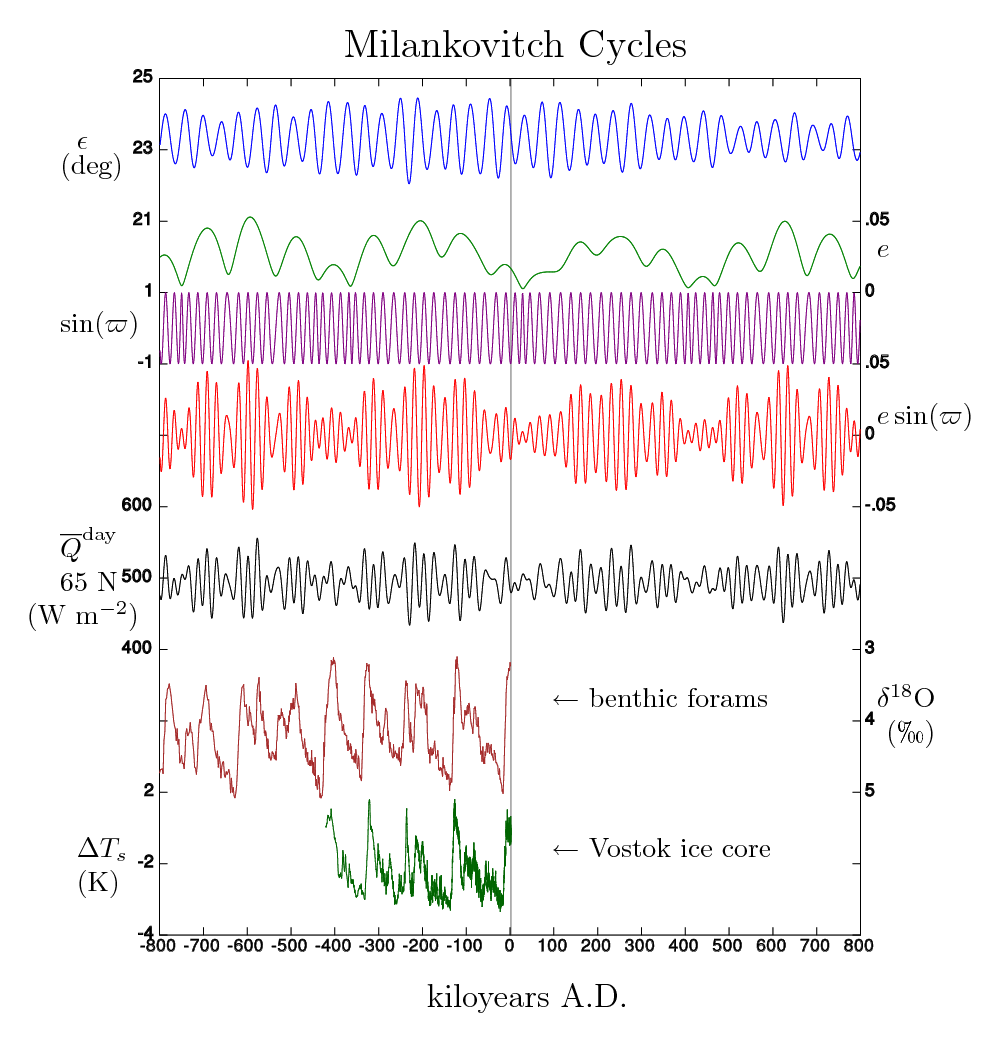
Of course we don’t know the “exact” mechanisms. If we already knew all there is to know, we wouldn’t need to do science at all. I think it is silly, demented and stupid to demand “exact” knowledge in a universe of unknowns as a strict requirement for making informed decisions — something we almost ALWAYS do on incomplete, imperfect — and yes, even flat-out wrong — information.
Financial investment is a perfect example.
You claim near-total lack of knowledge of why ice age cycles happen, yet you express strong certainty that CO2 isn’t causal. According to my understanding, it so happens that you’re partially correct. But only partially.
Orbital forcing is the primary driver of timing and amplitude by way of affecting ice sheet area in the northern hemisphere (surface albedo being the feedback mechanism). Radiative species like water vapor, CO2 and methane amplify the response, and also affect the shape of the temperature curve (note the sawtooth shape of temperature response in the above plot).
jclarke341,
Funny … I thought it was implicitly obvious that the protocol called for doing this experiment within Earth’s atmosphere.
The problem with that protocol is that you’ve changed two variables for the experimental pan: temperature and advection. This makes it difficult to isolate the cause of the differing evaporation rate in that pan relative to the control. Better would be to not heat the experimental pan but leave the fan. Then yes, assuming that relative humidity of the ambient atmosphere is less than 100%, it will experience a higher evaporation rate, and the remaining liquid water will become cooler than the remaining liquid water in the control pan. The experimental pan will also completely evaporate away in a shorter amount of time.
If I wanted to ding you for an overly-simplistic experiment, I could point out that it rains/sleets/hails/snows in the real atmosphere. We could simulate that on a kitchen countertop as well, but the experimental apparatus would obviously require more than two pans full of water and a fan.
Yes, and that prediction is confirmed by observation in the northern hemisphere:
http://data.remss.com/msu/graphics/TLT/plots/RSS_TS_channel_TLT_Northern%20Polar_Land_And_Sea_v03_3.png
http://data.remss.com/msu/graphics/TLT/plots/RSS_TS_channel_TLT_Tropics_Land_And_Sea_v03_3.png
Alas, Antarctica stubbornly refuses to cooperate as usual …
http://data.remss.com/msu/graphics/TLT/plots/RSS_TS_channel_TLT_Southern%20Polar_Land_And_Sea_v03_3.png
… but it’s also an ice-covered land mass completely surrounded by ocean, whereas the north pole is an ice-covered ocean surrounded by land. As you note, this stuff does get complicated in the real world in a hurry.
It could also be that there’s something funky going on we don’t yet understand when we try to estimate temperature from low Earth orbit by taking microwave soundings of the atmosphere whizzing by below the sensor.
Or both. Or something else entirely.
I think it’s an interesting argument, but not necessarily true since wind speed is not the only determinant of evaporation rate.
Hmm. Well I wasn’t arguing in support of the assumption of constant relative humidity, but rather for an increase in specific humidity as a function of temperature.
At least we agree on that much.
Relative humidity does vary globally over time, thing is, I know of no observational data which show an obvious long-term secular trend as a putative response to the observed long-term differing zonal secular trends in temperature. OTOH, I do know of observational data showing a distinct global secular trend in specific humidity:
http://www.climate4you.com/images/NOAA%20ESRL%20AtmospericSpecificHumidity%20GlobalMonthlyTempSince1948%20With37monthRunningAverage.gif
Um, no. AGW theory does not rest at all on the assumption of constant relative humidity. It most squarely rests on:
1) Stefan–Boltzmann law: radiant power varies as the 4th power of temperature
2) Kirchhoff’s law of thermal radiation: if an object is a good emitter at a particular wavelength, it is also a good absorber at that wavelength
3) Beer–Lambert law: attenuation of a radiant beam is a function of both the density of an absorbing species and the thickness (path length) of the volume containing that species.
Those principles would still apply on an Earth-sized barren rock completely devoid of water, but with a Nitrogen-Oxygen-CO2 atmosphere of comparable density and percentage by volume composition. In that very simplified case, I propose that CO2 really would be THE climate “control knob” assuming constant insolation and surface albedo.
Of course, as you point out, all else is never equal; however, that does not diminish the importance of understanding component first principles of the underlying physics in a complex system by appealing to isolated and well-controlled conditions so as to better understand them prior to mashing everything together and attempting to grok how they all interact … the first step of which is all my simple beaker experiment was intended to do. What actually happens in the real world is better represented by the reanalysis data plot I posted above, which is entirely consistent with what we’d expect from running my stove top experimental protocol even though, and despite the fact, that the real world scenario is far more massive and complex.
From this, I think it’s safe to infer that the Clausius–Clapeyron relation is a dominant mechanism in the real system, and therefore reliably predictive. YMMV.
So the apocalypse is delayed more that five years? Why should I send money to the Friends of the Earth to avert a disaster that far away. Al Gore must be disappointed.
And David Bowie just passed over to the next plane. “Five years, that’s all we’ve got!”
Why? Because, believe it or not, the “Friends of the Earth” ALSO helped determine the US Gov’t DIETARY guidelines! Lettuce good, bacon bad, science saying the opposite profoundly irrelevant. In fact, there are MANY parallels between “health” and “climate” idiocy.
I’ve been wondering if there was a link between poor nutrition and the global warming meme. They started at roughly the same time and it seemed to me like another prong of attack. What better way to avoid riots in the street than to keep the populace weak, poisoned and too lethargic to get out of their chairs?
https://www.youtube.com/watch?v=vRe9z32NZHY The complete video is supper. However you can skip a head and start at the 26 minute.
I remember reading a book about ice ages while I was still at school back in the 70’s. In it there was a theory that the Earth had to get warmer first in order to increase humidity, before extra snow cover triggered the ice age.
Bloke, the theory, as I remember it, was that warming would continue until the Arctic Ocean lost its ice cover, and then the exposed sea surface would provide water vapor to supply sufficient snowfall on the surrounding land to last through the cloudy summers. The Earth would then cool due to the increasing albedo caused by the ever increasing and spreading southward ice sheets.
The residual heat in the oceans would provide several thousand years of of heavy snowfall before loosing enough heat to allow the arctic to ice over again. This would stop the southward advance of the ice sheets and the Earth would slowly recover from this ice age until the Arctic ice thawed again…
SR
In my opinion, the second order control on the glacial/interglacial cycle — besides the Milankovitch Cycle — is the WAIS.
http://onlinelibrary.wiley.com/doi/10.1029/RG013i004p00502/abstract
http://geosci.uchicago.edu/pdfs/macayeal/MacAyeal_irregularWAIS.pdf
http://epic.awi.de/1459/1/Huy1990a.pdf
Basically, the ice sheet periodically has catastrophic events where the ice sheet flows much more rapidly. This temporarily raises sea levels but cools the climate considerably overall, possibly causing glacial maximum and initiating glacial periods.
There is good evidence that this is going on right now so it’s WAIS, the Milankovitch Cycle, and the overall first order controls on ice age/hot house climate Vs .005% CO2. Apparently those guys over at Exit College don’t know the odds.
Is this hogwash not already part of the CAGW meme? A runaway greenhouse effect presupposes that the next glacial period won’t happen.
“However, our study also shows that relatively moderate additional anthropogenic CO2-emissions from burning oil, coal and gas are already sufficient to postpone the next ice age for another 50,000 years,”
So we need to burn more to make sure we leave a green & pleasant earth for our grandchildren
The fact that this paper was so close to release just missing COP 21, it must have been the biggest discussion going on in Paris last month.
Great news.
We actually saved the planet!
no way i’m adding a sarc tag.
If CO2 emissions could actually delay or eliminate a glacial re-inception, we should pump as much as we can. The prospect of mile-high glaciers covering much of Canada and the northern United State is not terribly appealing. Alas, CO2 is just plant food.
https://stevengoddard.wordpress.com/2014/02/24/schneider-went-from-cooling-alarmist-to-warming-alarmist-in-just-four-years/
the definition of a leading scientists. look to see which way the parade is headed and stand in front.
Until it turns into a stampede away from whatever it is heading towards.
Another model. Oh God, how I love models! Especially models of the unknown.
But how do they compare to models of the past?
http://images2.fanpop.com/image/photos/9000000/Brigitte-Bardot-brigitte-bardot-9079264-454-597.jpg
What nice lips she has… I could just fall deeply into her eyes. I think that’s the difference between the AGWers and skeptics. The AGWers don’t believe in mother nature to take care of business. They want to think they have control, but they don’t.
She is wearing a truck load of make up. Especially on her eyes.
Yes, I could do without the flame motif myself. It messes with the clean lines of the classics.
We are talking about the car, right?
The first model I ever built was a P-61 Black Widow bought at the US Air Force Museum in Dayton Ohio.
I still have it.
(But it still won’t fly.)
I have a model of the Titanic that I have to build for my 8 year old.
I wonder which is more realistic.
michael
When I was a kid we would load our older ship models – WWII battleships, cruisers, destroyers, etc. into a gunny sack, and haul them on horse back out to “the mine.” We would launch them out on “he reservoir” (a highly toxic, settling pond from mine mill taliings) and then fight land-naval battles with our single-shot .22 rifles as the coastal artillery. The invading fleets never made shore.
Duster January 13, 2016 at 2:55 pm
We used BB guns for ships. Firecrackers for Tanks
I still have a stock of un-built models.
michael
I build, planes, ships etc ( Revell), the best one I ever did was a 3 foot high Saturn V with all the trimmings , took almost 2 years, painted all the parts even used needles to “paint” the control panels in side the capsules, the Gemini ones were also in the collection. That actually landed me my first full time job as a model builder for municipalities and governments, cool!
Does it fly?
Guys, did you ever try taping a bottle rocket onto a balsa wood glider to make a jet? They were 10 cents at the hobby store in ’67 so we’d spend our allowance and ride our bikes to the river bluff outcroppings and launch them over the water. Another fun launch is a silver salute under a baby moon hubcap, just be sure it’s on concrete…
Never did the bottle rocket glider thing, but we used to fill empty CO2 cartridges with paper match heads, jam a fuse in the neck and then launch from a 5 ft copper tube. Had a 1/2 mile range…
Also found that if you really tamped the match heads down into the cartridge, then crimped the end in a vise, the thing would explode and peel into a beautiful metal flower, with a stunning, and I mean stunning report.
I still have all my fingers.
Bottle rockets and balsa wood planes.
Our last version of this was to take a short section of thin-walled PVC pipe and seal one end with 5-minute epoxy. We wrapped two pieces of wire around the tube (with a dab of epoxy to keep it in place). The ends of the wire were bent so we could stick them through the balsa.
We splurged on the planes. We used balsa bi-planes. They cost a bit more but were easier to ensure it didn’t nose dive into the ground. We’d attach the tube then launch without the rocket. We’d adjust the wings to ensure it initially climbed.
The trick was to not throw the plane until the rocket lit or it would fall out.
The result was usually a series of high speed loops with an extra burst of speed when the report went off.
The plane would survive several flights.
Does this mean that the missing heat has come out of the ocean and is now hiding in the ice age?
Pot’s damn institute… you’d think they’d be all for some warming.
You mean …. you mean …. it’s better than we thought?
This is really unprecedented.
It would be “better than we thought,” if the tipping point was between glacial and interglacial stages. However, their model indicates that the tipping point is between PETM and glaciers bulldozing through Chicago.
Yes, when CO2 is the direct control knob of the entire climate of Earth, we will soon have Antarctic monkeys and polar frogs.
“palaeoclimatic”
I think that in the old days the reviewers at Nature used to a least check the spelling of the papers submitted to them.
“Palaeo” is the very British version of “paleo.”
Not to be confused with “palomino” which produces much of what the Mannian type of paleoclimate consist.
The “ae” was originally one letter. In the US it was subsumed into “e.” While in Britain they split it into two. Since the pronunciation was roughly like a long “i”, neither change makes a lot of sense.
Would that it were so. The anthropogenic CO2 spike duration is likely to be measured in hundreds of years. When mankind transitions to using thorium or fusion for most of its energy production, rather than burning fossil fuels, CO2 levels will fall, and that certainly won’t take 100k years.
Keeping CO2 levels high is going to hard, in the long term. Already, half of all CO2 mankind emits is being removed by the “greening” biosphere and by absorption into the oceans. So if CO2 emissions were suddenly reduced to less than half current emission rates, then CO2 levels would be falling.
The anthropogenic CO2 spike duration is likely to be measured in hundreds of years.
Mmmh, more like decades at most. Geological evidence supports a conclusion that biological processes fix and bury carbon faster than natural sources can supply it. The over all atmospheric concentration has been declining since the beginning of the Phanerozoic (600 MYA). The Permian Extinction (250 MYA) allowed available planetary carbon levels to recover, but the end of the Triassic, they were once more declining and have pretty steadily decreased since then. The present levels are once more at Permian levels – meaning that they are very, very low. Instead of staving off an ice age, we just might be staving off a major extinction event or at the very least mediating it. And yeah, lots of groups like the WWF would turn puce in shock at that suggestion, but the Permian Extinction was an “all-natural,” completely green event, without any intervention by intelligent species and the best explanation is a “combined cause” trigger of low CO2 levels leading to decreased biological resilience in the various ecological communities. coupled with something like an impact that triggered major vulcanism or similar geological punctuation.
I thought he was implying that man would be burning fossil fuels for another couple hundred years.
I like Patrick Moore’s suggestion, from his brilliant lecture
“If we assume human emissions have to date added some 200 billion tons of CO2 to the atmosphere, even if we ceased using fossil fuels today we have already bought another 5 million years for life on earth. But we will not stop using fossil fuels to power our civilization so it is likely that we can forestall plant starvation for lack of CO2 by at least 65 million years. Even when the fossil fuels have become scarce we have the quadrillion tons of carbon in carbonaceous rocks, which we can transform into lime and CO2 for the manufacture of cement. And we already know how to do that with solar energy or nuclear energy. This alone, regardless of fossil fuel consumption, will more than offset the loss of CO2 due to calcium carbonate burial in marine sediments. Without a doubt the human species has made it possible to prolong the survival of life on Earth for more than 100 million years. We are not the enemy of nature but its salvation.”
Hmm. For years I’ve thought our purpose on Earth was to protect mother Gaia from those pesky rocks the solar system keeps hurling at her. Now it seems she had an additional motive for our creation: to recycle that vital carbon her other children keep sequestering.
Clever girl. 🙂
Wow! This was the finest lecture i have seen in years! Please take the time to watch it!
Dr Moore’s lecture is outstanding.
Worry.
This study further confirms what I’ve suspected for some time. These press releases are written in a pub and possibly the papers as well.
So how come you are tin-foil wearing nutter if you think that the next ice age (glacial stage) is nigh but a cliamte scientist gets away with claiming that it were if not for Karl Benz?
Almost as bad proof reading as in Nature.
Robert B “you are tin-foil wearing nutter …”
And they can’t even select the correct hat appropriate to the situation – tin foil will make your head even hotter when it’s hot, and colder when it’s cold.
Especially if your tin foil is made from aluminum.
And so there you have if my friends. CO2 can do anything! (except pay my bills apparently)
need to get on the grant train Mark
“Humans now effectively control the climate of the planet.”
If I was Andrew Watson I wouldn’t be broadcasting my ignorance to the rest of the world.
I’m willing to bet him that the next glaciation will occur before the 100,000 years are up, whatever man tries to do to the climate.
OK, I’ll take that bet with half of my Powerball winnings from tonight … who shall we have hold it ?? /s
Someone who is going to live to a very old age.
Bubba, we have a winner right here in Chino Hills, Calif. $529 million ticket is 1 of 3.
I volunteer to hold the full amount of the wager. I will also agree to pay interest on the principal amount (fed rate of course).
Regarding Dr. Watson…
“Watson was a PhD student of James Lovelock, originator of the Gaia hypothesis of Earth regulation. He and Lovelock introduced the Daisyworld model in 1983, showing how ecological competition between hypothetical “daisies” could affect planetary albedo and regulate environmental temperature.[6]”
–Wikipedia
suppose the “positive” economic impact of preventing another glacial cycle via anthropogenic CO2 is greater than the supposed “negative” impact of warming due to anthro-CO2,
then presumably there should be a tax on people who take CO2 out of the atmosphere to subsidize activities that produce CO2?
Do they imply that the hiatus in warming should have been a cooling period?
I think that a major benefit of the this work lies in the references quoted , which lead the reader unfamiliar with the subject into further study of the postulated causes of the last 4 glaciations and the 100kyear cycle.
I suspect that this was seen to be an opportunity to advance the earlier work of one of the authors Ganopolski (who seems to have done most of the actual work) on the causes of the 100kyear cycle and the influence of, eg dust deposition preceding glaciation (at low CO2 concentration). This is a topic that has interested commenters here in the past , so the paper possibly merits being examined with greater critical attention than I , alas , can bring to it . :-
http://www.clim-past.net/7/1415/2011/cp-7-1415-2011.pdf
Sorry, meant to say “dust deposition preceding termination of glaciation”
And when the glaciers again advance, the failed climate scientists will still blame the event on mankind and CO2 emissions.
That’s exactly correct. They are already claiming increase CO2 causes cooling. Polar vortex excuses.
Most humans can’t control their bowels, let alone control the climate of the planet.
Hmmm…… so for the sake of our kids and great grand-kids and our great great great (etc.) grand-kids, we should or shouldn’t burn stuff for heat and power?
Should.
Definitely should.
I am turning up my oil heat as we speak ( but that is because we are rising bread dough).