
November 30, 2015 – Today, on the first day of the United Nations’ twenty-first conference of the parties (COP-21) taking place in Paris, a new book emphatically rejects claims of a “scientific consensus” on the causes and consequences of climate change.
The authors are three prominent climate scientists affiliated with the Nongovernmental International Panel on Climate Change (NIPCC). The book is titled Why Scientists Disagree about Global Warming: The NIPCC Report on Consensus.
About the Book
“Probably the most widely repeated claim in the debate over global warming is that ‘97% of scientists agree’ that climate change is man-made and dangerous,” the authors write. “This claim is not only false, but its presence in the debate is an insult to science.”
With these words, the authors begin a detailed analysis of one of the most controversial topics of the day. The authors make a compelling case against claims of a scientific consensus. The purported proof of such a consensus consists of sloppy research by nonscientists, college students, and a highly partisan Australian blogger. Surveys of climate scientists, even those heavily biased in favor of climate alarmism, find extensive disagreement on the underlying science and doubts about its reliability.
The authors point to four reasons why scientists disagree about global warming: a conflict among scientists in different and often competing disciplines; fundamental scientific uncertainties concerning how the global climate responds to the human presence; failure of the United Nations’ Intergovernmental Panel on Climate Change (IPCC) to provide objective guidance to the complex science; and bias among researchers.
The authors offer a succinct summary of the real science of climate change based on their previously published comprehensive review of climate science in a volume titled Climate Change Reconsidered II: Physical Science. They recommend policymakers resist pressure from lobby groups to silence scientists who question the authority of IPCC to claim to speak for “climate science.”
CRAIG D. IDSO, Ph.D., a climatologist, is one of the world’s leading experts on the effects of carbon dioxide on plant and animal life and is chairman of the Center for the Study of Carbon Dioxide and Global Change.
ROBERT M. CARTER, Ph.D., a paleogeologist, is emeritus fellow of the Institute of Public Affairs in Australia and author of Climate Change: The Counter Consensus (London: Stacey International, 2010).
S. FRED SINGER, Ph.D., a physicist, is president of the Science and Environmental Policy Project and founder of the Nongovernmental International Panel on Climate Change (NIPCC).
About NIPCC
The Nongovernmental International Panel on Climate Change (NIPCC) is an international panel of nongovernment scientists and scholars who have come together to present a comprehensive, authoritative, and realistic assessment of the science and economics of global warming. Whereas the reports of the United Nations’ Intergovernmental Panel on Climate Change (IPCC) warn of a dangerous human effect on climate, NIPCC concludes the human effect is likely to be small relative to natural variability, and whatever small warming is likely to occur will produce benefits as well as costs.
NIPCC is sponsored by three nonprofit organizations: the Center for the Study of Carbon Dioxide and Global Change, the Science and Environmental Policy Project (SEPP), and The Heartland Institute.
This volume, like past NIPCC reports, is edited and published by the staff of The Heartland Institute, a national nonprofit research and educational organization newly relocated from Chicago to suburban Arlington Heights, Illinois.
For More Information
For more information about the book, or to interview the authors, contact Donald Kendal, new media specialist, The Heartland Institute, at dkendal@heartland.org or 847/877-9100.
The Heartland Institute is a 31-year-old national nonprofit organization headquartered in Arlington Heights, Illinois. Its mission is to discover, develop, and promote free-market solutions to social and economic problems. For more information, visit our Web site or call 312/377-4000.
You can only label it a pause in hindsight, after it re-commences. Until then, it’s a stoppage.
That is exactly right… comrade.
I seem to have lost my latest post reply to dbstealey, so here goes again. You do love your insults, but I will not be drawn.
Your NODC graph shows ocean temperature increase from 1970 to 2004. The Wunsch graph shows heat content increasing from 1994-2009. The ENVISAT data confirm a sea level rise rate of 3.2 mm/yr, which is almost double what it was in the earlier part of the century. The Pokhrel et al paper of 2012 (your URL) shows that they found the missing part of what was causing the current rate of sea level rise. So for most of the end of the last century, into the early part of this century sea level and temperature and CO2 were all rising. Now, you seem to have a problem accepting that there can be a disconnect between CO2 and temperature, whereas I do not. Temperature rose in the 1997-98 El Nino, and fell in the 2008 La Nina. CO2 hardly changed at all. So the real world data is not following your logic. It is following my logic, which says that temperature has several controls, not just CO2, and will change independently of CO2 due to El Ninos, La Ninas, the PDO, and volcanics, for example. The 1:1 temperature-CO2 link that you seek is obscured. Take out all the temperature wiggles since 1900 and you are left with a curve of temperature rise that more or less well parallels the emissions rise of greenhouse gas emissions. I am not surprised, because geology tells us that 55 million years ago we had a similar event. Nature blasted carbon into the atmosphere, making temperature and sea level rise and acidifying bottom waters so that the CCD rose by 2 km. That’s what geology tells us.
Mr. Summerhayes (I trust my guess of your identity was accurate):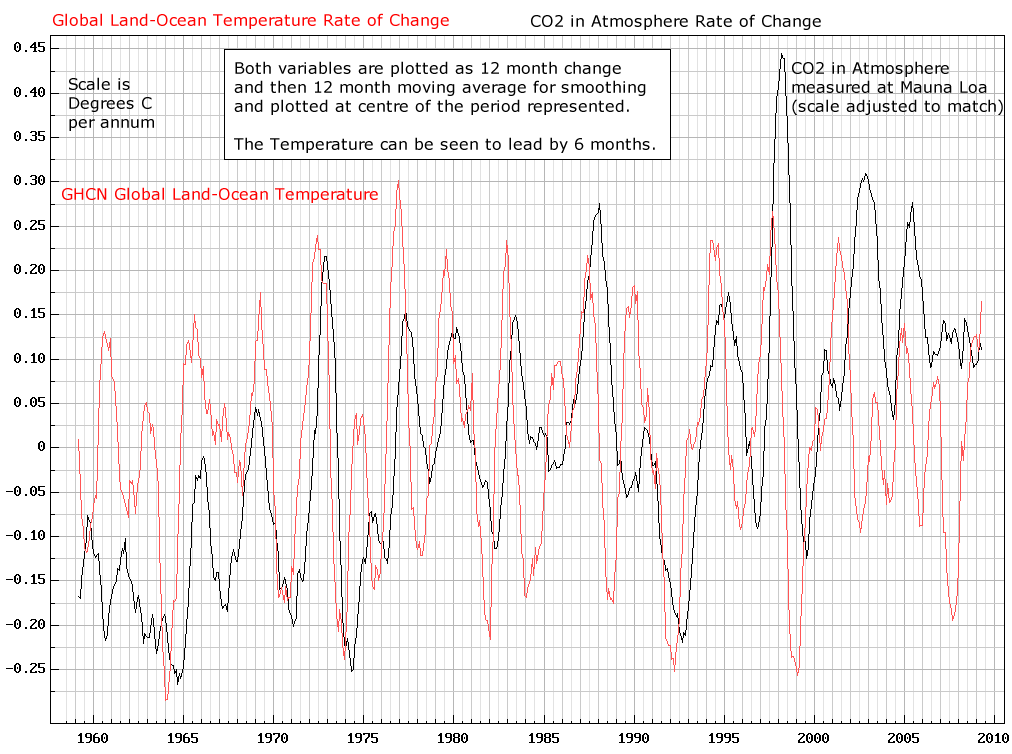

You cherry-picked certain factoids, out of only a few charts, which you believe support your conjecture that CO2 is the control knob of the planet’s temperature. But you disregarded all the other charts I’ve posted that debunk that notion. Well, hold on, because I have more, and they are all based on real world observations.
First, you say:
The Wunsch graph shows heat content increasing from 1994-2009.
Yep. And then the warming stopped. That was my point, which you could not refute.
Next:
The ENVISAT data confirm a sea level rise rate of 3.2 mm/yr, which is almost double what it was in the earlier part of the century.
You like your apples and oranges, don’t you? Envisat was not operating in the first half of the century, and your assertion is unsupported. Let me remind you of a famous physicist’s words:
Details that could throw doubt on your interpretation must be given, if you know them. You must do the best you can – if you know anything at all wrong, or possibly wrong – to explain it… It’s not right to pick only what you like, but to take all of the evidence…
~ Richard P. Feynman
But as we see, all your arguing is done to support your preconceived belief that CO2 controls global T. The only evidence you posted confirms your bias. You are so wrapped up in your conjecture that you cannot see the glaring errors in it. As a result, you constantly cherry-pick whatever factoids might support your argument, and disregard the rest. Prof Feynman would know exactly what’s going on.
Next, you say:
Now, you seem to have a problem accepting that there can be a disconnect between CO2 and temperature, whereas I do not.
You misrepresent my position. Let me be clear: I am saying that CO2 may have a minuscule effect on temperature (I thinkl it does), but that effect is too small to measure. I have never said anything else. Ever.
A much larger effect is that changes in temperature cause subsequent changes in CO2. I promised to post evidence:
http://www.daviesand.com/Choices/Precautionary_Planning/New_Data/IceCores1.gif
I’ve got lots of similar charts showing that ∆T is followeed by ∆CO2:
http://www.brighton73.freeserve.co.uk/gw/paleo/400000yearslarge.gif
Another one:
http://www.geo.arizona.edu/BGDL/images/Vostok_CO2_airt.gif
Here’s a shorter time scale; T leads CO2 by six months:
And here is another link, showing that ∆T causes ∆CO2.
Note the “Note:” in this chart:
[click in charts to embiggen]
We observe the same cause and effect on yearly time scales.
For years I have asked readers to post similar charts of observational evidence, showing that changes in CO2 are the cause of subsequent global warming. But no one has been able to produce any such charts. I invite you to try. The best they can do is to post overlay charts of T and CO2. But overlay charts do not show causation. All they show is coincidence.
So your CO2=AGW conjecture has been repeatedly falsified by the only Authority that matters: Planet Earth. Since no one has falsified the hypothesis that the observed temperatures changes are a consequence of natural variability, the climate Null Hypothesis stands: there is nothing either unusual or unprecedented happening. Everything being observed now has happened before, repeatedly, and to a much greater degree — and before human emissions were a factor.
You’ve spent many years promoting your belief that CO2 is the cause of global warming. So at this point you would probably consider it a climbdown to admit you could have been mistaken. As Leo Tolstoy wrote:
I know that most men, including those at ease with problems of the greatest complexity, can seldom accept even the simplest and most obvious truth if it be such as would oblige them to admit the falsity of conclusions which they have delighted in explaining to colleagues, which they have proudly taught to others, and which they have woven, thread by thread, into the fabric of their lives.
^That’s you, Colin^. Despite no credible real world evidence showing that ∆CO2 causes ∆T, and a mountain of empirical observations showing that temperature changes are the cause of subsequent changes in CO2, you still cling to your belief that CO2 controls global T. Tolstoy understood the reason why (and if you think this is “insulting”, show me where I’m factually wrong).
Here’s more received wisdom:
A false conclusion once arrived at and widely accepted is not easily dislodged, and the less it is understood the more tenaciously it is held.
~ Georg Cantor
You refuse to let any contrary facts dislodge you from your belief. The rest of your reply above is nothing but tap-dancing around the fact that global warming stopped many years ago, while CO2 continued to rise. Your response is simply an excuse to explain why the planet is falsifying your conjecture (at this point I would quote Langmuir and Popper, but I prefer to quote myself. ☺
In summary, I post empirical evidence, while you fall back on pal reviewed climate papers that disagree. If you can’t do better than that, you lose the argument. Because the final Authority is the Real World.
Response to dbstealey
The problem is that what you say about me can equally be said about you – e.g. your quote “A false conclusion once arrived at and widely accepted is not easily dislodged, and the less it is understood the more tenaciously it is held ~ Georg Cantor”. That’s why it is wise not to sling insults around.
My take on the relationship between CO2 in bubbles of fossil air and the temperature of the associated ice in ice cores comes from the latest work by Frederic Parrenin et al, 2013, Synchronous Change of Atmospheric CO2 and Antarctic Temperature During the Last Deglacial Warming: Science 339, p.1060 et seq. Here is the abstract:
“Understanding the role of atmospheric CO2 during past climate changes requires clear knowledge of how it varies in time relative to temperature. Antarctic ice cores preserve highly resolved records of atmospheric CO2 and Antarctic temperature for the past 800,000 years. Here we propose a revised relative age scale for the concentration of atmospheric CO2 and Antarctic temperature for the last deglacial warming, using data from five Antarctic ice cores. We infer the phasing between CO2 concentration and Antarctic temperature at four times when their trends change abruptly. We find no significant asynchrony between them, indicating
that Antarctic temperature did not begin to rise hundreds of years before the concentration of atmospheric CO2, as has been suggested by earlier studies.”
Unfortunately I cannot seem to download their key figures, which is their figure 4. But the point is that their work negates all of the previous graphs of temperature and CO2 profiles from Vostok and Dome C. So the graphs that you keep putting on the screen, which display a lag between CO2 and temperature change, are no longer relevant. They are now out of date. The old data has been replaced by new data. You have to keep up with these changes.
Similarly, you seem to have forgotten already that in an earlier post I pointed out that you are also misleading yourself and your readers by displaying the graphs showing changes in the rate of temperature and of CO2 in recent years. All that you are showing there is biology – the fact that temperature rises in the spring but CO2 does not because it is being eaten by plants, and that temperature declines in the fall when the CO2 from plants is being released back to the air by their death and decay. This annual process has nothing to do with the underlying rise in CO2 from human emissions, which is causing temperature to rise gradually
So no matter how many graphs you throw around you are failing to get the point. While there is a general background trend to both CO2 and temperature due to rising emissions causing temperature to grow, there are also disconnects between temperature and CO2 at all scales from the seasonal (my point above), to the El Nino and La Nina (4-7 years), to the PDO (15-25 years), not forgetting the cooling effects of the occasional very large volcano like Pinatubo. You have to understand the origin of each wiggle in the temperature curve before you can see the big picture. The temperature signal has to be disaggregated into its component parts. You will not understand what the planet is doing until you recognise that. But if you stay stuck in your “CO2 doesn’t affect temperature” rut, you will never see this bigger picture.
It is geology that tells us that over millions of years the output of CO2 from volcanoes changed temperature, as did the extraction of CO2 from the air by chemical weathering as mountains rose. This is all well explained by Bob Berner in his 2004 book “The Phanerozoic Carbon Cycle”. It is also geology that tells us that when Earth’s orbit changed our temperature, that affected the amount of CO2 coming out of or going into the ocean during the Ice Age (which Parrenin shows happened with no delay). In other words, geology tells us that CO2 can change temperature, and temperature can change CO2. Both are equally feasible.
These simple and verifiable facts have nothing to do with who is paying me to do my research (in fact nobody is).
Given this situation, maybe Tolstoy was writing about you when he said (your quote) “I know that most men, including those at ease with problems of the greatest complexity, can seldom accept even the simplest and most obvious truth if it be such as would oblige them to admit the falsity of conclusions which they have delighted in explaining to colleagues, which they have proudly taught to others, and which they have woven, thread by thread, into the fabric of their lives.”
Finally, it seems to me that the significant difference between us, apart from those errors enumerated above, lies in your refusal to accept a substantial sensitivity for CO2. But in refusing to do so you are making an assumption, one that is not at all well supported by geology. You do not know if your assumption is correct. Geology suggests it is not.
Please let’s stick to arguing about what the science says, and avoid the use of slurs. They do not help take matters forward in terms of advancing understanding of how the planet works.
The problem is that what you say about me can equally be said about you…
Nope. As a skeptic, my job is to falsify conjectures and hypotheses if I can. I have repeatedly falsified your claim that human-emitted CO2 is the cause of polar ice changes, which is such an unusual conjecture that it requires very strong evidence to support it.
But all you have are your assertions; your opinions. That’s your false conclusion once arrived at, which you hang your hat on. But your conclusions are belief-based, not data-based. Baseless opinions like that are not good enough to alter national and international policy. By the same token, you’ve appended your name to propaganda that claims the climate sensitivity number should be at least double what it is. But you don’t even know the climate sensitivity number!
Next, it is widely known that bubbles migrate in ice. That’s been discussed here extensively. But there are other proxies that produce the same result, and which do not depend on migrating bubbles. That’s the same kind of false argument that alarmists use when they claim that satellite temperature measurements are wrong. But when it’s pointed out that many thousands of radiosonde balloon measurements corroborate satellite data, they go silent.
Your ‘bubble’ argument reeks of desperation; cherry-picking one proxy and claiming that proves everything. It doesn’t.
You quote one particular claim:
“We find no significant asynchrony between them, indicating that Antarctic temperature did not begin to rise hundreds of years before the concentration of atmospheric CO2, as has been suggested by earlier studies.”
It is clear you picked it because of your confirmation bias.
Next:
…All that you are showing there is biology
Isn’t it amazing, then, that every graph shows the same causal relationship between temperature and CO2? I’ve repeatedly asked you to produce the same kind of verifiable, empirical charts showing that changes in CO2 cause changes in temperature. Where are they? Once again, your claims are nothing more than assertions.
And the biological effect is shown here. Notice that it’s very different from the charts I’ve posted, so that argument can be discarded as well.
Next:
…the underlying rise in CO2 from human emissions, which is causing temperature to rise gradually.
Ho-hum. Another assertion.
And your ‘geology’ paragraph has nothing to do with the claim that human CO2 emissions are the cause of polar ice changes. Then you say:
…no matter how many graphs you throw around you are failing to get the point
Right. I’m just a dummy who asks questions you can’t answer — so I don’t get the point. I think that there is no limit to the number of graphs you would reject based on that self-serving statement. You continually ignore the fact that as a promoter of the ‘damgerous man-made global warming’ conjecture, the onus is on you, not on skeptics. You are the one who needs to provide verifiable, empirical, testable evidence to support your conjecture:
Ei incumbit probatio, qui dicit, non qui negat; cum per rerum naturam factum negantis probatio nulla sit. – The proof lies upon him who affirms, not upon him who denies; since, by the nature of things, he who denies a fact cannot produce any proof. As to the conjecture that CO2 emissions are causing “unprecedented” global warming: the onus lies on those who say so. As to the proposition that there has been an alarming spike in global temperatures: the onus lies on those who say so.
The onus is on you, Colin. But so far, all you have are your links to like-minded papers and your assertions. You don’t have empirical evidence showing that CO2 causes what you’re claiming. Without verifiable measurements all you have are your opinions. That isn’t good enough. The onus is still on you, and you have not performed.
Next, you preposterously say:
…it seems to me that the significant difference between us, apart from those errors enumerated above, lies in your refusal to accept a substantial sensitivity for CO2.
Yeah. How about that? I refuse to accept your baseless assertions as facts. You claim that the climate sensitivity number should be doubled, and my refusal to accept that without supporting measurements is a problem for you.
Then you say:
Please let’s stick to arguing about what the science says.
I agree — with the caveat that the onus is on you to produce verifiable, testable, data-based measurements that support your claims. Anything less is only an opinion, and one that I disagree with. I am very skeptical of the claim that dangerous AGW is occurring, especially since we have just been through a true “Goldilocks” century of unusually flat global temperatures. How is that something to be alarmed about? These constant climate scares are self-serving propaganda by a relatively small clique of rent-seeking scientists, who want to alarm the public when there is absolutely no evidence that there is a problem. That is dishonest, no?
Yes.
Finally, you say you aren’t paid for your opinion, but of course you are: your name is on what many would consider to be a alarmist propaganda. Therefore, you can’t simply admit the truth: that you have no compelling evidence. If you did, your name wouldn’t be on many more of those papers, and you clearly enjoy seeing yourself as some kind of ‘authority’.
But that’s there, in alarmist world; here on the internet’s “Best Science” site, you need more than just your opinion. You need facts, evidence, and most important, you need measurements based on empirical data. But so far, we haven’t seen that.
I have provided numerous references to work published in the scientific literature. You choose to ignore them. I see no point in wasting my time providing further references for you to dismiss as simply the product of what you call “rent-seeking scientists” (yet another of your barrage of slurs). I am disappointed that you fail to see that temperature is forced by multiple drivers, which is why one has to dig into the data to understand what it means – and which is what I have done but you have not. Science is not just about data – it is about developing hypotheses to explain the data. That is what the scientific literature does. It is as plain as the nose on one’s face that temperature is influenced by El Nino and La Nina events, and by large volcanic eruptions, which is why one cannot simply stack temperature against CO2 and expect to see a perfect 1:1 correlation. It is equally plain that on an annual basis temperature will increase before CO2 because the CO2 is responding to biology. As you seem to be disputing these basic facts, I see no point in continuing a discussion with you.
“My take on the relationship between CO2 in bubbles of fossil air and the temperature of the associated ice in ice cores comes from the latest work by Frederic Parrenin et al, 2013,…”
Shouldn’t that be your take SPECIFICALLY the relationship between CO2 bubbles of fossil air and the temperatures of the associated ice during “4 times of abrupt change” during JUST “the last deglacial warming”. Right? Because Parrenin et al 2013 only studied 4 times of abrupt change during one SPECIFIC period of warming.
I was curious as to how “the takes” of other “scientists” might have been influenced by Parrenin et al 2013. I found a blog by Daniel B. Botkin, PhD and it’s apparent from his blog that he’s very concerned about the environment, thinks we should scale back fossil fuel usage, stop deforestation etc. I see no evidence that he might be a “big oil shill” or some kind of rabid “denier” of any kind. Here’s what he said about Parrenin et al 2013:
http://www.danielbbotkin.com/2013/03/04/carbon-dioxide-and-temperature-who-has-led-whom/
*****
“The new paper in Science presents new ways of analyzing those events, yielding results that greatly reduce the time gap between rising temperature and rising carbon dioxide. The lag could still be there but much shorter — perhaps only as long as 130 years. Or it might not exist at all.
The new Science paper is objective and open, and very careful, allowing for a variety of interpretations, even the previous much longer lags. This is the way that the entire discussion of climate change should be going on.”
*****
Wow. He doesn’t claim or falsely insinuate that Parrenin et al 2013 establishes anything…like that there is no lag at all. He says that “the paper is objective, open and very careful, and that it allows for a variety of interpretations, even the previous much longer lags”!
But YOU insist that “…their work negates all of the previous graphs of temperature and CO2 profiles from Vostok and Dome C. So the graphs that you keep putting on the screen, which display a lag between CO2 and temperature change, are no longer relevant. They are now out of date. The old data has been replaced by new data. You have to keep up with these changes.”
How is it that two scientists, who both seem to be concerned about the environment would come to such DIFFERENT conclusions from the same paper? According to Botkin, Parrenin et al 2013 simply introduced a new method for examining the data. According to you, this new method invalidates all previous data. I find it so ironic that someone like you would read one study and suddenly decide that it’s methods should be viewed as the new “consensus method”, and that one new study has rendered all of that “overwhelming evidence” from past scientists “no longer relevant”! Even skeptics don’t do that! It’s the kind of idiotic, irrational behavior that some alarmists like to attribute to “climate deniers”, whoever they might be.
For someone who asks “Please let’s stick to arguing about what the science says”, maybe you should actually DO what you ask-stick to what the science, like Parrenin et al 2013, actually SAYS instead of presenting your interpretation of it as FACT?
You really must read the paper, not what some blogger says about it. Here’s an extract: “Our chronology and the resulting aCO2-AT phasing strengthens the hypothesis that there was a close coupling between aCO2 and AT on both orbital and millennial time scales. The aCO2 rise could contribute to much of the AT change during TI, even at its onset, accounting for positive feedbacks and polar amplification, which magnify the impact of the relatively weak rCO2 change (Fig. 4) that alone accounts for ~0.6°C of global warming during TI. Invoking changes in the strength of the Atlantic meridional overturning circulation is no longer required to explain the lead of AT over aCO2”. In other words, the supposed lead of AT over CO2 has vanished.
“You really must read the paper, not what some blogger says about it.”
Really? “Some blogger”???? Are you engaging in logical fallacies in an attempt to somehow discredit his opinion? What on earth does him having a BLOG have to do with his extensive scientific credentials? Here’s a link –
http://www.danielbbotkin.com/about/
“Here’s an extract: ‘Our chronology and the resulting aCO2-AT phasing strengthens the hypothesis that there was a close coupling between aCO2 and AT on both orbital and millennial time scales. The aCO2 rise could contribute to much of the AT change during TI, even at its onset, accounting for positive feedbacks and polar amplification, which magnify the impact of the relatively weak rCO2 change (Fig. 4) that alone accounts for ~0.6°C of global warming during TI. Invoking changes in the strength of the Atlantic meridional overturning circulation is no longer required to explain the lead of AT over aCO2’. In other words, the supposed lead of AT over CO2 has vanished.”
I’m sorry, where in scientific nomenclature does “close coupling” equate with “non-existent”?
But let’s look at their work-figure 4 information since you love that chart so! (AT stands for “Antarctic Temperature”, TI stands for “Termination I”, and aCO2 stands for “atmospheric CO2”)
******
“The temporal variations of aCO2 and AT across TI (Fig. 4) on our chronology are highly correlated (Pearson correlation coefficient of 0.993 for a 20-year resampled time series). Both records can be accurately fitted by a six-point linear function (Fig. 4 and supplementary materials). We infer the aCO2
-AT phasing at the four break points using a Monte-Carlo algorithm (supplementary materials): the onset of TI (10 +/- 160 years, aCO2 leads), the onset of the Bølling oscillation (–260 +/-130 years, AT leads), the onset of the Younger Dryas (60 +/-120 years, aCO2 leads), and the onset of the Holocene (–500 +/- 90 years, AT leads). The uncertainty takes into account the uncertainty in the determination of the break
points and the uncertainty in the determination of (Delta) depth. The only significant aCO2 -AT lags are
observed at the onsets of the Bølling oscillation and the Holocene.
It should be noted that during these two events, the associated sharp increases in aCO2 were probably larger and more abrupt than the signals recorded in the ice core, due to the diffusion in the gas recording process (17). This atmosphere-ice core difference biases our break point determination toward younger ages. If we use these fast increases to determine the break points in aCO2, we find a lag of –10 +/-
130 years (aCO2) for the Bølling onset and – 130 +/- 90 years (aCo2) for the Holocene onset; that is, no significant phasing. If, instead of using aCO2 we use the radiative forcing of aCO2 (18) [rCO2 =5.35W/m
2 ln(CO2 /280 parts per million by volume)], the inferred phasing is not significantly changed.”
********
Parrenin et al 2013’s revolutionary method INFERS the following-
Holocene- AT temps lead increase in aCO2 by -500 years (plus or minus 90 years)
Younger Dryas aCO2 leads increase by 60 years (plus or minus 120 years)
Bolling Oscillation- AT leads aCO2 by -260 years (plus or minus 130 years)
TI -aCO2 leads AT by 10 years (plus or minus 160 years)
“The only significant lags are observed at the onsets of the Bolling Oscillation and the Holocene”.
(SO Parrenin et al 2013 ESTABLISHES that in the past 22,000 years, there have been TWO times when aCO2 has “lagged significantly” behind Antarctic Temperatures.)
A careful, educated reading of the above quote from Parrenin et al 2013 leads one to understand that the ONLY WAY they could get ALL FOUR break points to result in “no significant phasing” was to use a method they had already, carefully explained prior to this point in their paper (quote) did “not provide constraints for the onset of TI” and had a larger “analytical uncertainty” than the method they chose. They emphasize the fact that the fast break point method doesn’t hold up by showing that when they used the radiative forcing equation, it more closely matches their preferred method of “inferred phasing” than the fast break method.
So, I propose that polarscientist, either cannot read and understand Parrenin et al 2013 as written, or is deliberately lying about Parrenin et al’s conclusions. Either way he is FALSELY claiming that Parrenin et al 2013 says something that it does NOT say.
Mr. Summerhill, AKA: Polarscientist,
You say:
I have provided numerous references to work published in the scientific literature.
Yes, you have. Often. However, that answer is the ‘Appeal to Authority’ logical fallacy. Those papers may be truthful and accurate, or not. I don’t know. That’s why I constantly ask you for measurements showing that things have changed due to human CO2 emissions. But I’ve seen no convincing measurements showing that (and I assure you, I can be convinced; just not by assertions or published papers alone. Keep in mind that most published papers eventually turn out to be wrong).
Really, you have never provided one iota of empirical evidence showing that human CO2 emissions are the cause of polar variability. And that is the central issue in the debate. Because if there is no evidence linking emissions with polar variability or global temperature changes, then even if that is happening it must be too small to measure, and thus it is in the same ballpark as arguments about angels dancing on pinheads. It simply doesn’t matter. It only matters if it affects us.
Are you aware of the climate Null Hypothesis? It states that if there are any changes caused by an extraneous forcing such as CO2, that those changes must be measurable. If they are not quantifiable, then they may or may not exist, but for all practical purposes they do not exist. Does that make sense?
The Null Hypothesis has never been falsified. If I’m wrong about that, then post your measurements showing changes caused by human emissions. And as I’ve asked before, please, no ‘overlays’ like those posted in charts showing the coincidental rise of CO2 and temperature. We need to see the cause. It is causation that matters, not coincidence.
Next, regarding your complaints about my rent seeker comments, etc., the facts exposed in the Climategate email dump are very incriminating. Normally I wouldn’t care a whit if someone tells tall tales. But as a hard-bitten taxpayer who is forced to pay more every year, and seeing more than one billion dollars wasted every year on the ‘dangerous AGW’ (DAGW) nonsense (just in the U.S., I might add), I get highly incensed. And this is the internet, Colin. As a skeptic questioning the ‘dangerous mann-made global warming’ scare, I’ve been called far worse names than you can imagine, and I’m not alone. I have a folder full of literal death threats from people who have been spun up by climate alarmism. So if ‘rent seekers’ bothers you, just pretend you’re skeptical of DAGW. Go post that on blogs like treehugger or hotwhopper. Then you will see how petty your own complaints are.
That said, I apologize for hurting your feelings. My frustration comes from the lack of answers. In fact, no one ever seems to answer my straightforward questions. For example, you have never answered the points I’ve raised since we began our conversation. I suspect that is because you cannot answer them, or you would have. You say the sensitivity number should be doubled, but you can’t even say what the sensitivity number is! What is it, in your opinion? Your name is on that paper, surely you stand behind their conclusions. And you attribute what appears to be completely natural polar fluctuations to human CO2 emissions, but without any corroborating measurements that convincingly connect the two. As you say, you have developed a hypothesis (actually, a conjecture) that explains the data — but what data?? Measurements are data, but you have never posted any raw data that connects polar fluctuations with human CO2 emissions.
Now you bring up el nino, la nina, and volcanoes. I agree that global T is influenced by those natural events. I also agree that CO2 is influenced by biology. But as I’ve shown, ∆CO2 is independent of biology, in addition to responding on a seasonal time frame. So contrary to your assertion, I am not disputing natural events. But when those natural cycles are removed, we are still left with the fact that changes in CO2 are caused by changes in temperature — but we never see any empirical evidence showing that ∆T is caused by ∆CO2. Once again, if you have charts that show that alleged causation, please post them here.
Next, I dispute the conjecture that human-emitted CO2 has a measurable effect on global temperatures, or on polar parameters of any kind. Prove me wrong, if you can. I will accept convincing, measurement-based arguments. If you can produce empirical, testable (meaning replicable) measurements that convincingly show human emissions are affecting either global T or polar ice cover, or volume, or any other climate parameter, please post that data here. If I cannot find any way to show that it’s due to other causes, then I will admit that you are right and I am wrong. That’s fair, no? But as a scientific skeptic, I accept the Null Hypothesis as the starting point: you need to convncingly show a human cause, if it exists. But so far, it’s all been links to papers, and personal opinions. I’m sorry, Colin, but that just isn’t convincing enough when the putative answer is essentially the destruction of our modern technological society. We cannot do that based on an unproven conjecture.
So please, enough with the peer reviewed papers, and with opinions that human emissions are responsible for polar variability or any other climate changes. There is simply too much money involved supporting that narrative. It’s become so political that we cannot trust conclusions unless thay are solidly data-based. As Climategate showed, corrupt scientists have co-opted the journal system to the point that they have excluded other scientists — for nothing more than having a different scientific point of view! That isn’t acceptable. I think there are plenty of honest climate scientists, and I’ve never said you aren’t one of them. But when those gatekeepers get to decide who will be published and who won’t (with the exception of a few scientists who simply cannot be kept out, such as internationally esteemed scientists with hundreds of published papers to their credit), then it is impossible for the average reader to know who is being throoughly honest — and who is grant-trolling. Furthermore, the pressure created by immense piles of grant money naturally pushes scientists to add words like ‘climate change’ to their papers. We see that constantly — and if they will do that, what else do they do?
Anyway, those papers are an appeal to authority. They may or may not be correct. If there is a real connection between CO2 and polar variabilty or other climate parameters, you can certainly make that case without resorting to those papers unless they show raw, real world measurements directly connecting CO2 emissions with variability — and for that you don’t need the links, you just need to post the data.
What skeptics want are real world observations and data-based measurements that convincingly show that human emissions are the cause of polar or other climate variations. But so far I have not seen any such measurements. If you have them, I request that you post them here, rather than linking to papers that may or may not be accurate.
I do appreciate your responding. That way I get to see what is influencing your argument. As I’ve said, you can convince me. I was pretty convinced by the late ’90’s that there was a global warming problem. But nothing ever came of it, and since then there has been no global warming at all. So now my view is that everything observed is due to natural variability. You can prove me wrong. All you need are convincing data-based measurements. But so far, I haven’t seen them.
(Deleted. This commenter has been banned for identity theft. -mod)
polarscientist doesn’t even understand that a paper he seems to agree with- Parrenin et al 2013- does NOT say what HE claims it says. But he has no problem opening his mouth here and declaring that HIS interpretation of that paper is correct. Why? Because this forum is for the open debate/discussion of what “the science” says or does not say. No one here is deluded enough to think that posting on a blog makes them a “scientist” or that debates/discussions on a blog are “how you do science”.
So attempting to correlate your own “appeal to authority” about how science is done, to this discussion here is both logically flawed and irrelevant.
(Deleted. This commenter has been banned for identity theft. -mod)
MD said-
“Citing published research is not an “Appeal to Authority” fallacy as claimed by Dbstealey.”
You’re right, it’s not. But citing published research as if that research is accurate simply by default of being published, or insinuating that citing it that by-default-accurate research therefore proves the one citing it is also accurate IS illogical for PS to do.
“If you disagree with what I wrote about “how science is done” it would make your post intelligible if you would either quote what you think I got wrong, or at the least tell us how YOU think science is done.”
I don’t think that what you wrote about how “science is done” is wrong. I think that bringing up “how science is done” is irrelevant because dbstealey didn’t claim to be “doing science” here in this blog. Instead of your “trying to focus on what dbstealey had posted”, you “drag(ed) in (an) extraneous and irrelevant point”. Oh the irony.
(Deleted. This commenter has been banned for identity theft. -mod)
1) Thank you regarding the “fallacy”
(You’re welcome)
2) Nothing I’ve posted references Polarscientists, so you bringing it up to reply to me is irrelevant. (The very quote you used referenced a response to polarscientist by dbstealey-and you refer to dbstealey lecturing a real scientist (PS) below-proving how relevant PS is to you. 🙂
3) Thank you regarding how science is done.
(Of course)
4) Dbstealey wrote a long winded post that amounts to nothing, although he is desperately trying to give the impression he knows of what he speaks. Being that he feels the need to lecture a real scientist on how “to do the science”….you might just get the impression (as I have) that he is simply a frustrated wanna-be scientist, frustrated that he has not accomplished being one.
(And here you go again, engaging in more flawed logic. Your OPINIONS about dbstealey do not constitute PROOF of anything about dbstealey. That his “long winded post amounts to nothing”, is your opinion, not a fact. That he is “desperately trying to give” some impression or another is ad hominem. He doesn’t lecture anyone on “how to do the science”, so that’s a strawman argument, and that YOU “get the impression that he is…a frustrated wanna-be scientist” is just more ad hominem/personal opinion attacking the messenger. Your responses are not how “logic arguments are done”, and I BELIEVE the last place that illogical arguments belong, is in scientific discussions.)
(Deleted. This commenter has been banned for identity theft. -mod)
DB wrote the below as a response to polarscientist on 12/8/2015 2:19
“What skeptics want are real world observations and data-based measurements that convincingly show that human emissions are the cause of polar or other climate variations.”
I followed every back and forth closely looking for the “thing” that would sway me concerning CAGW and the CO2 connection. Something that would push me off my current disposition to think the current climate is part of the natural variability.
I looked with anticipation that polar would supply the needed smoking gun peer review article(s) with replicable data, known rates of error and experimental design that tests the theory because I am schooled in evaluating the status of what is best available science on the basis of daubert factors. It’s what I know.
Perhaps things come along at the same time to create a push. I also just finished reading all the “data and dogma” testimony today and was particularly struck by the way Dr Curry articulated the broken social contract concerning the objectivity of the peer review process itself as well as the disappointingly rigged status of professional advancement.
I now lean more towards not trusting the peer review process than I have ever been before. In fact, in the case of CAGW/CO2, I think we have reached a point of polarization that any data AND experiment design needs to be consider VALID only after truly independent parties have also conducted the experiment and produced VALIDATED data.
The credibility of the peer review process has been lost.
An independent process needs to take its place.
If that process is unavailable, then neither side gets to claim “peer review best available science” status until the other side has concurred with the validity of the design and the data.
I see no other way at this point.
Well, there is another way and it’s mostly the sort of strategy left to thugs and nobody wants that to be the default for decision making.
Thanks to WUWT, Climate Etc and Jo to name a few for illuminating the struggles that take place in this field.
Thanks to the many bloggers and hosts who engage and keep the light flickering.
Thanks to the scientists who speak up and articulate the struggles to be true to their craft.
Dear Mr DBStealey, I cite scientific papers because they are the sources of the data. I am not generating data myself. I am reading a broad range of published scientific papers in reputable scientific journals that contain the results of many years of analyses by large numbers of bona fide scientists on multiple aspects of climate change. Together those multiple papers enable their readers to figure out what is going on with our climate system. Those papers are themselves stimuli to others to test the published conclusions. Climate science is a constant process of gathering data to test hypotheses, leading to gradual improvement in our understanding (e.g. Parrenin’s work overturns pervious understanding). My self-imposed task is to synthesise the available data and conclusions to produce an overarching hypothesis about how the climate system works, how it has varied through time, and what the main driving forces were in the past, what they are in the present, and – on the basis of that understanding – what they are likely to be in the future. That is how science works. See “Earth’s Climate Evolution”. This is about real science. It would seem that Michael Darby agrees with me.
Michael Darby seeming to agree with you is irrelevant. Your “self imposed task” obviously doesn’t include eliminating your own biases or accurately representing other author’s conclusions, because Parrenin’s work does not overturn all pervious, nor previous, understanding. They even SAY in the paper-
“Our results are also in general agreement with a recent 0- to 400-year aCO2-AT average lag estimate for TI (20), using a different approach. Although this study does not make any assumption about the convective zone thickness, it is based on coastal cores, which might be biased by local changes in ice sheet thickness; and firn desification models, which may not be valid for past conditions (see the supplementary materials
for a more detailed discussion).”
Their results AGREE WITH another paper that “ESTIMATES” a 0-400 year aCO2-AT average LAG for TI. (Not ALL Terminations-just TI) I’m sorry but only a delusional/biased “scientist” would declare an average/median lag time of 200 years ( 0-400 = 200 average/median) to be non-existent/ “vanished”.
Here’s Parrenin et al 2013 in case anyone else would like to read it themselves and determine whether or not polarscientist actually understands what it says vs what it does NOT say.
https://courses.seas.harvard.edu/climate/eli/Courses/global-change-debates/Sources/11-Temperature-leads-CO2-in-ice-cores/Parrenin_Science_2013.pdf
‘polarscientist says:
…I am not generating data myself. I am reading a broad range of published scientific papers in reputable scientific journals that contain the results of many years of analyses by large numbers of bona fide scientists on multiple aspects of climate change. Together those multiple papers enable their readers to figure out what is going on with our climate system. Those papers are themselves stimuli to others to test the published conclusions. …&etc.
Nothing is stopping the ‘polarscientist’ from posting whatever data/measurements that support his conjecture that human CO2 emissions are the cause of polar variability. But despite repeatedly asking for data showing a direct connection between human emissions and changes in polar climate parameters, all we ever get is that kind of vague response.
‘polarscientist’ also states:
…the significant difference between us, apart from those errors enumerated above, lies in your refusal to accept a substantial sensitivity for CO2.
What is “substantial”? Is that like, “big”? Sorry, but that’s not sufficient. I’m asking for ‘polarscientist’ to post his specific climate sensitivity number. The same sensitivity number he says should now be “doubled”. But getting a number from that ‘authority’ is harder than pulling teeth.
I’m asking for other data, too. For instance, the only empirical data I am aware of shows that changes in CO2 are caused by changes in temperature. That’s the “causation” I keep referring to. But despite repeatedly asking for the past several years, no one has ever produced any data-based charts showing that changes in temperature are caused by changes in CO2. That’s another thing that ‘polarscientist’ disputes — but he can’t, or won’t, post any real world examples of ∆CO2 consistently causing ∆temperature.
But that is the basis for the entire ‘carbon’ scare: that a rise in CO2 will cause global warming, so surely there must be supporting measurements… shouldn’t there? Or, are we expected to just take the word of these putative ‘authorities’? See, that’s the problem with some authorities: they think they can overrule the real world, just because they’re ‘authorities’.
I’ve repeatedly stated that the ultimate Authority is Planet Earth (or Reality, if you like). Michael Darby can disagree, but I remind him that most published, peer reviewecd papers are ultimately found to be wrong. He is welcome to accept whatever ‘authority’ he wants. But that same authority still avoids giving whatever climate sensitivity number that he says should now be doubled.
It’s fine to disagree, I have no problem with that. But when the putative ‘authority’ will not answer questions, the first thought that comes to mind is: Why not??
So once again: what specific value does the ‘polarscientist’ assign as the climate sensitivity number? Since his name is on the paper stating that the sensitivity number must now be “doubled”, he is putting himself forth as an authority. In fact, he is the Chair of the 10-member committee that wrote that statement.
So he should have those answers ready, but this is the third time I’ve asked. How many times do skeptics have to ask for specific data? I am asking a self-identified, self-selected authority on polar science, so surely he can provide that data if he wants to (and if it exists). Once again: I am requesting verifiable, testable, data-based measurements that convincingly demonstrates a connection between human CO2 emissions, and polar variability. That is polarscientist’s conjecture. Will he defend it, or not?
Scientists like to replicate the claims of other scientists. Replicating experiments is part of the scientific method. But polarscientist’s claims cannot be replicated with opinions, papers, assertions, or appeals to authority. We need specific, data-based measurements showing a direct cause-and-effect relationship between CO2 and polar variability. If that relationship cannot be shown to exist, the conjecture is falsified.
I’ve tried to make it clear that while papers have their place, whenever there is a discrepancy between the opinions they express and the real world, then empirical observations rule. Data-based measurements always trump opinions, whether peer reviewed or otherwise.
I think you’ll find that the relationship between CO2 and temperature was first documented by Tyndall in 1859. He published further data in September 1861 in the London, Edinburgh and Dublin Philosophical Magazine and Journal of Science, Series 4, v 22, No 146, “On the Absorption and Radiation of Heat by Gases and Vapours, and on the Physical Connexion of Radiation, Absorption, and Conduction”. It is a paper, but it also contains original data.
Turning back to Parrenin, let me put this to you:
1. The temperature fluctuations of the Ice Age at any one location, as estimated by isotopic analyses (i.e. proxies), result, as far as we can ascertain, from the driving force of fluctuations in the Earth’s orbit and the tilt of the Earth’s axis.
2. These are the primary drivers of change for that period. Increasing insolation, e.g. at 65 deg North, warms the ocean.
3. Because warm water expels dissolved gases, the concentration of CO2 rises in the atmosphere as the ocean warms.
4. Because (according to Dick Lindzen among others) CO2 is a greenhouse gas, the atmosphere warms further (i.e. there is a positive feedback to temperature.
5. Orbitally induced warming also evaporates water vapour from the ocean, providing further positive feedback to temperature, since water vapour is another greenhouse gas.
5. The warming and the greenhouse gas feedback to warming stops when the insolation declines.
6. Experiment and theory indicate that the rising temperature will cause immediate release of dissolved gases and evaporation. Hence the rise in CO2 should occur with the rise in temperature, not after a significant delay.
7. Bearing that in mind it has long puzzled paleoclimatologists that the ice core records show an apparent delay between the rising temperature (proxy) and the rising CO2. They worried that the assumptions they had made about the relationship between the age of the ice and the age of the enclosed air bubbles at the same depth might be wrong.
8. Parrenin et al 2013 set out to investigate this problem by using a new method. It showed them that in the case of 2 out of 4 temperature changes between 22,000 and 10,000 years BP, there appeared to be no significant delay within the error bounds of their data. In the other 2 cases the answer was not so clear.
9. That raises the possibility that elsewhere down the EPICA ice cores we may find times when there was virtually no delay between the temperature and CO2 signals. This now needs investigating, as Parrenin et al point out.
10. So, we ought all to be able to agree that for the glacial to interglacial changes of the Ice Age, insolation (hence temperature) drives changes in CO2 (probably, if experiment and theory are right, with no delay). In other words, the new findings show that the older findings (of a delay) were in error. They confirm that the concept that temperature drives initial CO2 change was correct.
However, at other times in the geological past there is evidence that changes in CO2 did lead changes in temperature, for instance at the Palaeocene-Eocene boundary 55 million years ago, as pointed out by the likes of Jim Zachos. And in principle, given both experiment (Tyndall) and theory (Plass), there is no reason why that should not be the case – regardless of whatever one thinks the climate sensitivity is. That’s what you get when greenhouse gases behave the way they are supposed to – provided you can find a means of supplying them to the atmosphere. If you are prepared to accept that CO2 is a greenhouse gas, then you have to accept that possibility.
polarscientist
Odd effect then.
There is almost NO “ocean surface” at 65 north, and what little is at 65 north receives (on the horizontal ocean surface at 65 north below frequent cloud cover) almost no solar energy compared to ANY other area on earth. (The 14 million sq kilometers of Arctic Ocean receive even less, but that region is ice-covered most of the year, and the wide areas of ice cause it to receive even less solar energy per sq meter over the course of the year.)