
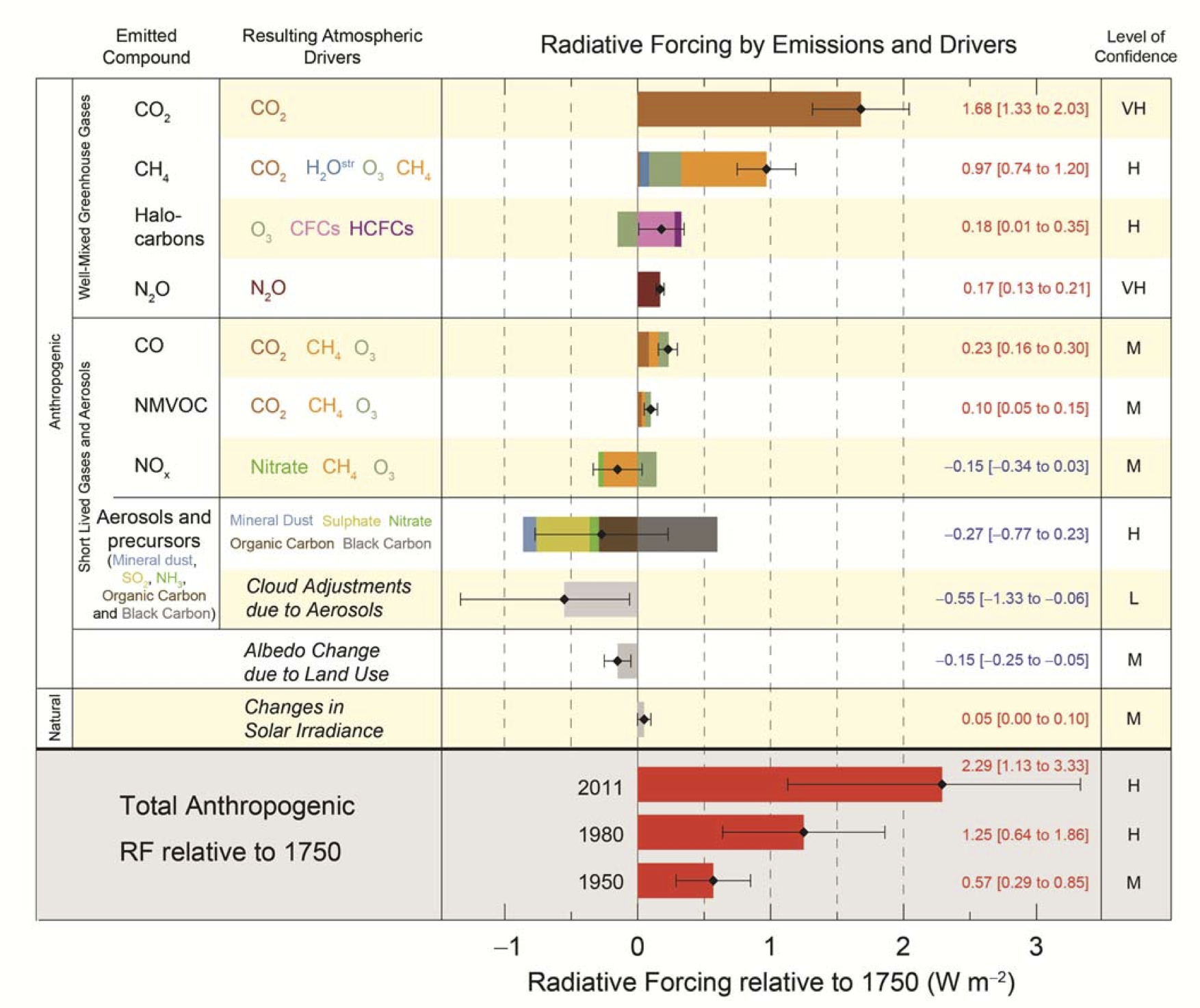
It was just yesterday that we highlighted this unrealistic claim from CMIP5 models: Laughable modeling study claims: in the middle of ‘the pause’, ‘climate is starting to change faster’. Now it seems that there is a major flaw in how the CMIP5 models treat incoming solar radiation, causing up to 30 Watts per square meter of spurious variations. To give you an idea of just how much of an error that is, the radiative forcing claimed to exist from carbon dioxide increases is said to be about 1.68 watts per square meter, a value about 18 times smaller than the error in the CMIP5 models!
The HockeySchtick writes:
New paper finds large calculation errors of solar radiation at the top of the atmosphere in climate models
A new paper published in Geophysical Research Letters finds astonishingly large errors in the most widely used ‘state of the art’ climate models due to incorrect calculation of solar radiation and the solar zenith angle at the top of the atmosphere.
According to the authors,
Annual incident solar radiation at the top of atmosphere (TOA) should be independent of longitudes. However, in many Coupled Model Intercomparison Project phase 5 (CMIP5) models, we find that the incident radiation exhibited zonal oscillations, with up to 30 W/m2 of spurious variations. This feature can affect the interpretation of regional climate and diurnal variation of CMIP5 results.

Why wasn’t this astonishing, large error of basic astrophysical calculations caught billions of dollars ago, and how much has this error affected the results of all modeling studies in the past?
The paper adds to hundreds of others demonstrating major errors of basic physics inherent in the so-called ‘state of the art’ climate models, including violations of the second law of thermodynamics. In addition, even if the “parameterizations” (a fancy word for fudge factors) in the models were correct (and they are not), the grid size resolution of the models would have to be 1mm or less to properly simulate turbulent interactions and climate (the IPCC uses grid sizes of 50-100 kilometers, 6 orders of magnitude larger). As Dr. Chris Essex points out, a supercomputer would require longer than the age of the universe to run a single 10 year climate simulation at the required 1mm grid scale necessary to properly model the physics of climate.
The paper: On the Incident Solar Radiation in CMIP5 Models
Linjiong Zhou, Minghua Zhang, Qing Bao, and Yimin Liu1
Annual incident solar radiation at the top of atmosphere (TOA) should be independent of longitudes. However, in many Coupled Model Intercomparison Project phase 5 (CMIP5) models, we find that the incident radiation exhibited zonal oscillations, with up to 30 W/m2 of spurious variations. This feature can affect the interpretation of regional climate and diurnal variation of CMIP5 results. This oscillation is also found in the Community Earth System Model (CESM). We show that this feature is caused by temporal sampling errors in the calculation of the solar zenith angle. The sampling error can cause zonal oscillations of surface clear-sky net shortwave radiation of about 3 W/m2 when an hourly radiation time step is used, and 24 W/m2 when a 3-hour radiation time step is used.
Brandon – for the third time:
What model of global “warming” do you subscribe to?
Fire?
http://www.independent.co.uk/environment/snowfalls-are-now-just-a-thing-of-the-past-724017.html
or Ice?
http://www.independent.co.uk/environment/climate-change/global-warming-will-make-our-winters-colder-9819825.html
Please answer the question.
Khwarizmi,
I answered you already: neither. Certainly not in such absolute form as stated by the headlines, or by your contrived dichotomy. I subscribe to the view that predicting local weather years in advance is difficult and filled with uncertainty.
Actually is easy , in the winter it will get colder , in the summer warming and in the spring more rain.
Now predicting climate is much harder has show by the failure of your beloved models to do just that.
knr,
Climate is defined as the statistics of weather over some extended period of time. 30 years is common, but not set in stone.
Which do you think is “easier” to do?
1) Predicting the temperature in downtown Topeka exactly 30 years from today.
2) Predicting the 30 year mean temperature anomaly for the entire planet exactly 30 years from today.
First-year stats for dummies should inform your answer.
Contrary to your latest assertion, none of your previous replies included an answer to my question.
But thanks for at last furnishing an answer of sorts at 5.11pm, even if it provides no information about what kind of phenomena you would expect the real world to exhibit as a consequence of warming. That was clearly the point of my question; to find out if you would expect more ice and snow,as per The Independant in 2014, or less, as per The Independant in 2000.
I always expect warming, or heating, to produce less ice in the system, not more. You seem to think that the word “weather” means the answer must be “difficult and filled with uncertainty.”
So how long do you wait for the weather in your oven to clear before you have climate fit for cooking?
30 years?
► Thing about models is: they’re always going to be wrong. How convenient for you.
How inconvenient for you that the FAO pattern matching model was correct in predicting a meridional cooling pattern after 2005, while your agenda-ridden CO2-forced playthings got is so horribly wrong, as demonstrated repeatedly.
Khwarizmi,
Quoting the report again: The main objective of the study was to develop a predictive model based on the observable correlation between well-known climate indices and fish production, and forecast the dynamics of the main commercial fish stocks for 5–15 years ahead.
Since you subscribe models based on correlation, here’s 135 years of correlation between CO2 and temperature:
http://3.bp.blogspot.com/-fRV6ymzCb7A/VQCAQnsE63I/AAAAAAAAAYQ/SDw5lXjU4GA/s1600/CMIP5%2Bto%2BGISS%2BNov%2B2014%2B12mo%2BMA.png
A few weeks ago I watch a forecast of 1-3 inches of snow to come 5 days later, Sunday. When Sunday came, there was no snow at all. If two super weather computers can’t predict the weather 5 days ahead of time, how am I or anyone else going to begin to even remotely believe a computer generated prediction of climate 10, 20 or more years in advance?
“Why wasn’t this astonishing, large error of basic astrophysical calculations caught …”
Because the models were built to reinforce the hypothesis, not agree with observed data.
Just lucky then that none of the major models have this error, including:
ACCESS1-0, ACCESS1-3, CMCC-CM, CNRM-CM5, CSIRO-Mk3-6-0, FGOALS-g2, FGOALS-s2, GFDL-CM3, GFDL-HIRAM-C180, GISS-E2-R, HadGEM2-A, IPSL-CM5A-LR, IPSLCM5A-MR, IPSL-CM5B-LR, MIROC5, MPI-ESM-LR, MPI-ESM-MR, MRI-AGCM3-2H, MRI-AGCM3-2S, MRI-CGCM3
The only one that has the 30W error is a Russian one that no-ones heard of called inmcm4.