
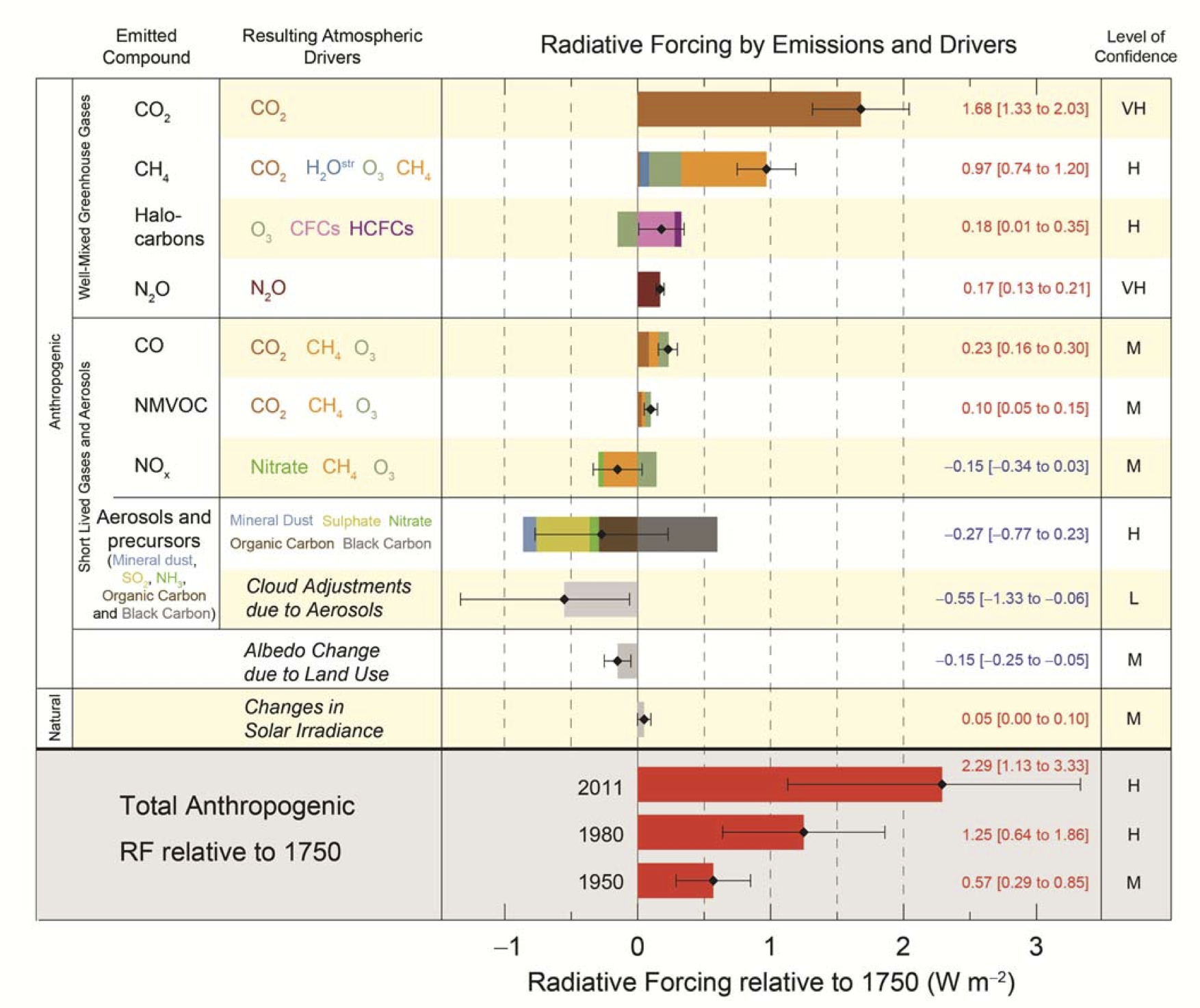
It was just yesterday that we highlighted this unrealistic claim from CMIP5 models: Laughable modeling study claims: in the middle of ‘the pause’, ‘climate is starting to change faster’. Now it seems that there is a major flaw in how the CMIP5 models treat incoming solar radiation, causing up to 30 Watts per square meter of spurious variations. To give you an idea of just how much of an error that is, the radiative forcing claimed to exist from carbon dioxide increases is said to be about 1.68 watts per square meter, a value about 18 times smaller than the error in the CMIP5 models!
The HockeySchtick writes:
New paper finds large calculation errors of solar radiation at the top of the atmosphere in climate models
A new paper published in Geophysical Research Letters finds astonishingly large errors in the most widely used ‘state of the art’ climate models due to incorrect calculation of solar radiation and the solar zenith angle at the top of the atmosphere.
According to the authors,
Annual incident solar radiation at the top of atmosphere (TOA) should be independent of longitudes. However, in many Coupled Model Intercomparison Project phase 5 (CMIP5) models, we find that the incident radiation exhibited zonal oscillations, with up to 30 W/m2 of spurious variations. This feature can affect the interpretation of regional climate and diurnal variation of CMIP5 results.

Why wasn’t this astonishing, large error of basic astrophysical calculations caught billions of dollars ago, and how much has this error affected the results of all modeling studies in the past?
The paper adds to hundreds of others demonstrating major errors of basic physics inherent in the so-called ‘state of the art’ climate models, including violations of the second law of thermodynamics. In addition, even if the “parameterizations” (a fancy word for fudge factors) in the models were correct (and they are not), the grid size resolution of the models would have to be 1mm or less to properly simulate turbulent interactions and climate (the IPCC uses grid sizes of 50-100 kilometers, 6 orders of magnitude larger). As Dr. Chris Essex points out, a supercomputer would require longer than the age of the universe to run a single 10 year climate simulation at the required 1mm grid scale necessary to properly model the physics of climate.
The paper: On the Incident Solar Radiation in CMIP5 Models
Linjiong Zhou, Minghua Zhang, Qing Bao, and Yimin Liu1
Annual incident solar radiation at the top of atmosphere (TOA) should be independent of longitudes. However, in many Coupled Model Intercomparison Project phase 5 (CMIP5) models, we find that the incident radiation exhibited zonal oscillations, with up to 30 W/m2 of spurious variations. This feature can affect the interpretation of regional climate and diurnal variation of CMIP5 results. This oscillation is also found in the Community Earth System Model (CESM). We show that this feature is caused by temporal sampling errors in the calculation of the solar zenith angle. The sampling error can cause zonal oscillations of surface clear-sky net shortwave radiation of about 3 W/m2 when an hourly radiation time step is used, and 24 W/m2 when a 3-hour radiation time step is used.
This clip applies sooooooo often to AGW ‘science’….
Maxwell Smart – Missed it by THAT much, Chief!
http://youtu.be/oPwrodxghrw
The more errors there are in the climate models of this sort, …
… the more fudge factors have to be built in to come close to the Earth’s actual climate.
Error 1 —> Fudge Factor 1
Error 2 —> Fudge Factor 2
…
And we are still waiting for them to come close
[You must use a legitimate email address to post here. ~mod.]
Even if the total solar irradiance averages out, if the model put more sunlight to the polar regions, that would cause more warming in the polar regions than expected (and less in the equatorial region?). Per Willie, the T^4 nature of blackbody radiation implies that the average global temp must increase in order to maintain the correct energy balance.
For how many years have the models and observations been diverging? They have known something is wrong, and could have tweaked the model parameters to make things fit, starting with CO2 sensitivity, yet have stubbornly refused to do so. Does anyone really think this will change anything about how the models work, or how the model results are reported?
Of course not.
” All models are wrong, But some models are more useful in extracting money from the taxpayer than others..”
That’s what you are saying, isn’t it, Mosher?
That the error may actually cancel itself out seems pretty logical. If it didn’t, an error that large would have sent the models careening out of the realm of possibility long ago instead of diverging from observations by a few tenths of a degree.
That’s not what is important here. What is important is that a fundamental, obvious, glaring error exists in the models, and appears to be shared by them. Meaning that someone blew it a long time ago and subsequent modelers simply built their own variations atop a faulty foundation. The questions now arises, are there similar fundamental errors built into the foundation?
Had we discovered that someone designed, built, and flew a passenger jet, only to discover that half the engineers were working in standard and half in metric, and by some miracle these monstrous errors cancelled each out such that the planes flew anyway, what would we do? Say its OK because the errors cancelled each other out? Our ground every single plane until all the designs could be picked through to see what other errors might have been made and just not presented themselves yet?
I don’t think that is a good analogy in this case David,
because while those planes actually flew
these models do not accurately match with the observed data.
The shuttles actually flew until one day they didn’t. MH370 actually flew until one day it didn’t. When/if we find root cause of these disasters is a mistake which by some miracle evaded detection until now, we ground everything until we know exactly what went wrong and if it affects anything else in the fleet.
davidmhoffer March 10, 2015 at 3:23 pm
And when that happens every engineer who was ever involved prays to God, “Not me dear God, please.”
Two almost too stupid to believe observations about the error:
1) Nobody noticed the gross error to “settled science” because everything surrounding it is also crap; hardly anybody believes anything about CO2 forcing – even warmist evangelicals;
2) Here’s the really funny part: THIS WILL BE CLAIMED TO HAVE ABSOLUTELY NO IMPACT ON MODEL ACCURACY (Real data? We don’t need no real data!).
I don’t think this will affect model output too much when corrected. Given TSI at TOA is about 1400 W/m2, this is approximately 2% error. And if we look at all the models in absolute temperatures, the coldest reproduces historical record about 2 degrees celsius below the hottest one. 2% difference in TSI can’t do that much so it’s all up to fudge factors.
” 2% difference in TSI can’t do that much so it’s all up to fudge factors.”
===============================
You forgot the sarcasm” tag.
It is actually about 400 w/m2. The sun does not stand still at the zenith all the time you know. As a matter of fact this whole debacle is about miscalculating the zenith angle.
Claiming an error in climate models is a bit comical. They are supposed to show a linear, upward trend with some variation and built in noise. They do this perfectly. Can’t argue with good results!
BBBBBut, it does not affect the results.
Let me see if I have this right. If [insert climate observation of your choice here] is “consistent with the models,” it’s either blind luck or a miracle?
It will be interesting to see what the models do when they correct the errors.
It’s not to late to coddle the model … maybe ad some hoc …
🙂
+1
Verification of the numerical methods is always an excellent idea.
Verification of the numerical methods is always an excellent idea and always an extremely useful exercise. Evaluation of component models, especially those critical to the application of interest, at different time-step sizes must be handled very carefully. Loss of energy conservation, for example, can be introduced.
Those people who say, it’s a small error, won’t do much, should consider that climate models are iterative; and the small error accumulates (assuming it does not cancel out completely. I think it cannot cancel out completely as the sampling leads to a step function that is NOT noon-symmetrical.)
It should be noted that the entire variation in temperature this whole fiasco is about is on the order of the 4th decimal place , ~ 0.3% .
And in a chaotic model (climate models are INHERENTLY chaotic) that can lead you to a different strange attractor. i.e. the error propagates and amplifies. Of course it might not propagate and it could be damped. You have to run it to see.
Oh , gobbledygook . The only tipping point around is 0c And our temperature is determined by our spectral map with respect to the Sun . And we’ve passed thru these temperatures many times before .
Tell me ;what threshold you assert is going to radically change our spectrum altho it has never happened in billions of years .
Bob Armstrong says: March 10, 2015 at 9:51 pm
“Oh , gobbledygook .”
Not gobbledygook but Chaos Theory terms. Let’s avoid the term Strange Attractor and just say: By definition an iterative model with finite precision of a chaotic system MUST develop an exponentially growing deviation of its state vector from the state vector of the simulated system.
Based on this precision argument, we would normally assume the UNAVOIDABLE deviation in each step to be of the order of least significant bits in the number format used. 0.3 % is many orders of magnitude larger.
Given this HUGE error we can say that what the Climate Models simulated HAS NOTHING AT ALL TO DO WITH THE CLIMATE SYSTEM OF THE PLANET EARTH. They simulated a DIFFERENT system.
I apologize for being a bit derisive , but the chaos of weather and climate is rather irrelevant to the boogeyman of mean global temperature . Determining the averages over the sphere and the year is more akin to calculating the temperature of a volume of gas via gas laws than understanding the eddies within it . Climate and weather are much harder problems than determining the mean and I think one of the impediments to solving the mean is that climatologists are looking up thru the chaos of the weather rather than down from the outside looking at the persistent “color” patterns of the ball .
The mean temperature of the planet is determined by its spectral map as seen from the outside . The eddies are blurred by time into relatively stable densities .
By the way , I learned what math I know hanging around Bob Williams and the NU math department in the late ’70s . Rene Thom and Christopher Zeeman’s catastrophe theory , closely akin to chaos , were pervasive influences .
Bob Armstrong
March 11, 2015 at 9:03 am
“Climate and weather are much harder problems than determining the mean”
That’s why I mentioned the deviation in the state vectors, not the deviation in a simple metric like average temperature.
It is always a joy to me to watch the scientists arguing over 0.2 of this and 0.002 of that when for the majority of the time they are talking about we measured to the nearest 0.5. Then they argue about how much cloud there is. We don’t know. Argue about how much heat we receive. Its an oblate spheroid, it wobbles…the ice changes daily, the clouds by the minute, the albedo by the season…We don’t know. How much heat gets in and how much is reflected? We don’t know. It depends on ice and snow cover, golden corn or brown earth, thin or thick cloud, how much water vapour, how much soot. We don’t know. So they create computer models which combine all the things we don’t really know and out of the spout comes disaster…the end of the world.. catastrophe….and worst of all…it is all caused by humans……the models say so. Yup.. gonna believe that when I see Obama sprout wings and ascend into heaven on January 20th 2017.
Until then I am going to enjoy the gift of life, in the most productive period of our race.
++
Yes, it should have been caught billions of dollars ago. But it was not.
The question is what are we going to do about it?
Business as usual with the IPCC and their flawed models?
Thanks, Linjiong Zhou, Minghua Zhang, Qing Bao and Yimin Liu.
Regardless of whether or not scientists are wrong on global warming, the European Union is pursuing the correct energy policies even if they lead to higher prices. -European Union Climate Commissioner Connie Hedegaard
The huge bureaucracy to implement the solution has already been decided upon. The actual problem, whether it exists or not is of no consequence and dwelling on such trivialities only delays implementation.
“pursuing the correct energy policies
even ifbecause they lead to higher prices. -European Union Climate Commissioner Connie Hedegaard ”…only that the EU is now running out of road… fast…
Higher prices is a means to the end. If you listen to the speeches at the United Nation IPCC/UNFCCC galas, the big talk is not about the environment or science. The environment and science are tools to implement the goal and the bureaucracy.
“This is the first time in the history of mankind that we are setting ourselves the task of intentionally, within a defined period of time to change the economic development model that has been reigning for at least 150 years…”
– UNFCCC Executive Secretary Christiana Figueres
The environment, Science or even Climate ‘science’ is a side show for this circus. If there are errors in the calculations they will be replaced by something else. It does not matter, the conclusion is predetermined. There are no ‘gotchas’ or silver bullets.
‘major errors of basic physics inherent in the so-called ‘state of the art’ climate models,’
sorry this does not matter one bit . becasue their ‘value’ has little relation to their scientific worth , their ‘value’ is in the support they offer to ‘the cause ‘ and the ‘impact’ they have in the press.
Nice picture
But why is there no Troposheric Water Vapour? Considering how much water vapour there is in the atmosphere I understood this to be a GHG? And work probably both positively and negatively.
Yeah. If you have water vapor in the model, it will completely wash out all the other factors. Which is why they left it out.
But reflected energy leaves the earth immediately!
And, reflected energy at low solar elevation angles is strongly dependent on solar elevation angles.
And, absorbed energy before the inbound short wave radiation even gets reflected (energy lost going through the atmosphere) is strongly dependent on the solar elevation angles as well.
So, they are calculated the basics of every albedo equation for every square meter of water on earth basically wrong.
Oh, and I see contrails get a mention, although the supposed effect seems to be about the same size as the ‘0’ reference line.
Whoops: climate modellers, already knowing the models are wrong since all models are, find their own errors and honestly publish them in primary literature. Why that is such a foreign concept for the proprietor — as well as so many denizens — of the “Best Science Website in the World” once again defies rational explanation.
Sorry, I musta missed something. Can you point me to the place where they say something to the effect of “we” found a problem with “our” models? I see some people studying OTHER people’s models and finding a problem with them. I don’t get the impression that these authors were themselves writing any of the models in CMIP5.
But feel free to edumacate me.
davidmhoffer,
Abstract from the present paper:
Abstract
Annual incident solar radiation at the top of atmosphere (TOA) should be independent of longitudes. However, in many Coupled Model Intercomparison Project phase 5 (CMIP5) models, we find that the incident radiation exhibited zonal oscillations, with up to 30 W/m2 of spurious variations. This feature can affect the interpretation of regional climate and diurnal variation of CMIP5 results. This oscillation is also found in the Community Earth System Model (CESM). We show that this feature is caused by temporal sampling errors in the calculation of the solar zenith angle. The sampling error can cause zonal oscillations of surface clear-sky net shortwave radiation of about 3 W/m2 when an hourly radiation time step is used, and 24 W/m2 when a 3-hour radiation time step is used.
Googling the lead author Linjiong Zhou yields a coupla’ hits, one of which is:
http://www.researchgate.net/publication/268821205_Global_energy_and_water_balance_Characteristics_from_finite-volume_atmospheric_model_of_the_IAPLASG_%28FAMIL1%29
ABSTRACT This paper documents version 1 of the Finite-volume Atmospheric Model of the IAP/LASG (FAMIL1), which has a flexible horizontal resolution up to a quarter of one degree. The model, currently running on the “Tianhe 1A” supercomputer, is the atmospheric component of the third-generation Flexible Global Ocean–Atmosphere–Land climate System model (FGOALS3) which will participate in the Coupled Model Intercomparison Project Phase 6 (CMIP6).
So yes, my read is: “we’ve found this spurious incident radiation problem in several current generation models” written by at least one person involved in writing the next generation models for CMIP6, and published in a reputable journal so that everyone working with CMIP5 knows there’s a potential issue, and that everyone working on CMIP6 is aware to not make the same mistake.
You were correct to ask for substantiation of my argument. I am happy to provide it.
davidmhoffer, PS:
From a preprint of the paper kindly chased down and provided by Lance Wallace upthread: https://dl.dropboxusercontent.com/u/75831381/zhou%20error%20in%20CMIP%20models%20solar%20zenith%20angle.pdf
The purpose of this short paper is to report this bias to inform users of CMIP5 results when interpreting the regional and diurnal variations of model results and to call for the attention of the relevant modeling groups to correct this bias in future simulations. We show that this unrealistic model behavior is caused by sampling errors in the radiation calculations, which are accounted for in some models but not in others. The impact of the bias on the simulation of atmospheric radiation and clouds is also presented.
Lance also notes that they found the problem in 8 current generation CMIP5 models:
Annual – mean incident solar radiation at TOA from 8 selected CMIP5 models is shown in Figure 1. In the figure, we amplified the color scale to highlight the spatial differences in the tropics . It is seen that the distributions of radiative flux in many models (bcc-csm1-1, BNU-ESM, CanAM4, CCSM4, CESM1-CAM5, EC-EARTH, inmcm4, NorESM1-M) exhibit longitudinal oscillations. The same type of biases was also reported in some climate model in AMIP-2 in the dezonalized anomalies plot [Raschke et al., 2005].
They also checked about 20 other CMIP5 models …
This variation would not be visible in zonally averaged plots or in spatial plots when the color scale has a large range. Other CMIP5 models are found to exhibit little or no zonal oscillations (ACCESS1-0, ACCESS1-3, CMCC-CM, CNRM-CM5, CSIRO-Mk3-6-0, FGOALS-g2, FGOALS-s2, GFDL-CM3, GFDL-HIRAM-C180, GISS-E2-R, HadGEM2-A, IPSL-CM5A-LR, IPSL-CM5A-MR, IPSL-CM5B-LR, MIROC5, MPI-ESM-LR, MPI-ESM-MR, MRI-AGCM3-2H, MRI-AGCM3-2S, MRI-CGCM3, see supplemental Figure S1 in the supporting document).
… and did not find the same error. Dunno what to tell you — that looks like good scientists doing what good scientists are supposed to do: identify error and communicate it so that everyone knows there’s a problem.
Dunno what to tell you — that looks like good scientists doing what good scientists are supposed to do: identify error and communicate it so that everyone knows there’s a problem.
= = = = = = = = = =
Brandon, don’t you mean “everyone except the general public“?
I can’t find any reports at the New York Times, Guardian, CNN, NBC, ABC, CBC, or any western media outlet (government or corporate), trying to inform their audience that “there’s a problem” with climate models.
Even the paper that claimed “snowfalls are now just a thing of the past” in 2000 has never revisited the issue to try to explain why they got it so horribly wrong.
http://www.metoffice.gov.uk/media/image/t/i/Satellite_UK_241210_mid.jpg
(UK, 2010)
But they did change their story in 2014 without batting an eyelid:
http://www.independent.co.uk/environment/climate-change/global-warming-will-make-our-winters-colder-9819825.html
Which “warming” model do you subscribe to: fire or ice?
Brandon Gates March 10, 2015 at 7:41 pm
Tx Brandon.
davidmhoffer, you’re welcome.
Khwarizmi,
Good point. I meant everyone who cares about such things to the point that they’d be looking for it, which does very likely preclude the majority of the general public.
Don’t you mean, “I think the models are garbage, and the fact that western media outlets don’t share my opinion is further evidence of massive fraud”?
That was the Guardian wasn’t it?
► I meant everyone who cares about such things to the point that they’d be looking for it, which does very likely preclude the majority of the general public.
The general public, without any question of consent, have to pay for all that pseudo-science that you care about so much. If it was question of consent, you could spend more time caring about the real world, instead of embarrassingly deficient toy versions of it that were specifically designed to freak you out.
► Don’t you mean, “I think the models are garbage, and the fact that western media outlets don’t share my opinion is further evidence of massive fraud”?
No, I don’t mean your version of what I said. I meant my version.
It is not mere opinion that the computer models of climate are “garbage,” as you put it. That’s why you can’t cite a single model that predicted the so-called “pause”, the expansion of Antarctic sea ice, or the record snowfalls in the northern hemisphere.
On the other hand, I can point to a pattern-matching model used by the United Nations Fisheries and Aquaculture Organization, that did successfully predict an end to “global warming” (their scare quotes, not mine), starting around 2005 with a shift to a dominance of a meridional circulation pattern:
http://www.fao.org/docrep/005/y2787e/y2787e03.htm
Incidentally, some climate scientologists and their followers today are peddling a new epicycle, in which that old meridional cooling pattern that we’ve been seeing of late is caused by “arctic amplification” shifting the jet stream, or some other ad hoc “garbage” that was made up on the spot today in order to explain away what you failed to predict yesterday:
http://www.washingtonpost.com/blogs/capital-weather-gang/wp/2014/02/20/scientists-dont-make-extreme-cold-centerpiece-of-global-warming-discussions/
I notice you didn’t answer my question about what model of global “warming” you subscribe to: fire or ice?
Thanks for the paper, Brandon, that’s a pretty basic error.
Khwarizmi,
I live in a republican democracy. YMMV.
It was sauce for the goose.
I don’t expect scientists to be omniscient, any more than the models they produce. Did your fish stocks model predict the expansion of Antarctic sea ice? Record snowfalls in the NH? Tide levels in New Jersey last week? The price of tea in China yesterday? I can do this all day.
Thing about models is: they’re always going to be wrong. How convenient for you.
The main objective of the study was to develop a predictive model based on the observable correlation between well-known climate indices and fish production, and forecast the dynamics of the main commercial fish stocks for 5–15 years ahead.
My emphasis. I’m not so sure you want to start talking about correlations.
It’s an intriguing theory – that recently has gotten legs: the melting Arctic – spurred by global warming – is causing the weather’s steering flow, the jet stream, to become more extreme … But more and more scientists are expressing reservations about this hypothesis, first proposed by Rutgers climate scientist Jennifer Francis and collaborators.
“It’s an interesting idea, but alternative observational analyses and simulations with climate models have not confirmed the hypothesis, and we do not view the theoretical arguments underlying it as compelling,” write five preeminent climate scientists (John Wallace, Isaac Held, David Thompson, Kevin Trenberth, and John Walsh) in a recent letter published in Science Magazine.
Elizabeth Barnes, an atmospheric scientists from Colorado State University, after an attempt to dismantle Francis’ theory last summer, published a second challenge in January.
“…the link between recent Arctic warming and increased Northern Hemisphere blocking is currently not supported by observations,” Barnes’ study concludes.
Your point?
Robert of Ottawa,
I can’t take credit, it was Lance’s doing upthread.
A feature is just a bug with seniority.
[You must use a legitimate email address to post here. ~mod.]
I am so glad that you have chosen to post here. Your comments are enlightening and very much appreciated.
Mr Gates the fact that models are wrong has been obvious for fifteen years, that is not the problem. The problem is that they have been used to spout fire and brimstone in a political manner causing untold expenditure on a non problem. Now we even have a pogrom against honest scientists in the run up to Paris this is why this fraud of climate models is so wrong. This is a religion for some in high places following these wrong climate models, they dictate to us on a fallacy.
wayne Job,
A non-problem yet.
If you’re talking about Grijalva’s fishing expedition, I think it was a stupid political stunt — typical opposition-party manuvering — and just plain wrong-headed. An across the board review would have been the better approach. Going after specific researchers set — no, reinforced — a bad precedent for academic freedom. All he’s done is strengthen the resolve of like-minded colleagues across his aisle
When someone cancels elections, I’ll complain with you about dictatorship. Worst I’ll go is democratic oligarchy. As for religion — what thread is this — oh yeah, scientists find an error in the models and publish it like they’re supposed to. You’re talking about politics by way of response. Funny how quickly the subject gets changed.
So, Brandon, if you’re so convinced of the honesty of your beloved warmist scientists, where are the announcements by the IPCC that all prognosis of a dangerously warmed world in 2100 must now be scrapped until a re-validation of the fixed model versions has taken place? (Which will take about 30 years)-
(Well I said re-validation, as if a validation of the buggy versions ever happened, but let’s play your “honest scientists” game here)
DirkH,
Not forthcoming any time soon according to my radar. CMIP6 is on the horizon after all. Why not scrapping the whole programme should be considered “dishonest” is a bizarre notion. If science, or indeed any human endeavor, were scrapped the first time it became apparrent that someone screwed up, we’d never get anything done.
I reiterate my view as first stated. The honest thing to do when identifying a mistake is to describe it in public so that others are aware of the error. I repeat my amazement that this is such a foreign concept so many people here.
Brandon;
as usual nothing but drivel.
“climate modellers, already knowing the models are wrong since all models are”
Funny isn’t how all the climate models are wrong in the same direction isn’t it.
Bob Boder,
Funny that you’re just repeating something you read somewhere without checking it. Much depends on how one determines “direction”. One way to do it is to take linear trends for each model over some period and compare that to observation over the same period. I did that for the first model member for each model from 1860-2014 and compared it to HADCRUT4. Exactly half of them are less than or equal to the HADCRUT4 trend, exactly half are greater. The overall ensemble IS biased hot, to the tune of 0.07 K/century.
An interesting article, but here’s the thing:
The models suffer from 2 fatal fundamental flaws (both of which were mentioned in the article).
1) The resolution is vastly too coarse to meaningfully model the circulation of air.
2) Some crucial phenomena are not even modeled, but instead are parameterized. And there is no way to know or demonstrate that the parameterization is correct. They can fiddle with the parameters to get the model output to match historical data over a given period of time, but that is really just a silly exercise, because there is no reason to believe that the time period they choose is any more representative than any other period.
My concern is that focusing on a particular error (such as the discussed error in the treatment of solar radiation) can give the impression that the models might be improved by fixing such errors. I prefer emphasizing that even if all such errors were fixed, the models’ intrinsic nature renders them incapable of providing information useful for the formulation of policy.
Yes, it is too soon to declare the models dead. If these relatively large variations are random in the model run, they may average out to some extent. A systematic error this large would have been obvious in the results.
IMHO the weakest link in the code are the assumptions of net positive feedback. This is very tricky, and a small error can make a very large difference. It is too tempting to adjust the feedback coefficients to obtain a “plausible” temperature increase over the next century.
And besides that, the story we are asked to believe is that we must keep our warming to less than 2 degrees, or disaster will ensue. Well, with positive feedbacks, and carbon dioxide supposedly resident for centuries, then are we not doomed in the next hundred years, even if we stay within the 2 degree budget for 2100?
I didn’t even know the CHIMP5 report was out!
This is a bit tangential, but I’ve always hated the use of the term “forcing” when it’s applied to phenomenon that don’t force anything in regard to the overall energy budget of Earth. To me, the only things that can correctly be called forcing are those things that add external energy into the climate system. These are few, and include electromagnetic energy from the sun and from space, atomic decay, and the energy from impacts. Those things are the only forcing factors. Everything else should be considered as buffering, which could further break down into storing and moving. Am I the only one who feels this way?
Boy , do I agree . Is this term forcing used in any other field ?
Let me see
dThis/dThatwithdThis/dThatgenerally proportional to the distance to some equilibrium . Forcings always sound like they are independent of how muchThisorThatthere is .Of course , I’m just an APL programer with some math and basic physics background .
This is also related to emissivity and absorptivity that apparently are not well understood by the modelers. The earth is not a black body and simply ‘estimating’ a number for absorptivity out of the air blows away any validity. aS (solar radiation at the ground) is not black body radiation – and varies with the elevation of the sun.
It has been some years since I looked at any model code, but when I did I found nothing to deal with the interplay of black body vs aS other than a fudge factor. .If one did real error analysis of the models, the true error bars would show exploding error bars as one goes into the future.
It also amazes me that so little is said about historical humidity numbers – that have changed as much as 50,000ppm. The huge increase in land under irrigation in the last 50 years apparently isn’t interesting to either side of the debate. The changes in humidity cause a real change in aS – a confounding variable.
All of the authors have appointments at Chinese institutions, as well as two affiliated with SUNY Stoney Brook.