North America To Flood The World With Cheap & Abundant Fossil Fuels

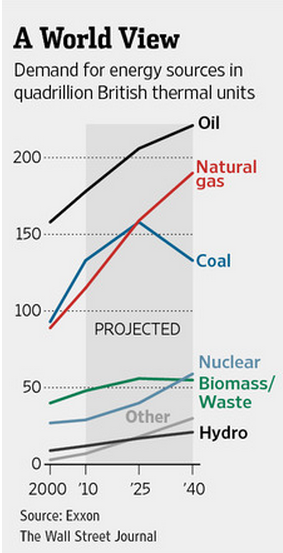
North America, once a sponge that sucked in a significant portion of the world’s oil, will instead be supplying the world with oil and other liquid hydrocarbons by the end of this decade, according to ExxonMobil’s annual long-term energy forecast. In a forecast that might make economists happy but environmentalists fret, Exxon’s two chief products, oil and natural gas, will be abundant and affordable enough to meet the rising demand for energy in the developing world as the global middle class swells to 5 billion from 2 billion and buys energy-hungry conveniences such as cars and air conditioners. — Jonathan Fahey, Associated Press, 9 December 2014

The world’s largest oil company sees emissions in the developing world surging 50 percent, a forecast that suggests the diplomatic push to draft an accord to curb global warming stands to fall short. Even as the most advanced economies cut energy use by almost one tenth through 2040 and add hundreds of millions of fuel-efficient vehicles, booming growth in places like India, South Africa and Thailand will boost demand for fuels 36 percent, the Irving, Texas-based company said in its annual outlook. Emissions will surge as an expanding middle class in poorer nations demands electricity, schools and hospitals. –Joe Carroll, Bloomberg, 10 December 2014
Low oil prices and the inaction of OPEC may well result in a shale crash next year. Many analysts now expect falling oil prices to throttle the US shale boom. The theory goes that, if high prices helped create the oil boom in USA and Canada, then low prices will inevitably result in a shale crash. That’s certainly what Saudi Arabia, the leading member of OPEC, are hoping. However, according to The Economist, ‘adversity will make shale stronger.’ The success of North American shale has been recognised globally and now many other countries are now hoping for similar success (Mexico
and the UK being two of the most prevalent). And, when oil prices recover, new wells can be purchased within weeks – it won’t take long to get North American shale production creaking back into action again. –Jeremy Coward, Shale World, 10 December 2014
A $200 million government backflip on an international green climate fund will come at the expense of Australia’s foreign aid budget. In a bittersweet victory for green groups, Foreign Minister Julie Bishop today announced to a UN climate change conference in Lima that Australia would now contribute to a $10 billion fund that aims to help developing nations tackle global warming. The decision is a reversal of its stance at the G20 summit in November. Mr Abbott said money from the fund would be “strictly invested in practical projects in our region” including energy efficiency, better infrastructure, reforestation and carbon offsets. –Dennis Shanahan, The Australian, 10 December 2014
Tabulation from Dr. Benny Peiser and the GWPF
Interesting also is that the US is the #1 oil supplier currently; surpassing Saudi (production, not reserves).
Basically, it is their fault, again, the current plunge
The USA isn’t the number one oil supplier. Those statistics can be confusing. USA production is inflated by biofuels and NGL s. The top producers are Saudi Arabia, Russia, and USA is third.
You might be right and over inflated by the media. However, the impact on the markets does inflate their case.
Here is the reported production for just crude and gas, the US ranks second: http://www.eia.gov/countries/index.cfm?view=production#allcountries
The world would be awash with oil, if only Greenpiss and their conniption-fit-brain-fart buddies would let everyone extract it.
There should be mass protests worldwide calling for greenies to be banned from using conventional energies full stop. That would feed them a huge spoonful of STFU.
But since we found naturally occurring hydrocarbons on Titan, where no dinosaur ever set foot, means that their favourite term “fossil fuel” needs a massive rethink.
Fernando Leanme
You say
Please explain why you think not all “oil” should be accounted when discussing USA “oil supplies”.
Surely, the total should include all sources and not only the oil obtained from a particular type of source? If not, then why not?
Your assertion would make sense if the total were of economic production methods, but it was not.
Richard
biofuels and NGLs don’t count because oil supplies more than just gasoline. A single barrel of oil cracks out to more than 1 barrel of various hydrocarbon outputs – including largely gasoline but not exclusively. Thus it is misleading to compare 1 barrel of biofuel or NGL to 1 barrel of oil – it significantly overstates the relative impact of the biofuel or NGL vs. its oil counterpart.
c1ue
Thankyou for your post that attempts to justify the exclusion of biofuels and NGLs by saying
Sorry, but that does not wash.
An oil refinery separates the components of crude oil by distilling the crude. The separated components are products which must match market demand; e.g. producing the required amount of benzene must not result in producing too much or too little petroleum. This match of products to market demand is obtained by blending (i.e. mixing) different crude oils for distillation: crudes from different places contain different proportions of hydrocarbons.
Blending is expensive. It requires a variety of crudes to be transported and stored then mixed in controlled ratios.
In the absence of further information it cannot be known whether the use of biofuels and NGLs increases or reduces the need for blending: that would depend oncircumstances. Simply, the inclusion of biofuels and NGLs may enhance or reduce the value of a “single barrel of oil”.
There is no reason to exclude any supplied oil when totaling the supply of oil.
Richard
Fernando (Dec10, 12:15p) is right. Oil & Gas Journal, Dec 1, 2014, pp32-34:
2014 average crude & condensate production (not consumption, and excludes bio-fuels) estimates in millions of barrels per day:
Russia 10,490
Saudi Arabia 9,848
United States 8,580
Tomazo
Fernando is only “right” if he excludes – as he honestly admits he does – biofuels and NGL s. Nobody has questioned that Fernando “right” in that sense.
c1ue and I have been discussing whether or not it can be considered as being acceptable to exclude biofuels and NGL s when totalling “production”: c1lue claims it is and I say it is not.
Richard
The theory goes that, if high prices helped create the oil boom in USA and Canada, then low prices will inevitably result in a shale crash. That’s certainly what Saudi Arabia, the leading member of OPEC, are hoping.
The wells, once drilled, aren’t going to be filled in, so obviously if prices drop some will be turned off and be turned back on when prices rise again. Perhaps the Greens weren’t told about supply and demand.
The Saudis are targeting alternative sources of oil but they have lost their stranglehold on supply.
Precisely true, the best the can hope for now is to modestly increase prices or to drop the floor on prices. If they increase prices they will have less income since they can only do so by reducing output – and the U.S. will just take up the slack and make a killing doing it, if they let prices fall they will have less income, but U.S. companies will have a hard time keeping supplies up until prices increase.
They have lost their stranglehold on the U.S. and, by extension, the global oil market. This is a wonderful thing, indeed!
In the USA, if you stop pumping oil from a well, you must seal it with concrete. This law was passed in the 1970s by democrats who didn’t want the oil companies to simply stop pumping from a well until prices rose again.
A well can become “unsealed” very quickly.
“Plugged and abandoned” has been the standard practice in the oil business for 100 years, more or less.
Nothing new.
Mike if i understand correctly, that is more of a safety issue, but I’ll try to find out.
The wells are plugged with cement (not concrete). I’m not aware of a law requiring plug and abandon immediately. You may be thinking of offshore regulations? Those are different. Most countries require that old wells be plugged.
North American shale peak 2017-2022, then its downhill all the way. Lower earlier peak ndue to low prices could extend the plateau a year or two.
Correct. There are several essays in Blowing Smoke that explain why. Russia’s Bazhenov likely wont produce as much as Bakken. China’s sichuan basin has the same folding/faulting problem as California’s Monterey. While there is ‘good’ shale in Argentina, Europe, and Australia, that won’t make up for the US decline.
Since read this report every year, all that can be said about the AP synopsis is that reporter didn’t.
We’ve been hearing this echo for 40 years now. New finds, new technologies, and new ideas always show that previous estimates are too conservative.
The echo has been reverberating for more than a hundred years, not just 40. The reason for this very durable error in reasoning may be easily seen in the following graph:
http://i.telegraph.co.uk/multimedia/archive/03133/shale_fields_cost_3133134a.PNG
The point is that reserves and availability are a very soft barrier. The graph only shows reserves where the break even is less than 75$, but obviously if market price goes above that point then ever increasing supplies become profitable.
I’m out of ideas. What do you have in mind? Shale oil looks attractive at high prices, it stinks at current prices. The same goes for deep water. And the Arctic? Forget it. We will be squeezing more oil, but it takes an ever increasing price. Maybe what needs to be explained is that oil prices will have to keep on climbing. Eventually it’ll be too expensive. By that time we will need something completely different.
The hard cap on pricing for oil is at the price where it becomes substantially cheaper for coal liquification.
One input that this price of coal liquification depends on is the price of electricity. A high electricity price provides an advantage for conventional and unconventional oil producers over coal liquification.
So high electricity prices provide a long-term advantage for oil producers. I guess this explains why you see so many oil producers as sponsors at the AGU meetings.
Great point. Peak oil was pretty much accepted dogma for decades. Then came tight oil and widespread fracking. All of a sudden the people who insisted that they could predict peak oil…the ones who couldn’t see the shale gas revolution coming…are making the same mistake. Truth is, we don’t know whether this oil will peter out or be replaced or supplemented by other oil produced by new techniques not yet invented.
We may run out of oil some day but my bet is on ingenuity, innovation, and the profit motive to keep it coming. As long as people want oil someone will figure out how to produce it for a profit and we are going to be wanting this for a long, long time.
Just remember how wrong all of the experts were on this one…and on climate change…oh, and ObamaCare…and on and on….
And this time we’re going to get our predictions right.
MarkW
If your comment was sarcasm, please accept mu apology & ignore the rest of my comment…otherwise, read on:
Global warming climate models and oil reserve predictions share (at least) 1 fatal flaw: neither one has ever accurately predicted the future.
The universe is saturated with carbon compounds. Every forecast of a peak has been wrong. I’m not buying yours.
Too, Colorado School of Mines has done research on the use of Liquid Nitrogen rather than water to do the fracking in shale formations. They have lis. Continental Oil Corp. to do trials early next year.
The EPA and the Greens have used the use of water to stall fracking. That in many parts of the world the formations are in areas where there is no water. The Liq. Nitrogen per. Col. School of Mines does a much better job due to great expansion of the gas when it reaches the formation to be fracked.
Do not have a link but I have people I know who are on a “oil shale” blog where this is being discussed in depth.
Liquid nitrogen fracking
“…..And because the liquid nitrogen would evaporate underground, cryogenic fracturing could form bigger canals for oil and gas to flow through than water-based fracturing, boosting oil and gas production. It would also solve the problem of extracting shale gas from clay-rich shales……”
http://www.shalegas.international/2014/09/02/is-using-nitrogen-for-water-free-fracking-the-way-forward/
Liquid co2 fracking
http://www.shalegas.international/2014/04/15/using-co2-instead-of-water-may-make-fracking-more-environmentally-friendly/
Interesting. My first thought was “how do they get the proppants down there?” but I see they thought of it first:
“However, the use of liquid nitrogen is not totally problem-free. It’s been pointed out, that liquid nitrogen, like many of the alternatives to water that the oil industry has tried, lacks the energy capacity – called viscosity – to carry sand and proppants.
“You can’t energize the fluid efficiently because the viscosity of the fluid is significantly lower than water, which you can put a lot of energy behind,” Ramanan Krishnamoorti, a professor of petroleum engineering at the University of Houston said. “People have been thinking about this for a while. It’s still a long way before it can truly be applied.”
It goes on to explain experimentation suggesting higher velocity can make a low viscosity fluid keep the particles in suspension and still drop them off where needed.
Human ingenuity knows no bounds.
“…Cheap & Abundant Fossil Fuels”
It’s the ‘cheap’ part that matters and at the heart of what is ‘peak.’
$200M eh? I guess Tony Abbott had no choice – but given the measure of control as to who gets the lolly and for what, reforestation and a few rooftop is good, andsolar panels in remote areas is an OK salve to the CO2 haters…please leave out BS wind farms?
The $200m is to be spent oin : energy efficiency – good, better infrastructure – good, reforestation – probably ok, carbon offsets – [unprintable]. Why oh why is Tony Abbott weakening just now, when he least needs to?
A promise is just a promise until it is fulfilled. Will there actually be a deposit of funds?
Oh the temerity! Don’t they know that you don’t need electricity, schools and hospitals, or clean water even when your destiny is to be part of the 95% reduction in population the Earth needs to survive?
+1 (you obviously Git it)
It should be mentioned that production costs are much lower than all-in costs (which include exploration and development costs). It’s unlikely that massive cuts in production will occur in the shale oil plays, but certainly massive reductions in exploration and development will happen almost immediately.
Also not mentioned is natural gas. The Marcellus play is so large that if it were its own country it would be the world’s 3rd largest producer. Its cost of production is almost 50% lower than the price seen in Alberta, Canada and this will have an effect on revenue for Canadian producers in another 2 years.
Also let’s not forget the downside of low oil prices. BP will lay off 84,000 workers in 2015 at a cost of $1 billion.
http://www.reuters.com/article/2014/12/10/us-bp-restructuring-idUSKBN0JO0QN20141210
You’re forgetting the rapid decline rates of existing shale wells. All that is needed for production to decline is to quit drilling new wells. That is already happening at $70/bbl.
The decline rates are high initially. They decrease over time. Meanwhile the well has already paid back the exploration and development costs and remains profitable at the lower production rates. The glut of oil from tight shale is very price sensitive at $70/bbl. But the pull-back in production will be slower than most think IMO. This will keep oil prices low for awhile (< $70/bbl for 18-24 months).
Also let’s not forget the downside of low oil prices. BP will lay off 84,000 workers in 2015 at a cost of $1 billion.
This is good news, not bad, for the USA where the destruction of BP is both government policy and a national sport.
Congradulation Mr. Phlogiston….
…
Everybody just loves receiving a “pink slip”
…
Have you ever received one?
“Congradulations?”
Is that what happens when you finish college? If so then .. congratulations!
So then, let me guess, you strutted up on stage to receive your pink slip?
Or was it pink and green?
Wow….
So your spell checker is better.
..
Kudos to you.
My guess is that most of the workers laid off by BP will be the ones with the least control over company policies.
BP is downsizing because of the racist lynching it is receiving in the spiritual home of the racist lynching, the US south. So now you’re attacking PB because after having its money stolen by Barack Obama and fellow Ku Klux Klansmen, it has to lay people off? Even give them pink slips? How quaint. Well I guess it gives you an excuse – as if one were needed – to renew the racist lynching. Hey guys – help me find a Brit we can tar and feather.
Are we at peak oil yet?
Not nearly. Most of the federal offshore areas are still unexplored. The Bakken is still developing and they essentially haven’t even explored on the rim of the basin. The Springer formation in Oklahoma could potentially hold high reserves. If someone finds a way to cheaply and effectively produce the Green River formation that alone would add billions of barrels to reserves. If regions of South America, Africa, and Asia become politically stable and business friendly then who knows what could be found in completely unexplored basins.
I can’t visualize federal offshore areas holding significant oil reserves. What do you have in mind?
Foreign Minister Julie Bishop today announced to a UN climate change conference in Lima that Australia would now contribute to a $10 billion fund that aims to help developing nations tackle global warming.
The context suggests that this should read would not contribute.
Sadly, no
It is to come out of the foreign aid budget. Just moving the the money accounts around.
Now that renewables are so price competitive with fossil fuels we need to tax them at the same rate as gasoline at the pumps. This way we can all benefit from their low cost and high efficiency and not just the people who put up the money originally (said the goose to the gander).
So where in the world are renewables (not counting cow dung and hydro) cost competitive with oil, coal and NG ?? (sans carbon credits and subsidies of course.)
Doesn’t matter about cost; they have to make increased net energy available, rather than drain existing energy supplies in their fruitless pursuit of net energy gain (availability).
They cannot tax the trees I cut down on my land which I use for firewood.
I’ll stay nice and warm this winter will my untaxed firewood.
Actually they can. it all depends if they want to pursue it or not.
Something tells me D. Socrates is a tax collector, not a taxpayer.
He’s lucky he’s not in Australia … whee you’re not allowed to cut down your trees.
Tell me… in Australia, is there a law against harvesting deadwood?……..you know, trees that have died and already fallen down?
You said cutting down trees, Not harvesting dead wood. And the goal posts move again.
David Socrates
December 10, 2014 at 8:02 pm
Tell me… in Australia, is there a law against harvesting deadwood?…
With some local councils –yes. The deadfall is deemed to provide a habitat for native animals.
Did you forget the SARC tag, Steve? The real cost of renewable fuels is about twice the cost of so-called fossil fuels, and aren’t necessarily cleaner burning.
Something tells me that once America starts exporting oil, it will become beneficial for the planet.
Free enterprise trumps greens every time.
Abundant and affordable energy leads to cleaner environments, lower birth rates, and far better health for the expanding middle classes in every developing country. The examples provided by developed countries are replete.
Steve from Rockwood
“It should be mentioned that production costs are much lower than all-in costs.”
The sunken costs are part of the overall cost to profitability of a company, but incremental cost of the production of the next barrel of oil are much lower and such production will continue.
The lower oil price will spur innovation and ultimately lead to lower total cost.
When we have a gas pipeline from the North Slope, the ~50% of the BTU’s (gas) pumped out of existing
wells will become a profit center instead of an expense, pumping the gas back into the ground, making the field much more profitable.
Adding production from the Arctic and ANWAR could fully utilize the existing oil pipe line.
These and many other conventional fields in addition to shale will continue to be discovered and produced
and once again all the predictors of oil’s approaching demise will be proved wrong
We’ve found too much oil. It has unintentionally triggered a deflationary spiral. To be fair, the true root cause of the spiral is not the oil supply. The underpinnings of the crisis were brewing for years. In any case, behold, Great Depression Release 2.0
James,
Low cost oil is a symptom of deflation, not the cause.
James
Study the effect of the extreme drop in the price of oil in the early ’80s secondary to Reagans’ freeing the price from Carter’s control.
The economy boomed.
There seems to be quite a bit of disinformation among the comments to this blogpost.
First, do not write off OPEC.
Saudi Arabia has probably made a very astute move by not intervening in the market and making very bearish comments at the OPEC meeting in Vienna on November 27th. The market has moved dramatically lower with WTI presently at $63 and Brent at $66. By letting the market set prices, they are spreading the “pain” of lower prices to all producers, but particularly high-cost production, oil sands in Canada and Venezuela, tight oil in North America, and deep water in Gulf of Mexico, Brazil and Angola. If OPEC had made a production cut, the tight oil surge from North America would have continued unabated, worsening their position.
Second, has their tactic had an effect?
Reuters reported that Drilling Info Inc., an industry data analyst, noted a 15% drop in US drill permits in October versus September and a 37.5% drop in November versus October. (http://www.reuters.com/article/2014/12/01/us-oil-prices-shale-permits-idUSKCN0JF2CU20141201
http://www.reuters.com/article/2014/12/01/us-oil-prices-shale-permits-idUSKCN0JF2CU20141201 )
Given that the production profile of a fracked well declines relatively quickly over a 6 – 9 month period, and thereafter may continue producing at a lower level for up to 20 years, the prerogative in a tight oil play is to keep drilling to maintain production. This is a very different to conventional oil fields.
Above there are comments about shutting in wells until prices recover. This does not work the same way in unconventional wells.
Thirdly, from a Saudi point of view, the low-price effect also impinges on Russia, Iran and Iraq. Although the latter 2 are OPEC members, both are claiming they should not make cuts because of previous or extant sanctions. Their call (and that of other OPEC members) for production cuts is directed mostly at Saudi Arabia. The lack of production cuts is a message from Saudi Arabia to its Middle East rivals that potential production increases in Iraq and Iran will be opposed.
Fourthly, comments have been made that the lack of cuts was agreed between the US and Saudi to punish Russia over recent military events in Ukraine. Oil price falls have had a dramatic effect on the exchange rate of the rouble, and in conjunction with sanctions, on the Russian economy in general.
Fifthly, lower prices put pressure on costs, and staff cuts are one of the obvious reactions among operating companies and the service sector. However, the example given above about BP is wrong as the figure given is close to the entire staff rather than the number that might be cut.
Finally, the fracking revolution and the surge in oil production in the US is proof that we have not reached peak oil. It is an example of how the market pushes technological innovation. Horizontal wells and multi-stage fracs caused a revolution in gas production. However collapsing gas prices in 2007/2008 motivated a switch to liquids-rich plays, and prompted a surge in US oil production from 2010 to the present to levels last seen 30 years ago.
We haven’t reached peak crude oil….maybe….when I look at refinery runs it sure looks like crude oil hit a plateau. We need $100 per bbl plus to overcome natural decline. Note: I don’t count syncrudes from gas to liquids plants, nor NGL as “crude oil”. I’ll give you the benefit of the doubt and count condensate as “oil”. If we limit it to oil (liquid at reservoir conditions treated to meet standard marketing specifications), we peaked a little while ago. And this is why worldwide refinery runs aren’t climbing that much.
The decline in crude oil prices also means that we do not need to worry so much about protecting the Saudi’s. You know, the guys behind the 9/11 attack on our country. The decreasing importance of mideast oil, in general, will have a tremendous effect upon the world view of our military strategists and those of other countries. That is, assuming they have the brains to figure it out. For one thing, the US and Russia now have at least one thing in common, the glut of mideast oil reduces the value of our reserves. A smart administration might consider more liberal tax deductions for exploration and development to break the strangle hold of the mideast oil suppliers. But then we do not have one of those.
Al Said most definitely not behind the 9/11
terrorism. They had kicked Bin Laden out of their country long before.
$#%%!!# .For Said read Saud
Thank you North Dakota and Texas!
Home heating oil is in a free fall. Spot NY harbor #2 is now under $2.00 again for the first time in ~5 years. Retail prices are also dropping steeply despite the colder temperatures going into this heating season.
http://www.eia.gov/dnav/pet/hist/LeafHandler.ashx?n=pet&s=eer_epd2f_pf4_y35ny_dpg&f=d
Good idea to get some extra storage capacity and fill ‘er up !!!!
Talking about storage how’s the promised land of electricity storage for wind turbines coming along?
Don’t need it
..
Talk to ERCOT
…
They get more than 10% of their needs from wind
…
They serve 85% of Texas
…
Funny how grid operators can utilize wind without storage.
False. That’s “nameplate rating” or “100% theoretical” ratings. Actual power averages no more than 3% over the year. But, then again, more than 3% irregular, unpredictable wind power threatens the stability. Unless, as in Germany and Holland, you have the Norwegian and Swedish water power ready IMMEDIATELY to turn on and turn off their hydrogenerators. Which cannot occur anywhere else in the world.
No sir, you need to examine the ERCOT data
..
Here is one
http://www.ercot.com/news/press_releases/show/26576
Note the percent figure for 2013…..9.9% in the “Generation mix changes” table.
…
..
Here is another
..
At the time the new record was set, wind generation was providing nearly 29 percent of the 35,768 MW of electricity being used on the ERCOT grid. The new record beats the previous record set earlier this month by more than 600 MW, and the American Wind Energy Association reports it was a record for any U.S. power system.
( http://ercot.com/news/press_releases/show/26611 )
Responding to David’s ERCOT posts: I noticed you are using the ERCOT website for your data. Do you work for the company? Statistics from green companies have been so inflated in the past, that there is no way I will believe that company’s are any better. Typically, wind and solar power sources only produce about 25% or less of their rated output over time. The cost of electricity from those sources is ten times or greater than that of conventional sources. Nothing to brag about here.
And:
– there’s shale gas in England
– Israel has been producing NG since 2010 from an offshore field that extends to Turkey IIRC, has made deals to sell to Egypt and Jordan, and is pitching a pipeline to Europe.
Drill, baby, drill. I’m going to go with if Sarah Palin says it and the Left flips out, it’s a certain thing. hey, she’s better at prediction than the consensus by a country mile.
Obama backed Solyndra over production and called it Winning The Future. And they want to be in charge of everything including the climate, what we know, what we think, and how we feel.. Arrogance on stilts.
At today’s price of $65 a barrel, the drillers in the Bakken or Eagle Ford are going to think twice about sinking any new wells.
Prices will go up eventually and drilling will resume.
If you are interested in buying oil properties you’ll find really good bargains in about three months.
Can’t think of better news. And they said gasoline would never get down below $2/gal. (One of the presidential candidates said he/she could get gas to $2/gal and they laughed at him/her) Maybe some poor folks can celebrate Christmas now and buy food and heat for a while. How long do you think this will last??
Next trick, drill in ANWR to keep the pipeline flowing and of course the Keystone Pipeline etc.
ANWR was set aside as an oil reserve originally…
At $60 WTI the Alaska National Wildlife Refuge looks as far as the moon. However, I’m pretty sure prices will recover. The low price environment will cut production in a jiffy. On the other hand, getting oil out of ANWR would take…7 to 10 years? Something like that.
They say 7-10 years, but if I was President, they could do it in less than a year,,,(or maybe if someone like Sarah Palin was pres.)
Good luck with our “less than a year” projection.
…
Takes time to prep, drill and lay the pipelines to move the product.
…
Look at some of the large scale projects that Exxon and BP have. Their time horizons are close to the decade time scale.
That pipeline to Valdez is also starting to look good for Canadian oil sands bitumen – someday …
You’d best get a map to locate where Valdez is relative to Alberta.
That pipeline can’t handle bitumen
Peterson, are you recycling Sarah Palin? I don’t think she can win the mayor’s election in Wasilla, but who knows, maybe she can convince somebody to vote for her in Waco.
Forgot to post this link: http://www.bloomberg.com/energy/
Too the claims that shale oil needs $75 a barrel where true initially but as the technology has developed the cost per barrel has gone down. I’m not certain what it is now but it isn’t $75 a barrel to break even anymore it is something lower than that.