Allan MacRae says: Thanks to Alberta Jacobs
2
1
vote
Article Rating
Greg Goodman says:
August 13, 2014 at 7:14 am
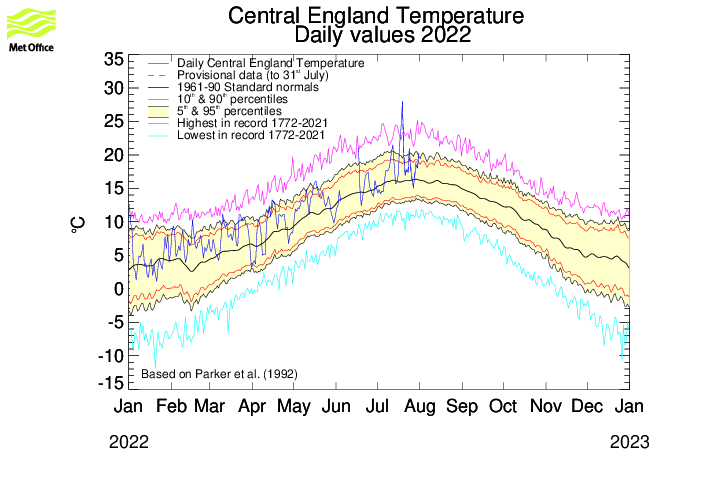
John: “The CET is currently showing that, to date, 2014 is the warmest year on record”
Well it’s mid August, most of the cold part of the year is still missing , quite what they are showing as 2014 seems undocumented.
The coldest months are January and February but that’s irrelevant. The comparison I made is with the Jan-July period of previous years. See here
http://www.metoffice.gov.uk/hadobs/hadcet/cet_info_mean.html
Every month in 2014 has been 1 to 2 degrees above the 1961-90 mean.
vukcevic says:
August 13, 2014 at 11:40 am
“The evidence is in the data all the way back to 1700, and the NASA says there is the observational evidence as shown in their video presentation”
_________________________
You have embedded a video which shows the Solar wind’s interaction with the Earth’s magnetosphere is influenced by gravitational effects of a mysterious Planet X.
Did I get that right?
John Finn says:
August 13, 2014 at 12:34 pm
The Met’s books are cooked, but even so, every month in 2014 has been lower than many years during the Medieval Warm Period, let alone the even warmer Roman & Minoan Warm Periods & the long Holocene Climatic Optimum. The majority of years during the Holocene have been warmer than 2014, to say nothing of the Eemian & MIS 11 interglacials.
Vuk’ : “Greg Goodman says: there’s a rather big “oops” behind all this !”
No, Greg Goodman says: “I get the impression there’s a rather big “oops” behind all this, that you’re trying to avoid admitting.”
Greg Goodman says: “A very strong 9.1y peak in some magnetic data would certainly be worth investigation.”
But yet again, again, you evade saying what the actual data you call “geo-solar cycle” actually is and refuse to provide a source for whatever it is you are plotting.
I have no idea what your game is, or why you keep popping up these plots of meaningless, unreferenced squiggles in the pretence that it shows something.
There is no logical reason in a scientific discussion that you would so pointedly and repeatedly avoid saying what it is you are plotting. It makes the whole thing without any merit or value.
Unattributed squiggles are of ZERO interest.
Looks like Leif is not far off the mark calling your stuff garbage.
Ulric says
The totals for each century are nothing like equal.
Henry says
from my own particular results, I have only been able to identify the Gleissberg cycle & I know where we are in that cycle. I think I can even estimate how much the variation in earth’s global temp. is within that cycle.
But there is also the DeVries/Suess cycle and perhaps even others
http://www.nonlin-processes-geophys.net/17/585/2010/npg-17-585-2010.html
I have no idea where we are within that cycle, let alone the others
but I think you can figure it out from the planets……
Makes you wonder, does it not: what if something happens to one of our planets?
Ulric: We’d be dead would we not?
John Finn. : The coldest months are January and February but that’s irrelevant. The comparison I made is with the Jan-July period of previous years. See here
http://www.metoffice.gov.uk/hadobs/hadcet/cet_info_mean.html
Every month in 2014 has been 1 to 2 degrees above the 1961-90 mean.
===
No, the comparison you made was “the warmest year on record”
Have the last 6 months of CET been “the warmest on record”. No.
@John Finn
Here you are again
I told you, I fixed that problem. There is no AGW. None whatsoever.
My bet is that AGW will go down in history as a scientific erroneous theory, just like the Phlogiston theory.
Unless you have any idea how we can add it, so that my formula for the deceleration of minimum temperatures still shows 100% correlation?
http://blogs.24.com/henryp/files/2013/02/henryspooltableNEWc.pdf
see graph at the bottom of the last table.
Leif Svalgaard says:
August 13, 2014 at 11:36 am
“R. de Haan says:
August 13, 2014 at 11:26 am
Your all time high global temperature claim is total BS of course and reflects the debunked hockey stick saga.
We just need to go back a bit more than 100 years [to stay out of hockey-stick trouble]:
http://jameswight.files.wordpress.com/2010/07/global-land-temperature-reconstructions.png
You want to quibble with the data? The data that some people say support their notion that ‘it is the Sun, Stupid’. Keep me out of that.”
Just giving you my personal opinion.
I am the last person on the world to “quibble” any data unless it has become evidently clear the data has been has rigged.
Appreciate to see you correct your own BS claim about current Global temps.
Saves me the trouble.
vuk says:
August 13, 2014 at 11:40 am
I said: produce a link to papers from the Themis project that contradicts my earlier findings.
You didn’t do that and you “don’t bother with papers”. I say ‘put up or shut up’.
You still didn’t do this and keep waffling about irrelevant [and dumbed down presentations].
Try again.
Ulric Lyons says:
August 13, 2014 at 11:56 am
“Solar activity has been about equally high in each of the last three centuries.”
The totals for each century are nothing like equal.
We only have ‘good’ sunspot data since 1759, but we can calculate the means of each half-century since then [using the revised sunspot count]. And we can calculate the spread of those means. The result is 56+/-10, that is how small the variation is. Graphically it looks like this
http://www.leif.org/research/New-Group-Numbers.png
Alan: You have embedded a video which shows the Solar wind’s interaction with the Earth’s magnetosphere is influenced by gravitational effects of a mysterious Planet X.
Did I get that right?
====
That seems to be copy of some NASA video with some planet X crap text stuck on the screen which has no bearing to the sound track. Not sure why Vuk linked that unless he’s really losing his grip.
Greg Goodman says:
August 13, 2014 at 12:57 pm
……………
Re: video
If you listen to second part narrative, all the way to the last sentence, ignoring the NASA’s promotional text, you would find out more about the context of Dr. S’s and mine disagreement.
If you are interested to see what “NASA video with some planet X crap text”, here is link to Science at NASA
http://science.nasa.gov/science-news/science-at-nasa/2008/16dec_giantbreach/
Re: GSO
I spent months of research, collecting data, emailing institutions, and worked out calculations and now you demand to be served over to you on a plate.
In 2012 I wrote a paper, which has been accepted by an important European scientific institution, copy was sent to an independent scientist, university climate professor, who number of times appeared in front of US Senate climate panel. Response was absolutely positive, only remark was that it would benefit from condensing and have a wider number of references.
Dr. S calls garbage anything he doesn’t like, but he has an advantage over you here, since he knows exactly what and how I have calculated, but then as Chinese say: the rich man’s garbage is the beggar’s treasure.
Now if you consider yourself in Dr. Svalgaard’s class and join the good doctor in attaching ‘the garbage’ attribute to whatever I write, you are not only entitled but also welcome to do it, but do not demand what you are not entitled to
Good day to you, sir.
I think the graph I showed gets my point across: solar activity now and a century ago were comparable, but the temperatures were not
That gets my point across which was solar activity has been quite active and the temperatures have responded in an upward trend.
In addition if one looks at the graph one will see in the two solar lulls the Dalton and the 1890-1910 period global temperatures were down not up..
p.s. here is link to ScienceNASA’s sound only
http://science.nasa.gov/media/medialibrary/2008/12/16/16dec_giantbreach_resources/story.m3u
“We only have ‘good’ sunspot data since 1759, but we can calculate the means of each half-century since then [using the revised sunspot count]. And we can calculate the spread of those means. The result is 56+/-10, that is how small the variation is.”
Not that the difference between 46 and 66 is small, but we were talking centuries earlier and not half centuries. The 19th century total is clearly much lower than the 20th century total.
From Ulric Lyons on August 13, 2014 at 9:45 am:
kadaka (KD Knoebel) says:
“Why did the little yellow Tweety bird lose a Twitter war with Sylvester the cat?”
No not all, I don’t like using twitter.
You cut off the punchline. Philistine.
Cherry picking that start point doesn’t prove anything about the trend up to 1995, why not start earlier in the 1970’s: http://snag.gy/gSIaw.jpg
Because 1979 was the recognized start of the satellite-based Arctic sea ice records. It’s not cherry-picking. Duh!
You made a horrible choice for picture hosting, it never loaded in its own window. I had to resort to the powerful hacking tool favored by Edward Snowden, wget.
I’m seeing an overlain mash-up of two graphs of completely unknown provenance, while the axes are matched up I have no idea if this is extent or area and if both are the same.
Uh-oh, huckster behavior detected. You stole that from Goddard and denied him attribution. The source he lists gives the left side graph, indicating the compilation is his.
http://stevengoddard.wordpress.com/2014/02/22/understanding-the-1979-arctic-ice-cherry-pick/
The acceleration of sea ice loss is in two steps, from 1995-1998, and from 2005 onwards (albeit with a slight recent respite due to moderately more positive NAO conditions in the last ~2yrs):
More huckster behavior with a modified Rorschach test, asking us to see what you say is there. Assuming 1995-1998 was inclusive:
http://woodfortrees.org/plot/nsidc-seaice-n/from:1979/to:2013/mean:13/plot/nsidc-seaice-n/from:1979/to:2014/trend/plot/nsidc-seaice-n/from:1995/to:1999/trend/plot/nsidc-seaice-n/from:2005/to:2014/trend/plot/nsidc-seaice-n/from:2000/to:2007/trend/
Click “Raw data”. The rate of loss from 2000 up to 2007 was greater than those two periods. And as your chosen regions are straddling peaks, indicating deceleration followed by acceleration for as much as such short periods can show, your choice of periods is quite mystifying.
milodonharlani says:
August 13, 2014 at 12:44 pm
John Finn says:
August 13, 2014 at 12:34 pm
The Met’s books are cooked,
Rubbish. You have no evidence for your accusation. I have compared the CET record with other station records and there is nothing to suggest the CET data is rigged.
but even so, every month in 2014 has been lower than many years during the Medieval Warm Period,
Again Rubbish. The MWP “temperatures” are based on proxies which are no more reliable than any other proxy. Craig Loehle, Ljungqvist (2010) and Moberg (2005)have all produced reconstructions which show a warmer MWP but the timing of the MWP (according to them) is totally different to the Lamb MWP. They can’t all be right. Also Lamb waffles on about wine production in England during the MWP which supposedly declined after the “MWP”. This was not true. At the beginning of the 16th century (reign of Henry VIII) there were 3 times as many vineyards as there were in the 11th century.
let alone the even warmer Roman & Minoan Warm Periods & the long Holocene Climatic Optimum.
Even less reliable evidence for the Roman warm period. There were good reasons for the Holocene warm period.
Ulric Lyons says:
August 13, 2014 at 11:56 am
“Solar activity has been about equally high in each of the last three centuries.”
The totals for each century are nothing like equal.
Here are the Group Number Record since 1749 http://www.leif.org/research/New-Group-Numbers-21-yr-Means.png
“R. de Haan says:
August 13, 2014 at 11:26 am
Appreciate to see you correct your own BS claim about current Global temps.
Here is the temperature record since 1753 http://www.leif.org/research/BEST-Temperature-Anomaly.png
Nice to know which doctrine you really support.
The above two graphs are what I support.
Ulric Lyons says:
August 13, 2014 at 2:11 pm
The 19th century total is clearly much lower than the 20th century total.
http://www.leif.org/research/New-Group-Numbers-21-yr-Means.png
Why cherry pick precisely a century?



In a recent paper “The Centennial Gleissberg Cycle and its Association with Extended Minima”, to be soon published in JGR/Space, Feynman and Ruzmaikin discuss how the recent extended minimum of solar and geomagnetic variability (XSM) mirrors the XSMs in the 19th and 20th centuries: 1810–1830 and 1900–1910.
Edited abstract:
Such extended minima also were evident in aurorae reported from 450 AD to 1450 AD. The paper argues that these minima are consistent with minima of the Centennial Gleissberg Cycles (CGC), a 90–100 year variation observed on the Sun, in the solar wind, at the Earth and throughout the Heliosphere. The occurrence of the recent XSM is consistent with the existence of the CGC as a quasi-periodic variation of the solar dynamo. Evidence of CGC’s is provided by the multi-century sunspot record, by the almost 150-year record of indexes of geomagnetic activity (1868-present), by 1,000 years of observations of aurorae (from 450 to 1450 AD) and millennial records of radionuclides in ice cores.
The “aa” index of geomagnetic activity carries information about the two components of the solar magnetic field (toroidal and poloidal), one driven by flares and CMEs (related to the toroidal field), the other driven by co-rotating interaction regions in the solar wind (related to the poloidal field). These two components systematically vary in their intensity and relative phase giving us information about centennial changes of the sources of solar dynamo during the recent CGC over the last century. The dipole and quadrupole modes of the solar magnetic field changed in relative amplitude and phase; the quadrupole mode became more important as the XSM was approached. Some implications for the solar dynamo theory are discussed.
* Says The Hockey Schtick: If it is true that the current lull in solar activity is “consistent with minima of the Centennial Gleissberg Cycles,” and the Gleissberg Cycle is a real solar cycle, the current Gleissberg minimum could last a few decades before solar activity begins to rise again.
* Solar physicist Habibullo Abdussamatov predicts the current lull in solar activity will continue until about the middle of the 21st century and lead to a new Little Ice Age within the next 30 years.