Allan MacRae says: Thanks to Alberta Jacobs
2
1
vote
Article Rating
Vuk says @ur momisugly 1:50pm August 13, ’14
“Re: video
If you listen to second part narrative, all the way to the last sentence, ignoring the NASA’s promotional text, you would find out more about the context of Dr. S’s and mine disagreement.
If you are interested to see what “NASA video with some planet X crap text”, here is link to Science at NASA…”
_______________________
Good grief!
If the best you could muster was a video to support your claims, couldn’t you at least, have found something without all the Planet X looney- bin bait?
————————————
In other news: Finn is a troll and has appeared in these pages, before. He has never displayed anything but classic troll behavior. Any response to him is wasted effort. He will never play it straight.
John Finn says:
August 13, 2014 at 4:12 pm
Strange that you don’t recall the UHI links posted on this blog, since you replied to them. How hard would it have been for you to find them? But because you’re so helpless, I’ll help you:
Even Dr. Phil has been forced to acknowledge problems, post-Climategate. Somehow you didn’t get the memo:
http://wattsupwiththat.com/2013/04/16/revisiting-temperature-reconstructions-used-in-climate-change-modeling/
http://www.warwickhughes.com/climate/uk.htm
Re. Armagh:
http://wattsupwiththat.com/2010/08/26/uhi-study-of-the-uk-armagh-observatory/
You make people foolish enough to respond to your ranting drivel do the same work over & over again, pretending you didn’t see prior replies, classic trollish behavior.
Clearly Alan has you pegged.
Ignore henceforward.
kadaka said
“Your middle yellow highlighter line actually goes to 2005.”
By about a month, so what, I made it clear that the period that I was referring to was 1995-2004.
“And now I’m wondering how you are drawing flat lines through what is clearly not flat. Moreover, why go 1995 to 2004 inclusive, when clearly that section of ice loss extends to 2007 inclusive?
Because with the data series that I am using, there is no real difference between 1995 and 2004:
http://snag.gy/3mgZy.jpg
From Ulric Lyons on August 13, 2014 at 6:34 pm:
Because with the data series that I am using, there is no real difference between 1995 and 2004:
Wait, we have a varying time series, different trends and curves, and you’re picking endpoints that just happen to have about the same value? Are you nucking futs?
http://woodfortrees.org/plot/nsidc-seaice-n/from:1979/to:2014/compress:12/plot/nsidc-seaice-n/from:1981/to:1995/trend/plot/nsidc-seaice-n/from:1995/to:2005/trend/plot/nsidc-seaice-n/from:2006/to:2014/trend
Raw data, “compressed” to annual averages:
1995 11.5667E6 km^2, 2004 11.3475E6 km^2, difference 0.219200E6 km^2.
2002 11.5692E6 km^2, only -0.0025E6 km^2 difference from 1995.
1995 is two whole orders of magnitude closer to 2002 than it is 2004. Why wasn’t 2002 chosen instead?
Of course back at the Cryosphere Today home page it is clear you are using an area chart, which is using data from NSIDC, while I am using the more-common extent data, which is also coming from NSIDC.
You really should make note you have selected the less-common data that people might not be aware even exists, as extent is the default standard when talking about sea ice.
When you don’t note it as such, people might think you are being deceptive.
vukcevic says:
August 13, 2014 at 3:53 pm
Although it is none of my business to question either your judgment or your memory, it appears that at least the memory is failing you.
Nonsense, my memory is very good on this. All your antics are just unsuccessful attempts to save some face. I say again: everything you ever ‘produced’ is and has always been garbage.
If all your ‘data’ and ‘methods’ have been available for years show it again [for Greg]. Your references to un-named persons and un-named institution and un-named journal are pathetic. If you got something, show it.
Ulric:
KDK:
“And now I’m wondering how you are drawing flat lines through what is clearly not flat. Moreover, why go 1995 to 2004 inclusive, when clearly that section of ice loss extends to 2007 inclusive?
Because with the data series that I am using, there is no real difference between 1995 and 2004:
http://snag.gy/3mgZy.jpg
====
So you still don’t explain how you drew those lines. It is so obvious that I did not even bother commenting before. They are freehand lines, drawn to fit your perception of steps. They have no objective value and do not substantiate your erroneous handwaving account of “acceleration”.
Here is a fully documented method looking at decadl variability in Arctic sea ice:
http://climategrog.wordpress.com/2013/09/16/on-identifying-inter-decadal-variation-in-nh-sea-ice/
The main areal acceleration was from 1997 to 2007. It has slowed since.
However, there is a fairly close connection between AO and the length of the Arctic melting and freezing seasons, so you are correct to point it out. You may need more that thick yellow pen to establish it though.
Note post 2007 drop in AO matches the shortening melting season and the deceleration in ice losss that I noted above.
1989 seems to be the most significant event in the satellite record. What was that about , goemagnetic activity ??
Alan Robertson says:
August 13, 2014 at 5:51 pm
Good grief! ….
……….
Hi Mr. Robertson
I had video link on my PC for some time ago. In the original, there was no screen text, since I listened to it on number of past occasions, I reviewed only the first few 2-3 min in order to check that it is correct link. As soon as Greg drew my attention to it, I provided link for NASA’s article and audio link only.
My impression was that for occasions when the science isn’t presented in an exact and rigorous manner, many may prefer to listen to a narrative than make effort to read a long text, but it appears I was wrong.
Lesson learned. My apologies to you and everyone concerned.
vukcevic says:
August 13, 2014 at 4:07 pm
Leif Svalgaard says: August 13, 2014 at 3:27 pm
“and you are concerned that somebody will steal your brilliant discoveries and deprive you of the serious income you feel must flow from those”
Missed that bit.
Wrong again, everything has been available with a free access to anyone for about two years now.
I did earn living for number of decades with a world wide known, privately owned company, where nonsense was not tolerated, and now and in foreseeable future have no reason to either solicit, look for or work to earn income.
====
“Everything ” except the data , the calculations and what it is you are plotting? Or is it hidden in plain view?
I have 50,000 euros freely available to anyone. I’m just not saying where it is. LOL
“Wrong. Not Russian journal, but a French science institution.”
Oh, so you are not even getting it published, it has just been “accepted” by some yet again undisclosed “institution”.
And what good is that? If you have something with any significance, stop dancing around and tell us where the “free access to anyone ” is, so we can be done with this CO2 fallacy before it’s too late.
So far you are encapsulating the very worst of the secretive, defensive and obstructive attitudes to science that this site and others has been battling for years.
{MODS} If you want to put all links to vuk’s site on moderation, please block that and not his name. Every time I quote him, I have to remember to change his name.
vuk says:
August 13, 2014 at 4:07 pm
Leif Svalgaard says: August 13, 2014 at 3:27 pm
“and you are concerned that somebody will steal your brilliant discoveries and deprive you of the serious income you feel must flow from those”
Missed that bit.
Wrong again, everything has been available with a free access to anyone for about two years now.
I did earn living for number of decades with a world wide known, privately owned company, where nonsense was not tolerated, and now and in foreseeable future have no reason to either solicit, look for or work to earn income.
====
“Everything ” except the data , the calculations and what it is you are plotting? Or is it hidden in plain view?
I have 50,000 euros freely available to anyone. I’m just not saying where it is. LOL
“Wrong. Not Russian journal, but a French science institution.”
Oh, so you are not even getting it published, it has just been “accepted” by some yet again undisclosed “institution”.
And what good is that? If you have something with any significance, stop dancing around and tell us where the “free access to anyone ” is, so we can be done with this CO2 fallacy before it’s too late.
So far you are encapsulating the very worst of the secretive, defensive and obstructive attitudes to science that this site and others has been battling for years.
KDK “You really should make note you have selected the less-common data that people might not be aware even exists, as extent is the default standard when talking about sea ice.”
There is no “default standard when talking about sea ice” you are making that up. There are two measures, both of which are featured on the sea ice page here on WUWT. You are correct it is good practice to be clear about what data is being referred to.
In estimating the length of the Arctic melting season I used the CT ice area data, which is less noisy than ice extent, which is highly dependent on weather conditions.
This does show strong similarities to AO, and is more objective than Ulirics rather vague claims and hand draw “steps”.
http://climategrog.wordpress.com/?attachment_id=226
Greg Goodman
The growth of ice in the Arctic this year will be bigger than we think.
http://arctic.atmos.uiuc.edu/cryosphere/arctic.sea.ice.interactive.html
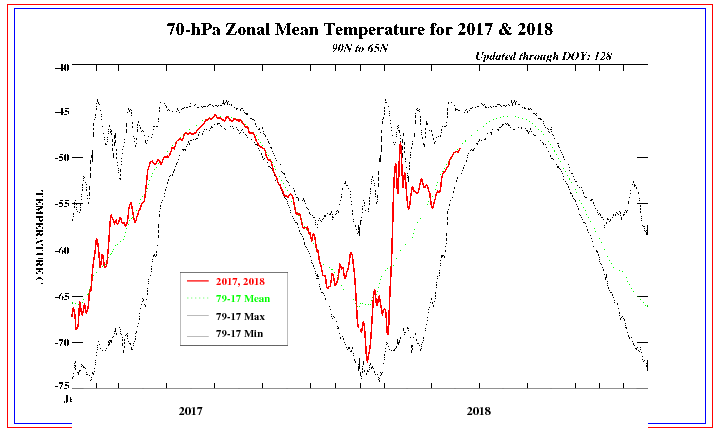
http://www.cpc.ncep.noaa.gov/products/stratosphere/temperature/70mb9065.gif
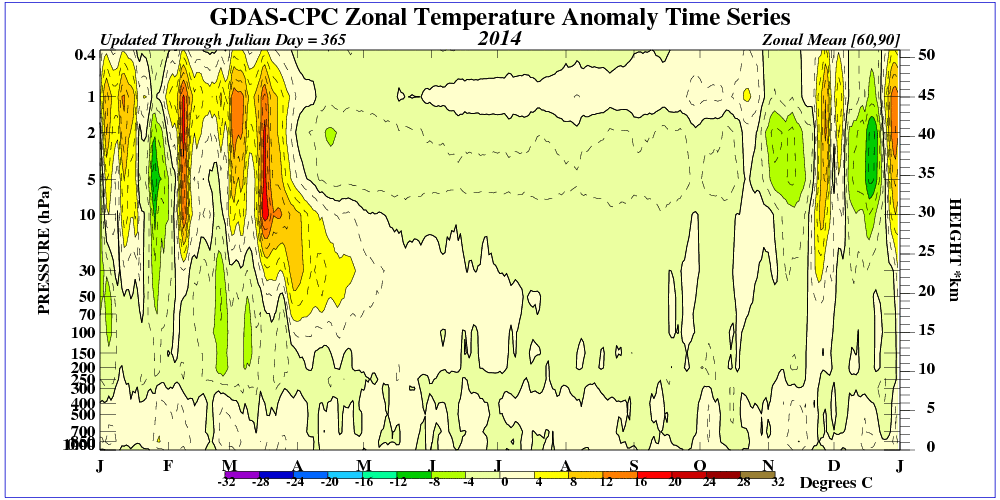
As you can see the temperature in the stratosphere over the northern polar circle below the normal.
http://www.cpc.ncep.noaa.gov/products/stratosphere/strat-trop/gif_files/time_pres_TEMP_ANOM_ALL_NH_2014.gif
john finn said;
‘Tony
I will read this but not on a laptop. I’m going to print it. Do you have a PDF/Word version?’
No there isn’t a pdf. I had intended to produce the next extension as a pdf and convert this one at the same time, but I hadn’t expected there would be three years between the two!
There will be a couple of addendums when I do, as I found additional evidence for the two warm periods that I hadn’t expected and said I would need to investigate further.
tonyb
985 AD
Erik returned to Eriksfiord and named the land Greenland. Twelve chieftains are established,
widely spaced up different fjords. In the autumn one final ship arrived, Herjolf and he
established a prime trading port not far north of cape Farewell. In late summer Bjarni
Herjolfsson sailed for Greenland to meet up with his father Herjolf. A storm drove him off
course to Newfoundland. The land is heavily forested with no ice-covered mountains, therefore
it was definitely not Greenland. Bjarni reckoned he was 800 nautical miles south west of
Greenland. Bjarni sailed north and recorded no signs of human habitation. Bjarni cleared cape
St. Francis and encountered Labrador. The next land sighting was Kaumajet peninsula of
northern Labrador. They then sailed due east for Greenland.
milodonharlani says:
August 13, 2014 at 6:09 pm
John Finn says:
August 13, 2014 at 4:12 pm
Strange that you don’t recall the UHI links posted on this blog, since you replied to them. How hard would it have been for you to find them? But because you’re so helpless, I’ll help you:
http://www.warwickhughes.com/climate/uk.htm
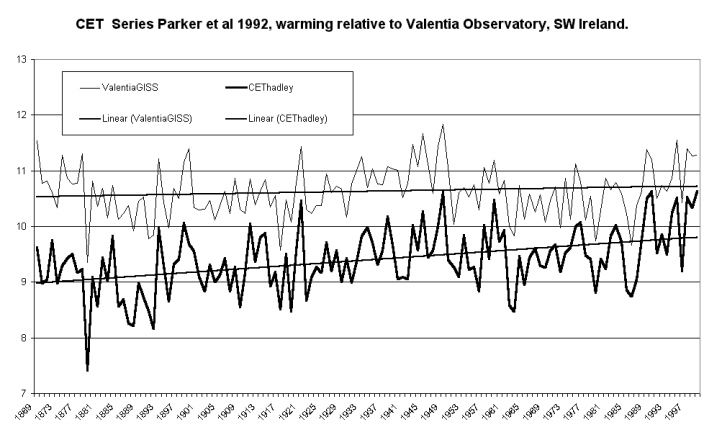
Before we start let’s establish one thing. Warwick Hughes knowledge of the geography of UK and Ireland is a bit suspect. There is no reason to think that Valentia and CET would have identical or even very similar temperature trends. Nevertheless I did check and compare the data for both locations.
The respective trends for the 20th century (1900-2000) are as follows:
Valentia 0.66 degrees per century
CET 0.65 degrees per century
I hope someone will check these for me – I may have made a mistake. Warwick Hughes does appear to get a bigger difference between the two as he shows here:
http://www.warwickhughes.com/climate/cetval.gif
But I think this is more to do with a relatively cooler period in the late 19th century in the CET record. If we extend the analysis back to 1880 (start of the Valentia record) then the trends (1880-2000) are as follows:
Valentia 0.6 degrees per century
CET 0.7 degrees per century
But that, I believe, is a result of differing weather patterns at the 2 locations. I can see no evidence for UHI. I doubt there is a statistically significant difference between the trends over any reasonable time period.
Re. Armagh:
http://wattsupwiththat.com/2010/08/26/uhi-study-of-the-uk-armagh-observatory/
Read the link. Particularly the conclusion which states
However, recent research into the historical temperature records and comparisons with present day data from rural weather stations indicate that any temperature differences which existed between the Observatory site and the countryside 20-30 years ago have not increased over the intervening years. This is contrary to the situation which would be expected if urban development were to influence air temperatures at the Observatory, since much of the growth of Armagh has taken place since the 1960s and still continues .
You really do need to read these things properly. There was a difference – but there has always been a difference. Local stations read higher or lower for a number of reasons which are entirely natural. ‘Nearby’ urban development at Armagh hasn’t changed a thing.
Clearly Alan has you pegged.
I’m sure Michael Mann thought he had me pegged [as a troll] too.
John Finn
Just in case you hadn’t noticed, as it is a little tucked away, there is a separate section providing research details linked to through my article. This part is a pdf. It is here;
http://curryja.files.wordpress.com/2011/12/long-slow-thaw-supplementary-information.pdf
tonyb
@kadaka
Area is the same as extent. This thread was about a Gleissberg Minimum until you hijacked it to air what you thought was dirty washing in my twitter account. Though I still stand by that tweet, “Arctic sea ice loss is due to negative NAO”, which is the opposite of a forced warming signal. as increased forcing of the climate increases positive NAO/AO conditions.
@Greg Goodman
I think that the correlation is better with the NAO than the AO, and really it needs inspection at at least seasonal scales as well to verify the connection, rather than just the trends, e.g., less summer ice extent when the NAO is more negative in those particular months, as in say 2007 and 2012.
milodonharlani says:
August 13, 2014 at 6:09 pm
In addition to my earlier response, I intended to quote more from the Conclusions such as
In addition, the fact that there has been no urban encroachment into the Observatory grounds and that the grounds have not been separated from the adjacent farmland by any development suggests that the Observatory weather station lies outside the urban climatic boundary.
It is concluded that temperature observations made at Armagh Observatory have been unaffected by rapid urbanisation over the past three decades.
So that’s no urban encroachment into the Observatory grounds and that the grounds have not been separated from the adjacent farmland by any development . In other words the Observatory is pretty much as it was 200 years ago, i.e. exactly what I said in a previous post.
Oh, and by the way, the 20th century (1900-2000) trend for Armagh is 0.69 degrees per decade.
So let’s just recap what we’ve learned so far shall we. The 1900-2000 trends for Armagh, Valentia and CET are as follows.
Armagh 0.69 degrees per century
Valentia 0.66 degrees per century
CET 0.65 degrees per century
John Finn says
So let’s just recap what we’ve learned so far shall we. The 1900-2000 trends for Armagh, Valentia and CET are as follows.
Armagh 0.69 degrees per century
Valentia 0.66 degrees per century
CET 0.65 degrees per century
Henry says
John, I am sure I have told you before that one has to be careful with data from before we started with thermo-couples and automatic recording. In fact, I do remember to challenging you to bring me even one certificate of a re-calibration done on a thermometer before 1945. You have not shown me anything on that request. To tell you the truth, the earliest date I found was 1948.
Remember that Means is an average for the day, and it makes a big difference if you observe 4 times per day by a human or every second of the day by a machine (as is done now)
So, I think you are on a wrong track here. You are comparing apples with pears and it does not work that way.
For Armagh, I found a value of +0.024K per annum since 1965, which compares well with that found in my tables
http://blogs.24.com/henryp/files/2013/02/henryspooltableNEWc.pdf
of 0,0234 for the whole of the NH from 1974.
That is 2.3K/century, which increase actually was what people were getting worried about AGW.
However, we are globally cooling now, at a rate of -0.015K per annum, on Means from 2000. As I said before: in nature it is either warming or cooling. There is no “pause”. That was just an idea from someone to keep the money (of the AGW scare) rolling into his pocket. 1995 was the middle of Gleissberg, as we can see further on in each of my 3 tables,Measure the increase from 1960 to 2000 and you will know you by how much we are cooling from 2000-2040.
I am not going to do it for you. The guys who frequent here are clever enough to figure it out for themselves.
vuk says:
August 14, 2014 at 1:46 am
985 AD
Yet another attempt to deflect attention form the core issue. You claimed that the latest research by the Themis team contradicts my earlier findings. I asked you to provide links to their papers showing the contradictions. You keep evading doing so. So again: produce the links.
My musings.
The new darling of the day for solar enthusiasts is the Gleissberg Cycle doncha know. They are all scrambling to find a match maker match maker find me a match find me a match. And they will box car it for sure. Exactly 100 years.
Leif, the temperature data set you refer to is yet another reconstruction replete with observation errors, something you understand well. All long term temperature sensor data sets (not proxy data) is “plagued with plot problems”, to alliterate the point. Take the example of agriculture seed plot experiments for a new grass seed. Start the experiment with a few scattered potted plots in various parts of the planet without regard to geologic location. Begin to take data on plant cycles. Don’t bother with geophysical features of the area the plots are in. Just take plant cycle data and don’t be too worried about when you take data. As the experiment progresses, add more plots here and there on the globe, and occasionally move the plots around locally. Then decide to get rid of a view plots without regard to geologic location. Finally, try and splice/adjust/smear data at the end of this wholly uncontrolled experiment, call the grass seed good for all climates, and put it on the market. I am here to tell you, a country gal who knows a bit about this, no company no matter how rich, would put that seed on the market and the researchers would be dismissed. Given the care you gave to correcting the SSN data sets, I wish we had someone like you who understands that temperature sensor historical data sets have issues similar to your field of work. Is BEST the best? So thought your colleagues with regard to the previous group number.
Pamela Gray says:
August 14, 2014 at 7:04 am
Leif, the temperature data set you refer to is yet another reconstruction replete with observation errors, something you understand well.
I’m willing to use another temperature reconstruction. Just tell me which one is good. If none are, then no claim can be made that ‘it is the Sun’ or anything else, because we don’t know what to compare with. So, tell me which one to use.
@Ulric
I thought your last reaction to me was rather impolite.
Ask yourself this question: If today were the last day of your life, would you have reacted differently than you did? I suspect that if everybody lived as if today were the last day of their life, a lot less time would be spend on silly strife and a whole lot more on love…
e.g. on how to provide food for 7 billion people and counting, in the face of the global cooling period that is coming.


In a recent paper “The Centennial Gleissberg Cycle and its Association with Extended Minima”, to be soon published in JGR/Space, Feynman and Ruzmaikin discuss how the recent extended minimum of solar and geomagnetic variability (XSM) mirrors the XSMs in the 19th and 20th centuries: 1810–1830 and 1900–1910.
Edited abstract:
Such extended minima also were evident in aurorae reported from 450 AD to 1450 AD. The paper argues that these minima are consistent with minima of the Centennial Gleissberg Cycles (CGC), a 90–100 year variation observed on the Sun, in the solar wind, at the Earth and throughout the Heliosphere. The occurrence of the recent XSM is consistent with the existence of the CGC as a quasi-periodic variation of the solar dynamo. Evidence of CGC’s is provided by the multi-century sunspot record, by the almost 150-year record of indexes of geomagnetic activity (1868-present), by 1,000 years of observations of aurorae (from 450 to 1450 AD) and millennial records of radionuclides in ice cores.
The “aa” index of geomagnetic activity carries information about the two components of the solar magnetic field (toroidal and poloidal), one driven by flares and CMEs (related to the toroidal field), the other driven by co-rotating interaction regions in the solar wind (related to the poloidal field). These two components systematically vary in their intensity and relative phase giving us information about centennial changes of the sources of solar dynamo during the recent CGC over the last century. The dipole and quadrupole modes of the solar magnetic field changed in relative amplitude and phase; the quadrupole mode became more important as the XSM was approached. Some implications for the solar dynamo theory are discussed.
* Says The Hockey Schtick: If it is true that the current lull in solar activity is “consistent with minima of the Centennial Gleissberg Cycles,” and the Gleissberg Cycle is a real solar cycle, the current Gleissberg minimum could last a few decades before solar activity begins to rise again.
* Solar physicist Habibullo Abdussamatov predicts the current lull in solar activity will continue until about the middle of the 21st century and lead to a new Little Ice Age within the next 30 years.