Guest Post by Willis Eschenbach
Recently there have been a number of accusations and bad blood involving myself, David Evans, Joanne Nova, Lord Christopher Monckton, and Leif Svalgaard. Now, I cannot speak for any of them, but on my part, my own blood ended up mightily angrified, and I fear I waxed wroth.
However, I see no point in rehashing the past. What I want to do is to return to the underlying scientific questions. In that spirit, I apologize sincerely and completely for wherever I put in “something extra” in the previous discussion. In Buddhism, there’s a concept called “something extra”, and one is enjoined to avoid putting in “something extra”.
It is explained in the following way:
If I say “I am angry” that is simply a true statement.
But if I say “You made me angry”, that is something extra.
So I ask any and all of you to please accept my sincere apologies for whatever what I said that was something extra, so that we can move past this difficult time and get back to discussing the science. Both sides have legitimate grievances, and I am happy to make the first move to get past all of them by apologizing to all of you for whatever my part was in the bad blood. I hope that the other participants accept my apology in the spirit of reconciliation in which it is offered, and that we can move forwards without rancor or recriminations.
Regarding the science, let me go back to the original question, and see what I can do in the way of making my claims in a more Canadian manner. I’ll start by looking at the recent record of the “TSI”, the total solar irradiance:
 Figure 1. Monthly total solar irradiance as measured by the CERES satellite. Vertical blue line shows mid-2004.
Now, if you don’t like the data from the CERES satellite, here’s the SORCE satellite data:
 Figure 2. Daily total solar irradiance as measured by the SORCE satellite. Vertical red line indicates mid-2004. SOURCE
Note what is happening in both graphs after mid-2004 (vertical lines in both plots). As in every solar cycle, the TSI declines somewhat, and bottoms out. Then, it starts to rise again. And by the end of the datasets, in both cases the TSI is higher that it was in 2004.
So what was the scientific dispute all about, the discussion that underlies all of the bad feelings?
It revolved around the following graph from David Evans, referenced by both Leif Svalgaard and Lord Monckton, showing the basis of his predicted upcoming global cooling :
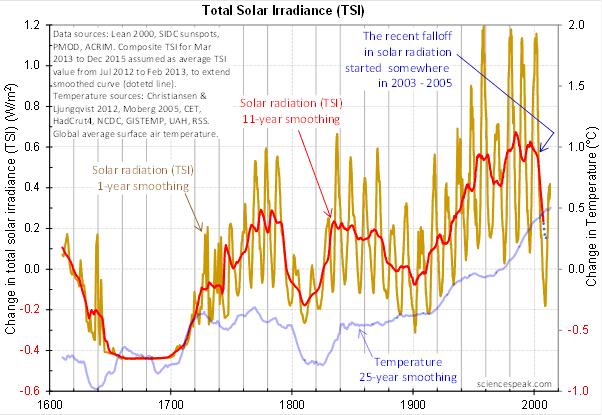
 Figure 3. David Evan’s graph of TSI (gold line), along with a centered 11-year moving average of the TSI data (red, with dotted blue extension), and a 25 year unspecified smooth of temperature, presumably a trailing average (blue line). (Click to enlarge)
Now, as you can see, the bright red line basically falls off the edge of the earth around 2004. The note says “The recent falloff in solar radiation started somewhere in 2003-2005″.
However, a look at both the SORCE and the CERES data shows no such “falloff in solar radiation”, neither precipitous nor otherwise. In fact, both datasets agree that by 2013 the TSI was well above the level in mid-2004.
Since there is no fall in the underlying data of any kind, why does the red 11-year average line show abrupt cooling starting around 2004?
The answer lies in the various problems with the graph.
• The TSI data is a splice of three datasets, with two of them showing the post-2000 period. This is a huge source of potential error in itself. However, it gets worse.
• One of the spliced datasets is the Lean TSI reconstruction, an outdated dataset that the authors of the reconstruction themselves admit is inaccurate.
• Another is the PMOD dataset. It is known to be reading low by 0.2 W/ms at the solar minimum, introducing a spurious apparently strong recent “cooling” where none exists.
• The 11-year centered average is an extremely bad choice for a filter for sunspot/TSI data. Because the solar cycle varies both longer and shorter than 11 years, at times the 11-year average actually reverses the sense of the data, converting peaks into valleys and valleys into peaks. Look at the period from 1760-1800 in Figure 3, for example. What is happening is that the frequency data is getting strongly aliased into the amplitude data. As a result, the average can end up far from the reality, particularly at the ends of the dataset.
For another example, look at the period just after 1740 in Figure 3. The 11-year average takes a huge vertical jump … but meanwhile back in the real word, the TSI itself is not rising at all. It is falling. Clearly, the large vertical jump in the red line is totally spurious.
• The TSI data has had about 900 days of “data” added to it using an arbitrarily chosen value. This is shown by the blue dots which indicate a continuing drop in the temperature.
So regarding the question of why the red line is acting so strangely, the answer is that we have a perfect storm of spliced data, bad data, arbitrary “data” added to the spliced bad data, and an extremely poor filter choice.
And as a result, the red line doesn’t represent reality in any shape or form. There is no precipitous drop in TSI starting around 2004. It doesn’t exist. Sure, the 11-year average says clearly that there is a huge drop starting around that time … but the actual data says something entirely different, as shown in Figures 1 and 2.
Now, in the heat of the moment Leif described the red line as being “almost fraudulent”. I think this was an over-reaction, but perhaps an understandable one. After all, if the red line were flipped over vertically it would make a lovely hockeystick, and if someone claimed warming was coming based on that hockeystick, people would call them alarmists … and calling someone an alarmist is certainly a close relative of calling them “almost fraudulent”.
However, my guideline is, never ascribe to malice what is adequately explained by error and misunderstanding. So I do not call their red line fraudulent, nor did I do so in the original discussion. Instead, I say that it is an error resulting from a misunderstanding. In any case, let me suggest that we leave out all ascription of motive and intent, that goes nowhere, and that we return to the science.
A more scientifically neutral description of the red line is that it is highly inaccurate and potentially misleading, because the apparent drop starting in 2003-2005 is simply an artifact of a combination of bad data and bad filtering.
Finally, to the degree that David Evans’ model predicts future cooling based on the red line, it is already falsified.
That is what I was trying to say, and I believe (subject to correction) that was what Leif was pointing out as well.
In closing, I will endeavor in this thread to keep my comments on as scientific a basis as possible, to avoid any personal references, and to not ascribe motive or intent. I request that everyone do the same. Many toes have already been stepped on in this discussion. Let’s see if we can simply discuss the science.
My best to all,
w.
VERY IMPORTANT: It is important in general, and in this discussion in particular, that you QUOTE THE EXACT WORDS THAT YOU DISAGREE WITH. Note that this doesn’t mean just referencing their entire comment. Quote the exact words of their comment that you think are in error, and tell us why you think those words are wrong. If you do not quote the exact words that you disagree with, none of us will know what you are referring to … and out of such misunderstandings grows animosity and misunderstanding.
Finally, please don’t delve into the rights and wrongs of what has happened in the previous discussions. I am not interested in the slightest in ascribing blame or responsibility. I have accepted my own responsibility for my own actions and apologized for wherever I was over the line. What I or the others did in the past is a blind alley, so please confine your comments to the science, and as the saying goes, “Let the dead past bury its dead”.
Willis,
“Many toes have already been stepped on in this discussion.”
I rarely contribute, but in this I feel compelled. I think Jo and David were very clear in their hypothesis and its parameters. Whether it explains a natural occurrence or not, it is a fascinating observation that I agree is worthy of debate and deeper analysis.
I appreciate your efforts to debate and analyze (and I generally enjoy your posts – though I think you are often unfair with critical commenters), but it seems to me you made a mistake in your interpretation of their data and assumptions. It also seems clear to me that you are deliberately turning that error into the central theme of your argument against the stated hypothesis. Your apology, and the obfuscation that follows, is both confounding and disappointing. Apologies to Jeff Id, above, but I do not think you are acting like “the adult in the room.” If you were my son acting thus, I would advise you to apologize directly for all of this:
Eschenbach 1: “I begged David Evans, begged him please, please, to release the hidden code, to stop keeping the model equation a secret, to reveal the data, to expose the numbers of tunable parameters, to show the results of the out-of-sample tests that Jo says he’s already done …”
Eschenbach 2:“I begged Jo and David to publish, and I got the same answer we’ve gotten from every other pseudo-scientist, that for me to ask was wrong, wrong, wrong, and that they’d publish the code and data and out-of-sample tests when they damn well felt like it … science at its finest.”
Eschenbach 3: “…and admit that (at least according to their graph) they have made a wildly incorrect claim that the TSI has fallen precipitously since about 2004. It is on the basis of this supposed fall that they are predicting falling temperatures.”
Eschenbach 4: “But neither of us owe David Evans an apology. He’s the one that made the horrendous newbie mistake, not us.”
Eschenbach 5: “That quote from the graph itself clearly says that they have invented the data from March of 2013 to December of 2015, which is the 900 days of data that Leif mentions. Now, I’ve used the word “invented” for that data. The graph itself uses the word “assumed” for that data. And Leif used the word “fabricated” for that data.”
Eschenbach 6: “Next, David Evans has not released the data, the model, the model results, the equations, the out-of-sample tests, or any of the details. This is the same garbage we got from Michael Mann and Phil Jones. And now, here you are cluttering up WUWT with the same kind of garbage. There is no transparency. There is no data. There is no code. In what alternate universe does this pass for science?”
Eschenbach 7: “Christopher, I have a simple rule that has never failed me. When a man is hiding something, it’s because he’s got something to hide.”
Eschenbach 8: “I’m sad to see you and David Evans and Joanne taking up the habits of Mann and Jones, David. I’d thought y’all were scientists. Ah, well, live and learn.”
ask for forgiveness, and present your argument against Dr. Evans’s use of smoothing as respectfully as possible. You have not done that with this post, rather you have attempted, with impressive rigor, by the way, to rationalize and excuse your behavior. That negates the apology. (As to number 8 above, there is no excuse. For that statement alone you should be ashamed of yourself, or at the very least embarrassed.) I do not believe in moral relativism. Your behavior is wrong, Jo’s and David’s is not. Your criticism may have merit, but that does not excuse the personal attacks. Jo’s posts on this very thing – the way to debate with respect – are wonderful to read. Given how deeply she cares about the way the scientific debate is conducted, I imagine your posts and those from Dr. Svalgaard must have been particularly upsetting. You should apologize to both of them – directly and privately – if you haven’t already.
If your toes were stepped on, it is only because you placed them knowingly and willingly in front of the elephant.
I do not expect you to take this post from me, another anonymous commenter, seriously (though Anthony may pass along my email to you if you care to discuss directly or want to know my full name). My intent is not to attack you at all, but only to offer one man’s opinion of this bitter exchange. I know it can be difficult to accept our mistakes and shortcomings, but with honest self-reflection we all have the opportunity to better ourselves.
Thanks for reading, Willis. I hope you are enjoying Big Sky Country.
Chris
Skeptics are skeptical and should fight about most everything. If everyone agreed and acted like cheerleaders, then we would start to look just like those…other people.
John West says:
July 17, 2014 at 10:43 am
1) The graph linked is titled:
“Total Solar Irradiance over a Solar Cycle”
Most people would consider a solar cycle the Sun’s 11 year (or so) cycle not our annual trip around the Sun.
The graph shows a full solar cycle [12 years]. Each year is plotted separately, so there are 12 curves [on top of each other].
3) Note that Northern Hemisphere Summer is during the lower TSI values… Now consider how this effect is amplified / negated as the orbital cycle moves through Milankovitch cycles
Actually not, the difference is enormous [almost 100 W/m2] as the date where we are farthest from the Sun varies from July [now] to January [during a glaciation].
Chris4692 says July 17, 2014 at 8:45 am
Mr. Evans’ graph (Figure 3) is not a running mean, it is a centered average.
What’s the difference? It uses a weighting scheme determined by SSN peak and trough metadata (either official max/min times from an input table or derived) to suppress variable frequency edge distortion that results from using a fixed averaging window. Read the code.
Geronimo – “Above all else in life the way you interact with strangers is the most important. ” And then you go ahead with “self-serving”, “very clever” self-convinced” , you could try your own advice sometime.
Chris says:
July 17, 2014 at 10:58 am
“Eschenbach 2:“I begged Jo and David to publish, and I got the same answer we’ve gotten from every other pseudo-scientist, that for me to ask was wrong, wrong, wrong,”
Weird. Those where their exact words?
An apology like this is no apology, but an apologia. Like Winston Churchill on Gallipoli. Jo is right.
Typically I enjoy your work Willis but in this post I have a problem. Now with any running average the beginning and end will be ‘not exactly’ the truth. The reason being, as you have pointed out in the past the newest data is highly influential. This being said, that precipitate drop off is probably an artifact of ‘the end’ of the data.
Now a couple of things stand out, first your two graphs of CERES and SOURCE are approx 11-12 years long. You then compare them to a graph demonstrating 400+ years. The biggest thing here is stretching the X axis, in your chosen graphs a small change cannot possible be demonstrated when compared to a 400+ yr x Axis. I do not have half the escritorial talent that you have so what I am attempting to get at is your Y-axis or at least your chosen data sets, show a range of 6W/M^2 while the 400+ yr graph shows a 1.8 W/M^2. Huge difference here, in fact if you look at the CERES data, it shows clearly a drop in .2W/M^2 the same exact drop (visually, I have not independently run numbers) as the longer range 400yr graph. The SOURCE data shows a minor drop to possibly no drop, then again the graph is not long enough to actually catch a change, nor is the Y-axis sensitive enough to demonstrate said change.
Finally, do not apologize… We all enjoy your posts.
Brian
willis, really, using wuwt as a forum for slandering folks is just not called for.
everything good about wuwt is made a mockery.
the worst troll here, lately, is you, homie.
I have not been following this argument from its beginning and I cannot tell from the discussion here what the central points of the disagreement are or even whether the two sides agree about what they are. I only know – from what Willis has written in the article above – that although the disagreement has arisen over a purely intellectual-academic topic it has generated some angry, hostile emotions too. I think Willis has taken a courageous step in publicly owning his angry emotions and of apologising for them, which has earned him much respect in my eyes. I hope his magnanimous gesture of a willingness for reconciliation will be reciprocated by the other side in some fashion, although after reading the other side’s comments above I won’t hold my breath because they still sound pretty outraged and indignant to me. Perhaps Willis’s apology has not addressed the issue that is concerning them and therefore they remain aggrieved?
I think it would be helpful towards the settlement of this dispute if the other side could say at this stage whether they are satisfied by Willis’s apology and if not then what it is that they are still aggrieved about. Willis appears to have sought to address the issue that he thought they were aggrieved over. I think the ball is in their court now to say whether or not he has done so to their satisfaction.
Monckton of Brenchley says:
July 17, 2014 at 3:56 am
Thanks for your response, Christopher. I will let Leif respond to this part. However, given the number of charges of actual fraud against alarmist scientists that you have leveled against scientists in the past, I find it curious that you are so sensitive when your own side is accused of being “almost fraudulent” … and I find it odd that you advocate “minimum standards of courtesy in scientific discourse”. You were happy to accuse the IPCC of using a “fraudulent statistical technique” for using what you thought was an inappropriate statistical method in FAQ 3.1 but which they defended as being appropriate for the purpose. It’s OK for you to yell FRAUD! when you disagree with someone’s statistical analysis, but not for anyone else?
And while I agree that Leif’s response certainly may have been over the top, I can understand his frustration. Dr. Evans laid out a 400-year TSI reconstruction that is known to be incorrect, and showed that it moved in a very similar manner to the temperature record. For the recent part of the data he spliced two reconstructions together, both of which have known problems, and in the process created a significant totally spurious reduction in TSI that is not present in either record.
Then he used a very bad filter which exaggerated the spurious reduction, which in turn was an exaggeration of the actual reduction shown in his own data, and which created the appearance of an alarming drop in the sun’s output.
Now as I said, I ascribe all of that to ignorance and error.
But while as I also said at that time I don’t approve of Leif’s characterization, I can understand someone taking that position, because truth be told, it is very hard to believe that someone who has spent five years researching the question would not know that the Lean reconstruction is incorrect, and would not realize that an 11-year boxcar filter is inappropriate for sunspot data because the frequency information is aliased into the amplitude, and that they would not notice that they’d introduced a spurious drop in TSI due to their splicing, and that they would not know that the PMOD reconstruction has known problems … all of which worked in favor of their model. Taking all of that into account, it’s hard to believe that there is not bad intent in there somewhere.
But I believe it. I absolutely don’t think that David and Jo’s intent in that regard was bad. The power of ignorance and error, whether in my own case or in someone else’s case, continues to impress me.
And while others may not be as charitable as I am, I can see that when all of these errors act in behalf of Dr. Evans results and his model, it gets to be like the multiple adjustments of the historical temperature record that almost always seem to increase the warming … it could easily make a man wonder.
Which is why, although I disapproved of Leif’s characterization both then and now, I find it understandable.
It was not I who said that 900 days of arbitrary “data” have been added to the actual TSI data. It is clearly stated in Figure 3 by David Evans, viz:
In other words, Dr. Evans himself says that he has has picked an arbitrary (“assumed”) value and added ~ 900 days worth of imaginary data with that arbitrary value to the end of the TSI dataset. Case closed.
And if, as you say, “the blue dots … are not in any way part of the smoothing”, then why does Dr. Evans say he’s added the imaginary data “to extend the smoothed curve (dotted line)”? I’m sorry, my friend, but in this one you are demonstrably wrong … and insisting that I “desist” from stating the truth doesn’t help your cause.
The graphs that I show are the complete record available from the CERES and the SORCE satellites. I’m not clear how I’m supposed to show observational data from the time before when each satellite started operating.

The problem with the TSI data is that the satellites don’t agree with each other. Let me show you want I mean, and why I couldn’t “show in [my] own graphs the full 5.5 year period before” 2004:
You can see the problem. How to splice these separate satellite records together is the subject of much debate, and the question is still unresolved. Dr. Evans has taken the PMOD reconstruction, which as I cited above is a reconstruction with known flaws, and spliced it willy-nilly onto the end of the incorrect Lean reconstruction. In the process, he’s created a 0.3 W/m2 spurious drop that is not present in the PMOD reconstruction itself, a drop which is responsible for a large part of his putative drop in TSI … I find it odd that you so passionately defend the creation of a fictitious, spurious 0.3 W/m2 reduction of TSI when the PMOD data that they used doesn’t show such a reduction.
The fact that that drop in TSI exists in other datasets does not excuse the use of an incorrect TSI reconstruction along with a splicing method that spuriously doubles the size of the drop and a filter that exaggerates the drop. The devil is in the details, and in my response to Jo above I showed how splicing the incorrect Lean data to the PMOD data has added a spurious “cooling” of 0.3 W/m2.
The other problem with using the incorrect Lean data is that in FIgure 3, Dr. Evans shows the TSI matching up pretty well with the smoothed temperature curve … a similarity which disappears entirely when the correct TSI dataset is used. Again, I find no bad intent in this … but his choice of the Lean reconstruction with its known flaws certainly can be criticized, and with good reason.
Christopher, I hate to say it, but no, Dr. Evans has NOT “made his model and his method fully and publicly available” as you claim. As both Steven Mosher and I have pointed out, he has not yet released the code that calculates his arbitrary parameters, and without that, it is not possible to do out-of-sample testing on his model. This part of the code, what Mosher called the “sciencey bits”, is critical to the functioning of the model, and it is still being kept secret despite numerous requests for its disclosure.
This would be less of a problem (although still a problem) if they had released the results of the out-of-sample testing which according to Jo was done and finished some weeks ago at the time of the second of their eleven posts on the subject … but they’re still keeping those results secret as well.
Finally, Dr. Evans spent weeks gathering adherents to his cause, people who were already staunchly defending his model despite having never seen their data or their code. He was able to “defeat” the objections of myself and others during that time, which appears to have greatly impressed the credulous. And he did so, in your excellent turn of phrase, “sure in the knowledge that no one will be able to falsify what he refuses to make available”.
For him to do that for even one day was wrong, and for him to do it for weeks was what we expect from alarmists, but which I’d never, ever seen before from a skeptic. I’m sorry to say it, but that is exactly what we received from Dr. Mann and Dr. Jones, arguing their respective cases while refusing to reveal their code, but I never expected that kind of lack of scientific transparency from Dr. Evans.
Well, that’s part of the moral to be sure … but you’re preaching to the choir. The other part of the moral is that a scientist has the obligation to ensure that “all the details of that research have been made available” before he starts discussing the model. Dr. Evans did not do that. He publicly asked for comments on his model weeks BEFORE he released a portion (but not all) of the data and code, so you can hardly blame people for acceding to his request … and assuredly you cannot fault us for criticizing his research despite lack of code and data when he publicly called for exactly such criticism and comment.
As I said before, Christopher, I don’t want to re-hash the past. I have apologized for my part in the bad blood. No one else has done so, not Leif, not you, not Jo, not David, and that’s fine by me. I doubt greatly that I’m the only one with something to apologize for, but every man has to live up to his own standards, I don’t make the rules for anyone but myself.
However, I do not apologize for pointing out that Dr. Evans said that they’d added 900 days of arbitrary data to the end of the TSI, and I find your insistence that I do so most puzzling. Dr. Evans said it, not I, so you should take your complaint up with him.
Nor do I apologize for comparing Dr. Evans to Mann and Jones. Each of them invited criticism of his work “sure in the knowledge that no one will be able to falsify what he refuses to make available”, in your own words. I find that to be totally unscientific, regardless of whether or not the code and data is subsequently made available some weeks, months or years later … and sadly, we’re already into “months” and to date Dr. Evans is still channelling Mann and Jones—despite repeated requests he still has not released the critical code that shows how he set the arbitrary parameters that make his model work, nor has he released the results of his out-of-sample tests that according to Jo were completed weeks ago.
Finally, you advocate “greater civility all around”, while at the same time you said you are paying your lawyers to find out if David and Jo can claim triple monetary damages from Leif and unspecified “others” (perhaps including myself) for some imagined damage to their reputations … perhaps it’s just me, but I find resorting to threats of legal action and triple monetary damages in a scientific discussion, however fractious, to be … well … not all that civil …
In any case, whether or not I agree with them your comments are always interesting and welcome, and I thank you for your detailed response.
Your friend,
w.
Isvalgard said:
“Solar activity is also visible: the tiny, tiny wiggles you sometimes can see on top of the curve due to varying distance. Bottom line: the Sun is very stable.”
http://www.leif.org/research/TSI-through-a-year.png
So SH summer should be warmer and NH should be milder?
Our star, The Sun, is stable but our planet, Earth, is unstable?
Correction : So SH summer should be warmer and NH winter should be milder?
Greg Goodman says:
July 17, 2014 at 5:12 am
I second that. Jo’s work in this regard has been thorough, effective, and far-reaching, and she deserves great credit for the outcome. My congratulations as well.
w.
The way you guys were behaving, I just about swore off this website for good.
Tom O says:
July 17, 2014 at 5:46 am
Tom, good question. However, I fear that since I hold that the temperature of the planet is thermostatically regulated, my “model” says that the temperature of the coming century will be much like the temperatures of the last century … which in turn were within half a degree or so of those of the century before.
It’s like putting together a model to predict the temperature of your house tomorrow … if it has a thermostat with a furnace and an air conditioner, such a “model” will only be able to say that tomorrow’s house temperature will be about the same as the house temperature today.
And given that the temperature of the current century has shown no statistically significant change, neither warmer or colder … well, I’d say my “model” is doing very well to date.
w.
Greg Goodman says:
July 17, 2014 at 4:55 am
“If you filter out the high frequencies, how can you have a sudden change ?!”
Low pass filters do not remove all high frequencies; they dampen them.
Here is the spectrum of a moving average.
http://demonstrations.wolfram.com/MovingAverageDiscreteFilters/
The remaining high frequency energy can therefore still create steep changes in the output signal even after it has been damped; depending on how big its amplitude was before dampening, and by how much it was dampened.
Claude Harvey says:
July 17, 2014 at 6:19 am
Claude! Claude! Claude! Can you not see where I said above to QUOTE THE WORDS THAT YOU DISAGREE WITH!
w.
Spliced data sets from different sources, different instruments, and even different proxies…. is seldom ‘a good idea’.
Many a slip betwixt cup and lip is too often the result.
I think Willis is correct in that a boxcar 11 year smooth is bad; finite impulse response filters are easy to implement and can be offset to allow “instant” response, but can have bad aliasing effects. I routinely use infinite impulse response filters that exhibit lag, but have no frequency peak of their own to cause aliasing. I think that Jo Nova and the others using “11 year filters” would see less dramatic (but inherently partially lagged) results with an IIR filter.
Mark Stoval (@MarkStoval) says:
July 17, 2014 at 6:46 am
I love folks who claim they never read my work, and yet here they are, reading my work … it appears that you don’t understand that after making such an obviously false claim, whatever you subsequently say is totally discredited.
In addition, I note that despite a clear and specific request you do not quote or cite my claimed “glee”, which I certainly have no memory of and greatly doubt … sorry, Mark, but so far you’re batting zero.
w.
All right, I’ll try it and see what happens.
Beetlejuice, Beetlejuice, Beetlejuice!
…
nope, nothing.
Anthony, Willis is running this blog into the ground. He’s a crank. He could have apologized personally like any normal person would do, but he’s turned it into this huge drama on your blog with his non-apology apology, and constantly telling commenters he doesn’t give a FF what they think. He has everyone all riled up and upset. You’re starting to sound snippy yourself. What’s happened over here? It’s sounding like Real Climate.
[Sorry you think that way, I don’t think it’s as bad as you dramatically describe. From my position, I’m damned if I do, damned if I don’t. So, let’s just consider me universally damned and carry on. If you have an issue with Willis, make it clear to him. – Anthony]
Hmmm, according to this the Earth, with up to 100 W/m2 more sun energy, during 6 months during Winter(Oct to March), should be much much warmer?
http://www.leif.org/research/TSI-through-a-year.png
Why does not the extra 100W/m2 show up in the data?
http://wps.prenhall.com/wps/media/objects/2513/2574258/pdfs/E17.9.pdf
?
Monckton of Brenchley says:
July 17, 2014 at 3:56 am
There are plenty of fraudsters in the climate scam,
Like this one: http://bbickmore.wordpress.com/lord-moncktons-rap-sheet/
or this one: http://www.realclimate.org/index.php/archives/2009/05/moncktons-deliberate-manipulation/comment-page-11/?wpmp_switcher=mobile&wpmp_tp=0
my comments stand.