EL NIÑO/SOUTHERN OSCILLATION (ENSO) DIAGNOSTIC DISCUSSION
issued by CLIMATE PREDICTION CENTER/NCEP and the International Research Institute for Climate and Society, 8 May 2014
ENSO Alert System Status: El Niño Watch
Synopsis: Chance of El Niño increases during the remainder of the year, exceeding 65% during summer.

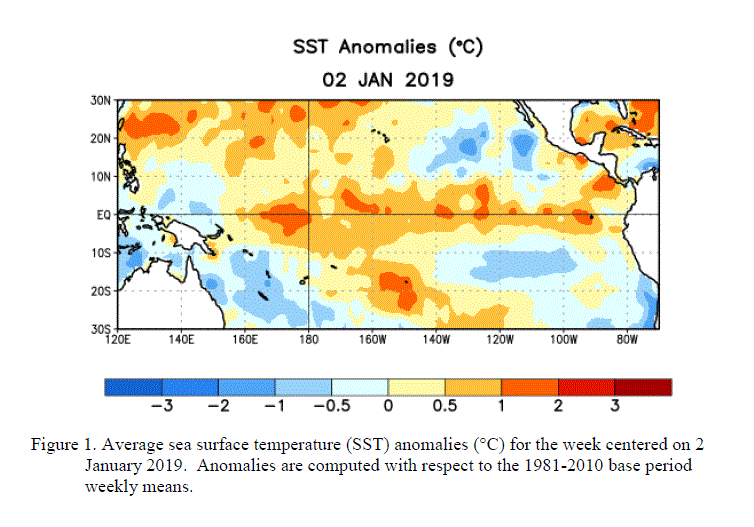
ENSO-neutral continued during April 2014, but with above-average sea surface temperatures (SST) developing over much of the eastern tropical Pacific as well as persisting near the International Date Line (Fig. 1).

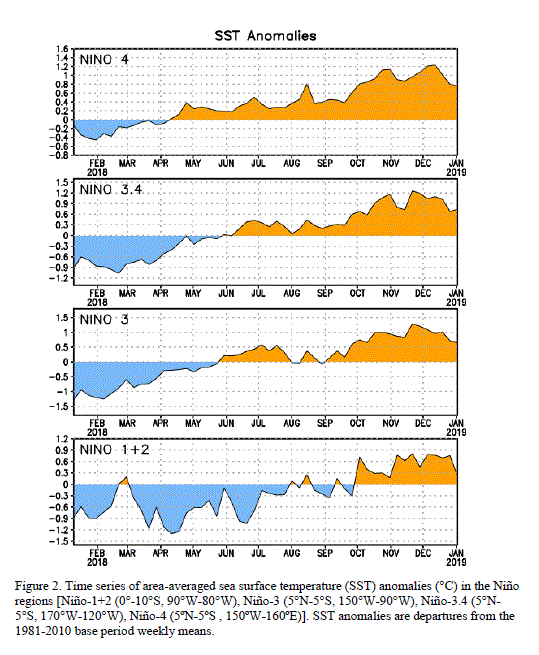
The weekly SST indices were near to slightly above average and increasing in the Niño1+2, Niño3 and Niño3.4 regions, and above average in the Niño4 region (Fig. 2).

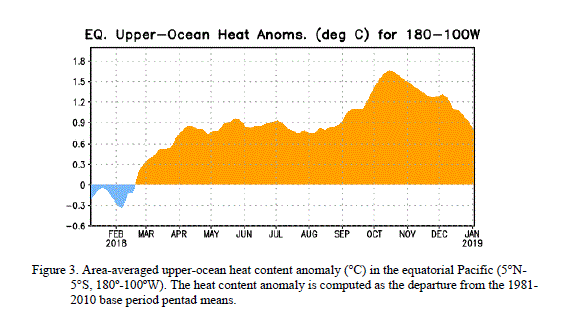
The downwelling phase of a strong oceanic Kelvin wave that began in January greatly increased the oceanic heat content during March and April (Fig. 3),

and produced large positive subsurface temperature anomalies across the central and eastern Pacific (Fig. 4).
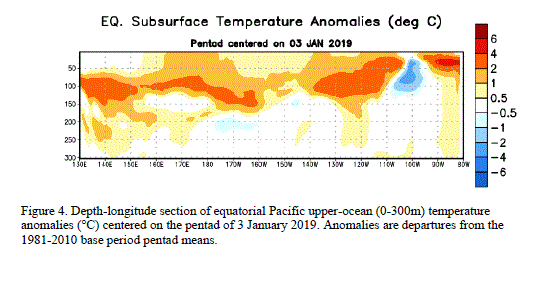

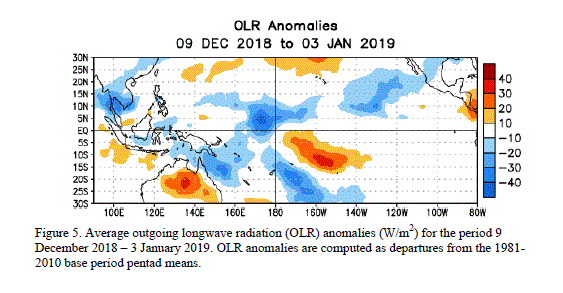
The upper portion of these subsurface anomalies reached the sea surface, warming the waters east of 125oW longitude. Also during April, weak low-level westerly wind anomalies were observed over the far western Pacific, while upper-level easterly anomalies occurred over much of the Pacific. Convection was enhanced over the west-central equatorial Pacific (Fig. 5).

These atmospheric and oceanic conditions collectively indicate a continued evolution toward El Niño.
The model predictions of ENSO for this summer and beyond are indicating an increased likelihood of El Niño compared with those from last month. Most of the models indicate that ENSO-neutral (Niño-3.4 index between -0.5oC and 0.5oC) will persist through part of the remainder of the Northern Hemisphere spring 2014 (Fig. 6),
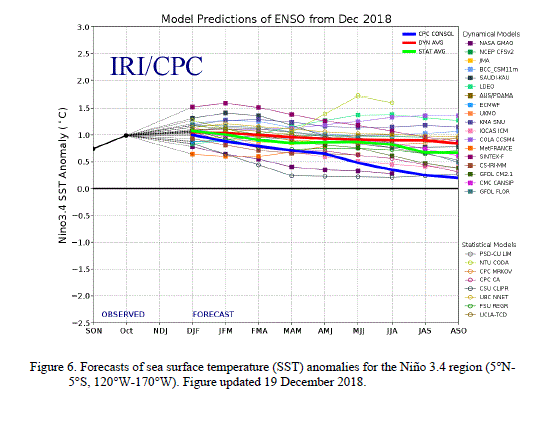

most likely transitioning to El Niño during the summer. There remains uncertainty as to exactly when El Niño will develop and an even greater uncertainty as to how strong it may become. This uncertainty is related to the inherently lower forecast skill of the models for forecasts made in the spring. While ENSO-neutral is favored for Northern Hemisphere spring, the chance of El Niño increases during the remainder of the year, exceeding 65% during the summer (click CPC/IRI consensus forecast for the chance of each outcome).
This discussion is a consolidated effort of the National Oceanic and Atmospheric Administration (NOAA), NOAA’s National Weather Service, and their funded institutions. Oceanic and atmospheric conditions are updated weekly on the Climate Prediction Center web site (El Niño/La Niña Current Conditions and Expert Discussions). Forecasts for the evolution of El Niño/La Niña are updated monthly in the Forecast Forum section of CPC’s Climate Diagnostics Bulletin. The next ENSO Diagnostics Discussion is scheduled for 5 June 2014.
One thing I want to point out for those who may not be used to these graphs, anomalies are temperatures changes from the climate average for that spot. That’s why the red grows redder as the Kelvin wave slides East towards the North American equatorial West Coast. The water itself is not getting warmer, it is just warmer relative to the usual temperature for that spot along the equator.
Steve, there are several applications related to these conditions, including ocean travel, fishing industry, and precipitation patterns that pose possible overly wet or dry conditions that can be prepared for. For example, most farmers I meet use this information to their advantage. Our own state of Oregon produces an El Nino forecast that is specific for agricultural purposes.
Weather Dave says:
May 8, 2014 at 11:32 am
……By mid May weather models (not climate) show a weak Low over Darwin and a ridge over Tahiti; with the pressures higher over Tahiti than Darwin……
————————————-
Many thanks for the forecast info, will keep a “weather eye” on it! I haven’t been looking any further ahead than the daily numbers.
I agree there are many indicators to take into account and they all move in “mysterious” ways:-)
One of which is OLR:-
http://cawcr.gov.au/staff/mwheeler/maproom/OLR/ts.r4.l.gif
In the end only time will tell.
ossqss says:
May 8, 2014 at 9:09 am
“Sooooo, does anyone think the Weather Channel will name the next El Nino like they are naming every other weather event? I vote for Gojira! ”
============================================================================
I would suggest “Sergio”.
“I don’t know. Maybe the Krakenino will rise, and devastate the Pause, and bring woe to the unbeliever. But even if it does, I don’t see how that fulfils the Prophecies as laid out by the GCMs.”
pretty simple. The GCMs dont get the timing of El Nino correct. That means
when we are in La Nina conditions they overestimate the warming and in El Nino they will
underestimate.
Over a long period these will balance out.
simple.
Not that a blockbuster El Nino would be a new thing (those 1790s in Sydney!), but if the approaching El Nino turns out to be no big deal the climatariat will simply change the subject. They’re good at that, and they have the great Herd of Independent Minds in the media and academia to help.
Remember that record breaking temp on the way for NZ? The one that didn’t actually happen, not even close? What about Australia’s cyclone cataclysm from a few weeks back? The one that caused some flooding up north and whose name they’ve forgotten everywhere else?
The trick seems to be to treat prediction as sensational reality and reality as so-last-week. Look, if these people ever achieve the impossible, namely, a stable climate, they’ll be complaining about an “eerie sameness” or “unsettling monotony” – for which they’ll blame Anthony Watts if they can’t find a suitable Bush.
From TomR,Worc,MA,USA on May 8, 2014 at 10:00 am:
Gonorrhea!
A strange unnatural-seeming warmth the accompanies the release of water, that arises from the motion of bodies predominantly composed of water…
Which many people will never know exists unless an authority informs them of it, and then still might not accept…
And will believe it just goes away instead of the results spreading out and distributing throughout the system…
And will think it’s gone for good until the ugly head arises again…
Steven Mosher says:
May 8, 2014 at 1:26 pm
Thanks Steven. I’ve never sorted this out, what with all the spagetti graphs and multimodel means that obscure things; do the models generally show warming in el Nino spurts? This is what I meant by not fulfilling the prophesy.
Skeptikal says: “If you predict an El Nino for long enough, then eventually you’ll be right.” Precisely my thoughts. But my sentiments differ. Knowing how desperately California needs moisture, especially winter snows, I hope the weak one in the offing develops next winter. The moisture and heating/cooling distributions throughout the Northern Hempishere could use some re-arranging.
If true, this should certainly kill off the
2014 Hurricane Season.
an El Nino question popped into my head the other day, and this may be the place to get it answered: how does the formation of Eastern Pacific hurricanes off the coast of Mexico & the Central American coasts affect the formation/strength or lack thereof of an El Nino?
since hurricanes suck heat out of the ocean, i was wondering if there was any relationship between the two events, either more hurricanes during an El Nino, since there would be more warm water to draw from or, conversely, if hurricanes could stunt an El Nino by whisking away the heat before it could head west.
http://www.nhc.noaa.gov/?epac
as for what’s coming in the next few months, i don’t have a crystal ball, but i can say that the weather in my part of SoCal is a lot like last spring: cooler than usual, which tells me that the forces responsible for our weather aren’t really changing in any dramatic fashion.
Only a Watch? What is required to issue a Warning? Does an El Niño have to be spotted or something? I’m not taking cover yet.
Over a long period these will balance out. says Steven Mosher
you mean over the last 17 years!!!!
Steven,
In fact, I didn’t think most of the models did all that good a job with El Nino. I read that some of the better ones are getting some of the features of El Nino right (whatever that means exactly). But from what I gather, if most of the models don’t model El Nino more or less correctly, warming due to El Nino’s can hardly be said to validate the models. That can’t be what the prophecy says, if the prophet knows El Nino not, or poorly at best.
Steven Mosher says:
May 8, 2014 at 1:26 pm
“pretty simple. The GCMs dont get the timing of El Nino correct. That means
when we are in La Nina conditions they overestimate the warming and in El Nino they will
underestimate.
Over a long period these will balance out.
simple.
——————————————————————————————————————–
Spoken like a true lawyer/politician. Sorry Steven, while I always read your comments (even the fly by ones) and respect your input and knowledge, suggesting that two incorrect estimates about a chaotic system will somehow simply “balance out” doesn’t get it.
Mark Bofill says: May 8, 2014 at 3:18 pm
“some of the better ones are getting some of the features of El Nino right (whatever that means exactly)”
Check this short video. About half-way through it switches to E pacific and an El Nino. It gets a typical jet, and even the spacing of the side vortices is about right.
Nick,
Thanks, I will.
Hey, I’d actually like to be wrong about this. I think it’d be pretty cool if we could model El Nino’s well. But however well we’re doing these days, there’s an awful lot of settled science that has to predate our current understanding. What happened to all that?
But I betcha that come the day (assuming we aren’t already there) that we can get ocean dynamics like this right, we’ll be a good long ways towards having decent models. All that’ll be left are to fix clouds, maybe.
From Steven Mosher on May 8, 2014 at 1:26 pm:
Much like the software at a bank that computes interest payments to depositors, which is set to always round down as a bank cannot pay out any sum that is not proven to exist, which could happen 50% of the time if round-ups were allowed as total round-ups exceeded total round-downs. Regulators frown on handing out non-existent money, and the total sums could be quite substantial.
Over a long period this will balance out, as the banks will charge enough in service fees in total to cancel out whatever interest payments were made.
aaauffff. (vomit). Mixed tenses.
In the headline graph, there are two sets of data points: a bar graph and a line graph denoting “Climatological Probability”. The line graph appears to show that the probability of La Nina (blue line) is roughly the same as the probability of El Nino (red line) throughout the year, with only the Neutral rating (green line) dropping.
That appears to contradict what is shown by the bar graph which favours El Nino heavily (red bars).
Anthony, can you explain in more detail the meaning of that graph? It’s not intuitively obvious.
Thanks.
Cool video Nick. Of course, I wouldn’t know a decent virtual El Nino if I was drowning in it, but I read that GFDL does El Nino pretty well, relative to the other models.
It’s one of those time I wish climate scientists had stuck to purely science instead of advocacy, so I could trust that I’m not being B.S.’d on how good the simulation is. Ah well.
It came from the equatorial Pacific , super climate devastating whole planet eating El Nino Godzilla…. news at eleven ….
If we are going to name it, name it “Hansen-illa.”
HenryP says:
May 8, 2014 at 9:48 am
Bob Tisdale says
http://wattsupwiththat.com/2014/05/08/el-nino-watch-issued-by-noaa/#comment-1631588
Henry says
let me guess
it is not happening?
============
Calm down, this doesn’t need to be decided in the next 5 minutes.
Steven Mosher says:
May 8, 2014 at 1:26 pm
“I don’t know. Maybe the Krakenino will rise, and devastate the Pause, and bring woe to the unbeliever. But even if it does, I don’t see how that fulfils the Prophecies as laid out by the GCMs.”
pretty simple. The GCMs dont get the timing of El Nino correct. That means
when we are in La Nina conditions they overestimate the warming and in El Nino they will
underestimate.
Over a long period these will balance out.
simple.
=========================
Just like air-to-air missiles, eh ?