Apparently, all that work in selective crop breeding won’t overcome ‘climate change’
This is the headline and story summary from Eurekalert:
Crop species may be more vulnerable to climate change than we thought
A new study by a Wits University scientist has overturned a long-standing hypothesis about plant speciation (the formation of new and distinct species in the course of evolution), suggesting that agricultural crops could be more vulnerable to climate change than was previously thought.
I’m thinking they’d test this on actual crops, like corn, wheat, soybeans, or the like, crops we consume and that are important to economies. That would make sense, right? But then, I remembered that this is about ‘climate change’, where nothing makes much sense anymore.
From the University of the Witwatersrand:
New study on plant speciation
A new study by a Wits University scientist has overturned a long-standing hypothesis about plant speciation (the formation of new and distinct species in the course of evolution), suggesting that agricultural crops could be more vulnerable to climate change than was previously thought.
Unlike humans and most other animals, plants can tolerate multiple copies of their genes – in fact some plants, called polyploids, can have more than 50 duplicates of their genomes in every cell. Scientists used to think that these extra genomes helped polyploids survive in new and extreme environments, like the tropics or the Arctic, promoting the establishment of new species.
However, when Dr Kelsey Glennon of the Wits School of Animal, Plant and Environmental Sciences and a team of international collaborators tested this long-standing hypothesis, they found that, more often than not, polyploids shared the same habitats as their close relatives with normal genome sizes.
“This means that environmental factors do not play a large role in the establishment of new plant species and that maybe other factors, like the ability to spread your seeds to new locations with similar habitats, are more important,” said Glennon.
“This study has implications for agriculture and climate change because all of our important crops are polyploids and they might not be much better at adapting to changing climate than their wild relatives if they live in similar climates.”
Glennon’s study also provides an alternative explanation for why plants are so diverse in places like the Cape where the climate has been stable for hundreds of thousands of years. Although her study examined plant species from North America and Europe only, she is looking forward to testing her hypotheses using South African plants.
Glennon’s paper has been published in Ecology Letters, a flagship journal for broad-scale ecology research.

Image: Output for Larrea tridentata (creosote bush) diploid and polyploid populations that shows that both ploidies share similar climate habitats, but differ in how they share that climate.
About Dr Kelsey Glennon
Dr Kelsey Glennon is a Carnegie Postdoctoral Fellow in Climate Change Research in the School of Animal, Plant and Environmental Sciences and the Global Change and Sustainability Research Institute at the University of the Witwatersrand, Johannesburg. She became interested in plant genetics while volunteering in the Hunter Lab at Salisbury University in her second year of college. She pursued a PhD at George Washington University in Washington, DC, studying plant hybridisation, its effects on species boundaries, and resulting conservation issues. Dr Glennon came to Wits University from a prestigious NSF Bioinformatics Fellowship at Syracuse University in New York. She is currently doing active field research on baobab trees in Limpopo Province and the medicinally important plant imphepho (Helichrysum odoratissimum).
===========================================================
Mmmmm, creosote.
Never mind the fact that we don’t eat it nor is it considered a “crop”, it seems quite a leap of logic to me to think that the creosote bush, something that has hardly any cross-breeding, selective enhancement, or other improvements to its genetic makeup to enhance yields and make it more palatable for human consumption would serve as a credible model for the highly modified and coddled crops in use today.
Unless of course, our new climate overlords expect us to be eating creosote in the future. I can’t wait for those protests over “GMO creosote”.
I wonder if the author of this study realized how many periods of climate change the King Clone creosote bush has gone through, in the Mojave desert, no less?
King Clone is thought to be the oldest Creosote bush ring in the Mojave Desert. The ring is estimated to be 11,700 years old. It is considered one of the oldest living organisms on Earth. This single clonal colony plant of Larrea tridentata reaches up to 67 feet (20 m) in diameter, with an average diameter of 45 feet (14 m).
I wonder how it survived the Roman Period “megadrought” found in the USA southwest?
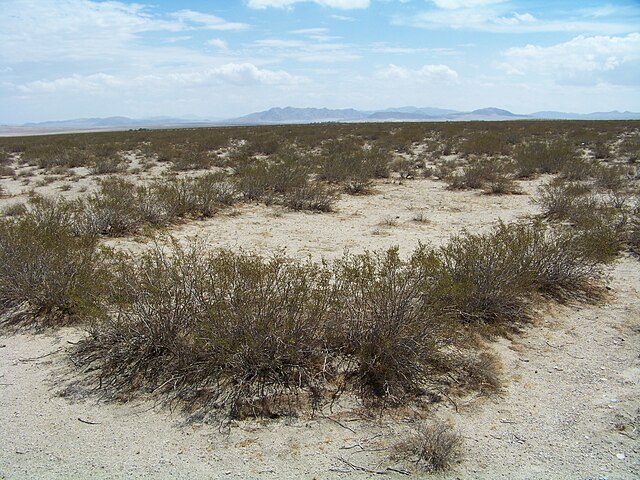
Looks tasty, doesn’t it? Somewhere, Norman Borlaug is ROTFL.
goldminor
Interesting story especially about the options trading. Is that why options traders retire at the end of a short rope attached to a tall tree?
Rick says:
February 24, 2014 at 7:22 am
—————————————
It is funny how one event can alter future events. If my father had listened to me, would I have ended up in this conversation about climate change? If I had listened to my wife and not ended up divorced, where would that path have led? Would I have had that dream of standing on a hill in a foreign land next to a beautiful golden haired woman? Would that same golden haired beauty have still moved to SF and would the family restaurant at that location have come to pass? Yet here I stand as of today with my memories of all of that behind me and ready to face what the future may yet bring. I did end up with 2 beautiful children and now 6 grandchildren, all of them are excellent students. I do feel blessed with that. I have been given many treasures, which has made the slings and arrows of outrageous fortune easily digested.
It is known as the Root, because it will display the root of your issues.
Embrace the uncertainty and know that karma is in play and, over all, think.
Now is the time to be more honest with a sweetheart.