Apparently, all that work in selective crop breeding won’t overcome ‘climate change’
This is the headline and story summary from Eurekalert:
Crop species may be more vulnerable to climate change than we thought
A new study by a Wits University scientist has overturned a long-standing hypothesis about plant speciation (the formation of new and distinct species in the course of evolution), suggesting that agricultural crops could be more vulnerable to climate change than was previously thought.
I’m thinking they’d test this on actual crops, like corn, wheat, soybeans, or the like, crops we consume and that are important to economies. That would make sense, right? But then, I remembered that this is about ‘climate change’, where nothing makes much sense anymore.
From the University of the Witwatersrand:
New study on plant speciation
A new study by a Wits University scientist has overturned a long-standing hypothesis about plant speciation (the formation of new and distinct species in the course of evolution), suggesting that agricultural crops could be more vulnerable to climate change than was previously thought.
Unlike humans and most other animals, plants can tolerate multiple copies of their genes – in fact some plants, called polyploids, can have more than 50 duplicates of their genomes in every cell. Scientists used to think that these extra genomes helped polyploids survive in new and extreme environments, like the tropics or the Arctic, promoting the establishment of new species.
However, when Dr Kelsey Glennon of the Wits School of Animal, Plant and Environmental Sciences and a team of international collaborators tested this long-standing hypothesis, they found that, more often than not, polyploids shared the same habitats as their close relatives with normal genome sizes.
“This means that environmental factors do not play a large role in the establishment of new plant species and that maybe other factors, like the ability to spread your seeds to new locations with similar habitats, are more important,” said Glennon.
“This study has implications for agriculture and climate change because all of our important crops are polyploids and they might not be much better at adapting to changing climate than their wild relatives if they live in similar climates.”
Glennon’s study also provides an alternative explanation for why plants are so diverse in places like the Cape where the climate has been stable for hundreds of thousands of years. Although her study examined plant species from North America and Europe only, she is looking forward to testing her hypotheses using South African plants.
Glennon’s paper has been published in Ecology Letters, a flagship journal for broad-scale ecology research.

Image: Output for Larrea tridentata (creosote bush) diploid and polyploid populations that shows that both ploidies share similar climate habitats, but differ in how they share that climate.
About Dr Kelsey Glennon
Dr Kelsey Glennon is a Carnegie Postdoctoral Fellow in Climate Change Research in the School of Animal, Plant and Environmental Sciences and the Global Change and Sustainability Research Institute at the University of the Witwatersrand, Johannesburg. She became interested in plant genetics while volunteering in the Hunter Lab at Salisbury University in her second year of college. She pursued a PhD at George Washington University in Washington, DC, studying plant hybridisation, its effects on species boundaries, and resulting conservation issues. Dr Glennon came to Wits University from a prestigious NSF Bioinformatics Fellowship at Syracuse University in New York. She is currently doing active field research on baobab trees in Limpopo Province and the medicinally important plant imphepho (Helichrysum odoratissimum).
===========================================================
Mmmmm, creosote.
Never mind the fact that we don’t eat it nor is it considered a “crop”, it seems quite a leap of logic to me to think that the creosote bush, something that has hardly any cross-breeding, selective enhancement, or other improvements to its genetic makeup to enhance yields and make it more palatable for human consumption would serve as a credible model for the highly modified and coddled crops in use today.
Unless of course, our new climate overlords expect us to be eating creosote in the future. I can’t wait for those protests over “GMO creosote”.
I wonder if the author of this study realized how many periods of climate change the King Clone creosote bush has gone through, in the Mojave desert, no less?
King Clone is thought to be the oldest Creosote bush ring in the Mojave Desert. The ring is estimated to be 11,700 years old. It is considered one of the oldest living organisms on Earth. This single clonal colony plant of Larrea tridentata reaches up to 67 feet (20 m) in diameter, with an average diameter of 45 feet (14 m).
I wonder how it survived the Roman Period “megadrought” found in the USA southwest?
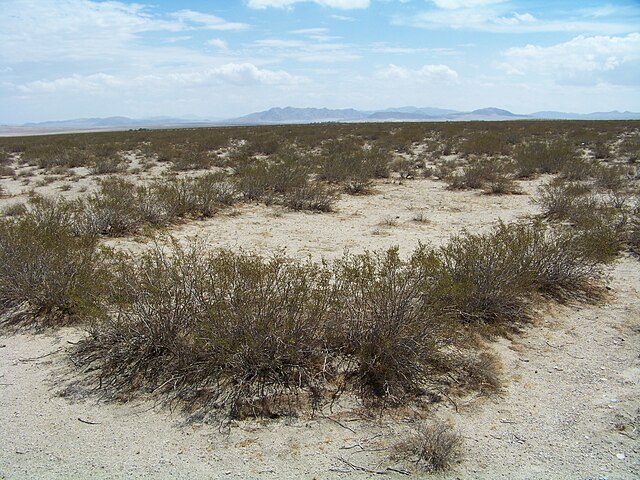
Looks tasty, doesn’t it? Somewhere, Norman Borlaug is ROTFL.
Right, we were thinking in Kansas of switching out wheat for coffee in preparation for climate change but then remembered we don’t live in the same fantasy world as these clowns.
” …other factors, like the ability to spread your seeds to new locations with similar habitats, are more important,” said Glennon.” Wouldn’t more extreme weather do just that with a … tumbleweed? Hmmm?
I guess if this “scientist” did a study on dogs using cats; she would feel her conclusions were also valid. And they wonder why they are losing the PR battle!
Why all the hand-wringing over every little thing pertaining to climate change obsession? Has anyone done a study of the propensity of climate alarmists and enviromentals to having OCD, since it appears they all have a severe case of it?
It wasn’t that long ago when the Laurentide Ice Sheet existed where my house is now. Back then there couldn’t have been very much in the way of flora and fauna in my neighborhood, living under the ice sheet and miraculously we now have flora/fauna in abundance, seemingly no worse for the wear.
1. “Unlike humans and most other animals, plants can tolerate multiple copies of their genes – in fact some plants, called polyploids, can have more than 50 duplicates of their genomes in every cell. Scientists used to think that these extra genomes helped polyploids survive in new and extreme environments, like the tropics or the Arctic, promoting the establishment of new species.”
The hypothesis USED to be that Polyploids used their extra genomes to survive.
Note you can test this theory by using ANY Polyploid, not just edible ones. The hypothesis tested was a hypothesis About POLYPLOIDS. so to falsesify that theory you only need to pick a polyploid.
2. However, when Dr Kelsey Glennon of the Wits School of Animal, Plant and Environmental Sciences and a team of international collaborators tested this long-standing hypothesis, they found that, more often than not, polyploids shared the same habitats as their close relatives with normal genome sizes.
in other words it is NOT the extra genomes that help polyploids survive.
3.“This means that environmental factors do not play a large role in the establishment of new plant species and that maybe other factors, like the ability to spread your seeds to new locations with similar habitats, are more important,” said Glennon.
So comments about how well cresote survive are NOT ON POINT. The hyopthesis was that polyploids survive BECAUSE they can use the extra genome to adapt to a changing environment.
The study was focused on that hypothesis. They looked at a polyploid. theory tested, falsified as you who follow popper would describe.
So what IMPLICATIONS does that have for us.
4.“This study has implications for agriculture and climate change because all of our important crops are polyploids and they might not be much better at adapting to changing climate than their wild relatives if they live in similar climates.”
Nothing about GMOs. Just a simple explanation.
A) we used to think polyploids extra genome would help them survive.
B) we tested that by looking at a polyploid.
C) we found that extra genome didn’t help.
D) our food is polyploid, we cannot count on the extra genome to make them more survivable.
Finally, if you think that polyploids we eat are somehow special, if you think their extra genome will make them more survivable, then you can go prove that.
King Clone is a piker to Pando’s arguable one million years.
http://discovermagazine.com/1993/oct/thetremblinggian285
“Robert W Turner says:
February 21, 2014 at 7:45 am”
OMG!!
Please don’t tell me we’ll have to start growing heat resistant TEXASS varieties in Kansas. We have enough weeds now.
http://varietytesting.tamu.edu/wheat/
After reading commentary and comments attributed to Dr Kelsey Glennon ….. my only thoughts were, …… just another published article about a study based on “circular reasoning and junk science”.
“This study has implications for agriculture and climate change because all of our important crops are polyploids and they might not be much better at adapting to changing climate than their wild relatives if they live in similar climates.”
Norman Borlaug, the father of the Green Revolution, always worked in the country and region where he was developing his new varieties. For example, when developing wheat varieties for Mexico, he lived there himself (often in places where there were no roads or tractors), and selectively bred cultivars that would survive at higher altitudes and in lower regions, so that Mexico was able to grow wheat year round, and in areas where wheat had not survived before. He also observed the kinds of rust that appeared and bred for resistance. That is the whole point of modern agricultural varieties.
It is very intensive, on-site field work, and was always opposed by the environmental activists who complained and campaigned about possible contamination of local species, etc.. The usual. Dr. Borlaug wanted to get to Africa to divert famines quickly, as he had done in Mexico, but the environmentalists protested and successfully attacked his funders. He needed to be on site to do his work.
This woman claiming that locally developed seed cannot adjust to climate change is ignoring the entire process of developing cereals for a particular area in real time. But many real scientists are carrying on this work and suffering persecution and smears from Greenpeace and sustainability activists. It may be that her work is supposed to contribute fodder to worthless legislation outlawing good locally developed high yield strains, on grounds that the are “not sustainable.”
climatology will not be able to adapt to climate change
Gotta give her some credit. I don’t see that she used any models but on the ground data and in the field field work.
“Steven Mosher says:
February 21, 2014 at 8:24 am”
Noone is arguing the ploidy influence, it’s completely IRRELEVANT. The discussion regards the BS in this line:
“suggesting that agricultural crops could be more vulnerable to climate change than was previously thought.”
It suggests no such thing AT ALL. Humans manipulate the ploidy to make varieties that are more suitable to the environment desired. The varieties in Texas are grown at an average temperture of 3+ degrees relative to Kansas. They grow wheat in Mexico. We’ll survive.
Natural genetic selection takes hundreds of years.
“This study has implications for agriculture and climate change because all of our important crops are polyploids and they might not be much better at adapting to changing climate than their wild relatives if they live in similar climates.”
Well heck yes, you idiots. If it warms up, plant breeders will perform another green revolution. Doh!
Stick with your temperature reconstructions, Mosh.
“This means that environmental factors do not play a large role in the establishment of new plant species and that maybe other factors, like the ability to spread your seeds to new locations with similar habitats, are more important,” said Glennon.
It’s good to see a study that finally reaches a common-sense conclusion. I have been stating this every-time some study predicts that the warming in the arctic regions is going to mean the trees are going to start marching north.
“This study has implications for agriculture and climate change because all of our important crops are polyploids and they might not be much better at adapting to changing climate than their wild relatives if they live in similar climates.”
Unfortunately she believes that wild plants are much more capable of pulling up their roots and marching to new climates.
The ability of any living organism to adapt to changing environmental conditions is dependent, first and foremost, on their mobility – this is an indisputable fact. If you find it too warm move to a cooler location. Can’t find enough food, move to somewhere with more food. Some other organism is eating you, run to somewhere else. Plants move by seed dispersal – that is another indisputable fact – there are coconut trees growing in Scotland because their seeds traveled from the Caribbean on the North Atlantic Current, not because the trees marched/swam there.
Evolution of any organisms is dependent on their ability to adapt to the changing environmental conditions – if you can’t move out of danger, the organisms less able to adapt will die. If an entire species, with the exception of a few, cannot survive the change then the survivors pass their genetic ability to their progeny and the species adapts – this is the basic point Darwin made about Evolution and is the reason we have drug resistant bacteria, insecticide resistant bugs and herbicide resistant weeds.
Steven Mosher, you said:
“However, when Dr Kelsey Glennon of the Wits School of Animal, Plant and Environmental Sciences and a team of international collaborators tested this long-standing hypothesis, they found that, more often than not, polyploids shared the same habitats as their close relatives with normal genome sizes.
in other words it is NOT the extra genomes that help polyploids survive.”
Is this what you determined from reading the paper? I don’t see how this can be gleaned from the press release. To me it looks like the showed that the different pliodies are currently occupying the same habitat. That says nothing about whether, if stressed, one or the other ploidies might adapt differently. Did they demonstrate that the specimens they observed were living at the boundary of what might be considered their normal habitat, or that the area was changing in some significant way?
To use an oversimplified analogy, just because cows and sheep live in the same pasture, that doesn’t mean they would have equal success in all pastures.
Also, though it has been a while since I studied Evolutionary Biology, I don’t think there was a belief that polyploids had a guaranteed evolutionary advantage. They simply result in extra genetic chances, that may in very rare cases result in speciation. And the speciation is more likely to occur if the polyploid is isolated reproductively from other ploides. So, I don’t see how they can look at this one instance and say that polyploides offer no advantage. They would have to test that against the introduction of all types changes to the habitat – new predators/diseases, new climate (did they demonstrate that?), new competitors, etc.
Different varieties of cash crops are already adapted to a wide range of environments. That’s what the age old practice of selective crossbreeding is about.
Berényi Péter says:
February 21, 2014 at 10:02 am
Different varieties of cash crops are already adapted to a wide range of environments. That’s what the age old practice of selective crossbreeding is about.
——————————————————————————————————————–
Don’t tell that to anyone who is opposed to GMO (genetically modified organisms).
Dare I to even make the comment that while GMO as it is considered today is a relatively new process, mankind has been selecting the best plants for next year’s seed since before they even knew they were doing it?
Savage man once spread the best wheat from the harvest on the ground as an offering to his gods
I have found out that
This is just like rice, the most important grain with regard to human nutrition and caloric intake. Next time I go to a Indian restaurant I will order a steaming bed of creosote bush with its aromatic resinous odour, to go with my chicken balti.
We must do all we can to protect the Creosote bush from global warming. It needs all the help we can provide. Think too of the children.
Ohhh Mosher, since you like observations and models here you go! The article said the following –
We have dangerous, man-made global heating and noxious co2 belching for decades now. Here are the results and model projections. What do you think?
Mike Trembley wrote:
“The ability of any living organism to adapt to changing environmental conditions is dependent, first and foremost, on their mobility – this is an indisputable fact.”
Actually, you must have just made that up because it makes no sense. If you are talking about a phenotype, then you are wrong because plants don’t locomote but many can nevertheless accommodate changing conditions. If you are talking about a genotype, then you are hopelessly confused because moving to where the environment is the same as the one you used to thrive in is the opposite of adapting to changing environmental conditions. In short, neither plant phenotypes, nor plant genotypes, “adapt” by changing locations. What you meant to say is that during a glacial epoch, the survival of a species is often predicated upon an ability to follow equitable habitat as that habitat changes location.
“This study has implications for agriculture and climate change because all of our important crops are polyploids and they might not be much better at adapting to changing climate than their wild relatives if they live in similar climates.”
Very true. We all know that wheat can’t be grown outside it’s natural distibution area in the Fertile Crescent, just like corn, which of course won’t flourish anywhere except in the Mexican highlands.
“We must do all we can to protect the Creosote bush from global warming. It needs all the help we can provide.”
The Creosote bush is an interesting example of extreme adaptability, since the genus Larrea is otherwise only found in South America, in the deserts from Nazca to Patagonia. Sometime in the not too distant past a creosote-bush seed must have been brought north by some migrating bird and dropped somewhere in the South-West. Its’ offspring seems to have done rather well in their new continent and habitat
STOP THE PRESSES! MAJOR CLIMATE CHANGE ANNOUNCEMENT TO FOLLOW:
“The creosote bush might not be much better at adapting to climate change than any thing else!” says researcher at Utssa Matta WIts U.
Yeeeeooowww! Better start hoarding creosote and investing in creosote futures, right away!
One.
Thin.
Wafer.
Hopefully when the CAGW farce implodes it won’t leave as much of a mess as Mr. Creosote…
(I thought they were going to blame it on the Bush….).