Guest Post by Willis Eschenbach
Well, I wasn’t going to mention this paper, but it seems to be getting some play in the blogosphere. Our friend Nicola Scafetta is back again, this time with a paper called “Solar and planetary oscillation control on climate change: hind-cast, forecast and a comparison with the CMIP5 GCMs”. He’s posted it up over at Tallbloke’s Talkshop. Since I’m banned over at Tallbloke’s, I thought I’d discuss it here. The paper itself is here, take your Dramamine before jumping on board. Dr. Scafetta has posted here on WUWT several times before, each time with his latest, greatest, new improved model. Here’s how well Scafetta’s even more latester, greatester new model hindcasts, as well as what it predicts, compared with HadCRUT4:
 Figure 1. Figure 16A from Scafetta 2013. This shows his harmonic model alone (black), plus his model added to the average of the CMIP5 models following three different future “Representative Concentration Pathways”, or RCPs. The RCPs give various specified future concentrations of greenhouse gases. HadCRUT4 global surface temperature (GST) is in gray.
So far, in each of his previous three posts on WUWT, Dr. Scafetta has said that the Earth’s surface temperature is ruled by a different combination of cycles depending on the post:
First Post: 20 and 60 year cycles. These were supposed to be related to some astronomical cycles which were never made clear, albeit there was much mumbling about Jupiter and Saturn.
Second Post: 9.1, 10-11, 20 and 60 year cycles. Here are the claims made for these cycles:
9.1 years : this was justified as being sort of near to a calculation of (2X+Y)/4, where X and Y are lunar precession cycles,
“10-11″ years: he never said where he got this one, or why it’s so vague.
20 years: supposedly close to an average of the sun’s barycentric velocity period.
60 years: kinda like three times the synodic period of Jupiter/Saturn. Why three times? Why not?
Third Post: 9.98, 10.9, and 11.86 year cycles. These are claimed to be
9.98 years: slightly different from a long-term average of the spring tidal period of Jupiter and Saturn.
10.9 years: may be related to a quasi 11-year solar cycle … or not.
11.86 years: Jupiter’s sidereal period.
The latest post, however, is simply unbeatable. It has no less than six different cycles, with periods of 9.1, 10.2, 21, 61, 115, and 983 years. I haven’t dared inquire too closely as to the antecedents of those choices, although I do love the “3” in the 983 year cycle. Plus there’s a mystery ingredient, of course.
Seriously, he’s adding together six different cycles. Órale, that’s a lot! Now, each of those cycles has three different parameters that totally define the cycle. These are the period (wavelength), the amplitude (size), and the phase (starting point in time) of the cycle.
This means that not only is Scafetta exercising free choice in the number of cycles that he includes (in this case six). He also has free choice over the three parameters for each cycle (period, amplitude, and phase). That gives him no less than 18 separate tunable parameters.
Just roll that around in your mouth and taste it, “eighteen tunable parameters”. Is there anything that you couldn’t hindcast given 18 different tunable parameters?
Anyhow, if I were handing out awards, I’d certainly give him the first award for having eighteen arbitrary parameters. But then, I’d have to give him another award for his mystery ingredient.
Because of all things, the mystery ingredient in Scafetta’s equation is the average hindcast (and forecast) modeled temperature of the CMIP5 climate models. Plus the mystery ingredient comes with its own amplitude parameter (0.45), along with a hidden parameter for the zero point of the average model temperatures before being multiplied by the amplitude parameter. So that makes twenty different adjustable parameters.
Now, I don’t even know what to say about this method. I’m dumbfounded. He’s starting with the average of the CMIP5 climate models, adjusted by an amplitude parameter and a zeroing parameter. Then he’s figuring the deviations from that adjusted average model result based on his separate 6-cycle, 18-parameter model. The sum of the two is his prediction. I truly lack words to describe that, it’s such an awesome logical jump I can only shake my head in awe at the daring trapeze leaps of faith …
I suppose at this point I need to quote the story again of Freeman Dyson, Enrico Fermi, “Johnny” Von Neumann, and the elephant. Here is Freeman Dyson, with the tale of tragedy:
By the spring of 1953, after heroic efforts, we had plotted theoretical graphs of meson–proton scattering.We joyfully observed that our calculated numbers agreed pretty well with Fermi’s measured numbers. So I made an appointment to meet with Fermi and show him our results. Proudly, I rode the Greyhound bus from Ithaca to Chicago with a package of our theoretical graphs to show to Fermi.
When I arrived in Fermi’s office, I handed the graphs to Fermi, but he hardly glanced at them. He invited me to sit down, and asked me in a friendly way about the health of my wife and our newborn baby son, now fifty years old. Then he delivered his verdict in a quiet, even voice.
“There are two ways of doing calculations in theoretical physics”, he said. “One way, and this is the way I prefer, is to have a clear physical picture of the process that you are calculating. The other way is to have a precise and self-consistent mathematical formalism. You have neither.”
I was slightly stunned, but ventured to ask him why he did not consider the pseudoscalar meson theory to be a self-consistent mathematical formalism. He replied, “Quantum electrodynamics is a good theory because the forces are weak, and when the formalism is ambiguous we have a clear physical picture to guide us.With the pseudoscalar meson theory there is no physical picture, and the forces are so strong that nothing converges. To reach your calculated results, you had to introduce arbitrary cut-off procedures that are not based either on solid physics or on solid mathematics.”
In desperation I asked Fermi whether he was not impressed by the agreement between our calculated numbers and his measured numbers. He replied, “How many arbitrary parameters did you use for your calculations?” I thought for a moment about our cut-off procedures and said, “Four.” He said, “I remember my friend Johnny von Neumann used to say, with four parameters I can fit an elephant, and with five I can make him wiggle his trunk.”
With that, the conversation was over. I thanked Fermi for his time and trouble, and sadly took the next bus back to Ithaca to tell the bad news to the students.
Given that lesson from Dyson, and bearing in mind that Scafetta is using a total of 20 arbitrary parameters … are we supposed to be surprised that Nicola can make an elephant wiggle his trunk? Heck, with that many parameters, he should be able to make that sucker tap dance and spit pickle juice …
Now, you can expect that if Nicola Scafetta shows up, he will argue that somehow the 20 different parameters are not arbitrary, oh, no, they are fixed by the celestial processes. They will likely put forward the same kind of half-ast-ronomical explanation they’ve used before—that this one represents (2X+Y)/4, where X and Y are lunar precession cycles, or that another one’s 60 year cycle is kind of near three times the synodic period of Jupiter and Saturn (59.5766 years) and close is good enough, that kind of thing. Or perhaps they’ll make the argument that Fourier analysis shows peaks that are sort of near to their chosen numbers, and that’s all that’s needed.
The reality is, if you give me a period in years, I can soon come up with several astronomical cycles that can be added, subtracted, and divided to give you something very near the period you’ve given me … which proves nothing.
Scafetta has free choice of how many cycles to include, and free choice as to the length, amplitude, and phase of each those cycles. And even if he can show that the length of one of his cycles is EXACTLY equal to some astronomical constant, not just kind of near it, he still has totally free choice of phase and amplitude for that cycle. So to date, he’s the leading contender for the 2013 Johnny Von Neumann award, which is given for the most tunable parameters in any scientific study.
The other award I’d give this paper would be for Scafetta’s magical Figure 11, which I reproduce below in all its original glory.

Figure 2. Scafetta’s Figure 11 (click to enlarge) ORIGINAL CAPTION: (Left) Schematic representation of the rise and fall of several civilizations since Neolithic times that well correlates with the 14C radio- nucleotide records used for estimating solar activity (adapted from Eddy’s figures in Refs. [90, 91]). Correlated solar-climate multisecular and millennial patterns are recently confirmed [43, 44, 47]. (Right) Kepler’s Trigon diagram of the great Jupiter and Saturn conjunctions between 1583 to 1763 [89], highlighting 20 year and 60 year astronomical cycles, and a slow millennial rotation.
First off, does that graphic, Figure 11 in Scafetta’s opus, make you feel better or worse about Dr. Scafetta’s claims? Does it give you that warm fuzzy feeling about his science? And why are Kepler’s features smooched out sideways and his fingers so long? At least let me give the poor fellow back his original physiognomy.

There, that’s better. Next, you need to consider the stepwise changes he shows in “carbon 14”, and the square-wave nature of the advance and retreat of alpine glaciers at the lower left. That in itself was good, I hadn’t realized that the glaciers advanced and retreated in that regular a fashion, or that carbon 14 was unchanged for years before and after each shift in concentration. And I did appreciate that there were no units for any of the four separate graphs on the page, that counted heavily in his favor. But what I awarded him full style points for was the seamless segue from alpine glaciers to the “winter severity index” in the year 1000 … that was a breathtaking leap.
And as you might expect from a man citing Kepler, Scafetta treats scientific information like fine wine—he doesn’t want anything of recent vintage. Apparently on his planet you have to let science mellow for some decades before you bring it out to breathe … and in that regard, I direct your attention to the citation in the bottom center of his Figure 11, “Source: Geophysical Data, J. Biddy J. B. Eddy (USA) 1978″. (Thanks to Nicola for the correction, the print was too small to read.)
Where he stepped up to the big leagues, though, is in the top line in the chart. Click on the chart to enlarge it if you haven’t done so yet, so you can see all the amazing details. The “Sumeric Maximum”, the collapse of Machu Pichu, the “Greek Minimum”, the end of the Maya civilization, the “Pyramid Maximum” … talk about being “Homeric in scope”, he’s even got the “Homeric Minimum”.
Finally, he highlights the “20 year and 60 year astronomical cycles” in Kepler’s chart at the right. In fact, what he calls the “20 year” cycles shown in Kepler’s dates at the right vary from 10 to 30 years according to Kepler’s own figures shown inside the circle, and what he calls the “60 year astronomical cycles” include cycles from 50 to 70 years …
In any case, I’m posting all of this because I just thought folks might like to know of Nicola Scafetta’s latest stunning success. Using a mere six cycles and only twenty tunable parameters plus the average of a bunch of climate models, he has emulated the historical record with pretty darn good accuracy.
…
And now that he has explained just exactly how to predict the climate into the future, I guess the only mystery left is what he’ll do for an encore performance. Because this most recent paper of his, this one will be very hard to top.
In all seriousness, however, let me make my position clear.
Are there cycles in the climate? Yes, there are cycles. However, they are not regular, clockwork cycles like those of Jupiter and Saturn. Instead, one cycle will appear, and will be around for a while, and then disappear to be replaced by some longer or shorter cycle. It is maddening, frustrating, but that’s the chaotic nature of the beast. The Pacific Decadal Oscillation doesn’t beat like a clock, nor does the El Nino or the Madden-Julian oscillation or any other climate phenomena.
What is the longest cycle that can be detected in a hundred year dataset? My rule of thumb is that even if I have two full cycles, my results are too uncertain to lean on. I want three cycles so I can at least get a sense about the variation. So for a hundred year dataset, any cycle over fifty years in length is a non-starter, and thirty-three years and shorter is what I will start to trust.
Can you successfully hindcast temperatures using other cycles than the ones Scafetta uses? Certainly. He has demonstrated that himself, as this is the fourth combination of arbitrarily chosen cycles that he has used. Note that in each case he has claimed the model was successful. This by no means exhausts the possible cycle combinations that can successfully emulate the historical temperature.
Does Scafetta’s accomplishment mean anything? Sure. It means that with six cycles and no less than twenty tunable parameters, you can do just about anything. Other than that, no. It is meaningless.
Could he actually test his findings? Sure, and I’ve suggested it to him. What you need to do is run the analysis again, but this time using the data from say 1910 to 1959 only. Derive your 20 fitted variables using this data alone.
Then test your 20 fitted variables against the data from 1960 to 2009, and see how the variables pan out.
Then do it the other way around. Train the model on the later data, and see how well it does on the early data. It’s not hard to do. He knows how to do it. But if he has ever done it, I have not seen anywhere that he has reported the results.
How do I know all this? Folks, I can’t tell you how many late nights I’ve spent trying to fit any number and combination of cycles to the historical climate data. I’ve used Fourier analysis and periodicity analysis and machine-learning algorithms and wavelets and stuff I’ve invented myself. Whenever I’ve thought I have something, as soon as it leaves the training data and starts on the out-of-sample data, it starts to diverge from reality. And of course, the divergence increases over time.
But that’s simply the same truth we all know about computer weather forecasting programs—out-of-sample, they don’t do all that well, and quickly become little better than a coin flip.
Finally, even if the cycles fit the data and we ignore the ridiculous number of arbitrary parameters, where is the physical mechanism connecting some (2*X+T)/4 combination of two astronomical cycles, and the climate? As Enrico Fermi pointed out, you need to have either “a clear physical picture of the process that you are calculating” or “a precise and self-consistent mathematical formalism”.
w.
PS—Please don’t write in to say that although Nicola is wrong, you have the proper combination of cycles, based on your special calculations. Also, please don’t try to explain how a cycle of 21 years is really, really similar to the Jupiter-Saturn synodic cycle of 19+ years. I’m not buying cycles of any kind, motorcycles, epicycles, solar cycles, bicycles, circadian cycles, nothing. Sorry. Save them for some other post, they won’t go bad, but please don’t post them here.
The global climate code of the last 10000 years has four main causes. The first cause is the tidal force from planetary neighbour couples acting on the Sun’s power. Hereby the tidal force is proportional to the inverse square root of the tide frequency. The second cause is the impedance of the ocean oscillations as effects of the wobbling Earth axis of 433 days and its higher harmonics, known as MEI. The third cause are the drops in temperature after massive volcano out stream. The 4th cause is the slowly relaxing high solar power after the last big ice age
The first cause of the climate code is solved. The second cause still waits for a formula describing the effect using the known harmonics. The third cause is recognized and can be used to the code. The 4th cause is solved by Prof. Patzelt from the glaciers in the Alps. The greenhouse effect is not significant in that code.
It has been shown that a subtraction of a time shifted MEI from hadcrut4 data remains with the solar tides in times, when there are no volcanos involved.
However, this scope is a basis to come to a good climate prediction tool if there no volcano outbreaks decreasing the global temperature temporary:
http://www.volker-doormann.org/images/solar_tides_1000_2500.gif
I thank Anthony for his personal investigations with WUWT to make it possible to share ideas relating to the global climate. But because WUWT is a sceptic blog and not a blog of climate science, there are different understandings of the subject. Because it is obvious that there is a lot of personal sceptics to new insights in climate physics, but a minor interest in respectful discussions of new ideas of the climate code, I conclude that it is of no sense to give here any news about the climate code.The wall, set up to protect holy science, has changed to isolate its blind knigths from the garden of scence.
V.
Willis Eschenbach says:
July 25, 2013 at 10:22 pm
While Watts and yourself continue to mock real science with articles such as this I will fight the good fight. I make no apologies and will use whatever means necessary to expose your unscientific methods and propaganda.
It is a pity when presented with the facts that cleared up your previous lack of understanding concerning Landscheidt’s work you resort to attacking the man. A real scientist would swallow his pride and investigate the evidence, I see you do not make that grade.
REPLY: OK Geoff, sure, whatever. You’ve had your reply, now kindly get out and stay out.
This makes the third time I’ve kicked you out, and this time, I’m putting extra efforts in place that prevent you from returning as any one of your fake personas, fake emails, or fake arguments.
What a sad example of a “scientist” you set. OTOH, you’ve set a great example for irrational, dishonest, zealotry.
-Anthony Watts
Well with that brouhaha over perhaps I might venture my tuppennyworth.
I detest the use of the word cycle to describe behaviour which varies in some periodic but not precisely regular way. For instance changes in solar activity tend to be periodic but they are not sufficiently regular as to be called cyclical. Although everybody does. Whereas an electromagnetic wave is truly cyclical: at least: on the classical scale anyway.
Thus we notice the tides on earth produced by the gravitational influence of the heavenly bodies are truly cyclical. But the seasons, despite being driven by the predictable relative motion between the earth and the sun are not, sometimes spring is early sometimes late. Indeed we have a word for it: seasonal. And periodic is a good word for such changes.
Now I am not going to venture into that vipers nest of cycles, epicycles and I know what not.
But I observe two things. Except on atomic and subatomic scales true randomness does not appear to occur in nature: only in mechanical artifacts designed to produce it such as dice or the roulette wheel.
And further, for whatever reason, we humans seem to seek out patterns even where there can be none. Which is why old fashioned casinos give you a card to record the results:and their modern internet equivalents like to list hot and cold numbers and so forth. But any pattern you think you might discern means nothing.
Likewise unless you know the constraints, as you might if you were checking on some mechanical part such as the dimensions of a bolt used in an assembly, there is no statistical technique which can determine whether a series of numerical values is random or has some variation due to an underlying if unknown cause. Despite what Mr. Connelly might urge to the contrary: as he used to do. Loudly.
Much the same goes for correlating so called cycles, perfectly possible in a gearbox of course, But otherwise what does the correlation mean even if it exists? Which it might, but without the constraint such as a mechanism there is no way of knowing whether the apparent correlation has any meaning or is just random coincidence.
But then saying correlation is not evidence of causation is a statement known to all: and always ignored since the modern fashion is to invent some supposed causel link afterwards.
Supposedly scientific papers are full of this kind of thing these days: and calculated to the last decimal place too, What balderdash.
Kindest Regards
Anthony,
as I told you many times, in science people needs to be humble at least toward “nature”.
You are too easily accusing me of being “emotional” and you do not see Willis and your own emotional reactions that are making both of you unable to properly see the things.
The fact itself that, as I noted above, Willis first write
Willis Eschenbach says: July 25, 2013 at 11:45 am
*******
Well, he starts by detrending the data using a quadratic equation of the form
A X4 + B X3 + C X2 + D X + E
*******
and then, after that I pointed out that the 4th-order polynomial written by Willis is not a “quadratic equation”, Willis acknowledges
Willis Eschenbach say: July 25, 2013 at 9:00 pm
“You are 100% correct, Nicola, my bad. I was thinking “quartic” for some reason, not quadratic.”
is a clear demonstration that Willis is in a state of mental confusion and that, consequently, his criticism must be considered suspect. Willis behavior is typical of people who write emotionally without properly thinking first, and without caring about what they are writing.
Willis is simply jumping around my papers without really reading them with the intention of understanding them.
You states: “So far I have not seen any solid defense. ”
See, Anthony, my paper defends itself quite well, you just need to read it with calm.
Download it from here:
http://people.duke.edu/~ns2002/pdf/Scafetta_EE_2013.pdf
and read it during the weekend.
You write: ” If you want to convince people, may I suggest you answer Willis’ questions of how you came to justify using some of the periodic numbers or “astronomical harmonics” of 115 and 983 years. Just saying they are beat of the Schwabe cycle aren’t enough. I can find harmonics in just about any signal, the question is why are they relevant.”
Anthony, these things are extensively discussed in my previous publication:
Scafetta N., 2012. Multi-scale harmonic model for solar and climate cyclical variation throughout the Holocene based on Jupiter-Saturn tidal frequencies plus the 11-year solar dynamo cycle. Journal of Atmospheric and Solar-Terrestrial Physics 80, 296-311.
Download my papers from here:
http://people.duke.edu/~ns2002/#sub_Scientific_papers_in
You write:”While I would admit that it would be elegant if temperature on Earth was indeed governed by “music of the spheres””
Anthony, you need to understand that the fact that Earth was partially governed by the “music of the spheres” is not my own theory, but it is what people have always noted for millennia and it is a theory supported by simple theorems of mathematics: the earth’s space environment is oscillating with the planets, so it must feel these oscillations. Ptolemy understood this 19 centuries ago already.
Only during the last decades or century people become suspicious of the theory because did not know how to do the calculations.
However, with the data we have today a lot of new evidences are emerging and theories are being proposed. Let the science to develop and your will see what happens.
As Ian Wilson “friendly” told you, new papers are in press, solar physicists are getting interested, a special section on this topic is being organized on a scientific journal, I am getting invitations to talk about it at conferences and astrophysical institutes, etc.
If you do not believe in me, see the papers presented at (section 5)
Space Climate Symposium-5 in Oulu, Finland. June 15-19, 2013
http://www.spaceclimate.fi/program.html
Which demonstrates the interest in solar physicist on the topic.
So, be humble and do not think to be above science and nature.
And ask me to summarize my papers instead of asking Willis that simply makes a mess.
REPLY: It doesn’t matter that some people are interested, nor does it matter what conferences or symposiums have carried discussions of your work. What matters is replication.
Thanks for clarifying that you refuse to share anything substantive that has been requested other than what papers you have already published. Clearly you are not interested in independent replication, only adoration. That’s not science, but advocacy. Therefore there’s no point in continuing a dialog any further.
Good luck getting published in the future. – Anthony
Good luck getting published in the future. – Anthony
This may be a turning point for this blog. This will be my last visit, science does not exist here.
@ur momisugly Eric Watson, I think you might be reading too much into that good luck statement. It’s just a standard signoff. But since you think that what Nicola is doing is science I’m curious as to why you don’t join the call for replicability? Right now the only place Nicola’s work can be replicated is at Nicola’s.
Is it science when only one person can do it because the tools and data aren’t made available to others?
Simple vibration can take down a bridge. Why is it so inconceivable that vibration could regulate the Sun, geomagnetic impulse and angular momentum. Lets turn to CO2 cause that complicated stuff makes my brain hurt.
Not that there is any reason anybody should care, really stating this for my own piece of mind:
1) I was originally interested in understanding Nicola’s arguments.
2) I have realized that, right or wrong, it’s a research project in and of itself to understand Dr. Scafetta’s arguments.
3) Right or wrong, my personal heuristic judgement system warns me that I am wasting valuable time and effort that I need for other endeavors, when people who’s judgement I respect all tell me that they have already looked at this and find the material wanting for reproducing Dr. Scafetta’s work.
I will probably continue to look into this on and off in my spare time, but for the record it’s dropped several priority levels from where it was. Also for the record, I am ~nobody~ with respect to climate science, I don’t know if I’m qualified or not to follow Dr. Scafettas work (and frankly don’t care), etc. etc. I don’t understand why anybody thinks these issues have any relevance, or why anyone is talking about them instead of talking about the science. All of the dramatic chest beating of credentials on this thread has thoroughly disgusted me, is why I mention this. Got no interest in that, don’t care, want no part of it, have better things to do.
Geoff Sharp says:
July 25, 2013 at 11:11 pm
Whatever means necessary? So we’re back into the region where the ends justify the means, are we, and you are justified in lying, cheating, and stealing, because you are on the side of the angels? …
Geoff, the best epitaph for folks like you was the one presented by Megan McCardle during the Peter Gleick atrocity. She said (my bold):
Can’t say it straighter than that, Geoff. You’ve now convinced me that you are willing to lie for the cause … and that’s the last thing you’ll ever convince me of.
You have given me absolutely no new facts about Landscheidt’s work. And your false claim that I “resort to attacking the man”? Hogwash.Ted Landscheidt was a long-distance friend of mine, a man I never met who generously gave me assistance and explained things to me when I was nobody and had never published a scientific paper. I did not attack him, I liked him although I couldn’t understand his work. That accusation is just more of your lies.
So … I’m glad you’re banned from here, Geoff. I rarely approve of banning anyone. But a man like you who boasts that he is willing to lie and cheat for his noble cause, and is proud of that? A man like you who sneaks back into a place where honest people have already asked him to leave because of his dishonesty?
I have no problem with banning a man like you at all. Even if you weren’t banned, Geoff, I’d say practical reasons dictate that you go and spread your lies somewhere else.
Because as Megan McArdle said, your claim that you “will use whatever means necessary” is the last thing you’ll ever convince anyone of around here … you’ve shot your bolt, no one at WUWT will ever believe another word from your lips. You’ve boasted to us that you’ll lie to our faces, we’d be crazy to trust you after that, duh.
It’s time to move on to a new batch of suckers, Geoff. Go fool someone else for a while. Don’t go away mad. Just go away.
w.
Eric Watson PHD says:
July 26, 2013 at 6:04 am
Say what? Eric, just what is it that you don’t like or don’t think is science? We’ve asked Nicola, over and over, to provide his data and code.
Nicola has flatly refused. He’s channelling Phil Jones and Michael Mann.
As an alternative, Joe Born offered him a great test, not just of his methods, but of ANY attempt to use cycles to explain the global mean surface temperature.
Nicola has flatly refused.
If you think that what Nicola is doing is science, then you should turn in your PhD on your way out the door.
Which leaves me quite curious. Science, to me, is a process wherein:
1. A scientist makes a claim, and buttresses it with all of the logic, math, data, statistics, observations, and information at their disposal.
2. He or she lays out all of their data, their code, their spreadsheets, and their results in a totally transparent manner, so other people can see, understand, and attempt to replicate what’s been done.
3. Other scientists try to tear the work to shreds. If they can do so, it goes in the trash. If they can’t tear it down, however, it is accepted as provisional scientific truth … until someone comes along who can tear it down.
To me, that slow centuries-long process is science. I make a claim, I lay it out transparently with all of my evidence and logic and math and all. Then I hand around the hammers, and see if someone can destroy it.
Since that is exactly what we do here at WUWT, science in its most immediate and transparent form, I have to say that I’m mystified by your mistaken idea that “science doesn’t exist here”.
SO … if you wanted to clarify your statement, now’s your chance. Otherwise, there’s a dumpster just outside the door, you can put your PhD in there when you leave …
w.
Leif Svalgaard says:
July 23, 2013 at 10:16 am There are several other cyclomaniacs on this site pushing similar [or worse] nonsense. And I agree that this association harms the skeptical movement. Once you have been stung by the cyclomania bug, there is no way back and no salvation for you. That bug rears its stinger in every generation.
<<<<<<<<<<<<<<<<<<<<<<<<<<<<<<<<<>>>>>>>>>>>>>>>>>>>>>>>>>>>>
Ditto, most emphatically. You can be a scientist or a simpleton, but not both.
The bit I don’t get is how he takes two astronomical frequencies, 9.93yrs and 11.86yrs, giving a beat frequency of 61.02yrs, and then sums the 61yr beat envelope with the original frequencies. Surely that can’t be right?
TLMango says:
July 26, 2013 at 7:41 am
TLMango, it’s not inconceivable that regular cycles from the planets could regulate the sun. And many people, myself included, have looked for evidence of that regularity.
Unfortunately, no one has found it yet. For example, consider the sunspots. They have a cycle of around 11 years, as is well known. It is very tempting to relate that to the planets, e.g. the 11.862 year cycle of Jupiter around the sun. And that would seem logical, that one of the few cyclicities in the sun would be related to the gravitational force of a huge planet like Jupiter.
But when you look at the data, you find that the sunspot cycles vary from 9 years to 13.7 years, and that their average is 11.0 ± 0.25 years since March of 1755. So the apparent alignment with the orbital period of Jupiter falls apart when it is examined closely. It’s revealed to be just coincidence.
So people are not turning away from the idea of cycles. They are turning away from the lack of evidence that planets rule the sun (and indirectly the climate). If the most massive planets don’t influence the sunspot cycle, it seems unlikely they’d influence something else. If the influence of the planets is as large as is claimed, why aren’t the sunspots phase-locked to Jupiter?
The problem is that with a spheroidal object in free-fall like the sun, the only effect the planets have is through tidal action. Other than tidally, they don’t exert any torque on the sun. Other than tidally, they can’t speed up or slow down the sun’s rotation.
And while it’s tempting to say OK, that proves that the planets can indeed exert torque on the sun, the problem then is one of size. By that I mean that Jupiter creates about a 1 mm tide on the sun, and the rest of the planets make tides than are much smaller than that.
Nicola gets around this by making an astounding claim, viz:
Riiiiight … because adding mass would increase the suns luminosity, one millimeter tides on the surface of the sun will do the same??? I’ve linked to the paper above in the quote. I find it barely understandable and totally unconvincing, but of course YMMV.
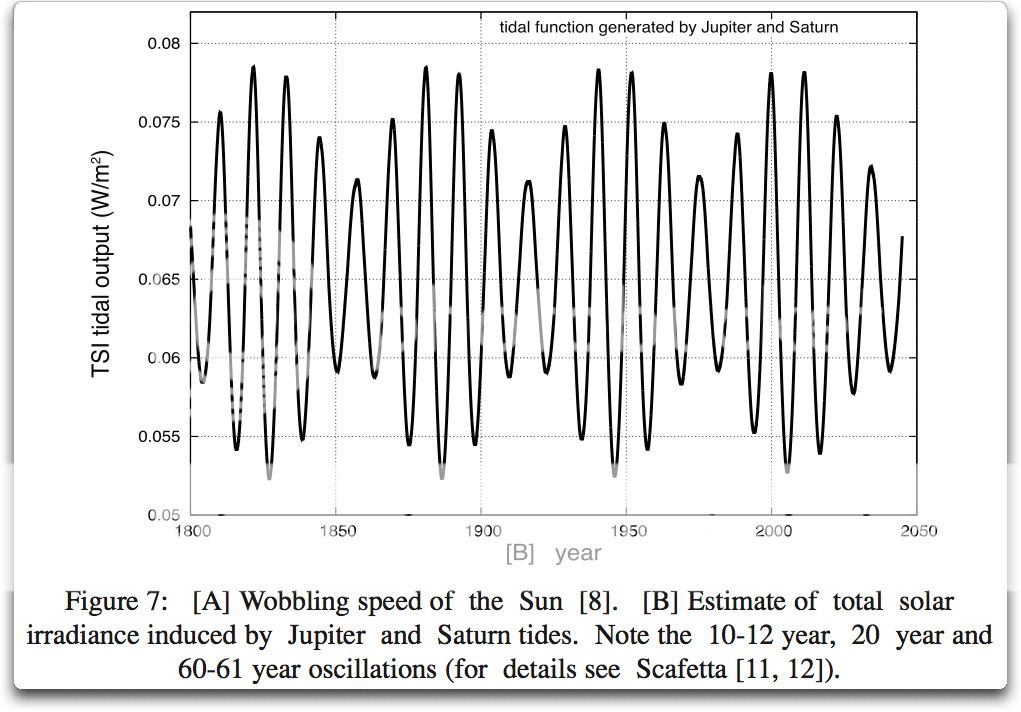
However, that hasn’t stopped people (including myself) from looking. The problem is that no one has ever found any clear, convincing evidence that the planets influence the sun (beyond the obvious barycentric motion, that is to say the motion of the center of gravity of the solar system).
Nicola, for example, hypothesizes that the ≈ 1mm planetary tides on the sun, by means of an unclear “nuclear amplification” mechanism that he has proposed, are multiplied “four million times”, and that this leads to a variation in solar luminosity of 0.02 W/m2.
Two hundredths of a watt per square metre? And this is supposed to affect the earth?
People have turned away from cycles from lack of evidence, TLMango, not lack of interest.
w.
Willis, always enjoy your posts.
I just thought I’d throw something out for your consideration regarding “cycles”.
Seems to me that I’ve read somewhere that the energy we are seeing at the surface of the sun was actually generated [via fusion I assume] many thousands of years ago [the figure 800,000 comes to mind but not sure of that]
If recent solar energy was actually generated internally millenia ago, should not those who try to advance the “cycles” idea be considering what the positions of the planets would have been at that time rather than in the recent past to account for what we are seeing today?
Wondering.
I am in complete agreement with Geoff Sharp.
This decade is going to go a very long way in deciding who is correct and who is wrong
Salvatore Del Prete says:
July 26, 2013 at 12:20 pm
I am in complete agreement with Geoff Sharp.
Are you then also a lying cheat?
This decade is going to go a very long way in deciding who is correct and who is wrong
You can be right for the wrong reason. I’ll go along with the pirate hypothesis: that the lack of pirates was causing global warming and that the current upswing in Somalian piracy is causing the ‘pause’ on global warming. Prove me wrong. Perhaps I’m right about global pause but for the wrong reason.
Leif Svalgaard says: July 23, 2013 at 10:16 am
There are several other cyclomaniacs on this site pushing similar [or worse] nonsense.
Hi Doc
Cyclomania is a bit like Japanese knotweed, more severe cases eventually mutate into D&K.
vukcevic says:
July 26, 2013 at 3:16 pm
Cyclomania is a bit like Japanese knotweed, more severe cases eventually mutate into D&K.
some people are already there…
Anthony,
as I explained you already, everything necessary to replicate my results are written in my papers.
What you do not realize is that to replicate a scientific result one also need to know how to do that. That is, one needs to have the appropriate mathematical and physical background.
For example, if I say that I am using the Maximum Entropy Method to evaluate the periodogram, one needs to know what is the Maximum Entropy Method, how it works, and how to use it. People with the sufficient expertise in time series analysis know these things because written in time series analysis textbooks. And such people know where to find the required codes, which are written also in specific textbook (referenced in my papers), etc. And then you need also know how to run the code etc.
Scientific works are not written as step-by-step tutorials for beginners. And scientists are not required to write such tutorials.
Your blog is very useful as a news outlet and a source of general information for scientists as me, as well as common people. But if you try to transform it as a place where people without sufficient scientific credentials such as Willis play around as the Sorcerer’s Apprentice, you only create a mess.
Professional scientists will be bored by Willis silliness, as I demonstrated above many times, and common people will not understand anything.
I suggest you to keep your blog as a news outlet and a source of general information. If you want a more in deep analysis of a paper, ask the scientist to write a short summary and respond questions people may have. Everybody will benefit from this.
REPLY: Nicola, how condescending. A week ago you were begging me to review this paper, I read it, decided pretty much what Willis did, and decided not to carry it. To my surprise, he covered what I wouldn’t. OK one last chance sir. People are asking for details that are NOT in your papers, do you get that? or are you being purposely obtuse? A simple way to solve the problem is to create an SI, rather than chant:
“read my papers”, “read my papers”, “read my papers”, “read my papers”, “read my papers”, “read my papers”, “read my papers”, “read my papers”, “read my papers”, “read my papers”, “read my papers”,
…when asked for those details.
Then when somebody actually reads and comments on your papers, you scream that they have misinterpreted them. You can’t have it both ways.
Will you supply an SI, or will you just continue to chant? Nobody is asking for a tutorial, that’s a strawman. They are asking for the elements to allow replication. Justifications for some of the magic numbers you came up with for example.
I’m guessing you will continue with the “read my paper” chanting, because to provide a useful SI, risks falsification of this apparent cyclomanian mess you call science.
If you don’t want to, that’s your right, but surely even you can predict that the next headline will be “Nicola Scafetta refuses to provide details to allow replication of his work” if you won’t provide the details to allow replication.
If you are willing, Willis has a list. If not, there is nothing more to discuss.
– Anthony
Nicola Scafetta says:
July 26, 2013 at 4:17 pm
What you do not realize is that to replicate a scientific result one also need to know how to do that. That is, one needs to have the appropriate mathematical and physical background.
I know how to. I have read your papers. I have the appropriate background. And I find your papers wanting.
Re your ‘data’. You may recall the debunking of your ‘auroral’ data here on WUWT some time ago.
Leif Svalgaard says:
July 26, 2013 at 6:01 pm
Re your ‘data’. You may recall the debunking of your ‘auroral’ data here on WUWT some time ago.
Doc. S is referring to the Hungarian aurora records. If these records are actually from the Hungary’s visible events, it being a mid latitude country, one would only observe strongest of auroras.
I looked into available records, distribution and the spectrum are shown here:
http://www.vukcevic.talktalk.net/HA-SSN.htm
Two pints worth noting:
– No prominent 60 year periodicity as Dr. Scafetta claims
– Aurora spectrum’s the most significant peak is at the solar magnetic cycle, not the sunspot cycle periodicity. This contradicts Dr. Svalgaard’s claim that the Earth does not react differently to the sunspot polarity (odd-even numbered cycles) as I have shown some time ago:
http://www.vukcevic.talktalk.net/SSN-LOD.htm
Why would this matter?
It may well answer the ‘mysterious’ periodicity of the Earth’s climate natural variability
http://www.vukcevic.talktalk.net/EarthNV.htm
All of data in the above graphs are well known to Dr. Svalgaard, I might some time write a more detailed article with the data sources links (all available on the web).
Nicola Scafetta says:
July 26, 2013 at 4:17 pm
Let me start by saying that I don’t need to know much to count the number of arbitrary fitted parameters in your model. By your own count, six in the amplitudes, three in the detrending, two in fitting the climate models. That’s eleven. Anyone using that many fitted parameters is just doing useless curve fitting.
Next, one of the ways that people judge impenetrable theorists like yourself is not by penetrating their theories. It’s by asking them to pass a simple test. Joe Born proposed one for you, a very nice one. You refused to take it. I don’t need an advanced degree or keen mathematical insight to read the writing on that wall …
I find it ironic that you talk about what is necessary “to replicate a scientific result”. The very first thing that we need to replicate your scientific result is YOUR DAMN CODE AND DATA, FOOL!! Without that, all the “appropriate mathematical and physical background” is useless. We can’t replicate what you’ve done because YOU WON’T LET US SEE HOW YOU DID IT!
Sheesh … is this really so hard to understand? But I’m a patient man, I’ll go through it once more.
Nicola, in 2013 all results are produced using the computer. I look at the papers from the 1970s and I see all kinds of hand-drawn graphs, the results of laborious hand calculations. Now we do all of that using computers.
One of the things that many of us have found in the process of auditing a bunch of climate science papers is that at times, the authors’ computer programs don’t actually do what they describe in their papers. Very occasionally this is deliberate, but much more often it’s just simple mistakes. They describe what they thought they did, but it’s not what they actually did, unknowingly or not.
In addition, the English language is not well suited to describe the hundreds of exact details of what’s been done in a typical climate paper. I can tell you I did a “Monte Carlo Analysis” to determine the statistics of the results, but that kind of an analysis depends critically on a dozen things that typically don’t make it into the papers, not even into the SI. You simply can’t describe a long series of mathematical transformations in English, that’s why we invented computer languages. And that’s what you haven’t shown us.
Next, many authors propose novel methods of your own invention. Hey, I do the same thing. But I know that no matter how well I may describe my whiz-bang method for analyzing proxy datasets, you may well not be able to understand it.
I can’t tell you how often this happens here in my work. It’s perfectly clear to me, and when I write about it, my writing seems perfectly to me … but despite that, people don’t understand it. Dangalang.
Next, there may be simple typographical errors or mental lapses in the work, putting in “Sin” for “Cos” is easy. It’s easy to mess up on the units too, done that more than once. We don’t know, and at this point can’t find out, if you’ve done something like that.
Next, words in English have a host of meanings. That’s why poetry works so well. It’s also why I can write a sentence which I know is an absolutely clear and precise definition of what I did, and you may not understand it at all.
But in computer languages and spreadsheets, there is absolutely zero ambiguity. Words have precise, strictly defined meanings, and they mean exactly that and nothing more.
So if I have the code or the spreadsheets that you used, then you don’t have to tell me how you determines the phase of each of your cycles. Each of the lines is an exact statement of what was done, with no mystery.
Only then can we see if you have hidden errors in your work. Only then can we see exactly how you fitted to half the data and tested on the other half. Only then can we see how you convert tidal force into TSI. Not handwaving explanations about 4 million times amplification by nuclear whatever, but what numbers are you using?
Finally, climate science is an oddity among physical sciences in that its subject matter isn’t physical at all. It’s mathematical, in that climate is defined as the long-term average of weather. But you can’t touch a long-term average, you can’t feel it, it has no corporality.
As a result, climate science consists almost entirely of the transformation and analysis of large datasets, subjects and objects which English is really crappy at describing. For example, I can say that “I took the average temperature of the gridcells”. But there are a variety of ways to do that. And if you don’t have access to the computer code I actually used, I might have done it a different way than you think.
For all of those reasons and more, Nicola, we need to see the actual datasets that you used, and the actual computer code and spreadsheets that operated on those datasets to produce your results and graphics. NOT THE PAPERS THAT YOU WROTE ABOUT THE THE RESULTS!! We need the data and the computer code and spreadsheets that PRODUCED those results. I asked before that you not keep saying “read my papers”. I’ve read far too many of your papers in the last while. I’m getting bored with the unending citations of your earlier works, which I then go to read, and they add no light, only heat, and in turn cite even earlier works by yourself. I’ve been through four iterations of your miracle model now, you keep adding wheels to your hexicycle or whatever it is at this point.
Never mind about your papers. Been there, read that. We need the data and the code.
This is the entry-level, bozo-simple requirement of honest climate science in the 21st century. We’ve learned not to trust people who won’t show their actual calculations.
We didn’t trust Michael Mann, he hid his data and code just as you are doing. And it turns out we didn’t trust him for very good reasons. When a man hides something, usually it’s because he has something to hide, duh …
And through all of it, we still haven’t seen your data and your code, and frankly, Scarlett, at this point I don’t give a damn. Publish it or not, Nicola. Do what you want. I’m sorry I raised the subject, and I only did it to keep you from ensnaring the unwary. At this point, even the most fervent of your adherents has noticed that you don’t follow the scientific norms of transparency and full disclosure, which means … well … it means that despite your PhD and your position at Duke University, regarding this particular subject you’re not a scientist. Scientists publish their data and their spreadsheets and their code so all of the questions are already answered, Nicola, and you don’t do that.
In any case, I’m outta here, I’ve got more interesting cycles to look at.
In closing, you do have my best wishes, Nicola. I object greatly to your hiding your data and code, but at least you are willing to come out and publicly dodge questions, and that’s more than many folks do.
w.
vukcevic says:
July 27, 2013 at 1:17 am
Two points worth noting:
– No prominent 60 year periodicity as Dr. Scafetta claims
– Aurora spectrum’s the most significant peak is at the solar magnetic cycle, not the sunspot cycle periodicity.
http://www.leif.org/research/Ungarn-Aurorae-1600-1960.png
http://www.leif.org/research/Rubenson-Auroral-Catalog.png
Leif Svalgaard says:
July 27, 2013 at 5:16 am
http://www.leif.org/research/Ungarn-Aurorae-1600-1960.png
Hmmmm
-360 years long data set
– spectral peak at 180 years
– spectral peak at 90 years
forget it doc, at least until I see your data file.
Here is extended spectrum,
http://www.vukcevic.talktalk.net/HA-SSN.htm
No real peaks above 44 years..
vukcevic says:
July 27, 2013 at 6:17 am
No real peaks above 44 years..
http://www.leif.org/research/Ungarn-Aurorae-1600-1960.png
http://www.leif.org/research/Rubenson-Auroral-Catalog.png
http://www.leif.org/EOS/92RG01571.pdf Figures 5 and 10
What is important is the strong real peak around 11 years.
Nope. Dodgy FFT analysis
http://www.leif.org/research/Rubenson-Auroral-Catalog.png
not enough sampling points above 12 years to resolve spectrum properly
Mine graph is far more accurate see and compare
http://www.vukcevic.talktalk.net/HA-SSN.htm
So let’s look at data file if you got one.