Guest Post by Willis Eschenbach
Well, I wasn’t going to mention this paper, but it seems to be getting some play in the blogosphere. Our friend Nicola Scafetta is back again, this time with a paper called “Solar and planetary oscillation control on climate change: hind-cast, forecast and a comparison with the CMIP5 GCMs”. He’s posted it up over at Tallbloke’s Talkshop. Since I’m banned over at Tallbloke’s, I thought I’d discuss it here. The paper itself is here, take your Dramamine before jumping on board. Dr. Scafetta has posted here on WUWT several times before, each time with his latest, greatest, new improved model. Here’s how well Scafetta’s even more latester, greatester new model hindcasts, as well as what it predicts, compared with HadCRUT4:
 Figure 1. Figure 16A from Scafetta 2013. This shows his harmonic model alone (black), plus his model added to the average of the CMIP5 models following three different future “Representative Concentration Pathways”, or RCPs. The RCPs give various specified future concentrations of greenhouse gases. HadCRUT4 global surface temperature (GST) is in gray.
So far, in each of his previous three posts on WUWT, Dr. Scafetta has said that the Earth’s surface temperature is ruled by a different combination of cycles depending on the post:
First Post: 20 and 60 year cycles. These were supposed to be related to some astronomical cycles which were never made clear, albeit there was much mumbling about Jupiter and Saturn.
Second Post: 9.1, 10-11, 20 and 60 year cycles. Here are the claims made for these cycles:
9.1 years : this was justified as being sort of near to a calculation of (2X+Y)/4, where X and Y are lunar precession cycles,
“10-11″ years: he never said where he got this one, or why it’s so vague.
20 years: supposedly close to an average of the sun’s barycentric velocity period.
60 years: kinda like three times the synodic period of Jupiter/Saturn. Why three times? Why not?
Third Post: 9.98, 10.9, and 11.86 year cycles. These are claimed to be
9.98 years: slightly different from a long-term average of the spring tidal period of Jupiter and Saturn.
10.9 years: may be related to a quasi 11-year solar cycle … or not.
11.86 years: Jupiter’s sidereal period.
The latest post, however, is simply unbeatable. It has no less than six different cycles, with periods of 9.1, 10.2, 21, 61, 115, and 983 years. I haven’t dared inquire too closely as to the antecedents of those choices, although I do love the “3” in the 983 year cycle. Plus there’s a mystery ingredient, of course.
Seriously, he’s adding together six different cycles. Órale, that’s a lot! Now, each of those cycles has three different parameters that totally define the cycle. These are the period (wavelength), the amplitude (size), and the phase (starting point in time) of the cycle.
This means that not only is Scafetta exercising free choice in the number of cycles that he includes (in this case six). He also has free choice over the three parameters for each cycle (period, amplitude, and phase). That gives him no less than 18 separate tunable parameters.
Just roll that around in your mouth and taste it, “eighteen tunable parameters”. Is there anything that you couldn’t hindcast given 18 different tunable parameters?
Anyhow, if I were handing out awards, I’d certainly give him the first award for having eighteen arbitrary parameters. But then, I’d have to give him another award for his mystery ingredient.
Because of all things, the mystery ingredient in Scafetta’s equation is the average hindcast (and forecast) modeled temperature of the CMIP5 climate models. Plus the mystery ingredient comes with its own amplitude parameter (0.45), along with a hidden parameter for the zero point of the average model temperatures before being multiplied by the amplitude parameter. So that makes twenty different adjustable parameters.
Now, I don’t even know what to say about this method. I’m dumbfounded. He’s starting with the average of the CMIP5 climate models, adjusted by an amplitude parameter and a zeroing parameter. Then he’s figuring the deviations from that adjusted average model result based on his separate 6-cycle, 18-parameter model. The sum of the two is his prediction. I truly lack words to describe that, it’s such an awesome logical jump I can only shake my head in awe at the daring trapeze leaps of faith …
I suppose at this point I need to quote the story again of Freeman Dyson, Enrico Fermi, “Johnny” Von Neumann, and the elephant. Here is Freeman Dyson, with the tale of tragedy:
By the spring of 1953, after heroic efforts, we had plotted theoretical graphs of meson–proton scattering.We joyfully observed that our calculated numbers agreed pretty well with Fermi’s measured numbers. So I made an appointment to meet with Fermi and show him our results. Proudly, I rode the Greyhound bus from Ithaca to Chicago with a package of our theoretical graphs to show to Fermi.
When I arrived in Fermi’s office, I handed the graphs to Fermi, but he hardly glanced at them. He invited me to sit down, and asked me in a friendly way about the health of my wife and our newborn baby son, now fifty years old. Then he delivered his verdict in a quiet, even voice.
“There are two ways of doing calculations in theoretical physics”, he said. “One way, and this is the way I prefer, is to have a clear physical picture of the process that you are calculating. The other way is to have a precise and self-consistent mathematical formalism. You have neither.”
I was slightly stunned, but ventured to ask him why he did not consider the pseudoscalar meson theory to be a self-consistent mathematical formalism. He replied, “Quantum electrodynamics is a good theory because the forces are weak, and when the formalism is ambiguous we have a clear physical picture to guide us.With the pseudoscalar meson theory there is no physical picture, and the forces are so strong that nothing converges. To reach your calculated results, you had to introduce arbitrary cut-off procedures that are not based either on solid physics or on solid mathematics.”
In desperation I asked Fermi whether he was not impressed by the agreement between our calculated numbers and his measured numbers. He replied, “How many arbitrary parameters did you use for your calculations?” I thought for a moment about our cut-off procedures and said, “Four.” He said, “I remember my friend Johnny von Neumann used to say, with four parameters I can fit an elephant, and with five I can make him wiggle his trunk.”
With that, the conversation was over. I thanked Fermi for his time and trouble, and sadly took the next bus back to Ithaca to tell the bad news to the students.
Given that lesson from Dyson, and bearing in mind that Scafetta is using a total of 20 arbitrary parameters … are we supposed to be surprised that Nicola can make an elephant wiggle his trunk? Heck, with that many parameters, he should be able to make that sucker tap dance and spit pickle juice …
Now, you can expect that if Nicola Scafetta shows up, he will argue that somehow the 20 different parameters are not arbitrary, oh, no, they are fixed by the celestial processes. They will likely put forward the same kind of half-ast-ronomical explanation they’ve used before—that this one represents (2X+Y)/4, where X and Y are lunar precession cycles, or that another one’s 60 year cycle is kind of near three times the synodic period of Jupiter and Saturn (59.5766 years) and close is good enough, that kind of thing. Or perhaps they’ll make the argument that Fourier analysis shows peaks that are sort of near to their chosen numbers, and that’s all that’s needed.
The reality is, if you give me a period in years, I can soon come up with several astronomical cycles that can be added, subtracted, and divided to give you something very near the period you’ve given me … which proves nothing.
Scafetta has free choice of how many cycles to include, and free choice as to the length, amplitude, and phase of each those cycles. And even if he can show that the length of one of his cycles is EXACTLY equal to some astronomical constant, not just kind of near it, he still has totally free choice of phase and amplitude for that cycle. So to date, he’s the leading contender for the 2013 Johnny Von Neumann award, which is given for the most tunable parameters in any scientific study.
The other award I’d give this paper would be for Scafetta’s magical Figure 11, which I reproduce below in all its original glory.

Figure 2. Scafetta’s Figure 11 (click to enlarge) ORIGINAL CAPTION: (Left) Schematic representation of the rise and fall of several civilizations since Neolithic times that well correlates with the 14C radio- nucleotide records used for estimating solar activity (adapted from Eddy’s figures in Refs. [90, 91]). Correlated solar-climate multisecular and millennial patterns are recently confirmed [43, 44, 47]. (Right) Kepler’s Trigon diagram of the great Jupiter and Saturn conjunctions between 1583 to 1763 [89], highlighting 20 year and 60 year astronomical cycles, and a slow millennial rotation.
First off, does that graphic, Figure 11 in Scafetta’s opus, make you feel better or worse about Dr. Scafetta’s claims? Does it give you that warm fuzzy feeling about his science? And why are Kepler’s features smooched out sideways and his fingers so long? At least let me give the poor fellow back his original physiognomy.

There, that’s better. Next, you need to consider the stepwise changes he shows in “carbon 14”, and the square-wave nature of the advance and retreat of alpine glaciers at the lower left. That in itself was good, I hadn’t realized that the glaciers advanced and retreated in that regular a fashion, or that carbon 14 was unchanged for years before and after each shift in concentration. And I did appreciate that there were no units for any of the four separate graphs on the page, that counted heavily in his favor. But what I awarded him full style points for was the seamless segue from alpine glaciers to the “winter severity index” in the year 1000 … that was a breathtaking leap.
And as you might expect from a man citing Kepler, Scafetta treats scientific information like fine wine—he doesn’t want anything of recent vintage. Apparently on his planet you have to let science mellow for some decades before you bring it out to breathe … and in that regard, I direct your attention to the citation in the bottom center of his Figure 11, “Source: Geophysical Data, J. Biddy J. B. Eddy (USA) 1978″. (Thanks to Nicola for the correction, the print was too small to read.)
Where he stepped up to the big leagues, though, is in the top line in the chart. Click on the chart to enlarge it if you haven’t done so yet, so you can see all the amazing details. The “Sumeric Maximum”, the collapse of Machu Pichu, the “Greek Minimum”, the end of the Maya civilization, the “Pyramid Maximum” … talk about being “Homeric in scope”, he’s even got the “Homeric Minimum”.
Finally, he highlights the “20 year and 60 year astronomical cycles” in Kepler’s chart at the right. In fact, what he calls the “20 year” cycles shown in Kepler’s dates at the right vary from 10 to 30 years according to Kepler’s own figures shown inside the circle, and what he calls the “60 year astronomical cycles” include cycles from 50 to 70 years …
In any case, I’m posting all of this because I just thought folks might like to know of Nicola Scafetta’s latest stunning success. Using a mere six cycles and only twenty tunable parameters plus the average of a bunch of climate models, he has emulated the historical record with pretty darn good accuracy.
…
And now that he has explained just exactly how to predict the climate into the future, I guess the only mystery left is what he’ll do for an encore performance. Because this most recent paper of his, this one will be very hard to top.
In all seriousness, however, let me make my position clear.
Are there cycles in the climate? Yes, there are cycles. However, they are not regular, clockwork cycles like those of Jupiter and Saturn. Instead, one cycle will appear, and will be around for a while, and then disappear to be replaced by some longer or shorter cycle. It is maddening, frustrating, but that’s the chaotic nature of the beast. The Pacific Decadal Oscillation doesn’t beat like a clock, nor does the El Nino or the Madden-Julian oscillation or any other climate phenomena.
What is the longest cycle that can be detected in a hundred year dataset? My rule of thumb is that even if I have two full cycles, my results are too uncertain to lean on. I want three cycles so I can at least get a sense about the variation. So for a hundred year dataset, any cycle over fifty years in length is a non-starter, and thirty-three years and shorter is what I will start to trust.
Can you successfully hindcast temperatures using other cycles than the ones Scafetta uses? Certainly. He has demonstrated that himself, as this is the fourth combination of arbitrarily chosen cycles that he has used. Note that in each case he has claimed the model was successful. This by no means exhausts the possible cycle combinations that can successfully emulate the historical temperature.
Does Scafetta’s accomplishment mean anything? Sure. It means that with six cycles and no less than twenty tunable parameters, you can do just about anything. Other than that, no. It is meaningless.
Could he actually test his findings? Sure, and I’ve suggested it to him. What you need to do is run the analysis again, but this time using the data from say 1910 to 1959 only. Derive your 20 fitted variables using this data alone.
Then test your 20 fitted variables against the data from 1960 to 2009, and see how the variables pan out.
Then do it the other way around. Train the model on the later data, and see how well it does on the early data. It’s not hard to do. He knows how to do it. But if he has ever done it, I have not seen anywhere that he has reported the results.
How do I know all this? Folks, I can’t tell you how many late nights I’ve spent trying to fit any number and combination of cycles to the historical climate data. I’ve used Fourier analysis and periodicity analysis and machine-learning algorithms and wavelets and stuff I’ve invented myself. Whenever I’ve thought I have something, as soon as it leaves the training data and starts on the out-of-sample data, it starts to diverge from reality. And of course, the divergence increases over time.
But that’s simply the same truth we all know about computer weather forecasting programs—out-of-sample, they don’t do all that well, and quickly become little better than a coin flip.
Finally, even if the cycles fit the data and we ignore the ridiculous number of arbitrary parameters, where is the physical mechanism connecting some (2*X+T)/4 combination of two astronomical cycles, and the climate? As Enrico Fermi pointed out, you need to have either “a clear physical picture of the process that you are calculating” or “a precise and self-consistent mathematical formalism”.
w.
PS—Please don’t write in to say that although Nicola is wrong, you have the proper combination of cycles, based on your special calculations. Also, please don’t try to explain how a cycle of 21 years is really, really similar to the Jupiter-Saturn synodic cycle of 19+ years. I’m not buying cycles of any kind, motorcycles, epicycles, solar cycles, bicycles, circadian cycles, nothing. Sorry. Save them for some other post, they won’t go bad, but please don’t post them here.
Leif Svalgaard says:
July 25, 2013 at 9:02 am
I know that the Earth follows a straight line, even if that line really bends around the Sun. But my Earth bound body tells me when you change direction on a roller coaster, in a car, on a motorcycle if you do it fast enough (ie you can do it so slow you don’t feel the force), there is a force imparted, Newton’s first law, a force is required to change direction.
While the center of the Sun is in free fall, isn’t the plasma bound to the core? which is changing direction? Are you sure the Sun has no “tides” associated to this?
I’m just trying to quell my cognitive dissonance.
Kev-in-Uk says:
July 25, 2013 at 3:14 am
I’d love to to see it established as a fact, Kev. I’ve just never seen anyone come up with a mechanism and a correlation that showed anything solid. Part of the problem, of course, is that there are dozens of astronomical bodies with a huge variety of both celestial and synodic periods and precessions. And as Scafetta has proven, you can do a Fourier analysis of the climate, and then search the heavens for corresponding cycles, and declare victory …
But unfortunately, that means nothing. Seriously. For example, to find a 9.1 year cycle, Scafetta says the derivation of the cycle is as follows. The length of the cycle is twice the length of one astronomical cycle, plus another astronomical cycle, and then divided by four … does anyone think God is actually playing that kind of dice? Really?
And if you do think that, then answer me this: what is the phase of the resulting 9.1 year cycle?
Finally, I say that Scafetta arbitrarily adjusts (fits) the amplitude, phase, and period of the data. He says no. He says he just adjusts the amplitude. However, he’s never demonstrated how that works. But let’s say that all that he is adjusting is the amplitude. I don’t believe that but lets see where that leads us.
I fear I don’t see any theoretical basis for this. He takes Jovian tides on the sun (period 11.84 years), gives them a new amplitude and adds them directly to the combination Jovian-Solar tides on the sun, which also have a new amplitude.
How does that work? You can’t arbitrarily say “this tidal force counts for more than that tidal force”.
So my objection is not to the possible solar/planetary influences. I have an open mind on them; however I’m also mindful that to date, despite lots of folks looking including myself, there’s been no strong connection established.
My objection is to Scafetta’s lack of science, as exemplified by his arbitrary parameters, coupled with his unwillingness to show his work or answer questions about it.
w.
MiCro says:
July 25, 2013 at 9:20 am
But my Earth bound body tells me when you change direction on a roller coaster, in a car, on a motorcycle if you do it fast enough (ie you can do it so slow you don’t feel the force), there is a force imparted
That is because the vehicle and you are not in free fall.
While the center of the Sun is in free fall, isn’t the plasma bound to the core? which is changing direction? Are you sure the Sun has no “tides” associated to this?
Every particle of the Sun is in free fall and they all change direction at the same time. An exception to this is tidal forces that arise from gravity being slightly different at different places. The tides are very small [millimeter sized].
Nicola Scafetta says: July 25, 2013 at 12:30 am
Anthony censored my words by stating “Nicola Scafetta says:
July 25, 2013 at 12:30 am
**********
[snip]
REPLY: Don’t put words in my mouth not said Dr. Scafetta. I won’t tolerate it.
You are welcome to compose a reply where you do not state things I have not said or written – Anthony
*********
Anthony, you are playing with the fire. Be careful.
I report again my response that you have censored.
[snip again. Dr. Scaffetta, if you were in my home, I’d show you the door. I’ll give you one last chance. As for playing with fire, you don’t want to go there. “Solar Physics” – Anthony]
Clive E. Birkland says:
July 25, 2013 at 1:46 am
Indeed, and I’ve done all of those calculations as well. You don’t seem to get it yet. Your usual objections to people who can’t follow what Ted did, that they can’t understand his concepts and they can’t do the math, don’t apply to me. I understand the concepts, and I’ve done the math, over and over.
What I never could do is understand Ted’s conceptual system of big hands and small hands and reversals of effects at certain points, and how he connected all of that that to the climate. I tried hard to understand it, and he tried hard to explain it to me … but at the end of the day, his explanations sloped off into vagueness, and his scientific claims seemed doubtful. I didn’t see then (and don’t see now) how the changing positions of the planets could apply a torque to the sun as Ted claimed (other than through tidal effects).
And the problem with tidal effects is that the planetary tides on the sun are really, really small. Gravity goes down by the square of the distance. But tidal forces go down by the cube of the distance.
Anyhow, that why I called Ted’s body of work vague and tantalizing and ultimately frustrating. You’re welcome to pursue it, and I wish you well. Me, I’ve been there and done that. I have no further interest in it. To me, it’s a dry hole, and recognizing those is one of my strengths. However, you may strike water, and I hope you do.
So unless there’s some huge breakthrough by you or someone else developing his work, I’m outta there.
Finally, we’ve been skirting the edges of the blog rules here. Discussion of Ted’s theory is heavily frowned upon here, because far too often it leads to food fights. As one of the few folk who actually corresponded with Ted on these questions, I feel like I have a neutral view on it, but it’s against blog policy nonetheless.
As a result, let me suggest that we leave it there. Email me if you find that you can accurately predict the next PDO regime change, but anything less than that, just let me sleep, thanks.
My best to you,
w.
@Leif
?? sorry, you’ve lost me there. Are you trying to say that the astronaut is NOT in a gravitational field just because his motion and the equivalence principle negates its actual presence on him personally? Does not compute to me! It’s not like he is at a Lagrange point or anything!
typo alert – Lagrange point!
[Fixed. -w.]
Kev-in-Uk says:
July 25, 2013 at 9:59 am
Are you trying to say that the astronaut is NOT in a gravitational field just because his motion and the equivalence principle negates its actual presence on him personally? Does not compute to me!
The equivalence principle states that in a reference frame that is in free fall, the laws of physics are the same as if there were no gravity at all – and hence no forces due to gravity. In other words, gravity is something that shows itself when things are not in free fall, e.g. when the falling elevator in Einstein’s thought experiment suddenly stops [hits the floor]. As long as the elevator is freely falling [as the Sun is] there are no effects of gravity – no observable gravitational forces – inside it.
The TSI Question
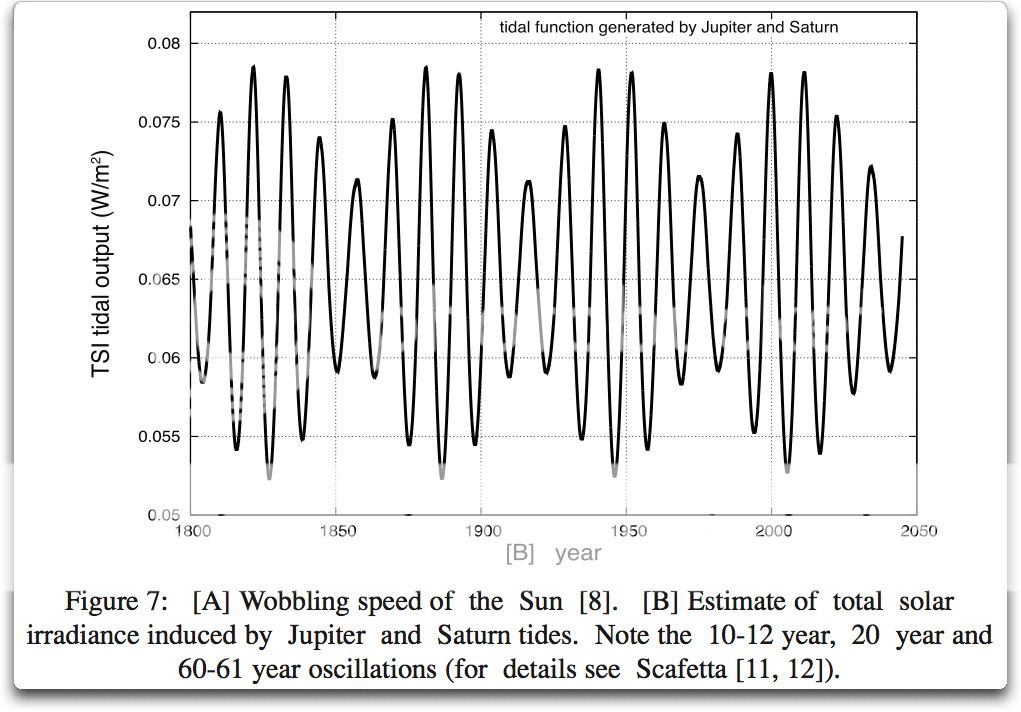
I wanted to comment on Figure 7b of the Scafetta work, viz:
The oddity about this is that it is a graph of the combined tidal effects of Jupiter and Saturn on the sun. But it is measured in units of total solar irradiance, that is to say “Estimated” watts per square metre … how he do dat?
Well, he doesn’t say how he do dat, does he. He refers you, as is his habit, to his previous work. Take a look there. If you can find anything in Scafetta [11, 12] that explains a conversion from gravitational force to total solar irradiance, I’m interested. I couldn’t find anything. In [12] he does say:
So perhaps the relationship is that

But somehow, the units seem a bit off, can’t put my finger on it …
These kinds of questions are what would be laid bare by Scafetta’s revealing of his data and his code. You’ll note that he claims that all is revealed … but we still don’t know how he sets the phases and amplitudes of his cycles. We still don’t know how he converts gravitational force into solar irradiance. There’s heaps of questions left unanswered … and meanwhile Scafetta is saying “If you had read my paper you would know that data and code are public.”
Well, no, Nicola, they’re not. We don’t have a single spreadsheet or computer program that you’ve used. We don’t have a single dataset that you used. We don’t know how you set the phase of the 9.1 year cycle, or the amplitudes of the rest. We don’t know how you produced the graphics.
And most of all, we don’t have the philosopher’s stone equation that miraculously transmutes the dross lead of tidal forces into the pure gold of total solar irradiance.
But heck, Nicola, if you think it’s all been revealed … then just take Joe Born’s test instead.
w.
Willis Eschenbach says:
July 25, 2013 at 10:19 am
——————-
Thanks. At my snail pace of examination I might have gotten there in the spring of next year if I was persistent. Still following this with significant interest. I’m hoping to find some hours this weekend to examine it further, so points of interest like this are most welcome in my book.
Clive Birkland says:
“Willis is not qualified to review papers concerning solar/planetary science.”
Says who? That is an assumption. What is it based upon? Unless you can give a good answer, it is a baseless assumption. But I can’t argue with what you say here:
“Science demands sufficient knowledge of the subject before peer review can be performed.”
Again, on what basis do you assert that Willis lacks sufficient knowledge of the subject?
I suggest you read A.W. Montford’s The Hockey Stick Illusion [available on the right sidebar] to get an understanding of what goes on behind the scenes during the climate peer review process. You will see why they call it “pal review”.
Or, you can read Prof R. Trebino’s more brief account of his peer review attempts here. Peer review isn’t anything like you describe it.
Kev-in-Uk says:
July 25, 2013 at 9:59 am
Are you trying to say that the astronaut is NOT in a gravitational field
Gravity is not a force at all, but the effect of curvature of spacetime. Now, spacetime is not something ‘absolute’ out there, but is local to every observer. For an observer in free fall her spacetime is locally flat, so no curvature, no gravity.
Willis Eschenbach says:
July 25, 2013 at 10:19 am
I wanted to comment on Figure 7b of the Scafetta work, viz:
The oddity about this is that it is a graph of the combined tidal effects of Jupiter and Saturn on the sun. But it is measured in units of total solar irradiance, that is to say “Estimated” watts per square metre
Regardless of how it was done [one could assign the proper units to the conversion factor to make the dimensions come out right], the fit is not even a reasonable approximation to the variations of TSI measured by other proxies [with the own units of conversion]. as is evident here: http://www.leif.org/research/Scafetta-Failure-Fig-7.png
Clive Birkland says:
Clive, I fear you suffer from a misconception, which is that some kid is not qualified to determine if the Emperor is clothed or naked as a jaybird …
One of the beauties of climate science is that no one can be an expert. The problem is that the climate is composed of seven inter-related systems—the atmosphere, the hydrosphere, the lithosphere, the biosphere, the cryosphere, the electrosphere, and the astrosphere. Most climate scientists are specialists in one of these realms.
Now one of these, the astronomical reality, has only a one-way influence on the climate. What happens with the climate doesn’t make the sun hotter or cooler, for example. But all the rest are intimately inter-related on all spatial and temporal scales, from the molecular to the planetary, and from nanoseconds to millennia. And anyone who says they are an expert in all of that is being less than economical with the truth.
This gives me a huge advantage in the field, because I’m a generalist. I’ve spent my life extending the breadth of my knowledge across all fields, rather than extending the depth of my knowledge in a single field.
So. Does my breadth of knowledge mean that I am “qualified” to review scientific papers on solar/planetary science?
The answer is, my knowledge and experience don’t matter in the slightest, Clive.
All that matters is, are my objections germane and defensible and true? Are the flaws that I point out real flaws? Are my logical deductions actually logical? Are my assertions butressed by citations and references? Is my work transparent and replicable?
Those are the only kinds of questions worth asking, not how do I dress or do I have a PhD or am I the head of some organization or do I have prior publications. I’m not asking you to take my objections on trust, for heavens sake.
I’m asking you to think about the objections and the issues I raise, and make up your own mind.
My best to you,
w.
PS—You don’t have to know much science to point out the use of a host of arbitrary parameters in a curve fitting exercise …
Leif Svalgaard says:
July 25, 2013 at 9:33 am
Now we’re getting somewhere, so there is a tidal force, wouldn’t there be a different path for every particle as they tried to follow a moving barycenter, as well as following the Sun’s CoG as it is also moving?
Additionally wouldn’t a mm tide at the Sun surface gravity equal a much larger tide on Earth at it’s surface gravity?
Ultimately, does this effect the operation of the Sun, and if the effects are in the core, how many thousands of years does it take for those effects to reach the surface (Willis this would make fitting the climate of today to the current planetary alignments furtile).
Let me add I appreciate your patience, I can only hope that something I say brings some value to this topic.
How Many Parameters are Fitted?
In my rummaging through Scafetta, I find this:
So … Scafetta found that using four arbitrary sine waves was not enough to reconstruct the global surface temperature record. Nothing daunted, he added two more “astronomical harmonics” of 115 and 983 years. He gives no justification of that choice, other than that they are “astronomical harmonics” … Their phase and amplitude are calibrated thusly:
As I said, he’s fitting the phase, not using the phase of an actual astronomical cycle.
But let’s take him at his word. He says that he only adjusted the amplitude …
So how many fitted parameters are in his model?
Well, he starts by detrending the data using a quadratic equation of the form
A X4 + B X3 + C X2 + D X + E
So that’s five arbitrary parameters right there. Then, he says he adjusts the amplitudes of the six cycles.
Finally, he has selected the six periods. Yes, he relates them to various things, but he’s chosen them freely, and in large part through a Fourier analysis of the data to be decomposed into sine waves. He’s picked different cycle lengths in the past, and they range from 9.1 years to 983 years, so obviously his choice of periods is not constrained in any manner.
So by Scafetta’s own count, we have no less than seventeen arbitrary parameters—five from the parameters used to “detrend” the data, six from the amplitudes, and six from the free choice of periods to include.
But wait, there’s more. He’s multiplied the average of the CMIP5 climate model ensemble’s estimate of the surface temperature by an arbitrary 0.45 … add one more parameter, that makes eighteen.
Finally, there’s what I called a “hidden” parameter above, when he combines his model with the CMIP5 climate model results. His inputs are all anomalies around some zero point, as the forces involved wax and wane. The CMIP5 models, on the other hand, have a zero point at their 1960-1989 average. So his sine-wave model results need to be adjusted vertically either up or down to agree with the CMIP5 model results. That takes one more arbitrary parameter.
So, IF Scafetta is not adjusting the phase of the six sine-wave components, but has freely chosen the periods and adjusted the amplitudes, there are nineteen arbitrary parameters in his model.
If, as his text suggests, he has fit the phase as well, then there are twenty-five arbitrary parameters in his model.
Now, all you folks out there that say that there are too many tunable parameters in the global climate models, I agree with you. But at least there’s lots of physics going on as well.
Scafetta doesn’t even have that going for him. All he has is Joseph Fourier, and a bunch of carefully selected sine waves involving a couple dozen tuned parameters …
So yes, Scafetta has indeed proven that Joseph Fourier was right—given a free choice of sine-wave numbers, cycle lengths, phases, and amplitudes, you can indeed get a pretty dang good replication of the historical global surface temperature.
You’ll excuse me if I fail to be impressed …
w.
PS—I still don’t understand the inclusion of the climate models. Fourier would be puzzled as well, as he proved you could do it with sine-waves alone, no need for anything else, models or not …
Willis, I’m reminded of the way you can tune a music synthesizer to reproduce just about any rhythm you want. Tunable parameters and cycles.

From: http://en.wikipedia.org/wiki/Synthesizer
Leif Svalgaard says:
July 25, 2013 at 10:31 am
“Gravity is not a force at all, but the effect of curvature of spacetime. Now, spacetime is not something ‘absolute’ out there, but is local to every observer. For an observer in free fall her spacetime is locally flat, so no curvature, no gravity.”
If I may, it would be like being inside the Vomit Comet. As the aircraft starts it’s free fall dive, everything inside falls at the same rate so to those INSIDE everything appears to be floating. If one holds a ball and lets go, it does not drop to the floor, again because it is falling at the same rate as the holder. Someone observing OUTSIDE he craft would see the craft and all inside falling from the effects of Earth’s gravity.
Willis, that quadratic fit should just be:
a x^2 + bx + c
So by Scafetta’s own count, we have no less than
seventeenfifteen arbitrary parameters. SO much better. 🙂[REPLY: True, I described a quartic fit, moving too fast, my error. Scafetta says:
I count three parameters.
Good catch, reduce the count by 2.
w.]
MiCro says:
July 25, 2013 at 11:44 am
Now we’re getting somewhere, so there is a tidal force, wouldn’t there be a different path for every particle as they tried to follow a moving barycenter, as well as following the Sun’s CoG as it is also moving?
The tides at the Sun would be caused by Jupiter [and Saturn], not by the barycenter [and it is not the sun trying to follow a moving barycenter, but the barycenter moving around corresponding to where the Sun and the planets are]. The tidal force would be given by the difference of the gravitational field caused by Jupiter [to stay Newtonian for simplicity] from one solar particle to the next. That difference is thousands of times smaller than the distance to Jupiter so is tiny indeed [raising millimeter-size tides], meaning that the difference in gravitational fields on two solar particles is billions of times smaller than the gravitational field from Jupiter upon the Sun.
Additionally wouldn’t a mm tide at the Sun surface gravity equal a much larger tide on Earth at it’s surface gravity?
The Sun’s surface gravity is 27 times larger than the Earth’s, but I do not understand your question. What matters is not the surface gravity of either. The Sun’s diameter is 100 times larger than the Earth’s so the tides on the Sun raised by Jupiter would be 100 times larger than the tides raised by Jupiter on the Earth.
Ultimately, does this effect the operation of the Sun, and if the effects are in the core, how many thousands of years does it take for those effects to reach the surface (Willis this would make fitting the climate of today to the current planetary alignments furtile).
This does not affect the Sun significantly, and by the way, the tides disappear when you go to the center. If the energy generation would be affected it would take about 200,000 years for that change to influence the surface [and the Earth].
Let me add I appreciate your patience, I can only hope that something I say brings some value to this topic.
All of this has already been explained extensively here at WUWT. Try to search some of the older postings.
In Dr. Scafetta’s paper in Figure 5 A he shows a 61 year sine modulation in respect to the global temperature minus its quadratic fit curve.
There are two real astronomic functions of A = 59.3 years and B = 63.6 years. In the years 1800 to 2100 these astronomical functions are near in phase corresponding to an average time period of 61.45 years and in phase with hadcrut4 oscillation:
http://www.volker-doormann.org/images/period_61year.gif
But the two functions A and B are not related to Jupiter/Saturn harmonics.
This shows that it is a better way to take the real astronomical functions instead of a stupid sine function and defined starting point.
Maybe in my next life people have understood the simple climate code and have proper climate predictions.
V.
Anthony,
why you do not want that people know what I wrote?
Willis is writing a lot of falsehoods and non-senses.
For example, above he wrote
Willis Eschenbach says: July 25, 2013 at 11:45 am
*******
Well, he starts by detrending the data using a quadratic equation of the form
A X4 + B X3 + C X2 + D X + E
*******
Anthony, let me know. How can the above function written by Willis be “quadratic”? It contains both a four and a third order power: X^4 and X^3.
And in addition I never use such 4-order function.
Who do you think to convince?
Those who will read my papers with the purpose to understand them will easily find it out.
Don’t you think?
REPLY: You can submit a comment, just don’t try to tell me what I said/wrote when your interpretation isn’t what I actually said.
My view is that you are becoming overly emotional trying to defend your work. So far I have not seen any solid defense. If you want to convince people, may I suggest you answer Willis’ questions of how you came to justify using some of the periodic numbers or “astronomical harmonics” of 115 and 983 years. Just saying they are beat of the Schwabe cycle aren’t enough. I can find harmonics in just about any signal, the question is why are they relevant.
While I would admit that it would be elegant if temperature on Earth was indeed governed by “music of the spheres” like Willis, every time I look into it I find that it is little more than a constructed illusion, much like the strained second law arguments of “the slayers”.
– Anthony
Leif Svalgaard says:
July 25, 2013 at 12:06 pm
{ Tom in Florida says:
July 25, 2013 at 12:01 pm
If one holds a ball and lets go, it does not drop to the floor, again because it is falling at the same rate as the holder. Someone observing OUTSIDE he craft would see the craft and all inside falling from the effects of Earth’s gravity. }
Leif:
Using Tom’s analogy of the “vomit comet”, people and objects inside the falling plane are in freefall, but outside the exterior shell of the aircraft, gravity affects the plane. So what is the outside structure of the sun’s Freefall environment. ie. When you say that the sun is in freefall, what is the outer limit of that effect. Is it a discrete interface, or a smoothing of the solar particle-space interface?
I can’t picture that in my mind.
Leif Svalgaard, Willis Eschenbach don’t have any understanding of thresholds and why sometimes solar changes will result in a major climate change ,while at other times they will not. Many times solar changes are not to a degree of magnitude great enough to flip the climate into another climatic regime, or even be the dominate factor in promoting which way the climate may go. They can’t grasp that simple fact, and therefore reach all bogus conclusions, when it comes to solar /climate relationships.
You will both however be proven wrong before the decade ends.
Nicola Scafetta , is more with it but is still lacking.
Nicola Scafetta does not understand thresholds (abrupt climate change),does not understand(like his counterparts) how sometimes solar changes might cause a major climatic shift while at other time hardly any.
He does not understand the beginning state of the climate will give a different end result even if the same forcings are applied to the climate.
Does not understand all the secondary effects which will come from a long prolonged solar minimum period.
He tries to fit everthing into a neat cycle, and thinks climate change is slow and gradual ,inspite of all the past evidence to the contary.
He still buys into the greenhouse gas effect (ridiculous) as a factor in the determination of the climate, when the reality is the greenhouse gas effect is a product of the climate.
The state of climate science is a mess and all of you three have made major contributions, to the mess.
Tim Clark says:
July 25, 2013 at 12:33 pm
Using Tom’s analogy of the “vomit comet”, people and objects inside the falling plane are in freefall, but outside the exterior shell of the aircraft, gravity affects the plane.
Not really: if you were flying in another plane following the first the objects in that other plane would also not fall to the floor. Imagine there were millions of such planes, objects in all of them would not fall. Connect the planes by a tube and they would make one huge structure with no gravity. Expand the tubes to fill all of space and then everywhere there would be no gravity. No gravity is the default conditions. It is only when we put obstacles in the path of the fall that it ceases to be free.
So what is the outside structure of the sun’s Freefall environment. ie. When you say that the sun is in freefall, what is the outer limit of that effect. Is it a discrete interface, or a smoothing of the solar particle-space interface?
Since nobody puts obstacles in the path of the Sun’s free fall, there are no interface or limits or smoothing or other strange things.
I can’t picture that in my mind.
consider my example with the millions of planes…
Salvatore Del Prete says:
July 25, 2013 at 12:40 pm
The state of climate science is a mess and all of you three have made major contributions, to the mess.
But now comes Salvatore to the rescue, true to his name. At least he does not suffer from cyclomania, but rather from acute alarmism. I’m not sure which is worst.
Again answers will be answered before this decade ends. I say make your arguments and stick to them , and then face up to being wrong when that time comes.
As we can see the AGW community keeps trying to come up with excuses for their failed AGW theory from the heat is in the deep oceans, to it’s the lack of Arctic Ice which is causing snowier winters /a more neg. AO.
They forecasted a much more +AO going forward. They are so full of it.