In the post Trenberth Still Searching for Missing Heat, we discussed the recent Balmaseda et al (2013) paper “Distinctive climate signals in reanalysis of global ocean heat content”, of which Kevin Trenberth was a coauthor.
Dr. Roy Spencer also has a recent post on that paper. I’ve cross posted Roy’s post following this introduction. Roy Spencer argues that it is possible for the oceans to warm to depth, while the surface temperatures remain flat, but… (No spoiler from me. You’ll have to read Roy’s post.)
Roy does note that arguments about continued ocean warming to depth “…depend upon global deep ocean temperature changes being measured to an accuracy of hundredths or even thousandths of a degree…”. That’s why all of the adjustments to the ocean heat content data are so critical to this discussion.

Figure 1
If we were to consider the “unadjusted” ocean heat content data (represented by the UKMO EN3 data in Figure 1) to be correct, then the ocean heat content for depths of 0-2000 meters flattened as soon as the ARGO floats had reasonably compete coverage of the global oceans in 2003-04. It’s only when the ocean heat content data is corrected, tweaked, adjusted, modified, whatever (represented by the NODC data in Figure 1), that the global ocean heat content continues to warm in relative agreement with climate models.
START OF ROY SPENCER’S POST
More on Trenberth’s Missing Heat
April 8th, 2013 by Roy W. Spencer, Ph. D.
While I don’t necessarily buy Trenberth’s latest evidence for a lack of recent surface warming, I feel I need to first explain why Trenberth is correct that it is possible for the deep ocean to warm while surface warming is seemingly by-passed in the process.
Then I will follow up with observations which run counter to his (and his co-authors’) claim that an increase in ocean surface wind-driven mixing has caused the recent lack of global warming.
Can Deep Ocean Warming Bypass the Surface?
It depends on what one means by “warming”. A temperature change is the net result of multiple processes adding and subtracting heat. Warming of the deep ocean originally caused by radiative forcing of the climate system cannot literally bypass the surface without some effect on temperature. But that effect might be to keep some cooling process from causing an even steeper dive in temperature.
It’s like adding a pint of warm water, and a gallon of cold water, to a sink full of room temperature water. Did adding the pint of warm water cause the temperature in the sink to rise?
To appreciate this, we first need to understand the basic processes which maintain the vertical temperature distribution in the global oceans. The following cartoon shows a North-South cross section of measured ocean temperatures in the Atlantic.

The average temperature distribution represents a balance between 3 major processes:
(1) surface heating by the sun (mitigated by surface evaporation and infrared radiative loss) which warms the relatively shallow ocean mixed layer;
(2) cold deepwater formation at high latitudes, which slowly sinks and fills up the oceans on time scales of centuries to millennia, and
(3) vertical mixing from wind-driven waves, the thermohaline circulation, and turbulence generated by flow over ocean bottom topography (the latter being partly driven by tidal forces).
The key thing to understand is that while processes (1) and (2) continuously act to INCREASE the temperature difference between the warm mixed layer and the cold deep ocean, the vertical mixing processes in (3) continuously act to DECREASE the temperature difference, that is, make the ocean more vertically uniform in temperature.
The average temperature distribution we see is the net result of these different, competing processes. And so, a change in ANY of these processes can cause surface warming or cooling, without any radiative forcing of the climate system whatsoever.
So, let’s look at a few ocean mixing scenarios in response to radiative forcing of the climate system (e.g. from increasing CO2, increasing sunlight, etc.), all theoretical:
Scenario 1) Warming with NO change in ocean mixing: It this case, surface warming is gradually mixed downward in the ocean, leading to warming trends that are a maximum at the ocean surface, but which decrease exponentially with depth.
Scenario 2) Warming with a SMALL increase in ocean mixing. This case will result in weaker surface warming, and slightly stronger warming of the deep ocean, both compared to Scenario 1. The warming still might decrease exponentially with depth.
Scenario 3) Warming with a LARGER increase in ocean mixing. This case could lead to an actual surface temperature decrease, but warming of the deep ocean, similar to what I believe Trenberth is claiming.
Yes, the surface waters “warmed” before the deep ocean in Scenario 3, but it was in the form of a weaker temperature drop than would have otherwise occurred.
Because of the immense heat capacity of the deep ocean, the magnitude of deep warming in Scenario 3 might only be thousandths of a degree. Whether we can measure such tiny levels of warming on the time scales of decades or longer is very questionable, and the new study co-authored by Trenberth is not entirely based upon observations, anyway.
I only bring this issue up because I think there are enough legitimate problems with global warming theory to not get distracted by arguing over issues which are reasonably well understood. It takes the removal of only one card to cause a house of cards to fall.
But it also points out how global warming or cooling can occur naturally, at least theoretically, from natural chaotic variations in the ocean circulation on long time scales. Maybe Trenberth believes the speedup in the ocean circulation is due to our driving SUVs and flipping on light switches. He has already stated that more frequent El Ninos are caused by anthropogenic global warming. (Except now they are less frequent — go figure).
In some sense, natural global warming and cooling events are made possible by the fact that we live within an exceedingly thin warm surface “skin” of a climate system in which most of the mass (the deep ocean) is exceedingly cold. Any variations in the heat exchange between those two temperature worlds (such as during El Nino with decreased mixing, or La Nina with increased mixing) can cause large changes in our thin-skinned world. It that sense, Trenberth is helping to point out a reason why climate can change naturally.
Have Ocean Winds Increased Recently?
Trenberth and co-authors claim that their modeling study suggests an increase in ocean surface winds since 2004 has led to greater mixing of heat down into the ocean, limiting surface warming.
Fortunately, we can examine this claim with satellite observations. We have daily global measurements of ocean surface roughness and foam generation, calibrated in terms of an equivalent 10 meter height wind speed, from AMSR-E:

I don’t know about you, but I don’t see an increase in surface winds since 2004 in the above plot. This plot, which is based upon wind retrievals that have been compared to (as I recall) close to 1 million buoy observations, really needs to be extended back in time with SSM/I and SSMIS data, which would take it back to mid-1987. That’s on my to-do list.
So far, I would say that the so-called missing heat problem is not yet solved. I have argued before that I don’t think it actually exists, since the “missing heat” argument assumes that feedbacks in the climate system are positive and that radiative energy is accumulating in the system faster than surface warming would seem to support.
For the reasons outlined above, Trenberth’s view of deep ocean storage of the missing heat is still theoretically possible since increased vertical ocean mixing doesn’t have to be wind-driven. But I remain unconvinced by arguments that depend upon global deep ocean temperature changes being measured to an accuracy of hundredths or even thousandths of a degree.
Finally, as I have mentioned before, even if increased rate of mixing of heat downward is to blame for a recent lack of surface warming, the total energy involved in the warming of the deep oceans is smaller than that expected for a “sensitive” climate system. Plots of changes in ocean heat content since the 1950′s might look dramatic with an accumulation of gazillions of Joules, but the energy involved is only 1 part in 1,000 of the average energy flows in and out of the climate system. To believe this tiny energy imbalance is entirely manmade, and has never happened before, requires too much faith for even me to muster.

END OF DR. SPENCER’S POST
Back to Roy’s statement, “But I remain unconvinced by arguments that depend upon global deep ocean temperature changes being measured to an accuracy of hundredths or even thousandths of a degree”:
First consider that the ARGO floats have had “complete” coverage of the global oceans since 2007. The Earth’s oceans and seas cover about 361 million square kilometers or 139 million square miles. There were 3566 ARGO floats in operation in March 2013. If the floats were spaced evenly, then each ARGO float is sampling the temperature at depth for a surface area of approximately 101,000 square kilometers or 39,000 square miles—or an area about the size of Iceland or the State of Kentucky.
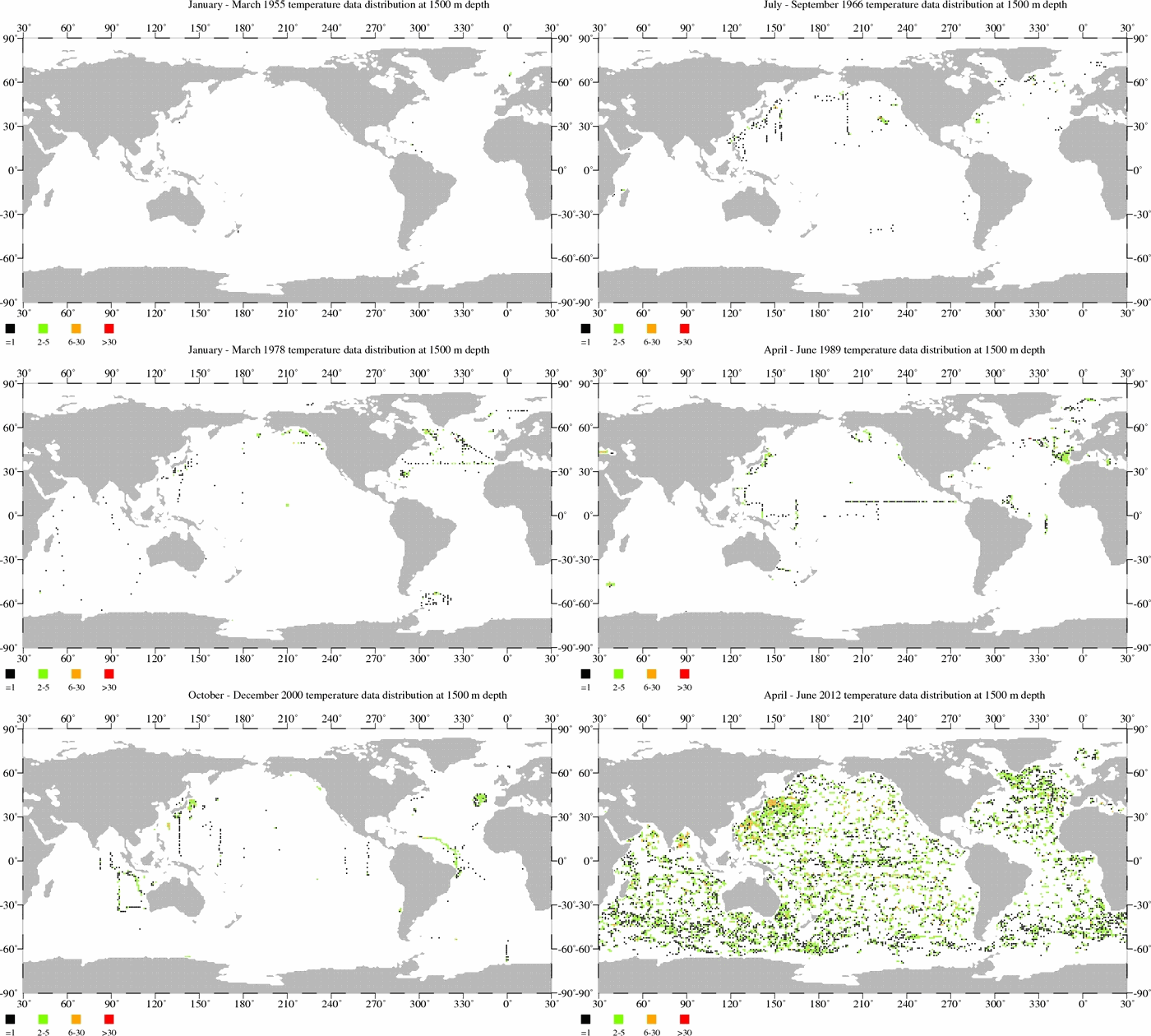
Second, consider that the ARGO era is when the sampling is at its best, but before ARGO temperature sampling at depth was very poor. Refer to the following animation. Temperature sample maps at 1500 meters (6MB). There is little observational data at depths of 1500 meters prior to ARGO. In other words, we have little idea about the temperatures of the global oceans to depths of 2000 meters and their variability before ARGO.
Third, on top of that, consider that ARGO floats have been found to be unreliable, hence the need to constantly readjust their observations.
Do we have any idea about the variability of the temperatures and ocean heat content of the global oceans to depth? Simple answer: No.
For more information on the problems with Ocean Heat Content data, refer to the post Is Ocean Heat Content Data All It’s Stacked Up to Be? and NODC’s Pentadal Ocean Heat Content (0 to 2000m) Creates Warming That Doesn’t Exist in the Annual Data – A Lot of Warming.
john robertson says:
April 15, 2013 at 5:51 pm: “…But what do we really know about the actual number and intensity of volcanic activity under the seas?Volcanic smoker vents? Who knew before their discovery?…”
1. A lot. There are essentially three sources of volcanic heat to the ocean: the material being accreted to the sea floor at the mid-ocean ridges annually; discrete seamounts (individual volcanic edifices; think Hawaii); and volcanic arcs forming above oceanic island arcs. The first of these is probably the biggest contributor, with some amount of material intruded/extruded at a temperature of around 1100 C (the first two sources are primarily basaltic in composition and that’s about the T of a basaltic melt). The ridges measure around 40,000 miles in length. One could make a calculation of the amount of heat contained in the annual volume of material added. I suspect it pales in significance to the volume of the ocean, filled with material having the greatest heat capacity of any widely-occuring material – i.e., water.
2. Volcanogenic massive sulfide deposits have been important sources of copper, zinc, iron and precious metals for centuries. In the 1970s, in particular, these were recognized as having been deposited by sea floor hydrothermal (hot water) systems. The idea that there would be similar deposits in the mid-ocean ridges was floating around since at least the 1980s (in fact, there are some examples of copper-rich black smokers incorporated in obducted sea floor in a number of places – Oregon, Cyprus and elsewhere). We have found numerous black smokers (mostly pyrite and relatively small); now we actually have some examples of cupriferous massive sulfide deposits in formation in a ridge (one offshore Oregon/Washington). The biggest of these deposits are typically Archaean in age (>2.7 billion years) but they occur in rocks of all ages. Younger, economically important versions are the Kuroko deposits of Japan – although these younger versions are small in comparison to Archaean supergiants like Kidd Creek in Ontario.
David Aronstein says:
April 15, 2013 at 6:13 pm
I didn’t check your math, but assuming it’s correct; increasing the average temperature of the world’s oceans by 1*C would mean a warming of 50%. The average temperature being ~2*C.
I may be wrong, but I think you’d be hard pressed to find a temperature increase of that magnitude on that time scale anywhere in the paleo record. It’s huge.
JP
Anymoose says:
April 15, 2013 at 11:31 am
“I have seen no “proof” that there is such a thing as greenhouse gas.”
If water vapor weren’t a greenhouse gas, you wouldn’t be alive to make that statement.
Arrhenius proved CO2 was a greenhouse gas 120 years ago. JP
Anymoose says:
April 15, 2013 at 11:31 am
By the way, you can buy a handheld thermometer for $350 that will make measurements to 0.005*C. Scientists are using quantum mechanics to make measurements to one part in a million.
You might want to look at some of the problems associated with such an endeavor. The important thing for scientists is not to measure absolute temperatures, but rather to make reproducible measurements. In other words if your thermometer says 0 degrees, mine should say the same thing making the same measurement.
JP
JP
Please check page 1005 of the URL http://publishing.cdlib.org/ucpressebooks/view?docId=kt167nb66r&chunk.id=d2_9_ch20&toc.id=d2_9_ch20&brand=eschol . Calcium carbonate does not dissolve easily. If you check the chart on page 1005, you will find that the bulk of it is dissolved at between 2000 meters and 5000 meters down in the Ocean. Each mole of calcium carbonate requires 12.3 kilojoules to attach the water molecules and become hydrated. This heat is removed from a cold ocean and makes the deep ocean even colder.
If you need to better understand hydration reactions and heat of hydration, check this URL http://www.docbrown.info/page07/delta2H.htm
Retired Engineer John says:
April 15, 2013 at 7:52 pm
Interesting, John. Do you know what constrains that reaction? Temperature? JP
John Parsons says: April 15, 2013 at 8:04 pm “Do you know what constrains that reaction.”
It is a combination of temperature and pressure.
Bob Tisdale,
Bob, Have to thank you for the link to the video “Verification of regional model trends”, over at RealClimate. I just didn’t get it until I saw that.
I have an internal ranking system for “true skeptics”. If I don’t see commenters asking questions at RC, Climate Etc., Tamino and WUWT; they get a lower rating, than those who only appear at one.
Thanks Again, JP
Retired Engineer John says:
April 15, 2013 at 8:17 pm
Thanks John, kind of figured it wasn’t chemical. So, given the constant pressure, that reaction must be in a sort of equilibrium. Yes? In your opinion, is the heat that Trenberth speaks of great enough to be sequestered chemically for long (geologic) periods of time. Or would the equilibrium just oscillate due to upwelling/mixing etc. JP
Pressure rules!
The super-heated water from interaction with the Earthly goo travels straight up and diffuses outward with decreasing pressure; not heating the surface or the bottom.
Can you imagine what life would be like in a truly 3D world? i.e. instead of just surface with height;
tickles my brain.
btw: did not know about the hydration but it makes sense as with the clathrates; i love learning thanks RE John.
Sea salt water has a lower specific heat than pure water because of its salt content. 4.0 rather than 4,186 joules per gram per degree C. It also does not have a maximum density at 4 degrees C. The density of sea salt water increases to its freezing point at about – 1.8 degrees C.
The flow rate of the THC is about 0.47 zeta grams of salt water per year so to pump 8 zeta joules per year to the ocean depths would require a temperature change of 8/4x.47 = 4.2 degrees C
per pass. Bearing in mind that sea surface temperature is about 16 degrees C and sea depth temperature is around 2 degrees C, a temperature change per pass of 4.2 degrees C does not seem unreasonable. If the THC increases because of extra rainfall, obviously the temperature change per pass does not need to be as high as 4.2.
I am not a cartoonist, just a retired chemical engineer looking for the truth.
The maximum density of water is not at zero nor is a brine solution maximal at -1.8 C. One of us has not checked the tables or noticed that ice floats…it must be me since i have no accolades nor can i retire; except from unemployment and what are the odds of that XD
http://solutionsguide.tetratec.com/index.asp?Page_ID=728&AQ_Magazine_Date=Current&AQ_Magazine_ID=2205
The surface temp of the ocean varies from -1.8 to 38 C. Heat is transferred to the atmosphere in the North Atlantic and from the atmosphere in the Indian Ocean principally with respect to the THC. I postulate an increase in the THC is the result of increased conveyance of thermal energy to and fro.
Extra rainfall cannot add to the THC due to a lack of density, fresh water simply cannot play that way.
John Parsons says “Thanks John, kind of figured it wasn’t chemical. So, given the constant pressure, that reaction must be in a sort of equilibrium. Yes? In your opinion, is the heat that Trenberth speaks of great enough to be sequestered chemically for long (geologic) periods of time. Or would the equilibrium just oscillate due to upwelling/mixing etc.”
The hydrated calcium carbonate is a chemical compound. Some of the hydrate undergoes further chemical changes into Ikaite,also a stone with a name starting with an “O”(I don’t remember the name something like Ooakole) as well as other compounds. However, some does stay in solution and will release it’s heat when it is brought to the surface. This release of heat seems to violate the second law of thermodynamics, but it doesn’t since the thermal energy is converted to chemical energy and back to thermal energy. Hydrates have been used for heat storage and release. Calcium chloride with it’s high heat of hydration has been used in some of these systems. When the hydrate is heated above a trigger temperature, it will release the heat that it has absorbed. The basic reaction of carbon dioxide and calcium hydroxide removes about 1600 kilojoules of energy from the ocean foe each mole of calcium carbonate formed.. This is often a permanent sequestration as the calcium carbonate that is not dissolved forms limestone and similiar rocks on the ocean floor.
Robert Shaw says “Sea salt water has a lower specific heat than pure water because of its salt content.”
Robert, you might want check your statement against a chemistry text. You will find that sea water has a higher specific heat.
I will try to check that, John. Can you give a lead?
Cheers
Rob
Rosco says:
If Trenberth wants his theory about the warming hiding in the deep ocean to be believable he needs to elaborate a mechanism for this and also to elaborate why it did not occur during the obvious decades of surface warming.
And somewhat more pointedly, why a slowdown in that sequestration of heat into the deep ocean – or in fact a return of some heat therefrom – was not the predominant cause of the obvious decades of surface warming.
Don’t hold your breath. They don’t have a comprehensive and testable theory of climate. They have a religious belief, and a penchant for ad hoc apologetics therefor.
Retired Engineer John, Regarding your endothermic reaction: If there is an endothermic reaction of the hydration of calcium carbonate going on in the deeps is there a complimentary exothermic reaction going on somewhere? If a sample of water is brought up from the depths will it heat slightly? Does limestone heat very slightly as it weathers or dehydrates? I certainly know that limestone bubbles if you treat it with vinegar and I’ve read that it also produces a little heat. My next question would be, is that biochemical heat deriving from the creatures that produce limestone or is it the endothermic heat you mention?
Thanks John, very interesting. JP
While it is true that detecting the movement of thermal energy into the deep oceans requires measurements resolving just a few hundredths of a degree in the temperature gradient over 2000m there is another very obvious indicator of the thermal energy held in the oceans.
The thermal expansion of the oceans is a direct measure of the extra thermal energy they have absorbed. GRACE satellite data enables the hydrological cycle to be followed and shows where the water has moved. Despite increased rainfall moving water from the oceans to land reservoirs it is clear there has been expansion of the oceans entirely consistent with significant amounts of extra energy from the rising CO2 being moved to the deeps.
Correct me if I am wrong here but if the 4C of the deep ocean becomes 4.001C how is it going to make the Earths atmosphere hotter. Heat content and temperature are two different animals.
It is the surface temperature of the oceans that warm the atmosphere and not the depths in Davy Jones locker.
izen
‘ Despite increased rainfall moving water from the oceans to land reservoirs ‘
I suggest you review how the ‘water cycle ‘ works and much like the ‘missing heat’ there is much about ocean expansion that is more myth than fact.
@- wayne Job
“Correct me if I am wrong here but if the 4C of the deep ocean becomes 4.001C how is it going to make the Earths atmosphere hotter.”
The more energy that moves into the deep oceans the slower the surface warms.
@-“Heat content and temperature are two different animals.”
But closely related by the specific thermal capacity of a substance.
John Parsons says: April 15, 2013 at 8:32 pm “I have an internal ranking system for “true skeptics”. If I don’t see commenters asking questions at RC, Climate Etc., Tamino and WUWT; they get a lower rating, than those who only appear at one.”
That’s a bit harsh. Some of us have very little worth saying and so don’t say as much.
Personally, I’m more likely to appear at the Guardian website (or Bishop Hill) as my knowledge of UK culture and politics is far better than my knowledge of Bayesian statistics.
Why should I go to Tamino and McIntyre and say something brash like “I can’t see how Bayesians don’t just beg the question”? That would make me rude, arrogant and openly stupid.
Why would I be open about it?
JP – What criteria do you rank “true skeptics” on? And why?
HankHenry says: April 16, 2013 at 12:24 am
“Regarding your endothermic reaction: If there is an endothermic reaction of the hydration of calcium carbonate going on in the deeps is there a complimentary exothermic reaction going on somewhere?”
As rainwater absorbs carbon dioxide falling to the Earth, it forms a weak carbonic acid. This weak acid dissolves limestone in the soil and releases heat. There are a series of reactions and the final product is the calcium hydroxide in the ocean. This is the corresponding exothermic reaction that releases heat and the heat is released in the Earth’s soil.
” If a sample of water is brought up from the depths will it heat slightly?”
The water will release the heat of hydration as the calcium carbonate hydration process is reversible.
” Does limestone heat very slightly as it weathers or dehydrates? I certainly know that limestone bubbles if you treat it with vinegar and I’ve read that it also produces a little heat.”
Limestone is not hydrated; it does produce heat as it is dissolved by an acid.
” My next question would be, is that biochemical heat deriving from the creatures that produce limestone or is it the endothermic heat you mention?”
Calcium carbonate is produced by two different ways: Living creatures in the ocean use photosynthesis to create calcium carbonate. The 1600 kilojoules of energy is supplied by the sun. That energy is removed from entering the ocean by converting thermal energy to chemical energy. The second process is a direct chemical reaction between carbon dioxide dissolved in the ocean and calcium hydroxide in the ocean. The ocean is super saturated with calcium hydroxide and has a plentiful supply of carbon dioxide; however, the reaction is inhibited by magnesium. When the ocean reaches 30.3 C, the critical point for carbon dioxide, something happens and the process is spontaneous. I have read an account, that I cannot find, about the tropical ocean bubbling on a warm night. These two processes cool the ocean.