UPDATES have been added: see below. Not only does Tobis have bupkis, he’s been caught out in a Janus moment from 2010 where he says the exact opposite. – Anthony
I wrote a post yesterday pointing out how a WWF zealot immediately linked a heavy snowfall event in Moscow, Russia to ‘global warming’. Marc Morano of Climate Depot pointed out this hilarity at the secular Tobis Planet 3.0 blog in an email: Warmist Tobis says heavy snow is agw: calls anyone who mocks ‘clueless’ Logic Fail Logic Fail
Here’s what Tobis thinks:
It is interesting that most deniers seem to live in warm climates.
They cannot conceive of the possibility that unusually heavy winter snow is connected with less than usual winter cold in cold zones, something that pretty much all of us who grew up in frigid zones understand perfectly well. They are so confused that they find this perfectly ordinary fact of mundane reality grounds for mockery.
It’s quite a spectacle.
(Igloos in DC are another matter. A rare snow event in a non-snowy zone is not evidence of a warming trend. Of course, there’s more to climate disruption than just warming, but at least they are making some semblance of sense in that case, at least polemically, as the relationship is a bit complicated.)
But to mock a connection between heavy snow in February in Moscow and global warming is pretty much clueless.
![michael_tobis-medium[1]](http://wattsupwiththat.files.wordpress.com/2013/02/michael_tobis-medium1.jpg?quality=83 "Michael Tobis")
 So, let’s look at some data.The popular warmist theory is that reduced summer sea ice causes the enhanced snow effect, and that sea ice reduction is caused by global warming, but it isn’t cut and dried proof. Then there is the months-long lag problem between reduced sea ice and weather.Dr. Judith Curry has discussed the science in her paper from Georgia Tech here: http://judithcurry.com/2012/03/05/impact-of-declining-arctic-sea-ice-on-winter-snowfall/ (h/t to Mosher)Joe D’Aleo also posted a critique to the Liu and Curry paper on WUWT here:http://wattsupwiththat.com/2012/03/02/increasing-winter-cold-in-recent-years-and-the-arctic/From a previous WUWT essay by Willis Eschenbach, who points out that neither essay compared sea ice and snow area, I repost this graph. Readers (and Tobis too) should find the correlation between Arctic sea ice and Snow area.

Figure 2. Arctic sea ice area (blue) and Northern Hemisphere snow area (red). Upper panel shows actual data. Lower panel shows the anomalies of the same data, with the same units (note different scales). The R^2 of the snow and ice anomalies is 0.01, meaninglessly small. The R^2 of the first differences of the anomalies is 0.004, equally insignificant. Neither of these are significantly improved by lags of up to ± 6 months. SNOW DATA ICE DATA
Willis wrote then:
I’m not going to say a whole lot about this graph. It is clear that in general the arctic ice area has been decreasing for twenty years or so. It is equally clear that the northern hemisphere snowfall has not been increasing for the last twenty years. Finally, it is clear that there is no statistical relationship between decreased ice and increased snow.
Speaking of statistical relationships, here’s a couple.
The graph below plots annual snowfall vs December to April temperature, for all Colorado USHCN stations which have been continuously active since at least 1920.

The Colorado USHCN Stations plotted are:
BOULDER, CANON CITY, CHEESMAN, CHEYENNE WELLS, DEL NORTE 2E, DILLON 1 E, EADS, FT COLLINS, FT MORGAN, FRUITA, GUNNISON 3SW, HERMIT 7 ESE, LAMAR, LAS ANIMAS, MANASSA, MONTROSE #2, ROCKY FORD 2 SE. STEAMBOAT SPRINGS, TRINIDAD, and WRAY
And for those that would say that is too small a sample size, let’s take it up a notch. Below is all USHCN station temperatures for December-April in the CONUS versus snowfall.

Here is all USHCN stations annual temperature in the CONUS versus snowfall.

Clearly snowfall increases with decreased temperature. The three graphs above were plotted by Steve Goddard.
But back to Tobis’ main point, in which is he’s claiming (bold mine):
They cannot conceive of the possibility that unusually heavy winter snow is connected with less than usual winter cold in cold zones, something that pretty much all of us who grew up in frigid zones understand perfectly well. They are so confused that they find this perfectly ordinary fact of mundane reality grounds for mockery.
Well, there’s data for that question too.
![tn27612_1yr[1]](http://wattsupwiththat.files.wordpress.com/2013/02/tn27612_1yr1.gif)
Note the middle graph in particular, showing below normal temperatures to the present. All temperatures in Celsius.
Source: http://www.cpc.ncep.noaa.gov/products/global_monitoring/temperature/tn27612_1yr.gif h/t to WUWT reader “J”.
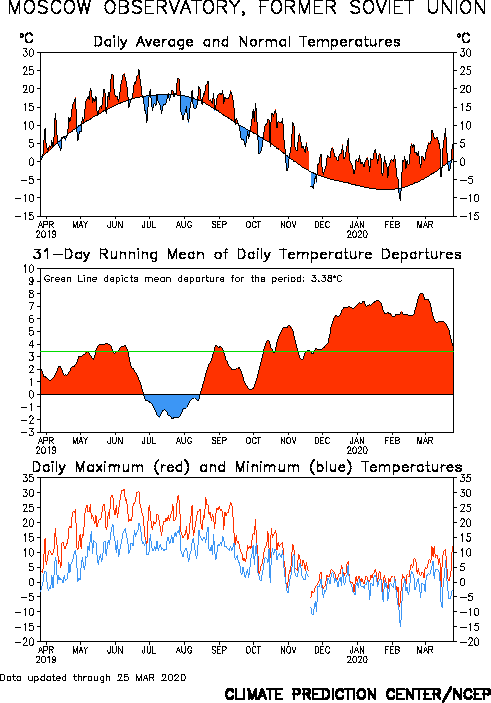
It really is rather hard to make a claim that “global warming did it” when data says otherwise.
So other than an angry rant basically saying “global warming caused it cuz we say it does”, what has Tobis got in the way of a factual argument? Where is his supporting data? And he didn’t answer the question: “If global warming caused this snowfall event, what caused the heavy snow 100 years ago when CO2 levels were below Hansen’s “safe” 350ppm?”
His two commenters didn’t answer the question either. They also offered no supporting data.
They and Tobis (and the WWF zealot with the original comment) have bupkis.
For the record I grew up in the midwest, and faced the great blizzard of 1978 with its exceptionally cold temperatures and huge snowfalls, plus the Chicago Blizzard of 1979 (to name a couple I experienced firsthand). Tobis and friends seem to think that living in Northern California now somehow disqualifies me from understanding snow and temperature. That’s probably the lamest argument ever put forth by that guy. Imagine if I made the same argument because Tobis lives in Austin, TX. where “snowfall is rare“.
Should you care to visit Tobis’ blog, here’s the link: http://planet3.org/2013/02/05/logic-fail-logic-fail/
Good luck trying to get a factual word in.
Sidebar: The WWF zealot (Kokorin) who made the claim about AGW and snow in the original newspaper article has an interesting view of the world. See this comment from WUWT Larry Huldén
Larry Huldén says:
Alexei Kokorin, director of the climate and energy program at WWF Russia, is the same person who claimed that malaria never occurred in Russia before late 20th century warming. He claimed that malaria for the first time entered Russia because of global warming in 1990′s.
That checks out, see this NPR story: Russian Scientists Fear Warming May Bring Disease
Mr. KOKORIN: (Through translator) There were no registered cases of malaria in the Moscow region until the 1970s. Since then, we’ve seen 400,000 cases of so-called three-day malaria. That’s like a bad flu for healthy adults but can be very serious for children and the elderly. It’s far too many cases.
Three day Malaria? Must be the Vodka.
But the truth about the cause says otherwise, from the World Health Organization report on Malaria in Russia (which they almost eradicated in the 1960s) here.
Profound socioeconomic changes in the newly independent states (NIS) in the 1990s had a negative impact on the malaria situation in the Russian Federation. Epidemics in Azerbaijan and Tajikistan in the early 1990s, along with intensive population movement from these countries into the Russian Federation, brought about an increase in malaria cases.
Not one mention of warming or temperature in that article, only socioeconomic causes.
Looks like the WWF zealot has bupkis too.
UPDATE: Within a few minutes of publication Mr. Tobis posted a rebuttal comment here (because unlike his blog, it is easy to post a comment here immediately) that said:
mtobis (@mtobis) says:
You’re missing the point. Obfuscation aside, the point is that excessive February snow in Moscow means that February in Moscow is more likely to be anomalously warn than anomalously cold. Which you ought to know.
Here is my reply:
Tobis writes: “February in Moscow is more likely to be anomalously warn[sic] than anomalously cold.”
But it isn’t, the data I presented from the Moscow Observatory shows a below normal temperature in January into February. And, this is a single event we are talking about in the newspaper article, not a trend, not a long term climate issue.For more on snow and temperature see this: http://ww2010.atmos.uiuc.edu/%28Gh%29/guides/mtr/fcst/prcp/rs.rxml
The claim about this snow event being driving by AGW is the same logical fallacy you and your buddies embraced with the Moscow heat wave in 2010, which was a weather event, not a climate event. And, that’s not just my opinion, NOAA shares it too.
http://wattsupwiththat.com/2011/03/09/noaa-findsclimate-change-blameless-in-2010-russian-heat-wave/
Further to your claim, let’s look at long term snow trends for that part of the world. Rutgers Snow Lab offers some helpful plots. First all months of data back to the beginning of their record:

Source: http://climate.rutgers.edu/snowcover/chart_anom.php?ui_set=0&ui_region=eurasia&ui_month=12
Now, the month of February.

Source: http://climate.rutgers.edu/snowcover/chart_anom.php?ui_set=1&ui_region=eurasia&ui_month=2
If global warming was creating more snow in that area, wouldn’t there be an upwards trend?
Ya still got bupkis Mike. – Anthony
UPDATE2: I recalled on the drive into the office today that Tobis made this claim in 2010 related to lack of snow at the winter Olympics:
“But there’s another lesson here, too. Don’t overreach. Is there anything in any particular weather event (except prehaps [sic] ones far more bizarre than this one) that offers strong evidence for or against any theory of climate change?
…
But big snowstorms in the mid-Atlantic or the South, particularly in El Nino years, are not evidence in favor of anthropogenic climate change either. They are not the sort of thing we particularly expect more of because of human interference. At best it seems to me that the case is uncertain.”
http://init.planet3.org/2010/02/hill-of-snow.html
Besides having bupkis, Mike Tobis can’t make up his mind about snow and AGW, like the weather itself, he’s fickle. – Anthony
UPDATE3: My response to Mr. Tobis in comments:
@mtobis.
You really shouldn’t try to cover up errors with more errors and some added lies.
Maybe you think you are being unclear, but your choice of words reveals that you are just being a sanctimonious fool and using the issue as an excuse to slog off on skeptics in general. Your comments about “deniers” and where they live and warm climate etc, have no basis in reality, and your insistence of “all I said was” doesn’t jibe with your original printed claims.
There’s no connection that you’ve demonstrated between the snow in Moscow and global warming, and you’ve offered nothing but sputtering rhetoric and condescension instead of substance to back up your ridiculous claims. This was a weather event, formed in the clash of air masses, cold and dry -vs- moist and warm, just as snow has formed since weather on Earth began. It is a simple case of patterns, much like the Russian heat wave during the summer of 2010.
Here in the image below, we have a meridional S-N flow pattern, pulling in warm air and moisture ahead of a low, which has been fairly persistent throughout the winter. Moscow has received several similar episodes of overrunning precipitation, with Moscow wedged between strong high pressure to its east and low pressure to its west. Its a persistent pattern driven funnel effect, nothing more.
If there was zonal flow instead, no big snow events would be happening in Moscow. As it stands, warmer moister air must be drawn northward to produce that sort of snow event.
This image from WeatherBell.com is a GFS model forecast, and it shows more snow to likely hit Moscow Friday as warmth/moisture from low pressure driven advection is drawn northward. Rinse, repeat, and you have a snow machine.

It was not a climate event, because as I demonstrated, there is no evidence of a longer trend for more snow in the area. There is also no evidence that the pump was “primed” for more snow by global warming.
The only reason this is an issue now is that you and others are losing the climate sensitivity argument due to lack of observed warming, and you and others are looking for linkages where there are none to be had. If you have something of substance (data, graphs, etc) to prove your point, you are welcome to post them here.
Otherwise your comments are just opinionated noise from somebody who doesn’t get the difference between weather events and climate, except when it suits you.
Discover more from Watts Up With That?
Subscribe to get the latest posts sent to your email.
Snow is a significant factor in colder temperatures, both in the day when it reflects more sunlight than the ground, and also at night, because snow is a better radiator than the ground. It gets significantly colder at night with snow cover than surrounding areas with no snow cover. Heavy snow makes for a colder winter. At least that’s our experience here in ND.
That’s why I love this blog. I’m a layman, so much of the more technical stuff goes over my head, but I really do appreciate the data presented here to buttress the claims made. It certainly is a breath of fresh air when compared to the claims made by the other side, many of which are based purely on emotion or faith, with no data to corroborate. Keep up the great work.
They made a prediction and because their prediction failed they are now curve fitting every natural weather event and calling it dangerous anthropogenic climate change, Where have I seen this happen before?
Anthony, this is tough. I admit it takes strenuous effort to read and understand the information you post here. The assimilation of any information requires energy. I believe if you’re told something and it instantly feels good, it is not information. A confirmation, maybe.
Talking at this level to the crowd that is used to be fed instantly palatable factoids is a waste of time. They will always dismiss everything you say as nonsense because they can’t be bothered to make an effort to understand it. They don’t need to. They are happy the way they are, and you can only make them happier by confirming their beliefs.
It is only for us who seek knowledge that it makes sense.
Anthony,
Tobis was talking about virtual weather and temperatures. In his head, there is a clear correlation and he is able to pick real weather events and use them as examples that prove his virtual weather theories. How dare you show actual data. Are you denying the virtual weather world?
REPLY: Damn, busted. Yes, I’m a virtual weather denier 😉 – Anthony
The Chicago Blizzard of 1979. That helped defeat Michael Bilandic in his run to continue being mayor of Chicago. Almost all transportation in the city was shut down and a reporter ask ask Bilandic why the city workers weren’t getting the the streets cleared quicker. Bilandic responded that he didn’t know what the reporter was talking about as he did not have any problem getting his car out of his garage and driving to work. The voters realized that Bilandic had had his alleyway and path to work plowed while all the major streets and bus routes were still buried in snow. Results: Jane Byrne wins Democratic primary and mayoral election.
If Envirinmentalists had not obtained a virtual ban on DDT there would be no Malaria.
You cheated. You used facts and data.
Nice post!
You’re missing the point. Obfuscation aside, the point is that excessive February snow in Moscow means that February in Moscow is more likely to be anomalously warn than anomalously cold. Which you ought to know.
REPLY: “February in Moscow is more likely to be anomalously warn[sic] than anomalously cold.”
But it isn’t, the data I presented shows a below normal temperature leading into February. And, this is a single event we are talking about in the newspaper article, not a trend, not a long term climate issue. Its the same logical fallacy you and your buddies embraced with the Moscow heat wave in 2010, which was a weather event, not a climate event. And, that’s not just my opinion, NOAA shares it too.
http://wattsupwiththat.com/2011/03/09/noaa-findsclimate-change-blameless-in-2010-russian-heat-wave/
Ya still got bupkis Mike. – Anthony
P.S. See my update in the head post to Mr. Tobis comment, and note the snow graphs from Rutgers. – Anthony
“Environmentalists”.Tut!
You’re still not getting it.
MT and the IPCC say that in climates that already have thoroughly cold winters, global warming will cause more snow (because it causes more precipitation, and in cold climates, precipitation = snow).
This was in direct reply to the posts and commenters who were saying “OMG more snow = AGW is wrongz!” (I’m slightly paraphrasing). No it’s not.
You reply by showing that colder places have more snow than warmer places (Duh!)
Can you see the disconnect between the two?
By the way, increased winter precipitations (AKA *snow*) in Asia is one of the predictions of IPCC AR4:
http://www.ipcc.ch/publications_and_data/ar4/wg1/en/ch11s11-4-3-2.html
REPLY: See my update in the head post to Mr. Tobis comment, and note the snow graphs from Rutgers. – Anthony
Could it possibly be that the breakdown of internal passport controls in the Soviet Union under Brezhnev and their removal under the Russian Federation has led more people to show up in Moscow with malaria? Nah, couldn’t be.
Anthony. You need a “chuckle count button” for comments. The exchange between you and Bill got me my first little chuckle of the day. I enjoy getting my first smile in relatively early. Thanks
Cheers
Be easy on Michael, his life’s got to get weird when fat tails flop.
=============
See my update in the head post in response to Mr. Tobis comment above.
‘It is interesting that most deniers seem to live in warm climates’
his proof for this is no doubt ‘has good’ has his proof for his original claim .
He must have missed out on the Siberian malaria epidemic that took place in the 1920s and 1930s, or the many malaria deaths that occurred during the digging of the Erie canal. Malaria is primarily a tropical disease — roughly half a billion cases a year occur, killing 1-2 million people, with 90% of the cases in sub-Saharan Africa. 20% of all childhood deaths occur due to malaria, which works out to a child dying every 30 seconds from the disease. But “local temperature” isn’t any sort of barrier to malaria per se — it is perfectly happy being transmitted by mosquitoes all the way up to the Arctic circle — it is rather a question of the range and prevalence of the right kinds of mosquitoes and most important of all, prevalence of plasmodium in the human population!
There are no animal reservoirs for Plasmodium malariae!
This latter is the crucial point. Once one eradicates malaria in a human population, it remains eradicated until infected humans move in and are bitten by the right kinds of mosquitoes. The range of Anopheles mosquitoes is plenty wide enough to transmit the disease anywhere, but the advent of electricity, modern medicine and transportation, screened windows, insect repellents, closed automobiles all have greatly reduced human-mosquito contact. I get bitten by fewer mosquitoes in a typical year than a person living in an open hut in subtropical Africa would be bitten by in a single day.
Climate change is not a factor in the mixing of human populations that re-introduces the plasmodium vector into geographical areas that had all but eradicated it, but the availability of energy absolutely is. Cheap electricity and prosperity are the worst enemy of malaria — air conditioned houses and cars keep mosquitoes outside of closed windows, water management and drainage eliminate mosquito breeding areas, cheap manufacturing of screens and good clothing and the availability of repellents all reduce the requisite interaction needed to maintain the transmission chain and the prevalence of the disease in any given community. Insecticides produced with electricity can directly affect mosquito populations (sometimes with negative or unexpected side effects on other animal or insect populations).
I’m guessing that nearly all of the “surplus” deaths attributed to AGW are bogus numbers associated with a presumed but unverified expansion of malarial deaths — looking at the supposed boundaries of “subtropical” regions and how they are “supposed” to have changed, and then doing a multiplication of the new area by the old rates of death. I very much doubt that there is any sort of reliable counting going on.
However, the good thing about malaria is that it is a disease, like smallpox, that we could completely eliminate in as little as one year if we came up with an effective vaccine and administered to everybody, and then aggressively treated every single case as it arose. With no animal reservoirs, malaria is vulnerable to complete eradication. All we have to do is eliminate or strongly reduce the disease in its one host reservoir — humans — and keep the pressure on until the last plasmodium-infected human has been cleared of the disease.
We could probably do this without the vaccine if we put one tenth of the money we’ve wasted on carbon trading and ameliorating AGW into the aggressive treatment of the disease and the aggressive economic development of the impoverished peoples of the parts of the world where the disease thrives, not because it can’t live anywhere, but because without air conditioning and screens and repellants and cars and insecticides and modern medical clinics and water control and all of the other aspects of civilization that we take for granted and that are the real reason I don’t worry about getting malaria while I’m out fishing in NC, the people live in constant contact with both the mosquitoes and with other infected people who have the disease. We cannot reasonably eliminate the mosquitoes, but we could greatly reduced their habitat. We can, and probably will over the next two decades, first reduce the number of people who have the disease at all, and then eradicate the disease.
rgb
We lived in Terre Haute, Indiana, during the 1978 and 1979 blizzards. Even halfway downstate, those were serious storms. Back in 1977, Mayor Larrison sold off the snow removal equipment because it had not been used for several mild winters. During the 1978 storm the order went out from the Indiana State Police to stay off the roads. Even so, they and other emergency folk had to rescue dozens of people from I-74 and other big roads. Terre Haute was at a standstill. A young and silly person of 36 at the time, I tried to drive to school (Indiana State University) in my 1968 VW Squareback, a marvelous and fuel efficient car, but got caught in a monster snowdrift and managed to blow the engine. I had to leave the car where it was (it had good company) and walk home. About that time Mayor Larrison appeared on the TV noon news, and reporters were haranguing him about the sold-off snowplows. They asked him what he planned to do about the snow-clogged streets. The mayor drew up to his full height and intoned, “In His infinite wisdom, God has sent the snow. In His own good time, He will take it away.” The voters took the mayoralty away from Mr. Larrison in the next election.
I think Michael Tobis said it best about recent snowy insights made by Michael Tobis-
“”I think [Michael Tobis] should [snip . . “be quiet” . . mod], or at least stick to such matters, if any, where [he] has reason for confidence in what [he] says.”
Michael Tobis, November, 2011
Maybe M Tobis has decided to follow the brilliant pioneering work of David Appell and try to lure visitors over to his blog by posting clever, insightful comments at ‘evil, oil-funded denier’ websites.
It has durably certain results. Ask David Appell.
Of course we all remember that the warmists predicted exactly the opposite, a vastly diminished snow cover. Then there is the fact that this cold front extends all the way to Britain which hardly makes it regional.
And then there is his certain knowledge of where skeptics live.
This is not a serious person.
Reblogged this on Sparks.
“But to mock a connection between heavy snow in February in Moscow and global warming is pretty much clueless.”
Mr. Tobis appears to be an expert in “clueless”.
Here’s daily February temperatures for Moscow so far from the NCEP http://www.cpc.ncep.noaa.gov/products/global_monitoring/temperature/tn27612_30.gif
motobis says:
> Obfuscation aside,
I take it, obfuscation is precisely what I observed in my previous comment: potential information. It is new; it is complex; you don’t know where to place it; some of it may be irrelevant; some related in ways you don’t recognise. It may all be obfuscation, by the looks of it. By the same token, everything written everywhere may be obfuscation. Avoid reading, then.
> … the point is that excessive February snow in Moscow means that February in Moscow is more likely to be anomalously warn than anomalously cold.
It means no such thing. It only means that snowfall being an exothermic transition, it causes a momentary warming while it happens. Then you find yourself in deep-frozen snow or warm snow depending on subsequent weather.
Well, according to Ryan Maue’s map over at weather bell, Moscow has indeed been warmer than normal in the first 4 days of February: http://models.weatherbell.com/temperature.php – but it has been way colder than normal in the first 35 days of 2013. So now we know that Tobis thinks 4 days is climate, but 5 weeks is weather ;-p
mtobis (@mtobis) says:
February 6, 2013 at 8:19 am
You’re missing the point. Obfuscation aside, the point is that excessive February snow in Moscow means that February in Moscow is more likely to be anomalously warn than anomalously cold. Which you ought to know.
>>>>>>>>>>>>>>>>>>>>
Mike,
I’d be interested to know why you think this should be the case. As Anthony pointed out, the data shows otherwise, but let’s put that aside for a moment. Why should heavy snowfall result in warmer temps? The physics would suggest otherwise.
All that LW that would normally be emitted from ground surface to be in part absorbed by ghg’s and re-radiated back to earth is in fact blocked by heavy snowfall. Snow is an excellent insulator. I grew up in a part of the world where we used to make jokes about the wimps in Chicago and their 79 blizzard because we got blizzards like that a dozen times a year. So you can’t suggest that I don’t know snow.
We used to shovel snow up against the sides of buildings because it cut heating fuel consumption by 1/2 or more. In years where there was little snow cover, temps would be warmer than usual because the earth itself was radiating heat that came back via ghe. When teaching kids about winter camping we used to take them out in a fresh snowfall and show them how the snow on top was loose, but at the very bottom was a thin sheet of ice with a layer of air (yes air!) underneath it. It formed when the snow first fell, melting and refreezing when it struck the earth, then more snow on top, trapping the warmth below.
In spring, we would see the opposite. Counter intuitive though it may seem, years with plenty of snow cover tended to exhibit early springs. As the snow itself was warmer in the bottom layers than it would have been otherwise due to trapping the earth’s warmth below, it would melt more readily and faster in spring. It was the years with little snow cover that featured late springs. Air temps would often be higher over the course of the year because of LW from the earth and ghe, but in spring we paid for it big time. So much heat left the earth that the earth itself was very cold, frost lines would be 2 feet deeper than normal. Come spring, all the warmth of the sun had to go into raising the temperature of the dirt itself before it stopped sucking the heat out of the atmosphere and delaying spring by weeks.
So those are my observations about snow cover from living in a climate not unlike Moscow’s (but colder) for a few decades. Those are my observations of the physics that lead me to believe the opposite of what you suggest.
If you could explain the observations and physics that suggest otherwise, I’d be interested.