Guest Post by Willis Eschenbach
There’s a discussion over at Judith Curry’s excellent blog, about peak oil. I find the whole madness surrounding peak oil to be one more example of our human love for warnings of future disaster. Few people want to hear that tomorrow will be OK, that things will work out. Instead, most folks want to hear some terrible story about what tomorrow holds, whether it’s peak oil or climate meltdown or the coming ice age. Go figure.
 Figure 1. Conventional oil leaking out of the ground near McKittrick, CA.
One part of the discussion of peak oil that has always bothered me is the division of oil into “conventional oil” and “unconventional oil”. Here’s why I think that division makes no sense with regards to peak oil.
I’ve lived through much of the whole peak oil deal, which near as I can tell has turned into a half-century-long goat roping contest. During the earlier years, people were shouting that the oil would run out, that the top would be very soon now, we’d hit the peak and by gosh, at that point things would turn ugly. Of course, that still hasn’t happened, so the peak oilers were left with the question pondered by failed doomcasters throughout history, viz:
How the heck do I explain the cratering of my position and still maintain some shred of my reputation?
For the peak oil folks, salvation came in the form of “unconventional oil”. Now, we’re assured, oil is still running out, so they were right all along … You see, they say, King Hubbert was right, we’re running out of conventional oil, but as it runs out it is being seamlessly replaced by “unconventional oil”, so we still have oil even though we’re running out of oil. Got it?
The strange part is, when you open a barrel of unconventional oil to see what conventions were broken in its creation, you find it is indistinguishable from conventional oil.
What is unconventional oil? Well, we could start by considering the conventions regarding oil. For literally billions of years the convention was that oil was found in small pools and seeps like you see in Figure 1. Indeed, the discovery of oil in Oil Creek, Pennsylvania, the site of the first US oil well, came about because oil had been seeping out there for untold centuries, and had been known and utilized by the Early Asian Immigrants in the area before the later arrival of the melanin-deficient crowd.
So conventional oil, by ancient hallowed convention handed down through the millennia, is found in tar pits and oil seeps on the surface. Which means that people being so rash as to drill for oil, by definition, would be pumping up “unconventional oil” … but of course, life is not that simple.
As a result, “conventional oil” is not from the conventional method of dipping it up in a bucket from a seep, but by the decidedly unconventional and at that time unheard of method of drilling a hole in the earth to get it to come out …
Things went along just fine like that for years. Then “secondary recovery” methods started to come into use. These were a variety of physical and chemical methods used to squeeze more oil out of existing fields, including fracturing the rock to allow the oil to come out more easily.
Now, about this time, the whole “peak oil” story started to go south, because no matter how much peak oilers howled there was more oil discovered every year. Every year the proved reserves just kept growing. And that process has continued to this very day, with more proved reserves than ever. How were the peak oilers to explain it? Hey, “unconventional oil” to the rescue!

For example, thinner oils were “conventional”, but thicker, more tarry deposits, despite having been utilized by humans for centuries, were “unconventional” oil, so they weren’t counted regarding the peak.
The real laugher, however, the place where you can see the gears stripping, involves the “conventions” about fracturing the rocks to allow more oil to come out, what we call “fracking”. The fracturing technology was developed about forty years ago, and has been used ever since, mostly for secondary recovery. And for all those decades the oil coming from the fractured rocks has been “conventional oil”. But now people have learned to drill wells horizontally and fracture them … and now suddenly after forty years of fracturing the rock, which gave “conventional oil” when it was done from vertical wells, fracking now only delivers “unconventional oil” simply because the drill hole goes horizontally instead of vertically … does this make any sense to anyone?
The classification of oil from fracking as “unconventional oil” shows clearly the ludicrous nature of the dividing line when we are discussing peak oil. Regarding the putative peak, why is oil from a horizontal well “unconventional” and oil from a vertical well “conventional”? It is all gotten by technology, and none of it is any more “unconventional” than the drilling of the first oil well, a most unconventional act …
Calling oil from horizontal wells “unconventional” is crucial for the peak oil folks, however, because if the oil from fracking were classified as conventional oil, the “peak oil” claims and the “peak gas” claims would sink of their own weight …
Look, folks, the ugly truth is that the world is awash with fossil fuels. To start with, The largest single concentration of fossil energy on the planet is the Powder River coal formation in the Northern US. The world has several hundred years worth of coal. The Canadians have huge amounts of oil … of course it too is called “unconventional” oil, because it alone is enough to blow the “peak oil” claims out of the water. Plus now we have the “tight oil”, oil in the rocks that is, of course, unconventional.
Then we have the discovery of the shale gas resources all around the planet. Even Israel finally has some domestic energy resources. How unconventional is that? Australia just announced a huge find. China has massive gas resources. A preliminary assessment says including shale gas we have enough gas for the next couple of hundred years.
And finally, we have the wild card, the methane hydrates, the “ice that burns”. Estimates of the amount of these are all over the map, but all of them share one feature—they are very, very large, on the order of quadrillions of cubic feet. This is rivals the size of the global natural gas resource …

Finally, most of these forms of fossil fuels occur in combination and can be converted into one another. Coal, for example, can be converted to a liquid fuel, or to a gas.
Now, because there never was anyone hollering about “peak coal”, there’s no such thing as “unconventional coal”, despite huge changes in mining technology. Coal mining has changed as much or more than drilling for oil … so why isn’t there “unconventional coal”?
But in that case, since all of the coal on the planet seems to be “conventional” coal, if we convert coal to oil, are we making “conventional oil” or “unconventional oil”? Presumably it would matter whether we converted coal to oil horizontally or vertically …
In summary, once you get past the nonsense of “conventional” and “unconventional”, there’s enough coal and gas for a couple hundred years, and enough oil for a hundred years, just with what we know about now, and that’s not even counting methane hydrates. Which is why I pay no more attention to the peak oil alarmists than I do to the climate alarmists. One group claims we have too much oil and we’re gonna burn it all, the other group claims we’ll soon have too little oil to burn, and I treat those two impostors just the same.
Was the division between “conventional” and “unconventional” oil devised to cover up the failure of the peak oilers? No way. The distinction is useful in a variety of ways for analyzing the world of oil sources. I think that the concept was simply appropriated by the peak oilers because it was very useful to them, since it totally obscured the failure of their peak oil predictions. To me, oil is oil is oil, and if you claim the world will run out of oil, you can’t later say that you have redefined things, and that the oil that proves your prediction wrong is some other special kind of oil that doesn’t count as oil but walks like oil and quacks like oil …
w.
… Oh, yeah, the weather report. Late night again, two AM. The wind has changed and is blowing from the southwest, landcasting the fog and the smells of the ocean. The characteristic sea smells of iodine and dimethyl sulfide in the fog draw my thoughts back, back to the many mornings I spent getting out of bed here on the hill at 4 am and going down to the harbor, rigging the boat and setting out in the dark to have the commercial fishing gear in the water for the dawn salmon bite. Sliding out of Bodega harbor in the half-light with my gorgeous ex-fiancee and my good friend, once again motoring between the rock jetties at the harbor entrance, going out to discuss matters of life and death with the ocean. I love the ocean because it doesn’t give a damn about a man’s position and his power and his pretenses. Knowledge and experience mean nothing to the ocean. After a life at sea, if I put one foot wrong, I get just as wet as the landlubber falling off the dock … I take pleasure in that ultimate equality and justice of the ocean. I know that even if it is a California ocean it would kill me without first asking me to share my feelings, so leaving the safety of the harbor is always sobering moment …

… sneaking out between Bodega Rock and Bodega Head itself, the little shallow passage the fishermen call “between the rock and the hard place”, where once my heart almost stopped with fear, or at least it started with fear, but other emotions got involved. The channel there is shallow, the sport fishing boat “Mary Jane” was capsized in 1986 with the loss of nine souls by a sneaker wave, “full fathom five thy fishermen lie, of their bones are coral made” …
So when I heard a wave break right behind our little fishing boat one afternoon as we were coming in between the rock and the hard place, my first thought was that we were about to join the folks from the Mary Jane.
We spun around, and aaaah, dear heavens, it wasn’t a breaking wave at all, although a wave was breaking, instead it was my old friend Missus Fishbreath breaking the surface just behind the boat, and breaking my heart with the slow-moving stillness of her majestic beauty, a great gray whale dancing her way three thousand miles from the tropics to Alaska. As we turned and gaped, we were looking her right in the eye, and then she rolled our way and opened her blowhole so close to the boat we could almost look down it, it was as big as a dinner plate, we were close, close enough to count the barnacles clinging to her hull, she was the very picture of natural wildness and glorious beauty and unimaginable power, my heart leapt to see it … and she blew out a great cloud of gagging mist, a noxious enveloping adherent miasma reeking of the million vanished piscatorial souls of her most recent month’s meals, a clogging, thick effluvium that enveloped the boat and then drifted away to leeward as the lovely lady disappeared beneath the waves …
… leaving me in the strangest condition imaginable, with the boat wandering off course, my jaw hanging down to my umbilicus, a pulse rate well into the triple digits, adrenalin-shocked, awed beyond words, smelling like the dumpster behind a cheap fish restaurant, blasted by the natural beauty I had just witnessed, and uncertain whether I was going to vomit or not, but tending toward the former.
I’m not jonesing to visit that particular emotional place again, once was enough for any man. And on a cold night like tonight, I’m glad I’m not rolling out at four am. I fished the Bering Sea as well, and these days I’m just as happy to see the bergy bits and watch the Bering ice on the “Deadliest Catch” TV show from the safety of my couch … but ah, dear friends, mostly I’ve just moved my ocean madness to warmer waters, and I wouldn’t have missed it for rubies and pearls …
Sports and gallantries, the stage, the arts, the antics of dancers,
The exuberant voices of music,
Have charm for children but lack nobility; it is bitter earnestness
That makes beauty; the mind
Knows, grown adult.
A sudden fog-drift muffled the ocean,
A throbbing of engines moved in it,
At length, a stone’s throw out, between the rocks and the vapor,
One by one moved shadows
Out of the mystery, shadows, fishing-boats, trailing each other
Following the cliff for guidance,
Holding a difficult path between the peril of the sea-fog
And the foam on the shore granite.
One by one, trailing their leader, six crept by me,
Out of the vapor and into it,
The throb of their engines subdued by the fog, patient and
cautious,
Coasting all round the peninsula
Back to the buoys in Monterey harbor. A flight of pelicans
Is nothing lovelier to look at;
The flight of the planets is nothing nobler; all the arts lose virtue
Against the essential reality
Of creatures going about their business among the equally
Earnest elements of nature.
Robinson Jeffers saw it … when you read those lists of famous last words, nobody ever says “I wish I’d spent more time at the office”. Don’t mail the envelope in, push the envelope, the journey will end long before any of us wish it to. Live your most impossiblessed dreams, my friends, because any other kind is just a dream. Chance the widdershins steps of the tarantella, lift the ancient curses and look under them for old coins and lost loves and dust bunnies with a vest and a gold pocketwatch, opt for an immediate increase in the uncertainty levels, stay away from the world of adrenalin deficit spending, hold your dearest warm under your heart while you dare the icy seas of life, for the night is assuredly coming …
My very best wishes to all, I’m off to sleep.
Japan is moving from Uranium to Thorium reactors, it will just take a few decades.
Next, you posted “In the real world, dollars input per dollar value of energy recovered is the important measurement, not energy input per unit of energy recovered. ”
Yes, that is true. But two aspects of the monetary side dont make a good case for unconventional sources surviving. One is in a lethargic economy there is less investment available to fund expensive projects. Second, the decrease in ERoEI means dollar input costs go up disproportionally. That is, your monetary rate of return is lower as ERoEI drops. It costs more and more money to develop lower and lower ERoEI deposits.
The Alberta oil sands can produce oil at $80 per barrel now because of low NG prices. Double NG prices and their break even increases to $100.
Think of this too. Soon as energy costs go up, the rate of inflation goes up. Central Bankers dont like that. They increase interest rates in an effort to, literally, throttle back people spending. But if inflation is driven by energy costs, and are required expenses, then people are forced to cut back on other things. Recession again.
That’s what I see for North America’s future. Little to no economic growth punctuated with economic collapses and recessions. Or an out right permanent depression.
I’m quite willing, and wanting, to be shown wrong.
Curt Lampkin says:
February 3, 2013 at 4:38 pm
Another comment on your citation, Curt. The article says that there will be a peak of all oil, not just conventionaloil . It claims that (from our perspective) that peak has already well passed, and the terrible decline has already begun … as they say,
Now, they have been more daring than most peak oilers, because they said that the peak would be for ALL oil, conventional and un.
Unfortunately, their daring has not been rewarded. The total oil production has not been in decline since 2006 as they claimed, it hasn’t been in decline at all. We’re seven years past when they claimed we should see the start of the “more permanent decline” … and despite their very scientific graphs and equations, despite the articles strong warnings of disaster, despite their twenty seven eight-by-ten colour glossy pictures with circles and arrows and a paragraph on the back of each one, despite all of that, oil production is still rising. Go figure.
How is this anything other than another badly failed peak oil prediction?
The fact it was published in “UsedToBeScientific American” should have been the tipoff …
w.
jrwakefield says:
“If you have enough power, you can make synthetic oil out of practically anything, coal, gas, plant and animal matter (soylent green brand oil), even carbon bearing asteroids (there is carbon out there, lots of it). ”
Yes, you can. But 1) is negative ERoEI and 2) you cant make it fast enough to meet demand in the volumes required.
Here’s an example of ERoEI misappropriations. Corn based ethanol to add to gasoline. It’s taking food away from people, and drives up the price of food.
First, spell out ERoEI please, inquiring minds wanta know.
Second, I don’t think you understand what can be done if you have large enough quantities of cheap power. Plain old nuclear can produce that with the technologies we have now, and thorium can do it even better, once again, with technologies we have now plus those in development (a thorium reactor is producing now). This is nothing compared to space based solar, which can produce literally unlimited amounts of power.
With that amount of power, you can produce oil from any hydrocarbon, such as atmospheric CO2 (which is supposed to be bad, and we want to reduce it, right?). Now, make your corn, then, dare I say it, eat it, produce the oil from the leftover cornstalks. That is done far quicker than corn based ethanol, since, with that amount of cheap power, you are not worried about whether the process is wasteful of power, there is plenty more where that came from, all you want is to turn that electric power into gasolene your car can use, portable power. All you are doing is what the earth did but far faster. And with that amount of power, volumes are not a problem.
Once you are not worried about power efficiency, it’s easy. For that matter, so are a lot of things.
And corn based ethanol will be obsolete and forgotten. The only reason it exists is because we do NOT have the cheap and abundant power we can easily produce now (with the amount of money we spent invading Iraq, the US could have built 100 to 200 nuclear power plants).
We need to get our definition of “Peak Oil” clear. A lot of the arguments here are at cross-purposes because “Peak Oil” is being interpreted differently by different people.
Willis states it very clearly: “Peak oil production means just what it says. It refers to the year when the maximum amount of oil hits the market.“. And this is equivalent to the definition that I have been using.
Alan Watt explains further: “If [by “Peak Oil”] you mean there will come a time when we don’t need to produce more oil, then we are in complete accord. At some point better (cheaper, more abundant) resources will be found for all the purposes we now use oil.“.
So arguments such as “Peak oil? Nonsense. One day we’ll just stop producing the stuff because some other energy source will be more cost effective.” make sense with the catastrophic versions of “Peak Oil”, but make no sense with Willis’ definition above. With that definition, Peak Oil is the day we stop increasing production of the stuff because some other energy source is more cost effective. In other words, increasing availability of cost-effective alternatives doesn’t make Peak Oil “nonsense”, the exact opposite applies: it causes Peak Oil.
I think we are at or near Peak Oil. Willis thinks we aren’t. Either way, the world has no problem, and if alternatives get used because they’re much cheaper (that rules out wind and ethanol) then Peak Oil is highly beneficial!!. Surely the best and most sensible thing we can all do is to remove the idea that “Peak Oil” is some kind of disaster.
“All I said was that according to the chart the peak oiler cited we haven’t reached peak even by 2030. You can take that for what it’s worth, IEA made the chart, the peak oiler cited it. ”
Yes, nothing to do with you. Not trying to shoot the messenger. First, the IEA has consistently been over optimistic with every new issue. They have to be. They cant send panic into the market place. Second, the graph itself does in no way make any claim we reach peak after 2030. It says IFF and that is a huge IFF everything goes as they hoped it would, peak should come not before 2030. Even if that is true, that’s only 20 years away. Then what? A new form of energy (say electrical power) and converting society over to it, will take longer than that and be horrendously expensive. The economy likely couldnt afford it. Hell, governments today cant even spend money to fix decaying infrastructure.
Just as a comparison, if the US government stopped borrowing today, and started to pay off the loans completely, including State governments, it would take more than 40 years. And there is no sign the government is even going to slow the growth of debt, let alone stop it.
High energy costs and huge indebtedness is a recipe for economic collapse. No one has any idea how that will pan out, it’s never happened at this scale before.
We wont reach flow rate peak oil here, our economy is likely to collapse before then. China will take up the slack of consumption.
BTW, people are already altering behaviour because of high energy costs. Miles driven in the US is down some 10% since 2008. Public transit is seeing the largest increase ever. Rail traffic is also seeing a huge increase in volume. Buffet bought Burlington Northern, gee wonder why…
jrwakefield says:
February 3, 2013 at 4:39 pm
Thanks, jr. I understand that the bell curve is the preferred shape, there’s no need for you to post more. Let me post a few instead:
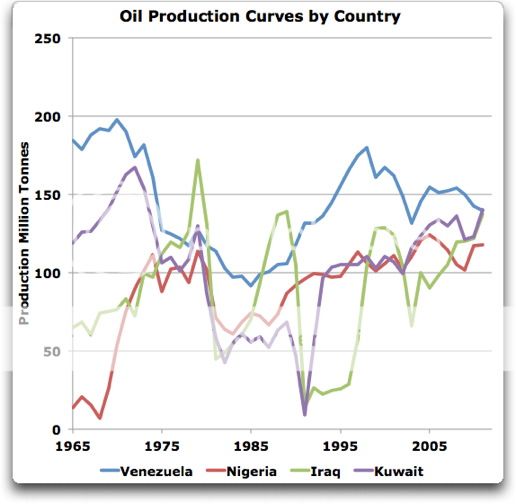
Bell curves? I don’t think so …
w.
Willis makes the claim that world oil production has increased since 2005. Willis, you are correct, BUT. Let’s see by how much.
http://www.indexmundi.com/energy.aspx?product=oil&graph=production
2005 71,980.94 2.02 %
2006 71,846.10 -0.19 %
2007 71,354.19 -0.68 %
2008 72,151.61 1.12 %
2009 70,808.59 -1.86 %
2010 72,631.37 2.57 %
2011 72,888.60 0.35 %
It’s an increase of just 1.2% over 6 years. China’s economy is growing at 8% per year. In that period of time their oil consumption increased 4% to 10% per year. India’s increase is also about 4% per year.
Where did that oil for them come from? How did they manage to keep that high increase? Because the Western World is consuming less oil, due to oil prices and economic issues. Hard to imagine us recovering from this.
So yes, oil production did “increase”, a puny 1.2% over 6 years. That’s not an increase, that’s a plateau.
A few years back I did a company directors course with a BP executive, and I asked, him about peak oil. If there as anyone that was in the know it was him, he completely confirmed what I though was going to happen, not peak oil but peak demand. See what’s going to happen is as oil gets more expensive other alternatives come on stream, renewables, ect… that puts a ceiling to energy prices in the long term. All these harder to get at reserves will simply not be developed as it’ll just be to uneconomical to do so.
Solar has dropped in price so much over the past few years that it already pass the cross over with nuclear, see here
http://cleantechnica.com/2011/05/29/ge-solar-power-cheaper-than-fossil-fuels-in-5-years/
Import prices for solar panels are now at near 50c/watt, and they are only going down in the future with further developments in technology, while oil extraction is only going one way… i mean it doesn’t take a genius to see where we are headed.
Peak oil won’t de a disaster, cheap alternatives will simply replace ever more expensive extraction.
jrwakefield says:
February 3, 2013 at 5:06 pm
Why do you think they are called “heavy oil” if they are not oil? What is it that you think is flowing from the Canadian oil sands, milk?
This is the exact nonsense that is the subject of the post, this jive division into conventional and unconventional oil purely to rescue failed predictions.
Oil is oil is oil. You can’t arbitrarily re-classify 2/3 of the global oil reserve as “not oil” because it’s heavy oil and then claim the earth is running out of oil. That’s like the guy who murdered his parents and then throws himself on the mercy of the court because he’s an orphan …
w.
Willis writes:
“Why do you think they are called “heavy oil” if they are not oil? What is it that you think is flowing from the Canadian oil sands, milk?”
It is oil but not all barrels of oil are the same. A barrel of light sweet crude produces far more high value products like gasoline and kerosine than a barrel of heavy oil that needs further upgrading before it can even be used to produce the lower amounts of product that is sold to the final consumer. The simple fact is that the production of light sweet, which is the best oil to use if you want the greatest amount of high value product, has already peaked. The barrels of heavy oil that are coming out of some of the unconventional sources are not equivalent unless you are very interested in higher bunker oil or asphalt production. By counting them as equivalent you are making an error that cannot be justified rationally. We do not put oil in our vehicles to make them go; we use gasoline. And on that front there is a difference that we cannot ignore.
Sorry Willis but I believe that you need to do some more reading on this topic. While you are a very smart man I do not believe that you have all the facts necessary to draw the right conclusions.
Come on Willis. Really. Countries have fields come on line while others die off. Hence the roller coaster graph. Look at individual fields for the bell curves.
Now what do I see in those graphs? Kuwait production is down. Iraq production is trying to recover. Venezuela production is down. Only Nigeria appears to be increasing.
Now other countries. US production is still well below peak. Mexico production is declining. North Sea production is declining (The UK now must import oil). Canadian conventional plays are declining. Indonesia was kicked out of OPEC because its now an importer of oil. China’s oil production peaked. Iran has peaked. Very likely Saudi Arabia has (but their books are as transparent as the oil they produce).
New fields today are puny. In fact, I had to laugh. A new find off Newfoundland was announced last month with great fan-fair. The MSM here hyped it all up as being the biggest find in decades. They were right, yet it was a mere 300 MILLION barrels in place. Talk about puny.
vangelv says:
February 3, 2013 at 5:12 pm
Oh, please, talk about picking tiny nits, and yours aren’t even real nits. Yes, what I said is indeed “exactly true”. READ WHAT I SAID.
I said the gasoline/diesel from those fuels burn the same in your engine, not that the source fuels had identical chemical compositions. I picked those words very carefully because they were exactly what I meant—it makes no difference in the everyday world you and I live in, it makes no difference to the engines of our cars.
Please up your game and read my words with the care that I put into writing them. That way you can answer what I actually said.
w.
Willis wrote:
I said the gasoline/diesel from those fuels burn the same in your engine, not that the source fuels had identical chemical compositions.
Yes you did. But a barrel of heavy oil produces much less high value gasoline and jet fuel than a barrel of light sweet. You treat every barrel as if were the same but it isn’t. And this is not nitpicking. The refineries are built to use specific grades of oil and require massive amounts of new investment in money and energy to be rebuilt to handle the lower quality grades of crude that will replace light sweet. That matters far more than you seem to think.
TimTheToolMan says:
February 3, 2013 at 5:35 pm
Thanks, Tim, that’s great to know. Since Exxon is investing up to half a billion dollars on it, obviously they care as much about your opinion as folks here do …
w.
“Why do you think they are called “heavy oil” if they are not oil? What is it that you think is flowing from the Canadian oil sands, milk?”
Bitumen isnt oil, not even heavy oil. It’s bitumen. It’s not oil. It has to be converted to oil/fuels.
“this jive division into conventional and unconventional oil purely to rescue failed predictions.”
No, the difference is a geological and petroleum industry term. Peak oil people didnt invent those words. They have specific geological definitions. Look it up.
“Oil is oil is oil. You can’t arbitrarily re-classify 2/3 of the global oil reserve as “not oil” because it’s heavy oil and then claim the earth is running out of oil. ”
No, oil isnt oil. There are many classifications of oil (I recommend reading Oil 101, good book). Refineries are designed to take specific types of oil. Many cant handle heavy oils. Different compounds that have to be removed change the behavior of oil. Not just sulphur, but heavy metals that must be removed. The chemical composition of each oil field is unique.
An oil field in SA had to be completely shut in and permanently sealed because it contained too much H2S.
What you get as “oil” for your car has had to go through a lot of processing. You dont care where the oil comes from, but the refineries definitely do.
“Since Exxon is investing up to half a billion dollars on it, obviously they care as much about your opinion as folks here do …”
That’s because they know all about peak oil and are desperate to keep themselves going. It’s a grasping at straws. We’ll see a lot of that.
Its a shame that once again, the concept of peak oil is (deliberately?) misunderstood and misrepresented.
Peak oil simply means the point at which global oil production peaks,. It has nothing at all to do with how much is still there. It has everything to do with its cost, especially its energy cost, of extraction.
What peak oil means is the days of $40 a barrel oil have gone forever. Maybe the days of $100 a barrel oil have already past. At some point if the oil takes more energy to extract than it gives on burning, its no longer a viable fuel. Though its still a useful chemical feedstock.
At some point the cost of oil/gas starts to become greater than the alternatives: In most places its already more expensive than coal, but not yet as expensive as – say synthetic gasoline made from nuclear power.
THAT is peak oil. When it is so expensive that people simply use alternatives that are cheaper. And so demand starts to fall.
AGW may be a busted flush, but peak oil is not. A glance at the spot prices and production volumes will reveal that oil production is no longer increasing exponentially – the second time derivative is now negative. Just as the same effect in the temperature data tends to refute runaway climate warming, the same effect in oil production show peak oil is near.
For the USA, there is maybe 20-30 years of ECONOMICALLY EXTRACTABLE unconventional oil and gas left. For other parts of the world, more, or less.
This is in fact a far more serious issue than climate change. Especially for the USA. Whilst electricity generation can easily switch to coal or nuclear (or both) transport cannot. And biofuel or synthetic fuel is several times more expensive and has other implications. ships can run on nuclear power. Trains can run (after a massive upgrade to electrify them) on electricity, but no really suitable alternative in terms of safety and energy density exists for cars trucks and aircraft.
And those are the core infrastructure that keeps city populations alive.
Just because someone is crying WOLF doesn’t mean that occasionally there isn’t one.
Those interested further should check http://ourfiniteworld.com/ for some interesting data and discussions.
Willis writes “Since Exxon is investing up to half a billion dollars on it, obviously they care as much about your opinion as folks here do …”
That “massive” investment represents about 5-6 days worth of profit Willis. Profit, not expendature and thats profit in a depressed economy too.
http://thinkprogress.org/climate/2012/04/26/471469/exxon-takes-104-million-profits-per-day-so-far-in-2012-while-americans-are-stuck-with-a-higher-gas-bill/
I think you should read Doug Proctor’s post in some detail Willis.
Wakefield is banging a drum not using brain
quote
The cost of production has fallen: a few years ago most firms thought the break-even price was $75 per barrel, but now companies such as Shell say new developments are economical at $50. The provincial and federal governments are unsurprisingly supportive.
http://www.economist.com/node/17959688
unquote
Thats for public consumption, perhaps near USD 35 or less is real figure but as i said above, two trains recently constructed, cost a lot of money but that total cost was recovered in 66 days. factor that in, capital cost recovered and what is the remaining operating cost? And how much is there, more than all of Saudi.
His silly energy in / energy out. Fundamental law, energy can neither be created nor destroyed only transformed. Willis and his Japanese sponges nailed that one.
Wakefield
Oil is oil. It is Alberta Oil sands not bitumen. Even bitumen is oil. The business is global and integrated. Old fixed run refineries not use blends to maintain balance. Hydrocrackers and other advanced tech make oils to order. Read up on shells gas to liquids program.
Matters not a single jot where your standard API spec diesel comes from, Its standard spec means you use it with confidence. Matters not who made it or what refinery or what process. You fill with Shell petrol ,you think Shell made it. Think again.
Its action that makes the world go round, not semantics and splitting hairs.
Grey Lensman please answer. All super giant conventional fields are in terminal decline? Yes or no. We are consuming more oil than we find (including unconventional)? Yes or No. Is the Energy Trap real or just a con invented by peak oilers? Yes or no?
vangelv says:
February 3, 2013 at 7:49 pm
vangelv, I’m getting dizzy with the moving of the goalposts. First the peak was supposed to be peak oil. Then it was peak conventional oil. Now, you are talking about peak light sweet crude. Plus you want to make the judgement on what should be included in the peaks based on how much of the heavier and how much of the lighter grades you get out of it … really?
This evasive goal-shifting behavior of yours is exactly the subject of the post. You will claim anything to avoid noticing that despite all of your screaming, OIL PRODUCTION CONTINUES TO INCREASE.
So make your claims, vangelv. The oil production has continued to increase. Tell me about heavy versus light. Oil production has continued to increase. Explain about light sweet crude as though I never heard of it. Oil production has continued to increase.
You can interpret the facts however you wish, but you don’t get your own facts. As long as oil production continues to increase, we’re not at the peak, no matter what you claim.
w.
PS—You close by saying “Sorry Willis but I believe that you need to do some more reading on this topic. While you are a very smart man I do not believe that you have all the facts necessary to draw the right conclusions.”
My friend, I spent three years as the Chief Financial Officer of the largest fuel importer in the Solomon Islands, overseeing $40 million worth of business annually. During that time, I did nothing but monitor and research the oil industry during my working hours, that was what I was paid to do, to understand the financial aspects of the oil business. I’ve negotiated multi-million dollar oil contracts, and been involved in all aspects of the fuel distribution network. Of course, as you might imagine given my mania for studying subjects, I have spent hundreds and hundreds of hours considering all of the issues surrounding oil, from the field to the final customer. As a result, perhaps I may not have drawn the right conclusions, but if so it’s not from lack of facts or study …
Since you haven’t falsified anything that I’ve said in the head post, and since you have been unsuccessful in establishing and supporting your own claims, let me suggest that you might consider taking your own advice and doing some more reading on this topic yourself.
My friend, I spent three years as the Chief Financial Officer of the largest fuel importer in the Solomon Islands, overseeing $40 million worth of business annually. During that time, I did nothing but monitor and research the oil industry during my working hours, that was what I was paid to do, to understand the financial aspects of the oil business. I’ve negotiated multi-million dollar oil contracts, and been involved in all aspects of the fuel distribution network. Of course, as you might imagine given my mania for studying subjects, I have spent hundreds and hundreds of hours considering all of the issues surrounding oil, from the field to the final customer. As a result, perhaps I may not have drawn the right conclusions, but I’m definitely not short of facts as you assert …
Then how is it that you have missed the shale bubble? Why is it that you have failed to notice that shale projects are not self financing outside of a few core areas? The facts are not what we wish them to be but what they are. Go to EDGAR and pull up the 10-Ks for the shale producing companies. Take a look at the cash flow statements and the debts on the balance sheets and tell me they show a healthy and sustainable business model.
Now you can tell me that you have looked at many of the studies coming from industry ‘experts’, academic institutions, and the IEA/EAI type of agencies. But when you did, were you paying attention to the assumptions being made and if those assumptions made sense. I have looked at studies that assumed that shale wells had 15% decline rates when the actual production data shows that 75% – 80% is more likely. I have seen studies that assume hyperbolic decline rates that are not supported by the actual production data. But most of all I have seen the price explosion drive hundreds of billions of new investment into all kinds of unconventional plays only to see crude production stay flat. The simple fact that the energy companies are financing such low return activities should tell you what is really going on. Shale and tar sands are the bottom of the barrel. The easy oil has already been pulled out of the ground and we are probably looking at Hubbert’s Peak through the rear view mirror already. You can’t see it because the data is not very good and contains a great deal of noise. But as I pointed out, give the Bakken another year or two and you will see what I am talking about. At that point I think that you will find new sources of information that are a bit more helpful to clarify this debate.
Willis wrote
Since you haven’t falsified anything that I’ve said in the head post, and since you have been unsuccessful in establishing and supporting your own claims, let me suggest that you might consider taking your own advice and doing some more reading on this topic yourself.
Since you have not really made a very clear point it is hard to falsify it. You are supposed to know exactly what Hubbert said before you argue that his theory is wrong. But you are still not clear about it and tend to create a general straw-man position that you try to knock down. Frankly, I am not interested in that because what is material is a bit more subtle and complex.
Hubbert’s methodology is pretty simple and very useful. Take any field and you can plot a production profile that identifies a peak. Can new technology change it? Of course, but not by enough to really matter because the energy sector has been relying on technological advancement for more than a century and the effects are minor. (Yes, that includes shale.) To get an idea at how much oil is to be extracted all you do is plot the data (see Deffeyes) and extend your trend until you see the answer quite clearly. The method works as long as you have all of the data on a field by field basis. If you don’t, you simply make a few adjustments as new data becomes available. Given where we are no new data is likely to have a big effect on the Peak.
Now you can bring in new sources, which is where you have concentrated your argument. But you fail to look at the logic. Those new sources are only even looked at because the easy oil is mostly gone. They might give you a bit more oil that you can recover but will not change the peak date by very much. Have you noticed that the hundreds of billions in new investment have not moved the production needle since 2005? If you need that much capital just to stay level how can you say that the peak is not here already? And let us not look at a change of less than half a percent and try to make an argument given the quality of the data that we are using. The bottom line is that all of that capital destruction in shale has not given us much more oil. The SEC filings already show that increased production is driven by capital destruction. That is not sustainable.
I think that you are grasping at straws here. And by the way, the Hubbert methodology is quite useful at looking at the production of other commodities. If you use it things are not exactly as bright as you might argue from the supply perspective. For the record, I am not worried that the peak has to be very destructive and harmful because we can adjust if the markets are allowed to work properly. The problem is that the markets aren’t permitted to solve some of our problems because governments get in the way. All of the money printing and all those subsidies have distorted the picture and created an environment where malinvestments are not punished as quickly as they should be. Eventually reality will intervene and you will see that you did not really understand the subject as well as you thought. To get a better idea of what the supporters of the Peak Oil theory are saying you might try reading their books and papers. Until you do you only have part of the picture.
Willis
Re: “long as the amount of oil hitting the market keeps going up, we haven’t yet seen peak oil.”
Each crude oil field peaks, each State’s crude oil production peaks, each nation’s crude oil production peaks, and consequently, global crude oil production peaks.
Now we have the challenge of replacing declining crude oil with other hydrocarbons.
See Robert L. Hirsch, The Impending World Energy Mess
All hydrocarbons are not equal. It will take $1 trillion to convert 10 million bbl/day of bitumen to crude oil, plus provide the pipelines. Obama preventing pipelines from being brought from Canada will directly increase US scarcity. etc.
willis wrote:
Please up your game and read my words with the care that I put into writing them. That way you can answer what I actually said.
This is ironic because it is very clear that you have not read carefully about the Peak Oil issue. You seem not to be aware that the amount of final products that come from a barrel of conventional oil tends to differ in amount from the final products that come from a barrel of unconventional oil. That matters no matter how much you want to play it down. And if you look at the data you find that the amount of oil produced in 2011 was not materially different than production in 2005. But when you account for the difference in mix and look at the higher proportion of heavy oil you see that the amount of final product like gasoline and kerosene has declined. That also matters.
I suggest that you take your own advice and read very carefully about the subject before you make claims that expose just how unprepared you are to deal with the debate. As others have pointed out, the terms have real meaning in the industry and are not simply used by the Peak Oil crowd to divert attention from any predictions. In fact, I imagine that the Peak Oil crowd is very pleased with the predictions because all of the data actually lends support to their position rather than to yours. While this may not be clear to you yet all you have to do is wait a year or two and things should be far easier to see then. Algae, coal to oil, hydrates, shale oil, etc., are all signs that the easy oil is gone and that we are on the back end of Hubbert’s curve. While we should find viable alternatives some time in the future there are too many people ignorant of the facts who divert attention from what must be done that prevent the efforts that are required to get us there. If this stupidity persists I suggest that you take advantage and buy coal companies for your investment portfolio. And as the effects of this crisis hits the economy you better have a lot invested in gold and silver and little in the way of exposure to certificates of confiscation that pay you in fiat money that will be created out of thin air.
Leo Smith – “ships can run on nuclear power. Trains can run (after a massive upgrade to electrify them) on electricity, but no really suitable alternative in terms of safety and energy density exists for cars trucks and aircraft.“.
That’s true now, but they’re working on it. For cars and trucks that is. http://www.gizmag.com/drawing-power-from-the-road/12874/ [“IAV is confident that its electromagnetic induction technology will be developed to production-ready status in the next few years. A 1/28 scale model of the system is already “functioning perfectly” the company says, and construction of a demonstration section of “charging road,” and a full-scale test track, are in the planning stages in the German state of Lower Saxony.“] They might even get it up and running in time for the fuel to be coal, but longer term I would expect them to be using nuclear power. Then the (eventually) dwindling oil supply can keep planes flying for a few hundred years while they find a solution for them.
vangelv says:
February 3, 2013 at 8:32 pm
valgelv, i am very aware of that difference. As I said, I made my living running the numbers on the oil industry. You mistake me for some kind of newbie or person unaware of the issues in the field. I am nothing of the sort.
While I am aware of the differences you discuss, I am also aware that the claim was not “peak of just oil that gives certain percentages of kerosene and gasoline and diesel”. The claim was not “peak of just oil that has an API gravity greater than 20”.
The claim was “peak oil”, period. Not peak heavy oil, or peak light oil, or peak oil except for oil from production gains. The claim was that we would see peak oil production. It is those claims that I have been discussing.
And despite all your objections, the peak hasn’t happened. Oil production continues to rise no matter how you twist and turn, and until it stops rising, we have no peak.
Yes, there are a host of side issues, as you say … so what? I’m discussing the peak oil claims, not the hundreds of other interesting and even critical issues about oil. If you want to discuss the peak in production of “Oil With API Gravity Greater Than 20”, go for it … but that’s not what I’m talking about.
w.
Thanks jrwakefield. I thought sanity was lost here for a while.