Guest Post by Willis Eschenbach
There’s a discussion over at Judith Curry’s excellent blog, about peak oil. I find the whole madness surrounding peak oil to be one more example of our human love for warnings of future disaster. Few people want to hear that tomorrow will be OK, that things will work out. Instead, most folks want to hear some terrible story about what tomorrow holds, whether it’s peak oil or climate meltdown or the coming ice age. Go figure.
 Figure 1. Conventional oil leaking out of the ground near McKittrick, CA.
One part of the discussion of peak oil that has always bothered me is the division of oil into “conventional oil” and “unconventional oil”. Here’s why I think that division makes no sense with regards to peak oil.
I’ve lived through much of the whole peak oil deal, which near as I can tell has turned into a half-century-long goat roping contest. During the earlier years, people were shouting that the oil would run out, that the top would be very soon now, we’d hit the peak and by gosh, at that point things would turn ugly. Of course, that still hasn’t happened, so the peak oilers were left with the question pondered by failed doomcasters throughout history, viz:
How the heck do I explain the cratering of my position and still maintain some shred of my reputation?
For the peak oil folks, salvation came in the form of “unconventional oil”. Now, we’re assured, oil is still running out, so they were right all along … You see, they say, King Hubbert was right, we’re running out of conventional oil, but as it runs out it is being seamlessly replaced by “unconventional oil”, so we still have oil even though we’re running out of oil. Got it?
The strange part is, when you open a barrel of unconventional oil to see what conventions were broken in its creation, you find it is indistinguishable from conventional oil.
What is unconventional oil? Well, we could start by considering the conventions regarding oil. For literally billions of years the convention was that oil was found in small pools and seeps like you see in Figure 1. Indeed, the discovery of oil in Oil Creek, Pennsylvania, the site of the first US oil well, came about because oil had been seeping out there for untold centuries, and had been known and utilized by the Early Asian Immigrants in the area before the later arrival of the melanin-deficient crowd.
So conventional oil, by ancient hallowed convention handed down through the millennia, is found in tar pits and oil seeps on the surface. Which means that people being so rash as to drill for oil, by definition, would be pumping up “unconventional oil” … but of course, life is not that simple.
As a result, “conventional oil” is not from the conventional method of dipping it up in a bucket from a seep, but by the decidedly unconventional and at that time unheard of method of drilling a hole in the earth to get it to come out …
Things went along just fine like that for years. Then “secondary recovery” methods started to come into use. These were a variety of physical and chemical methods used to squeeze more oil out of existing fields, including fracturing the rock to allow the oil to come out more easily.
Now, about this time, the whole “peak oil” story started to go south, because no matter how much peak oilers howled there was more oil discovered every year. Every year the proved reserves just kept growing. And that process has continued to this very day, with more proved reserves than ever. How were the peak oilers to explain it? Hey, “unconventional oil” to the rescue!

For example, thinner oils were “conventional”, but thicker, more tarry deposits, despite having been utilized by humans for centuries, were “unconventional” oil, so they weren’t counted regarding the peak.
The real laugher, however, the place where you can see the gears stripping, involves the “conventions” about fracturing the rocks to allow more oil to come out, what we call “fracking”. The fracturing technology was developed about forty years ago, and has been used ever since, mostly for secondary recovery. And for all those decades the oil coming from the fractured rocks has been “conventional oil”. But now people have learned to drill wells horizontally and fracture them … and now suddenly after forty years of fracturing the rock, which gave “conventional oil” when it was done from vertical wells, fracking now only delivers “unconventional oil” simply because the drill hole goes horizontally instead of vertically … does this make any sense to anyone?
The classification of oil from fracking as “unconventional oil” shows clearly the ludicrous nature of the dividing line when we are discussing peak oil. Regarding the putative peak, why is oil from a horizontal well “unconventional” and oil from a vertical well “conventional”? It is all gotten by technology, and none of it is any more “unconventional” than the drilling of the first oil well, a most unconventional act …
Calling oil from horizontal wells “unconventional” is crucial for the peak oil folks, however, because if the oil from fracking were classified as conventional oil, the “peak oil” claims and the “peak gas” claims would sink of their own weight …
Look, folks, the ugly truth is that the world is awash with fossil fuels. To start with, The largest single concentration of fossil energy on the planet is the Powder River coal formation in the Northern US. The world has several hundred years worth of coal. The Canadians have huge amounts of oil … of course it too is called “unconventional” oil, because it alone is enough to blow the “peak oil” claims out of the water. Plus now we have the “tight oil”, oil in the rocks that is, of course, unconventional.
Then we have the discovery of the shale gas resources all around the planet. Even Israel finally has some domestic energy resources. How unconventional is that? Australia just announced a huge find. China has massive gas resources. A preliminary assessment says including shale gas we have enough gas for the next couple of hundred years.
And finally, we have the wild card, the methane hydrates, the “ice that burns”. Estimates of the amount of these are all over the map, but all of them share one feature—they are very, very large, on the order of quadrillions of cubic feet. This is rivals the size of the global natural gas resource …

Finally, most of these forms of fossil fuels occur in combination and can be converted into one another. Coal, for example, can be converted to a liquid fuel, or to a gas.
Now, because there never was anyone hollering about “peak coal”, there’s no such thing as “unconventional coal”, despite huge changes in mining technology. Coal mining has changed as much or more than drilling for oil … so why isn’t there “unconventional coal”?
But in that case, since all of the coal on the planet seems to be “conventional” coal, if we convert coal to oil, are we making “conventional oil” or “unconventional oil”? Presumably it would matter whether we converted coal to oil horizontally or vertically …
In summary, once you get past the nonsense of “conventional” and “unconventional”, there’s enough coal and gas for a couple hundred years, and enough oil for a hundred years, just with what we know about now, and that’s not even counting methane hydrates. Which is why I pay no more attention to the peak oil alarmists than I do to the climate alarmists. One group claims we have too much oil and we’re gonna burn it all, the other group claims we’ll soon have too little oil to burn, and I treat those two impostors just the same.
Was the division between “conventional” and “unconventional” oil devised to cover up the failure of the peak oilers? No way. The distinction is useful in a variety of ways for analyzing the world of oil sources. I think that the concept was simply appropriated by the peak oilers because it was very useful to them, since it totally obscured the failure of their peak oil predictions. To me, oil is oil is oil, and if you claim the world will run out of oil, you can’t later say that you have redefined things, and that the oil that proves your prediction wrong is some other special kind of oil that doesn’t count as oil but walks like oil and quacks like oil …
w.
… Oh, yeah, the weather report. Late night again, two AM. The wind has changed and is blowing from the southwest, landcasting the fog and the smells of the ocean. The characteristic sea smells of iodine and dimethyl sulfide in the fog draw my thoughts back, back to the many mornings I spent getting out of bed here on the hill at 4 am and going down to the harbor, rigging the boat and setting out in the dark to have the commercial fishing gear in the water for the dawn salmon bite. Sliding out of Bodega harbor in the half-light with my gorgeous ex-fiancee and my good friend, once again motoring between the rock jetties at the harbor entrance, going out to discuss matters of life and death with the ocean. I love the ocean because it doesn’t give a damn about a man’s position and his power and his pretenses. Knowledge and experience mean nothing to the ocean. After a life at sea, if I put one foot wrong, I get just as wet as the landlubber falling off the dock … I take pleasure in that ultimate equality and justice of the ocean. I know that even if it is a California ocean it would kill me without first asking me to share my feelings, so leaving the safety of the harbor is always sobering moment …

… sneaking out between Bodega Rock and Bodega Head itself, the little shallow passage the fishermen call “between the rock and the hard place”, where once my heart almost stopped with fear, or at least it started with fear, but other emotions got involved. The channel there is shallow, the sport fishing boat “Mary Jane” was capsized in 1986 with the loss of nine souls by a sneaker wave, “full fathom five thy fishermen lie, of their bones are coral made” …
So when I heard a wave break right behind our little fishing boat one afternoon as we were coming in between the rock and the hard place, my first thought was that we were about to join the folks from the Mary Jane.
We spun around, and aaaah, dear heavens, it wasn’t a breaking wave at all, although a wave was breaking, instead it was my old friend Missus Fishbreath breaking the surface just behind the boat, and breaking my heart with the slow-moving stillness of her majestic beauty, a great gray whale dancing her way three thousand miles from the tropics to Alaska. As we turned and gaped, we were looking her right in the eye, and then she rolled our way and opened her blowhole so close to the boat we could almost look down it, it was as big as a dinner plate, we were close, close enough to count the barnacles clinging to her hull, she was the very picture of natural wildness and glorious beauty and unimaginable power, my heart leapt to see it … and she blew out a great cloud of gagging mist, a noxious enveloping adherent miasma reeking of the million vanished piscatorial souls of her most recent month’s meals, a clogging, thick effluvium that enveloped the boat and then drifted away to leeward as the lovely lady disappeared beneath the waves …
… leaving me in the strangest condition imaginable, with the boat wandering off course, my jaw hanging down to my umbilicus, a pulse rate well into the triple digits, adrenalin-shocked, awed beyond words, smelling like the dumpster behind a cheap fish restaurant, blasted by the natural beauty I had just witnessed, and uncertain whether I was going to vomit or not, but tending toward the former.
I’m not jonesing to visit that particular emotional place again, once was enough for any man. And on a cold night like tonight, I’m glad I’m not rolling out at four am. I fished the Bering Sea as well, and these days I’m just as happy to see the bergy bits and watch the Bering ice on the “Deadliest Catch” TV show from the safety of my couch … but ah, dear friends, mostly I’ve just moved my ocean madness to warmer waters, and I wouldn’t have missed it for rubies and pearls …
Sports and gallantries, the stage, the arts, the antics of dancers,
The exuberant voices of music,
Have charm for children but lack nobility; it is bitter earnestness
That makes beauty; the mind
Knows, grown adult.
A sudden fog-drift muffled the ocean,
A throbbing of engines moved in it,
At length, a stone’s throw out, between the rocks and the vapor,
One by one moved shadows
Out of the mystery, shadows, fishing-boats, trailing each other
Following the cliff for guidance,
Holding a difficult path between the peril of the sea-fog
And the foam on the shore granite.
One by one, trailing their leader, six crept by me,
Out of the vapor and into it,
The throb of their engines subdued by the fog, patient and
cautious,
Coasting all round the peninsula
Back to the buoys in Monterey harbor. A flight of pelicans
Is nothing lovelier to look at;
The flight of the planets is nothing nobler; all the arts lose virtue
Against the essential reality
Of creatures going about their business among the equally
Earnest elements of nature.
Robinson Jeffers saw it … when you read those lists of famous last words, nobody ever says “I wish I’d spent more time at the office”. Don’t mail the envelope in, push the envelope, the journey will end long before any of us wish it to. Live your most impossiblessed dreams, my friends, because any other kind is just a dream. Chance the widdershins steps of the tarantella, lift the ancient curses and look under them for old coins and lost loves and dust bunnies with a vest and a gold pocketwatch, opt for an immediate increase in the uncertainty levels, stay away from the world of adrenalin deficit spending, hold your dearest warm under your heart while you dare the icy seas of life, for the night is assuredly coming …
My very best wishes to all, I’m off to sleep.
Vanglev says
Quote
Once you add the full costs you are looking at a much bigger number.
Unquote
So, there is the simple actual reported cost as per international global convention. Then there is the unknown Vanglev cost. Say no more.
The guys , most of the current players, have recovered in full all their capital costs, can and will expand as and when it suits them.
Gray writes:
So, there is the simple actual reported cost as per international global convention. Then there is the unknown Vanglev cost. Say no more.
Actually, the cash costs are not per GAAP standards. If you look at the releases you will find that to be true. And as I said, once you write down the cost of all of those facilities and equipment, as Suncor did during the lean times, it is easy to claim that your costs are low. But that does not mean that anyone else can get the same costs because they would have to depreciate those costs over time.
The guys , most of the current players, have recovered in full all their capital costs, can and will expand as and when it suits them.
There is little doubt that the big tar sands players will be successful once the shale oil bubble is burst but the companies know that it will be a long slog and are reluctant to invest now because of the low prices. This does not mean that there is no investment because the capital budgets are quite large. But there is clearly a lot less being invested than could be.
” Bob Kutz says… Your comment is unsupported by the facts.”
I kept on investing in oil, right up to now, where I have several MM invested. It has been a 10 fold increase since 2004, that is why I am smiling when people dismiss peak oil. There have been ups and downs for sure, but it was not luck, it was Hubbbert.
Things holding back Oil sands developments, Lack of pipeline capacity and lack of export terminal. Both due to politics not economics or technology or willpower.
As I said re costs etc, splitting hairs is not business, its sour grapes and or disinformation
Things holding back Oil sands developments, Lack of pipeline capacity and lack of export terminal. Both due to politics not economics or technology or willpower.
As I said re costs etc, splitting hairs is not business, its sour grapes and or disinformation
It is not splitting hairs. It is a fact that cash accounting is not used unless you are a fisherman, trapper, or a government trying to hide unfunded liabilities. Note that the shale industry loves to quote the cash costs of production as it ignores the cost of leasing, overhead, exploration, seismic services, etc., etc., etc. That is why we have to look at the cash flows in the sector and keep a close eye on the balance sheets.
Vangelv, What part exactly of my statement “As I said re costs etc” do you not understand. Please point out where is says “cash”.
Sorry but Alberta is a Super Field and economic and destined to grow. Stupid claims such a USD90 per barrel production costs, shot down along with false claims of trillion dollars per million barrels to develop.
The latest Saudi Super Field, to come on stream, Wow, USD one per barrel, OK slice it dice,it, choose a nasty discount rate, bung in a daft IRR and call it USD 1.27 then call me out for being wrong.
Stupid is stupid does.
Willis points that out nicely.
Grey Lensman
Vangelv, What part exactly of my statement “As I said re costs etc” do you not understand. Please point out where is says “cash”.
It says cash in the information that the company releases. Wiki is not exactly the most detailed and comprehensive source.
“Oil Sands cash operating costs (excluding Syncrude) per barrel were $40.20 per barrel in 2011 compared to $38.65 per barrel in 2010. The increase in cash costs reflects the impacts of the ramp up of production from the Firebag 3 expansion, as well as reduced volumes and higher costs from planned and unplanned maintenance.
from: http://sustainability.suncor.com/2012/en/economic/economic-performance.aspx
Of course, you can’t just look at non GAAP cash cost reports to see what is going on. You also have to look at all of write-downs that are typical in the industry. Just a few hours ago Suncor announced that it is writing down nearly $1.5 billion for its Voyageur upgrader. Note that this project could still wind up set aside and that Suncor is simply writing off cost overruns. If the project is shelved there are more write-downs to come. The shale companies are masters of this as they slowly depreciate wells that are no longer economically useful to keep stated earnings higher than they should be. But Suncor’s tar sands projects should still have a profitable future. Most of the shale plays will not.
http://tinyurl.com/bzqqe2a
You see my friend, it is important to do the research yourself by going as deep into the sources as you can. Reading superficial articles that are puff pieces short of the necessary details only lead you down the wrong path. As I said, if there were some magic way to perform the processing cheaply the shares would already have responded and the industry magazines would be full or articles about the implementation of ionic polymer separation. They aren’t. Neither Alberta Oil Magazine nor Oilsands Review, both of which typically run such articles regularly each time there is some new claim of promising technology, have anything about it. Stop pretending that you know a lot more than you do just because you read some article in Wikki and start doing some thinking about what it is that you are writing about. As I said, the SEC filings are on my side of this debate. Shale companies have very few self financing wells and those are limited to the core areas of certain formations. But for shale to be a solution the average shale well will have to be self financing and provide an adequate return to reward investors for the risks taken. If you bothered looking at the actual data you would find that is not the case.
Grey writes:
Sorry but Alberta is a Super Field and economic and destined to grow. Stupid claims such a USD90 per barrel production costs, shot down along with false claims of trillion dollars per million barrels to develop.
There is no doubt that the tar sands deposits near Wood Buffalo have a large amount of tar in them. That is not the question and has never been in question. The real questions are about production costs and production rates. The cost is much higher than for a typical conventional deposit of the type that is now in decline. The production rate is quite low and nobody has ever claimed that peak production will exceed the peak that we saw in Ghawar which, thanks to the Late Jurassic Arab D Formation, is a super field that has cheap-to-extract high quality crude.
That is the problem for your side of the debate. Even the most optimistic claims fall short of what is needed to keep post peak production from falling. Not just that but your economic logic is also very poor. As more and more resources are diverted to the production of each new low-EROEI barrel of oil there is less capital for other activities and energy costs have to rise. As the rise demand is squeezed and the production levels fall. Even with a lot of oil still in the ground you are still on the back end of Hubbert’s Peak because people cannot afford to use as much oil as they used to.
You may not like this but that is the way the real world works. The only hope is transitioning to some other source. Ironically, people like you and Willis make that very difficult because you are continually diverting attention from the problems that are facing as you help the promoters and charlatans who are hoping to get rich as they transfer wealth from ordinary people looking to score in the markets to themselves. Because of that the transition will not be as rapid as it should have been and most people will find life going forward tougher until the transition is made.
The latest Saudi Super Field, to come on stream, Wow, USD one per barrel, OK slice it dice,it, choose a nasty discount rate, bung in a daft IRR and call it USD 1.27 then call me out for being wrong.
I have friends who work on the cost accounting side in the Middle East. They have never mentioned any new Saudi field that has a $1 per barrel cost and ask why it is that the Saudis are spending hundreds of billions on expensive water flood and other enhanced recovery techniques if they had a large field that had such cheap oil. Please show your sources and I would be more than happy to show you why you are wrong. The overhead for the Saudis is more than $1 per barrel. That means unless there is gold or silver being brought up with the oil your figure has to be wrong. Of course, a person who cannot understand why cash accounting is not an accurate measure of true cost is probably easy to fool.
vangelv, Grey Lensman – I don’t wish to take a position over whether tar sands companies are profitable, but all the listed ones have to publish their results. It might be worth your respective whiles to check those results and see how they are doing. Summaries are available on Yahoo, eg. for Athabasca Oil Corp (ATH.TO) see http://finance.yahoo.com/q/ks?s=ATH.TO+Key+Statistics
Profit Margin (ttm): 1,200.10% – looks very very good
Operating Margin (ttm): -659.27% – looks very very bad
It seems than more than a cursory scan of the data is needed.
List of Tar Sands companies : http://ran.org/list-tar-sands-companies
vangelv says:
Thanks for the info. I always wondered about the Baaken shale formations. Looks like production is flattening out, just as you advised. I prefer Albertas sandstone horizontals, as they flow more and are subject to water floods to squeeze more out.
Everything is there for us to see clearly. The problem is that many of us let our emotions get in the way and go with what we want to believe rather than believe what the data tells us. What gets to me is how people who see the process being used by the AGW believers don’t see how they do the same thing at times. I would love to be proven wrong. But to do that we need actual data that supports the position that Willis holds. Frankly, I don’t see it anywhere and I have been looking for a very long time.
More support for peak oil:
Record crude prices still can’t fuel oil giants’ profits
Christopher Swann The Globe and Mail
Thursday, January 31, 2013
Record crude prices are no longer enough to keep oil producers’ profit going up. ConocoPhillips and Occidental Petroleum, the top two U.S. exploration and production companies, both reported 2012 core profit down more than 15 per cent from 2011 while oil prices went up. The main reason – high production costs – is a worry for investors and suggests the floor under oil prices is rising.
It doesn’t help that prices for natural gas and associated products fell. But in a year when Brent crude hit a record average price of $112 (U.S.) a barrel and both companies sold their oil for more than in 2011, that is far from a sufficient explanation. The fact is, oil is getting harder to find and more expensive to extract.
A $1.2-billion dip in ConocoPhillips’ annual profit to $6.7-billion – after stripping out its spun-off refineries and some one-off items – was largely due to rising expenses. Outlays on production climbed by almost $400-million, while exploration spending surged even more. Occidental is battling similar pressures. Its adjusted earnings from oil and gas fell to $8.8-billion in 2012, down $1.5-billion from the year before.
Occidental CEO Stephen Chazen is hoping to trim U.S. drilling costs by 15 per cent in 2013 by using fewer contractors and eliminating unnecessary maintenance. These economies even started to take effect in the fourth quarter. Yet cost cutting can only go so far before it hits output. Capital spending at Oxy still rose 35 per cent. Increasingly, all the big oil groups are resorting to pricey techniques to extract oil from aging wells, shale or the deep sea. That puts pressure on the bottom line.
Higher costs also mean oil companies require more expensive crude to justify new projects. A sharp fall in prices would see plenty of them mothballed – ultimately reducing supply and curtailing any likelihood of sustained low prices. For the companies involved, as for some of the governments that depend on oil revenue, relatively high prices have become more of a necessity than a luxury. For consumers, that could mean getting used to them – and consigning the sub-$40 prices last seen at the height of the financial crisis to history.
Interesting article from Christof Rühl, Group Chief Economist of BP, in today’s International Herald Tribune (from NYT). He argues that the renaissance of Oil & Gas in N. America is the result of open markts and sound policies (and not just dumb luck).
Excerpts:
“Three years ago, pundits [agreed] we had reached peak oil, … that the industry would suffer price shocks in the transition to a post-fossil fuel economy.”
“We now estimate that tight oil will account for almost half of the 16 million barrel per day increase in the world’s oil output by 2030. Almost 2/3 of the new oil will come from the Americas (mainly U.S. tight oil and oil sands from Canada).”
“Non-OPEC production will dominate global supply growth over the coming decade.”
“Without a clear signal that carbon has a price, European utilities will be charmed by the cheapness of coal, increasingly available thanks to America’s embrace of shale gas.”
Kurt in Switzerland
BUT, the chief economist also says in the same article:(forcasts of its potential differ widely… LOL!
“A surge in shale gas and tight-oil production is transforming our energy landscape. Forecasts of its potential differ widely. What is certain, however, is that our energy future is not wholly at the mercy of geology. The speed at which we can bring this useful resource to market will depend to a great extent on issues that will be decided by our governments, in our parliaments and in our town halls”
Van
Just read the BBC report posted early on by me. All the figures you need are there.
Just read the BBC report posted early on by me. All the figures you need are there.
I assume that you are talking about this.
http://news.bbc.co.uk/2/hi/business/7487070.stm
If that is the case the numbers are there. In fact, the history is not there. This is not a new field but an old field that failed to produce at a low enough price before and was shut down. Mat Simmons actually spoke and wrote about Khurais several years ago. He pointed out that the poor results in the 1960s caused Saudi Aramco to mothball the field. It was not just costs that were the issue but the quality of the oil as well.
But let us forget history for a while and look at a few of the things in the article that should set off the alarm bells going. Did you get the part about a sea-water treatment plant that will supply an extra two million barrels a day of water? And do you know why the Saudi’s are doing this? Well, had you read the SPE papers that Simmons based his conclusions on you would be aware of the very poor quality of the reservoir. Unlike Uthmaniyah, which did not experience a major pressure drop once injection began in the 1980s, Khurais failed to maintain the pressure increases and production collapsed. If memory serves me right this will be the third time that Saudi Aramco will try to build up the pressure to a reasonable level and use some of its injection capacity to offset the lack of support of the underlying aquifer.
This tells us a lot of things. For one, costs are much higher than $1 per barrel. Most likely they will actually challenge the worst and most expensive of current Saudi production. But it gets even worse that that. What this means is that the Saudi Aramco managers are desperate. They are finally worried enough about the water cut in Ghawar that they will take a chance on a long-shot that has already destroyed a great deal of capital without offering any positive returns to the company. Saudi Arabia has peaked and all the PR will not change the fact that the technical problems are too large to overcome.
I think that you need to stop looking at puff pieces full of speculation and start looking at what the engineers who are working on the ground tell us when they publish the production and test data.
http://www.onepetro.org/mslib/servlet/onepetropreview?id=00077743
http://www.onepetro.org/mslib/servlet/onepetropreview?id=00011447
Ed_B: LOL?
FYI, not everyone is arguing with you here. (I posted something which I read in the IHT which happened to be pertinent — I wasn’t disagreeing with anyone’s opinion per se).
So forecasts of “potential” differ wildly. What else is new? Just like forecasts of the potential for solar and wind power differ wildly. Or the economic growth in China. Or the population growth in Africa and Asia. Or the weather next week. Or the climate next year or next decade, next century or next millennium.
BP’s Chief Economist is giving his best guesstimate for the coming 20 y. It does differ considerably from the doomsday “peak oil” scenarios put forth by many.
Does anyone seriously question that the potential to exploit resources in the future will NOT be a function of government policy (among other things)?
Kurt in Switzerland
KKurt says:
“BP’s Chief Economist is giving his best guesstimate for the coming 20 y. It does differ considerably from the doomsday “peak oil” scenarios put forth by many”
Thats the part I don’t get. BP is shrinking, along with other super majors. That is fact. Is that a puff piece by him to try and placate nervous shareholders? The first stage of human reaction to an adverse event is denial. Is that going on? The thought of ever declining profits due to a rising capex treadmill must be truly scary.
Ed_B says:
February 7, 2013 at 11:48 am
Since the “capex treadmill” has obviously been going on for at least a decade, and has intensified over the last 5 years with the introduction of ever-increasing quantities of “tight oil” and Canadian heavy oil, IF your theory about ” ever declining profits due to a rising capex treadmill” are correct, of course we will see that in the profits of the companies in question:

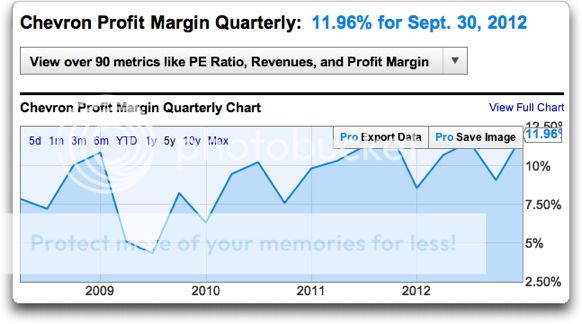

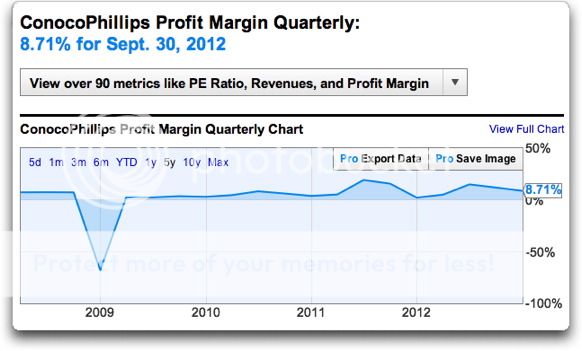
BP took a huge hit in the Gulf disaster, but despite that its profits are flat … as they have been for some time. The other majors are also either flat or slightly increasing. Get back to me when their profits actually start dropping, not just when you claim they are dropping …
w.
Van said
quote
This tells us a lot of things. For one, costs are much higher than $1 per barrel. Most likely they will actually challenge the worst and
Unquote
Just because you say so, dont make it so. Check number of barrels per day multiply6 by price of oil at the time. Simple arithmetic. Pay back about 46 days.
Next look at capital expenditure, and multiply number of barrel per day by 365 times 25.
Look at operations costs, virtual nil, no pumps, gas separation is automatic, a bit of maintenance nd some watch guys, yes oodles of cost there.
net conservative result less than one usd per barrel.
bad oil, shucks, bet that hurts.
so how does 1 usd or even 4 usd (two fields I built and operated, expensive, offshore, ground breaking ones) challenge 80 or 90 dollars or for gods sake one trillion per million barrels.
Wake up dont follow wakefield, he is stuck in the mud.
Grey writes:
Just because you say so, dont make it so. Check number of barrels per day multiply6 by price of oil at the time. Simple arithmetic. Pay back about 46 days.
Thank your for showing exactly why ignorant investors lose money so easily. There isn’t enough information in your BBC article to tell you anything about the cost because important things like injection costs are not included. Do you really think that you can inject that extra 2 mpbd of seawater into the aquifer at 2500 psi for less than $1 per barrel? Do you think it is costless to transport that much water hundreds of miles through a pipe that has to be protected from the elements in one of the worst environments possible and inject it under that much pressure? And do you think that the separation facilities are costless to run?
You need a better education on this issue. The Saudi financed videos below are a good place to start. Use the stop buttons and look up the terms and the implications as far as costs are concerned.
http://www.youtube.com/watch?feature=player_embedded&v=C7MH9MhOpRk
Now let me tell you what an engineer sees in all the data. The bottom line is that Ghawar, the Saudi’s greatest field, and the greatest producing oil field in the history of this planet, is dying. The Saudis are spending billions to inject water to keep production from falling at a massive cost in both capital AND oil left behind the rising flood. That loss could be anywhere from 5% to 40% of the oil in place. The BBC article shows desperation and huge cost increases. Somehow you have misinterpreted what it shows and drawn conclusions that could not be further from the truth.
Among many of your errors there are two that I want to point out. First, you reference a puff piece that talks about a future event without showing that what was predicted actually happened. Second, you are missing the fact that all of the stories that we get are talking about specifications that may or may not be met by the projects. What matters more for our purposes is what actually happens. In the case of the field in question, it finally opened up last year in late August and the kinks were probably mostly worked out by the forth quarter. But even though prices were high the Saudi output did not increase by the 1.2 mbpd capacity being thrown around. Had the costs been what you claim you could bet on an increase that was greater than 1.2 mpbd. All of this is just noise. What we really need to know comes from applying Hubbert’s methodology and seeing where the data leads us. If we look at the logistic decline plot we find that the total ultimate recoverable reserves for Saudi Arabia are approximately 275 billion barrels, which means that the kingdom has extracted about half of what it can. The problem is that once you get between the 45-55% point the job of extracting oil is much more difficult and much more costly. That is when national oil companies look at their inventory of old fields that were shut down due to pressure drops and other factors and are ‘rehabilitated’ by throwing a lot of money at them. When that happens you should be scared about the cost and about future production, not make up stories about how cheap new production is going to be. From what I can see in your postings yours is a very superficial and faith-based approach that needs to change if you really want to see things as they are rather as you want them to be. Start educating yourself and begin to understand.