
UPDATE: New table added below.
While searching for something else, I came across this entertaining collection of grand predictive failures related to resources and climate change, along with some of the biggest predictive failures of Paul Ehrlich. I thought it worth sharing.
Exhaustion of Resources
“Indeed it is certain, it is clear to see, that the earth itself is currently more cultivated and developed than in earlier times. Now all places are accessible, all are documented, all are full of business. The most charming farms obliterate empty places, ploughed fields vanquish forests, herds drive out wild beasts, sandy places are planted with crops, stones are fixed, swamps drained, and there are such great cities where formerly hardly a hut… everywhere there is a dwelling, everywhere a multitude, everywhere a government, everywhere there is life. The greatest evidence of the large number of people: we are burdensome to the world, the resources are scarcely adequate to us; and our needs straiten us and complaints are everywhere while already nature does not sustain us.”
- In 1865, Stanley Jevons (one of the most recognized 19th century economists) predicted that England would run out of coal by 1900, and that England’s factories would grind to a standstill.
- In 1885, the US Geological Survey announced that there was “little or no chance” of oil being discovered in California.
- In 1891, it said the same thing about Kansas and Texas. (See Osterfeld, David. Prosperity Versus Planning : How Government Stifles Economic Growth. New York : Oxford University Press, 1992.)
- In 1939 the US Department of the Interior said that American oil supplies would last only another 13 years.
- 1944 federal government review predicted that by now the US would have exhausted its reserves of 21 of 41 commodities it examined. Among them were tin, nickel, zinc, lead and manganese.
- In 1949 the Secretary of the Interior announced that the end of US oil was in sight.
Claim: In 1952 the US President’s Materials Policy Commission concluded that by the mid-1970s copper production in the US could not exceed 800,000 tons and that lead production would be at most 300,000 tons per year.
Data: But copper production in 1973 was 1.6 million tons, and by 1974 lead production had reached 614,000 tons – 100% higher than predicted.
Claims: In 1968, Paul R. Ehrlich wrote The Population Bomb and declared that the battle to feed humanity had been lost and that there would be a major food shortage in the US. “In the 1970s … hundreds of millions are going to starve to death,” and by the 1980s most of the world’s important resources would be depleted. He forecast that 65 million Americans would die of starvation between 1980-1989 and that by 1999, the US population would decline to 22.6 million. The problems in the US would be relatively minor compared to those in the rest of the world. (Ehrlich, Paul R. The Population Bomb. New York, Ballantine Books, 1968.) New Scientist magazine underscored his speech in an editorial titled “In Praise of Prophets.”
Claim: “By the year 2000 the United Kingdom will be simply a small group of impoverished islands, inhabited by some 70 million hungry people … If I were a gambler, I would take even money that England will not exist in the year 2000.” Paul Ehrlich, Speech at British Institute For Biology, September 1971.
Claim: Ehrlich wrote in 1968, “I have yet to meet anyone familiar with the situation who thinks India will be self-sufficient in food by 1971, if ever.”
Data: Yet in a only few years India was exporting food and significantly changed its food production capacity. Ehrlich must have noted this because in the 1971 version of his book this comment is deleted (Julian Simon, The Ultimate Resource, Princeton: Princeton Univesity Press, 1981, p. 64).
The Limits to Growth (1972) – projected the world would run out of gold by 1981, mercury and silver by 1985, tin by 1987, zinc by 1990, petroleum by 1992, and copper, lead and natural gas by 1993. It also stated that the world had only 33-49 years of aluminum resources left, which means we should run out sometime between 2005-2021. (See Donella Meadows et al., The Limits to Growth: A Report for the Club of Rome’s Project on the Predicament of Mankind. New York: New American Library, 1972.
Claim: In 1974, the US Geological Survey announced “at 1974 technology and 1974 price” the US had only a 10-year supply of natural gas.
Data: The American Gas Association said that gas supplies were sufficient for the next 1,000-2,500 years. (Julian Simon, Population Matters. New Jersey: Transaction Publications, 1990): p. 90.
Population and Poverty
In the mid 1970s the US government sponsored a travelling exhibit for schoolchildren titled, “Population: The Problem is Us.” (Jacqueline Kasun, The War Against Population, San Francisco: CA, Ignatius, 1988, p. 21.)
In 1973, Supreme Court Justice Potter Stewart’s vote in Roe v. Wade was influenced by this idea, according to Bob Woodward and Scott Armstrong: “As Stewart saw it, abortion was becoming one reasonable solution to population control” (quoted in Newsweek of September 14, 1987, p. 33.).
In 1989, when the US Supreme Court was hearing the Webster case, Justice Sandra Day O’Connor brought the idea of overpopulation into a hypothetical question she asked of Charles Fried, former solicitor-general, “Do you think that the state has the right to, if in a future century we had a serious overpopulation problem, has a right to require women to have abortions after so many children?”
World Bank president Barber Conable calls for population control because “poverty and rapid population growth reinforce each other” (Washington Post, July 16, 1990, p. A13)
Prince Philip advises us that “It must be obvious by now that further population growth in any country is undesirable” (Washington Post, May 8, 1990, p. A26)
37 Senators wrote President Bush in support of funding for population control (Washington Post, April 1, 1990, p. H1)
The Trilateral Commission and the American Assembly call for reduction in population growth (U. S. News and World Report, May 7, 1990)
Newsweek‘s year-ending cover story concluded that “Foremost of the new realities is the world’s population problem” (December 25, 1990, p.44)
The president of NOW warns that continued population growth would be a “catastrophe” (Nat Hentoff in the Washington Post, July 29, 1989, p. A17)
Ted Turner (Atlanta Journal Constitution, Wed. Dec. 2, 1998) in an address to the Society of Environmental Journalists in Chattanooga – blamed Christianity for overpopulation and environmental degradation, and argued that the people who disagree with him are “dummies.” He stated in part, “The Judeo-Christian religion says man was given dominion over everything, and his salvation was that he was to go out and increase and multiply. Well, we have done that … to the point where in Calcutta, it’s a hellhole. So it’s not an environmentally friendly religion.”
Ellen Goodman laments “People Pollution” (Washington Post, March 3, 1990, p. A25)
Herblock cartoon shows that the U. S. neglecting the “world population explosion” (Washington Post, July 19, 1990, p. A22)
Hobart Rowen likens population growth to “the pond weed [which] grows in huge leaps” (Washington Post, April 1, 1990, p. H8).
A Newsweek “My Turn” suggests giving every teen-age girl a check for up to $1200 each year that she does not have a baby “in order to stop the relentless increase of humanity” (Noel Perrin. “A Nonbearing Account”, April 2, 1990, p. 9).
Climate Change
Claim Jan. 1970: “By 1985, air pollution will have reduced the amount of sunlight reaching earth by one half.” Life Magazine, January 1970. Life Magazine also noted that some people disagree, “but scientists have solid experimental and historical evidence to support each of the predictions.”
Data: Air quality has actually improved since 1970. Studies find that sunlight reaching the Earth fell by somewhere between 3 and 5 percent over the period in question.
Claim April 1970: “If present trends continue, the world will be … eleven degrees colder by the year 2000. This is about twice what it would take to put us in an ice age.” Kenneth E.F. Watt, in Earth Day, 1970.
Data: According to NASA, global temperature has increased by about 1 degree Fahrenheit since 1970.

Claim 1970: “In ten years all important animal life in the sea will be extinct. Large areas of coastline will have to be evacuated because of the stench of dead fish.” Paul Ehrlich, speech during Earth Day, 1970.
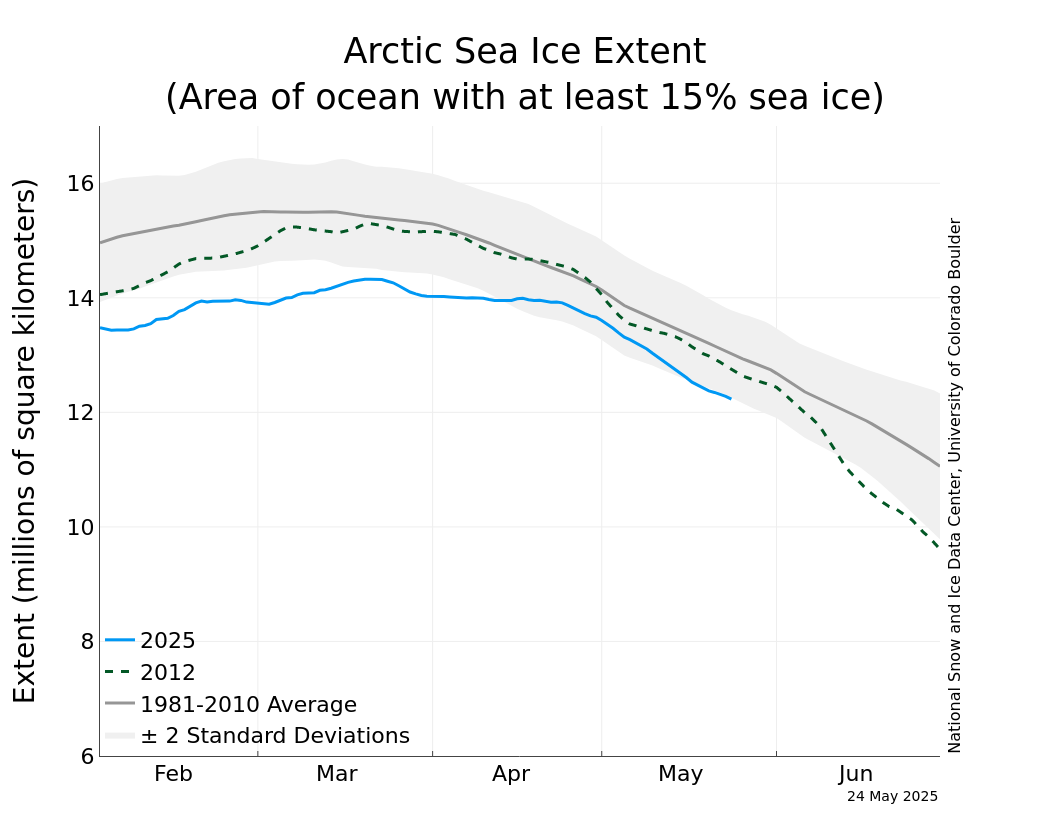
Claim 1972: “Artic specialist Bernt Balchen says a general warming trend over the North Pole is melting the polar ice cap and may produce an ice-free Arctic Ocean by the year 2000.” Christian Science Monitor, June 8, 1972.
Data: Ice coverage has fallen, though as of last month, the Arctic Ocean had 3.82 million square miles of ice cover — an area larger than the continental United States — according to The National Snow and Ice Data Center.
Claims 1974: “… when metereologists take an average of temperatures around the globe they find the atmosphere has been growing gradually cooler for the past three decades. The trend shows no indication of reversing. Climatological Cassandras are becoming increasingly apprehensive, for the weather aberrations they are studying may be the harbinger of another ice age. Telltale signs are everywhere–from the unexpected persistence and thickness of pack ice int eh waters around Iceland to the southward migration of a warmth-loving creature like the armadillo from the Midwest. When Climatologist George J. Kukla of Columbia University’s Lamont-Doherty Geological Observatory and his wife Helena analyzed satellite weather data fro the Northern Hemisphere, they found that the area of ice and snow cover had suddenly increased by 12% in 1971 and the increase has persisted ever since. Areas of Baffin Island in the Canadia Arctic, for example, were once totally free of any snow in summer; now they are covered year round.”
Later in the article, “Whatever the cause of the cooling trend, its effects could be extremely serious, if not catastrophic. Scientists figure that only a 1% decrease in the amount of sunlight hitting the earth’s surface could tip teh climatic balance, and cool the planet enough to send it sliding down the road to another ice age within only a few hundred years.”
Source: “Another Ice Age,” Time Magazine, June 24, 1974.
Claim 1989: “Using computer models, researchers concluded that global warming would raise average annual temperatures nationwide two degrees by 2010.” Associated Press, May 15, 1989.
Data: According to NASA, global temperature has increased by about 0.7 degrees Fahrenheit since 1989. And U.S. temperature has increased even less over the same period.

Claims: “Britain’s winter ends tomorrow with further indications of a striking environmental change: snow is starting to disappear from our lives.”
“Sledges, snowmen, snowballs and … are all a rapidly diminishing part of Britain’s culture, as warmer winters–which scientists are attributing to global climate change–produce not only fewer white Christmases, but fewer white Januaries and Februaries.”
“London’s last substantial snowfall was in February 1991.” “Global warming, the heating of the atmosphere by increased amounts of industrial gases, is now accepted as a reality by the international community.”
According to Dr. David Viner, a senior research scientist at the climatic research unit (CRU) of the University of East Anglia, within a few years “children just aren’t going to know what snow is” and winter snowfall will be “a very rare and exciting event.” Interviewed by the UK Independent, March 20, 2000.
“David Parker, at the Hadley Centre for Climate Prediction and Research in Berkshire, says ultimately, British children could have only virtual experience of snow.”
See “Snowfalls are now just a thing of the past.” The Independent. March 20, 2000.
Data: “Coldest December Since records began as temperatures plummet to minus 10 C bringing travel chaos across Britain.” Mailonline. Dec. 18, 2010.
Claim: “[By] 1995, the greenhouse effect would be desolating the heartlands of North America and Eurasia with horrific drought, causing crop failures and food riots … [By 1996] The Platte River of Nebraska would be dry, while a continent-wide black blizzard of prairie topsoil will stop traffic on interstates, strip paint from houses and shut down computers.” Michel Oppenheimer and Robert H. Boyle, Dead Heat, St. Martin’s Press, 1990. Oppenheimer is the Albert G. Milbank Professor of Geosciences and International Affairs in the Woodrow Wilson School and the Department of Geosciences at Princeton University. He is the Director of the Program in Science, Technology, and Environmental Policy at the Wilson School. He was formerly a senior scientist with the Environmental Defense Fund, the largest non-governmental organization in the U.S. that examines problems and solutions to greenhouse gases.
Data: When asked about these old predictions Oppenheimer stated, “On the whole I would stand by these predictions — not predictions, sorry, scenarios — as having at least in a general way actually come true,” he said. “There’s been extensive drought, devastating drought, in significant parts of the world. The fraction of the world that’s in drought has increased over that period.”
However, that claim is not obviously true. Data from NASA’s Goddard Space Flight Center show that precipitation — rain and snow — has increased slightly over the century.
—
How could scientists have made such off-base claims? Dr. Paul Ehrlich, author of “The Population Bomb” and president of Stanford University’s Center for Conservation Biology, told FoxNews.com that ideas about climate science changed a great deal in the the ’70s and ’80s.
Ehrlich told FoxNews.com that the consequences of future warming could be dire.
=============================================================
Source: University of Georgia, Terry College of Business. Economics 2200, Economic Development of the US, David B. Mustard
http://www.terry.uga.edu/~mustard/courses/e2200/pop.htm
UPDATE: reader Dennis Wingo writes in with this table:
Great article. I went into this myself in my book “Moonrush“, I took all of the predictions for the depletion of resources from the book and marked in red the deadlines that had already passed. All of the predictions failed.

London may not be knee deep in horse manure but the area around Westminster and the Department for Climate Change is full of male bovine excreta
I noticed my copy of Ehrlich’s Pop Bomb on a bookshelf in my cabin the other day still sitting where I put it some 35 or 40 years ago. Some day I will make the effort to read it again, but probably not today or tomorrow. I recall not enjoying it much back in the 1970s when I first bought it and read it. Or I could use it to start a fire. This has been a very cold winter so far.
@ur momisugly Sam Norton, re why we are not running out of oil.
I suggest you start by reading my speech from 2010:
http://sowellslawblog.blogspot.com/2011/04/speech-on-peak-oil-and-us-energy-policy.html
No-one’s mentioned Y2K….
Computers and planes were going to be crashing…..
Jevons was a liberal in the “classic” sense. You can read his
“The Theory of Political Economy” here:
http://www.econlib.org/library/YPDBooks/Jevons/jvnPE1.html#firstpage-bar
Are you assuming that the world’s population will continue rising for “an unlimited amount of time on a planet”? It MAY start contracting this century, then again maybe not. (I don’t want to be caught out making a prediction) 🙂
http://www.economist.com/node/14744915
http://www.med.uottawa.ca/sim/data/Birth_Rate_Decline_e.htm
On a positive note, at least we have a good blueprint for surviving an apocolypse…
I am FIRMLY against abortion but think allowing retroactive abortions for those like Paul Ehrlich might be acceptable
Beating my Black Swan drum – boom, Boom, BOOM, BOOM – Taleb has much to say on prediction, cautions against the Ludic Fallacy, and to Doxastic commitment.
The Ludic Fallacy is the fallacious belief that reality has game-like rules. Doxastic commitment is committing a pound of ones own flesh to expressions of opinion. (Ancient Greek δοξασία doxasia, “belief, opinion, conviction”).
“Global production of corn, wheat and rice have all more than doubled since 1970 as global warming occurred. Corn production, the current flavor of the week for Internet fear-mongering, has more than tripled since 1970. So, too, has global vegetable production as a whole.
“Importantly, higher crop production is resulting from higher yields per acre rather than merely an increase in land dedicated to crop production.”
http://www.forbes.com/sites/jamestaylor/2013/01/16/fortified-by-global-warming-crop-production-keeps-breaking-records/
The article links to GeoHive which gives statistics for the huge increase in production of all crops since 1970:
http://www.geohive.com/charts/ag_crops.aspx
And who predicted that invading Iraq would turn into a blood bath and cost thousands of lives.
Robbie says:
January 19, 2013 at 3:28 am
Oh really Mr. Watts!
Are you trying to suggest to your audience with this piece that we (humans) can go on with business as usual for an unlimited amount of time on a planet that has a limited amount of space and resources?
_____________
Robbie, could you point to anything that he wrote that even hinted at such a suggestion? Reductio ad absurdum is a clever, but empty, debate tactic.
It is quite clear that catastrophic predictions of resource depletion have been hyperbolic, at best, and have in many cases been intentionally fraudulent. The obvious point that Mr. Watts was making in this post is that trusting Paul Erlich and those he relies on for science that supports his predictions is folly.
Sam Norton (@Elizaphanian) says:
January 19, 2013 at 2:03 am
….. Anyone who thinks we’re not running up against some resource limits needs to have an alternative, and preferably plausible, explanation for why the tripling of oil prices over the last decade has seen no significant increase in the production of oil.
>>>>>>>>>>>>>>>>>>>>>>>>>>>>>
Politics, Regulations and Cartels, Reduction of oil refinery capacity, prohibition on drilling.
In other words Who makes What and for Whom?
“And who decides that?
This is the foundational question of Economics.”
The basic plan for a would be monopoly is to have enough back-up capital to sell cheap and drive the other guys out of business then raising your prices. A chain feed store just pulled that trick in my town a few years ago. The newer method is more sure fired. Buy politicians who pass the laws you wrote raising the entry bar on the industry beyond the level most newcomers can meet and then ‘pack’ the resulting bureaucracy with ‘your people’ so the regulations are selectively enforced. An Example
If you have a monopoly/cartel the last thing you want to do is flood the market. You want to make the product scare and expensive. Think of the difference in profit between Chanel # 5 and ‘Evening at Walmart’
Why work harder for less money per unit of goods? Who in their right mind would want a glut on the market?
There is plenty of historic evidence of “Monopoly Practices” causing economic destruction of the non-monopolists and for the prices after monopoly (or cooperating oligopoly) to be damagingly high to the economy as a whole. Now that ‘big money’ has targeted food as the next bubble, if you pay attention you can watch how ‘big money’ engineers a bubble and profits from it. link
Claim from April 1970: “If present trends continue, the world will be … eleven degrees colder by the year 2000. This is about twice what it would take to put us in an ice age.”
This makes perfect sense to me. In spring time it may happen that each day the temperature increases with one degree. If that trend continues, we will be cooked within a year.
Reblogged this on Two Heads are Better Than One and commented:
And you’ll notice NONE of these folks ever says “We were wrong”!? They just go on to their next, & equally wrong, prediction…
About Iraq (or IraX), any warrior.
UK Sceptic says:
January 19, 2013 at 3:09 am
WOLF!!!!!
>>>>>>>>>>>>>>>>>>>>>>>>
Best comment on the thread.
Now I have to clean my computer again.
Sam Norton (@Elizaphanian) says:
January 19, 2013 at 2:03 am
“Anyone who thinks we’re not running up against some resource limits needs to have an alternative, and preferably plausible, explanation for why the tripling of oil prices over the last decade has seen no significant increase in the production of oil.”
Wow! I guess old Sam must be living in Cassablanca playing piano, and NOT paying attention.
Worldwide oil PRODUCTION is about 40% more than a “decade” ago. AND, the production from the Bakken now EXCEEDS the “North Slope” in Alaska. By the way, the practical cost of oil (inflation considered) IS NOT 3 times, about 1.7 compared to 10 years ago. HOWEVER the cost of natural gas (inflation included) is about 1/2 (at the delivery point). AN ARGUEMENT CAN BE MADE that the peak price of Natural Gas helped the foundation for the current abundant supply.
Sorry Sam, you can’t “play it again” with the Malthusian arguement.
Population growth. As countries develop their birth rates fall. What countries require to develop is access to copious and cheap energy sources. It is in our interests to help undeveloped countries have this access.
Fantastic presentation by Hans Gosling on this here :-
http://www.economist.com/blogs/babbage/2010/12/data_visualation
Jim south London says:
January 19, 2013 at 6:09 am
And who predicted that invading Iraq would turn into a blood bath and cost thousands of lives.
===========================================================================
Me, for starters. Had a stand up with a beloved cousin and the husband of another such. They both thought it was long overdue. I said we had opened Pandora’s Box, and that what would ensue would be horrific. No, I’m not that smart. I simply extrapolated what has always happened when we mess arouns with the Middle East.
Same goes for the “Arab Spring” which has rapidly become the Arab Winter. It seems that every terrorist group in Africa now has been armed by the fallout from Gaddhafi’s demise.
Go Home says:
January 19, 2013 at 4:50 am
I think all these gloom and doom ‘scientists’ reports, books, and articles are dangerous. I think we should ban all that hold more than 6 claims of doom. Why would they ever need more than 6 clams? Oh, and if you want to write one, you need to have a psychiatric test and pass an extensive background check. That should make us all safer.
>>>>>>>>>>>>>>>>>>>>>>>>>>>>
A psychiatric test by this guy?
Thanks, Anthony, for a very thoughtful and telling retrospective of ‘scientific’ scaremongering over the decades. Sometimes it’s so very useful to look back at what history might have to tell us about both our present and our possible future. An excellent piece which I sincerely wish could be shown to schoolchildren instead of (or perhaps as well as) Gore’s deplorable science fiction movie, which, as readers here might know, is shown as matter of course in UK classrooms as part of the United Kingdom government’s wretched pro-CAGW ‘educational’ man-made climate change indoctrination program.
The new book by Nate Silver – “The signal and the noise. Why so many predictions fail – but some don’t”, is a very interesting read on this topic. Nate is the guy who predicted the results of the presidential election so accurately and so his insights and methods have a decent track record.
He also discusses climate change predictions in his book. It would be interesting to see Anthony’s or Willis’s views on this chapter in Nate’s book, particularly in view of the Met’s and Hansen’s walking back of their warming forecasts
Jim south London says:
January 19, 2013 at 6:09 am
“And who predicted that invading Iraq would turn into a blood bath and cost thousands of lives.”
Don’t know what that has to do with anything, but I did – in my opinion countries like Iraq should only be controlled from the air – too many rifles around. In fact, my prediction made me vote for Schroeder, a social-democrat, because he promised not to send German troops, a promise that he even kept, quite remarkable that. Gulf war 1 was an easy containment effort; Gulf war 2 turned into the expected costly desaster – due to the deployment of ground troops.
As we see now, pretty much for nought.
“The Limits to Growth (1972) – projected the world would run out of gold by 1981, ”
That report consedered several different scenarios. The 1981 figure is what they got if they assumed exponential growth in demand and no new reserves found. It thus is the most pessimistic scenario, not the one considered most likely. They also added a scenario with 5 times the known reserves leading to reserves running out 2001. Obviously they did get something wrong here too, and in that case it was the growth in production. LTG assumed an annual growth 0f 4.1% while in reality it has been only 1.6%.
It’s the same for petroleum where the figure for no more reserves found is quoted.You can find some more data over at the wikipedia page:
http://en.wikipedia.org/wiki/The_Limits_to_Growth
I don’t know how reliable the rest of that list is, but the statements on LTG are definitely misleading.